Mark 13:24

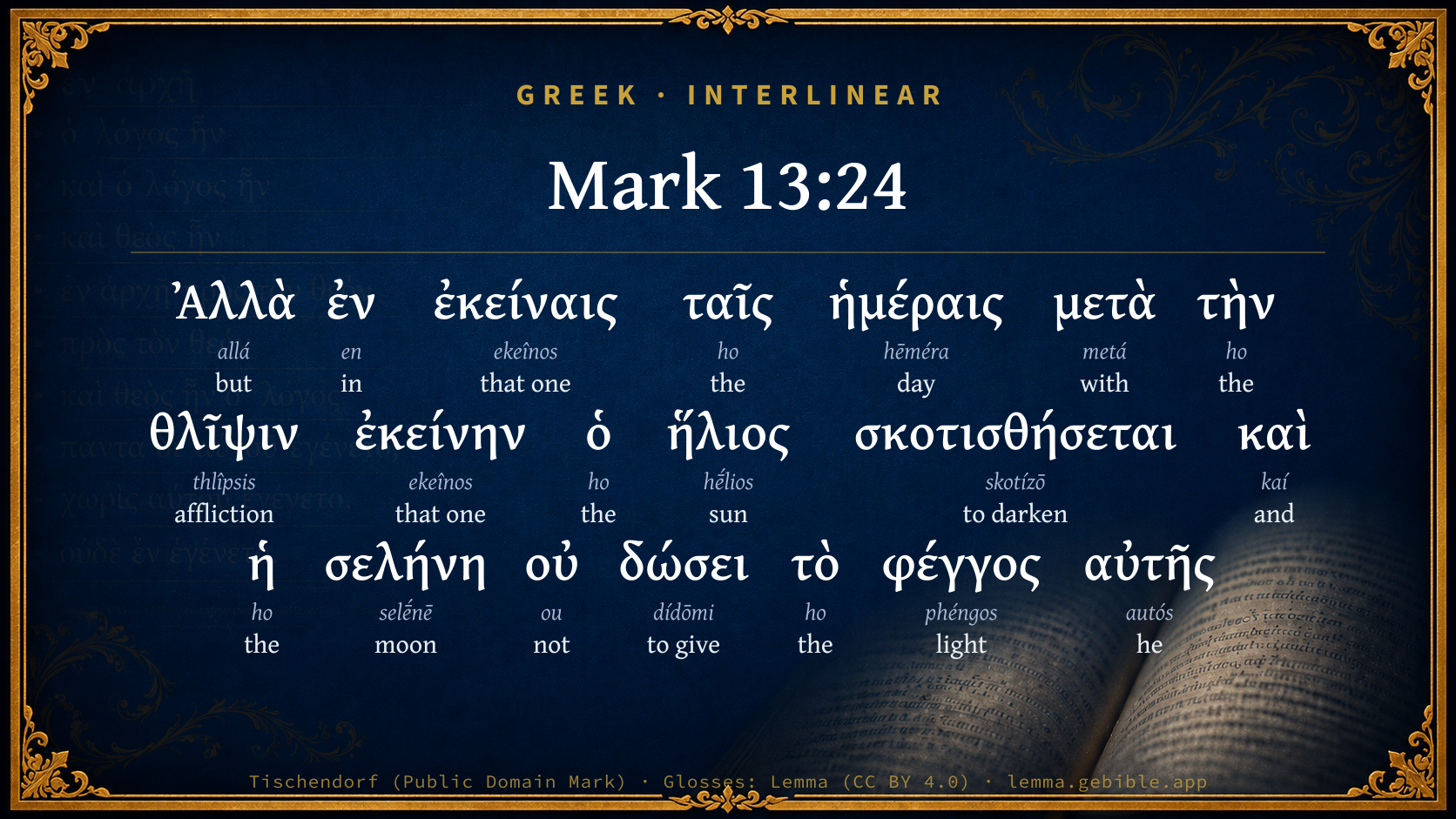
Greek (Tischendorf 8th ed.) Mark 13:24 appears in the Greek New Testament. The text above is from the Tischendorf 8th edition. Each word links to its Strong’s number and a concise gloss. Click any word for its full Thayer’s Greek Lexicon entry.
Download image
Cite this verse

Mark 13:24 (World English Bible). Public Domain. Lemma interlinear Bible study tool, https://lemma.gebible.app/v/mark/13/24.

Show BibTeX & RIS
BibTeX
RIS
English Translation
But in those days, after that oppression, the sun will be darkened, the moon will not give its light,
World English Bible · Public Domain
Download a study sheet

One document with this verse’s original text, its word-by-word gloss line, the meaning frame, cross-references with their text, attributed commentary, and full source and license credits — printable, and it pastes into notes with its structure intact.

This verse Autodidact and up

Study sheet (.html) Plain text (.txt)

A passage Seminary Student

Up to 50 verses in one chapter. A passage sheet keeps up to 6 commentary sources and 12 cross-references per verse, in the order this page ranks them, and says so on the sheet whenever that leaves anything out. Ask for a single verse and you get the Autodidact verse sheet above.

Everything on this page stays free to read, with no account — the sheet is a download of what is already on screen, not access to it.

Want to remove ads? Support Godless Engineer
Compare translations 3

The same verse in 3 English versions, stacked beneath the original-language interlinear above. Click any original word for its lexicon entry.

Each is an independent rendering of the whole verse — the interlinear is not word-aligned to these translations.

Highlighted words mark where these versions differ — a whole-verse word diff, not a word-by-word alignment.

  • World English Bible Public Domain
    But in those days, after that oppression, the sun will be darkened, the moon will not give its light,
  • King James Version Public Domain
    But in those days, after that tribulation, the sun shall be darkened, and the moon shall not give her light,
  • unfoldingWord Literal Text CC BY-SA 4.0
    But in those days, after that tribulation, the sun will be darkened, and the moon will not give its light;

unfoldingWord Literal Text — © unfoldingWord, licensed CC BY-SA 4.0. Word-aligned USFM3 via Door43 (git.door43.org/unfoldingWord/en_ult).

Versions to compare (up to 4)

3 of 4 selected

Show all 19 translations

Every available English version of this verse, each an independent rendering of the whole verse.

  • World English Bible Public Domain
    But in those days, after that oppression, the sun will be darkened, the moon will not give its light,
  • Berean Standard Bible Public Domain
    But in those days, after that tribulation: ‘The sun will be darkened, and the moon will not give its light;
  • Majority Standard Bible Public Domain
    But in those days, after that tribulation: ‘The sun will be darkened, and the moon will not give its light;
  • King James Version Public Domain
    But in those days, after that tribulation, the sun shall be darkened, and the moon shall not give her light,
  • American Standard Version (1901) Public Domain
    But in those days, after that tribulation, the sun shall be darkened, and the moon shall not give her light,
  • Revised Version (1885) Public Domain
    But in those days, after that tribulation, the sun shall be darkened, and the moon shall not give her light,
  • Geneva Bible (1599) Public Domain
    Moreouer in those dayes, after that tribulation, the sunne shall waxe darke, and ye moone shall not giue her light,
  • Douay-Rheims (1899) Public Domain
    But in those days, after that tribulation, the sun shall be darkened, and the moon shall not give her light.
  • Young's Literal Translation Public Domain
    `But in those days, after that tribulation, the sun shall be darkened, and the moon shall not give her light,
  • Literal Standard Version CC BY-SA 4.0
    But in those days, after that tribulation, the sun will be darkened, and the moon will not give her light,
  • Unlocked Literal Bible CC BY-SA 4.0
    But after the tribulation of those days, the sun will be darkened, the moon will not give its light,
  • unfoldingWord Literal Text CC BY-SA 4.0
    But in those days, after that tribulation, the sun will be darkened, and the moon will not give its light;
  • Darby Bible Public Domain
    But in those days, after that distress, the sun shall be darkened and the moon shall not give its light;
  • World Messianic Bible Public Domain
    But in those days, after that oppression, the sun will be darkened, the moon will not give its light,
  • Webster's Bible Public Domain
    But in those days, after that tribulation, the sun shall be darkened, and the moon shall not give her light,
  • Free Bible Version CC BY-SA 4.0
    This is what will happen after those troubles: ‘The sun will become dark, the moon won't shine,
  • Bible in Basic English Public Domain
    But in those days, after that time of trouble, the sun will be made dark and the moon will not give her light,
  • Text-Critical English NT CC BY 4.0
    “But in those days, after that time of tribulation, the sun will be darkened, and the moon will not give its light.
  • Tyndale New Testament (1534) Public Domain
    Moreover in thoose dayes after that tribulacion the sunne shall wexe darke and the mone shall not geve her light

Literal Standard Version (2020), Covenant Press — licensed CC BY-SA 4.0. Text via the HelloAO Bible API (eBible.org). Unlocked Literal Bible (unfoldingWord) — licensed CC BY-SA 4.0. Text via the HelloAO Bible API (eBible.org). unfoldingWord Literal Text — © unfoldingWord, licensed CC BY-SA 4.0. Word-aligned USFM3 via Door43 (git.door43.org/unfoldingWord/en_ult). Free Bible Version, Dr. Jonathan Gallagher — licensed CC BY-SA 4.0. Text via the HelloAO Bible API (eBible.org).

Word by word

More ways to search: Search by grammar → Find every occurrence → Compare this word →

Practice this passage: Drill this verse → Learn its vocabulary →

φέγγος
phéngos
G5338
“light”
Noun, Accusative, Singular, Neuter
Part of Speech
Noun
Case
Accusative
Number
Singular
Gender
Neuter
Full Thayer's Definition

Origin: probably akin to the base of G5457 [cf G5350 ]

TDNT: None

1. light a. of the moon b. of a candle or lamp 2. the bright sunshine, the beam of light
  1. Ἀλλὰ allá G235 “but” Conjunction
  2. ἐν en G1722 “in” Preposition
  3. ἐκείναις ekeînos G1565 “that one” Demonstrative pronoun, Dative, Plural, Feminine
  4. ταῖς ho G3588 “the” Article, Dative, Plural, Feminine
  5. ἡμέραις hēméra G2250 “day” Noun, Dative, Plural, Feminine
  6. μετὰ metá G3326 “with” Preposition
  7. τὴν ho G3588 “the” Article, Accusative, Singular, Feminine
  8. θλῖψιν thlîpsis G2347 “affliction” Noun, Accusative, Singular, Feminine
  9. ἐκείνην ekeînos G1565 “that one” Demonstrative pronoun, Accusative, Singular, Feminine
  10. ὁ ho G3588 “the” Article, Nominative, Singular, Masculine
  11. ἥλιος hḗlios G2246 “sun” Noun, Nominative, Singular, Masculine
  12. σκοτισθήσεται skotízō G4654 “to darken” Verb, Future, Passive, Indicative, 3rd person, Singular
  13. καὶ kaí G2532 “and” Conjunction
  14. ἡ ho G3588 “the” Article, Nominative, Singular, Feminine
  15. σελήνη selḗnē G4582 “moon” Noun, Nominative, Singular, Feminine
  16. οὐ ou G3756 “not” Particle, Negative
  17. δώσει dídōmi G1325 “to give” Verb, Future, Active, Indicative, 3rd person, Singular
  18. τὸ ho G3588 “the” Article, Accusative, Singular, Neuter
  19. αὐτῆς autós G846 “he” Personal pronoun, Genitive, Singular, Feminine

About this verse

These counts appear in no published source. They are computed here, from the morphology-tagged text and Lemma’s own curated glosses. What Lemma adds →

20
words
15
distinct lemmas
Gospels
section

Notable vocabulary

The rarest word here is φέγγος light G5338 — appearing just 3 times in the whole Greek New Testament.

Shared distinctive vocabulary

φέγγος light G5338 occurs in 3 verses of the Greek New Testament. Also found in:

Repetition

Words recur within this verse:

  • ἐκείναις that one G1565 ×2
  • ταῖς the G3588 ×5

Cross-references

19

Topical passages linked to Mark 13:24 in the Treasury of Scripture Knowledge — connected by theme and wording, ordered by reader-vote popularity; previews shown in the World English Bible.

  • Isaiah 13:10 For the stars of the sky and the constellations of it shall not give their light; the sun shall be darkened in its going forth, and the moon shall not cause its light to shine.
  • Acts 2:19–20 I will show wonders in the sky above, And signs on the earth beneath; Blood, and fire, and billows of smoke.
  • Matthew 24:29–31 But immediately after the oppression of those days, the sun will be darkened, the moon will not give its light, the stars will fall from the sky, and the powers of the heavens will be shaken;
  • Revelation 6:12–14 I saw when he opened the sixth seal, and there was a great earthquake. The sun became black as sackcloth made of hair, and the whole moon became as blood.
  • Joel 2:30–31 I will show wonders in the heavens and in the earth: Blood, fire, and pillars of smoke.
  • Joel 3:15 The sun and the moon are darkened, And the stars withdraw their shining."
  • Amos 5:20 Will the day of Yahweh not be darkness, and not light? Even very dark, and no brightness in it?
  • 2 Peter 3:10 But the day of the Lord will come as a thief in the night; in which the heavens will pass away with a great noise, and the elements will be dissolved with fervent heat, and the earth and the works that are in it will be burned up.
  • Jeremiah 4:23–25 I saw the earth, and, behold, it was waste and void; and the heavens, and they had no light.
  • Ezekiel 32:7 When I shall extinguish you, I will cover the heavens, and make the stars of it dark; I will cover the sun with a cloud, and the moon shall not give its light.
  • Daniel 7:10 A fiery stream issued and came forth from before him: thousands of thousands ministered to him, and ten thousand times ten thousand stood before him: the judgment was set, and the books were opened.
  • Daniel 12:1 "At that time shall Michael stand up, the great prince who stands for the children of your people; and there shall be a time of trouble, such as never was since there was a nation even to that same time: and at that time your people shall be delivered, everyone who shall be found written in the book.
  • Joel 2:10 The earth quakes before them. The heavens tremble. The sun and the moon are darkened, And the stars withdraw their shining.
  • Zephaniah 1:14–18 The great day of Yahweh is near. It is near, and hurries greatly, the voice of the day of Yahweh. The mighty man cries there bitterly.
  • Luke 21:25–27 There will be signs in the sun, moon, and stars; and on the earth anxiety of nations, in perplexity for the roaring of the sea and the waves;
  • Revelation 20:11 I saw a great white throne, and him who sat on it, from whose face the earth and the heaven fled away. There was found no place for them.
  • Isaiah 24:20–23 The earth shall stagger like a drunken man, and shall sway back and forth like a hammock; and the disobedience of it shall be heavy on it, and it shall fall, and not rise again.
  • Jeremiah 4:28 For this shall the earth mourn, and the heavens above be black; because I have spoken it, I have purposed it, and I have not repented, neither will I turn back from it.
  • 2 Peter 3:12 looking for and earnestly desiring the coming of the day of God, by reason of which the heavens being on fire will be dissolved, and the elements will melt with fervent heat?

Cross-references courtesy of OpenBible.info (CC BY 4.0).

Commentary

Notes on Mark 13:24 from classic Christian and Jewish commentators (each source and its license shown beneath its notes). The classic Christian expositions comment on the surrounding passage and are grouped to its opening verse, so a note may address several verses; the Jewish commentaries on the Tanakh (Rashi and others) are per-verse, so they appear only where the commentator wrote on this verse.

Lemma curates 59 commentaries, every one of them public domain or Creative Commons licensed, each selected and text-cleaned for this edition rather than reprinted as found. About our sources →

Joseph Benson's Commentary

Mar 13:24-31. But in those days — Of vengeance; after that tribulation — Attending the siege and taking of Jerusalem; the sun shall be darkened, &c. — Our Lord having, in the preceding part of his discourse, given his disciples a particular account of the various circumstances which should precede and accompany the destruction of Jerusalem, proceeds now to describe the dissolution of the Jewish polity, and the abolition of the Mosiac economy, in all the pomp of language and imagery made use of by the ancient prophets, when they foretold the overthrow of cities and states. The expressions are highly figurative, and signify the passing away of all the glory, excellence, and prosperity of the nation: and the introduction of universal sadness, misery, and confusion; that the Jewish polity, both civil and religious, should be destroyed; that the Jews should be no more a people, united under a form of government administered by themselves, and possessing their own country. See notes on Mat 24:29-35.

Joseph Benson's Commentary on the Old and New Testaments (1811–1818) — public domain. Text from a community e-Sword module.

Tyndale Open Study Notes

Tyndale Open Resources

13:24-27 At that time, after the anguish of those days: Many scholars argue that the cosmic signs of 13:24-25, the coming of the Son of Man in 13:26, and the gathering of the chosen ones from throughout the world in 13:27 are metaphorical ways of referring to the destruction of Jerusalem in AD 70 and to the vindication of the Son of Man by that event. The traditional interpretation, though, is that, whereas the former material refers to the destruction of Jerusalem, this passage refers to the coming of the Son of Man (the parousia) that will occur at the end of history. This interpretation fits better for several reasons: (1) After the anguish of those days means after the destruction of Jerusalem, not during it, and at that time (literally in those days) could occur at any time after the events of 13:5-23; (2) several words used in 13:26 are used elsewhere to describe the coming of the Son of Man: glory (8:38), power and clouds (14:62); and (3) in light of the early church’s longing and praying for the return of the Lord Jesus (1 Cor 16:22; Rev 22:20), Mark’s readers would have interpreted Mark 13:26 as the second coming of Jesus, which will bring history as we know it to a close. The prophets, Jesus, and the Gospel writers described this event as though seen through a telescope, and the distance between events is unclear; no one knows the time for this event except God himself (13:32). The events of 13:5-23 and 13:24-27 are part of the same great, divine act that includes the coming of the Son of Man, his ministry, death, and resurrection, the judgment of Jerusalem in AD 70, and the Son of Man’s final coming in glory.

13:24b-25 Some of the language used in the New Testament to describe Jesus’ second coming, such as the “trumpet call of God” (1 Thes 4:16), appears to be metaphorical, and in the Old Testament, cosmic language is frequently used to describe historical events metaphorically (see Isa 11:1-9; 13:9-11; Jer 4:23-28; Ezek 32:1-16). So it is possible that this imagery could refer to a past event, such as the destruction of Jerusalem, if that is the meaning of Mark 13:24-27. However, the New Testament writers clearly understood the coming of the Son of Man to be the visible and personal return of Jesus in the future (see Acts 1:9-11).

Tyndale Open Study Notes — © Tyndale Open Resources, licensed CC BY-SA 4.0. Text via the HelloAO Bible API.

Bengel's Gnomon

Johann Albrecht Bengel

Mar 13:24. Ἐν ἐκείναις ταῖς ἡμέραις μετὰ τὴν θλίψιν ἐκείνην, in those days after that tribulation) After that tribulation shall come those days. Therefore the ἐκείνην, that, refers to a different thing from ἐκείναις, those. That refers back to the whole preceding discourse; but those, looks forward to the last events of all, as in Mar 13:32. For the question of the disciples, to which the Lord replies, in Mark also, Mar 13:4 [as in Matthew], had reference by implication, to the end of the world.

Bengel's Gnomon of the New Testament — English translation (T&T Clark, Edinburgh, 1860) — public domain. Text from a community e-Sword module.

Meyer's Critical & Exegetical Commentary

Heinrich August Wilhelm Meyer

Mar_13:24-27. See on Mat_24:29-31. Comp. Luk_21:25-28.

ἀλλʼ] breaking off and leading over to a new subject. Hartung, Partikell. II. p. 34 f.

ἐν ἐκείναις τ. ἡμέρ. μετὰ τ. θλίψ. ἐκ.] Thus in Mark also the Parousia is predicted as setting in immediately after the destruction of Jerusalem, since it is still to follow in those days[156] (comp. Mar_13:19-20). The εὐθέως of Matthew is not thereby avoided (de Wette, Bleek, and others), but this εὐθέως is only a still more express and more direct definition, which tradition has given to the saying. To refer ἐν ἐκ. τ. ἡμ., to the times of the church that are still continuing, is an exegetical impossibility. Even Baur and Hilgenfeld are in error in holding that Mark has conceived of the Parousia as at least not following so immediately close upon the destruction.

Mar_13:25. οἱ ἀστέρες τοῦ οὐρανοῦ κ.τ.λ.] the stars of heaven shall be, etc., which is more simple (comp. Rev_6:13) than that which is likewise linguistically correct: the stars shall from heaven, etc. (Hom. Od. xiv. 31, II. xi. 179; Soph. Aj. 1156; Aesch. ii. 34; Gal_5:4; 2Pe_3:17).

ἔσονται ἐκπίπτ.] more graphic and vividly realizing than the simple πεσοῦνται (Matt.).

Mar_13:26. Mark has not the order of sequence of the event, as Matthew depicts it; he relates summarily.

Mar_13:27. ἀπʼ ἄκρου γῆς ἕως ἄκρου οὐρανοῦ] From the outmost border of the earth (conceived as a flat surface) shall the ἐπισυνάγειν begin, and be carried through even to the opposite end, where the outmost border of the heaven (κατὰ τὸ φαινόμενον of the horizon) sets limit to the earth. The expression is more poetical than in Matthew; it is the more arbitrary to think (with Bleek) in the case of γῆς of those still living, and in that of οὐρ. of those who sleep in bliss.

[156] It is, in fact, to impute great thoughtlessness and stupidity to Mark, if people can believe, with Baur, Markusev. p. 101, that Mark did not write till after Matthew and Luke, and yet did not allow himself to be deterred by all that had intervened between the composition of Matthews Gospel and his own, from speaking of the nearness of the Parousia in the same expressions as Matthew used. This course must certainly be followed, if the composition of Mark (comp. also Köstlin, p. 383) is brought down to so late a date.

Meyer — Critical and Exegetical Commentary on the New Testament — English translation by Peter Christie, edited by Frederick Crombie (T&T Clark, 1880) — public domain. Text from a community e-Sword module.

Expositor's Greek Testament

ed. W. Robertson Nicoll

Mar 13:24-31 . The coming of the Son of Man (Mat 24:29-35 , Luk 21:25-33 ).

Mar 13:24 . ἀλλὰ , opposes to the false Christs who are not to be believed in, the coming of the true Christ. ἐν ἐκείναις τ . ἡμέραις , in those days, for Mt.’s εὐθέως , a vaguer phrase, yet making the parusia synchronise with the thlipsis .

The Expositor's Greek Testament, edited by W. Robertson Nicoll (1897–1910) — public domain. Text from a community e-Sword module.

Geneva Bible (1599)

Geneva Bible translators

Isa. 13:10; Ezek. 52:7; Joel 2:10; Joel 3:15

Geneva Bible (1599) marginal notes — public domain. Text via Bolls.life.

Matthew Henry's Commentary

These verses seem to point at Christ's second coming, to judge the world; the disciples, in their question, had confounded the destruction of Jerusalem and the end of the world (Mat 24:3), which was built upon a mistake, as if the temple must needs stand as long as the world stands; this mistake Christ rectifies, and shows that the end of the world in those days, those other days you enquire about, the day of Christ's coming, and the day of judgment, shall be after that tribulation, and not coincident with it. Let those who live to see the Jewish nation destroyed, take heed of thinking that, because the Son of man doth not visibly come in the clouds then, he will never so come; no, he will come after that. And here he foretels,

1. The final dissolution of the present frame and fabric of the world; even of that part of it which seems least liable to change, the upper part, the pure and more refined part; The sun shall be darkened, and the moon shall no more give her light; for they shall be quite outshone by the glory of the Son of man, Isa 24:23. The stars of heaven, that from the beginning had kept their place and regular motion, shall fall as leaves in autumn; and the powers that are in heaven, the heavenly bodies, the fixed stars, shall be shaken.

2. The visible appearance of the Lord Jesus, to whom the judgment of that day shall be committed (Mar 13:26); Then shall they see the Son of man coming in the clouds. Probably he will come over that very place where he sat when he said this; for the clouds are in the lower region of the air. He shall come with great power and glory, such as will be suited to the errand on which he comes. Every eye shall then see him.

3. The gathering together of all the elect to him (Mar 13:27); He shall send his angels, and gather together his elect to him, to meet him in the air, Th1 4:17. They shall be fetched from one end of the world to the other, so that none shall be missing from that general assembly; they shall be fetched from the uttermost part of the earth, most remote from the places where Christ's tribunal shall be set, and shall be brought to the uttermost part of heaven; so sure, so swift, so easy, shall their conveyance be, that there shall none of them miscarry, though they were to be brought from the uttermost part of the earth one way, to the uttermost part of the heaven another way. A faithful Israelite shall be carried safely, though it were from the utmost border of the land of bondage to the utmost border of the land of promise.

Matthew Henry's Commentary on the Whole Bible (1708–1710) — public domain (CC PDM 1.0). Text via the HelloAO Bible API.

Ellicott's Commentary for English Readers

(24-31) But in those days.—See Notes on Mat_24:29-35.

A Bible Commentary for English Readers, edited by Charles John Ellicott (1878–1897) — public domain. Text from a community e-Sword module.

The Cambridge Bible for Schools and Colleges

gen. ed. J. J. S. Perowne

24–31. The Second Advent of the Lord

24. in those days] He, to Whom “a thousand years are as one day, and one day as a thousand years” (2Pe_3:8), to Whom there is no past or future but one eternal Present, passes from one chapter to another in the history of the world with the ease of One, Who seeth all things clearly revealed.

the sun shall be darkened] Two of those then listening to the Lord, have themselves described the signs in the physical world which are to usher in the End; (a) St Peter, in his second Epistle, Mar_3:1-13, and (b) St John, in Revelation 20; Revelation 21

The Cambridge Bible for Schools and Colleges (gen. ed. J. J. S. Perowne; Cambridge University Press, 1878–1918) — public domain. Text from a community e-Sword module.

John Gill's Exposition

And then shall they see the son of man,.... Not in person, but in the power of his wrath and vengeance; of which the Jews then had a convincing evidence, and full proof; and even of his being come in the flesh, as if they had seen him in person: this shows, that the sign of the son of man, in Mat 24:30 is the same with the son of man:

coming in the clouds with great power and glory; not to judgment, but having taken vengeance on the Jewish nation, to set up his kingdom and glory in the Gentile world; See Gill on Mat 24:30.

John Gill's Exposition of the Whole Bible (1746–1763) — public domain (CC PDM 1.0). Text via the HelloAO Bible API.

Trapp's Complete Commentary

John Trapp

21 And then if any man shall say to you, Lo, here is Christ; or, lo, he is there; believe him not:

22 For false Christs and false prophets shall rise, and shall shew signs and wonders, to seduce, if it were possible, even the elect.

23 But take ye heed: behold, I have foretold you all things.

24 But in those days, after that tribulation, the sun shall be darkened, and the moon shall not give her light,

Ver. 24. {See Trapp on "Mat 24:29"}

John Trapp, A Commentary or Exposition upon All the Books of the Old and New Testament (1647–1656) — public domain. Text from a community e-Sword module.

Haydock's Catholic Bible Commentary

In the day of judgment the luminaries of heaven shall be darkened, not by the privation of their light, but by the approach of the true light of the world, i.e. the great Judge. And what cause for wonder can there be, that man should be terrified at the thoughts of the last day, when the angelic powers shall tremble; or, how will these mortal habitations of ours stand the shock, when the very pillars of heaven shall be moved? what will the tender osier suffer, when the lofty cedars of Paradise bend their head! (Ven. Bede)

George Leo Haydock (1774–1849), Haydock's Catholic Family Bible and Commentary, 1859 edition — public domain. Excludes Psalms (Douay-Rheims chapter numbering differs from Protestant) and Deuterocanonical books (Catholic canon only).

Matthew Poole's English Annotations

The usage of these phrases, of the darkening the sun and the moon, and the falling of the stars, to signify the ruin of nations, and changes wrought in them; as in Isa 13:10, as to the destruction of Babylon, and Eze 32:7, to express the change the providence of God made by the destruction of Egypt, as also to signify the change made in the world by setting up the gospel, to which purpose they are used by Joel, Joe 2:31; hath given interpreters a latitude to interpret these verses,

1. With relation to the destruction of the Jews, which made a great change as to the Jewish church and state.

2. And with reference to the change made by setting up the gospel church.

But Mar 13:26,27 incline me rather to interpret them of the end of the world. For though those other expressions are used to express great changes and mutations, yet it is not said of any of them,

Then shall they see the Son of man coming in the clouds with great power and glory. And then shall he send his angels, & c. Which phrases do so agree with those other texts, where Christ’s second coming to judgment is expressed certainly, that I cannot but think our Saviour speaks here with reference to that. See Mat 13:41; 1Co 15:52; 1Th 4:16; Rev 1:7.

Matthew Poole's English Annotations on the Holy Bible (1683–1685) — public domain. Text from a community e-Sword/MySword module.

Whedon's Commentary on the Bible

Daniel D. Whedon

24-27. All before the beginning of this paragraph describes the ruin of the Jewish state; all subsequent to that beginning predicts the judgment day. Did but this report of our Lord’s discourse alone exist, not the slightest difficulty would exist in its interpretation. All the difficulty in fact arises in Mat_24:29 being the parallel passage to the first verse of this paragraph; and all the difficulty in that verse arises from the word “immediately.”

Mark says that the “sun shall be darkened,” etc., “in those days, after that tribulation.” Making allowance for prophetic perspective and for the intentional obscurity, the phrase “those days” may bring us down to the last period of time. It thus stands in contrast with the phrase “these things” in the apostle’s question. The period of the destruction and the period of the advent stand, as the Lord intended, in stupendous contrast.

If we ask, When shall the second advent take place? Mark answers, It is in THOSE DAYS which are after that (Jewish) tribulation. If we ask, In what part of THOSE DAYS? Matthew will answer, Immediately after the (mundane) tribulation of THOSE DAYS.

We have then this parallel: a tribulation including the city’s destruction, a tribulation ending in the world’s judgment.

That a tribulation is to precede the second advent is the clear doctrine of Scripture. Thus, in Rev_20:7-10, at the close of the millennial thousand years, Satan, who had been bound during that period, is let loose, and with his armies besieges the camp of the saints just before the appearance of the judgment throne. And in 2 Peter 3 : “In the last days scoffers shall come,” etc. Of this truth the Jewish tradition gives a shadowing, in the doctrine that a desperate tribulation shall precede Messiah’s advent. “The Jews (as Kuinoel observes) expected that great calamities would precede the advent of the Messiah; yet at the time when these calamities should have reached their height they hoped that he would unexpectedly appear.” — Bloomfield’s Recensio Synoptica.

Daniel D. Whedon (gen. ed.), Commentary on the Old and New Testaments (1874–1909) — public domain. Text from a community e-Sword module.

The Pulpit Commentary

But in those days, after that tribulation, the sun shall be darkened, and the moon shall not give her light. St. Matthew (Mat_24:29) has the word "immediately," before the words "after that tribulation." If this word "immediately" is to be understood literally, then the things spoken of subsequently must be understood in a figurative and spiritual sense. But it would seem more natural to understand "immediately" according to the reckoning of him with whom "a thousand years are as one day." Our Lord now passes away from the events connected with the overthrow of the Jewish polity, and proceeds to speak of things connected with the new dispensation. His mind is now turned to "the last time to the whole period between his first and his second advent. The things towards which he was now looking belonged, not to the end of the Jewish dispensation, but to the end of the present age and the present dispensation. Eighteen centuries have passed since the destruction of Jerusalem; and more years, it may be, will come and go before the end. Nevertheless, all this time, although it may seem long to us who are confined within the narrow limits of a short life, is nevertheless, when compared with the eternity of God, but as a moment. "The sun shall be darkened." The signs here enumerated are mentioned elsewhere as the signs that would appear before the second coming of Christ. (See Joe_2:31 and Luk_21:25, Luk_21:26) St. Augustine (Ep. 80, "Ad Hesychium") says, "The light of truth shall be obscured; because in the great tribulation that shall come on the world, many will fall from the faith, who had seemed to be bright and firm, like the sun and the stars." "And the moon," that is, the Church, "shall not give her light.

Vers. 24-32. The second coming.

It is very difficult exactly to discriminate between some words of Christ which refer to the destruction of Jerusalem, and others which refer to our Lord"s coming to judge all mankind. There seems to be a designed blending of the references to these events. We are thus taught to remember that we are called to be as men that wait for their Lord.

I THE CERTAINTY OF CHRIST"S COMING. If his words are to be accepted, this great event of the future is not to be denied or questioned. In the fulfillment of the special prediction regarding the downfall of Jerusalem in the lifetime of the generation then living, we have the pledge of the ultimate accomplishment of the larger prophecy. At his trial Jesus reported the assurance; and his inspired apostles have foretold that he shall come again the "second time without sin unto salvation.

II THE UNCERTAINTY OF THE TIME OF CHRIST"S COMING. The words in ver. 32 are very distinct. The date of our Lord"s return is known only to the Father. If neither the angels nor the Son himself could communicate this knowledge, how ridiculous and presumptuous is the conduct of those who, treating the Scriptures as a riddle, profess to have discovered the secret, and put forth their own fancies and follies as the declarations of the oracles of God! It is wisely hidden from us, and we show our wisdom by contented acquiescence in ignorance.

III THE SIGNS OF CHRIST"S COMING. Changes on earth and in heaven are indications of the approaching day. As the leaves of the fig tree tell that summer is nigh, so events, will occur which to the understanding mind will herald the Lord"s return. Yet even these events do not tell us when our Savior shall appear; but, since they remind us that he is at hand, they answer the purpose, for they put us upon our guard, and admonish us to be prepared.

IV THE PREPARATION FOR CHRIST"S COMING.

1. Heedfulness and observation.

2. Watchfulness.

3. Prayer.

Vers. 24-31. Parallel passages: Mat_24:29-35 Luk_21:25-33. The second advent.

I THE GREATNESS OF THE EVENT. Whether our Lord"s coming shall be pro-millennial or post-millennial we stay not to inquire. The great importance attaches to the fact of the second coming of the Son of man, which this section describes and which all Christians believe. The future coming of the Son of man naturally leads us back in thought to his first coming. The world had waited long for that blessed day. Patriarchs had looked forward to it, but it was in faith; prophets saw it, but it was in vision; saints sighed for its approach, but it was still a great way off they hoped for its arrival, but they died before the promise was fulfilled; servants of God longed for its coming, and when it at length arrived they felt so satisfied that there seemed nothing further for them to desire the language of Simeon expressed their thoughts, "Now, Lord, lettest thou thy servant depart in peace, according to thy word: for mine eyes have seen thy salvation." Angels celebrated it on the plains of Bethlehem, and sang in heavenly carol, Glory to God in the highest, peace on earth, and good will to men." The people of God look forward with equal longing and equal eagerness to the day of Christ"s second coming. They look and long for it as the period of complete redemption; they expect it as the time of home-gathering of all their brethren in the Lord; in anticipation of that great deliverance and of that blessed reunion they cry, "Even so, Lord Jesus, come quickly.

II THE GLORY OF HIS COMING. He will come, we are taught to believe, personally, visibly, and gloriously. He will come "in the clouds. " The clouds of heaven serve many important purposes; they screen from the heat of the sun by day, and moderate the radiation of the earth by night. Sometimes they supply from their contents moisture to plants, and bring gladness to the thirsty ground; sometimes they pour down the water that originates springs or swells rivers; sometimes they cover with snow the polar regions. Those cloud-masses, as they float in the atmosphere, now approach within a mile of the earth, again ascend to the distance of five or six miles above its surface. Sometimes they curl in thin, parallel, silvery streaks; sometimes they form dense conical or convex heaps; sometimes, at the approach of night, they spread out in wide low-lying horizontal sheets; sometimes, fraught with storm, they move like a dark canopy overhead; again they unite and form various combinations. At all times they claim our attention, and commend themselves to our admiration by their fantastic forms, their changing colors, their varying density, and their strange combinations. The views of a kaleidoscope are nothing compared with the manifold aspects of the clouds. The clouds of heaven, then, are objects of great beauty, grandeur, and glory. The ancient heathens had a just appreciation of the magnificence of the clouds, and accordingly associated them with their highest conceptions of majesty. They represented their deities as clothed with clouds, or seated on clouds, or surrounded with clouds, as if to hide from mortal gaze their excessive splendor. In Scripture, also, the true God is represented as making the clouds his chariot, and walking upon the wings of the wind; and, again, we read that "his pavilion round about him were dark waters, and thick clouds of the skies." When Isaiah predicts the destruction of Egypt and the confusion of its idols from the hand of the Lord, he uses the sublime representation, "Behold, the Lord rideth upon a swift cloud, and shall come into Egypt." Daniel employs similar language in relation to the Son of man: "Behold, one like the Son of man came with the clouds of heaven, and came to the Ancient of days, and they brought him near before him. And there was given him dominion, and glory, and a kingdom, that all people, nations, and languages, should serve him." The representation before us here is in accordance also with our Lord"s reply, when, in answer to his question about his Messiahship, he directed their attention from the humility of his first to the honor of his second coming, saying, "Ye shall see the Son of man sitting on the right hand of power, and coming in the clouds of heaven." So also, when he was going to part from his disciples, when he was going to leave our world, when his feet last stood on Olivet, when he was about to ascend to his Father and our Father, to his God and our God, the cloud became his vehicle, and coming under him received (upelaben) him out of the disciples" sight; and in that car of cloud he rose onward, and mounted upward to the right hand of the Father everlasting. Thence he shall come again with glorious majesty, according to the promise, "This same Jesus, which is taken up from you into heaven, shall so come in like manner as ye have seen him go into heaven." Further, in the Apocalypse, the Apostle John"s representation of Christ"s coming with clouds is designed and calculated to signify the grandeur and the glory, the solemnity and the sublimity of his second advent: "Behold, he cometh with clouds; and every eye shall see him, and they also which pierced him: and all kindreds of the earth shall wail because of him. Even so, Amen.

III THE GLORY AND POWER WITH WHICH HE COMES. Every manifestation of glory shall attend him; every symbol of unspeakable splendor shall accompany him; every token of dignity shall signalize him; every adjunct of might and magnificence shall mark his advent. The Son of man shall come with great power and glory; all the holy angels shall swell his train. The dead in Christ shall rise first, and swell that assemblage; they that are still alive, and remain till that dread day, shall be caught up together with them in the clouds to meet the Lord in the air. Can anything be grander than this? Can anything be more august? Can anything be more solemn? Can anything be more awe-inspiring? Is there anything more calculated to overwhelm with consternation the wicked? Is there anything more fitted to create deep and universal alarm among the ungodly? What, on the other hand, can be more inspiriting to the believer? What more encouraging and comforting to the child of God? What more suitable to nerve to high effort and holy purpose than the prospect of being presented faultless in that day, and amid that assembly, and before the presence of his glory, with exceeding joy? "A hope so great and so Divine May trials well endure, And purge the soul from sense and sin, As Christ himself is pure.

IV THE OBJECT or his coming. We may now reflect for a moment on the great purposes for which Christ shall come the second time. At first he came in weakness, but at his next coming he will take to him his great power and reign. At first he came in dishonor, born in a stable, cradled in a manger, being "despised and rejected of men;" but then he shall come in dignity, and so that "every eye shall see him," every tongue confess him, and every knee bow before him. At first he came in a servile, suffering state; but then in awful majesty and glory everlasting in his own glory, and in the glory of his Father. At first he came to call sinners to repentance; but then to summon each to his reward, be it recompense or retribution, and to give every man according as his work shall be." It is true that the coming of the Son of man described in the verses immediately before us has for its specific object the grand assemblage of his saints to meet him; the accessories of the resurrection, the transformation of the living, and the general judgment are left out of sight. From the tribulation connected with the fall of Jerusalem the Savior had looked far forward into other days, when great changes, whether literal and cosmical, or figurative and political, shall precede and serve as precursors of the second coming of the Son of man. If the language is understood figuratively, the darkening of the sun may denote the eclipse of ecclesiastical authority; that of the moon, the collapse of civil polity; while the stars or potentates shall be falling or waning (the form of the future made up of substantive verb and participle, implying a more durable effect than the simple future). In the parable of the fig tree, however, he reverts to the precursors of the dissolution of the Jewish state and the destruction of its capital; and affirms that, as the tender leaf-buds of the fig tree signified the near approach of harvest-time ( yerov), so the signs already specified in an early part of this chapter indicated the fast-approaching destruction of the sanctuary and city of Jerusalem. If, then, the statement of ver. 30, "that this generation shall not pass, till all these things be done," be referred to the end of the Jewish state, the word genea retains its ordinary sense of generation or contemporary race, which some insist on. If, on the other hand, the end of the age or world be referred to, whether the coming of the Son of man be for the purpose of ushering in the millennium, that is, pre-millennial, or for the final winding up of all things, the word genea must be understood as equivalent genov , race, that is, the people or nation of the Jews, or, according to some, the race of men in general, more especially the generation of the faithful.

V THE DIFFERENT FEELINGS WITH WHICH HIS COMING IS REGARDED, The visit of some distinguished person to our neighborhood or to our habitation may, according to circumstances, awaken emotions of a very different or even diverse character. Our feelings in view of the expected visit will be either pleasant or painful, according to the character of the visitor or the object of his coming. If he comes as a friend to further our interests, to favor our fondly cherished hopes, and to confer on us certain benefits, we naturally hail his coming with delight and rejoice at the prospect of his speedy advent. If, on the contrary, we have reason to believe that his intentions are hostile, that he means to oppose our plans, that he has some unpleasant measure to enforce or some punishment to inflict, we just as naturally dread his arrival and recoil from his approach. With similarly opposite views and feelings, saints and sinners, believers and unbelievers, look forward to the coming of him to whom this passage refers. J.J.G.

The Pulpit Commentary (1880–1919), ed. H.D.M. Spence-Jones & Joseph S. Exell — public domain. Text from a community e-Sword module.

John Wesley's Explanatory Notes

But in those days - Which immediately precede the end of the world: after that tribulation - Above described.

John Wesley, Explanatory Notes Upon the Whole Bible (1754–1765) — public domain. Text via the GEBible commentary corpus.

Kretzmann's Popular Commentary

Paul E. Kretzmann

The coming of Judgment Day:

v. 24. But in those days, after that tribulation, the sun shall be darkened, and the moon shall not give her light,

v. 25. and the stars of heaven shall fall, and the powers that are in heaven shall be shaken.

v. 26. And then shall they see the Son of Man coming in the clouds with great power and glory.

v. 27. And then shall He send His angels, and shall gather together His elect from the four winds, from the uttermost part of the earth to the uttermost part of heaven.

The evangelist’s account is only a brief summary of the words of the Lord, but what depth of emotion is in the few words thus recorded! As Jesus looks forward, according to His omniscience, the earlier calamity will merge into the later, the judgment upon Jerusalem is carried out only on a greater scale in the final judgment of the world. There will be no interval of a happy, sinless reign, no millennium. With no respite and without extensive previous warning the Day of the Lord will dawn, it will burst upon the world with great suddenness. Then there will be signs such as are entirely out of the usual course of events in nature; no ordinary eclipses which follow laws and rules framed by God, but a return to chaos. The sun will be darkened; the moon will lose her splendor; the stars will no longer be able to hold the position which was given them by the Creator, but will fall from heaven. There will be a great concussion of the powers of the heavens. The entire universe will go out of joint. The hand of God’s providence and government will be withdrawn, and all will be dissolved into its component parts. And then, when the world is falling to pieces and the heavens are being rolled up like a curtain, then they, the people of the earth, will see the Son of Man, the divine-human Savior of mankind, that came into the world for them all, but was received by so few, coming in the clouds. Like a mighty conqueror riding in his chariot of triumph, the former despised Nazarene will appear, with great power and glory. According to His human nature, He has now assumed the full divine glory and majesty, and now returns as the Judge of the living and the dead. In the fullness of this majesty He will command His angels to go forth and to bring together to Him the elect, from the four winds, from every part of the earth, as far as the world extends, wherever human beings have penetrated. Not the slightest shred of the former lowliness and weakness is evident in this glorious picture, it is the great; the almighty Lord of the universe that is here holding the great harvest of the last day.

Paul E. Kretzmann, Popular Commentary of the Bible (1921–1924) — public domain. Text from a community e-Sword module.

Burkitt's Expository Notes on the New Testament

William Burkitt

Our Saviour goes on in figurative expressions, to set forth the calamities that should befall the Jewish nation immediately after Jerusalem’s destruction. The sun shall be darkened; that is, all their glory and excellency shall be eclipsed, all their wealth and prosperity shall be laid waste, their whole government, civil and ecclesiastical, destroyed; and such marks of misery found upon them, as never were seen upon a people. Those that apply this to the general judgment, understand the word literally, that the sun and moon will then have their influences suspended; that the holy angels will be sent forth to gather the elect from all quarters of the world, with the sound of the trumpet, says St. Matthew. Prfobably, as there was an audible sound of a trumpet at the giving of law, so three shall be the like sound of a trumpet, when Christ shall summon the world to judgment, for transgressing of that law. A joyful sound will this be to the friends of Christ; a doleful, dreadful sound in the ears of his enemies.

William Burkitt's Expository Notes on the New Testament (1700–1703) — public domain. Text from a community e-Sword module.

McGarvey & Pendleton's Commentaries

J. W. McGarvey

J. W. McGarvey's The Fourfold Gospel [CXIV. The Second Coming of Christ].

CXIV. THE SECOND COMING OF CHRIST. aMATT. XXIV. 29-51; bMARK XIII. 24-37; cLUKE XXI. 25-36.

b24 But in those days, aimmediately after the bthat atribulation of those days. [Since the coming of Christ did not follow close upon the destruction of Jerusalem, the word "immediately" used by Matthew is somewhat puzzling. There are, however, three ways in which it may be explained: 1. That Jesus reckons the time after his own divine, and not after our human, fashion. Viewing the word in this light, the passage at 2Pe_3:4-9 may almost be regarded as an inspired comment with reference to this passage. 2. The terrible judgment upon Jerusalem and the corresponding terror of the judgment day have between them no intervening season of judgment in any way worthy to be compared to either of them. The two periods, therefore, stand with regard to each other in immediate connection. 3. The tribulation which came upon the Jewish people merely began with the destruction of Jerusalem, other woes followed at once, and, coming down through all the centuries of wandering and dispersion, they were yet unfulfilled and incomplete. See Deu_28:58-68] the sun shall be darkened, and the moon shall not give her light, and the stars shall fall { bshall be falling from heaven, aand the powers of [629] { bthat are in the heavens shall be shaken. [The language is that of the ancient prophets. See Amo_8:9, Joe_2:30, Joe_2:31, Eze_32:7, Eze_32:8. Compare also Rev_6:12-14. Some regard the language as metaphorical, indicating the eclipse of nations and the downfall of rulers, but there are many similar passages of Scripture which constrain us to regard the language here as literal rather than figurative. See 2Pe_3:10, Heb_1:12, Rev_20:11.] c25 And there shall be signs in sun and moon and stars; and upon the earth distress of nations, in perplexity for the roaring of the sea and the billows [We can conceive of nothing which would produce greater mental distress or perplexity than changes in the position or condition of the heavenly bodies. Such changes will be followed by corresponding commotions on our planet, as, for instance, great tidal waves and vast agitation in the ocean]; 26 men fainting for fear, and for expectation of the things which are coming on the world: for the powers of the heavens shall be shaken. a30 and then shall appear the sign of the Son of man in heaven [The coming and the sign are the same thing. The word "sign" is used in connection with the coming of Christ to indicate that the nature of the coming (that is, the manner of its manifestations) will be fully commensurate with the importance of the event. His first coming in the manger was not so]: and then shall all the tribes of the earth mourn [The coming will occasion universal mourning in the unprepared, and apparently the majority of people will be in that condition. The term "all" is not, however, to be construed as including all individuals-- 1Th_4:15-17], b26 And then shall they see the Son of man coming in aon the clouds cin a cloud aof heaven bwith great power aand great glory. b27 And then shall he send forth the ahis angels with a great sound of a trumpet, and they shall gather together his elect from the four winds, from one of heaven to the other. bfrom the uttermost part of the earth to the uttermost part of heaven. [To the Jews the trumpet would naturally be [630] associated with the assembling of the people, for silver trumpets were used to call Israel together ( Num_10:1-4, Exo_19:13, Exo_19:16, Exo_19:19, Psa_81:3-5). We are not told why angels are used on this occasion, but they appear to be employed in all the great operations of Providence ( Mat_13:41). The phrases "four winds," etc., indicate that the angelic search shall extend over the entire globe. The language is that which was then used when one desired to indicate the whole earth. It is based upon the idea which then prevailed that the earth is flat, and that it extends outward in one vast plain until it meets and is circumscribed by the overarching heavens.] c28 But when these things begin to come to pass, look up, and lift up your heads; because your redemption draweth nigh. [The preliminary death-throes of this present physical universe, which will strike terror to the souls of those who have limited themselves to material hopes, will be to the Christian a reassuring sign, since he looks for a new heaven and a new earth.] 29 And he spake to them a parable: a32 Now from the fig tree learn her parable: when her branch is now become tender, and putteth forth its leaves, ye know that the summer is nigh; cBehold the fig tree, and all the trees: 30 when they now shoot forth, ye see it and know of your own selves that the summer is now nigh. 31 Even so ye also, when ye see aall cthese things coming to pass, know ye that the kingdom of God is nigh. aknow ye that he is nigh, even at the doors. [As the change of the season in the natural world has its preliminary signs, so the change of conditions in the spiritual realm has its premonitory symptoms. When men see the symptoms which Jesus has described, they will recognize that changes are coming as to the nature of which they can only guess. But the Christian is informed that these changes indicate the coming of the Son of God--a change from a worse to a better season.] 34 Verily I say unto you, This generation shall not pass away, buntil all things be accomplished. [Commentators differ widely as to the import of these words. Godet is so perplexed by them that he thinks [631] they refer to the destruction of Jerusalem, and have been misplaced by the Evangelist. Cook straddles the difficulty by giving a dual significance to all that our Lord has said concerning his coming, so that our Lord in one narrative speaks figuratively of a coming in the power of his kingdom before, during, and right after the destruction of Jerusalem, and literally of his final coming at the end of the world. But this perplexing expression under this theory refers exclusively to the figurative and not to the literal sense of the passage. The simplest solution of the matter is to take the word "generation" to mean the Jewish family or race--and the word does mean race or family-- Luk_16:8. Thus interpreted, the passage becomes a prophecy that the Jewish people shall be preserved as such until the coming of Christ. The marvelous and almost miraculous preservation of the racial individuality of the Jews, though dispersed among all nations, might well become the subject of prophecy, especially when Jesus had just spoken of an event which threatened their very extermination.] 31 Heaven and earth shall pass away: but my words shall not pass away. [The disciples had regarded the temple as so permanent that they found it hard to conceive that Christ's words could be fulfilled with regard to it; but he assures them that his predictions and prophecies are the stable and imperishable things. That even the more permanent structure of the heavens is not so abiding as his utterances.] a36 But of that day and bor that hour knoweth no one, not even the angels in aof heaven, neither the Son, bbut the Father. aonly. [These words indicate the profound secrecy in which God has concealed the hour of judgment. It is concealed from all people, that each generation may live in expectation of its fulfillment, and we are to watch for the signs, though we may not fully know the times. They also indicate that either by reason of his assumption of our human nature, or by a voluntary act on his part, the knowledge of Jesus became in some respects circumscribed. They also suggest that it is not only idle, but also presumptuous, for men to strive to find out by mathematical calculation and expositions of [632] prophecy that which the Son of God did not know.] 37 And as i were the days of Noah, so shall be the coming of the Son of man. 38 For as in those days which were before the flood they were eating and drinking, marrying and giving in marriage, until the day that Noah entered into the ark, 39 and they knew not until the flood came, and took them all away; so shall be the coming of the Son of man. [See Psa_1:5, Mal_3:2.] b33 Take ye heed, watch and pray: for ye know not when the time is. 34 It is as when a man, sojourning in another country, having left his house, and given authority to his servants, to each one his work, commanded also the porter to watch. [Under the figure of the householder and the thief, Jesus appealed to the sense of danger. Under the figure of the servant he appealed to the sense of duty, and under this figure of the porter he appealed to the sense of loyalty. The porter's desire to honor his lord was to make him so vigilant that he would open the door at once upon his lord's appearing.] 35 Watch therefore: for ye know not when the lord of the house cometh, whether at even, or at midnight, or at cockcrowing, or in the morning [The night was then divided into four watches. See p. 322. Jesus may here refer either to the duration of the world or to the life of the individual. He divides either period into four sections, in accordance with the night watches which were so fully associated with watchfulness]; 36; lest coming suddenly he find you sleeping. 37 And what I say unto you I say unto all, Watch. [This warning message was not for the apostles alone, but for all disciples.]

[FFG 629-634]

J. W. McGarvey (with Philip Y. Pendleton), Commentaries on the New Testament (The Fourfold Gospel, 1914; Acts; and the epistles) — public domain. Text from a community e-Sword/MySword module.

unfoldingWord translationNotes

Door43 World Missions Community

the sun will be darkened

This can be stated in active form. AT: "the sun will become dark" (See: Active or Passive)

the moon will not give its light

Here the moon is spoken of as if it were alive and able to give something to someone else. AT: "the moon will not shine" or "the moon will be dark" (See: Personification)

the stars will fall from the sky

This does not mean that they will fall to earth but that they will fall from where the are now. AT: "the stars will fall from their places in the sky" (See: Assumed Knowledge and Implicit Information)

the powers that are in the heavens will be shaken

This can be stated in active form. AT: "the powers in the heavens will shake" or "God will shake the powers that are in the heavens" (See: Active or Passive)

the powers that are in the heavens

"the powerful things in the heavens." Possible meanings are 1) this refers to the sun, moon, and stars or 2) this refers to powerful spiritual beings

in the heavens

"in the sky"

Then they will see

"Then people will see"

with great power and glory

"powerfully and gloriously"

he will gather

The word "he" refers to God and is a metonym for his angels, as they are the ones who will gather the elect. AT: "they will gather" or "his angels will gather" (See: Metonymy)

the four winds

The whole earth is spoken of as "the four winds," which refer to the four directions: north, south, east, and west. AT: "the north, south, east, and west" or "all parts of the earth" (See: Metaphor)

from the ends of the earth to the ends of the sky

These two extremes are given to emphasize that the elect will be gathered from the entire earth. AT: "from every place on earth" (See: Merism)

translationWords

tribulation

power

Son of Man

angel

glory

chosen one

unfoldingWord translationNotes — © Distant Shores Media and the Door43 World Missions Community, licensed CC BY-SA 4.0. Source: git.door43.org/Door43/en_tn.

Cambridge Greek Testament for Schools and Colleges

24–27. THE CLOSE OF THE AGE FORETOLD

Mat 24:29-31. Luk 21:25-28

24. ἐν ἐκείναις ταῖς ἡμέραις. Very indefinite; see on Mar 1:9. We may believe that this is nearer to the expression actually used than the εὐθέως of Mt. Mt. wrote at a time when it was believed that the Second Advent would quickly follow the fall of Jerusalem, and, as often, he gives his interpretations as having been actually spoken; see on Mar 8:29, Mar 9:29, Mar 10:19; Mar 10:28; Mar 10:33; Mar 10:38; Mar 10:40. Christ showed that His Coming would not save Jerusalem from destruction but would follow that destruction. That it would follow quickly (Rev 22:20) was a wrong inference which experience corrected: ἀρχὴ ὠδίνων (Mar 13:8) and πρῶτον δεῖ (Mar 13:10) imply that the interval would not be short. The language here used is highly symbolical, such as is found in the Prophets and in the apocalyptic literature of the Jews. Cf. Isa 13:10, Isa 34:4; Eze 32:7-8; Amo 8:9; Joe 2:30-31; Joe 3:5. It intimates that mighty results follow when God shows His hand in the government of the world. “It is needless to minimize these words into eclipses or meteoric showers, or to magnify them into actual destruction of sun and moon and stars. They are not events, but only imaginative portrayal of what it means for God to interfere in the history of the nations” (Gould). All three Gospels here speak of catastrophic changes of nature which probably represent catastrophic changes in the social and spiritual world. Guesses as to their exact meaning are not very profitable.

μετὰ τ. θλίψιν ἐκείνην. After the overthrow of Jerusalem.

σκοτισθήσεται. Cf. Luk 23:45; Rev 6:12; Rev 8:12: also the Testaments, Levi iv. 1; Enoch lxxx. 2–7; Assumption of Moses x. 5, where we read that the sun will not give light, the horns of the moon will be broken and turned to darkness, and the circle of the stars will be shaken.

Cambridge Greek Testament for Schools and Colleges (Cambridge University Press, 1896; 21 vols, various authors incl. Carr, Maclear, Plummer, Farrar, Lumby, Moule, M. R. James, Simcox) — public domain. Text from a community e-Sword module.

Alford’s Greek Testament

Henry Alford

24.] ἀλλά is to be noticed. It is more than the simple ‘but:’ and is best rendered by nevertheless: qu. d., though I have forewarned you of all things, yet some of those shall be so terrible as to astound even the best prepared among you.

ἐν ἐκ. τ. ἡμ. μετὰ τ. θλ. ἐκ.—then those days come after that tribulation: see note on Matt. ver. 29.

Henry Alford, The Greek Testament (1849–1861) — public domain. Text from a community e-Sword module.

International Critical Commentary

24. ἐν ἐκείναις ταῖς ἡμέραις—in those days. These words denote the general period which he is describing, the fall of Jerusalem. This coming of the Son of Man belongs to that epoch. μετὰ τὴν θλίψιν ἐκείνην—after that calamity. The θλίψις referred to is that of v. 19; so that what follows is included in the period, but placed after the calamity. ὁ ἥλιος σκοτισθήσεται—the sun will be darkened. This disturbance of the heavenly bodies, and the prediction of the coming of the Son of Man, have been supposed to be decisive of the view that this prophecy looks beyond the fall of Jerusalem to the end of the world. But this darkening and fall of the heavenly bodies is so common an accompaniment of O.T. prophecy, and its place is so definitely and certainly fixed there, as belonging to the Apocalyptic imagery of prophecy, and not to the prediction of events, that it presents no difficulty whatever, and does not even create a presumption in favor of the view that this is a prophecy of the final catastrophe. In Isa 13:10, it reads, “For the stars of heaven and the constellations thereof shall not give their light; the sun shall be darkened in his going forth, and the moon shall not cause her light to shine. … I will make the heaven to tremble, and the earth shall be shaken out of her place.” But this is a part of the prophecy of the destruction of Babylon by the Medes. In Isa 34:4, it reads, “And all the host of heaven shall be dissolved, and the heavens shall be rolled together as a scroll, and all their host shall fade away as the leaf fadeth from off the vine, and as a fading leaf from the fig tree,” where the event predicted is the judgment of Edom. In Eze 32:7, Eze 32:8, similar language is used of the judgment of Egypt, and in Amo 8:9, of the northern kingdom. In Joe 2:30, Joe 2:31, Joe 2:3:15, where the subject is the judgment of the nations in connection with the return of Judah from captivity (see 3:1), it says: “I will show wonders in the heavens above, and in the earth blood and fire, and pillars of smoke. The sun shall be turned into darkness, and the moon into blood, before the great and terrible day of the Lord come. … The sun and the moon are darkened, and the stars withdraw their shining.” That is to say, this language is intended to portray the greatness of the doom of such nations as come under the judgment of God. When he comes in judgment, the earth and even the heavens dissolve before him. But it is needless to minimize these words into eclipses, or earthquakes, or meteoric showers, or to magnify them into actual destruction of sun and moon and stars. They are not events, but only imaginative portrayal of what it means for God to interfere in the history of nations. αἱ δυνάμεις αἱ ἐν τ. οὐρανοῖς. δύναμις is used frequently in Greek writers of armies, hosts, and hence it is used to translate the Heb. צְבָא הַשָּׁמַיִם the host of heaven, a phrase used of the stars (2 K. 17:16, 23:4, Isa 34:4). See Thay.-Grm. Lex.

ἔσονται ἐκ τοῦ οὐρανοῦ, instead of τοῦ οὐρανοῦ ἔσονται, Tisch. Treg. WH. RV. א ABCU Π* mss. Lat. Vet. Egyptt. Pesh. πίπτοντες, instead of ἐκπίπτοντες, same editors, and א BCDL Π* mss. Lat. Vet.

International Critical Commentary — older volumes (1896–1929), various authors — public domain. Text from a community e-Sword module.

Vincent's Word Studies in the New Testament

Marvin R. Vincent

Light [φεγγος] . The word is used in the New Testament wherever the light of the moon is referred to. Compare Mt 24:29, the only other instance. It occurs also in Luk 11:33, but meaning the light - of a lamp.

Marvin R. Vincent, Word Studies in the New Testament (1887–1900) — public domain. Text from a community e-Sword/MySword module.

Lesson kit

Teaching starters — assembled from the data on this page, not authored interpretation. Every prompt links to the verse data it draws on. Edit before teaching.

Mark, in the Gospels, opens this verse with 20 words (15 distinct Greek lemmas). Its most distinctive word is phéngos (“light”). A historical commentator’s framing appears above. Read the whole chapter for the surrounding context.

Discussion questions

  1. The word phéngos carries the sense “light.” How does it shape the verse?
  2. How does Matthew 24:29, which shares the word «light», read alongside this verse?
  3. What does the repetition of “that one” (2× in this one verse) do in this verse?
  4. These translations render this verse differently; the difference is in the English rendering, not the original. What questions does that raise?
  5. Compare how Joseph Benson's Commentary and Tyndale Open Study Notes read this verse. Where do they agree or differ?

Things to notice

  • These translations choose different wording for 4 words in this verse.
  • “that one” occurs 2× in this single verse.
  • 15 distinct Greek lemmas span 20 words in this verse.

Reading settings

Reading text

Shown beneath each verse's original-language words.

Old Testament
Old Testament edition

Read the OT as the Masoretic Hebrew (MT) or the Greek Septuagint (LXX).

English shown for the Greek Septuagint (in the Hebrew ↔ Greek comparison).

Comparing translations? Open the Compare panel on any verse page to stack up to four side by side.