Acts 22:11

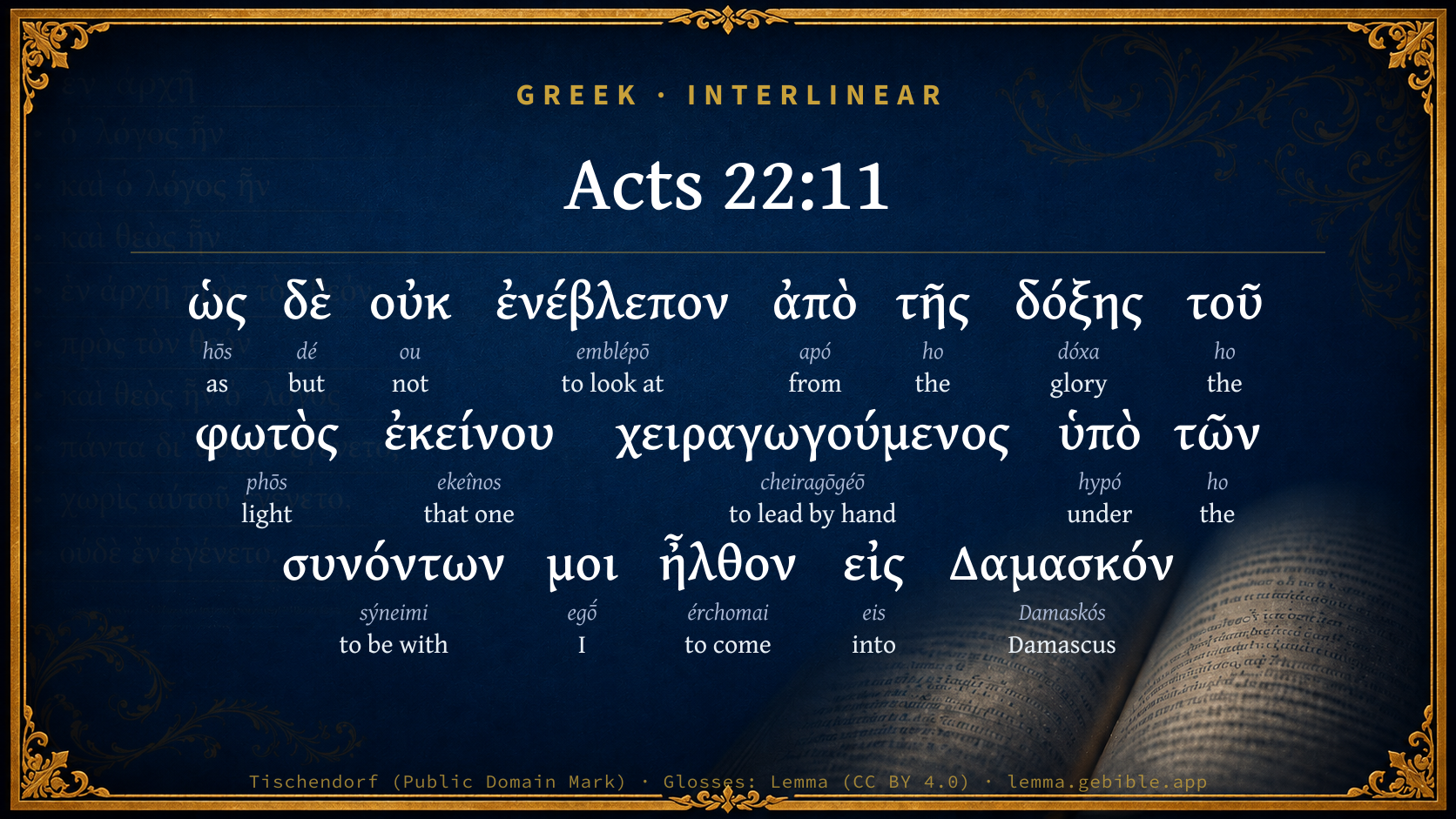
Greek (Tischendorf 8th ed.) Acts 22:11 appears in the Greek New Testament. The text above is from the Tischendorf 8th edition. Each word links to its Strong’s number and a concise gloss. Click any word for its full Thayer’s Greek Lexicon entry.
Download image
Cite this verse

Acts 22:11 (World English Bible). Public Domain. Lemma interlinear Bible study tool, https://lemma.gebible.app/v/acts/22/11.

Show BibTeX & RIS
BibTeX
RIS
English Translation
When I couldn't see for the glory of that light, being led by the hand of those who were with me, I came into Damascus.
World English Bible · Public Domain
Download a study sheet

One document with this verse’s original text, its word-by-word gloss line, the meaning frame, cross-references with their text, attributed commentary, and full source and license credits — printable, and it pastes into notes with its structure intact.

This verse Autodidact and up

Study sheet (.html) Plain text (.txt)

A passage Seminary Student

Up to 50 verses in one chapter. A passage sheet keeps up to 6 commentary sources and 12 cross-references per verse, in the order this page ranks them, and says so on the sheet whenever that leaves anything out. Ask for a single verse and you get the Autodidact verse sheet above.

Everything on this page stays free to read, with no account — the sheet is a download of what is already on screen, not access to it.

Want to remove ads? Support Godless Engineer
Compare translations 3

The same verse in 3 English versions, stacked beneath the original-language interlinear above. Click any original word for its lexicon entry.

Each is an independent rendering of the whole verse — the interlinear is not word-aligned to these translations.

Highlighted words mark where these versions differ — a whole-verse word diff, not a word-by-word alignment.

  • World English Bible Public Domain
    When I couldn't see for the glory of that light, being led by the hand of those who were with me, I came into Damascus.
  • King James Version Public Domain
    And when I could not see for the glory of that light, being led by the hand of them that were with me, I came into Damascus.
  • unfoldingWord Literal Text CC BY-SA 4.0
    And as I was not seeing clearly because of the glory of that light, being led by the hand by the ones being with me, I came into Damascus.

unfoldingWord Literal Text — © unfoldingWord, licensed CC BY-SA 4.0. Word-aligned USFM3 via Door43 (git.door43.org/unfoldingWord/en_ult).

Versions to compare (up to 4)

3 of 4 selected

Show all 19 translations

Every available English version of this verse, each an independent rendering of the whole verse.

  • World English Bible Public Domain
    When I couldn't see for the glory of that light, being led by the hand of those who were with me, I came into Damascus.
  • Berean Standard Bible Public Domain
    Because the brilliance of the light had blinded me, my companions led me by the hand into Damascus.
  • Majority Standard Bible Public Domain
    Because the brilliance of the light had blinded me, my companions led me by the hand into Damascus.
  • King James Version Public Domain
    And when I could not see for the glory of that light, being led by the hand of them that were with me, I came into Damascus.
  • American Standard Version (1901) Public Domain
    And when I could not see for the glory of that light, being led by the hand of them that were with me I came into Damascus.
  • Revised Version (1885) Public Domain
    And when I could not see for the glory of that light, being led by the hand of them that were with me, I came into Damascus.
  • Geneva Bible (1599) Public Domain
    So when I could not see for the glory of that light, I was led by the hand of them that were with me, and came into Damascus.
  • Douay-Rheims (1899) Public Domain
    And whereas I did not see for the brightness of that light, being led by the hand by my companions, I came to Damascus.
  • Young's Literal Translation Public Domain
    `And when I did not see from the glory of that light, being led by the hand by those who are with me, I came to Damascus,
  • Literal Standard Version CC BY-SA 4.0
    And when I did not see from the glory of that light, being led by the hand by those who are with me, I came to Damascus,
  • Unlocked Literal Bible CC BY-SA 4.0
    I could not see because of that light's brightness, and being led by the hands of those who were with me, I came into Damascus.
  • unfoldingWord Literal Text CC BY-SA 4.0
    And as I was not seeing clearly because of the glory of that light, being led by the hand by the ones being with me, I came into Damascus.
  • Darby Bible Public Domain
    And as I could not see, through the glory of that light, being led by the hand of those who were with me, I came to Damascus.
  • World Messianic Bible Public Domain
    When I couldn’t see for the glory of that light, being led by the hand of those who were with me, I came into Damascus.
  • Webster's Bible Public Domain
    And when I could not see for the glory of that light, being led by the hand of them that were with me, I came into Damascus.
  • Free Bible Version CC BY-SA 4.0
    Since I couldn't see because of the brightness of the light, those who were with me led me by the hand into Damascus.
  • Bible in Basic English Public Domain
    And because I was unable to see because of the glory of that light, those who were with me took me by the hand, and so I came to Damascus.
  • Text-Critical English NT CC BY 4.0
    But since I could not see because of the brightness of that light, I was led by the hand by those who were with me, and went into Damascus.
  • Tyndale New Testament (1534) Public Domain
    And when I sawe nothynge for the brightnes of that light I was ledde by the honde of them that were with me and came into Damasco.

Literal Standard Version (2020), Covenant Press — licensed CC BY-SA 4.0. Text via the HelloAO Bible API (eBible.org). Unlocked Literal Bible (unfoldingWord) — licensed CC BY-SA 4.0. Text via the HelloAO Bible API (eBible.org). unfoldingWord Literal Text — © unfoldingWord, licensed CC BY-SA 4.0. Word-aligned USFM3 via Door43 (git.door43.org/unfoldingWord/en_ult). Free Bible Version, Dr. Jonathan Gallagher — licensed CC BY-SA 4.0. Text via the HelloAO Bible API (eBible.org).

Word by word

More ways to search: Search by grammar → Find every occurrence → Compare this word →

Practice this passage: Drill this verse → Learn its vocabulary →

χειραγωγούμενος
cheiragōgéō
G5496
“to lead by hand”
Verb, Present, Passive, Participle, Nominative, Singular, Masculine
Part of Speech
Verb
Tense
Present
Voice
Passive
Mood
Participle
Case
Nominative
Number
Singular
Gender
Masculine
Full Thayer's Definition

Origin: from G5497

TDNT: 16:15,1

1. to lead by the hand
  1. ὡς hōs G5613 “as” Adverb
  2. δὲ dé G1161 “but” Conjunction
  3. οὐκ ou G3756 “not” Particle, Negative
  4. ἐνέβλεπον emblépō G1689 “to look at” Verb, Imperfect, Active, Indicative, 1st person, Singular
  5. ἀπὸ apó G575 “from” Preposition
  6. τῆς ho G3588 “the” Article, Genitive, Singular, Feminine
  7. δόξης dóxa G1391 “glory” Noun, Genitive, Singular, Feminine
  8. τοῦ ho G3588 “the” Article, Genitive, Singular, Neuter
  9. φωτὸς phōs G5457 “light” Noun, Genitive, Singular, Neuter
  10. ἐκείνου ekeînos G1565 “that one” Demonstrative pronoun, Genitive, Singular, Neuter
  11. ὑπὸ hypó G5259 “under” Preposition
  12. τῶν ho G3588 “the” Article, Genitive, Plural, Masculine
  13. συνόντων sýneimi G4895 “to be with” Verb, Present, Active, Participle, Genitive, Plural, Masculine
  14. μοι egṓ G1473 “I” Personal pronoun, 1st person, Dative, Singular
  15. ἦλθον érchomai G2064 “to come” Verb, Aorist, Active, Indicative, 1st person, Singular
  16. εἰς eis G1519 “into” Preposition
  17. Δαμασκόν Damaskós G1154 “Damascus” Noun, Accusative, Singular, Feminine

About this verse

These counts appear in no published source. They are computed here, from the morphology-tagged text and Lemma’s own curated glosses. What Lemma adds →

18
words
16
distinct lemmas
Acts
section

Notable vocabulary

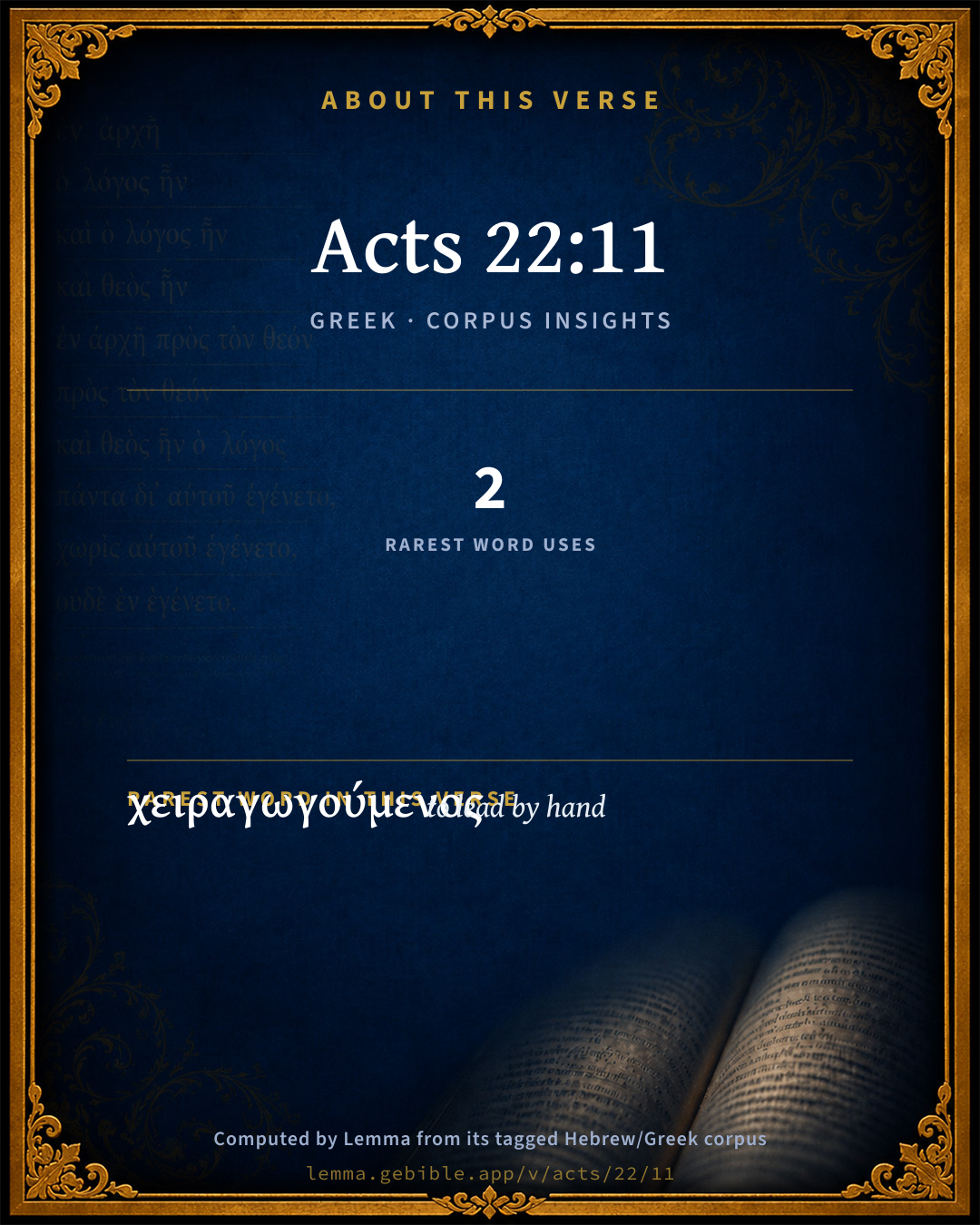
The rarest word here is χειραγωγούμενος to lead by hand G5496 — appearing just 2 times in the whole Greek New Testament.

Shared distinctive vocabulary

χειραγωγούμενος to lead by hand G5496 occurs in 2 verses of the Greek New Testament. Also found in:

Repetition

A word recurs within this verse:

Cross-references

3

Topical passages linked to Acts 22:11 in the Treasury of Scripture Knowledge — connected by theme and wording, ordered by reader-vote popularity; previews shown in the World English Bible.

  • Acts 9:8–9 Saul arose from the ground, and when his eyes were opened, he saw no one. They led him by the hand, and brought him into Damascus.
  • Isaiah 42:16 I will bring the blind by a way that they don't know; in paths that they don't know will I lead them; I will make darkness light before them, and crooked places straight. These things will I do, and I will not forsake them.
  • Acts 13:11 Now, behold, the hand of the Lord is on you, and you will be blind, not seeing the sun for a season!" Immediately there fell on him a mist and darkness. He went around seeking someone to lead him by the hand.

Cross-references courtesy of OpenBible.info (CC BY 4.0).

Commentary

Notes on Acts 22:11 from classic Christian and Jewish commentators (each source and its license shown beneath its notes). The classic Christian expositions comment on the surrounding passage and are grouped to its opening verse, so a note may address several verses; the Jewish commentaries on the Tanakh (Rashi and others) are per-verse, so they appear only where the commentator wrote on this verse.

Lemma curates 59 commentaries, every one of them public domain or Creative Commons licensed, each selected and text-cleaned for this edition rather than reprinted as found. About our sources →

The Biblical Illustrator

Joseph S. Exell

Act_22:11

And when I could not see for the glory of that light.

Too much light

There is such a thing as having too much light, as having so much light that we can see nothing. If God should send us all the light we ask for, we should all be blinded. What we need is not more light, so much as more faith--in a world where we must walk by faith rather than by sight. Light, in and of itself, is no guide to truth. Its glare is liable to bewilder, if not actually to blind, the human eye. Unless our faith keeps pace with--no, keeps ahead of--the light which we have, we are pretty sure to be worse off than if in darkness. That is the trouble with many a poor scientist--from the young medical student up to the agnostic philosopher--the light which has come into his eyes has dazed his sight, and he doesnt know enough to ask someone to take him by the hand and lead him. Lord, increase our faith! is a better prayer, for most of us, than Lord, increase the light! (H. C. Trumbull, D. D.)

Brighter than we can bear

We are fearfully and wonderfully made. Think of the human eye, and all the machinery connected with it. And yet the eye has limits of its power. Let some unusual strain come upon it--some burst of heavenly radiance, and the marvellous mechanism gives way. Apply the text to--

I. The attributes of God.

1. His eternity. The days of our years are threescore years and ten: and my mind can easily take in the measurement of such a period. Nay, I can easily look back to the time when the first star was kindled. I have no difficulty with the most ancient of Gods creatures; only tell me that they are creatures, and once began to be. But a Being who never began to be--a river of life that never had a fountainhead, this is more than I have faculties to grapple with. I cannot see for the glory of the light.

2. His omnipresence. When the Psalmist says, Whither shall I go from Thy spirit, or whither shall I flee from Thy presence? etc., who is there that is not ready to cry with him, Such knowledge is too wonderful for me? I cannot see for the glory of the light!

3. His other attributes: His omniscience--that there is nothing He doesnt know; His omnipotence--that there is nothing He cannot do. We have no power of vision that can bear the strain. We cannot see for the glory of the light.

II. The discoveries of the gospel. It is a very pleasant thing to be able to say that there is not a little child that cannot understand it. But when you inquire into its origin, its spirit, its provisions, you soon find yourself diving in deep waters. The incarnation of Christ in our inferior nature--the substitution of Christ in the place of guilty men--the love of God, that provided such a substitute, and consented to such humiliation: these are things which, the more yon ponder them, the grander and more glorious do they appear.

III. The future blessedness of the world. You see at once that we must change the scene. Crosses and curses tell of a world that is not blessed. See how cruel men are to themselves and to one another! See the strifes of families, of neighbourhoods, of nations; the oppression of the weak, the envy of the strong. But now hear words like these, The nations shall be glad and sing for joy. Why? Because none shall hurt and none destroy. Nay, more! The tabernacle of God is with men, etc. These are not dreams, but true sayings of God. But what a picture do they raise! It is too bright--it is more than my eyes can bear! I cannot see for the glory of the light.

IV. The final heaven. This seems the appropriate close of all earths promised blessedness--indeed, the one seems to merge into the other, just as the distant sea seems to merge into the sky. Thus the last quotation is followed by And God shall wipe away all tears from their eyes; and there shall be no more death, etc. Little does it matter where heaven shall be, if we may but be there! It is to be with Christ--to see His glory--to be conformed to His image: this must be heaven, wherever heaven may be. Nor can I doubt that in the world where the redeemed are to sit down with Abraham, Isaac, and Jacob, we shall meet beloved ones who have gone before. But, oh, glorious inheritance of the saints in light! They shall be glorious in body, in soul, in surroundings, society, service, life, love, joy! But it is not for me to sketch the outline of the scene, for I cannot see for the glory of the light. (F. Tucker, B. A.)

Blinded by excessive light

There are three distinct accounts of the conversion of Paul. In the first we are simply told that it was a light from heaven; in the second, that it was a great and glorious light; and in the third, that it was above the brightness of the noonday sun. It is of that light we desire to speak.

I. The excellence of thy light. We have nothing definitely recorded as to the nature of the light. To assert, as some have done, that it was a mere electric phenomenon is absurd. Equally unsatisfactory is the theory that it was only a vision peculiar to Paul (Act_26:13). The minute particulars given of the light evince the objective reality of this heavenly manifestation. To us the most reasonable explanation is that which regards this light as the Shekinah--that visible and miraculous glory which was a symbol of the Divine presence. As Dr. Bonar has well said, It appeared at sundry times and in divers forms for various purposes--now of mercy, now of judgment. It was the light that blazed out in the flaming sword; that appeared to Abraham in Ur of the Chaldees; that was seen by Moses in the burning bush; that shone out in the pillar of cloud and compassed the top of Sinai; that dwelt in the tabernacle and temple; that showed itself to Gideons father; that kindled the fire on Solomons altar; that was seen by Ezekiel departing, and by Daniel in his visions; that for four hundred years left the earth, but reappeared at Bethlehem to the shepherds and to the wise men; at Christs baptism; at the Transfiguration; at Pentecost; at Stephens martyrdom; and now at Sauls conversion, and afterward at Patmos. Such is the history of this wondrous light--the representation of Him who is light, and in whom is no darkness at all. Whatever that light may have been, we do know most certainly that at every conversion there is light--the light of the glorious gospel of Christ and the illumination of the Holy Ghost. For God, who commanded the light to shine out of darkness, hath shined in our hearts to give the light of the knowledge of the glory of God in the face of Jesus. Between the visible glory that shone around Saul and the invisible brightness that shines in upon every converted soul there are several points of likeness.

1. It was a light from heaven. Not merely streaming from the firmament, but actually emanating from the dwelling place of the Divine Being. It shone from that city where they have no need of the sun, neither of the moon, to shine in it; for the glory of God doth lighten it, and the Lamb is the light thereof. And so is it with gospel light. It proceeds alone from God. His wisdom devised and His grace first contrived the way to save rebellious man. The Dayspring from on high hath visited us. Our calling is in every way a heavenly one. We needed a Divine revelation. The light of such a revelation is far brighter than that of human reason. The light of reason is utterly insufficient to lead one soul in the way of holiness.

2. It was a light above the brightness of the sun. This is very remarkable. It was midday, the sun had reached its zenith. It was an Oriental sun, the heavens were ablaze with light. So the light of the gospel is superior to the brightest light of nature. Revelation exceeds Nature at her best.

3. It was a light which revealed Christ. This light revealed Christ. There is no doubt that Saul had an actual sight of Jesus. It pleased God to reveal His Son in me. And last of all, He was seen of me also. It was the greatest glory of the light that it brought Jesus into view. And this is the glory of the gospel, that it brings Jesus before us, and herein is its superiority not only to reason and nature, but also to the law of Moses. For if the ministration of condemnation be glory, much more doth the ministration of righteousness exceed in glory. For even that which was made glorious had no glory in this respect by reason of the glory that excelleth. For if that which is done away was glorious, much more that which remaineth is glorious. The law makes known the spotless holiness and inflexible justice of God, and thereby renders us conscious of sin. But the light of the gospel tells of grace as well as truth, and mercy as well as righteousness.

II. The effect of the light. I Could not see for the glory of that light. A strange effect, surely! Yet there is such a thing as being dark with excess of light. And right through his Christian career he might constantly have said, I could not see for the glory of that light.

1. He was blinded to the world. He became blind to the worlds glory, pride, pomp, wealth, and pleasure. The light of heavenly glory was so dazzling that he could not see lesser lights. And thus it is with every converted soul. Earth has no attractions for such an one. Faithful walked through Vanity Fair with averted eyes, so does a true believer pass through the world.

2. He was blinded to his old views of religion. There was never a more remarkable change of opinion and creed than in his case. He preached the faith which once he destroyed. Oh, it is a blessed thing when the light of truth blinds us to error! There are people now embracing false ideas which seem to them wonderfully plain. They see certain things (as they imagine) with the utmost clearness. We cannot convince them that they are wrong. But let this heavenly light shine upon them, and what a transformation will be effected!

3. He was blinded to his own greatness and goodness. Before his conversion he had a capital opinion of himself. Now he is less than least of all saints and the chief of sinners. He cannot see that well-satisfied, boastful, righteous self. The glory of the Divine light has blinded him to his own glory.

4. He was blinded to his former companions. He could not see those with whom he journeyed. He saw no man, we read. And when his eyes were opened, the first face that greeted his regained vision was that of a follower of Jesus. He chooses the people of God, and bids farewell to those with whom he once consorted. (C. W. Townsend.)

Truths overlooked because of their obviousness

1. We need some light in order that we may see; but too much light prevents us from seeing at all. Bury a man in a dungeon to which no ray of sunshine ever comes, and he sees nothing. Bring him out into the full glare of the noonday sun, and he sees no more; and by long gazing at excessive light the power of vision becomes impaired or destroyed.

2. The self-same law which obtains in the external world has its types in the world of mind; and as regards spiritual things as well as visible ones, there is such a thing as over-much glory dazzling, instead of informing and enlightening the mind.

I. The first object concerning which it is true that for very glory we cannot see it clearly is God Himself. God is Light: the Father of Lights: that dwelleth in Light. And yet, is it not true that we cannot see Him for the glory of that light? No man hath seen God at any time; no man can see God and live. We cannot comprehend God; and the longer and more deeply we think upon the Almighty, the more humbly we say, Verliy Thou art a God that hidest Thyself! It is only when His glory is tempered down to our weak sight by coming through the medium of a human nature in the face of Jesus that we can understand it, at least in some degree. His eternity, His omnipresence, His reading of every thought of our heart: who can understand all that? You will remember the ancient fable of the sage, who was asked by his king, What is God? and who asked a day to consider his reply: and then at the end of the day a month; and at the end of the month a year; and at the end of the year said he never could answer the question at all, because mystery gathered on mystery the longer he dwelt upon the theme. Ah! it is the experience of every man who looks at God in any way but as revealed in Christ. We cannot see for the glory of that light.

II. Religious truths are very often overlooked, just because they are set in a light so thorough that reasoning about them is needless. We do not see them, for the very clearness of the light which shines upon them. If you are trying to impress upon any man some truth of great practical importance, but which is not quite apparent at the first glance, you make use of various arguments and illustrations to make it plainer and more obvious. But if a man doubts or denies a truth which is already so plain, what is the use of arguing with him? And the most real of all ways of denying any truth is to deny it practically. Now the evil and the difficulty is that almost all those religious truths which men practically deny are truths which are already so plain that no talking can make them plainer. Take the following truths:

1. The necessity of obtaining a part in Christs salvation before we leave this world. I know what to do if a man says, But I do not believe in Christ; and so I seek no part or lot in Him. I should seek to set before him the various reasons we have for believing Christ; and then I should hope that he would begin to act upon his belief. But what can you say to a man who believes that by turning to Christ he may gain heaven and escape hell, and yet who knows and confesses that he is living as though his creed were the atheists? You can tell him nothing he does not know. Argument and information have no effect upon him, just because he agrees with them so readily: as the strongest blast can make no permanent impression on the willow, just because the willow bends so readily before its breath.

2. The certainty of death and its possible nearness. It is a trite truism to say that all must die. Who doubts it? We all admit the truth, but who acts upon it? One would think that amid a world of many graves, we who have looked so often upon them would hardly be able to forget that in a little while we shall be laid where we have seen many laid before us. But how very little we realise the hour when we shall lie upon our bed of death! It was no wonder that David said, Oh, that they were wise, that they understood this, that they would consider their latter end! for if we could only every day keep that parting hour before us, and realise all it means, what earnest Christians we should be! There is no reason at all why such a remembrance should overcast our days with sadness. Those who think most of death, if they think in the way the Psalmist wished us, are those who will fear it least.

III. The way in which this evil may be remedied. The right course to take when we feel that any religious doctrine has grown too familiar to us, so that familiarity has taken from the effect it used to have upon our hearts, is to make it a subject of special prayer, that the Holy Spirit may open the eyes of our understandings to understand it better, and touch our hearts to feel it more. Many a Christian can tell you that in a season of prayer or of solemn meditation he has had glimpses of the Saviours value, and while thus musing the fire has burned--a fire which no earthly power kindled in his heart. And in all this the believer would trace the breathing of the enlightening Spirit of God. Now these influences are free to all believers: we have more confidence in praying for the Spirit than in asking for almost any other blessing. If ye, being evil, etc. And while we would bear it in our remembrance how much we need Him in many ways--as a Spirit of holiness, prayer, and comfort--let us ask for Him, too, as one whose special province it is to open the eyes of our understanding and make us see by uncreated light.

IV. The guilt of thus overlooking religious truths. God has said and shown enough to us; and it is our own fault if we will not see and hear. You remember the answer of Abraham to the rich man in woe, They have Moses and the prophets. If they would neglect and overlook all the warnings they had, they must do so at their own peril. It would be no answer at the day of judgment to say that they really had never noticed how much God had done to make them think of eternity. And there can hardly be a more awful thing in the appearance of the careless soul, when at last the hour of death draws near, than when first there breaks upon it the awful sense of how much light it had sinned against in its progress towards endless woe. We shall feel then, if not before, the tremendous force of the old reasons for going to Christ and believing on Him, which were pressed upon us a thousand times, till they grew so familiar to us that they produced no impression. (A. K. H. Boyd, D. D.)

The Biblical Illustrator, edited by Joseph S. Exell (c. 1880s–1900s) — public domain. Text from a community e-Sword module.

Expositor's Greek Testament

ed. W. Robertson Nicoll

Act 22:11 . οὐκ ἐνέβλεπον , cf. Xen., Mem. , iii., 11, 10, here absolute, Grimm-Thayer, sub v. : chap. ix., 8, gives the fact of the blindness, here we have its cause as from St. Paul’s personal reminiscence. δόξης : Heb. כָּבוֹד cf. 1Co 15:40 , 2Co 3:7 , and Luk 9:31 .

The Expositor's Greek Testament, edited by W. Robertson Nicoll (1897–1910) — public domain. Text from a community e-Sword module.

Ellicott's Commentary for English Readers

(11) And when I could not see for the glory of that light.—It is again characteristic of a personal recollection that, while the narrative of Act_9:8 states only the fact of blindness, St. Paul himself connects it with its cause.

A Bible Commentary for English Readers, edited by Charles John Ellicott (1878–1897) — public domain. Text from a community e-Sword module.

The Cambridge Bible for Schools and Colleges

gen. ed. J. J. S. Perowne

11. could not see for the glory of that light] This explanation of the reason of the Apostle’s blindness is only given in this place.

The Cambridge Bible for Schools and Colleges (gen. ed. J. J. S. Perowne; Cambridge University Press, 1878–1918) — public domain. Text from a community e-Sword module.

John Gill's Exposition

Came unto me,.... Being at the house of Judas, in that street of Damascus called Straight, Act 9:11 and stood; at the side of him, or by him, putting his hands on him:

and said unto me, brother Saul; See Gill on Act 9:17.

receive thy sight, "or look up",

and the same hour I looked up upon him; that is, immediately, directly: for so the phrase, "that same hour", is frequently used by the Jews: the words in Num 16:21 "that I may consume them in a moment", are rendered by Onkelos, "that I may consume them in an hour"; for an hour is used for a moment with them.

John Gill's Exposition of the Whole Bible (1746–1763) — public domain (CC PDM 1.0). Text via the HelloAO Bible API.

Matthew Poole's English Annotations

I could not see for the glory of that light; the excellency of the object overpowering his sight. It was a strange work of God that enabled St. Stephen to see Christ, who is now so glorious, Act 7:55. And it will be according to God’s wonderful power, when at the resurrection we shall be enabled to look upon Christ in his greatest glory. Behold the goodness and severity of God upon Paul: severity upon him in striking of him with blindness in his body; but goodness indeed to him, in enlightening, converting, and saving of his soul.

Matthew Poole's English Annotations on the Holy Bible (1683–1685) — public domain. Text from a community e-Sword/MySword module.

The Pulpit Commentary

When I could not see. (comp. Act_9:8, and note) Them that were with me (twn sunontwn moi). Suneinai occurs only here and Luk_9:18, hut is used several times by the LXX It is very common in medical waters for the accompanying symptoms of a disease.

The Pulpit Commentary (1880–1919), ed. H.D.M. Spence-Jones & Joseph S. Exell — public domain. Text from a community e-Sword module.

McGarvey & Pendleton's Commentaries

J. W. McGarvey

See notes on verse 3

J. W. McGarvey (with Philip Y. Pendleton), Commentaries on the New Testament (The Fourfold Gospel, 1914; Acts; and the epistles) — public domain. Text from a community e-Sword/MySword module.

Cambridge Greek Testament for Schools and Colleges

11. ὡς δὲ οὐκ ἐνέβλεπον ἀπὸ τῆς δόξης τοῦ φωτὸς ἐκείνου, and when I could not see for the glory of that light. This explanation of the reason of the Apostle’s blindness is only given in this place.

ἐμβλέπω is found Mar 8:25 of sight returned after blindness.

Cambridge Greek Testament for Schools and Colleges (Cambridge University Press, 1896; 21 vols, various authors incl. Carr, Maclear, Plummer, Farrar, Lumby, Moule, M. R. James, Simcox) — public domain. Text from a community e-Sword module.

Alford’s Greek Testament

Henry Alford

11.] See notes, ch. 9:8, 18.

Henry Alford, The Greek Testament (1849–1861) — public domain. Text from a community e-Sword module.

Vincent's Word Studies in the New Testament

Marvin R. Vincent

For the glory of that light. The cause of his blindness is not stated in ch. 9.

Marvin R. Vincent, Word Studies in the New Testament (1887–1900) — public domain. Text from a community e-Sword/MySword module.

Lesson kit

Teaching starters — assembled from the data on this page, not authored interpretation. Every prompt links to the verse data it draws on. Edit before teaching.

Acts, in the Acts, opens this verse with 18 words (16 distinct Greek lemmas). Its most distinctive word is cheiragōgéō (“to lead by hand”). A historical commentator’s framing appears above. Read the whole chapter for the surrounding context.

Discussion questions

  1. The word cheiragōgéō carries the sense “to lead by hand.” How does it shape the verse?
  2. How does Acts 9:8, which shares the word «to lead by hand», read alongside this verse?
  3. What does the repetition of “the” (3× in this one verse) do in this verse?
  4. These translations render this verse differently. What is at stake in choosing one wording over another?
  5. Compare how The Biblical Illustrator and Expositor's Greek Testament read this verse. Where do they agree or differ?

Things to notice

Reading settings

Reading text

Shown beneath each verse's original-language words.

Old Testament
Old Testament edition

Read the OT as the Masoretic Hebrew (MT) or the Greek Septuagint (LXX).

English shown for the Greek Septuagint (in the Hebrew ↔ Greek comparison).

Comparing translations? Open the Compare panel on any verse page to stack up to four side by side.