John 19:27

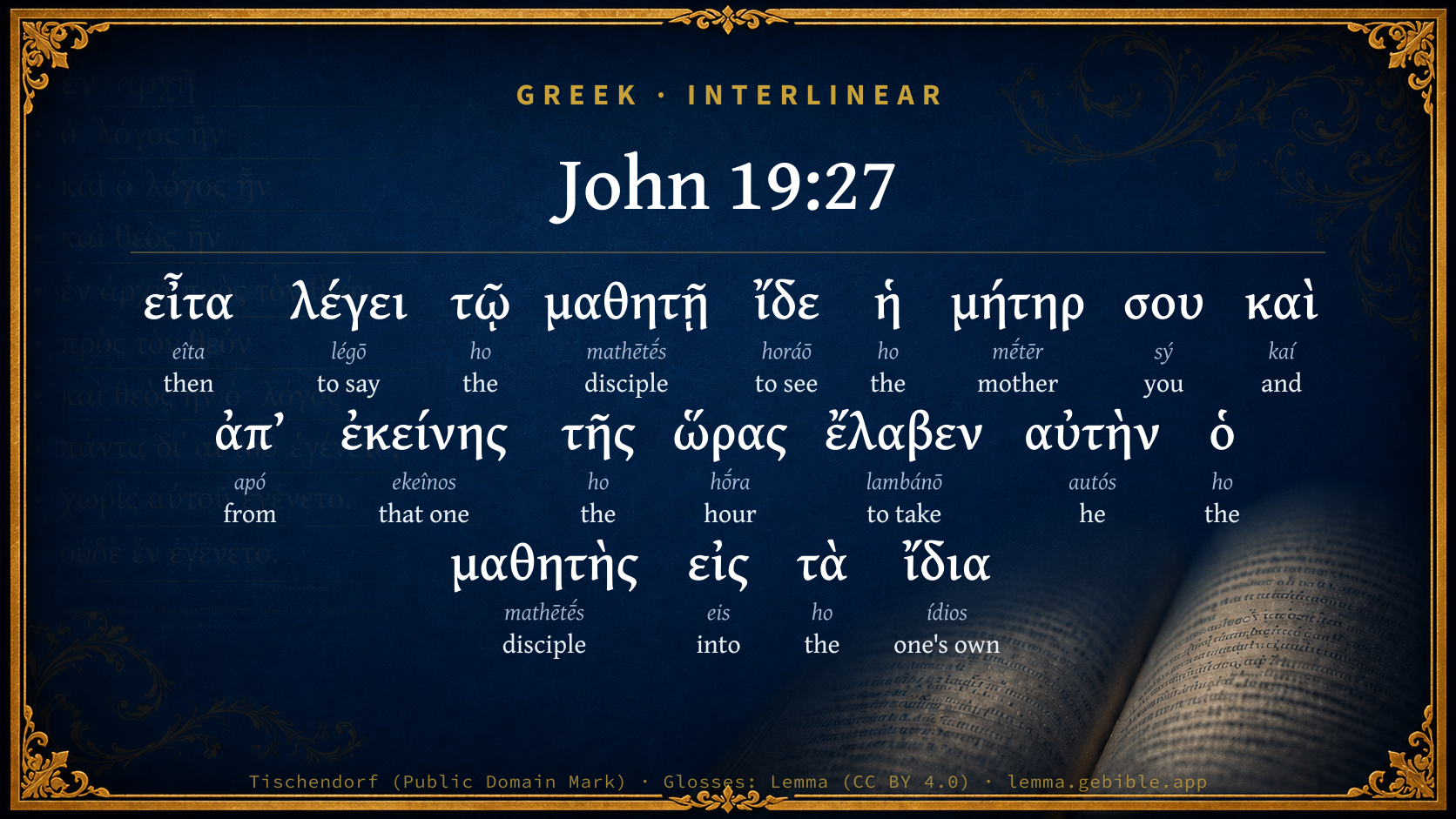
Greek (Tischendorf 8th ed.) John 19:27 appears in the Greek New Testament. The text above is from the Tischendorf 8th edition. Each word links to its Strong’s number and a concise gloss. Click any word for its full Thayer’s Greek Lexicon entry.
Download image
Cite this verse

John 19:27 (World English Bible). Public Domain. Lemma interlinear Bible study tool, https://lemma.gebible.app/v/john/19/27.

Show BibTeX & RIS
BibTeX
RIS
English Translation
Then he said to the disciple, "Behold, your mother!" From that hour, the disciple took her to his own home.
World English Bible · Public Domain
Download a study sheet

One document with this verse’s original text, its word-by-word gloss line, the meaning frame, cross-references with their text, attributed commentary, and full source and license credits — printable, and it pastes into notes with its structure intact.

This verse Autodidact and up

Study sheet (.html) Plain text (.txt)

A passage Seminary Student

Up to 50 verses in one chapter. A passage sheet keeps up to 6 commentary sources and 12 cross-references per verse, in the order this page ranks them, and says so on the sheet whenever that leaves anything out. Ask for a single verse and you get the Autodidact verse sheet above.

Everything on this page stays free to read, with no account — the sheet is a download of what is already on screen, not access to it.

Want to remove ads? Support Godless Engineer
Compare translations 3

The same verse in 3 English versions, stacked beneath the original-language interlinear above. Click any original word for its lexicon entry.

Each is an independent rendering of the whole verse — the interlinear is not word-aligned to these translations.

Highlighted words mark where these versions differ — a whole-verse word diff, not a word-by-word alignment.

  • World English Bible Public Domain
    Then he said to the disciple, "Behold, your mother!" From that hour, the disciple took her to his own home.
  • King James Version Public Domain
    Then saith he to the disciple, Behold thy mother! And from that hour that disciple took her unto his own home.
  • unfoldingWord Literal Text CC BY-SA 4.0
    Then he says to the disciple, “Behold, your mother!” And from that hour the disciple took her into his own.

unfoldingWord Literal Text — © unfoldingWord, licensed CC BY-SA 4.0. Word-aligned USFM3 via Door43 (git.door43.org/unfoldingWord/en_ult).

Versions to compare (up to 4)

3 of 4 selected

Show all 19 translations

Every available English version of this verse, each an independent rendering of the whole verse.

  • World English Bible Public Domain
    Then he said to the disciple, "Behold, your mother!" From that hour, the disciple took her to his own home.
  • Berean Standard Bible Public Domain
    Then He said to the disciple, “Here is your mother.” So from that hour, this disciple took her into his home.
  • Majority Standard Bible Public Domain
    Then He said to the disciple, “Here is your mother.” So from that hour, this disciple took her into his home.
  • King James Version Public Domain
    Then saith he to the disciple, Behold thy mother! And from that hour that disciple took her unto his own home.
  • American Standard Version (1901) Public Domain
    Then saith he to the disciple, Behold, thy mother! And from that hour the disciple took her unto his own `home'.
  • Revised Version (1885) Public Domain
    Then saith he to the disciple, Behold, thy mother! And from that hour the disciple took her unto his own home.
  • Geneva Bible (1599) Public Domain
    Then saide he to the disciple, Beholde thy mother: and from that houre, the disciple tooke her home vnto him.
  • Douay-Rheims (1899) Public Domain
    After that, he saith to the disciple: Behold thy mother. And from that hour, the disciple took her to his own.
  • Young's Literal Translation Public Domain
    afterward he saith to the disciple, `Lo, thy mother;' and from that hour the disciple took her to his own `home'.
  • Literal Standard Version CC BY-SA 4.0
    afterward He says to the disciple, “Behold, your mother”; and from that hour the disciple took her to his own [home].
  • Unlocked Literal Bible CC BY-SA 4.0
    Then he said to the disciple, “See, your mother!” From that hour the disciple took her to his own home.
  • unfoldingWord Literal Text CC BY-SA 4.0
    Then he says to the disciple, “Behold, your mother!” And from that hour the disciple took her into his own.
  • Darby Bible Public Domain
    Then he says unto the disciple, Behold thy mother. And from that hour the disciple took her to his own home.
  • World Messianic Bible Public Domain
    Then he said to the disciple, “Behold, your mother!” From that hour, the disciple took her to his own home.
  • Webster's Bible Public Domain
    Then saith he to the disciple, Behold thy mother! And from that hour that disciple took her to his own home.
  • Free Bible Version CC BY-SA 4.0
    Then he said to the disciple, “This is your mother.” From then on the disciple took her into his home.
  • Bible in Basic English Public Domain
    Then he said to the disciple, There is your mother! And from that hour the disciple took her to his house.
  • Text-Critical English NT CC BY 4.0
    Then he said to the disciple, “Behold, yoʋr mother.” And from that hour the disciple took her into his own home.
  • Tyndale New Testament (1534) Public Domain
    Then sayde he to the disciple: beholde thy mother. And from that houre the disciple toke her for his awne.

Literal Standard Version (2020), Covenant Press — licensed CC BY-SA 4.0. Text via the HelloAO Bible API (eBible.org). Unlocked Literal Bible (unfoldingWord) — licensed CC BY-SA 4.0. Text via the HelloAO Bible API (eBible.org). unfoldingWord Literal Text — © unfoldingWord, licensed CC BY-SA 4.0. Word-aligned USFM3 via Door43 (git.door43.org/unfoldingWord/en_ult). Free Bible Version, Dr. Jonathan Gallagher — licensed CC BY-SA 4.0. Text via the HelloAO Bible API (eBible.org).

Word by word

More ways to search: Search by grammar → Find every occurrence → Compare this word →

Practice this passage: Drill this verse → Learn its vocabulary →

εἶτα
eîta
G1534
“then”
Adverb
Part of Speech
Adverb
Full Thayer's Definition

Origin: of uncertain affinity

TDNT: None

1. then 2. next, after that
  1. λέγει légō G3004 “to say” Verb, Present, Active, Indicative, 3rd person, Singular
  2. τῷ ho G3588 “the” Article, Dative, Singular, Masculine
  3. μαθητῇ mathētḗs G3101 “disciple” Noun, Dative, Singular, Masculine
  4. ἴδε horáō G3708 “to see” Verb, Aorist, Active, Imperative, 2nd person, Singular
  5. ἡ ho G3588 “the” Article, Nominative, Singular, Feminine
  6. μήτηρ mḗtēr G3384 “mother” Noun, Nominative, Singular, Feminine
  7. σου sý G4771 “you” Personal pronoun, 2nd person, Genitive, Singular
  8. καὶ kaí G2532 “and” Conjunction
  9. ἀπ’ apó G575 “from” Preposition
  10. ἐκείνης ekeînos G1565 “that one” Demonstrative pronoun, Genitive, Singular, Feminine
  11. τῆς ho G3588 “the” Article, Genitive, Singular, Feminine
  12. ὥρας hṓra G5610 “hour” Noun, Genitive, Singular, Feminine
  13. ἔλαβεν lambánō G2983 “to take” Verb, Aorist, Active, Indicative, 3rd person, Singular
  14. αὐτὴν autós G846 “he” Personal pronoun, Accusative, Singular, Feminine
  15. ὁ ho G3588 “the” Article, Nominative, Singular, Masculine
  16. μαθητὴς mathētḗs G3101 “disciple” Noun, Nominative, Singular, Masculine
  17. εἰς eis G1519 “into” Preposition
  18. τὰ ho G3588 “the” Article, Accusative, Plural, Neuter
  19. ἴδια ídios G2398 “one's own” Adjective, Accusative, Plural, Neuter

About this verse

These counts appear in no published source. They are computed here, from the morphology-tagged text and Lemma’s own curated glosses. What Lemma adds →

20
words
15
distinct lemmas
Gospels
section

Notable vocabulary

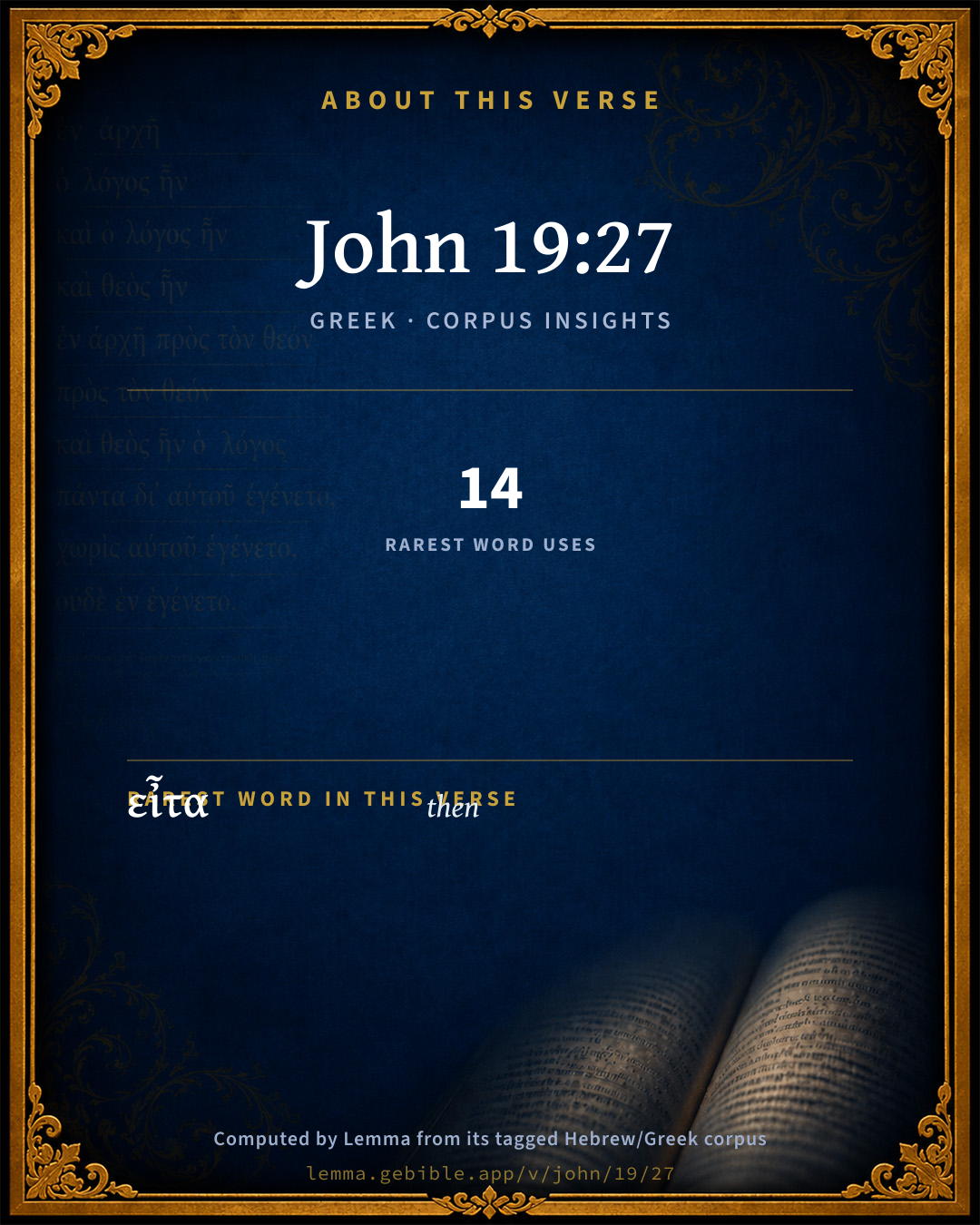
The rarest word here is εἶτα then G1534 — appearing just 14 times in the whole Greek New Testament.

Shared distinctive vocabulary

εἶτα then G1534 occurs in 13 verses of the Greek New Testament. Also found in:

Repetition

Words recur within this verse:

  • μαθητῇ disciple G3101 ×2
  • τῷ the G3588 ×5

Cross-references

6

Topical passages linked to John 19:27 in the Treasury of Scripture Knowledge — connected by theme and wording, ordered by reader-vote popularity; previews shown in the World English Bible.

  • Matthew 12:48–50 But he answered him who spoke to him, "Who is my mother? Who are my brothers?"
  • John 16:32 Behold, the time is coming, yes, and has now come, that you will be scattered, everyone to his own place, and you will leave me alone. Yet I am not alone, because the Father is with me.
  • 1 Timothy 5:2–4 the elder women as mothers; the younger as sisters, in all purity.
  • 1 John 3:18–19 My little children, let's not love in word only, neither with the tongue only, but in deed and truth.
  • John 1:11 He came to his own, and those who were his own didn't receive him.
  • Genesis 45:8 So now it wasn't you who sent me here, but God, and he has made me a father to Pharaoh, lord of all his house, and ruler over all the land of Egypt.

Cross-references courtesy of OpenBible.info (CC BY 4.0).

Commentary

Notes on John 19:27 from classic Christian and Jewish commentators (each source and its license shown beneath its notes). The classic Christian expositions comment on the surrounding passage and are grouped to its opening verse, so a note may address several verses; the Jewish commentaries on the Tanakh (Rashi and others) are per-verse, so they appear only where the commentator wrote on this verse.

Lemma curates 59 commentaries, every one of them public domain or Creative Commons licensed, each selected and text-cleaned for this edition rather than reprinted as found. About our sources →

Tyndale Open Study Notes

Tyndale Open Resources

19:27 Here is your mother: Jesus employed a Jewish family law that assigned the care of one person to another. The scene had an additional significance: The people who were present represented the new community of the church that was born at the cross. Jesus wanted them to care for each other in obedience to his command to love one another (13:34; 15:12, 17).

Tyndale Open Study Notes — © Tyndale Open Resources, licensed CC BY-SA 4.0. Text via the HelloAO Bible API.

Bengel's Gnomon

Johann Albrecht Bengel

Joh 19:27. Ἡ μήτηρ σου) thy mother, both by natural and spiritual grade of relationship and of age; the care of whom do thou take in charge in My stead. This consequence the love of the disciple easily deduced from the brief sentence spoken by Jesus. The sword had already enough “pierced into the soul” of Mary: now a precaution is taken that she may not see and hear the most severe trials of all—the darkness, the dereliction of the Son by the Father, the death.—ἔλαβεν, took) Perhaps he had not ventured to do so until he was desired.—εἰς τὰ ἴδια, to his own) viz. home. Great was the faith of Mary to stand by the cross of her Son; great her obedience, to depart before His death. [At least the disciple immediately gave proofs (indications) that he would comply with the wish of Jesus, and subsequently (then next) he took His mother to his own home: whether he did so in that very hour, before the death of the Lord and the piercing of His side (in which case John must have returned to the cross, Joh 19:35, “He that saw it [the piercing of the side] bare record”); or whether his doing so took place not until afterwards. Therefore the dwelling of John was at Jerusalem, and in that dwelling the mother of Jesus stayed during subsequent times.—V. g.]

Bengel's Gnomon of the New Testament — English translation (T&T Clark, Edinburgh, 1860) — public domain. Text from a community e-Sword module.

Expositor's Greek Testament

ed. W. Robertson Nicoll

Joh 19:27 . And this trust He commits to John in the simple words, Ἰδοὺ ἡ μήτηρ σου , although his natural mother, Salome, was also standing there. [ Cf. the bequest of Eudamidas: “I leave to Aretaeus the care of nourishing and providing for my mother in her old age”. Lucian’s Toxaris .] John at once accepted the charge, “from that hour (which cannot be taken so stringently as to imply that they did not wait at the cross to see the end) the disciple took her to his own home”; εἰς τὰ ἴδια , see Joh 1:11 , Joh 16:32 . The circumstances of the Nazareth home which made this a possible and desirable arrangement are not known. That Mary should find a home with her sister and her son is in itself intelligible, and this close intimacy of the two persons whose hearts had been most truly the home of Jesus must have helped to cherish and vivify all reminiscences of His character and words.

The Expositor's Greek Testament, edited by W. Robertson Nicoll (1897–1910) — public domain. Text from a community e-Sword module.

John Calvin's Commentaries

27. The disciple took her to his own home. It is a token of the reverence due by a disciple to his master, that John so readily obeys the command of Christ. Hence also it is evident, that the Apostles had their families; for John could not have exercised hospitality towards the mother of Christ, or have taken her to his own home, if he had not had a house and a regular way of living. Those men, therefore, are fools, who think that the Apostles relinquished their property, and came to Christ naked and empty; but they are worse than fools, who make perfection to consist in beggary.

John Calvin's Commentaries (1540-1563) — public domain. Text from the Calvin Translation Society English edition (1840s-50s) via the Christian Classics Ethereal Library (ccel.org). Calvin's coverage is partial (roughly two-thirds of the Bible); uncommented books and verses are honest gaps, never fabricated. The 19th-century editor's footnotes and remarks are omitted so the notes are faithfully Calvin's own voice.

Ellicott's Commentary for English Readers

(27) Behold thy mother!—The solemn committal is a double one. The loving heart of the disciple should find, as well as give, sympathy and support in the love of the mother. The sympathy in their common loss is to be the source of love for each other.

And from that hour.—The words do not necessarily mean, but they certainly may mean, that St. John at once took Mary away from the scene that a mother’s heart could hardly bear; but he is himself present (Joh_19:35), and the whole account, brief as it is, is that of an eye-witness.

Unto his own home.—Comp. Note on Joh_1:11, and Introduction, pp. 369, 371. The word is used in Joh_16:32 of the lodging or sojourning place of the Apostles. The meaning here is that whatever was his home became hers.

A Bible Commentary for English Readers, edited by Charles John Ellicott (1878–1897) — public domain. Text from a community e-Sword module.

The Cambridge Bible for Schools and Colleges

gen. ed. J. J. S. Perowne

27. from that hour] Quite literally, as soon as all was over (Joh_19:30); or he may have led her away at once and then have returned (Joh_19:35).

unto his own home] Although the commendation was double, each being given to the other, yet (as was natural) S. John assumes the care of Mary rather than she of him. This shews the untenability of the view that not only S. John, but in him all the Apostles, were committed by Christ to the guardianship of Mary. We have had the Greek expression for ‘his own (home)’ twice already in this Gospel: see on Joh_1:11 and Joh_16:32. That S. John was known to the high-priest (Joh_18:15) and that his family had hired servants (Mar_1:20) would seem to imply that he was a man of some position and substance.

The Cambridge Bible for Schools and Colleges (gen. ed. J. J. S. Perowne; Cambridge University Press, 1878–1918) — public domain. Text from a community e-Sword module.

John Gill's Exposition

Then saith he to the disciple,.... The same disciple John:

behold thy mother; take care of her, and provide for her, as if she was thine own mother: this shows the meanness of Christ, who had nothing to leave her, though Lord of all; it is very probable that Joseph was dead, and Mary now a widow; and whereas Christ had taken care of her, and maintained her hitherto, he now, in his dying moments, commits her to the care of this disciple; which is an instance of his humanity, and of his regard to every duty; and this in particular, of honouring parents, and providing for them in distress, and old age:

and hour that disciple took her to his own home: or house; so the Septuagint render "to his house", by , in Est 6:12 the phrase here used, and in Joh 16:32. Some say she lived with John at Jerusalem, and there died; and others say, that she died in the twelfth year after the resurrection of Christ, being 59 years of age, and was buried by John in the garden of Gethsemane: where his house was is not certain, whether at Jerusalem or in Galilee, nor how long she lived with him; but this is not to be doubted, that he took care of her, and provided for her, as if she was his own mother; and his doing this forthwith shows his great regard to Christ, his readiness and cheerfulness to comply with his orders and directions, and his unfeigned love unto him.

John Gill's Exposition of the Whole Bible (1746–1763) — public domain (CC PDM 1.0). Text via the HelloAO Bible API.

Trapp's Complete Commentary

John Trapp

27 Then saith he to the disciple, Behold thy mother! And from that hour that disciple took her unto his own home.

Ver. 27. The disciple took her, &c.] A precious depositum; trust the house was the better she abode in; yet dare we not deify her, as the Papists; as neither will we vilify her, as the author of the Female Glory basely slanders some of us, that we rudely call her Moll, God’s maid. Os durum! Horsh speech! Our parents, saith the heathen, are our household gods, θεοι εφεστιοι. (Hierocles.) Honour them we must both in word and deed. That our Saviour here calls her woman, and not mother, was either because he would not add to her grief, who was now pierced to the soul with that sword Simeon spake of, Luk 2:35; or, lest he should create her further trouble, if she had been known to be his mother; or, for that, being now in his last work, and ready way to heaven, he knew none after the flesh. Thomas Watt, martyr, spake thus at his death to his wife and six children: Wife and my good children, I must now depart from you; therefore henceforth know I you no more, &c. But whereas Christ commends the care of his mother to his beloved disciple, with, Behold thy mother, the Samians used the like speech, when to the richer of the citizens, the mothers of those who died in the wars were given to be maintained by them, Σοι ταυτην διδωμι την μητερα.

John Trapp, A Commentary or Exposition upon All the Books of the Old and New Testament (1647–1656) — public domain. Text from a community e-Sword module.

Albert Barnes' Notes on the Bible

Behold thy mother! - One who is to be to thee as a mother. The fact that she was the mother of Jesus would secure the kindness of John, and the fact that she was now intrusted to him demanded of him affectionate regard and tender care.

From that hour ... - John seems to have been in better circumstances than the other apostles. See Joh 18:16. Tradition says that she continued to live with him in Judea until the time of her death, which occurred about fifteen years after the death of Christ.

Albert Barnes' Notes on the Bible (1834–1885) — public domain. Text from a community e-Sword/MySword module.

Haydock's Catholic Bible Commentary

The disciple took her to his own[1] home, or into his own are, not for his mother, by the Greek expression. See St. John Chrysostom and St. Augustine. (Witham)

===============================

[BIBLIOGRAPHY]

Accepit eam discipulus in sua. Not in suam. Greek: eis ta idia.

====================

George Leo Haydock (1774–1849), Haydock's Catholic Family Bible and Commentary, 1859 edition — public domain. Excludes Psalms (Douay-Rheims chapter numbering differs from Protestant) and Deuterocanonical books (Catholic canon only).

Matthew Poole's English Annotations

He also reciprocally commendeth his mother to John, to be cared for as his own mother. From that time Mary went home, and lived with John.

Matthew Poole's English Annotations on the Holy Bible (1683–1685) — public domain. Text from a community e-Sword/MySword module.

Whedon's Commentary on the Bible

Daniel D. Whedon

27. Unto his own home—Doubtless to his own immediate residence in Jerusalem; next, to his home in Galilee; and finally, perhaps, to Ephesus, his last abode in Asia Minor. See our note on Mat_1:18. That John had a home at Jerusalem is implied by the phrase from that hour, as he remained some time in Jerusalem.

The writers of the Romish Church, assuming that John was committed to the protection of Mary, use this passage as an argument in support of Mariolatry. John is made to represent the Church, which is bound to solicit the guardianship of this “Mother of God.” All this is precisely the reverse of the fact. Mary was committed to the protection of John, not John to the protection of Mary.

Daniel D. Whedon (gen. ed.), Commentary on the Old and New Testaments (1874–1909) — public domain. Text from a community e-Sword module.

The Pulpit Commentary

(b) Filial love thy mother!" and the issue. Then he saith to the disciple, Behold thy mother! The very garments that covered him had been rudely divided among the soldiers. He is therefore as a dead man, and yet he made the most royal gifts and precious assignments of that which was nevertheless inalienable. He gave a mother to his dearest friend. He gave a son most precious to the bereaved and desolate and broken heart of his widowed mother. Inconceivable that Weisse should call this "the basest self-adulation." The animus manifested to this document by a certain school partakes of the animosity of political partisanship. From that hour, says the evangelist, the disciple took her (eiv ta idia) to his own home. This may have been some temporary lodging in Jerusalem, but it is more probable, as we have seen, that Salome and John had homes both in Jerusalem (see Introduction, p. 56) and Capernaum. The mere phrase is used in Joh_16:32 in a more general sense of all the apostles. It is not necessary to believe that John at once removed the sacred deposit and bequest of his dying Lord to that home, though it is just possible. Bengel and many others think so, but it is not necessary to limit the meaning of "hour" to moment. The departure could hardly have taken place till all was over. In this brief reference a key is given to what John became to the Church. We must think of Salerno and John ever by the holy mother of the Lord, whether at Jerusalem, Capernaum, or Ephesus. The few words speak volumes, and his reticence here, as elsewhere, gives an unutterable grandeur to his words.

The Pulpit Commentary (1880–1919), ed. H.D.M. Spence-Jones & Joseph S. Exell — public domain. Text from a community e-Sword module.

John Wesley's Explanatory Notes

Behold thy mother - To whom thou art now to perform the part of a son in my place, a peculiar honour which Christ conferred on him. From that hour - From the time of our Lord's death.

John Wesley, Explanatory Notes Upon the Whole Bible (1754–1765) — public domain. Text via the GEBible commentary corpus.

Alford’s Greek Testament

Henry Alford

27.] The solemn and affecting commendation of her to John is doubly made,—and thus bound by the strongest injunctions on both. The Romanist idea, that the Lord commended all His disciples, as represented by the beloved one, to the patronage of His mother, is simply absurd. The converse is true: He did solemnly commend the care of her, especially indeed to the beloved disciple, but in him to the whole cycle of disciples, among whom we find her, Act 1:14.

No certain conclusion can be drawn from this commendation, as to the ‘brethren of the Lord’ believing on Him or not at this time. The reasons which influenced Him in his selection must ever be far beyond our penetration:—and whatever relations to Him we suppose those brethren to have been, it will remain equally mysterious why He passed them over, who were so closely connected with His mother. Still the presumption, that they did not then believe on Him, is one of which it is not easy to divest one’s self; and at least may enter as an element into the consideration of the whole subject, beset as it is with uncertainty.

ἀπʼ ἐκ. τ. ὥρας is probably to be taken literally,—from that time;—so that she was spared the pangs of witnessing what was to follow. If so, John returned again to the Cross, ver. 35.

εἰς τὰ ἴδια need not imply that John had a house in Jerusalem. It would equally apply to his lodging during the feast; only meaning, that henceforth, wherever he was, she was an inmate with him; and certainly that his usual habitation was fixed, and was his own.

Ewald remarks (see Meyer in loc.), “It was for the Apostle in his later years a sweet reward to recall vividly every such minute detail,—and for his readers a sign that he alone could have written all this.”

Henry Alford, The Greek Testament (1849–1861) — public domain. Text from a community e-Sword module.

International Critical Commentary

27. ἀπʼ ἐκείνης τῆς ὥρας, “from that hour.” It has been thought that this implies that Mary did not wait for the end, but that John led her away at once. It may have been so, but in that case John returned soon, for he is present at the Cross later (vv. 28-35). Cf. 11:53.

That Jn. does not mention the cry Eli, Eli, lama sabachthani? which is reported by Mk. (15:34) followed by Mt. (27:46) as having been uttered “with a loud voice,” may perhaps be explained as due to the absence of the eye-witness at this point. The aged disciple recalls only his own personal experiences. Another possible explanation is that Jn. has omitted this saying, because he wishes to emphasise the voluntary character of Christ’s death. See on v. 30.

εἰς τὰ ἴδια, “to his own home.” The phrase is used thus Est 5:10, Est 5:3 Macc. 6:27, 37, 7:8, Act 21:6, and it is the most natural meaning. It occurs twice elsewhere in Jn. (1:11, 16:32), where the sense is probably the same, but is not quite so clear as it is here (see note on 1:11). John brought the Virgin Mother to his own lodging1 (see on 20:10), and she lived with him thereafter; but we cannot build on the phrase εἰς τὰ ἴδια a theory which would give him a house of residence at Jerusalem (see on 18:15).

International Critical Commentary — older volumes (1896–1929), various authors — public domain. Text from a community e-Sword module.

Vincent's Word Studies in the New Testament

Marvin R. Vincent

His own home [τα ιδια] . See on 1 11.

28 - 30. Compare Mt 27:45 - 50; Mr 14:33 - 37; Luk 23:44 - 46.

Marvin R. Vincent, Word Studies in the New Testament (1887–1900) — public domain. Text from a community e-Sword/MySword module.

Lesson kit

Teaching starters — assembled from the data on this page, not authored interpretation. Every prompt links to the verse data it draws on. Edit before teaching.

John, in the Gospels, opens this verse with 20 words (15 distinct Greek lemmas). Its most distinctive word is eîta (“then”). A historical commentator’s framing appears above. Read the whole chapter for the surrounding context.

Discussion questions

  1. How does “then” (eîta) shape what this verse is saying?
  2. Mark 4:17 shares the word «then» with this verse. How do the two illuminate each other?
  3. “disciple” occurs 2× in this one verse. What is the effect of the repetition?
  4. These translations render this verse differently; the difference is in the English rendering, not the original. What questions does that raise?
  5. Reading how Tyndale Open Study Notes and Bengel's Gnomon read this verse, where do the two commentators agree and where do they part?

Things to notice

  • These translations choose different wording for 4 words in this verse.
  • “disciple” occurs 2× in this single verse.
  • 15 distinct Greek lemmas span 20 words in this verse.

Reading settings

Reading text

Shown beneath each verse's original-language words.

Old Testament
Old Testament edition

Read the OT as the Masoretic Hebrew (MT) or the Greek Septuagint (LXX).

English shown for the Greek Septuagint (in the Hebrew ↔ Greek comparison).

Comparing translations? Open the Compare panel on any verse page to stack up to four side by side.