John 13:30

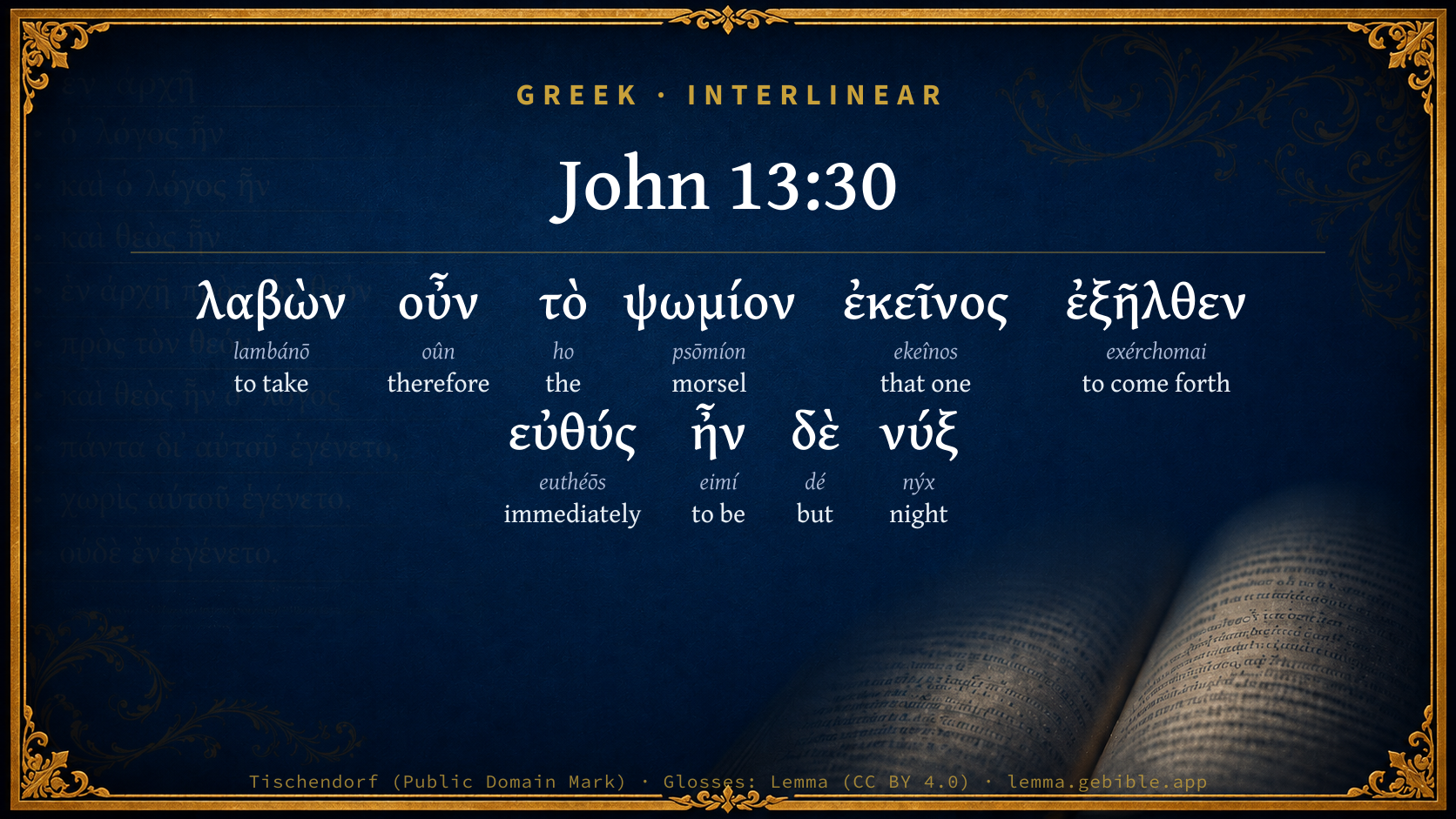
Greek (Tischendorf 8th ed.) John 13:30 appears in the Greek New Testament. The text above is from the Tischendorf 8th edition. Each word links to its Strong’s number and a concise gloss. Click any word for its full Thayer’s Greek Lexicon entry.
Download image
Cite this verse

John 13:30 (World English Bible). Public Domain. Lemma interlinear Bible study tool, https://lemma.gebible.app/v/john/13/30.

Show BibTeX & RIS
BibTeX
RIS
English Translation
Therefore, having received that morsel, he went out immediately. It was night.
World English Bible · Public Domain
Download a study sheet

One document with this verse’s original text, its word-by-word gloss line, the meaning frame, cross-references with their text, attributed commentary, and full source and license credits — printable, and it pastes into notes with its structure intact.

This verse Autodidact and up

Study sheet (.html) Plain text (.txt)

A passage Seminary Student

Up to 50 verses in one chapter. A passage sheet keeps up to 6 commentary sources and 12 cross-references per verse, in the order this page ranks them, and says so on the sheet whenever that leaves anything out. Ask for a single verse and you get the Autodidact verse sheet above.

Everything on this page stays free to read, with no account — the sheet is a download of what is already on screen, not access to it.

Want to remove ads? Support Godless Engineer
Compare translations 3

The same verse in 3 English versions, stacked beneath the original-language interlinear above. Click any original word for its lexicon entry.

Each is an independent rendering of the whole verse — the interlinear is not word-aligned to these translations.

Highlighted words mark where these versions differ — a whole-verse word diff, not a word-by-word alignment.

  • World English Bible Public Domain
    Therefore, having received that morsel, he went out immediately. It was night.
  • King James Version Public Domain
    He then having received the sop went immediately out: and it was night.
  • unfoldingWord Literal Text CC BY-SA 4.0
    Therefore, having received the bread, he went out immediately. Now it was night.

unfoldingWord Literal Text — © unfoldingWord, licensed CC BY-SA 4.0. Word-aligned USFM3 via Door43 (git.door43.org/unfoldingWord/en_ult).

Versions to compare (up to 4)

3 of 4 selected

Show all 19 translations

Every available English version of this verse, each an independent rendering of the whole verse.

  • World English Bible Public Domain
    Therefore, having received that morsel, he went out immediately. It was night.
  • Berean Standard Bible Public Domain
    As soon as he had received the morsel, Judas went out into the night.
  • Majority Standard Bible Public Domain
    As soon as he had received the morsel, Judas went out into the night.
  • King James Version Public Domain
    He then having received the sop went immediately out: and it was night.
  • American Standard Version (1901) Public Domain
    He then having received the sop went out straightway: and it was night.
  • Revised Version (1885) Public Domain
    He then having received the sop went out straightway: and it was night.
  • Geneva Bible (1599) Public Domain
    Assoone then as he had receiued the soppe, he went immediately out, and it was night.
  • Douay-Rheims (1899) Public Domain
    He therefore having received the morsel, went out immediately. And it was night.
  • Young's Literal Translation Public Domain
    having received, therefore, the morsel, that one immediately went forth, and it was night.
  • Literal Standard Version CC BY-SA 4.0
    having received, therefore, the morsel, that one immediately went forth, and it was night.
  • Unlocked Literal Bible CC BY-SA 4.0
    After Judas received the bread, he went out immediately. It was night.
  • unfoldingWord Literal Text CC BY-SA 4.0
    Therefore, having received the bread, he went out immediately. Now it was night.
  • Darby Bible Public Domain
    Having therefore received the morsel, he went out immediately; and it was night.
  • World Messianic Bible Public Domain
    Therefore having received that morsel, he went out immediately. It was night.
  • Webster's Bible Public Domain
    He then having received the sop, went immediately out: and it was night.
  • Free Bible Version CC BY-SA 4.0
    Judas left immediately after he'd taken the piece of bread, and went out into the night.
  • Bible in Basic English Public Domain
    So Judas, having taken the bit of bread, straight away went out: and it was night.
  • Text-Critical English NT CC BY 4.0
    As soon as Judas took the morsel, he went out. And it was night.
  • Tyndale New Testament (1534) Public Domain
    Assone then as he had receaved the soppe he wet immediatly out. And it was night.

Literal Standard Version (2020), Covenant Press — licensed CC BY-SA 4.0. Text via the HelloAO Bible API (eBible.org). Unlocked Literal Bible (unfoldingWord) — licensed CC BY-SA 4.0. Text via the HelloAO Bible API (eBible.org). unfoldingWord Literal Text — © unfoldingWord, licensed CC BY-SA 4.0. Word-aligned USFM3 via Door43 (git.door43.org/unfoldingWord/en_ult). Free Bible Version, Dr. Jonathan Gallagher — licensed CC BY-SA 4.0. Text via the HelloAO Bible API (eBible.org).

Word by word

More ways to search: Search by grammar → Find every occurrence → Compare this word →

Practice this passage: Drill this verse → Learn its vocabulary →

About this verse

These counts appear in no published source. They are computed here, from the morphology-tagged text and Lemma’s own curated glosses. What Lemma adds →

10
words
10
distinct lemmas
Gospels
section

Notable vocabulary

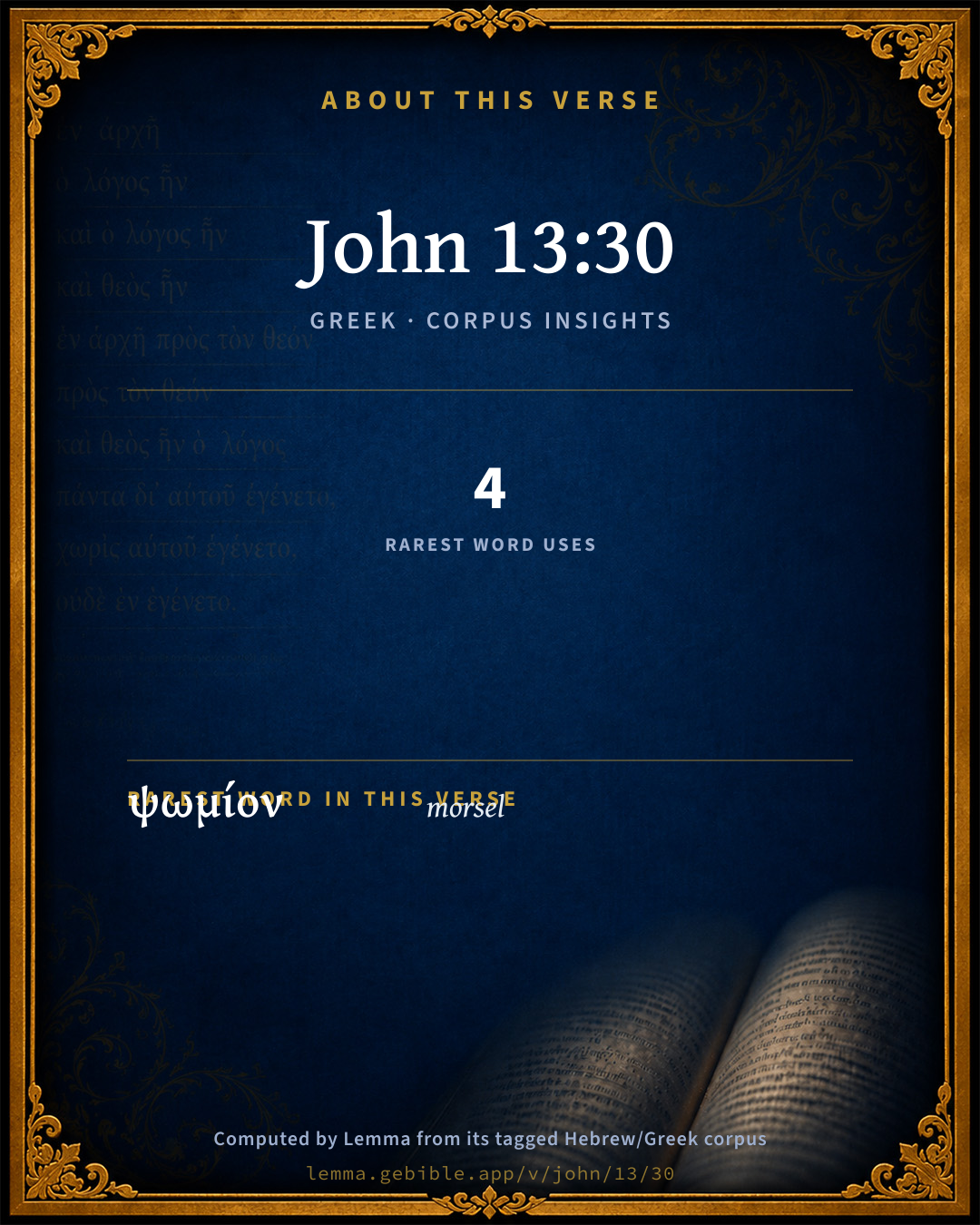
The rarest word here is ψωμίον morsel G5596 — appearing just 4 times in the whole Greek New Testament.

Shared distinctive vocabulary

ψωμίον morsel G5596 occurs in 3 verses of the Greek New Testament. Also found in:

Cross-references

5

Topical passages linked to John 13:30 in the Treasury of Scripture Knowledge — connected by theme and wording, ordered by reader-vote popularity; previews shown in the World English Bible.

  • Isaiah 59:7 Their feet run to evil, and they make haste to shed innocent blood: their thoughts are thoughts of iniquity; desolation and destruction are in their paths.
  • Proverbs 4:16 For they don't sleep, unless they do evil. Their sleep is taken away, unless they make someone fall.
  • Romans 3:15 "Their feet are swift to shed blood.
  • Job 24:13–15 "These are of those who rebel against the light; They don't know the ways of it, Nor abide in the paths of it.
  • Luke 22:53 When I was with you in the temple daily, you didn't stretch out your hands against me. But this is your hour, and the power of darkness."

Cross-references courtesy of OpenBible.info (CC BY 4.0).

Commentary

Notes on John 13:30 from classic Christian and Jewish commentators (each source and its license shown beneath its notes). The classic Christian expositions comment on the surrounding passage and are grouped to its opening verse, so a note may address several verses; the Jewish commentaries on the Tanakh (Rashi and others) are per-verse, so they appear only where the commentator wrote on this verse.

Lemma curates 59 commentaries, every one of them public domain or Creative Commons licensed, each selected and text-cleaned for this edition rather than reprinted as found. About our sources →

The Biblical Illustrator

Joseph S. Exell

Joh_13:30

He then having received the sop went immediately out: and it was night

Judas and the sop

The subject suggests

I.

THE TWO-FOLD AND EVEN CONTRASTED SIGNIFICANCE OF THE SAME THING.

1. The giving of the sop meant one thing to John, viz., who was the betrayer? It does not seem to have been fully understood (verse 28), but that was its meaning. To Judas it was meant as a mark of kindness. There was no inconsistency in this. It was done for a good reason. It consisted with Christs affection for John, not to allow the suspicion of betrayal to rest upon him, and with His love for Judas to show him kindness. But why should Christ so act when He knew the result? Because He invariably acted as though results were unknown. He knew that He would raise Lazarus, yet He gave way to grief. He knew who believed not and who should betray Him, but that did not lead Him to slacken efforts on their behalf.

2. And so the same providence now may convey a varied meaning according to our feeling or position. We are more susceptible at one time than another. A song may make glad feelings in one and sad in another, according to the mood. Let each learn what God says aside to him.

II. HOW MUCH MEANING MAY BE CONVEYED BY A LITTLE THING. In the very unobtrusiveness of the sop there was an element of power. It was better than if many words had been employed. The little friendly act was sufficient to flash the whole before His mind, and to discover the whole attitude of the Saviour. It was an intimation that it was not too late for repentance. Shortly before Christ put into a little service the great lesson of humility and serviceableness; shortly after He put great meaning into a look; and while sitting there He put meaning to all time into simple bread and wine. It needs only to have susceptible warm hearts to learn great lessons through little things.

III. THE DISASTROUS EFFECT THAT MAT FOLLOW FROM THE REJECTION OF AN APPEAL.

1. During all his declension Judas had the close attendance of Jesus, and therefore must have had every help toward a successful issue in his trial. And now a last appeal was about to be made. Would he say yes or no to the love of Christ. That was the turning point in his, as in every mans, destiny. And he was so infatuated with evil as to say No. And so Satan, who had only previously put the thought in his heart, now entered him, and the Spirit of the Lord departed from him. But as soon as the act was performed, the enchantment was gone, and he hurried himself into eternity.

2. And so Christ is continually making appeals to us, in some sermon, book, mercy, worldly loss. If we do not yield there will come a last and decisive appeal, and if we reject that, despair.

IV. HOW EXTERNAL NATURE REFLECTS AND MEETS STATES OF THE HUMAN SOUL. It was night--a congenial time for the deed of darkness. The children of darkness are dark within, and when Judas went out the dark thought of his mind was reflected there. Perhaps it was a relief to be away from the light, perhaps a suggestion of destiny. There is only outer darkness for those who go out from Christ. Let us accept Him now, from whose presence by and by we shall go no more out. (R. Finlayson, B. A.)

The sop and a dark deed

Notice

I. THE GROWTH AND STRENGTHENING OF EVIL AMID THE HOLIEST INFLUENCES. Judas lived within the circle of the Saviours influence for three years. Eli was rebuked by Samuel for permitting his sons to commit sin on the threshold of the Temple, and--strange irony--Samuels sons while doing priestly work walked in the same evil way. We may attend the sanctuary and listen to a mothers prayers for fifty years, and afterwards be lost.

II. THE SAVIOURS GOODNESS BECOMES THE OCCASION OF GREAT EVIL. Judas was a worse man at the end of three years; while Christs appreciation of Marys offering, and His appeal to Judas, seemed to strengthen him in his purpose. So the presence of goodness, if not a blessing to us, is a withering curse.

III. CHRISTS GENEROUS TREATMENT OF THE SINNER. He saw the growth of evil in Judas, but it made no difference in His trust and love. At the last moment, there was one more attempt to touch the traitors heart. Friend, etc. The gift of the sop was a sign of love. What a wealth of persevering love is poured out on the most depraved!

IV. THE DARK TERMINATION OF AN EVIL LIFE. Judas went out into the calm of that beautiful Syrian night, but is was a scene of blankness and tempest to him. Then came that deeper night of unavailing penitence and suicide. The path of sin always ends in night. It may be strewn with flowers or steeped in blood, but there is the same termination--the night of separation from God and communion with our own sins. (Noel R. Hamer, M. A.)

It was night

I. IN JERUSALEM. Only the pale shining of the passover moon lit the streets. The sieve was shaken, and the small soul of the money lover dropped through out of honour into shame and gloom.

II. In His HEART. For Satan, the prince of darkness, in person was ruling there. Over him swept a wave of the outer darkness like a cloud from the bottomless pit. Suicide was just at hand.

III. IN ALL THE VAST FUTURE. He was going to his own place. (Job_10:22). We see at this vanishing moment that the man is lost while he is living, virtually in hell because the prince of hell is in his heart. And so we know that a soul can be damned even before it is dead. (C. S.Robinson, D. D.)

Walking in the night

I. THE DARKNESS OF JUDASS CRIME.

1. The night has become intolerable to him now.

2. He was not always a traitor.

3. He may even have been brought into Christs company that he might be saved.

4. But over all good his evil heart obtains supremacy.

II. THE DARKNESS OF HIS REPENTANCE.

1. His conscience works up with the terror of night upon it, but without the accents of hope.

2. His repentance leads only to suicide--a further crime.

III. THE DARKNESS OF HIS DOOM. It had been better for that man, if he had never been born. (J. H. Hargreaves.)

The harmony of nature with our mental moods

We always like to have nature in sympathy with our sorrows and our joys; to have our moods of mind quite in accordance with our moods of seasons. Thus, if you and I are in distress, there is a sort of melancholy pleasure to find the sky gloomy with clouds; and when the shutter which tells our loss, and hides our mourning from the world and casts a shadow upon our home, lets in through the crevice the sunbeam, and we hear the happy crowd enjoying it outside, that intrusion seems quite an injury to our feelings. We take our moods of mind from those of nature, and this is a mystery, of course, which we cannot explain; but we have pleasure in finding that her moods are in accordance with ours, that she is bright when we are bright, that she is in sackcloth when we are sad. And so it is quite a relief to our feelings, just as it must have been to the Evangelists, to find it was night. Such a deed could not have been done before the face of Gods smiling sun. (C. J. P. Eyre, M. A.)

Moral seasons

There is a moral night upon the soul of every sinful creature, just as there has been a day spring in the soul of every true believer. (C. J. P. Eyre, M. A.)

Now is the Son of Man glorified.

The triple glorification

I. THE GLORIFICATION OF THE SON OF MAN IN AND BY HIS SUFFERING. This language is strange here. It would not have been wonderful at Jordan or on the Mount of Transfiguration. Observe that it is as the Son of Man He is glorified, i.e., His glory

1. As the perfect man was displayed in and by His sufferings. Mans excellence consists in entire conformity to Gods will. Of this Christ was all through possessed, but more particularly when at the supreme moment to do Gods will He died for man.

2. As the representative man, as typified by the vicarious sacrifice on the Day of Atonement, and by the Kinsman Redeemer. How glorious this was.

3. As the God-man, as illustrated by the supernatural portents before and at the Crucifixion, which made the Centurion exclaim, Surely this is the Son of God.

4. As the predicted man. At no period of His history were so many prophecies fulfilled. It is probable that the words suggest that there should be spectators: that there should not only be glory, but glorification. If so, Christ was glorified in His sufferings by the dying thief, God the Father, and the holy angels. Some expositors refer the words to the Lords supper--a glorious display of His authority as the Legislator, and His love as theSaviour of the Church.

II. THE GLORIFICATION OF GOD IN THE SON OF MAN SUFFERING. This is a strange declaration. We can understand how God is glorified in heaven, in the universe, in His government, and in multitudes of saved beings, but how in the sufferings of His Son? Now was the hour and power of darkness. The words in Him explain the mystery. By men and devils God was dishonoured, but by Christ honoured. God was glorified in Christs sufferings

1. Viewed in themselves, they glorify

(1) The Divine power which inflicted them and sustained the Sufferer. Never was sorrow like Christs sorrow, but never was Gods grace so abundant. Christ crucified is the power of God.

(2) The Divine wisdom. Christs sufferings

(a) Effectually answer an important end--the eternal salvation of man.

(b) By means different from any that created wisdom could have suggested.

(3) The Divine justice (Rom_3:25-26).

(4) The Divine faithfulness in exactly fulfilling so many predictions.

(5) The Divine benignity (chap. 3:16).

2. Viewed in their results.

(1) In the events themselves. The enemy of God is baffled, evil in the form of sin and suffering prevented, and good in the form of holiness and happiness produced.

(2) In those events as the results of Christs suffering--to bring such results out of such means. Satans ruin rises out of his apparent triumph; life is the fruit of death; favour arises out of wrath, etc.

III. THE GLORIFICATION BY GOD OF THE SON OF MAN, ON ACCOUNT OF HIS SUFFERINGS, IN CONSEQUENCE OF GOD BEING GLORIFIED BY HIM IN THEM.

1. God glorified the Son of Man

(1) Under His sufferings, which tested His power to bear and His disposition to obey, by sustaining Him amid them.

(2) After His sufferings--straightway, It is finished, paradise, the resurrection, ascension, session, and the judgment to come.

2. God glorified the Son of Man in Himself. If God is glorified in Him He shall be glorified in God.

3. Gods glorification of the Son of Man was the result and reward of God being glorified in and by the Son of Mans sufferings.

Conclusion: The subject bids us

1. Rest with entire confidence on the finished work of Christ as the ground of our hope.

2. Imitate the Son of Man in glorifying God and in seeking thus to be glorified by God.

3. Cooperate, though at an infinite distance, with God in glorifying the Son of Man. (J. Brown, D. D.)

God glorified in His Son

showed what glory accrued from the sufferings of Christ.

I. TO THE SON HIMSELF.

1. In completing His engagements with the Father.

2. In redeeming from death a ruined world.

II. TO THE FATHER THROUGH THE SON.

1. In the display of all His perfections.

2. In the accomplishment of all His purposes.

III. TO THE SON BY AND WITH THE FATHER.

1. In the testimonies borne to Him under His sufferings.

2. In the triumphant issue of them.

3. In the benefits conferred in consideration of them. (C. Simeon, M. A.)

God glorified in His Son

By

I. HIS OBEDIENCE TO GODS LAW.

II. HIS TEACHING OF GODS WILL.

III. HIS SUBMISSION TO GODS APPOINTMENTS.

IV. HIS DEATH FOR GODS CHILDREN. (S. S. Times.)

The cross the glory of Christ and God

There is something very weird and awful in the brief note of time--it was night. In immediate connection comes this singular burst of triumph--Therefore. Now that that spot in their feast of charity had disappeared, the Master felt at ease; and, like some stream, out of the bed of which a black rock has been taken, His words flow more freely. How intensely real and human the narrative becomes when we see that Christ, too, felt the oppression of an uncongenial presence, and was relieved and glad at its removal! The departure of the traitor evoked these words of triumph in another way. The match was lit that was to be applied to the train. He had gone out on his dark errand, and that brought the Cross within measurable distance of our Lord. What Judas went to do was the beginning of Christs glorifying.

I. THE SON OF MAN GLORIFIED IN HIS CROSS.

1. There is a double aspect under which our Lord regarded His sufferings. On the one hand we mark the innocent shrinking of His manhood. And yet, side by side with that, there is the reaching out almost with eagerness to bring the Cross nearer. Like the pellucid Rhine and the turbid Moselle, that flow side by side, so the shrinking and the desire were contemporaneous in Christs mind. Here we have the triumphant anticipation rising to the surface, and conquering for a time the shrinking.

2. Why did Christ think of His Cross as a glorifying? The New Testament generally represents it as the lowest point of His degradation; Johns Gospel always represents it as the highest point of His glory. And both are true; just as the zenith of our sky is the nadir for these on the other side of the world. The same fact which in one aspect sounds humiliating, in another is glorious. The Cross glorified Christ because

(1) It was the revelation of His heart. All His life long He had been trying to tell the world how much He loved it; but in His death it comes in a flood, and pours itself upon the world. For Him to be known was to be glorified. So pure and perfect was He, that revelation of His character and glorification of Himself were one and the same thing. We can fancy a mother in the anticipation of shame, and suffering, and death for the sake of some prodigal child, forgetting all, because all are absorbed in the one thought: If I bear them, my poor, rebellious child will know at last how much I loved him. So Christ yearns to impart the knowledge of Himself to us because by that knowledge we may be won to His love and service.

(2) It is His throne of saving power. Christ could not have spoken such words as these if He had simply thought of His death as a Plato or a John Howard might have thought of his, as being the close of his activity for the welfare of his fellows. If His death is His glorifying, it must be because in that death something is done which was not completed by the life, however fair; by the words, however wise and tender; by the works of power, however restorative and healing. Here is something more, viz., that His

Cross is the propitiation for the sins of the whole world. He is glorified therein, not as a Socrates might be glorified by his calm and noble death; but because in that death He wrestled with and overcame our foes, and because, like the Jewish hero, dying, He pulled down the house which our tyrants had built, and overwhelmed them in its ruins.

3. And so there blend, in that last act, the two contradictory ideas of glory and shame; like some sky, all full of dark thunderclouds, and yet between them the brightest blue and the blazing sunshine. In the Cross Death crowns Him the Prince of Life, and His Cross is His throne. He endured the Cross, despising the shame; and lo! the shame flashed up into the very brightness of glory, and the ignominy and the suffering became the jewels of His crown.

II. GOD GLORIFIED IN THE SON OF MAN. The mystery deepens as we advance. That God shall be glorified in a man is not strange, but it is strange that the act in which He was glorified was the death of an innocent man, and must imply

1. That God was in Christ, in some singular and eminent manner. If His whole human life and nature were the brightest manifestation of God, we can understand that the Cross was the highest point of the revelation of the Divine nature, and so was the glorifying of God in Him. But if we take any lower view of the relation between God and Christ, these words are a world too wide for the facts of the case.

2. That these sufferings bore no relation to the deserts of the person who endured them. If Christ, with His pure and perfect character, suffered so, then, if they have any bearing at all on the character of God, they cast a shadow rather than a light upon the Divine government. But if we can say, God was in Christ reconciling the world to Himself; that His death was the death of Him whom God had appointed to live and die for us, and to bear our sins then, though deep mysteries come with the thought, still we can see that, in a very unique manner, God is glorified and exalted in His death. For, if the dying Christ be the son of God dying for us, then the Cross glorifies God, because it teaches us that the glory of the Divine character is the Divine love. If there be nothing Diviner in God than His giving of Himself to His creatures, then the Cross towers above all other revelations. And is it not so? Has it not scattered doubts that lay like mountains of ice upon mans heart? Has it not delivered men from the dreams of gods angry, capricious, vengeful, etc.? Has it not taught us that love is God, and God is love?

III. THE SON OF MAN GLORIFIED IN THE FATHER. The mysteries deepen as we advance. If God be glorified in Him, etc. Do these words sound to you as if they expressed no more than the confidence of a good man, who, when he was dying, believed that he would be accepted of a loving Father, and would be at rest from his sufferings?

1. In Himself. That is the obvious antithesis to the previous clause, a glorifying which consisted in a manifestation to the external universe, whereas this is a glorifying within the depths of the Divine nature. And the best commentary is: Father! glorify Thou Me with the glory which I had with Thee before the world was. We get a glimpse into the very centre of the brightness of God; and there, walking in that beneficent furnace, we see One like unto the Son of Man.

2. This reception into the bosom of the Father is given to the Son of Man. The brother of us all, in His manhood, enters into that same glory, which, from the beginning, the Eternal Word had with God.

3. That glorifying is set forth as commencing immediately--straightway. At the instant, then, that He said, It is finished, and all that the Cross could do to glorify God was done, at that instant there began, with Gods glorifying of the Son in Himself. It began in that Paradise into which we know that upon that day He entered. It was manifested to the world when He raised Him from the dead and gave Him glory. It reached a still higher point when, ascending up on high, a dominion and a throne and a glory were given to Him. It shaft rise to its highest manifestation before an assembled world, when He shall come in His glory, and before Him shall be gathered all nations. Conclusion: From that elevation He looks down ready to bless each poor creature here. And if we will but take Him as our Saviour, His all-prevalent prayer, presented within the veil for us, will certainly be fulfilled at last--Father, I will that they also whom Thou has given Me, etc. (A. Maclaren, D. D.)

Three important facts in relation to Christ

I. A PAINFUL IMPRESSION REMOVED FROM HIS HEART. Therefore when he was gone out

1. An object of moral offence had been removed from His vision. It is never felt to be a pleasant thing to have in your social circle a corrupt man, especially if you know he has plotted against you. The exit of such a man is felt to be a relief.

2. An obstruction to the free utterance of His love had been removed from amongst His hearers. Parents and pastors have often things to say which they will not utter in the presence of a stranger or enemy. When the traitor was gone Christs tongue was free.

II. A GLORIOUS CONSUMMATION OF THE GREAT PURPOSE OF HIS LIFE. The expression Son of Man occurs sixty-six times. Not son of a tribe, nation, sect, or He would have had tribal, etc., peculiarities. He realized the Divine ideal of what man ought to be.

1. The true glory of a man is the realization of the Divine purpose in his Ills. The universe is glorious because it realizes the Divine purpose. The gospel is glorified when it transforms men into the image of God.

2. The man who thus realizes the Divine purpose glorifies God also. We see most of Gods glory in his life who works out the Divine will in a Godlike life. This is what Christ felt now.

III. A TENDER CONSIDERATION FOR THE COMING TRIAL OF HIS DISCIPLES (Joh_13:33).

1. He informs them of that trial. A trial that would crush if it came unexpectedly may fall lightly when anticipated.

2. He informs them in the language of endearment. (D. Thomas, D. D.)

The Biblical Illustrator, edited by Joseph S. Exell (c. 1880s–1900s) — public domain. Text from a community e-Sword module.

Tyndale Open Study Notes

Tyndale Open Resources

13:30 out into the night: Judas’s departure was emblematic: The darkness had swallowed him completely (see study note on 13:2; cp. 3:19). Jesus, the light of the world, is the antithesis of the night.

Tyndale Open Study Notes — © Tyndale Open Resources, licensed CC BY-SA 4.0. Text via the HelloAO Bible API.

Bengel's Gnomon

Johann Albrecht Bengel

Joh 13:30. Ἐξῆλθεν, went out) However he afterwards returned: as appears by a comparison with Mat 26:20 [Judas was one of the Twelve, with whom He sat down on the following even, that of the paschal supper]; and indeed otherwise he could hardly have acted the part of a traitor.—ἦν δὲ νὺξ, ὅτε ἐξῆλθε) Moreover it was night, when he went out. A similar form of expression occurs, ch. Joh 9:14, It was moreover the Sabbath when Jesus made the clay, etc. The words which were spoken on the following day, begin at Joh 13:31.

Joh 13:30-31. Ἦν δὲ νὺξ, ὅτε ἐξῆλθε. Λέγει ὁ Ἰησοῦς, Νῦν, κ.τ.λ.) It was night when Judas went out. But it was not in the beginning of that night, but on the following day, early in the morning, Jesus said, Now is the Son of man glorified, etc., as we have shown in the Harmon. Evang. §§ 174, 178. It is therefore wrongly that some have construed this clause, ὅτε ἐξῆλθε, with λέγει, and some have even inserted οὖν after ὅτε.[337]

[337] A and other Uncial MSS., Chrysostom, and Stephens’ Edition, agree with Beng. in joining ὅτε ἐξῆλθε with ἦν δὲ νύξ: ΑΛΔ, and both Syr. Versions, omit οὖν. But (B?) CDLXabc Vulg. Orig. 4,445e support the οὖν.—E. and T.

Bengel's Gnomon of the New Testament — English translation (T&T Clark, Edinburgh, 1860) — public domain. Text from a community e-Sword module.

Meyer's Critical & Exegetical Commentary

Heinrich August Wilhelm Meyer

Joh_13:30-31. Λαβὼν οὖν] connecting with Joh_13:27. With ἐξῆλθεν εὐθύς begins the fulfilment of the command of Christ, given in Joh_13:27. How erroneous therefore is Hengstenbergs statement, in spite of the εὐθύς: he went away first at the close of the meal! Before the ἐξῆλθεν the supper, indeed, is said to have its place, and Judas to have taken part in it!

ἦν δὲ νύξ] The meal had begun in the evening, andwhen one considers also the time consumed in the feet-washinghad already advanced into the night. This conclusion of the narrative respecting Judas presents, unsought, something full of horror, and precisely in this simplest brevity of expression something that profoundly lays hold of the imagination. Comp. Luk_22:53. With ὅτε οὖν ἐξῆλθε begins a fresh break in the narrative. To omit οὖν (see critical notes), and to connect these words with ἦν δὲ νύξ (Chrysostom, Theophylact, Euth. Zigabenus, and several others, including Bengel, Paulus, Ewald), has against it, apart from the critically certified οὖν, the considerations that the following λέγει would stand very abruptly,[132] ὍΤΕ ἘΞῆΛΘΕ itself would be very superfluous, and the deeper emphasis of the mere ἮΝ ΔῈ ΝΎΞ at the close would be lost.

[132] Ewald supposes that by an old mistake ὅτε οὗν ἐξῆλθεν had dropped out before λέγει. But such is the reading of Cyril only.

Meyer — Critical and Exegetical Commentary on the New Testament — English translation by Peter Christie, edited by Frederick Crombie (T&T Clark, 1880) — public domain. Text from a community e-Sword module.

Expositor's Greek Testament

ed. W. Robertson Nicoll

Joh 13:30 . Judas on his part, having accepted the sop, ἐξῆλθεν εὐθύς , the εὐθύς answering to τάχιον , Joh 13:27 ; he went out immediately, taking the purse with him no doubt. ἦν δὲ νύξ , “and it was night”. The sudden darkness succeeding sunset in the East suddenly fell on the room, impressing John’s sensitive spirit and adding to the perturbation of the company. The note of time may however only result from John’s desire to keep his narrative exact.

The Expositor's Greek Testament, edited by W. Robertson Nicoll (1897–1910) — public domain. Text from a community e-Sword module.

Jamieson, Fausset & Brown

Robert Jamieson, A. R. Fausset & David Brown

He then, having received the sop, went immediately out--severing himself for ever from that holy society with which he never had any spiritual sympathy.

and it was night--but far blacker night in the soul of Judas than in the sky over his head.

Jamieson, Fausset & Brown — Commentary Critical and Explanatory on the Whole Bible (1871) — public domain (CC PDM 1.0). Text via the HelloAO Bible API.

Adam Clarke's Commentary

Verse 30. He - went immediately out: and it was night.] He set off to Jerusalem from Bethany, which was about two miles distant; and, under the conduct of the prince of darkness, and in the time of darkness, he did this work of darkness.

Adam Clarke's Commentary on the Bible (1810–1826) — public domain. Text from a community e-Sword/MySword module.

Ellicott's Commentary for English Readers

(30) He then having received the sop.—Comp. Note on Joh_13:27. The narrative is resumed from that point, Joh_13:28-29 being an explanatory note added by the writer. Returning to the record of what took place, he dwells again on the moment of receiving the sop as that in which the betrayer took the fatal step which could not be retraced.

And it was night.—These words doubtless state the physical fact that at the time when Judas left the room the darkness of night had already come on. He went out, and went out into the darkness of night. We cannot say that the writer meant them to express more than this, and yet we feel that there is in them a fulness of meaning that cannot have been unintentional. It was night; and he stepped forth from light into darkness; from the presence and guidance of the Light of the World, to be possessed by and guided by the prince of darkness. It was night; and St. John could hardly have written these words without remembering those he had written but a short time before: “If a man walk in the night, he stumbleth, because there is no light in him.” (See Note on Joh_11:10.) Comp., for the way in which St. John gives emphasis to a tragic fulness of meaning by expressing it in a short detached sentence, Joh_11:35; Joh_18:40.

[(2) THE LAST WORDS OF DEEPEST MEANING TO THE FAITHFUL FEW (Joh_13:31 to Joh_16:33).

(a) His glory is at hand, because He is going to the Father; they are therefore to love one another (Joh_13:31-38);

(b) In the Father’s house He will receive them to Himself. He is the Way, the Truth, the Life (Joh_14:1-10);

(c) Being in the Father, He will be present in the disciples (Joh_13:11-24):

(α) By answering their prayers (Joh_13:12-14);

(β) By sending to them the Paraclete (Joh_13:13-17);

(γ) By abiding in them (Joh_13:18-24).

(d) His legacy of peace to them (Joh_13:25-31).]

A Bible Commentary for English Readers, edited by Charles John Ellicott (1878–1897) — public domain. Text from a community e-Sword module.

The Cambridge Bible for Schools and Colleges

gen. ed. J. J. S. Perowne

30. He then having received the sop] Better, He therefore having received the morsel. The pronoun here and in Joh_13:27 (ekeinos) indicates that Judas is an alien. Comp. Joh_7:11, Joh_9:12; Joh_9:28. The last two verses are a parenthetical remark of the Evangelist; he now returns to the narrative, repeating with solemnity the incident which formed the last crisis in the career of Judas.

went immediately out] This is no evidence as to the meal not being a Paschal one. The rule that ‘none should go out at the door of his house until the morning’ (Exo_12:22) had, like standing at the Passover, long since been abrogated. “When Satan entered into him, he went out from the presence of Christ, as Cain went out from the presence of the Lord.”

and it was night] The tragic brevity of this has often been remarked, and will never cease to lay hold of the imagination. It can scarcely be meant merely to tell us that at the time when Judas went out night had begun. In the Gospel in which the Messiah so often appears as the Light of the World (Joh_1:4-9, Joh_3:19-21, Joh_8:12, Joh_9:5, Joh_12:35-36; Joh_12:46), and in which darkness almost invariably means moral darkness (Joh_1:5, Joh_8:12, Joh_12:35; Joh_12:46) a use peculiar to S. John (1Jn_1:5; 1Jn_2:8-9; 1Jn_2:11),—we shall hardly be wrong in understanding also that Judas went forth from the Light of the World into the night in which a man cannot but stumble ‘because there is no light in him’ (Joh_11:10). Thus also Christ Himself said some two hours later, ‘This is your hour, and the power of darkness’ (Luk_22:53). For other remarks of telling brevity and abruptness comp. ‘Jesus wept’ (Joh_11:35); ‘He saith to them, I am He’ (Joh_18:5); ‘Now Barabbas was a robber’ (Joh_18:40).

These remarks shew the impropriety of joining this sentence to the next verse; ‘and it was night, therefore, when he had gone out;’ a combination which is clumsy in itself and quite spoils the effect.

The Cambridge Bible for Schools and Colleges (gen. ed. J. J. S. Perowne; Cambridge University Press, 1878–1918) — public domain. Text from a community e-Sword module.

John Gill's Exposition

He then having, received the sop,.... As soon as ever he received it, he

went immediately out; fearing lest an entire discovery should be made, and he be prevented accomplishing his design; or being more violently stirred up to it by, Satan, who after the sop entered into him, he directly went from Bethany to Jerusalem, to the chief priests, there, in order to consult and agree upon the delivery of him into their hands:

and it was night; this circumstance is added, to show how eagerly he was bent upon it; that though it was night, it did not hinder or discourage him from setting out on his journey to Jerusalem; and as this was a work of darkness, the night was the fittest time for it, and was a proper emblem of the blackness of the crime he was going to perpetrate.

John Gill's Exposition of the Whole Bible (1746–1763) — public domain (CC PDM 1.0). Text via the HelloAO Bible API.

Trapp's Complete Commentary

John Trapp

30 He then having received the sop went immediately out: and it was night.

Ver. 30. He then having received the sop] So many having received the Supper of the Lord, eat their bane and drink their poison; what they eat is sauced, and what they drink is spiced, with the bitter wrath of God, their hearts are woefully hardened, and their dispositions to sin seven times more inflamed than ever before.

John Trapp, A Commentary or Exposition upon All the Books of the Old and New Testament (1647–1656) — public domain. Text from a community e-Sword module.

Albert Barnes' Notes on the Bible

It was night - It was in the evening, or early part of the night. What is recorded in the following chapters took place the same night.

Albert Barnes' Notes on the Bible (1834–1885) — public domain. Text from a community e-Sword/MySword module.

Matthew Poole's English Annotations

From hence appeareth:

1. That it is impossible to prove that Judas was with our Saviour when he instituted and celebrated the supper; though if he were, it proveth nothing of a liberty for ignorant and scandalous persons to be there, (for Judas was not such a one), nor yet of a lawfulness for ministers of the gospel, knowing any to be such, to give the Lord’s supper to them. For although Christ knew Judas’s heart, yet he acted not according to his omniscience, but as the first and prime minister of the gospel, setting us an example, not to judge of secret things, but of things open only.

2. It also appeareth from hence, that it is not probable that this was any other supper than the passover supper; for if it were not, the passover supper must be after this, and this same supper preceding it. Our famous Dr. Lightfoot thinks it was a supper in Bethany, at two miles distance (or near so much) from Jerusalem. But then it must follow:

a) That John speaks nothing of the paschal supper, or the Lord’s supper; and:

b) It doth by no means appear probable to me, that Judas, after such a discovery of him, should come again to eat the passover with Christ and his disciples.

These things, together with what I noted before, that here is no mention made of more guests than the twelve; that the posture used (especially as to leaning) was peculiar to the paschal supper; that the discourse mentioned by this evangelist as had at this supper about the discovery of the traitor, is the same in substance (though not in terms) with what Matthew and Luke report, as passed at the passover: all these things confirm me, that it is the paschal supper that John speaketh of. Whether Judas was at the Lord’s supper, which we know followed the passover immediately, depends upon the sense of the particle ευθεως, which we translate immediately; but doth not signify necessarily such a present departure, but the action of the Lord’s supper might be first over; though in reason it seemeth to me more probable, because of those words,

having received the sop, he immediately went out, that it should be here interpreted strictly, and that shame and horror should not suffer him to stay so long, as till the action of the supper was over: though whether he were at the Lord’s supper (as I said before) signifieth nothing at all to the questions about mixed communion, either as to the part of the minister administering, or the people communicating.

Matthew Poole's English Annotations on the Holy Bible (1683–1685) — public domain. Text from a community e-Sword/MySword module.

Whedon's Commentary on the Bible

Daniel D. Whedon

30. It was night—It is a dreary image here presented. This son of night goes through the darkness of night on his message of treason. The Evangelist closes the door upon him as with a shudder; and fairly rid of his presence, yet conscious of his purpose, Jesus breaks forth in a rapture of relief.

Daniel D. Whedon (gen. ed.), Commentary on the Old and New Testaments (1874–1909) — public domain. Text from a community e-Sword module.

The Pulpit Commentary

He then having received the sop went out straightway: and it was night. There is no advantage to be secured by omitting the oun , and connecting the hn de nux with the ote (sun) exhlye , nor is it preferred by the later editors. The immediate departure of Judas when he had taken the sop is compatible with all the context a horror of the shadow of death falls on the tragic scene. He at least passes out into the outer darkness, apt symbol of his soul and of his deed. Hengstenberg imagines the Lord"s Supper to have followed the previous words, and that the euyuv must be interpreted with some laxity, leaving time for the sacred meal to have been instituted and the solemn song to have been sung. It is difficult to say where the Eucharistic service is to be introduced, and every possible suggestion has been made. The statement of Luk_22:21, 22 makes it probable that the traitor was present at it. And all the synoptists make the indication of the traitor follow the institution of the Eucharist, and two of them place it on the very way to the garden of Gethsemane. Bengel, in harmony with his chronological scheme, supposes that the traitor went out and returned. According to Keim, the Eucharistic meal may be supposed to be introduced at the close of Joh 14 and before the discourse on the vine; but that discourse follows a summons of Jesus to his disciples to leave the upper chamber. And every attempt to find a place for it in the midst of the valedictory discourse is unsatisfactory (see these amply discussed in Godet, Lucke, Meyer). Thus Paulus, etc., place it after ver. 30. Lucke and Meyer, between vers. 33 and 34; but Peter"s question looks back to ver. 33, allowing no such break. Neander and Ebrard place after ver. 32. Tholuck, after ver. 34, Lange identifies it with the new commandment; and Bengel makes the discourse down to Joh_14:31 precede Christ"s journey to Jerusalem to keep the Passover, so that no clashing takes place. I think that the simplest solution of the difficulty is to put it at the commencement of the feast, and in the folds as it were of the sentence in Joh_13:2, which tells us that Jesus loved his disciples to the uttermost (eiv to telov). The endeavor made by Strauss, to argue from the silence of the fourth evangelist that he knew nothing of the institution of the Eucharist, is a great exaggeration. The synoptic tradition must, ex hypothesi of the late authorship of the Gospel, be well known to the author, and 1Co_11:33, etc., was ample proof of its historic basis. There was, in the entire representation of this Gospel, an intense perception of the inner meaning of the Eucharist, and of the new covenant and commandment based on the assumption of the Passion and death of the incarnate God; so that instead of describing the ceremonial, he expounds its ideas (see Introduction, pp. 105, 106).

The Pulpit Commentary (1880–1919), ed. H.D.M. Spence-Jones & Joseph S. Exell — public domain. Text from a community e-Sword module.

John Wesley's Explanatory Notes

He went out - To the chief priests. But he returned afterward, and was with them when they ate the passover, Matt. xxvi, 20, though not at the Lord's Supper.

John Wesley, Explanatory Notes Upon the Whole Bible (1754–1765) — public domain. Text via the GEBible commentary corpus.

The People's New Testament

B. W. Johnson

30. Went immediately out. It is probable that the Lord's Supper was instituted, at this point, after Judas went out. It was, as we learn from Matthew, after the passover. Matthew's order (see Matt., chap. 26) is as follows: (1) The Passover; (2) the Exposure of Judas; (3) the Lord's Supper. This is John's order, save that he omits, because well known, to record the origin of the Lord's Supper here, and simply tells of the departure of Judas.

B. W. Johnson's The People's New Testament with Notes (1889–1891) — public domain. Electronic text from the Christian Classics Ethereal Library (CCEL) ThML edition.

Cambridge Greek Testament for Schools and Colleges

30. ἐκεῖνος. Here and in Joh 13:27 the pronoun marks Judas as an alien (comp. Joh 7:11, Joh 9:12; Joh 9:28). Joh 13:28-29 are parenthetical: the Evangelist now returns to the narrative, repeating with solemnity the incident which formed the last crisis in the career of Judas. Ἐξῆλθεν εὐθύς is no evidence that the meal was not a Paschal one. The rule that ‘none should go out at the door of his house until the morning’ (Exo 12:22) had, like standing at the Passover, long since been abrogated. Judas goes out from the presence of the Christ like Cain from the presence of the Lord. Dum vult esse praedo, fit praeda.

ἧν δὲ νύξ. Comp. 1Sa 28:8. The tragic brevity of this has often been remarked, and will never cease to lay hold of the imagination. It can scarcely be meant merely to tell us that at the time when Judas went out night had begun. In the Gospel in which the Messiah so often appears as the Light of the World (Joh 1:4-9, Joh 3:19-21, Joh 8:12, Joh 9:5, Joh 12:35-36; Joh 12:46), and in which darkness almost invariably means moral darkness (Joh 1:5, Joh 8:12, Joh 12:35; Joh 12:46), a use peculiar to S. John (1Jn 1:5; 1Jn 2:8-9; 1Jn 2:11),—we shall hardly be wrong in understanding also that Judas went forth from the Light of the World into the night in which a man cannot but stumble ‘because there is no light in him’ (Joh 11:10): see on Joh 3:2, Joh 10:22, Joh 18:1. Thus also Christ Himself said some two hours later, ‘This is your hour, and the power of darkness’ (Luk 22:53). For other remarks of telling brevity and abruptness comp. χειμὼν ἦν (Joh 10:22); ἐδάκρυσεν ὁ Ἰησοῦς (Joh 11:35); λέγει αὐτοῖς Ἐγώ εἰμι (Joh 18:5); ἦν δὲ ὁ Βαραββᾶς λῃστής (Joh 18:40).

These remarks shew the impropriety of joining this sentence to the next verse; ‘and it was night, therefore, when he had gone out;’ a combination which is clumsy in itself and quite spoils the effect.

Joh 13:31 to Joh 15:27. CHRIST’S LOVE IN KEEPING HIS OWN

Cambridge Greek Testament for Schools and Colleges (Cambridge University Press, 1896; 21 vols, various authors incl. Carr, Maclear, Plummer, Farrar, Lumby, Moule, M. R. James, Simcox) — public domain. Text from a community e-Sword module.

Alford’s Greek Testament

Henry Alford

30.] The remark ἧν δὲ νύξ (which certainly concludes this period, see ὅτε οὖν, ver. 12) seems to be added to bring the whole narrative from ch. 13:1 to ch. 18:3 into precision, as happening on one and the same night. It is perhaps fanciful to see, as , Olsh., Stier, &c. have done, an allusion to the σκοτία in Judas’s soul, or to ὑμῶν … ἡ ὥρα καὶ ἡ ἐξουσία τοῦ σκότου, Luk 22:53; though doubtless there the Lord alludes to its being also night: but I quite feel, with Meyer, that there is something awful in this termination—it was night.

Henry Alford, The Greek Testament (1849–1861) — public domain. Text from a community e-Sword module.

International Critical Commentary

30. λαβὼν οὖν τὸ ψωμίον κτλ. “So, having taken the sop, that one went out immediately.” Jn. lays stress on the acceptance of the sop by Judas, the suggestion being that Judas had recognised the significance of the offer of it by Jesus, and understanding now that Jesus knew his purpose he proceeds to execute it at once, whatever he may have intended before as to the day or hour of the betrayal.

ἐξῆλθεν εὐθύς. This is the right order (אBCDLW), as against εὐθέως ἐξῆλθεν of AΘ and the rec. text: so also at 19:34. The emphasis is on εὐθύς; Judas hurried away at once.

There is a variant εὐθέως (AΓΔΘ), but εὐθύς is read here by אBCDLW. Abbott (Diat. 1911 f.) seems to draw a distinction in use between these forms, but his argument is over subtle. For εὐθύς, see on 5:9; and cf. 1:22.

ἦν δὲ νύξ. This may be only a note of time, such as Jn. is apt to give (see on 1:29); but it is remarkably impressive here, and the dramatic horror of the moment is brought before the reader. Judas went out into the darkness. The symbolic meaning of this can hardly have been absent from the mind of the evangelist. Cf. Luk 22:53, Rev 21:25, Rev 22:5.

The departure of Judas from the room is not mentioned by the Synoptists, although it is assumed.

31a. ὅτε οὖν ἐξῆλθεν. The rec. omits οὖν, with A, but ins. אBCDLWΘ. Some commentators, e.g. Bengel, omitting it, connect the preceding words ἦν δὲ νύξ with ὅτε ἐξῆλθεν, and this repetition of ἐξῆλθεν would be quite in the style of Jn. But the MS. evidence is conclusive for οὖν, and this disposes of such an arrangement of the words. The sentence ends dramatically with the monosyllable νύξ.

Here there seems to have been a dislocation of the original text,1 and in this commentary we take the text in the order cc. 13:31a, 15, 16, 13:31b-38, 14, 17. This is also the time (see Introductory Note to v. 4) at which we must suppose the Eucharist to have been instituted. Whether Jn.’s account of this has been lost, or whether he did not describe the institution at all, is not certain; but in any case it is at this point in the narrative that we suppose it to have taken place.

13:31a, 15:1. ὅτε οὖν ἐξῆλθεν, λέγει Ἰησοῦς Ἐγώ εἰμι ἡ ἄμπελος ἡ ἀληθινή. οὖν is emphatic. Such a discourse as this of the True Vine which follows was only for the faithful.

It has been suggested2 that cc. 14-17 are more easily understood if we suppose them to represent discourses of Jesus which belong to His post-resurrection life on earth, rather than discourses spoken on the eve of His Passion. That their teachings are specially apposite, when read in public worship between Easter and Pentecost, has been recognised by Christendom for many centuries, the Greek, Syrian, and Latin Churches (as well as the Anglican) making use of selections from these chapters as the Gospels for some of the Sundays after Easter. It is not impossible that Jn. has preserved in cc. 14-17 some of the Lord’s post-resurrection counsels with other words spoken after the Last Supper. Thus 16:7-11 present an interesting resemblance to words ascribed to Jesus after His Resurrection in an addition to Mar 16:14, preserved in the Freer MS. (see on 16:11 below). But it can hardly be doubted that cc. 14-17 belong to the eve of the Passion, or that 16:5 must precede 13:36.

13:31b. νῦν ἐδοξάσθη ὁ υἱὸς τοῦ ἀνθρώπου κτλ. We now go on with 13:31 f.1 The note of triumph in the words ἐγὼ νενίκηκα τὸν κόσμον (16:33) is continued. νῦν, Now “has the Son of Man been glorified.”

The aorist ἐδοξάσθη challenges attention, for we should expect the future tense, “Now shall the Son of Man be glorified.” But it is a Hebrew usage to employ an aorist with prophetic anticipation of the future. Thus to Abraham it was said (Gen 15:18), “Unto thy seed have I given this land,” where the LXX marks the meaning by the rendering δώσω. And this way of speaking is specially appropriate when the Speaker is Divine (which Jn. never allows his readers to forget when he is recording the words of Jesus), and is One to whom the inevitable future is involved in the present, and is foreseen. See also, for this use of the aorist, on 12:23, 15:8.

ὁ θεὸς ἐδοξάσθη ἐν αὐτῷ. This is a different thought from that expressed in the first clause of the verse. Not only was Christ “glorified” in His Passion (see on 7:39), but God was glorified thereby (cf. 12:28). Martyrdom is always a glorifying of God, in whose name the martyr lays down his life. See 21:19, and the note there.1 In other passages of the Gospel we have the idea of the Father being glorified in Christ (e.g. 14:13, 15:8, 17:4, and cf. 1Pe 4:11) because of Christ’s ministry and works; but here the idea is confined to that “glorification” of God by Christ’s Passion, of which lower illustrations may be found in every martyrdom.

International Critical Commentary — older volumes (1896–1929), various authors — public domain. Text from a community e-Sword module.

Vincent's Word Studies in the New Testament

Marvin R. Vincent

He [εκεινος] . See on ver. 27.

Marvin R. Vincent, Word Studies in the New Testament (1887–1900) — public domain. Text from a community e-Sword/MySword module.

Lesson kit

Teaching starters — assembled from the data on this page, not authored interpretation. Every prompt links to the verse data it draws on. Edit before teaching.

John, in the Gospels, opens this verse with 10 words (10 distinct Greek lemmas). Its most distinctive word is psōmíon (“morsel”). A historical commentator’s framing appears above. Read the whole chapter for the surrounding context.

Discussion questions

  1. How does “morsel” (psōmíon) shape what this verse is saying?
  2. John 13:26 shares the word «morsel» with this verse. How do the two illuminate each other?
  3. The translations on this page render this verse differently — a whole-verse word diff, not a word-by-word alignment. What might account for the different wordings?
  4. Reading how The Biblical Illustrator and Tyndale Open Study Notes read this verse, where do the two commentators agree and where do they part?

Things to notice

Reading settings

Reading text

Shown beneath each verse's original-language words.

Old Testament
Old Testament edition

Read the OT as the Masoretic Hebrew (MT) or the Greek Septuagint (LXX).

English shown for the Greek Septuagint (in the Hebrew ↔ Greek comparison).

Comparing translations? Open the Compare panel on any verse page to stack up to four side by side.