John 13:25

Greek (Tischendorf 8th ed.) John 13:25 appears in the Greek New Testament. The text above is from the Tischendorf 8th edition. Each word links to its Strong’s number and a concise gloss. Click any word for its full Thayer’s Greek Lexicon entry.
Download image
Cite this verse

John 13:25 (World English Bible). Public Domain. Lemma interlinear Bible study tool, https://lemma.gebible.app/v/john/13/25.

Show BibTeX & RIS
BibTeX
RIS
English Translation
He, leaning back, as he was, on Jesus' breast, asked him, "Lord, who is it?"
World English Bible · Public Domain
Download a study sheet

One document with this verse’s original text, its word-by-word gloss line, the meaning frame, cross-references with their text, attributed commentary, and full source and license credits — printable, and it pastes into notes with its structure intact.

This verse Autodidact and up

Study sheet (.html) Plain text (.txt)

A passage Seminary Student

Up to 50 verses in one chapter. A passage sheet keeps up to 6 commentary sources and 12 cross-references per verse, in the order this page ranks them, and says so on the sheet whenever that leaves anything out. Ask for a single verse and you get the Autodidact verse sheet above.

Everything on this page stays free to read, with no account — the sheet is a download of what is already on screen, not access to it.

Want to remove ads? Support Godless Engineer
Compare translations 3

The same verse in 3 English versions, stacked beneath the original-language interlinear above. Click any original word for its lexicon entry.

Each is an independent rendering of the whole verse — the interlinear is not word-aligned to these translations.

Highlighted words mark where these versions differ — a whole-verse word diff, not a word-by-word alignment.

  • World English Bible Public Domain
    He, leaning back, as he was, on Jesus' breast, asked him, "Lord, who is it?"
  • King James Version Public Domain
    He then lying on Jesus' breast saith unto him, Lord, who is it?
  • unfoldingWord Literal Text CC BY-SA 4.0
    So having thus leaned back against the chest of Jesus, that one says to him, “Lord, who is it?”

unfoldingWord Literal Text — © unfoldingWord, licensed CC BY-SA 4.0. Word-aligned USFM3 via Door43 (git.door43.org/unfoldingWord/en_ult).

Versions to compare (up to 4)

3 of 4 selected

Show all 19 translations

Every available English version of this verse, each an independent rendering of the whole verse.

  • World English Bible Public Domain
    He, leaning back, as he was, on Jesus' breast, asked him, "Lord, who is it?"
  • Berean Standard Bible Public Domain
    Leaning back against Jesus, he asked, “Lord, who is it?”
  • Majority Standard Bible Public Domain
    Falling back upon Jesus, he asked, “Lord, who is it?”
  • King James Version Public Domain
    He then lying on Jesus' breast saith unto him, Lord, who is it?
  • American Standard Version (1901) Public Domain
    He leaning back, as he was, on Jesus' breast saith unto him, Lord, who is it?
  • Revised Version (1885) Public Domain
    He leaning back, as he was, on Jesus’ breast saith unto him, Lord, who is it?
  • Geneva Bible (1599) Public Domain
    He then, as he leaned on Iesus breast, saide vnto him, Lord, who is it?
  • Douay-Rheims (1899) Public Domain
    He therefore, leaning on the breast of Jesus, saith to him: Lord, who is it?
  • Young's Literal Translation Public Domain
    and that one having leant back on the breast of Jesus, respondeth to him, `Sir, who is it?'
  • Literal Standard Version CC BY-SA 4.0
    and that one having leaned back on the breast of Jesus, responds to Him, “Lord, who is it?”
  • Unlocked Literal Bible CC BY-SA 4.0
    So he leaned back against the side of Jesus and said to him, “Lord, who is it?”
  • unfoldingWord Literal Text CC BY-SA 4.0
    So having thus leaned back against the chest of Jesus, that one says to him, “Lord, who is it?”
  • Darby Bible Public Domain
    But he, leaning on the breast of Jesus, says to him, Lord, who is it?
  • World Messianic Bible Public Domain
    He, leaning back, as he was, on Yeshua’s chest, asked him, “Lord, who is it?”
  • Webster's Bible Public Domain
    He then lying on Jesus' breast, saith to him, Lord, who is it?
  • Free Bible Version CC BY-SA 4.0
    So he leaned over to Jesus and asked, “Lord, who is it?”
  • Bible in Basic English Public Domain
    He, then, resting his head on Jesus' breast, said to him, Lord, who is it?
  • Text-Critical English NT CC BY 4.0
    Leaning back on Jesus' chest, he said to him, “Lord, who is it?”
  • Tyndale New Testament (1534) Public Domain
    He then as he leaned on Iesus brest sayde vnto him: Lorde who ys it?

Literal Standard Version (2020), Covenant Press — licensed CC BY-SA 4.0. Text via the HelloAO Bible API (eBible.org). Unlocked Literal Bible (unfoldingWord) — licensed CC BY-SA 4.0. Text via the HelloAO Bible API (eBible.org). unfoldingWord Literal Text — © unfoldingWord, licensed CC BY-SA 4.0. Word-aligned USFM3 via Door43 (git.door43.org/unfoldingWord/en_ult). Free Bible Version, Dr. Jonathan Gallagher — licensed CC BY-SA 4.0. Text via the HelloAO Bible API (eBible.org).

Word by word

More ways to search: Search by grammar → Find every occurrence → Compare this word →

Practice this passage: Drill this verse → Learn its vocabulary →

στῆθος
stēthos
G4738
“breast”
Noun, Accusative, Singular, Neuter
Part of Speech
Noun
Case
Accusative
Number
Singular
Gender
Neuter
Full Thayer's Definition

Origin: from G2476 (as standing prominently)

TDNT: None

1. the breast
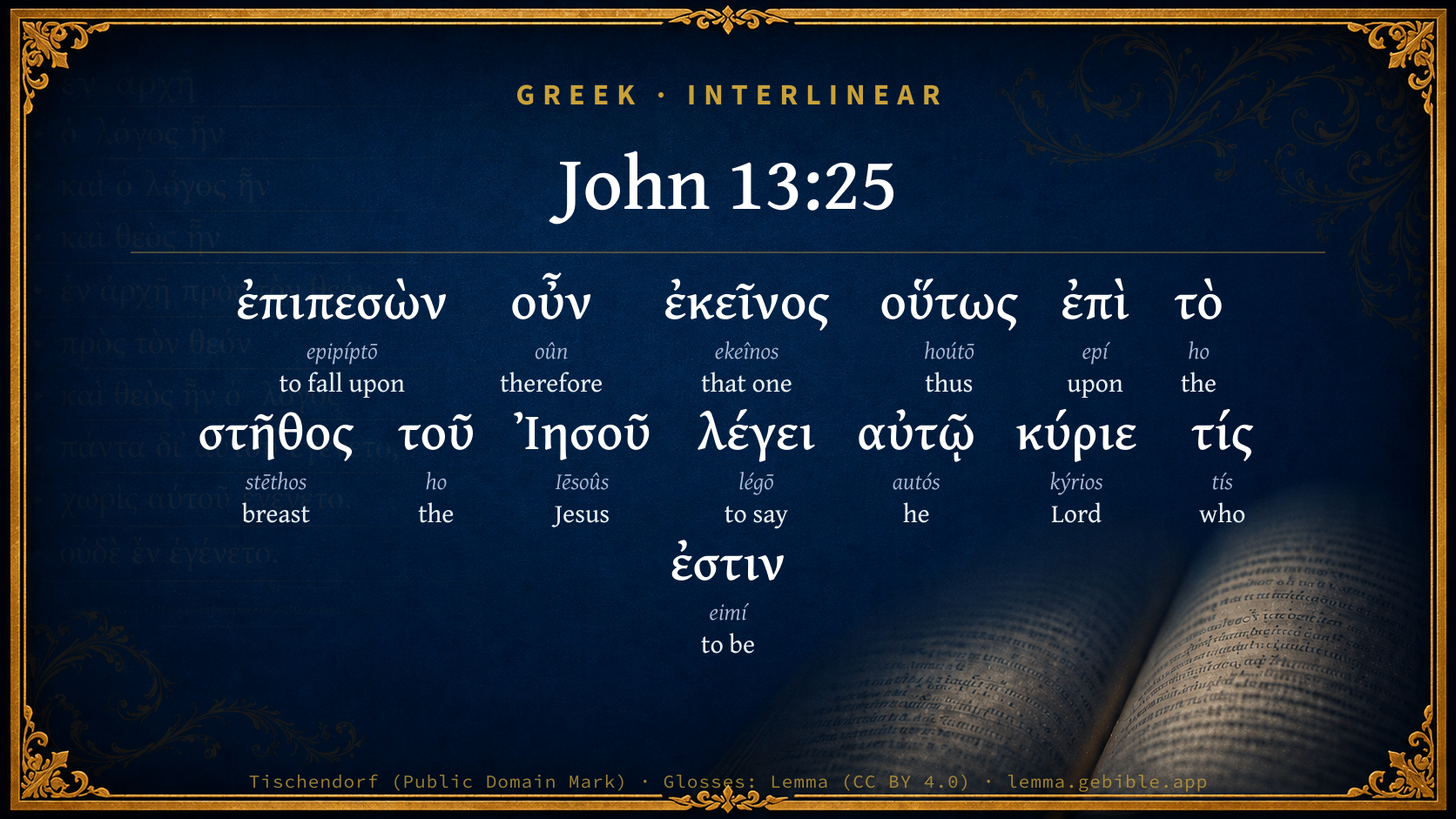
  1. ἐπιπεσὼν epipíptō G1968 “to fall upon” Verb, Aorist, Active, Participle, Nominative, Singular, Masculine
  2. οὖν oûn G3767 “therefore” Conjunction
  3. ἐκεῖνος ekeînos G1565 “that one” Demonstrative pronoun, Nominative, Singular, Masculine
  4. οὕτως hoútō G3779 “thus” Adverb
  5. ἐπὶ epí G1909 “upon” Preposition
  6. τὸ ho G3588 “the” Article, Accusative, Singular, Neuter
  7. τοῦ ho G3588 “the” Article, Genitive, Singular, Masculine
  8. Ἰησοῦ Iēsoûs G2424 “Jesus” Noun, Genitive, Singular, Masculine
  9. λέγει légō G3004 “to say” Verb, Present, Active, Indicative, 3rd person, Singular
  10. αὐτῷ autós G846 “he” Personal pronoun, Dative, Singular, Masculine
  11. κύριε kýrios G2962 “Lord” Noun, Vocative, Singular, Masculine
  12. τίς tís G5101 “who” Interrogative pronoun, Nominative, Singular, Masculine
  13. ἐστιν eimí G1510 “to be” Verb, Present, Active, Indicative, 3rd person, Singular

About this verse

These counts appear in no published source. They are computed here, from the morphology-tagged text and Lemma’s own curated glosses. What Lemma adds →

14
words
13
distinct lemmas
Gospels
section

Notable vocabulary

The rarest word here is στῆθος breast G4738 — appearing just 5 times in the whole Greek New Testament.

Shared distinctive vocabulary

στῆθος breast G4738 occurs in 5 verses of the Greek New Testament. Also found in:

Repetition

A word recurs within this verse:

Cross-references

3

Topical passages linked to John 13:25 in the Treasury of Scripture Knowledge — connected by theme and wording, ordered by reader-vote popularity; previews shown in the World English Bible.

  • John 21:20 Then Peter, turning around, saw a disciple following. This was the disciple whom Jesus sincerely loved, the one who had also leaned on Jesus' breast at the supper and asked, "Lord, who is going to betray You?"
  • Genesis 44:4–12 When they had gone out of the city, and were not yet far off, Joseph said to his steward, "Up, follow after the men. When you overtake them, ask them, 'Why have you rewarded evil for good?
  • Esther 7:5 Then spoke the king Ahasuerus and said to Esther the queen, Who is he, and where is he, that dared presume in his heart to do so?

Cross-references courtesy of OpenBible.info (CC BY 4.0).

Where the printed editions differ

1 variant

Places in this verse where the major printed Greek editions disagree on the wording in a way that affects the translation — a comparison of editions, not a manuscript-by-manuscript collation. The editions are the modern critical texts (Nestlé-Aland 28/27, SBL, Westcott-Hort, Tregelles, Tyndale House) and the traditional texts behind the KJV (the Textus Receptus and the Byzantine/Majority text). It is not a claim about which reading is original.

  1. Extra text
    οὕτως

    “thus”

    In NA28NA27TynSBLWHTregByz Not in TR

    οὕτως (houtōs) 'thus' is only in older manuscripts (NA28+NA27+Tyn+SBL+WH+Treg+Byz)

Textual data: Translators Amalgamated Greek New Testament (STEPBible TAGNT) · CC BY 4.0.

Commentary

Notes on John 13:25 from classic Christian and Jewish commentators (each source and its license shown beneath its notes). The classic Christian expositions comment on the surrounding passage and are grouped to its opening verse, so a note may address several verses; the Jewish commentaries on the Tanakh (Rashi and others) are per-verse, so they appear only where the commentator wrote on this verse.

Lemma curates 59 commentaries, every one of them public domain or Creative Commons licensed, each selected and text-cleaned for this edition rather than reprinted as found. About our sources →

MacLaren's Expositions of Holy Scripture

Alexander MacLaren

Matthew

‘IS IT I?’

Mat 26:22, Mat 26:25. - Joh 13:25.

The genius of many great painters has portrayed the Lord’s Supper, but the reality of it was very different from their imaginings. We have to picture to ourselves some low table, probably a mere tray spread upon the ground, round which our Lord and the twelve reclined, in such a fashion as that the head of each guest came against the bosom of him that reclined above him; the place of honour being at the Lord’s left hand, or higher up the table than Himself, and the second place being at His right, or below Himself.

So there would be no eager gesticulations of disciples starting to their feet when our Lord uttered the sad announcement, ‘One of you shall betray Me!’ but only horror-struck amazement settled down upon the group. These verses, which we have put together, show us three stages in the conversation which followed the sad announcement. The three evangelists give us two of these; John alone omits these two, and only gives us the third.

First, we have their question, born of a glimpse into the possibilities of evil in their hearts, ‘Lord, is it I?’ The form of that question in the original suggests that they expected a negative answer, and might be reproduced in English: ‘Surely it is not I?’ None of them could think that he was the traitor, yet none of them could be sure that he was not. Their Master knew better than they did; and so, from a humble knowledge of what lay in them, coiled and slumbering, but there, they would not meet His words with a contradiction, but with a question. His answer spares the betrayer, and lets the dread work in their consciences for a little longer, for their good. For many hands dipped in the dish together, to moisten their morsels; and to say, ‘He that dippeth with Me in the dish, the same shall betray Me,’ was to say nothing more than ‘One of you at the table.’

Then comes the second stage. Judas, reassured that he has escaped detection for the moment, and perhaps doubting whether the Master had anything more than a vague suspicion of treachery, or knew who was the traitor, shapes his lying lips with loathsome audacity into the same question, but yet not quite the same, The others had said, ‘Is it I, Lord?’ he falters when he comes to that name, and dare not say ‘Lord!’ That sticks in his throat. ‘Rabbi!’ is as far as he can get. ‘Is it I, Rabbi?’ Christ’s answer to him, ‘Thou hast said,’ is another instance of patient longsuffering. It was evidently a whisper that did not reach the ears of any of the others, for he leaves the room without suspicion. Our Lord still tries to save him from himself by showing Judas that his purpose is known, and by still concealing his name.

Then comes the third stage, which we owe to John’s Gospel. Here again he is true to his task of supplementing the narrative of the three synoptic Gospels. Remembering what I have said about the attitude of the disciples at the table, we can understand that Peter, if he occupied the principal place at the Lord’s left, was less favourably situated for speaking to Christ than John, who reclined in the second seat at His right, and so he beckoned over the Master’s head to John. The Revised Version gives the force of the original more vividly than the Authorised does: ‘He, leaning back, as he was, on Jesus’ breast, saith unto Him, Lord! who is it?’ John, with a natural movement, bends back his head on his Master’s breast, so as to ask and be answered, in a whisper. His question is not, ‘Is it I?’ He that leaned on Christ’s bosom, and was compassed about by Christ’s love, did not need to ask that. The question now is, ‘Who is it?’ Not a question of presumption, nor of curiosity, but of affection; and therefore answered: ‘He it is to whom I shall give the sop, when I have dipped it.’

The morsel dipped in the dish and passed by the host’s hand to a guest, was a token of favour, of unity and confidence. It was one more attempt to save Judas, one more token of all-forgiving patience. No wonder that that last sign of friendship embittered his hatred and sharpened his purpose to an unalterable decision, or, as John says: ‘After the sop, Satan entered into him.’ For then, as ever, the heart which is not melted by Christ’s offered love is hardened by it.

Now, if we take these three stages of this conversation we may learn some valuable lessons from them. I take the first form of the question as an example of that wholesome self-distrust which a glimpse into the slumbering possibilities of evil in our hearts ought to give us all. I take the second on the lips of Judas, as an example of the very opposite of that self-distrust, the fixed determination to do a wrong thing, however clearly we know it to be wrong. And I take the last form of the question, as asked by John, as an illustration of the peaceful confidence which comes from the consciousness of Christ’s love, and of communion with Him. Now a word or two about each of these.

I. First, we have an example of that wholesome self-distrust, which a glimpse into the possibilities of evil that lie slumbering in all our hearts ought to teach every one of us.

Every man is a mystery to himself. In every soul there lie, coiled and dormant, like hibernating snakes, evils that a very slight rise in the temperature will wake up into poisonous activity. And let no man say, in foolish self-confidence, that any form of sin which his brother has ever committed is impossible for him. Temperament shields us from much, no doubt. There are sins that ‘we are inclined to,’ and there are sins that ‘we have no mind to.’ But the identity of human nature is deeper than the diversity of temperament, and there are two or three considerations that should abate a man’s confidence that anything which one man has done it is impossible that he should do. Let me enumerate them very briefly. Remember, to begin with, that all sins are at bottom but varying forms of one root. The essence of every evil is selfishness, and when you have that, it is exactly as with cooks who have the ‘stock’ by the fireside. They can make any kind of soup out of it, with the right flavouring. We have got the mother tincture of all wickedness in each of our hearts; and therefore do not let us be so sure that it cannot be manipulated and flavoured into any form of sin. All sin is one at bottom, and this is the definition of it-living to myself instead of living to God. So it may easily pass from one form of evil into another, just as light and heat, motion and electricity, are all-they tell us-various forms and phases of one force. Just as doctors will tell you that there are types of disease which slip from one form of sickness into another, so if we have got the infection about us it is a matter very much of accidental circumstances what shape it takes. And no man with a human heart is safe in pointing to any sin, and saying, ‘That form of transgression I reckon alien to myself.’

And then let me remind you, too, that the same consideration is reinforced by this other fact, that all sin is, if I may so say, gregarious; is apt not only to slip from one form into another, but that any evil is apt to draw another after it. The tangled mass of sin is like one of those great fields of seaweed that you some times come across upon the ocean, all hanging together by a thousand slimy growths; which, if lifted from the wave at any point, drags up yards of it inextricably grown together. No man commits only one kind of transgression. All sins hunt in couples. According to the grim picture of the Old Testament, about another matter, ‘None of them shall want his mate. The wild beasts of the desert shall meet with the wild beasts of the islands.’ One sin opens the door for another, ‘and seven other spirits worse than himself’ come and make holiday in the man’s heart.

Again, any evil is possible to us, seeing that all sin is but yielding to tendencies common to us all. The greatest transgressions have resulted from yielding to such tendencies. Cain killed his brother from jealousy; David besmirched his name and his reign by animal passion; Judas betrayed Christ because he was fond of money. Many a man has murdered another one simply because he had a hot temper. And you have got a temper, and you have got the love of money, and you have got animal passions, and you have got that which may stir you up into jealousy. Your neighbour’s house has caught fire and been blown up. Your house, too, is built of wood, and thatched with straw, and you have as much dynamite in your cellars as he had in his. Do not be too sure that you are safe from the danger of explosion.

And, again, remember that this same wholesome self-distrust is needful for us all, because all transgression is yielding to temptations that assail all men. Here are one hundred men in a plague-stricken city; they have all got to draw their water from the same well. If five or six of them died of cholera it would be very foolish of the other ninety-five to say, ‘There is no chance of our being touched.’ We all live in the same atmosphere; and the temptations that have overcome the men that have headed the count of crimes appeal to you. So the lesson is, ‘Be not high-minded, but fear.’

And remember, still further, that the same solemn consideration is enforced upon us by the thought that men will gradually drop down to the level which, before they began the descent, seemed to be impossible to them. ‘Is thy servant a dog that he should do this thing?’ said Hazael when the crime of murdering his master first floated before him. Yes, but he did it. By degrees he came down to the level to which he thought that he would never sink. First the imagination is inflamed, then the wish begins to draw the soul to the sin, then conscience pulls it back, then the fatal decision is made, and the deed is done. Sometimes all the stages are hurried quickly through, and a man spins downhill as cheerily and fast as a diligence down the Alps. Sometimes, as the coast of a country may sink an inch in a century until long miles of the flat seabeach are under water, and towers and cities are buried beneath the barren waves, so our lives may be gradually lowered, with a motion imperceptible but most real, bringing us down within high-water mark, and at last the tide may wash over what was solid land.

So, dear friends, there is nothing more foolish than for any man to stand, self-confident that any form of evil that has conquered his brother has no temptation for him. It may not have for you, under present circumstances; it may not have for you to-day; but, oh! we have all of us one human heart, and ‘he that trusteth in his own heart is a fool.’ ‘Blessed is the man that feareth always.’ Humble self-distrust, consciousness of sleeping sin in my heart that may very quickly be stirred into stinging and striking; rigid self-control over all these possibilities of evil, are duties dictated by the plainest common-sense.

Do not say, ‘I know when to stop.’ Do not say, ‘I can go so far; it will not do me any harm.’ Many a man has said that, and many a man has been ruined by it. Do not say, ‘It is natural to me to have these inclinations and tastes, and there can be no harm in yielding to them.’ It is perfectly natural for a man to stoop down over the edge of a precipice to gather the flowers that are growing in some cranny in the cliff; and it is as natural for him to topple over, and be smashed to a mummy at the bottom. God gave you your dispositions and your whole nature ‘under lock and key,’-keep them so. And when you hear of, or see, great criminals and great crimes, say to yourself, as the good old Puritan divine said, looking at a man going to the scaffold, ‘But for the grace of God there go I!’ And in the contemplation of sins and apostasies, let us each look humbly at our own weakness, and pray Him to keep us from our brother’s evils which may easily become ours.

II. Secondly, we have here an example of precisely the opposite sort, namely, of that fixed determination to do evil which is unshaken by the clearest knowledge that it is evil.

Judas heard his crime described in its own ugly reality. He heard his fate proclaimed by lips of absolute love and truth; and notwithstanding both, he comes unmoved and unshaken with his question. The dogged determination in his heart, that dares to see his evil stripped naked and is ‘not ashamed,’ is even more dreadful than the hypocrisy and sleek simulation of friendship in his face.

Now most men turn away with horror from even the sins that they are willing to do, when they are put plainly and bluntly before them. As an old mediaeval preacher once said, ‘There is nothing that is weaker than the devil stripped naked.’ By which he meant exactly this-that we have to dress wrong in some fantastic costume or other, so as to hide its native ugliness, in order to tempt men to do it. So we have two sets of names for wrong things, one of which we apply to our brethren’s sins, and the other to the same sins in ourselves. What I do is ‘prudence,’ what you do of the same sort is ‘covetousness’; what I do is ‘sowing my wild oats,’ what you do is ‘immorality’ and ‘dissipation’; what I do is ‘generous living,’ what you do is ‘drunkenness’ and ‘gluttony’; what I do is ‘righteous indignation,’ what you do is ‘passionate anger.’ And so you may go the whole round of evil. Very bad are the men who can look at their deed, described in Its own inherent deformity, and yet say, ‘Yes; that is it, and I am going to do it.’ ‘One of you shall betray Me.’ ‘Yes; I will betray you!’ It must have taken something to look into the Master’s face, and keep the fixed purpose steady.

Now I ask you to think, dear friends, of this, that that obstinate condition of dogged determination to do a wrong thing, knowing it to be a wrong thing, is a condition to which all evil steadily tends. We may not come to it in this world-I do not know that men ever do so wholly; but we are all getting towards it in regard to the special wrong deeds and desires which we cherish and commit. And when a man has once reached the point of saying to evil, ‘Be thou my good,’ then he is a ‘devil’ in the true meaning of the word; and wherever he is, he is in hell! And the one unpardonable sin is the sin of clear recognition that a given thing is contrary to God’s will, and unfaltering determination, notwithstanding, to do it. That is the only sin that cannot be pardoned, ‘either in this world or in the world to come.’

And so, my brother, seeing that such a condition is possible, and that all the paths of evil, however tentative and timorous they may be at first, and however much the sin may be wrapped up with excuses and forms and masks, tend to that condition, let us take that old prayer upon our lips, which befits both those who distrust themselves because of slumbering sins, and those who dread being conquered by manifest iniquity:-’Who can understand his errors? Cleanse Thou me from secret faults. Keep back Thy servant also from presumptuous sins. Let them not have dominion over me.’

III. Now, lastly, we have in the last question an example of the peaceful confidence that comes from communion with Jesus Christ.

John leaned on the Master’s bosom. ‘He was the disciple whom Jesus loved.’ And so compassed with that great love, and feeling absolute security within the enclosure of that strong hand, his question is not, ‘Is it I?’ but ‘Who is it?’ From which I think we may fairly draw the conclusion that to feel that Christ loves me, and that I am compassed about by Him, is the true security against my falling into any sin.

It was not John’s love to Christ, but Christ’s to John that made his safety. He did not say: ‘I love Thee so much that I cannot betray Thee.’ For all our feelings and emotions are but variable, and to build confidence upon them is to build a heavy building upon quicksand; the very weight of it drives out the foundations. But he thought to himself-or he felt rather than he thought-that all about him lay the sweet, warm, rich atmosphere of his Master’s love; and to a man who was encompassed by that, treachery was impossible.

Sin has no temptation so long as we actually enjoy the greater sweetness of Christ’s felt love. Would thirty pieces of silver have been a bribe to John? Would anything that could have terrified others have frightened him from his Master’s side whilst he felt His love? Will a handful of imitation jewellery, made out of coloured glass and paste, be any temptation to a man who bears a rich diamond on his finger? And will any of earth’s sweetness be a temptation to a man who lives in the continual consciousness of the great rich love of Christ wrapping him round about? Brethren, not ourselves, not our faith, not our emotion, not our religious experience; nothing that is in us, is any security that we may not be tempted, and yield to the temptation, and deny or betray our Lord. There is only one thing that is a security, and that is that we be folded to the heart, and held by the hand, of that loving Lord. Then-then we may be confident that we shall not fall; for ‘the Lord is able to make us stand.’

Such confidence is but the other side of our self-distrust; is the constant accompaniment of it, must have that self-distrust for its condition and prerequisite, and leads to a yet deeper and more blessed form of that self-distrust. Faith in Him and ‘no confidence in the flesh’ are but the two sides of the same coin, the obverse and the reverse. The seed, planted in the ground, sends a little rootlet down, and a little spikelet up, by the same vital act. And so in our hearts, as it were, the downward rootlet is self-despair, and the upward shoot is faith in Christ. The two emotions go together-the more we distrust ourselves the more we shall rest upon Him, and the more we rest upon Him, and feel that all our strength comes, not from our foot, but from the Rock on which it stands, the more we shall distrust our own ability and our own faithfulness.

Therefore, dear brethren, looking upon all the evil that is around us, and conscious in some measure of the weakness of our own hearts, let us do as a man would do who stands upon the narrow ledge of a cliff, and look sheer down into the depth below, and feels his head begin to reel and turn giddy; let us lay hold of the Guide’s hand, and if we cleave by Him, He will hold up our goings that our footsteps slip not. Nothing else will. No length of obedient service is any guarantee against treachery and rebellion. As John Bunyan saw, there was a backdoor to hell from the gate of the Celestial City. Men have lived for years consistent professing Christians, and have fallen at last. Many a ship has come across half the world, and gone to pieces on the harbour bar. Many an army, victorious in a hundred fights, has been annihilated at last. No depths of religious experience, no heights of religious blessedness, no attainments of past virtue and self-sacrifice, are any guarantees for to-morrow. Trust in nothing and in nobody, least of all in yourselves and your own past. Trust only in Jesus Christ.

‘Now unto Him that is able to keep us from falling, and to present us faultless before the presence of His glory with exceeding joy; to the only wise God our Saviour be glory and majesty, dominion and power, both now and for ever.’ Amen.

Alexander MacLaren, Expositions of Holy Scripture (1904–1910) — public domain. Text from a community e-Sword module.

Tyndale Open Study Notes

Tyndale Open Resources

13:25 Peter told “the disciple Jesus loved” (13:23), who was sitting next to Jesus, to ask the betrayer’s identity. As he reclined next to Jesus, he leaned over to Jesus and spoke privately.

Tyndale Open Study Notes — © Tyndale Open Resources, licensed CC BY-SA 4.0. Text via the HelloAO Bible API.

Bengel's Gnomon

Johann Albrecht Bengel

Joh 13:25. Ἐπιπεσών, throwing himself back [not as Engl. Vers. lying on]) This was a new [unprecedented] instance of freedom, such as neither he nor any other disciple used on any other occasion [therefore it is specially referred to, as something extraordinary in]: ch. Joh 21:20. John was lying in the bosom of the Lord: from that position he leaned back with loving familiarity to the breast of Jesus, by that very act hiding his purpose of asking the question: he then asked the question privately. Comp. Joh 13:28, “Now no man at the table knew with what intent Jesus spake this unto Judas.”—ἐκεῖνος) Many copies formerly added οὕτως. It is a good gloss [interpolated explanatory note]; comp. ch. Joh 4:6, note.[334]

[334] Jesus at the well, ἐκαθέζετο οὕτως. BCLXΔ add the οὕτως here, ch. Joh 13:25. But ADabc Vulg. Orig. 4,437c, support Beng. and Rec. Text in omitting it.—E. and T.

Bengel's Gnomon of the New Testament — English translation (T&T Clark, Edinburgh, 1860) — public domain. Text from a community e-Sword module.

Meyer's Critical & Exegetical Commentary

Heinrich August Wilhelm Meyer

Joh_13:25-26. Graphic representation. Raising himself from the κόλπος of Jesus to His breast, nearer to His ear, he draws close to Him, and asks (in a whisper).

ἐγώ] I, for my part.

τὸ ψωμ.] which he meanwhile took into His hand.

ἐπιδώσω] shall give away. The morsel is to be thought of as a piece of bread or meat, which Jesus dips into a broth on the table (not into the Charoseth, see on Mat_26:23, since the meal, according to John, was not the paschal meal).

The closing words of Joh_13:26 contain something of tragic solemnity.[131] By the designation of the traitor, it was not the curiosity of John, but his own love, which Jesus satisfied, and this by means of a token not of apparent, but of real and sorrowful goodwill towards Judas, in whom even now conscience might have been awakened and touched, by means of a token at the same time, such as most naturally suggested itself at table to the Lord as the head of the family, expressive of forbearance towards the traitor. This in answer to Weisse, who psychologically mishandles the entire representation as a fiction derived from Joh_13:18, and finds the true occurrence only in Mark, whilst Strauss gives the relative preference to Luke (Luk_22:21).

[131] To this belongs also the circumstantial λαμβάνει καί after ψωμ. (see critical notes). Jesus has put the morsel in the broth (βάψας), and then takes it, etc.

Meyer — Critical and Exegetical Commentary on the New Testament — English translation by Peter Christie, edited by Frederick Crombie (T&T Clark, 1880) — public domain. Text from a community e-Sword module.

Expositor's Greek Testament

ed. W. Robertson Nicoll

Joh 13:25 . That disciple, ἐκεῖνος , when thus appealed to, ἀναπεσὼν ἐπὶ τὸ στῆθος τοῦ Ἰησοῦ , “having leant back towards the breast of Jesus” so as to speak more directly to Him and to be heard only by Him. On the difference between ἀνακείμενος and ἀναπεσών see Origen in Evang. Jo. , ii. 191, Brooke.

The Expositor's Greek Testament, edited by W. Robertson Nicoll (1897–1910) — public domain. Text from a community e-Sword module.

Jamieson, Fausset & Brown

Robert Jamieson, A. R. Fausset & David Brown

He then lying--rather leaning over on Jesus' bosom.

saith--in a whisper, "Lord, who is it?"

Jamieson, Fausset & Brown — Commentary Critical and Explanatory on the Whole Bible (1871) — public domain (CC PDM 1.0). Text via the HelloAO Bible API.

Adam Clarke's Commentary

Verse 25. He then lying on Jesus' breast] επιπεσων, laying his head against the breast of Christ, in a loving, respectful manner. As the expressions in the text are different here from those in the preceding verse, it shows that John altered his position at table, in order to ask the question which Peter suggested, which he probably did by whispering to our Lord; for, from Joh 13:28, we may learn that the other disciples had not heard what John said; and it is likely that the following words - It is he to whom I shall give the morsel when I have dipped it, were whispered back by Christ to John.

Adam Clarke's Commentary on the Bible (1810–1826) — public domain. Text from a community e-Sword/MySword module.

Ellicott's Commentary for English Readers

(25) He then lying on Jesus’ breast.—Several good authorities, including the Vatican and the Cambridge MSS., insert the word “thus.” “He then leaning thus . . . ,” describes the action just as it took place (comp. Note on Joh_4:6); but the balance of authority is against the insertion. The action is, however, exactly described in the original, for the words “lying” and “breast” are both different from those in Joh_13:23. The English preserves this difference, but hardly conveys the full meaning. There the beloved disciple is described as reclining towards his Master’s bosom. Here he leans upon (or leans back upon, as many good authorities read), the Master’s breast, and asks Him the question, “Who is it?”

A Bible Commentary for English Readers, edited by Charles John Ellicott (1878–1897) — public domain. Text from a community e-Sword module.

The Cambridge Bible for Schools and Colleges

gen. ed. J. J. S. Perowne

25. lying on Jesus’ breast] Our version does well in using different words from those used in Joh_13:23, but the distinction used is inadequate. Moreover the same preposition, ‘on,’ is used in both cases; in the Greek the prepositions differ also. In Joh_13:23 we have the permanent posture; here a change, the same verb being used as in Joh_13:12 (see note). The meaning is leaning back on to Jesus’ breast. Comp Joh_21:20, where our translators give a similarly inadequate rendering. “This is among the most striking of those vivid descriptive traits which distinguish the narrative of the Fourth Gospel generally, and which are especially remarkable in these last scenes of Jesus’ life, where the beloved disciple was himself an eye-witness and an actor. It is therefore to be regretted that these fine touches of the picture should be blurred in our English Bibles.” Lightfoot, On Revision, p. 73.

Some good MSS. insert ‘thus’ before ‘on to Jesus’ breast’ (comp. Joh_4:6).

The Cambridge Bible for Schools and Colleges (gen. ed. J. J. S. Perowne; Cambridge University Press, 1878–1918) — public domain. Text from a community e-Sword module.

John Gill's Exposition

He then lying on Jesus' breast,.... Being on the couch just before Jesus, with his back to him, he bends backwards, and falling on Jesus' breast, whispers in his ear:

and saith unto him, Lord, who is it? using his interest in Christ, and making thus free with him, in compliance with Peter's request; and was no doubt desirous himself of knowing who the person was.

John Gill's Exposition of the Whole Bible (1746–1763) — public domain (CC PDM 1.0). Text via the HelloAO Bible API.

Trapp's Complete Commentary

John Trapp

25 He then lying on Jesus’ breast saith unto him, Lord, who is it?

Ver. 25. He then lying on Jesus’ breast] Ad pectus allapsus, as laying his ear to our Saviour’s mouth, that he might whisper him who it was; {a} for things were as yet secretly carried, and the traitor not discovered, save to John only, who knew Christ’s soul secrets, and afterward received his revelation.

{a} In accubitu mos ille ut accumberent uxores in sinu virorum. Lips. ad Tacit. xi.

John Trapp, A Commentary or Exposition upon All the Books of the Old and New Testament (1647–1656) — public domain. Text from a community e-Sword module.

Albert Barnes' Notes on the Bible

He then lying on Jesus’ breast - This is a different word from the one rendered Joh 13:23 leaning. It means falling back or reclining on the bosom of Jesus. When Peter spake, John laid his head back on the bosom of Jesus, so that he could speak to him privately without being heard by others.

Albert Barnes' Notes on the Bible (1834–1885) — public domain. Text from a community e-Sword/MySword module.

Haydock's Catholic Bible Commentary

When Christ had said, one of you is to betray me, St. Peter whispered with St. John, by turning to him behind Jesus’s back, and desired him to ask, who this was: now when John had leaned down upon the breast of Jesus, or as the Greek hath it, falling down on the breast of Jesus, as a person may do in a great concern, or fit of grief, he said, Lord, who is it? This posture seems to have been only for that moment of whispering, and to have been different from the posture of eating at table. (Witham)

George Leo Haydock (1774–1849), Haydock's Catholic Family Bible and Commentary, 1859 edition — public domain. Excludes Psalms (Douay-Rheims chapter numbering differs from Protestant) and Deuterocanonical books (Catholic canon only).

Matthew Poole's English Annotations

John accordingly, doth propound the question to Christ.

Matthew Poole's English Annotations on the Holy Bible (1683–1685) — public domain. Text from a community e-Sword/MySword module.

The Pulpit Commentary

He, leaning back as he was against the breast of Jesus, saith unto him, Lord, who is it? Meyer explains, "He, raising himself from the kolpov of Jesus to his breast, nearer to his ear, draws close to him, and asks in a whisper." This turns on the special rendering given by Meyer and others to kolpov , as meaning the fold of the garment above the girdle, as in Luk_6:38; but the fundamental meaning of kolpov is bosom, womb, embrace, and this secondary meaning need not be pressed. (Joh_1:18 Luk_16:22, Luk_16:23)

The Pulpit Commentary (1880–1919), ed. H.D.M. Spence-Jones & Joseph S. Exell — public domain. Text from a community e-Sword module.

John Wesley's Explanatory Notes

Leaning down, and so asking him privately.

John Wesley, Explanatory Notes Upon the Whole Bible (1754–1765) — public domain. Text via the GEBible commentary corpus.

Cambridge Greek Testament for Schools and Colleges

25. ἀναπεσών for ἐπιπεσών (from Luk 15:20?).

25. ἀναπεσὼν … ἐπὶ τὸ στῆθος. In Joh 13:23 we have the permanent posture, here a change, as in Joh 13:12: he leaning back on to Jesus’ breast. For ἐκεῖνος see on Joh 1:8; for οὕτως, as he was, comp. Joh 4:6. “This is among the most striking of those vivid descriptive traits which distinguish the narrative of the Fourth Gospel generally, and which are especially remarkable in these last scenes of Jesus’ life, where the beloved disciple was himself an eye-witness and an actor. It is therefore to be regretted that these fine touches of the picture should be blurred in our English Bibles.” Lightfoot, On Revision, p. 73.

Cambridge Greek Testament for Schools and Colleges (Cambridge University Press, 1896; 21 vols, various authors incl. Carr, Maclear, Plummer, Farrar, Lumby, Moule, M. R. James, Simcox) — public domain. Text from a community e-Sword module.

Alford’s Greek Testament

Henry Alford

25.] ἀναπεσών, leaning back on the bosom of Jesus.

οὕτως, as in ref. I understand it, that John, who was before lying close to the bosom (ἐν τῷ κόλπῳ) of Jesus, now leaned his head absolutely upon His breast, to ask the question. This escaped the notice of the rest at the table: see on Matt. as above.

Henry Alford, The Greek Testament (1849–1861) — public domain. Text from a community e-Sword module.

International Critical Commentary

25. ἀναπεσών. So אcBC*L, as at 21:20; the rec. ἐπιπεσών, following א*AC3DWΓΔΘ, suggests too violent a change of posture for the occasion. The rec. inserts δέ after ἐπιπεσών, with AΘ, but it is om. by BC; אDLW have οὖν.

ἀναπεσὼν ἐκεῖνος οὕτως ἐπὶ τὸ στῆθος τοῦ Ἰη.,3 “he (i.e. John) leaning back just as he was (cf. 4:6 for οὓτως) on the breast of Jesus,” i.e. leaning back, keeping the same attitude that has been described in v. 23. For the frequent use of ἐκεῖνος by Jn., see on 1:8.

οὕτως is omitted by the rec., with אADWΘ; but BCLΔ have it, and it gives an intimate touch to the narrative here.

λέγει αὐτῷ, “saith to Him,” viz. in a whisper so that the others could not hear, which his position on the right of Jesus would enable him to do.

τίς ἐστιν; “Who is it?” But Jesus does not give the name of the traitor in reply. He answers in a way that even John does not seem to have been able to interpret (see on vv. 21, 28).

International Critical Commentary — older volumes (1896–1929), various authors — public domain. Text from a community e-Sword module.

Vincent's Word Studies in the New Testament

Marvin R. Vincent

Lying [επιπεσων] . This word is, literally, to fall upon, and is so rendered in almost every instance in the New Testament. In Mr 3:10, it is applied to the multitudes pressing upon Christ. It occurs, however, nowhere else in John, and therefore some of the best authorities read ajnapeswn, leaning back, a verb which John uses several times in the Gospel, as in ver. 12. 44 So Rev. Whichever of the two is read, it points out the distinction, which the A. V. misses by the translation lying, between hn ajnakeimenov (ver. 23), which describes the reclining position of John throughout the meal, and the sudden change of posture pictured by ajnapeswn, leaning back. The distinction is enforced by the different preposition in each case : reclining in [εν] Jesus ' bosom, and leaning back [ανα] . Again, the words bosom and breast represent different words in the Greek; kolpov representing more generally the bend formed by the front part of the reclining person, the lap, and sthqov the breast proper. The verb ajnapiptw, to lean back, always in the New Testament describes a change of position. It is used of a rower bending back for a fresh stroke. Plato, in the well - known passage of the "Phaedrus," in which the soul is described under the figure of two horses and a charioteer, says that when the charioteer beholds the vision of love he is afraid, and falls backward [ανεπεσεν] , so that he brings the steeds upon their haunches.

As he was [ουτως] . Inserted by the best texts, and not found in the A. V. Reclining as he was, he leaned back. The general attitude of reclining was maintained. Compare Joh 4:6 : "sat thus [ουτως] on the well." According to the original institution, the Passover was to be eaten standing (Exo 12:11). After the Captivity the custom was changed, and the guests reclined. The Rabbis insisted that at least a part of the Paschal meal should be eaten in that position, because it was the manner of slaves to eat standing, and the recumbent position showed that they had been delivered from bondage into freedom.

Breast [στηθος] . From isthmi, to cause to stand. Hence, that which stands out. In later writings John was known as oJ ejpisthqiov, the one on the breast, or the bosom friend.

Marvin R. Vincent, Word Studies in the New Testament (1887–1900) — public domain. Text from a community e-Sword/MySword module.

Godet's Commentaries

Frédéric Louis Godet

Vv. 25-27a. “He therefore leaning back on Jesus’ breast, says to him, Lord, who is it? 26. Jesus answers him: He it is to whom I shall give a piece of bread when it is dipped.And having dipped the piece, he gave it to Judas Iscariot, son of Simon. 27a. And, after he had taken the piece, then Satan entered into him.”

The received reading ἐπιπεσών (which is found in the Sinaitic, and Alexandrian MSS., etc.), leaning, strictly throwing himself, indicates a sudden movement, in harmony with the liveliness of the feeling which produces it. It is perfectly suitable, provided we do not add οὕτως, thus, as Tischendorf and Meyer do, which is wholly without meaning. The οὕτως can only be maintained with the reading ἀναπεσών : “seated at table as he was;” it would be an allusion to Joh 13:23 :on the breast of Jesus, so Baumlein.

But the reading ἀναπεσών may easily have arisen from Joh 21:20 and the adverbοὕτως may have been added to complete this participle, which could only be a repetition of Joh 13:23. In the course of the Paschal meal, the father of the family offered to the guests pieces of bread or meat which he dipped in a broth composed of fruits boiled in wine; these fruits represented the blessings of the Promised Land. And even outside of this special meal it is customary in the East, it seems, for the host to offer the guest whom he wishes to honor a piece of meat (see Westcott). Jesus, connecting Himself with this custom, answers John in this form which was naturally intelligible only to him. As a sign of communion, it was a last appeal to the conscience of Judas. If, in receiving it, his heart had broken, He could still have obtained pardon. This moment was therefore decisive; and it is this that John makes manifest by the τότε, then (Joh 13:27), a word of tragic weight.

The Alexandrian reading adds, after the words: “having dipped the morsel,” the following: he takes it and, which could only mean: “he takes itfrom the dish;” a very idle meaning. “Until this time,” says Hengstenberg, “Judas had stifled in himself, in the interest of his passion, the conviction of the divinity of Jesus. Now the ray of divine omniscience which had, in the preceding warnings (Joh 13:10; Joh 13:18) only grazed the surface, penetrates him. Jesus says to him plainly by this sign and by the words which accompany it (Mat 26:25, “Thou hast said”): Thou art the one who eats my bread and yet betrays me! But He also gives him to understand that he is still of the number of His own. He might therefore return backward. But he would not; and the violent effort which he was obliged to make in order to close his heart against the heavenly powers opened its doors to the diabolical powers. It is even from these last that he must seek the strength to accomplish this final act of resistance. As it is said of David: “He strengthened himself in God, so Judas strengthened himself in Satan.” The dwelling of Satan in a soul has its degrees, as well as that of the Holy Spirit.

Luke (Luk 22:3) has united the phases which John distinguishes (comp. Joh 13:2). The present moment is that in which the will of Judas was finally confiscated by the power to which he had gradually surrendered himself. Until then he had acted freely and as if by way of experiment; he had played with the enemy. From this moment it will be impossible for him to draw back; it will be the enemy who will play with him. It has been asserted that John ascribes this result to a magical action of the morsel of bread, and that there was here, according to him, a miracle by means of which Jesus “demonized the soul of the disciple.” If John had wished to express such an idea he would have written, not μετὰ τὸ ψωμίον, after the morsel, but μετὰ τοῦ ψωμίου, with the morsel. It is also asked: Who then saw Satan enter into Judas? Perhaps, John himself, we will answer. The terrible conflict which was carried on within him at this moment could not remain unnoticed by the eyes of him who anxiously observed the traitor, and something infernal in the expression of his features bore testimony of the decisive victory which the devil had just gained in his heart. Weiss and Keil are willing to admit here only a pure “psychological assurance.” But such an assurance has as its basis either some perception or a revelation. Would these interpreters then adopt this second alternative? Keim has judged the conduct of Jesus at this moment with severity, in case John has exactly described it; it would even, up to a certain point, excuse Judas. But Jesus carefully spared the traitor, in making him known to no one but John only.

Frédéric Louis Godet — Commentaries on Luke, John, Romans, and 1 Corinthians — English translation (T&T Clark, Edinburgh, 1870s–1890s) — public domain. Text from a community e-Sword module.

Lesson kit

Teaching starters — assembled from the data on this page, not authored interpretation. Every prompt links to the verse data it draws on. Edit before teaching.

John, in the Gospels, opens this verse with 14 words (13 distinct Greek lemmas). Its most distinctive word is stēthos (“breast”). A historical commentator’s framing appears above. Read the whole chapter for the surrounding context.

Discussion questions

  1. How does “breast” (stēthos) shape what this verse is saying?
  2. Luke 18:13 shares the word «breast» with this verse. How do the two illuminate each other?
  3. “the” occurs 2× in this one verse. What is the effect of the repetition?
  4. These translations render this verse differently; the difference is in the English rendering, not the original. What questions does that raise?
  5. Reading how MacLaren's Expositions of Holy Scripture and Tyndale Open Study Notes read this verse, where do the two commentators agree and where do they part?

Things to notice

Reading settings

Reading text

Shown beneath each verse's original-language words.

Old Testament
Old Testament edition

Read the OT as the Masoretic Hebrew (MT) or the Greek Septuagint (LXX).

English shown for the Greek Septuagint (in the Hebrew ↔ Greek comparison).

Comparing translations? Open the Compare panel on any verse page to stack up to four side by side.