
Luke 21:34

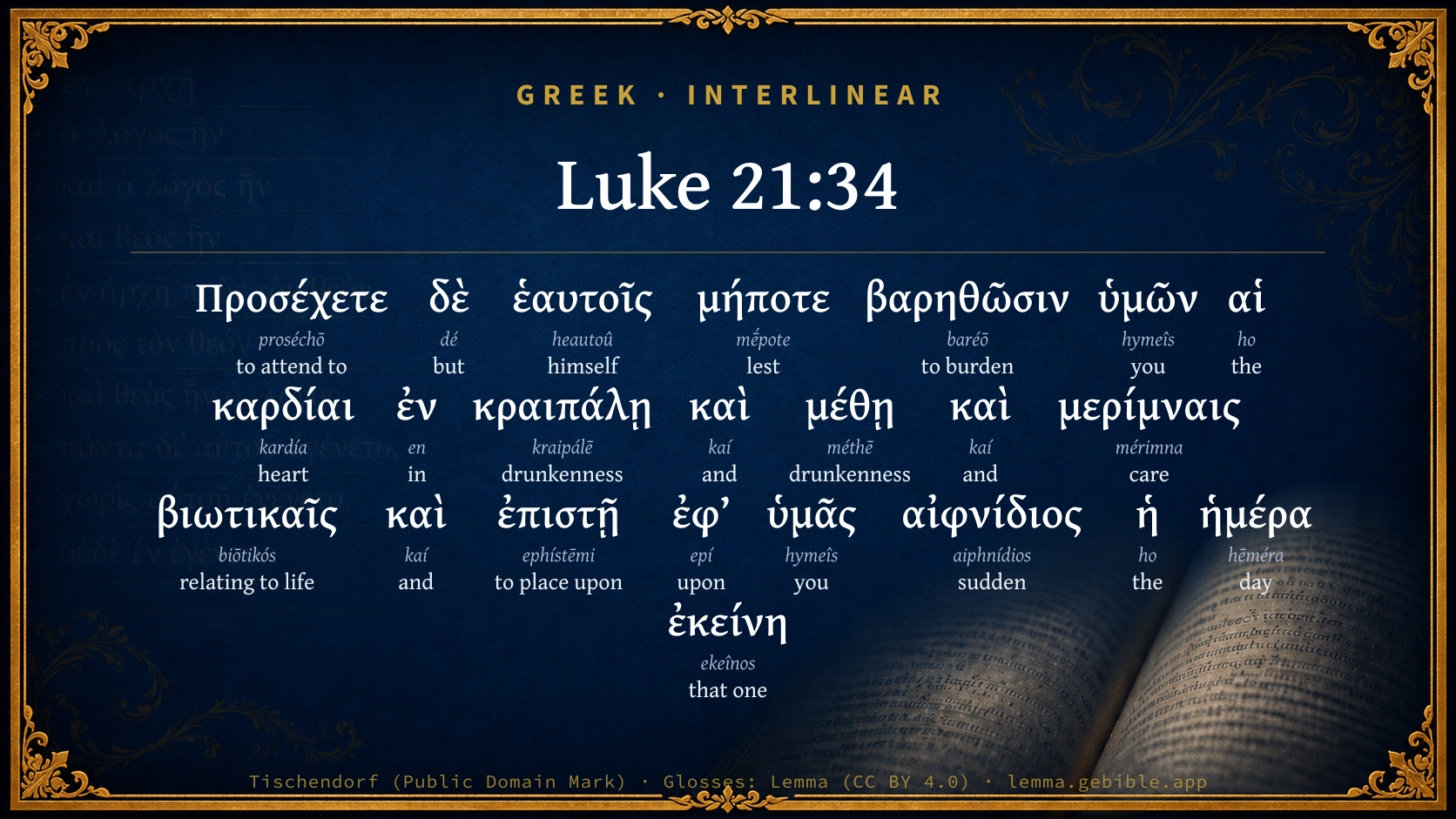
Greek (Tischendorf 8th ed.) Luke 21:34 appears in the Greek New Testament. The text above is from the Tischendorf 8th edition. Each word links to its Strong’s number and a concise gloss. Click any word for its full Thayer’s Greek Lexicon entry.
Download image
Cite this verse

Luke 21:34 (World English Bible). Public Domain. Lemma interlinear Bible study tool, https://lemma.gebible.app/v/luke/21/34.

Show BibTeX & RIS
BibTeX
RIS
English Translation
"So be careful, or your hearts will be loaded down with carousing, drunkenness, and cares of this life, and that day will come on you suddenly.
World English Bible · Public Domain
Highlights
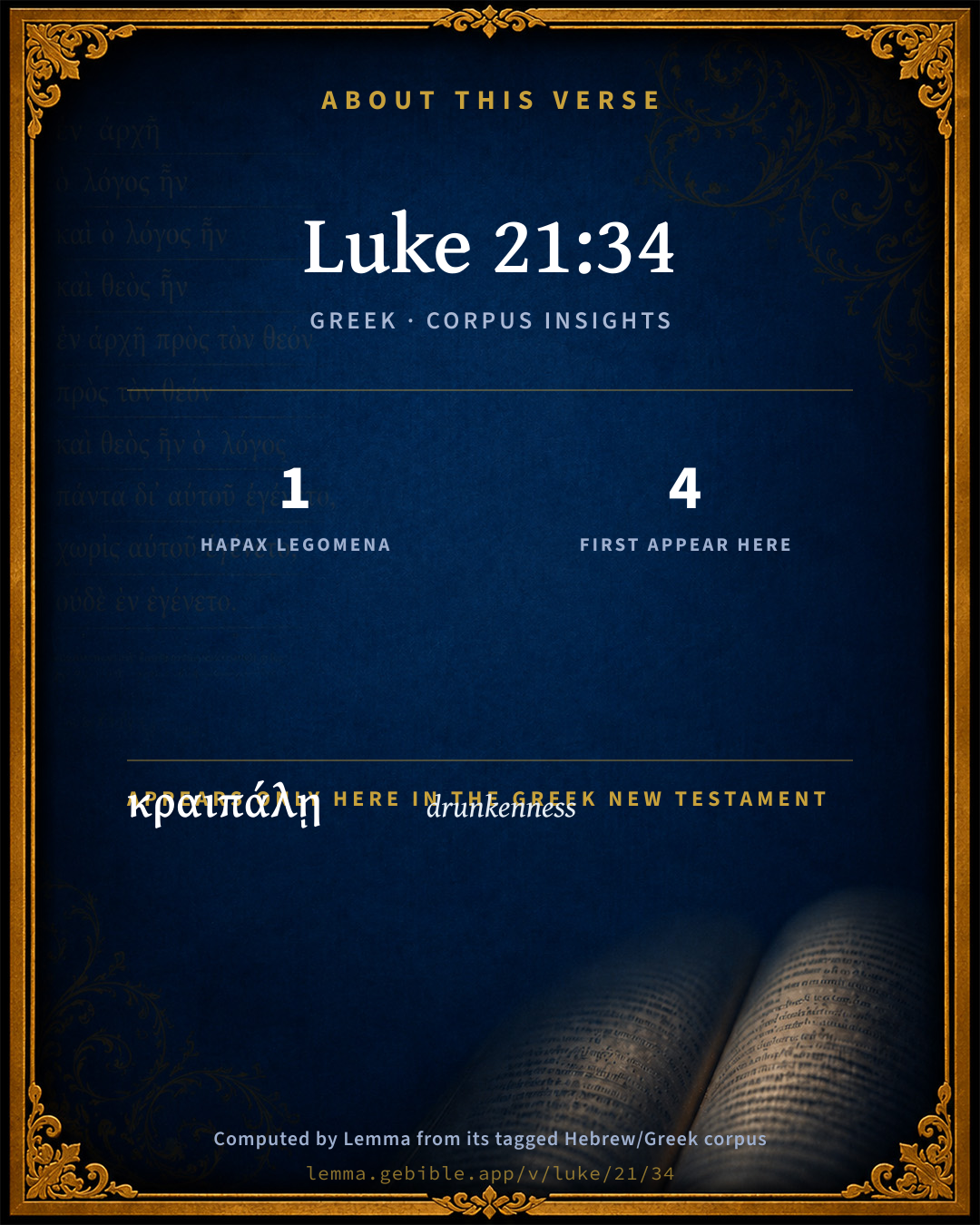
  • 1 hapax legomenon — only here in the Greek New Testament
  • 4 first appearances in the Greek New Testament
Full analysis ↓
Download a study sheet

One document with this verse’s original text, its word-by-word gloss line, the meaning frame, cross-references with their text, attributed commentary, and full source and license credits — printable, and it pastes into notes with its structure intact.

This verse Autodidact and up

Study sheet (.html) Plain text (.txt)

A passage Seminary Student

Up to 50 verses in one chapter. A passage sheet keeps up to 6 commentary sources and 12 cross-references per verse, in the order this page ranks them, and says so on the sheet whenever that leaves anything out. Ask for a single verse and you get the Autodidact verse sheet above.

Everything on this page stays free to read, with no account — the sheet is a download of what is already on screen, not access to it.

Want to remove ads? Support Godless Engineer
Compare translations 3

The same verse in 3 English versions, stacked beneath the original-language interlinear above. Click any original word for its lexicon entry.

Each is an independent rendering of the whole verse — the interlinear is not word-aligned to these translations.

Highlighted words mark where these versions differ — a whole-verse word diff, not a word-by-word alignment.

  • World English Bible Public Domain
    "So be careful, or your hearts will be loaded down with carousing, drunkenness, and cares of this life, and that day will come on you suddenly.
  • King James Version Public Domain
    And take heed to yourselves, lest at any time your hearts be overcharged with surfeiting, and drunkenness, and cares of this life, and so that day come upon you unawares.
  • unfoldingWord Literal Text CC BY-SA 4.0
    But pay attention to yourselves, so that your hearts may not be burdened with hangover and drunkenness, and everyday worries, and that sudden day may come upon you

unfoldingWord Literal Text — © unfoldingWord, licensed CC BY-SA 4.0. Word-aligned USFM3 via Door43 (git.door43.org/unfoldingWord/en_ult).

Versions to compare (up to 4)

3 of 4 selected

Show all 19 translations

Every available English version of this verse, each an independent rendering of the whole verse.

  • World English Bible Public Domain
    "So be careful, or your hearts will be loaded down with carousing, drunkenness, and cares of this life, and that day will come on you suddenly.
  • Berean Standard Bible Public Domain
    But watch yourselves, or your hearts will be weighed down by dissipation, drunkenness, and the worries of life—and that day will spring upon you suddenly like a snare.
  • Majority Standard Bible Public Domain
    But watch yourselves, or your hearts will be weighed down by dissipation, drunkenness, and the worries of life—and that day will spring upon you suddenly like a snare.
  • King James Version Public Domain
    And take heed to yourselves, lest at any time your hearts be overcharged with surfeiting, and drunkenness, and cares of this life, and so that day come upon you unawares.
  • American Standard Version (1901) Public Domain
    But take heed to yourselves, lest haply your hearts be overcharged with surfeiting, and drunkenness, and cares of this life, and that day come on you suddenly as a snare:
  • Revised Version (1885) Public Domain
    But take heed to yourselves, lest haply your hearts be overcharged with surfeiting, and drunkenness, and cares of this life, and that day come on you suddenly as a snare:
  • Geneva Bible (1599) Public Domain
    Take heede to your selues, lest at any time your hearts be oppressed with surfeting and drunkennesse, and cares of this life, and least that day come on you at vnwares.
  • Douay-Rheims (1899) Public Domain
    And take heed to yourselves, lest perhaps your hearts be overcharged with surfeiting and drunkenness, and the cares of this life, and that day come upon you suddenly.
  • Young's Literal Translation Public Domain
    `And take heed to yourselves, lest your hearts may be weighed down with surfeiting, and drunkenness, and anxieties of life, and suddenly that day may come on you,
  • Literal Standard Version CC BY-SA 4.0
    And take heed to yourselves lest your hearts may be weighed down with carousing, and drunkenness, and anxieties of life, and suddenly that day may come on you,
  • Unlocked Literal Bible CC BY-SA 4.0
    But pay attention to yourselves, so that your hearts are not burdened with the effects of drinking and intoxication, and the worries of life, and then that day will close on you suddenly like a trap.
  • unfoldingWord Literal Text CC BY-SA 4.0
    But pay attention to yourselves, so that your hearts may not be burdened with hangover and drunkenness, and everyday worries, and that sudden day may come upon you
  • Darby Bible Public Domain
    But take heed to yourselves lest possibly your hearts be laden with surfeiting and drinking and cares of life, and that day come upon you suddenly unawares;
  • World Messianic Bible Public Domain
    “So be careful, or your hearts will be loaded down with carousing, drunkenness, and cares of this life, and that day will come on you suddenly.
  • Webster's Bible Public Domain
    And take heed to yourselves, lest at any time your hearts be overcharged with surfeiting and drunkenness, and cares of this life, and so that day come upon you unawares.
  • Free Bible Version CC BY-SA 4.0
    Watch out that you don't become distracted by partying or getting drunk or by the worries of this life, so that this day catches you by surprise.
  • Bible in Basic English Public Domain
    But give attention to yourselves, for fear that your hearts become over-full of the pleasures of food and wine, and the cares of this life, and that day may come on you suddenly, and take you as in a net:
  • Text-Critical English NT CC BY 4.0
    “Watch yourselves, lest your hearts be weighed down with carousing, drunkenness, and the cares of this life, and that day come upon you suddenly.
  • Tyndale New Testament (1534) Public Domain
    Take hede to youre selves lest youre hertes be overcome with surfettinge and dronkennes and cares of this worlde: and that that daye come on you vnwares.

Literal Standard Version (2020), Covenant Press — licensed CC BY-SA 4.0. Text via the HelloAO Bible API (eBible.org). Unlocked Literal Bible (unfoldingWord) — licensed CC BY-SA 4.0. Text via the HelloAO Bible API (eBible.org). unfoldingWord Literal Text — © unfoldingWord, licensed CC BY-SA 4.0. Word-aligned USFM3 via Door43 (git.door43.org/unfoldingWord/en_ult). Free Bible Version, Dr. Jonathan Gallagher — licensed CC BY-SA 4.0. Text via the HelloAO Bible API (eBible.org).

Word by word

More ways to search: Search by grammar → Find every occurrence → Compare this word →

Practice this passage: Drill this verse → Learn its vocabulary →

κραιπάλῃ
kraipálē
G2897
“drunkenness”
Noun, Dative, Singular, Feminine
Part of Speech
Noun
Case
Dative
Number
Singular
Gender
Feminine
Full Thayer's Definition

Origin: probably from the same as G726

TDNT: None

1. the giddiness and headache caused by drinking wine to excess
  1. Προσέχετε proséchō G4337 “to attend to” Verb, Present, Active, Imperative, 2nd person, Plural
  2. δὲ dé G1161 “but” Conjunction
  3. ἑαυτοῖς heautoû G1438 “himself” Reflexive pronoun, 2nd person, Dative, Plural, Masculine
  4. μήποτε mḗpote G3379 “lest” Adverb, Negative
  5. βαρηθῶσιν baréō G916 “to burden” Verb, Aorist, Passive, Subjunctive, 3rd person, Plural
  6. ὑμῶν hymeîs G5210 “you” Personal pronoun, 2nd person, Genitive, Plural
  7. αἱ ho G3588 “the” Article, Nominative, Plural, Feminine
  8. καρδίαι kardía G2588 “heart” Noun, Nominative, Plural, Feminine
  9. ἐν en G1722 “in” Preposition
  10. καὶ kaí G2532 “and” Conjunction
  11. μέθῃ méthē G3178 “drunkenness” Noun, Dative, Singular, Feminine
  12. καὶ kaí G2532 “and” Conjunction
  13. μερίμναις mérimna G3308 “care” Noun, Dative, Plural, Feminine
  14. βιωτικαῖς biōtikós G982 “relating to life” Adjective, Dative, Plural, Feminine
  15. καὶ kaí G2532 “and” Conjunction
  16. ἐπιστῇ ephístēmi G2186 “to place upon” Verb, Aorist, Active, Subjunctive, 3rd person, Singular
  17. ἐφ’ epí G1909 “upon” Preposition
  18. ὑμᾶς hymeîs G5210 “you” Personal pronoun, 2nd person, Accusative, Plural
  19. αἰφνίδιος aiphnídios G160 “sudden” Adjective, Nominative, Singular, Feminine
  20. ἡ ho G3588 “the” Article, Nominative, Singular, Feminine
  21. ἡμέρα hēméra G2250 “day” Noun, Nominative, Singular, Feminine
  22. ἐκείνη ekeînos G1565 “that one” Demonstrative pronoun, Nominative, Singular, Feminine

About this verse

These counts appear in no published source. They are computed here, from the morphology-tagged text and Lemma’s own curated glosses. What Lemma adds →

23
words
19
distinct lemmas
Gospels
section

Notable vocabulary

1 hapax legomenon — a word that appears only here in the entire Greek New Testament:

  • κραιπάλῃ drunkenness G2897

First appearance in Scripture

These words make their first canonical appearance in the Greek New Testament here:

  • κραιπάλῃ drunkenness G2897
  • μέθῃ drunkenness G3178
  • βιωτικαῖς relating to life G982
  • αἰφνίδιος sudden G160

Shared distinctive vocabulary

αἰφνίδιος sudden G160 occurs in 2 verses of the Greek New Testament. Also found in:
Repetition

Words recur within this verse:

Cross-references

31

Topical passages linked to Luke 21:34 in the Treasury of Scripture Knowledge — connected by theme and wording, ordered by reader-vote popularity; previews shown in the World English Bible.

  • Mark 4:19 and the cares of this age, and the deceitfulness of riches, and the lusts of other things entering in choke the word, and it becomes unfruitful.
  • Luke 12:40 Therefore be ready also, for the Son of Man is coming in an hour that you don't expect him."
  • Luke 12:45–46 But if that servant says in his heart, 'My lord delays his coming,' and begins to beat the menservants and the maidservants, and to eat and drink, and to be drunken,
  • 1 Thessalonians 5:2–8 For you yourselves know well that the day of the Lord comes like a thief in the night.
  • 1 Peter 4:3–7 For we have spent enough of our past time doing the desire of the Gentiles, and having walked in lewdness, lusts, drunken binges, orgies, carousings, and abominable idolatries.
  • 1 Corinthians 6:10 nor thieves, nor covetous, nor drunkards, nor slanderers, nor extortioners, will inherit the Kingdom of God.
  • Revelation 3:3 Remember therefore how you have received and heard. Keep it, and repent. If therefore you won't watch, I will come as a thief, and you won't know what hour I will come upon you.
  • 2 Peter 3:14 Therefore, beloved, seeing that you look for these things, be diligent to be found in peace, without blemish and blameless in his sight.
  • Hosea 4:11 Prostitution, wine, and new wine take away understanding.
  • Mark 13:35–37 Watch therefore, for you don't know when the lord of the house is coming, whether at evening, or at midnight, or when the rooster crows, or in the morning;
  • 1 Corinthians 5:11 But as it is, I wrote to you not to associate with anyone who is called a brother who is a sexual sinner, or covetous, or an idolater, or a slanderer, or a drunkard, or an extortioner. Don't even eat with such a person.
  • Galatians 5:20 idolatry, sorcery, hatred, strife, jealousies, outbursts of anger, rivalries, divisions, heresies,
  • Isaiah 28:7 Even these reel with wine, and stagger with strong drink; the priest and the prophet reel with strong drink, they are swallowed up of wine, they stagger with strong drink; they err in vision, they stumble in judgment.
  • Matthew 13:22 What was sown among the thorns, this is he who hears the word, but the cares of this age and the deceitfulness of riches choke the word, and he becomes unfruitful.
  • Luke 21:8 He said, "Watch out that you don't get led astray, for many will come in my name, saying, 'I AM,' and, 'The time is at hand.' Therefore don't follow them.
  • Deuteronomy 29:19 and it happen, when he hears the words of this curse, that he bless himself in his heart, saying, I shall have peace, though I walk in the stubbornness of my heart, to destroy the moist with the dry.
  • Proverbs 21:4 A high look, and a proud heart, The lamp of the wicked, is sin.
  • Isaiah 56:10–12 His watchmen are blind, they are all without knowledge; they are all mute dogs, they can't bark; dreaming, lying down, loving to slumber.
  • Romans 13:11–13 Do this, knowing the time, that it is already time for you to awaken out of sleep, for salvation is now nearer to us than when we first believed.
  • Isaiah 28:1–3 Woe to the crown of pride of the drunkards of Ephraim, and to the fading flower of his glorious beauty, which is on the head of the fat valley of those who are overcome with wine!
  • Matthew 24:39–50 and they didn't know until the flood came, and took them all away, so will be the coming of the Son of Man.
  • Mark 13:9 But watch yourselves, for they will deliver you up to councils. You will be beaten in synagogues. You will stand before rulers and kings for my sake, for a testimony to them.
  • Luke 8:14 That which fell among the thorns, these are those who have heard, and as they go on their way they are choked with cares, riches, and pleasures of life, and bring no fruit to maturity.
  • Luke 10:41 Jesus answered her, "Martha, Martha, you are anxious and troubled about many things,
  • Luke 17:3 Be careful. If your brother sins against you, rebuke him. If he repents, forgive him.
  • Philippians 4:6 In nothing be anxious, but in everything, by prayer and petition with thanksgiving, let your requests be made known to God.
  • Leviticus 10:9 "Drink no wine nor strong drink, you, nor your sons with you, when you go into the Tent of Meeting, that you don't die: it shall be a statute forever throughout your generations:
  • 1 Samuel 25:36 Abigail came to Nabal; and, behold, he held a feast in his house, like the feast of a king; and Nabal's heart was merry within him, for he was very drunken: therefore she told him nothing, less or more, until the morning light.
  • Psalms 35:8 Let destruction come on him unawares. Let his net that he has hidden catch himself. Let him fall into that destruction.
  • Hebrews 12:15 looking carefully lest there be any man who falls short of the grace of God; lest any root of bitterness springing up trouble you, and thereby the many be defiled;
  • 2 Peter 3:10 But the day of the Lord will come as a thief in the night; in which the heavens will pass away with a great noise, and the elements will be dissolved with fervent heat, and the earth and the works that are in it will be burned up.

Cross-references courtesy of OpenBible.info (CC BY 4.0).

Commentary

Notes on Luke 21:34 from classic Christian and Jewish commentators (each source and its license shown beneath its notes). The classic Christian expositions comment on the surrounding passage and are grouped to its opening verse, so a note may address several verses; the Jewish commentaries on the Tanakh (Rashi and others) are per-verse, so they appear only where the commentator wrote on this verse.

Lemma curates 59 commentaries, every one of them public domain or Creative Commons licensed, each selected and text-cleaned for this edition rather than reprinted as found. About our sources →

Matthew Poole's English Annotations

I take the Luk 21:34 to be a good exposition of the term watch, Luk 21:36. Avoid sin industriously, in a prospect of my coming to judgment: for sin is compared to sleep, Rom 13:11; Eph 5:14; and as he that watcheth doth not only wake, but setteth himself designedly to forbear sleep, in order to some end; so he who keepeth the spiritual watch must set himself designedly to avoid sin, upon a prospect of Christ’s coming, and the uncertainty of it. Particularly he cautions his disciples against luxury and worldly mindedness. The first he expresses under the notions of gluttony and drunkenness, which are two eminent species of it.

The latter, under the notion of the cares of this life; not necessary and provident cares, but superfluous and distracting cares. These things he presseth them to avoid, lest they should be surprised by Christ’s coming, as he tells them the most of the world would be.

He further exhorteth them to pray always; the sense of which precept we showed largely in our notes on Luk 18:1.

He further presseth both these duties in those words,

That ye may be accounted worthy to escape all these things that shall come to pass; those that should come to pass at or before the destruction of Jerusalem, or afterward;

and to stand before the Son of man, that is, in the last judgment; for, The ungodly shall not stand in the judgment, nor sinners in the congregation of the righteous, Psa 1:5.

Matthew Poole's English Annotations on the Holy Bible (1683–1685) — public domain. Text from a community e-Sword/MySword module.

The Biblical Illustrator

Joseph S. Exell

Luk_21:34-35

Surfeiting and drunkenness

Gluttony and drunkenness to be avoided

I.

I will attempt to show you THE EVILS AND MISCHIEF OF THESE SINS WHICH OUR SAVIOUR HERE CAUTIONS US AGAINST. Be it known to you, then, that miserable are the effects and fruits of these vices. Gluttony and greediness drove our first parents out of Paradise. They tell us that Heliogabalus used to bring his parasites into dining-rooms that had deceitful floors, and thence they fell and were destroyed. This is but an emblem of the ruin which attends those who are addicted to immoderate eating and drinking. Besides what I have said already, I will farther show you the pernicious effects of this luxurious practice in these five particulars.

1. This vice is generally fatal to mens estates, as the wise man observes, and therefore dissuades from this folly (Pro_23:20-21).

2. How unspeakably pernicious is this sin to the body as well as the estate!

3. This sin is injurious not only to the body of man, but to his mind and soul, his better and move refined part. Its operations are stifled and choked, its faculties are rendered dull and useless, and the excellent spirit which was made to look up to heaven bows down to the earth, becomes gross and carnal, and is plunged into dirt and mire.

4. Luxurious eating and drinking are the nurses of wantonness and uncleanness.

5. Contempt and disgrace are the just reward of luxury.

II. I am to lay down CERTAIN RULES AND DIRECTIONS WHEREBY YOU MAY ORDER YOURSELVES ARIGHT IN THE USE OF THE PLEASURES OF MEAT AND DRINK. These are things natural and necessary, and therefore lawful and innocent in themselves.

1. Offend not as to quantity; eat and drink no more than what is requisite. Nature is content with slender provision, and Christianity maintains the same moderation.

2. Offend not as to quality, that is, be not over-curious in the choice of your meats and drinks.

3. Desire not to fare more costly than is agreeable to your condition.

4. Be careful that you spend not too much time in eating and drinking.

5. (And which is near a-kin to the former rule) Make it not your grand business to eat and drink.

6. Then these bodily refreshments of meat and drink are lawful and commendable, when they are accompanied with charity towards the needy.

7. Let your eating and drinking be attended not only with charity, but with all other testimonies of religion and serving God. Among the pagans their tables were sacred. It should be much more so among Christians, that is, we should make them serviceable to virtue, and to the promoting of our own and others spiritual good.

III. I will propound to you some HELPS AND ASSISTANCES.

1. That you may not offend God by the extravagant use of meats and drinks, begin within, and strive to check your undue appetites there.

Intemperance and luxury begin at the heart; stifle it there.

2. You may be helped in the discharge of the duty which I have been treating of, by understanding your selves aright, by considering your excellent nature and make.

3. To antidote you against this immoderation in meats and drinks, think seriously of the dreadful judgments of God which attend this sin (see Isa_5:11; Amo_6:1, etc.).

4. Think of death and judgment, and the serious consideration of these will be serviceable to check you in your intemperate courses.

(John Edwards, D. D.)

Ruined by drink

The following fact is related by a worthy clergyman, who lived and officiated not far from this place. There are persons so hardened in sin, and so totally given up of God, that neither sickness nor death can make any impression on them. I remember one of this unhappy description, in the county of Essex, whom I both visited during his illness, and interred after he was dead. He was a clever fellow, and of good family, but so totally depraved, that when one of his bottle companions wrote to inform him that he was about to die and go to hell, and desired to know what place he should bespeak for him there, he sat down and gave him for a reply, that he did not care where it was if there was only brandy and rum enough. Thus he lived, and soon after died a martyr to spirituous liquors, cursing and blaspheming, notwithstanding all that could be done to bring him to a better mind. Being possessed of two bank bills, of the value of ten pounds each, which was all the little property he had left,--Now, said he to a person who stood by, when I have spent these in brandy and rum, I shall be content to die and go to hell. He sunk, however, before they were expended, and left just enough to bury him. (Essex Remembrancer.)

The luxury and worldliness of the present age

I. First, THE WARNING. To whom is that warning addressed? Take heed to yourselves;… for as a snare shall it come on all them that dwell on the face of the whole earth. You see there is a contrast drawn between yourselves and the whole earth. Yourselves shows us to whom the warning is spoken--it is to the Church. To His own washed, saved, sanctified ones, He says, Take heed to yourselves. He says to them, Take heed to yourselves, lest at any time your hearts be overcharged with surfeiting, and drunkenness, and the cares of this life. Mark that expression, at any time. It would seem as though the prophecy has a continuous bearing, from the time that it was delivered up to the end of the world--that this warning is spoken to the Church of God in all ages. Take notice here that the heart is spoken of as meaning the inner life of a Christian. Take heed lest the springs of spiritual life be weakened by the cares, or the frivolities, or the ease, or the luxury, or the gains, or the occupations of this present life. The word overcharged literally means weighed down. You see that not only surfeiting and drunkenness are spoken of, but the cares of this life. On the one hand the Lord speaks of all the glare of earth, on the other hand He speaks of the toil of earth.

II. Now, see THE REASON OF THE WARNING--For as a snare shall it come upon all them that dwell upon the face of the whole earth. The meaning of this is, that the day of the Lord will take the world by surprise.

III. Thirdly, we come to speak of THE PRECEPT GROUNDED UPON THE WARNING, and the reason of the warning--Watch ye, therefore, and pray always, that ye may be accounted worthy to escape all these things that shall come to pass, and stand before the Son of Man. You may have marked in history, that before empires fell, or great capitals were destroyed, luxury in the empire or in the capital had reached a climax. It was so at Herculaneum and Pompeii; it was the case at Rome. Every species of indulgence, luxury, and comfort seemed to be gathered together by the inhabitants around, when the burning mountain poured forth its flames, while streams of lava buried the cities, and hurried the people into eternity. And so, when Rome was taken by the Goths, or northern nations, it had reached the highest point of luxury, pomp, and pride. So Babylon is described in the Revelation--whatever that Babylon means--it is described as saying, just before it is destroyed--I sit as a queen, and am no widow. In the very heigh of her pomp--in the very zenith of her pride--in the midst of her magnificence, God casts her down, and she sinks likelead in the mighty waters. It will be so, doubtless, with the nations of the world--with the kingdoms of professing Christendom--with the great capitals of Europe; there will be pride, and luxury, and magnificence, and men will be passing their time in ease and affluence, and self-indulgence, when sudden destruction shall come upon them, as travail upon a woman with child, and they shall not escape. Watch ye, therefore; watch against the prevailing taste for show--watch against the prevailing love of ease--watch against the selfishness of the age, the luxury that creeps even into the Church; watch and take heed, brethren, lest you tread in the worlds footsteps. (W. Pennefather, M. A.)

A heart overcharged with care

I. Let us, think, then, in the first place of WHERE THIS INJUNCTION REALLY APPLIES TO US--When is the heart overcharged with care? Distinguish between care and sorrow. Goal sends sorrows but He never sends cares. No one can doubt the necessity Or sorrow, it has a part in our development which nothing else can fulfil, and, there fore, as long as God loves us and would do His best for us we may be sure we shall suffer, and that such suffering never need be a curse, but care always must. Who are the most miserable to-day? Not the sorrowful, but the careworn. When Christ said Take heed lest your hearts be overcharged with care, He pointed to lifes great tyranny. When, then, does this concern us? The word means oppressed, weighed down.

1. Then it is true when the heart is not able to rise. Spiritual aspirations have not quite died out nor are heavenward promptings ever felt, but the soul cannot respond to them; response needs thought, time, effort, and these cannot be spared, so life is absorbed by the earthly, and the higher things are as though they were not. Then, indeed, the heart is overcharged (oppressed, weighed down) with care.

2. So, too, is it when the heart has no room for the play of its best affections. So I say is it right to be so absorbed by business that we are practically lost to everything else, are practically slaves to money-getting, and deadened to those influences and enjoyments by which our better nature is developed and the deep places of our heart satisfied? We cannot believe it is.

3. And so, too, when the heart finds care to be a burden that crushes it. God means us to be free from oppression. His promises and requirements and the provisions of His grace all point to that: Come unto Me and I will give you rest, says He, peace I leave with you, My peace I give unto you, be careful for nothing, take no anxious thought, the peace of God which passeth all understanding shall keep your heart and mind.

II. Consider WHAT OUR LORD SAYS ABOUT THIS STATE. Take heed! He says, take heed to yourselves lest at any time your hearts be overcharged with care. That is, you may fall into this state unawares, to avoid it needs much watchfulness. Glance at two or three facts which blind us to the perils of a care-burdened heart.

1. For instance, it seems inseparable from duty. The tendency of our time is opposed to calm life, and even to calm pauses in the midst of life. How seldom one sees a really quiet face! Care need not be, that is. Let us not be misled into it with the idea that it is unavoidable, that we cannot perform our proper task and keep our proper place without being oppressed by it. Christs Take heed! means that if we will, for all appearance to the contrary, we may escape the evil.

2. Them, it seems consistent with devotion to Christ. That is another point which makes us think lightly of care--there seems to be no sin in it. But see the company this keeps in the text: Hearts overcharged with surfeiting and drunkenness and cares! Surfeiting and drunkenness and cares--these are classed together in the mind of Christ. Then failure in these matters, as much as failure in the other, is to be abhorred as disloyalty to God. Care springs from very evil roots, from unbelief and waywardness and very often from an idolatrous spirit. Therefore let us not go into it or live in it deceived as to its nature, as though it were harmless, but let us shrink from it alarmed at our Lords warning: Take heed!--Take heed lest at any time your heart be overcharged with care.

3. Then, too, it seems the natural result of temperament. That is another fact which blinds us to its evil, for we are apt to excuse certain forms of wrong-doing if we have, as we think, a tendency to them. Let us give up making light of the sin of care because it is natural, and of thinking that because it is natural it is unconquerable. Consider, thirdly,

III. WHAT THIS WORD OF OUR LORD YET FURTHER IMPLIES. The command not under any circumstances to have hearts overcharged with care, is a most solemn assurance that this is possible. We can rise to some measure of it at once, but its full measure is the fruit of spiritual culture. Briefly notice the lines this culture must take.

1. We must train ourselves to undertake nothing but at the bidding of God. Cares are largely due either to a consciousness that we have taken our affairs into our own hands and must be responsible for the result, or to a feeble realization that having obeyed God we are His servants and are thus under His protection. Deliberate obedience is one of the great secrets of peace.

2. And we must train ourselves to commit our cares fearlessly to Him. Many of them are self-imposed, and, as I implied, it will not be easy to lose their burden. We must avoid such.

3. I need only add that we must train ourselves to regard communion with God as our first duty. For that communion is the basis of the faith I speak of. (C. New.)

The Biblical Illustrator, edited by Joseph S. Exell (c. 1880s–1900s) — public domain. Text from a community e-Sword module.

Joseph Benson's Commentary

Luk 21:34-36. Take heed, &c. — Here our Lord cautions them against the security and sensuality, to which, if they should yield, they would unfit themselves for the trying times that were approaching, and would render those times a great surprise and terror to them; nay, and involve themselves in the ruin about to come on others of their countrymen. By this we learn, 1st, That Christ’s promises of deliverance to his disciples and the first Christians were conditional, and only to be fulfilled, provided that, through divine grace, they made it their care to guard against those sins which would have exposed them to God’s judgments: and, 2d, That there is a close connection between our duty and safety; between our obedience to God and the divine aid and providence, for our preservation, whether temporal or spiritual: and that we are not to expect preservation immediately from his hand, without the use of those means which he has put it into our power to use in order to it. Lest at any time your hearts be overcharged, &c. — The original word βαρυνθωσιν, here rendered overcharged, properly signifies burdened, or, pressed down, and so very elegantly and strongly expresses the hateful consequences of intemperance; and the load which it brings on those rational faculties, which are the glory of the human nature. Thus Horace, — corpus onustum Hesternis vitiis animum quoque prægravat unà, Atque affigit humo divinæ particulam auræ. SAT. 2. lib. 2. lin. 77. The immoderate use of meat and drink not only burdens the mind with the guilt thereby contracted, but it renders it dull, stupid, and lifeless in duty, and indeed unfit for prayer and praise, for the exercise of any grace, and the practice of any virtue: nay, it stupifies the conscience, and renders the heart unaffected with those things that are most affecting. And cares of this life — Anxious cares about visible and temporal things, and the inordinate pursuit of them. The former is the snare of those that are given to their pleasures; this is the snare of the men of business that will be rich. Observe, reader, we have need to guard against both, also against all other temptations, lest at any time our hearts should be thus overcharged. Our caution against sin, and our care of our own souls, must be constant. But was there need to warn the apostles themselves against such sins as these? Then surely there is need to warn even strong Christians against the very grossest sins. Neither are we wise if we think ourselves out of the reach of any sin. And so that day — That awful and important time, of which he had been speaking, when these dreadful calamities should come upon that nation; and overwhelm the unwary and carnally secure. For as a snare, &c. — For the character of the generality of people in the Jewish nation, at that time, would be such that this ruin would come on all — Or on the greatest part of all; that dwelt on the face of the whole earth — Or, of the whole land, as a snare upon a thoughtless bird, which, in the midst of its security, finds itself inextricably taken. Thus should we take heed, lest either the hour of death or day of judgment should come upon us, when we neither expect nor are prepared for such awful events. Watch ye, therefore — This is the general conclusion of all that precedes. Watch against every temptation to negligence and sin, and against every thing which might lull you into a dangerous security; and pray always — With the most fervent importunity; that ye may be accounted worthy — Through pardoning mercy, and the renewing, assisting grace of God; to escape all these things — Those calamitous and destructive events; that shall assuredly come to pass — In the very manner I have described them. And stand before the Son of man — With courage and acceptance, acquitted and approved as his servants, and may not fall before him as his enemies in that day of awful visitation. In Rom 14:4, standing and falling are terms used to signify the being approved or condemned. Those of our Lord’s disciples who followed his directions, and were faithful to the grace they had received, not only escaped the destruction coming on the great body of the Jewish nation, but were acknowledged as his servants, and appointed to be the ministers of his word, and the heralds of his grace and mercy to the Gentile nations. The expression, καταξιωθητε, here rendered accounted worthy, sometimes implies an honour conferred on a person, as when the apostles are said to be counted worthy to suffer shame for Christ, Act 5:41; some times the being meet or fit for any thing, or suitable thereto, as when John the Baptist exhorts to bring forth fruits worthy of repentance, Luk 3:8. And so to be accounted worthy to escape, is, to have the honour of it, and to be fitted, or prepared for it. “The reader will observe that Luke’s account of this discourse is very short, in comparison with that of Matthew and Mark, for this obvious reason, that he had given the chief heads of it before, partly in a discourse of our Lord’s last coming, which was delivered to a very numerous assembly in Galilee, (Luk 12:35-48,) and partly in another discourse, relating only to the destruction of Jerusalem, which was delivered in his journey thither, at the feast of dedication, Luk 17:20, &c. Here, therefore, he chooses to omit what had been inserted on either of those occasions; as John, who probably wrote after the accomplishment of this prophecy, entirely omits it, as already so largely recorded by the former three, from whom, considering the circumstances of time, it came with infinitely better grace, than it could afterward have done from him.” — Doddridge. See notes on Mat 24:42-51; and Mar 13:33-37.

Joseph Benson's Commentary on the Old and New Testaments (1811–1818) — public domain. Text from a community e-Sword module.

Tyndale Open Study Notes

Tyndale Open Resources

21:34 The central theme of the discourse is Watch out! Believers are always to be alert and ready for Christ’s return.

Tyndale Open Study Notes — © Tyndale Open Resources, licensed CC BY-SA 4.0. Text via the HelloAO Bible API.

Bengel's Gnomon

Johann Albrecht Bengel

Luk 21:34. Μήποτε βαρηθῶσιν, lest at any time your hearts be weighed down [“be overcharged”]) βάρος expresses drowsy torpor: Mat 26:43.—ἐν κραιπάλῃ καὶ μέθῃ, with surfeiting and drunkenness) κραιπάλη is the headache and sickness which the previous day’s drunkenness entails.[229]—ΜΕΡΊΜΝΑΙς ΒΙΩΤΙΚΑῖς, the cares of life) in planting, purchasing costly garments, gardens, houses, etc.: ch. Luk 17:27-28 [As in the days of Noah, and those of Lot].—αἰφνίδιος) sudden, unexpected, unforeseen. The same epithet occurs in 1Th 5:3 [“When they shall say, Peace and safety, then sudden destruction cometh upon them, as travail upon a woman with child”]. Refer to this the, for, in Luk 21:35.—ἐφʼ ὑμᾶς, upon you) To these are opposed all the rest of the world, who are mere dwellers on the earth [τοὺς καθημένους ἐπὶ πρόσωπον πάσης τῆς γῆς]. The character of the latter is expressed in ch. Luk 17:27-28.—ἘΚΕΊΝΗ, that) the last day. In antithesis to αὕτη, this generation, Luk 21:32. The universality of its visitation is in consonance with this view. See Luk 21:35.

[229] Latin crapula, Th. ἁρπ-ἁζω, carpo, rapio; which would form ἁρπάλη, ῥαπάλη and so κραιπάλη.—E. and T.

Bengel's Gnomon of the New Testament — English translation (T&T Clark, Edinburgh, 1860) — public domain. Text from a community e-Sword module.

Meyer's Critical & Exegetical Commentary

Heinrich August Wilhelm Meyer

Luk_21:34-36, peculiar to Luke. Ἑαυτοῖς has the emphasis; from the external phenomena the attention of the hearers is directed to themselves. The ὑμῶν placed first contains a contrast with others who are in such a condition as is here forbidden.[247]

βαρηθῶσιν] even in the classical writers often used of the psychical oppression that presses down the energy of the spiritual activity by means of wine, sorrow, etc. Hom. Od. iii. 139; Theocr. xvii. 61; Plut. Aem. P. 34. See generally, Jacobs, ad Anthol. VI. p. 77. On the distinction between κραιπάλη, giddiness from yesterdays debauch, and μέθη, see Valckenaer, Schol. p. 262. The figurative interpretation (Bleek) of want of moral circumspection is arbitrary. Comp. Luk_12:45; Eph_5:18. This want is the consequence of the βαρηθ., whereby it happens that the heart cannot turn itself to Christs word, Luther, Predigt.

μεριμν. βιωτικαῖς] with cares, quae ad victum parandum vitaeque usum faciunt, Erasmus. Comp. 1Co_6:3; Polyb. iv. 73. 8 : βιωτικαὶ χρεῖαι; and see Lobeck, ad Phryn. p. 355.

αἰφνίδιος] as one who is unexpected (1Th_5:3, often in Thucydides); thus conceived adjectivally, not adverbially. See Krüger, § 57. 5, A 4; Winer, p. 412 [E. T. 583].

ἐφʼ ὑμᾶς ἐπιστῇ] should come upon you, which, according to the context, is conceived of as something sudden (comp. on Luk_2:9). The day is personified.

Luk_21:35. ὡς παγὶς γὰρ κ.τ.λ.] gives a reason for the warning καὶ (μήποτε) αἰφνίδιος ἐφʼ ὑμᾶς κ.τ.λ. All the more were they to guard against this, as the Parousia will come upon all as a snare (Isa_24:17), thus unobserved, and suddenly bringing destruction on them. This must arouse you to hold yourselves in readiness for it, because otherwise ye also shall be overtaken and hurried away by this universal sudden ruin. For the figure, comp. Rom_11:9. It is a snare which is thrown over a wild beast.

ἐπεισελεύσεται] (see the critical remarks) it will come in upon all. In the doubly compounded form (comp. 1Ma_16:16, often in the classical writers) ἐπί denotes the direction, and εἰς the coming in from without (from heaven).

καθημένους] not generally: who dwell, but: who sit (comp. Jer_25:29), expressing the comfortable, secure condition. Comp. on Mat_4:16. Theophylact: ἐν ἀμεριμνίᾳ διάγοντες καὶ ἀργίᾳ.

Luk_21:36. ἐν παντὶ καιρῷ] belongs to δεόμενοι. Comp. Luk_18:1; Luk_18:7. Others, as Luther and Bleek, connect it with ἀγρ.

ἵνα] the purpose, and therefore contents of the prayer.

κατισχύσητε] (see the critical remarks) have the power; be in the position. So κατισχ. with infinitive, Wis_17:5; Isa_22:4, and often in the later Greek writers.

ἑκφυγεῖν κ.τ.λ.] to escape from all this, etc., i.e. in all the perilous circumstances whose occurrence I have announced to you as preceding the Parousia (from Luk_21:8 onward), to deliver your life, which is to be understood in the higher meaning of Luk_21:19.

καὶ σταθῆναι κ.τ.λ.] and to he placed before the Messiah. This will be done by the angels who shall bring together the ἐκλεκτούς from the whole earth to the Messiah appearing in glory. Mat_24:31; Mar_13:27. Nothing is said here about standing in the judgment (in opposition to Erasmus, Beza, Grotius, Kuinoel, and many others).

[247] Comp. on these warnings the expression quoted by Justin, c. Tr. 47, as a saying of Christ: ἐν οἷς ἂν ὑμᾶς καταλάβω, ἐν τούτοις καὶ κρινῶ. Similarly Clem. Alex., quis dives salv. 40, quotes it.

Meyer — Critical and Exegetical Commentary on the New Testament — English translation by Peter Christie, edited by Frederick Crombie (T&T Clark, 1880) — public domain. Text from a community e-Sword module.

Expositor's Greek Testament

ed. W. Robertson Nicoll

Luk 21:34-36 . General exhortation to watchfulness , peculiar to Lk.; each evangelist having his own epilogue. ἐν κραιπάλῃ καὶ μέθῃ : this seems to be a phrase similar to ἠχοῦς καὶ σάλου sound and wave for sounding wave (Luk 21:25 ) = in headache (from yesterday’s intoxication) and drunkenness, for: in drunkenness which causes headache and stupidity. Pricaeus denies that κραιπάλη (here only in N.T.) means yesterday’s debauch ( χθεσινὴ μέθη ), and takes it = ἀδηφαγία , gluttony. That is what we expect certainly. The warning he understands figuratively. So also Bleek. μερίμναις βιωτικαῖς , cares of life, “what shall we eat, drink?” etc. (Luk 12:22 ).

The Expositor's Greek Testament, edited by W. Robertson Nicoll (1897–1910) — public domain. Text from a community e-Sword module.

Godet's Commentaries

Frédéric Louis Godet

Vers. 34-36. Here, as in chap. 12, the life of the disciples is apparently to be prolonged till the Parousia. The reason is, that that period is ever to remain the point on which the believer’s heart should fix (Luk 12:36); and if, by all the generations which precede the last, this expectation is not realized in its visible form, it has its truth, nevertheless, in the fact of death, that constant individual returning of Jesus which prepares for His general and final advent.

The warning Luk 21:34 refers to the danger of slumbering, arising from the state of the world in the last times, Luk 17:26-30. On the last words of the verse, comp. 1Th 5:1-7.

Ver. 35. The image is that of a net which all at once encloses a covey of birds peacefully settled in a field. To watch (Luk 21:36) is the emblem of constant expectation. With expectation prayer is naturally conjoined under the influence of that grave feeling which is produced by the imminence of the expected advent. The word σταθῆναι, to stand upright, indicates the solemnity of the event. A divine power will be needed, if we are not to sink before the Son of man in His glory, and be forced to exclaim: “Mountains, fall on us!”

With this discourse before it, the embarrassment of rationalism is great. How explain the announcement of the destruction of Jerusalem, if there are no prophecies? that of the Parousia, if Jesus is but a sinful man like ourselves (not to say, with Renan, a fanatic)? Baur and Strauss say: Under the influence of Daniel’s extravagant sayings, Jesus could easily predict His return; but He could not announce the destruction of Jerusalem. Hase and Schenkel say: Jesus, as a good politician, might well foresee and predict the destruction of the temple, but (and this is also M. Colani’s opinion) it is impossible to make a fanatic of Him announcing His return. Each writer thus determines à priori the result of his criticism, according to his own dogmatic conviction. It is perfectly useless to discuss the matter on such bases. Keim recognises the indisputable historical reality of the announcement of the destruction of Jerusalem, on the ground of Mat 26:60 (the false witnesses), and of Act 6:11-14 (Stephen), and the truth of the promise of the Parousia as well; the saying Mar 13:32 is a proof of it which cannot be evaded. Nevertheless, agreeing in part with M. Colani, he regards the discourse Matthew 24 as the composition of an author much later than the ministry of Jesus, who has improved upon some actual words of His. This apocalyptic poem, Jewish according to Weizsäcker, Judeo-Christian according to Colani and Keim, was written shortly before the destruction of Jerusalem.

The following are our objections to this hypothesis: 1. It is not in this discourse only that Jesus announces the catastrophe of Israel, and appends the extraordinary assertion of His return. On the destruction of Jerusalem, read again Mat 21:44, Luk 19:42-44, Mar 11:14; Mar 11:20; Mar 12:9, etc. etc.; and on the Parousia, Mat 7:21-23; Mat 19:28; Mat 25:31-46; Mat 26:63-64, Luk 9:26 and parall., Luk 13:23-27, etc. How could those numerous declarations, which we find scattered over different parts of our Syn. Gospels, be all borrowed from this alleged apocalyptic poem? 2. How could a private composition have obtained such general authority, under the very eyes of the apostles or their first disciples, that it found admission into our three Syn. Gospels as an authentic saying of our Lord? Was ever a pure poem transformed into an exact and solemn discourse, such as that expressly put by our three evangelists at this determinate historical time into the mouth of Jesus? Such a hypothesis is nothing else than a stroke of desperation.

Volkmar finds in this discourse, as everywhere, the result of the miserable intrigues of the Christian parties. John the apostle had published in 68 the great reverie of the Apocalypse. He still hoped for the preservation of the temple (Rev 11:1 et seq.), which proves that he had never heard his Master announce its destruction. Five years later, in 73, Mark composes another Apocalypse, intended to rectify the former. He elaborates it from the Pauline standpoint; he rejects its too precise dates, and the details which had been hazarded, but which the event had proved false; the fixing, e.g.,, of the three years and a half which were to extend to the Parousia, a date for which he prudently substitutes the saying: “As to that day, even I myself know it not,” etc. Such is the origin of the great eschatological discourse in the Syn., the most ancient monument of which is Mark 13. But, 1. This alleged dogmatic contrast between the discourse Mark 13 and the Apocalypse, exists only in the mind of Volkmar; the latter celebrates the conversion of the Gentiles with the same enthusiasm as the former foretells it. 2. The composition of the Apocalypse in 68 is an hypothesis, the falsehood of which we have, as we think, demonstrated. 3. It is utterly false that the Apocalypse teaches the preservation of the temple of Jerusalem. The description Luk 11:1 et seq., if it is to be rescued from absurdity, must necessarily be taken in a figurative sense, as we have also demonstrated. 4. Certainly the poetical representations of the Apocalypse were not the original of the simple, concise, prosaic expressions of the discourse of Jesus in the Syn.; it was these, on the contrary, which served as a canvas for the rich delineations of the Apocalypse. Is it not evident that the literal terms war, famine, pestilence, earthquakes, in the mouth of Jesus (Luk 21:9-11 and parall.), are amplified and developed into the form of complete visions in the apocalyptic seals (war, in Rev 6:3-4; famine, in Luk 21:5-6; pestilence, in Luk 21:7-8; earthquake, in Luk 21:12-17; comp. also the persecutions foretold Luk 5:16-17, with Rev 6:9-11, and the false Christs and prophets predicted Mat 24:24, with Revelation 13)? The inverse procedure, the return from the elaborate to the simple, from the Apocalypse to the Gospels, is in its very nature inadmissible. The composition of Jesus’ discourse in the Syn. is therefore anterior to that of the Apocalypse, and not the reverse. 5. The historical declaration of Jesus in Mark: “Of that day knoweth no man, not even the Son,” is confirmed by Mat 24:36 and Mar 13:35. It results from the very contents of this marvellous saying. Who would have thought, at the time when the conviction of the Lord’s divinity was making way with so much force in the Church, and when Jesus was represented in this very discourse as the universal Judge, of putting into His mouth a saying which seemed to bring Him down to the level of other human beings? Such a saying must have rested on the most authentic tradition. 6. We have proved the mutual independence of the three synoptical accounts. The origin of this discourse of Jesus was therefore, no doubt, apostolical tradition circulating in the Church, agreeably to Luk 1:1-2.

Jesus then called Himself, and consequently either knew or believed Himself to be, the future Judge of the Church and the world. In the former case, He must be something more than a sinful man

He can be only the God-man; in the latter, He is only a fool carried away with pride. In vain will MM. Colani, Volkmar, and Keim attempt to escape from this dilemna. Genuine historical criticism and an impartial exegesis will always raise it anew, and allow no other choice than between the Christ of the Church and the clever charmer of M. Renan.

What conclusion should be drawn from this discourse as to the date when our Syn., and Luke in particular, were composed? De Wette has justly concluded, from the close connection which this discourse, as we have it in Matthew, fixes between the destruction of Jerusalem and the Parousia, that this Gospel must have been composed before the former of those two events. And, in truth, it requires all Volkmar’s audacity to attempt to prove the contrary by means of that very εὐθέως, immediately (Luk 24:29), which so directly, as we have seen, connects the second event with the first. But if this conclusion is well founded in regard to the first Gospel, it is not less applicable to the second, which in this respect is in exactly the same circumstances as the first. As to Luke, it has often been inferred from the well-marked distinction kept up between the two subjects and the two discourses (Parousia, chap. 17; destruction of Jerusalem, chap. 21), that he wrote after the destruction of Jerusalem, when the interval between the two events was historically established. Rational as this conclusion may appear at first sight, it is nevertheless unfounded. For, 1. Luke himself, as we have seen at Luk 21:32, is not wholly exempt from the confusion which prevails in the other two. 2. If Jesus in His own judgment distinctly separated those two events, why might He not have spoken of them Himself in two separate discourses; and why might not Luke, in this case as in many others, have simply reproduced the historical fact from more exact originals (Luk 1:3-4)?

Frédéric Louis Godet — Commentaries on Luke, John, Romans, and 1 Corinthians — English translation (T&T Clark, Edinburgh, 1870s–1890s) — public domain. Text from a community e-Sword module.

Jamieson, Fausset & Brown

Robert Jamieson, A. R. Fausset & David Brown

surfeiting, and drunkenness--All animal excesses, quenching spirituality.

cares of this life--(See on Mar 4:7; Mar 4:19).

Jamieson, Fausset & Brown — Commentary Critical and Explanatory on the Whole Bible (1871) — public domain (CC PDM 1.0). Text via the HelloAO Bible API.

Adam Clarke's Commentary

Verse 34. Take heed to yourselves] See our Lord's parable, relative to this matter, explained, Mr 13:34.

Be overcharged] Literally, be made heavy, as is generally the case with those who have eaten or drank too much. Take heed that ye be not rendered secure by an improper use of lawful things: do not make this earth your portion: expect its dissolution, and prepare to meet your God.

Adam Clarke's Commentary on the Bible (1810–1826) — public domain. Text from a community e-Sword/MySword module.

Ellicott's Commentary for English Readers

(34) Take heed to yourselves, lest at any time . . .—We again pass into what has nothing corresponding to it in the other reports of the discourse, and may therefore be assumed to be of the nature of a paraphrase. We note in it, as such, that, as far as the New Testament is concerned, St. Luke only uses the words for “overcharged” and “surfeiting” (the latter word belonged, more or less, to the vocabulary of medical science); St. Luke and St. Paul alone those for “drunkenness” (Rom_13:13; Gal_5:21), and cares “of this life” (1Co_6:3-4), and “unawares” (1Th_5:3). In the last passage we have what reads almost like a distinct echo from this verse. The whole passage, it may be noted, falls in with St. Luke’s characteristic tendency to record all portions of our Lord’s teaching that warned men against sensuality and worldliness.

A Bible Commentary for English Readers, edited by Charles John Ellicott (1878–1897) — public domain. Text from a community e-Sword module.

The Cambridge Bible for Schools and Colleges

gen. ed. J. J. S. Perowne

34. surfeiting] The headache after drunkenness.—Lat. crapula.

drunkenness] Comp. Rom_13:13. Hence the exhortation “be sober,” nepsate, 1Pe_4:7; 1Th_5:6.

cares of this life] Comp. Mat_13:22. The surfeit of yesterday; drunkenness of today; cares for to-morrow (Van Oosterzee).

The Cambridge Bible for Schools and Colleges (gen. ed. J. J. S. Perowne; Cambridge University Press, 1878–1918) — public domain. Text from a community e-Sword module.

Trapp's Complete Commentary

John Trapp

34 And take heed to yourselves, lest at any time your hearts be overcharged with surfeiting, and drunkenness, and cares of this life, and so that day come upon you unawares.

Ver. 34. Take heed that your hearts] The disciples themselves had in them the common poison of nature, and so were obnoxious even to the most reproachful evils. That, πανσπερμια, if watered with the temptation of Satan, what sin may it not produce in the best, unless God prevent? Let the best take heed that they be not irregulares gulares, making the corpse a cloak bag, the gut a gulf, &c. A full belly makes a foul heart: the rankest weeds grow out of the fattest soil.

John Trapp, A Commentary or Exposition upon All the Books of the Old and New Testament (1647–1656) — public domain. Text from a community e-Sword module.

The Pulpit Commentary

And take heed to yourselves. The Master ended his discourse with an earnest practical reminder to his disciples to live ever with the sure expectation of his return to judgment. As for those who heard him then, conscious of the oncoming doom of the city, temple, and people, with the solemn procession of signs heralding the impending ruin ever before their eyes, no passions or cares of earth surely would hinder them from living the brave, pure life worthy of his servants. As for coming generations for the warning voice of Jesus here is equally addressed to them they too must watch for another and far more tremendous ruin falling upon their homes than ever fell upon Jerusalem. The attitude of his people in every age must be that of the "watcher" till he come.

Christian and unchristian carefulness.

Take care not to be overtaken and overweighted by care is the simple and intelligible paradox of the text; in other words, have a wise care lest you have much care that is unwise. There is a carefulness that is eminently godly and worthy, the absence of which is not only faulty and dangerous, but even guilty and fatal; but there is another carefulness which is an excess, a wrong, an injury in the last degree.

I A WISE ORDINATION OF GOD. Surely it is in pure kindness to us that God has ordained that if we will not work neither shell we eat; that possession and enjoyment involve thoughtfulness and activity on our part. To be provided with everything we could wish for without the necessity for habitual consideration as well as regular exertion is found to be hurtful, if not positively disastrous to the spirit. The necessity for care, in the sense of a thoughtful provision for this life, involves two great blessings.

1. The formation of many homely but valuable virtues the cultivation of the intellect, forethought, diligence, sobriety of thought and conduct, regularity of daily habits, the practice of courtesy, and the avoidance of offense, etc.

2. The practice of piety; there is perhaps no better field in which we can be serving God than in that of our daily duties as citizens of this world. Whether it be the counting-house, the desk, the factory, the shop, the home, the school, in each and in all of these there is a constant opportunity for remembering and doing the will of God; there will true and genuine godliness find a field for its exercise and its growth.

II OCCASION FOR FILIAL TRUST. Care, in the sense of anxiety, about our temporal affairs is an evil to be met and mastered by Christian thought. Christ has said to us, "Take no thought be not anxious for your life"; (Mat_6:25) Paul writes, "Be careful anxious for nothing," etc.; (Php_4:6) Peter says, "Casting all your care upon him; for he careth for you". (1Pe_5:7) Clearly our Christian duty is to do our best with head and hand, by thoughtfulness and diligence, to ask for God"s direction and blessing, and then to put our trust in him, resting humbly but confidently on his Word of promise. This is a promise where there is much occasion for filial trustfulness. When the way is dark we must not yield to an unspiritual anxiety, hut rise to a holy, childlike faith in our heavenly Father.

III A SPHERE FOR DETERMINED LIMITATION. The great and the growing temptation is to fill our lives and hearts with the affairs of time. No more needful or seasonable counsel could be given us than this of our Lord, "Take heed to yourselves, lest your hearts be overcharged with.., the cares of this life." Undue and unwise carefulness about these mundane interests does two evil things: it wears out that which is good good health, good spirits, good temper; and it shuts out that which is best for it excludes the worship and the direct service of God; it leaves no time for devout meditation, for profitable and instructive reading, for religious exercises, for Christian work. It shuts men up to the lesser and lower activities; it dwarfs their life, it starves their soul; they "lose their life itself for the sake of the means of living." Two things are requisite, requiring a very firm and vigorous hand.

1. To resist the temptation to enlarge our worldly activities when such enlargement means spiritual shrinkage, as it very often does.

2. To insist upon it that the cares of life shall not exclude daily communion with God and the culture of the soul. If we do not exhibit this wise care against the unwise carefulness, we shall

a. displease our Divine Lord by our disobedience;

b. sacrifice ourselves to our circumstances;

c. be unready for the advancing future; "that day will come upon us unawares," and we shall not be "worthy to stand before the Son of man" (see next homily). C.

The Pulpit Commentary (1880–1919), ed. H.D.M. Spence-Jones & Joseph S. Exell — public domain. Text from a community e-Sword module.

John Wesley's Explanatory Notes

Take heed, lest at any time your hearts be overloaded with gluttony and drunkenness - And was there need to warn the apostles themselves against such sins as these? Then surely there is reason to warn even strong Christians against the very grossest sins. Neither are we wise, if we think ourselves out of the reach of any sin: and so that day - Of judgment or of death, come upon you, even you that are not of this world-Unawares. Matt. xxiv, 42; Mark xiii, 33; Luke xii, 35.

John Wesley, Explanatory Notes Upon the Whole Bible (1754–1765) — public domain. Text via the GEBible commentary corpus.

Kretzmann's Popular Commentary

Paul E. Kretzmann

A final warning:

v. 34. And take heed to yourselves, lest at any time your hearts be overcharged with surfeiting and drunkenness and cares of this life, and so that day come upon you unawares.

v. 35. For as a snare shall it come on all them that dwell on the face of the whole earth.

v. 36. Watch ye therefore and pray always, that ye may be accounted worthy to escape all these things that shall come to pass, and to stand before the Son of Man.

v. 37. And in the daytime He was teaching in the Temple; and at night He went out, and abode in the mount that is called the Mount of Olives.

v. 38. And all the people came early in the morning to Him in the Temple for to hear Him.

It is not an easy matter to remain steadfast in the Word and faith under the conditions as pictured here by Christ; in fact, no person could hope to stand firm and brave all dangers to the end. But by following the Lord’s admonition here given, the impossible becomes possible, and we shall be able to stand against all our enemies and against all the temptations of the latter days. We should take heed, watch ourselves very carefully, not permit our flesh and its lusts to gain the ascendancy. We should not weigh down our hearts with the burden of gluttony and drunkenness, for this causes headache and stupidity, and makes the Christian unfit for the battle with the powers of darkness. His heart and mind must be clear as a bell at all times, in order that he may recognize the dangers described in Scriptures and fight them with the weapons suggested by the Lord. But just as dangerous for true Christian watchfulness are the cares of this life, the anxiety and concern for the future which always threatens to fill our hearts and to drive out all trust in the Lord and His gracious providence. Where care becomes supreme, there faith cannot exist, but is invariably suffocated. With such a lack of proper preparation, the coming of the last day will prove a calamity and will catch even those that professed Christianity unawares. For just as a snare falls down over the head of the unsuspecting animal that is not ever on the alert for signs of danger, so will the day of the Lord come upon all those that dwell upon the face of the earth. And therefore the Lord once more, in conclusion, urges watchfulness, tireless vigilance at all times, with unceasing prayer to the Lord, in order that the Christians may be enabled to escape from all the terrible punishments that await the unbelievers and scoffers, and to stand before the Son of Man on that last great day with cheerful trust. This is not a matter of individual worthiness, but of being declared worthy through the blood and merits of Jesus Christ the Savior. "For the godless and unbelievers He will come as a Judge and punish them as His own enemies and those of His Christians. But for the believers and Christians He will come as their Savior. This we should firmly believe and joyfully look forward to His advent, and see to it that we, when He comes, as St. Peter says, be found in faith and holy life and in peace, without spot, and blameless before Him. " Luke adds a final note as to the way in which Jesus spent His last days. All day long He was teaching in the Temple, but night after night He went out and lodged in Bethany, which was on the southeastern slope of Mount Olivet. There was no need of His sleeping in the open air, as some commentators think, for He had His friends in Bethany, but a short distance from the city. However, in the morning He was always in the city betimes; not too soon, however, for the people, for they surged to Him early in the morning, earnestly desiring to hear the Word of Grace from His lips. Note: Many a Christian of our days might learn a lesson from these people that got up unusually early and thronged to the Temple to hear the Lord, whereas many in our days act as though they were conferring a favor upon the Lord by appearing at His house some half hour after service has begun.

Summary.Jesus commends the poor widow for her love in giving her last mite to the Lord, and gives a long discourse on the destruction of Jerusalem and the end of the world, with warnings and admonitions that are in full force in our days.

Paul E. Kretzmann, Popular Commentary of the Bible (1921–1924) — public domain. Text from a community e-Sword module.

Burkitt's Expository Notes on the New Testament

William Burkitt

Here our Lord cautions his disciples against such a distemper and indisposition of mind, as may render them unfit and unready for his coming and appearance; and to take heed of two dangerous sins, namely, voluptousness and earthly-mindedness, which above any other sins will indispose us for the duty of watchfulness. There is a three-fold reason why our Saviour forewarns us of these sins, with reference to the day of judgment;

1. Because there are certain prognostics of the day of judgment approaching; As it was in the days of Noah, so shall the coming of the Son of man be.

2. Because there are certain prognostics of the day of judgment approaching, they do not only foretell, but hasten the coming of Christ, to see the world drowned in voluptousness and earthly-mindedness, in security and sensuality, is not only a sign to foretell, but a sin that hastens judgment, and pulls down vengeance upon a wicked world.

3. Christ bids us beware of these sins with reference to the day of judgment, because these sins are derisoria judicia, they beget in men a profane spirit of scoffing and deriding at the notices of Christ’s appearing to judgment. In the last days there shall come scoffers, walking after their own lusts, and saying, Where is the promise of his coming? 2Pe 3:3-4

Our Saviour having thus warned them of these sins, he next exhorts them to watchfulness; Watch ye, therefore, for as a snare that day will come upon you; that is, very suddenly, and very unexpectedly: a snare has a threefold property, to catch suddenly, to hold sure, to destroy certainly. Our Lord’s coming to Jerusalem was very unexpected, and his coming to us by death and judgment will steal upon us if we are not watchful.

Watch ye then, for our Lord will come; at what hour he will come cannot certainly be known; there is no time in which we can promise or assure ourselves, that our Lord will not come; the time of our whole life is little enough to prepare for his coming. Our preparation for, will be no acceleration or hastening of, our Lord’s coming. And oh, how dreadful will his coming be, if we be found off our watch, and altogether unready for his appearance: appear we must in judgment, but shall not be able to stand in the judgment; see Christ we shall as a judge, but not behold him as a redeemer.

William Burkitt's Expository Notes on the New Testament (1700–1703) — public domain. Text from a community e-Sword module.

The People's New Testament

B. W. Johnson

34–36. Take heed to yourselves. The words here, but not the ideas, are peculiar to Luke. See notes on Matt. 24:37–51.

B. W. Johnson's The People's New Testament with Notes (1889–1891) — public domain. Electronic text from the Christian Classics Ethereal Library (CCEL) ThML edition.

unfoldingWord translationNotes

Door43 World Missions Community

so that your hearts are not burdened

The "heart" here refers to the mind and thoughts of the person. AT: "so that you are not occupied" (See: Metonymy)

are not burdened

Jesus here speaks of the following sins as if they were a physical weight that a person had to carry. (See: Metaphor)

the effects of drinking

"what drinking too much wine will do to you" or "drunkenness"

the worries of life

"worrying too much about this life"

then that day will close on you suddenly like a trap

Just as a trap closes on an animal when the animal does not expect it, that day will happen when people do not expect it. AT: "that day will happen when you are not expecting it, as when a trap closes suddenly on an animal" (See: Simile)

that day will close on you suddenly

The coming of that day will appear to be sudden and unexpected to those who are not ready and watching for it. AT: "life. For if you are not careful, that day will close on you suddenly" (See: Assumed Knowledge and Implicit Information)

that day

This refers to the day when the Messiah returns. AT: "the day when the Son of Man comes"

it will come upon everyone

"it will affect everyone" or "the events of that day will affect everyone"

on the face of the whole earth

The surface of the earth is spoken of as if it was the face of a person. That is, the outward part. AT: "on the surface of the whole earth" or "on the entire earth" (See: Metaphor)

translationWords

burden

drunk

snare

unfoldingWord translationNotes — © Distant Shores Media and the Door43 World Missions Community, licensed CC BY-SA 4.0. Source: git.door43.org/Door43/en_tn.

Cambridge Greek Testament for Schools and Colleges

34, 35. αἰφνίδιος … ὡς παγίς. ἐπ[εισ]ελεύσεται γάρ אBDL La[360] Ti[361] W. H[362]

[360] La. Lachmann.

[361] Ti. Tischendorf.

[362] W. H. Westcott and Hort.

34. κραιπάλῃ. ‘The giddiness of yesterday’s debauch’; the headache after drunkenness.—Lat. crapula.

μέθῃ. Only in St Paul and St Luke. Comp. Rom 13:13. Hence the exhortation “be sober,” νήψατε, 1Pe 4:7; 1Th 5:6.

μερίμναις. Comp. Mat 13:22. The surfeit of yesterday; drunkenness of to-day; cares for to-morrow (Van Oosterzee). The verse recalls the traditional utterance of Christ, ἐν οἷς ἂν ὑμᾶς καταλάβω, ἐν τούτοις καὶ κρινῶ, in whatsoever things I shall find you, in those I will also judge you. Just. Mart. Dial. 47. Clem. Alex. Quis Div. Salv. 40 (Meyer).

βιωτικαῖς. Comp. 1Co 6:3. ἐπιστῇ. Luk 20:1.

Cambridge Greek Testament for Schools and Colleges (Cambridge University Press, 1896; 21 vols, various authors incl. Carr, Maclear, Plummer, Farrar, Lumby, Moule, M. R. James, Simcox) — public domain. Text from a community e-Sword module.

Alford’s Greek Testament

Henry Alford

34-36.] Peculiar to Luke.

34.] ἑαυτοῖς and ὑμῶν are emphatic, recalling the thoughts to themselves, after the recounting of these outward signs.

Henry Alford, The Greek Testament (1849–1861) — public domain. Text from a community e-Sword module.

International Critical Commentary

34-36. Concluding Warning as to the Necessity of Ceaseless Vigilance. Comp. Mat 25:13-15; Mar 13:33-37. The form of this warning differs considerably in the three Gospels. Not many words are common to any two of them; and very few are common to all three. It should be noted that here as elsewhere (10:7 = Tim. 5:18, 24:34 = 1Co_5), Lk. in differing from Mt. and Mk. agrees with S. Paul. Comp. with this 1Th 5:3 See Lft. Epp. p. 72.

34. For προέχετε δὲ ἑαυτοῖς see on ver. 30 and 12:1; and for βαρηθῶσιν see on 9:32.

κρεπάλῃ. Not “surfeiting,” but the nausea which follows a debauch: crapula. Here only in bibl. Grk. For this and μέθη (Rom 13:13; Gal. v. 21) see Trench, Syn. lxi.; and for the orthography see WH. 2. App. p. 151.

μερίμναις βιωτικαῖς. The adj. occurs 1Co 6:3, 1Co 6:4: but is not found in LXX, nor earlier than Aristotle. Comp. πρὸς τὰς βιωτικὰς χρείας ὑπηρετεῖν (Philo, Vit. Mo. 3:18).

The remarkable rendering soniis for μερίμηαις in Cod. Bezae has long attracted attention, and has been regarded by some as a manifest Gallicism. It is confidently connected with the French soins. But the connexion is not certain. The word may be a form of somniis, and the transition from “turbing dreams” to “perplexities” and “own” would not be difficult, The word occurs once in the St. Gall MS. of the Sortes, and soniari occurs four times. It was therefore a word which was established in use early in the sixth century. Whether it is original in the text of D, or is a later substitution, is much debated. Here other renderings are sollicitudinibus (a e), cogitationibus (b f), curis (Tert. Vulg.). The prevalent Old Latin rendering was sollicitudines (a b d f) both in 8:14 and Mat 13:22 (comp. Mar 4:19); and the translator of Irenæus has sollicitudinibus here. see Scrivener, Codex Bezae, pp. 44, 45 Rendel Harris, p. 26; and an excellent review in the Guardian, May 18, 1892, p. 743.

ἐφνίδιος. Here, but not 1Th 5:3 or Wisd. 17:14, this form is best attested. WH. Intr. 309, App. 151. The Latin renderings are repentaneus (a), subitaneus (d e), repentina (f Vulg.).

ἡ ἡμέρα ἐκείνη. This is the one expression which in section is common to all three accounts. Comp. 10:12, 17:31. The day of the Messiah’s return is meant.

ὡς παγίς. According to the best authorities (א B D L, a b c e ff2 1 Boh., Tert.) these words belong to what precedes, and the γάρ follows ἐπεισελεύσεται, not παγίς. The whole recalls φόβος καὶ βόθυνος καὶ παγὶς ἐφʼ ἡμᾶς τοὺς ἐνοικοῦντας ἐπὶ τῆς γῆς (Isa 24:17). The resemblance between the passages, and the fact that ἐπεισελεύσεται suits the notion of a παγίς (“noose” or “lasso”), accounts for the transposition of the γάρ. Originally α παγίς (πήγνυμι) is that which holds fast: Psa 91:3; Pro 7:23; Ecc 9:12. Here most Latin texts have laqueus, but Cod. Palat. has muscipula.

International Critical Commentary — older volumes (1896–1929), various authors — public domain. Text from a community e-Sword module.

Vincent's Word Studies in the New Testament

Marvin R. Vincent

Overcharged (barhqwsin). Weighed down. Compare ch. 9 32; 2Co 5:4.

Surfeiting [κραιπαλη] . Only here in New Testament. Derivation uncertain : akin to the Latin crapula, intoxication. Trench finds an equivalent in fulsomeness, in its original sense of fulness. In the medical writings it is used of drunken nausea or headache.

Drunkenness [μεθη] . Compare are well drunk, Joh 2:10. This and kindred words in the New Testament always refer to intoxication, or that which intoxicates. See note on Joh 2:10.

Cares [μεριμναις] . See on Mt 6:25.

Of this life [βιωτικαις] . The rendering is too general; though it might be difficult to give a better. Biov, life, means life considered either as to its duration (1Pe 4:3); the means of support (Mr 12:44; Luk 8:43; Luk 21:4; 1Jo 3:17); or the manner of leading it (1Ti 2:2). The meaning here is pertaining to the support or luxury of life; and so in the only other passages where it occurs, 1Co 6:3, 4. The parallel is Mt 6:31. Wyc., business of this life.

Suddenly [αιφνιδιος] . Only here and 1Th 5:3.

Marvin R. Vincent, Word Studies in the New Testament (1887–1900) — public domain. Text from a community e-Sword/MySword module.

Lesson kit

Teaching starters — assembled from the data on this page, not authored interpretation. Every prompt links to the verse data it draws on. Edit before teaching.

Luke, in the Gospels, opens this verse with 23 words (19 distinct Greek lemmas). Its most distinctive word is kraipálē (“drunkenness”). A historical commentator’s framing appears above. Read the whole chapter for the surrounding context.

Discussion questions

  1. What does “drunkenness” (kraipálē) contribute to the verse as a whole?
  2. 1 word here appears nowhere else in the Greek New Testament. Why might the author reach for such rare wording?
  3. 4 words make their first appearance in Scripture here. What does this debut establish?
  4. How does 1 Thessalonians 5:3, which shares the word «sudden», read alongside this verse?
  5. What does the repetition of “and” (3× in this one verse) do in this verse?
  6. The translations on this page render this verse differently — a whole-verse word diff, not a word-by-word alignment. What might account for the different wordings?
  7. Compare how Matthew Poole's English Annotations and The Biblical Illustrator read this verse. Where do they agree or differ?

Things to notice

  • 1 word in this verse appears nowhere else in the Greek New Testament.
  • 4 words make their first canonical appearance in Scripture here.
  • These translations choose different wording for 26 words in this verse.
  • “and” occurs 3× in this single verse.
  • 19 distinct Greek lemmas span 23 words in this verse.

Reading settings

Reading text

Shown beneath each verse's original-language words.

Old Testament
Old Testament edition

Read the OT as the Masoretic Hebrew (MT) or the Greek Septuagint (LXX).

English shown for the Greek Septuagint (in the Hebrew ↔ Greek comparison).

Comparing translations? Open the Compare panel on any verse page to stack up to four side by side.