

Acts 8:1
Greek (Tischendorf 8th ed.) Acts 8:1 appears in the Greek New Testament. The text above is from the Tischendorf 8th edition. Each word links to its Strong’s number and a concise gloss. Click any word for its full Thayer’s Greek Lexicon entry.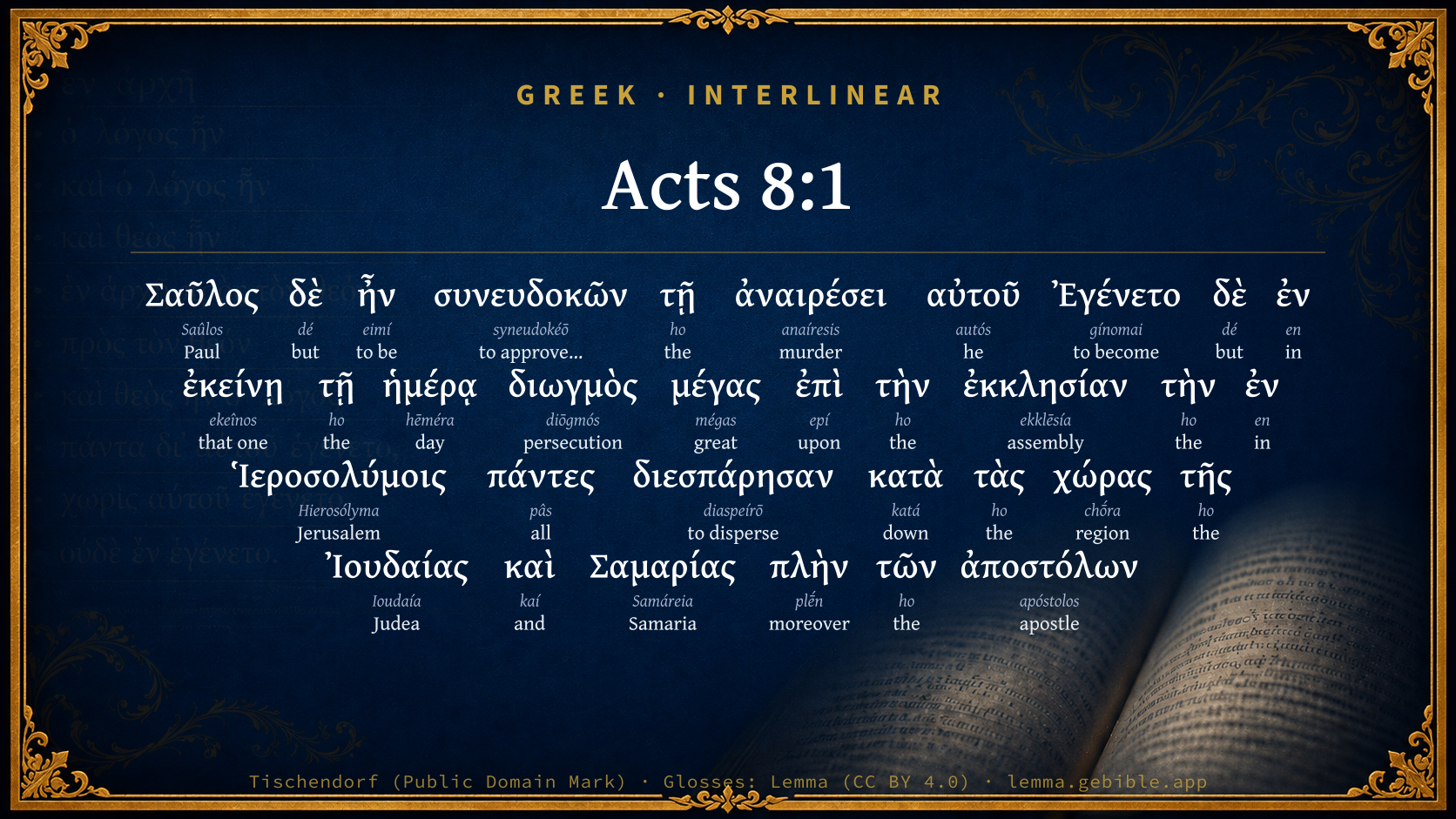
Saul was consenting to his death. A great persecution arose against the assembly which was in Jerusalem in that day. They were all scattered abroad throughout the regions of Judea and Samaria, except for the apostles.
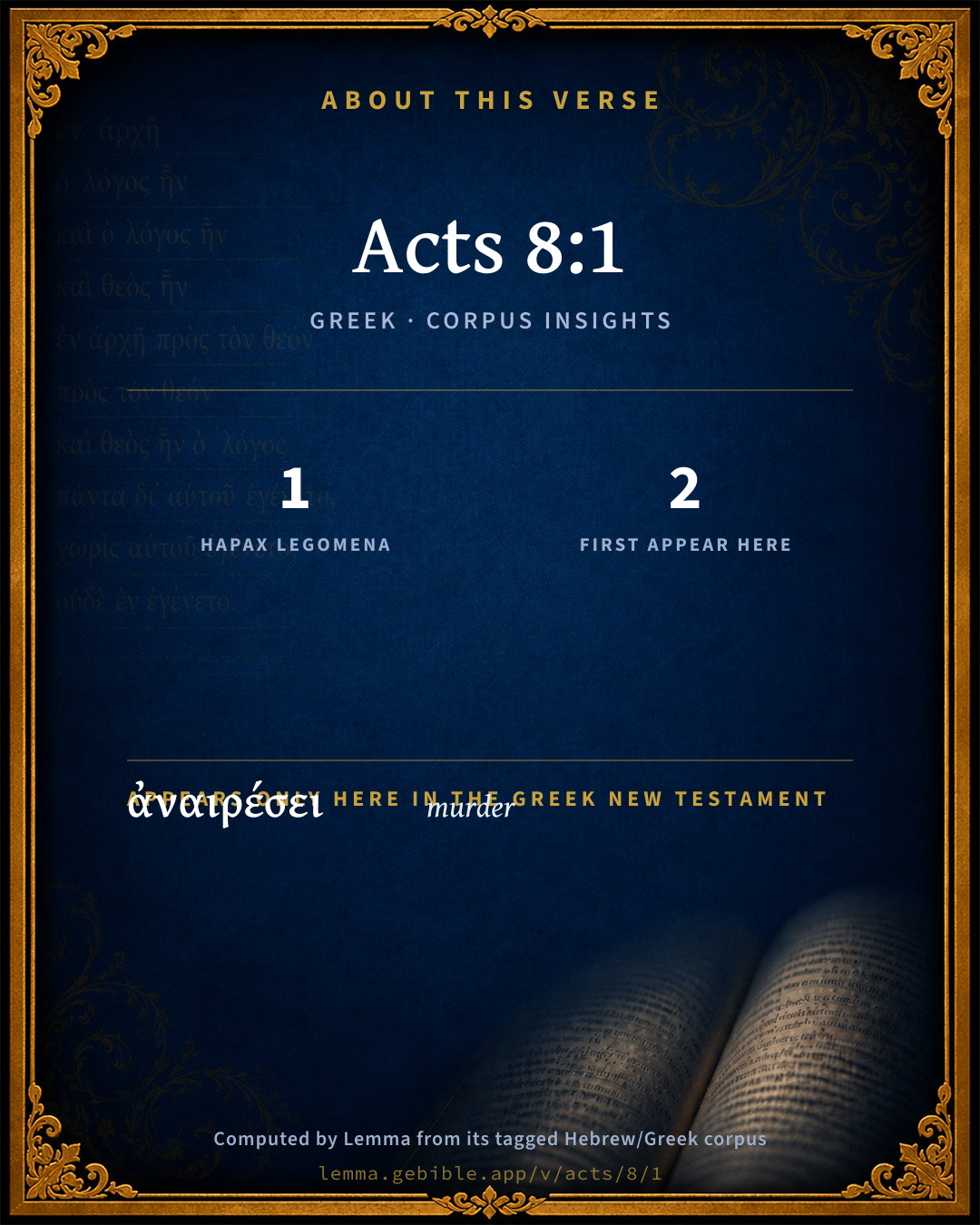
- 1 hapax legomenon — only here in the Greek New Testament
- 2 first appearances in the Greek New Testament
Download a study sheet
One document with this verse’s original text, its word-by-word gloss line, the meaning frame, cross-references with their text, attributed commentary, and full source and license credits — printable, and it pastes into notes with its structure intact.
This verse Autodidact and up
A passage Seminary Student
Up to 50 verses in one chapter. A passage sheet keeps up to 6 commentary sources and 12 cross-references per verse, in the order this page ranks them, and says so on the sheet whenever that leaves anything out. Ask for a single verse and you get the Autodidact verse sheet above.
Everything on this page stays free to read, with no account — the sheet is a download of what is already on screen, not access to it.
Compare translations 3
The same verse in 3 English versions, stacked beneath the original-language interlinear above. Click any original word for its lexicon entry.
Each is an independent rendering of the whole verse — the interlinear is not word-aligned to these translations.
Highlighted words mark where these versions differ — a whole-verse word diff, not a word-by-word alignment.
-
World English Bible Public Domain
Saul was consenting to his death. A great persecution arose against the assembly which was in Jerusalem in that day. They were all scattered abroad throughout the regions of Judea and Samaria, except for the apostles.
-
King James Version Public Domain
And Saul was consenting unto his death. And at that time there was a great persecution against the church which was at Jerusalem; and they were all scattered abroad throughout the regions of Judaea and Samaria, except the apostles.
-
unfoldingWord Literal Text CC BY-SA 4.0
And Saul was agreeing with his execution. And on that day a great persecution began against the church that in Jerusalem, and they all were scattered throughout the regions of Judea and Samaria, except the apostles.
unfoldingWord Literal Text — © unfoldingWord, licensed CC BY-SA 4.0. Word-aligned USFM3 via Door43 (git.door43.org/unfoldingWord/en_ult).
Show all 19 translations
Every available English version of this verse, each an independent rendering of the whole verse.
-
World English Bible Public Domain
Saul was consenting to his death. A great persecution arose against the assembly which was in Jerusalem in that day. They were all scattered abroad throughout the regions of Judea and Samaria, except for the apostles.
-
Berean Standard Bible Public Domain
And Saul was there, giving approval to Stephen’s death. On that day a great persecution broke out against the church in Jerusalem, and all except the apostles were scattered throughout Judea and Samaria.
-
Majority Standard Bible Public Domain
And Saul was there, giving approval to Stephen’s death. On that day a great persecution broke out against the church in Jerusalem, and all except the apostles were scattered throughout Judea and Samaria.
-
King James Version Public Domain
And Saul was consenting unto his death. And at that time there was a great persecution against the church which was at Jerusalem; and they were all scattered abroad throughout the regions of Judaea and Samaria, except the apostles.
-
American Standard Version (1901) Public Domain
And Saul was consenting unto his death. And there arose on that day a great persecution against the church which was in Jerusalem; and they were all scattered abroad throughout the regions of Judaea and Samaria, except the apostles.
-
Revised Version (1885) Public Domain
And Saul was consenting unto his death. And there arose on that day a great persecution against the church which was in Jerusalem; and they were all scattered abroad throughout the regions of Judaea and Samaria, except the apostles.
-
Geneva Bible (1599) Public Domain
And Saul consented to his death, and at that time, there was a great persecution against the Church which was at Hierusalem, and they were all scattered abroad thorowe the regions of Iudea and of Samaria, except the Apostles.
-
Douay-Rheims (1899) Public Domain
And at that time there was raised a great persecution against the church which was at Jerusalem; and they were all dispersed through the countries of Judea, and Samaria, except the apostles.
-
Young's Literal Translation Public Domain
And Saul was assenting to his death, and there came in that day a great persecution upon the assembly in Jerusalem, all also were scattered abroad in the regions of Judea and Samaria, except the apostles;
-
Literal Standard Version CC BY-SA 4.0
And Saul was assenting to his death, and there came in that day a great persecution on the Assembly in Jerusalem, all were also scattered abroad in the regions of Judea and Samaria, except the apostles;
-
Unlocked Literal Bible CC BY-SA 4.0
Saul was in agreement with his death. So there began on that day a great persecution against the church that was in Jerusalem; and the believers were all scattered throughout the regions of Judea and Samaria, except the apostles.
-
unfoldingWord Literal Text CC BY-SA 4.0
And Saul was agreeing with his execution. And on that day a great persecution began against the church that in Jerusalem, and they all were scattered throughout the regions of Judea and Samaria, except the apostles.
-
Darby Bible Public Domain
And Saul was consenting to his being killed. And on that day there arose a great persecution against the assembly which was in Jerusalem, and all were scattered into the countries of Judaea and Samaria except the apostles.
-
World Messianic Bible Public Domain
Saul was consenting to his death. A great persecution arose against the assembly which was in Jerusalem in that day. They were all scattered abroad throughout the regions of Judea and Samaria, except for the emissaries.
-
Webster's Bible Public Domain
And Saul was consenting to his death. And at that time there was a great persecution against the church which was at Jerusalem; and they were all dispersed throughout the regions of Judea and Samaria, except the apostles.
-
Free Bible Version CC BY-SA 4.0
Saul approved of his killing. On that very day terrible persecution broke out against the church in Jerusalem, and all except for the apostles were scattered throughout Judea and Samaria.
-
Bible in Basic English Public Domain
And Saul gave approval to his death. Now at that time a violent attack was started against the church in Jerusalem; and all but the Apostles went away into all parts of Judaea and Samaria.
-
Text-Critical English NT CC BY 4.0
And Saul approved of his execution. Saul Persecutes the Church On that day a great persecution arose against the church in Jerusalem, and all the believers except the apostles were scattered throughout the regions of Judea and Samaria.
-
Tyndale New Testament (1534) Public Domain
Saul had pleasure in his deeth. And at that tyme there was a great persecucion agaynst the congregacion which was at Ierusalem and they were all scattered abroade thorowout the regions of Iury and Samaria except the Apostles.
Literal Standard Version (2020), Covenant Press — licensed CC BY-SA 4.0. Text via the HelloAO Bible API (eBible.org). Unlocked Literal Bible (unfoldingWord) — licensed CC BY-SA 4.0. Text via the HelloAO Bible API (eBible.org). unfoldingWord Literal Text — © unfoldingWord, licensed CC BY-SA 4.0. Word-aligned USFM3 via Door43 (git.door43.org/unfoldingWord/en_ult). Free Bible Version, Dr. Jonathan Gallagher — licensed CC BY-SA 4.0. Text via the HelloAO Bible API (eBible.org).
Word by word
More ways to search: Search by grammar → Find every occurrence → Compare this word →
Practice this passage: Drill this verse → Learn its vocabulary →
- Appears 1× in the Greek New Testament
- First appears here
- Part of Speech
- Noun
- Case
- Dative
- Number
- Singular
- Gender
- Feminine
Full Thayer's Definition
- Σαῦλος Saûlos G4569 “Paul” Noun, Nominative, Singular, Masculine
- δὲ dé G1161 “but” Conjunction
- ἦν eimí G1510 “to be” Verb, Imperfect, Active, Indicative, 3rd person, Singular
- συνευδοκῶν syneudokéō G4909 “to approve together” Verb, Present, Active, Participle, Nominative, Singular, Masculine
- τῇ ho G3588 “the” Article, Dative, Singular, Feminine
- ἀναιρέσει anaíresis G336 “murder” Noun, Dative, Singular, Feminine
- αὐτοῦ autós G846 “he” Personal pronoun, Genitive, Singular, Masculine
- Ἐγένετο gínomai G1096 “to become” Verb, Aorist, Middle deponent, Indicative, 3rd person, Singular
- δὲ dé G1161 “but” Conjunction
- ἐν en G1722 “in” Preposition
- ἐκείνῃ ekeînos G1565 “that one” Demonstrative pronoun, Dative, Singular, Feminine
- τῇ ho G3588 “the” Article, Dative, Singular, Feminine
- ἡμέρᾳ hēméra G2250 “day” Noun, Dative, Singular, Feminine
- διωγμὸς diōgmós G1375 “persecution” Noun, Nominative, Singular, Masculine
- μέγας mégas G3173 “great” Adjective, Nominative, Singular, Masculine
- ἐπὶ epí G1909 “upon” Preposition
- τὴν ho G3588 “the” Article, Accusative, Singular, Feminine
- ἐκκλησίαν ekklēsía G1577 “assembly” Noun, Accusative, Singular, Feminine
- τὴν ho G3588 “the” Article, Accusative, Singular, Feminine
- ἐν en G1722 “in” Preposition
- Ἱεροσολύμοις Hierosólyma G2414 “Jerusalem” Noun, Dative, Plural, Neuter
- πάντες pâs G3956 “all” Adjective, Nominative, Plural, Masculine
- διεσπάρησαν diaspeírō G1289 “to disperse” Verb, Aorist, Passive, Indicative, 3rd person, Plural
- κατὰ katá G2596 “down” Preposition
- τὰς ho G3588 “the” Article, Accusative, Plural, Feminine
- χώρας chṓra G5561 “region” Noun, Accusative, Plural, Feminine
- τῆς ho G3588 “the” Article, Genitive, Singular, Feminine
- Ἰουδαίας Ioudaía G2449 “Judea” Noun, Genitive, Singular, Feminine
- καὶ kaí G2532 “and” Conjunction
- Σαμαρίας Samáreia G4540 “Samaria” Noun, Genitive, Singular, Feminine
- πλὴν plḗn G4133 “moreover” Adverb
- τῶν ho G3588 “the” Article, Genitive, Plural, Masculine
- ἀποστόλων apóstolos G652 “apostle” Noun, Genitive, Plural, Masculine
About this verse
These counts appear in no published source. They are computed here, from the morphology-tagged text and Lemma’s own curated glosses. What Lemma adds →
- 33
- words
- 25
- distinct lemmas
- Acts
- section
Notable vocabulary
1 hapax legomenon — a word that appears only here in the entire Greek New Testament:
- ἀναιρέσει murder G336
First appearance in Scripture
These words make their first canonical appearance in the Greek New Testament here:
Shared distinctive vocabulary
διεσπάρησαν to disperse G1289 occurs in 3 verses of the Greek New Testament. Also found in:
Cross-references
30Topical passages linked to Acts 8:1 in the Treasury of Scripture Knowledge — connected by theme and wording, ordered by reader-vote popularity; previews shown in the World English Bible.
- Acts 22:20 When the blood of Stephen, your witness, was shed, I also was standing by, and consenting to his death, and guarding the cloaks of those who killed him.'
- Daniel 3:16–18 Shadrach, Meshach, and Abednego answered the king, Nebuchadnezzar, we have no need to answer you in this matter.
- Acts 5:40 They agreed with him. Summoning the apostles, they beat them and charged them not to speak in the name of Jesus, and let them go.
- Acts 7:58 They threw him out of the city, and stoned him. The witnesses placed their garments at the feet of a young man named Saul.
- Luke 11:49–50 Therefore also the wisdom of God said, 'I will send to them prophets and apostles; and some of them they will kill and persecute,
- Acts 1:8 But you will receive power when the Holy Spirit has come upon you. You will be witnesses to me in Jerusalem, in all Judea and Samaria, and to the uttermost parts of the earth."
- Acts 5:33 But they, when they heard this, were cut to the heart, and determined to kill them.
- Exodus 10:28–29 Pharaoh said to him, "Get away from me! Be careful to see my face no more; for in the day you see my face you shall die!"
- Acts 8:14 Now when the apostles who were at Jerusalem heard that Samaria had received the word of God, they sent Peter and John to them,
- John 15:20 Remember the word that I said to you: 'A servant is not greater than his lord.' If they persecuted me, they will also persecute you. If they kept my word, they will keep yours also.
- Acts 8:4 Therefore those who were scattered abroad went around preaching the word.
- Acts 9:31 So the assemblies throughout all Judea and Galilee and Samaria had peace, and were built up. They were multiplied, walking in the fear of the Lord and in the comfort of the Holy Spirit.
- Nehemiah 6:3 I sent messengers to them, saying, I am doing a great work, so that I can't come down: why should the work cease, while I leave it, and come down to you?
- Daniel 6:10 When Daniel knew that the writing was signed, he went into his house (now his windows were open in his chamber toward Jerusalem) and he kneeled on his knees three times a day, and prayed, and gave thanks before his God, as he did before.
- Daniel 6:23 Then was the king exceeding glad, and commanded that they should take Daniel up out of the den. So Daniel was taken up out of the den, and no manner of hurt was found on him, because he had trusted in his God.
- Matthew 5:13 "You are the salt of the earth, but if the salt has lost its flavor, with what will it be salted? It is then good for nothing, but to be cast out and trodden under the feet of men.
- Matthew 10:25–28 It is enough for the disciple that he be like his teacher, and the servant like his lord. If they have called the master of the house Beelzebul, how much more those of his household!
- Matthew 22:6 and the rest grabbed his servants, and treated them shamefully, and killed them.
- John 4:39–42 From that city many of the Samaritans believed in him because of the word of the woman, who testified, "He told me everything that I did."
- John 16:2 They will put you out of the synagogues. Yes, the time comes that whoever kills you will think that he offers service to God.
- Acts 2:47 praising God, and having favor with all the people. The Lord added to the assembly day by day those who were being saved.
- Acts 5:18 and laid hands on the apostles, and put them in public custody.
- Acts 5:20 "Go stand and speak in the temple to the people all the words of this life."
- Acts 11:19–22 They therefore who were scattered abroad by the oppression that arose about Stephen traveled as far as Phoenicia, Cyprus, and Antioch, speaking the word to no one except to Jews only.
- Acts 13:1 Now in the assembly that was at Antioch there were some prophets and teachers: Barnabas, Simeon who was called Niger, Lucius of Cyrene, Manaen the foster-brother of Herod the tetrarch, and Saul.
- Philippians 1:12 Now I desire to have you know, brothers, that the things which happened to me have turned out rather to the progress of the Gospel;
- Hebrews 11:27 By faith, he left Egypt, not fearing the wrath of the king; for he endured, as seeing him who is invisible.
- Matthew 23:34 Therefore, behold, I send to you prophets, wise men, and scribes. Some of them you will kill and crucify; and some of them you will scourge in your synagogues, and persecute from city to city;
- Acts 7:38 This is he who was in the assembly in the wilderness with the angel that spoke to him on Mount Sinai, and with our fathers, who received living oracles to give to us,
- Acts 7:54 Now when they heard these things, they were cut to the heart, and they gnashed at him with their teeth.
Cross-references courtesy of OpenBible.info (CC BY 4.0).
Lesson kit
Teaching starters — assembled from the data on this page, not authored interpretation. Every prompt links to the verse data it draws on. Edit before teaching.
Acts, in the Acts, opens this verse with 33 words (25 distinct Greek lemmas). Its most distinctive word is anaíresis (“murder”). A historical commentator’s framing appears above. Read the whole chapter for the surrounding context.
Discussion questions
- How does “murder” (anaíresis) shape what this verse is saying?
- This verse holds 1 word here found nowhere else in the Greek New Testament. What might the rare word draw attention to?
- 2 words here appear for the first time in Scripture. What is being introduced at this debut?
- Acts 8:4 shares the word «to disperse» with this verse. How do the two illuminate each other?
- “the” occurs 7× in this one verse. What is the effect of the repetition?
- These translations render this verse differently. What is at stake in choosing one wording over another?
- Reading how Matthew Henry's Commentary and Adam Clarke's Commentary read this verse, where do the two commentators agree and where do they part?
Things to notice
- 1 word in this verse appears nowhere else in the Greek New Testament.
- 2 words make their first canonical appearance in Scripture here.
- These translations choose different wording for 15 words in this verse.
- “the” occurs 7× in this single verse.
- 25 distinct Greek lemmas span 33 words in this verse.
Commentary
Notes on Acts 8:1 from classic Christian and Jewish commentators (each source and its license shown beneath its notes). The classic Christian expositions comment on the surrounding passage and are grouped to its opening verse, so a note may address several verses; the Jewish commentaries on the Tanakh (Rashi and others) are per-verse, so they appear only where the commentator wrote on this verse.
Lemma curates 59 commentaries, every one of them public domain or Creative Commons licensed, each selected and text-cleaned for this edition rather than reprinted as found. About our sources →
Matthew Henry's Commentary
Matthew Henry's Commentary on the Whole Bible (1708–1710) — public domain (CC PDM 1.0). Text via the HelloAO Bible API.
Adam Clarke's Commentary
Adam Clarke's Commentary on the Bible (1810–1826) — public domain. Text from a community e-Sword/MySword module.
The Cambridge Bible for Schools and Colleges
gen. ed. J. J. S. Perowne
The Cambridge Bible for Schools and Colleges (gen. ed. J. J. S. Perowne; Cambridge University Press, 1878–1918) — public domain. Text from a community e-Sword module.
The Biblical Illustrator
Joseph S. Exell
The Biblical Illustrator, edited by Joseph S. Exell (c. 1880s–1900s) — public domain. Text from a community e-Sword module.
Joseph Benson's Commentary
Joseph Benson's Commentary on the Old and New Testaments (1811–1818) — public domain. Text from a community e-Sword module.
Dummelow's Commentary on the Holy Bible
J. R. Dummelow
J. R. Dummelow, A Commentary on the Holy Bible (Macmillan, 1909) — public domain. Text from a community e-Sword module.
The Preacher's Complete Homiletical Commentary
Joseph S. Exell (gen. ed.)
The Preacher's Complete Homiletical Commentary (gen. ed. Joseph S. Exell; Funk & Wagnalls, c. 1892) — public domain (pre-1929). A full-Bible homiletical/sermon-outline anthology covering 65 of 66 books (2 John is absent from the source module). Text from a community e-Sword module.
Lange's Commentary on the Holy Scriptures
Lange's Commentary on the Holy Scriptures (Critical, Doctrinal, and Homiletical), ed. John Peter Lange, English translation edited by Philip Schaff (1864–1880) — public domain. Text from a community e-Sword module.
MacLaren's Expositions of Holy Scripture
Alexander MacLaren
Alexander MacLaren, Expositions of Holy Scripture (1904–1910) — public domain. Text from a community e-Sword module.
The Annotated Bible
Arno C. Gaebelein
Arno C. Gaebelein, The Annotated Bible (1913–1922) — public domain. Text from a community e-Sword module.
F. W. Grant's Numerical Bible
F. W. Grant, The Numerical Bible (4th ed., 1903) — public domain. Text from a community e-Sword module.
Tyndale Open Study Notes
Tyndale Open Resources
Tyndale Open Study Notes — © Tyndale Open Resources, licensed CC BY-SA 4.0. Text via the HelloAO Bible API.
Bengel's Gnomon
Johann Albrecht Bengel
Bengel's Gnomon of the New Testament — English translation (T&T Clark, Edinburgh, 1860) — public domain. Text from a community e-Sword module.
Meyer's Critical & Exegetical Commentary
Heinrich August Wilhelm Meyer
Meyer — Critical and Exegetical Commentary on the New Testament — English translation by Peter Christie, edited by Frederick Crombie (T&T Clark, 1880) — public domain. Text from a community e-Sword module.
Expositor's Greek Testament
ed. W. Robertson Nicoll
The Expositor's Greek Testament, edited by W. Robertson Nicoll (1897–1910) — public domain. Text from a community e-Sword module.
Cambridge Greek Testament for Schools and Colleges
Cambridge Greek Testament for Schools and Colleges (Cambridge University Press, 1896; 21 vols, various authors incl. Carr, Maclear, Plummer, Farrar, Lumby, Moule, M. R. James, Simcox) — public domain. Text from a community e-Sword module.
Alford’s Greek Testament
Henry Alford
Henry Alford, The Greek Testament (1849–1861) — public domain. Text from a community e-Sword module.
Geneva Bible (1599)
Geneva Bible translators
Geneva Bible (1599) marginal notes — public domain. Text via Bolls.life.
John Calvin's Commentaries
John Calvin's Commentaries (1540-1563) — public domain. Text from the Calvin Translation Society English edition (1840s-50s) via the Christian Classics Ethereal Library (ccel.org). Calvin's coverage is partial (roughly two-thirds of the Bible); uncommented books and verses are honest gaps, never fabricated. The 19th-century editor's footnotes and remarks are omitted so the notes are faithfully Calvin's own voice.
Ellicott's Commentary for English Readers
A Bible Commentary for English Readers, edited by Charles John Ellicott (1878–1897) — public domain. Text from a community e-Sword module.
Trapp's Complete Commentary
John Trapp
John Trapp, A Commentary or Exposition upon All the Books of the Old and New Testament (1647–1656) — public domain. Text from a community e-Sword module.
Albert Barnes' Notes on the Bible
Albert Barnes' Notes on the Bible (1834–1885) — public domain. Text from a community e-Sword/MySword module.
Haydock's Catholic Bible Commentary
George Leo Haydock (1774–1849), Haydock's Catholic Family Bible and Commentary, 1859 edition — public domain. Excludes Psalms (Douay-Rheims chapter numbering differs from Protestant) and Deuterocanonical books (Catholic canon only).
Matthew Poole's English Annotations
Matthew Poole's English Annotations on the Holy Bible (1683–1685) — public domain. Text from a community e-Sword/MySword module.
The Pulpit Commentary
The Pulpit Commentary (1880–1919), ed. H.D.M. Spence-Jones & Joseph S. Exell — public domain. Text from a community e-Sword module.
John Wesley's Explanatory Notes
John Wesley, Explanatory Notes Upon the Whole Bible (1754–1765) — public domain. Text via the GEBible commentary corpus.
Scofield Reference Notes
C. I. Scofield
The Scofield Reference Bible (1917 edition), notes by C. I. Scofield — public domain. Text from a community e-Sword module.
Kretzmann's Popular Commentary
Paul E. Kretzmann
Paul E. Kretzmann, Popular Commentary of the Bible (1921–1924) — public domain. Text from a community e-Sword module.
The Sermon Bible
William Robertson Nicoll (ed.)
The Sermon Bible, ed. William Robertson Nicoll (1888–1900) — public domain. Text from a community e-Sword module.
Burkitt's Expository Notes on the New Testament
William Burkitt
William Burkitt's Expository Notes on the New Testament (1700–1703) — public domain. Text from a community e-Sword module.
Godbey's Commentary on the New Testament
William B. Godbey
William B. Godbey, Commentary on the New Testament (1896–1900) — public domain. Text from a community e-Sword module.
McGarvey & Pendleton's Commentaries
J. W. McGarvey
J. W. McGarvey (with Philip Y. Pendleton), Commentaries on the New Testament (The Fourfold Gospel, 1914; Acts; and the epistles) — public domain. Text from a community e-Sword/MySword module.
Darby's Synopsis of the New Testament
John Nelson Darby
John Nelson Darby — Synopsis of the Books of the Bible: the New Testament (c. 1857–1862) — public domain. Text from a community e-Sword module.
The People's New Testament
B. W. Johnson
B. W. Johnson's The People's New Testament with Notes (1889–1891) — public domain. Electronic text from the Christian Classics Ethereal Library (CCEL) ThML edition.
unfoldingWord translationNotes
Door43 World Missions Community
unfoldingWord translationNotes — © Distant Shores Media and the Door43 World Missions Community, licensed CC BY-SA 4.0. Source: git.door43.org/Door43/en_tn.
Vincent's Word Studies in the New Testament
Marvin R. Vincent
Marvin R. Vincent, Word Studies in the New Testament (1887–1900) — public domain. Text from a community e-Sword/MySword module.