Acts 14:21

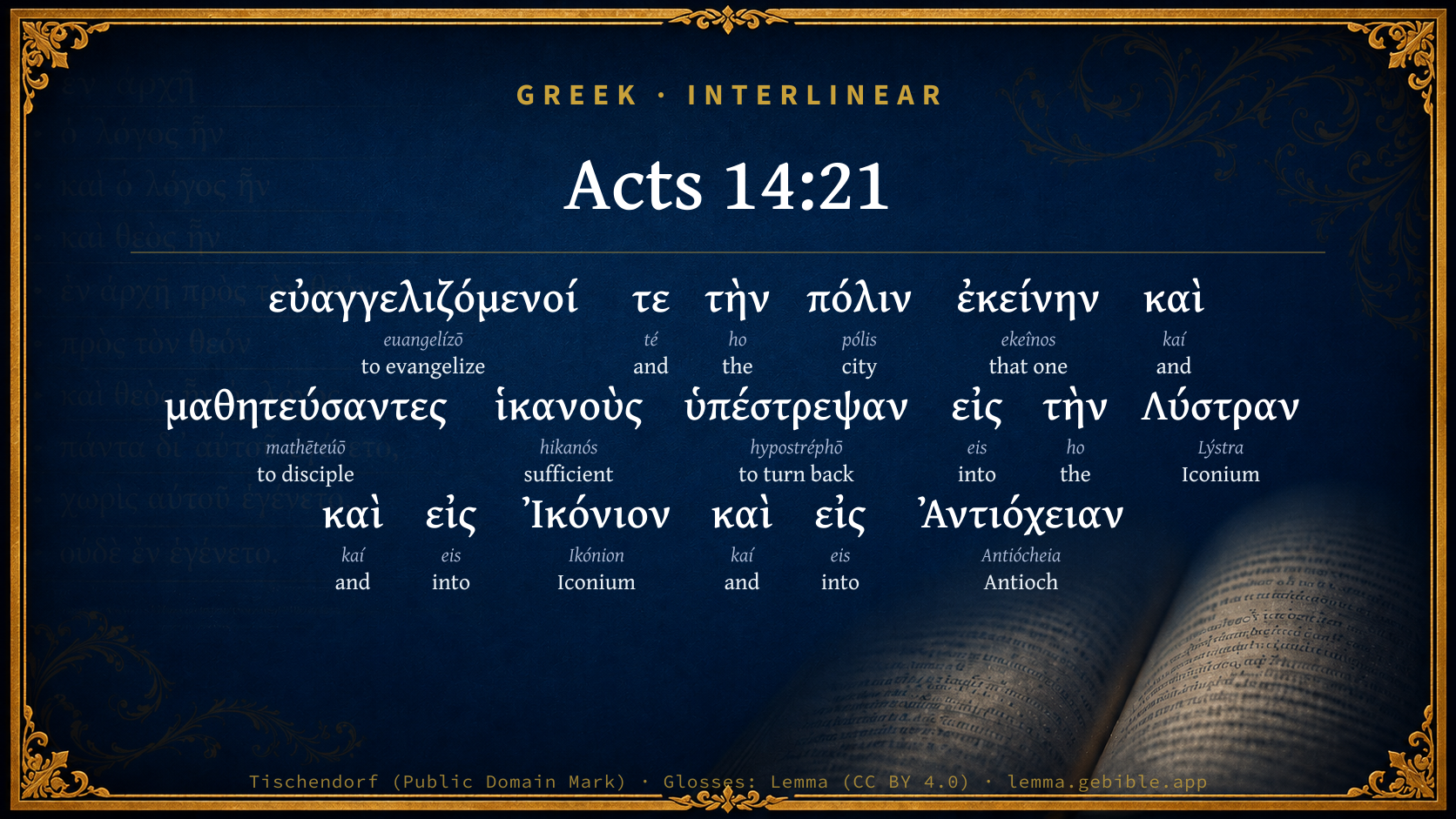
Greek (Tischendorf 8th ed.) Acts 14:21 appears in the Greek New Testament. The text above is from the Tischendorf 8th edition. Each word links to its Strong’s number and a concise gloss. Click any word for its full Thayer’s Greek Lexicon entry.
Download image
Cite this verse

Acts 14:21 (World English Bible). Public Domain. Lemma interlinear Bible study tool, https://lemma.gebible.app/v/acts/14/21.

Show BibTeX & RIS
BibTeX
RIS
English Translation
When they had preached the Gospel to that city, and had made many disciples, they returned to Lystra, Iconium, and Antioch,
World English Bible · Public Domain
Download a study sheet

One document with this verse’s original text, its word-by-word gloss line, the meaning frame, cross-references with their text, attributed commentary, and full source and license credits — printable, and it pastes into notes with its structure intact.

This verse Autodidact and up

Study sheet (.html) Plain text (.txt)

A passage Seminary Student

Up to 50 verses in one chapter. A passage sheet keeps up to 6 commentary sources and 12 cross-references per verse, in the order this page ranks them, and says so on the sheet whenever that leaves anything out. Ask for a single verse and you get the Autodidact verse sheet above.

Everything on this page stays free to read, with no account — the sheet is a download of what is already on screen, not access to it.

Want to remove ads? Support Godless Engineer
Compare translations 3

The same verse in 3 English versions, stacked beneath the original-language interlinear above. Click any original word for its lexicon entry.

Each is an independent rendering of the whole verse — the interlinear is not word-aligned to these translations.

Highlighted words mark where these versions differ — a whole-verse word diff, not a word-by-word alignment.

  • World English Bible Public Domain
    When they had preached the Gospel to that city, and had made many disciples, they returned to Lystra, Iconium, and Antioch,
  • King James Version Public Domain
    And when they had preached the gospel to that city, and had taught many, they returned again to Lystra, and to Iconium, and Antioch,
  • unfoldingWord Literal Text CC BY-SA 4.0
    And having proclaimed the gospel in that city and having made many disciples, they returned to Lystra and to Iconium and Antioch,

unfoldingWord Literal Text — © unfoldingWord, licensed CC BY-SA 4.0. Word-aligned USFM3 via Door43 (git.door43.org/unfoldingWord/en_ult).

Versions to compare (up to 4)

3 of 4 selected

Show all 19 translations

Every available English version of this verse, each an independent rendering of the whole verse.

  • World English Bible Public Domain
    When they had preached the Gospel to that city, and had made many disciples, they returned to Lystra, Iconium, and Antioch,
  • Berean Standard Bible Public Domain
    They preached the gospel to that city and made many disciples. Then they returned to Lystra, Iconium, and Antioch,
  • Majority Standard Bible Public Domain
    They preached the gospel to that city and made many disciples. Then they returned to Lystra, Iconium, and Antioch,
  • King James Version Public Domain
    And when they had preached the gospel to that city, and had taught many, they returned again to Lystra, and to Iconium, and Antioch,
  • American Standard Version (1901) Public Domain
    And when they had preached the gospel to that city, and had made many disciples, they returned to Lystra, and to Iconium, and to Antioch,
  • Revised Version (1885) Public Domain
    And when they had preached the gospel to that city, and had made many disciples, they returned to Lystra, and to Iconium, and to Antioch,
  • Geneva Bible (1599) Public Domain
    And after they had preached the glad tidings of the Gospel to that citie, and had taught many, they returned to Lystra, and to Iconium, and to Antiochia,
  • Douay-Rheims (1899) Public Domain
    Confirming the souls of the disciples, and exhorting them to continue in the faith: and that through many tribulations we must enter into the kingdom of God.
  • Young's Literal Translation Public Domain
    Having proclaimed good news also to that city, and having discipled many, they turned back to Lystra, and Iconium, and Antioch,
  • Literal Standard Version CC BY-SA 4.0
    Having also proclaimed good news to that city, and having discipled many, they turned back to Lystra, and Iconium, and Antioch,
  • Unlocked Literal Bible CC BY-SA 4.0
    After they had proclaimed the gospel in that city and made many disciples, they returned to Lystra, to Iconium, and to Antioch.
  • unfoldingWord Literal Text CC BY-SA 4.0
    And having proclaimed the gospel in that city and having made many disciples, they returned to Lystra and to Iconium and Antioch,
  • Darby Bible Public Domain
    And having announced the glad tidings to that city, and having made many disciples, they returned to Lystra, and Iconium, and Antioch,
  • World Messianic Bible Public Domain
    When they had preached the Good News to that city and had made many disciples, they returned to Lystra, Iconium, and Antioch,
  • Webster's Bible Public Domain
    And when they had preached the gospel to that city, and had taught many, they returned again to Lystra, and to Iconium, and to Antioch,
  • Free Bible Version CC BY-SA 4.0
    After sharing the good news with the people in that town, and after many had become believers, they went back to Lystra, Iconium, and Antioch.
  • Bible in Basic English Public Domain
    And having made a number of disciples through the preaching of the good news in that town, they went back to Lystra and Iconium and Antioch,
  • Text-Critical English NT CC BY 4.0
    After preaching the gospel in that city and making many disciples, Paul and Barnabas returned to Lystra, Iconium, and Antioch,
  • Tyndale New Testament (1534) Public Domain
    After they had preached to that cite and had taught many they returned agayne to Lisira and to Iconium and Antioche

Literal Standard Version (2020), Covenant Press — licensed CC BY-SA 4.0. Text via the HelloAO Bible API (eBible.org). Unlocked Literal Bible (unfoldingWord) — licensed CC BY-SA 4.0. Text via the HelloAO Bible API (eBible.org). unfoldingWord Literal Text — © unfoldingWord, licensed CC BY-SA 4.0. Word-aligned USFM3 via Door43 (git.door43.org/unfoldingWord/en_ult). Free Bible Version, Dr. Jonathan Gallagher — licensed CC BY-SA 4.0. Text via the HelloAO Bible API (eBible.org).

Word by word

More ways to search: Search by grammar → Find every occurrence → Compare this word →

Practice this passage: Drill this verse → Learn its vocabulary →

μαθητεύσαντες
mathēteúō
G3100
“to disciple”
Verb, Aorist, Active, Participle, Nominative, Plural, Masculine
Part of Speech
Verb
Tense
Aorist
Voice
Active
Mood
Participle
Case
Nominative
Number
Plural
Gender
Masculine
Full Thayer's Definition

Origin: from G3101

TDNT: 11:41,6

1. to be a disciple of one a. to follow his precepts and instructions 2. to make a disciple a. to teach, instruct
  1. εὐαγγελιζόμενοί euangelízō G2097 “to evangelize” Verb, Present, Middle, Participle, Nominative, Plural, Masculine
  2. τε té G5037 “and” Particle
  3. τὴν ho G3588 “the” Article, Accusative, Singular, Feminine
  4. πόλιν pólis G4172 “city” Noun, Accusative, Singular, Feminine
  5. ἐκείνην ekeînos G1565 “that one” Demonstrative pronoun, Accusative, Singular, Feminine
  6. καὶ kaí G2532 “and” Conjunction
  7. ἱκανοὺς hikanós G2425 “sufficient” Adjective, Accusative, Plural, Masculine
  8. ὑπέστρεψαν hypostréphō G5290 “to turn back” Verb, Aorist, Active, Indicative, 3rd person, Plural
  9. εἰς eis G1519 “into” Preposition
  10. τὴν ho G3588 “the” Article, Accusative, Singular, Feminine
  11. Λύστραν Lýstra G3082 “Iconium” Noun, Accusative, Singular, Feminine
  12. καὶ kaí G2532 “and” Conjunction
  13. εἰς eis G1519 “into” Preposition
  14. Ἰκόνιον Ikónion G2430 “Iconium” Noun, Accusative, Singular, Neuter
  15. καὶ kaí G2532 “and” Conjunction
  16. εἰς eis G1519 “into” Preposition
  17. Ἀντιόχειαν Antiócheia G490 “Antioch” Noun, Accusative, Singular, Feminine

About this verse

These counts appear in no published source. They are computed here, from the morphology-tagged text and Lemma’s own curated glosses. What Lemma adds →

18
words
13
distinct lemmas
Acts
section

Notable vocabulary

The rarest word here is μαθητεύσαντες to disciple G3100 — appearing just 4 times in the whole Greek New Testament.

Shared distinctive vocabulary

μαθητεύσαντες to disciple G3100 occurs in 4 verses of the Greek New Testament. Also found in:

Repetition

Words recur within this verse:

Cross-references

10

Topical passages linked to Acts 14:21 in the Treasury of Scripture Knowledge — connected by theme and wording, ordered by reader-vote popularity; previews shown in the World English Bible.

  • Acts 13:51 But they shook off the dust of their feet against them, and came to Iconium.
  • Acts 14:1 It happened in Iconium that they entered together into the synagogue of the Jews, and so spoke that a great multitude both of Jews and of Greeks believed.
  • Acts 14:19 But some Jews from Antioch and Iconium came there, and having persuaded the multitudes, they stoned Paul, and dragged him out of the city, supposing that he was dead.
  • Matthew 28:19 Therefore go, and make disciples of all nations, baptizing them in the name of the Father and of the Son and of the Holy Spirit,
  • Acts 13:14 But they, passing on from Perga, came to Antioch of Pisidia. They went into the synagogue on the Sabbath day, and sat down.
  • Acts 14:6 they became aware of it, and fled to the cities of Lycaonia, Lystra, Derbe, and the surrounding region.
  • Acts 14:8 At Lystra a certain man sat, impotent in his feet, a cripple from his mother's womb, who never had walked.
  • Acts 15:36 After some days Paul said to Barnabas, "Let's return now and visit our brothers in every city in which we proclaimed the word of the Lord, to see how they are doing."
  • Acts 16:2 The brothers who were at Lystra and Iconium gave a good testimony about him.
  • 2 Timothy 3:11 persecutions, and sufferings: those things that happened to me at Antioch, Iconium, and Lystra. I endured those persecutions. Out of them all the Lord delivered me.

Cross-references courtesy of OpenBible.info (CC BY 4.0).

Commentary

Notes on Acts 14:21 from classic Christian and Jewish commentators (each source and its license shown beneath its notes). The classic Christian expositions comment on the surrounding passage and are grouped to its opening verse, so a note may address several verses; the Jewish commentaries on the Tanakh (Rashi and others) are per-verse, so they appear only where the commentator wrote on this verse.

Lemma curates 59 commentaries, every one of them public domain or Creative Commons licensed, each selected and text-cleaned for this edition rather than reprinted as found. About our sources →

Jamieson, Fausset & Brown

Robert Jamieson, A. R. Fausset & David Brown

and when they had preached . . . to that city and had taught many--rather, "had made many disciples" (Margin); but probably without suffering any persecution, as Derbe is not mentioned along with Antioch, Iconium, and Lystra (Ti2 3:11).

PAUL AND BARNABAS RETRACE THEIR STEPS, RETURN TO ANTIOCH IN SYRIA, AND THUS COMPLETE THEIR FIRST MISSIONARY JOURNEY. (Act 14:21-28)

they returned . . . to Lystra, Iconium, and Antioch, confirming the souls, &c.--At Derbe, Paul was not far from the well-known pass which leads down from the central tableland to Cilicia and Tarsus. But his thoughts did not center in an earthly home. He revisited the places where he had been reviled and persecuted, but where he had left as sheep in the desert the disciples whom his Master had enabled him to gather. They needed building up and strengthening in the faith, comforting in the midst of their inevitable suffering, and fencing round by permanent institutions. Undaunted therefore by the dangers that awaited them, our missionaries return to them, using words of encouragement which none but the founders of a true religion would have ventured to address to their earliest converts, that "we can only enter into the kingdom of God by passing through much tribulation" [HOWSON].

Jamieson, Fausset & Brown — Commentary Critical and Explanatory on the Whole Bible (1871) — public domain (CC PDM 1.0). Text via the HelloAO Bible API.

Joseph Benson's Commentary

Act 14:21-22. And when they had preached, and taught many — Namely, at Derbe; and, it seems also, in Galatia and Phrygia: see Col 4:13. Greek, μαθητευσαντες ικανους, having made many disciples; they returned again to Lystra, &c. — Being doubtless directed so to do by the Spirit; confirming the souls of the disciples — Whom they had converted in their former journey; exhorting them to continue in the faith — With a steadfastness becoming the evidence and importance of it; and testifying that we must through much tribulation — Which will unavoidably lie in our way; enter into the kingdom of God — A kingdom which, however, will amply recompense us for all the sufferings that we shall meet with in our way to it. “The cross was eminently the way to the crown in those days: the Head, says Zanchy, having been crowned with thorns, it is not fit the feet should tread on roses: — an easy way to heaven is a false one.”

Joseph Benson's Commentary on the Old and New Testaments (1811–1818) — public domain. Text from a community e-Sword module.

Lange's Commentary on the Holy Scriptures

§ III. Paul and Barnabas, on returning to Antioch [in Syria], pass through Lystra, Iconium and the Pisidian Antioch, strengthening and encouraging the newly-formed congregations in those places, and completing their organization

Act_14:21-28

21And when [after] they had preached the gospel12 to that city, and had taught many [gained numerous disciples]13, they returned again [om. again] to Lystra, and to Iconium, and14 Antioch, 22Confirming [Strengthening] the souls of the disciples, and exhorting them to continue in the faith, and [teaching them] that we must through much tribulation [many afflictions] enter into the kingdom of God. 23And when they had ordained [chosen] them elders in every church, and had prayed with fasting, they commended them [congregation, they commended them with prayer and fasting] to the Lord, on whom they [plup. had] believed. 24And after they had passed throughout Pisidia, they came to Pamphylia. 25And when they had preached [spoken] the word in Perga, they went down into Attalia: 26And thence sailed [away] to Antioch, from whence they had been recommended [commended] to the grace of God for the work which they [had now] fulfilled. 27And when they were come [But after they had arrived here], and had gathered the church [congregation] together, they rehearsed15 [announced] all that [how much] God had done with them, and how [that ὅτι] he had opened the door of faith unto the Gentiles. 28And there16 they abode long [not a little] time [in intercourse] with the disciples.

EXEGETICAL AND CRITICAL

Act_14:21-23. a. And when they had preached the gospel in that city, etc.—The preaching of the Gospel in Derbe seems to have been followed by the happiest results; the statement that the apostles had made ἱκανούς disciples, permits us to assume that the converts were quite numerous. [And as Derbe is not “enumerated, 2Ti_3:11, with Antioch, Iconium, and Lystra, as the scene of any of Paul’s sufferings, we may perhaps infer that none befell him there.” (Alf.).—Tr.]. It is, besides, not probable that the two missionaries hastened to depart from this city, where their labors met with no opposition.—From this point they returned to Syria, without, however, taking the road which was, geographically, the nearest, namely, through the province of Cilicia, which bordered on Lycaonia on the south-east; their course at first conducted them further from Syria, through the same cities which they visited on their approach to Derbe. They can have had no other motive in proceeding in such a direction than that of visiting all the congregations which had been gathered on this missionary journey, and, of establishing them more firmly, both in their external and their internal affairs. As the circumstances seemed to impose this duty on them, they revisited, after leaving Derbe, the three cities of Lystra, Iconium, and Antioch in Pisidia, in which they had successfully founded congregations.

b. The statements in Act_14:21-23 refer, summarily, to the three cities, or, rather, to The four; for, before the apostles departed from Derbe, they doubtless adopted the same course there, which seems, it is true, according to the grammatical construction, to be described only in the case of Lystra, Iconium and Antioch. Their labors assumed, partly, a direct form—words and acts; partly, an indirect form—prayer to God. In the former case, they endeavored strengthen the souls of individuals by the word of doctrine and exhortation, urging them to adhere with fidelity to the faith which they had received, and to remain steadfast. They also represented to the believers (for ὅτι implies that παρακαλεῖν here includes λαλεῖν or διδάσκειν), that the way to the kingdom of God, would necessarily (δεῖ) conduct them through many trials. Such instructions and representations, which tended, to strengthen their souls, were the more appropriate and necessary, as persecution and affliction might have otherwise perplexed their minds, and induced them to renounce their faith.—Paul and Barnabas sought, moreover, to strengthen the congregations, as such, by adopting a certain measure of a practical character: they supplied the latter with elders, who might lead and direct them—πρεσβυτέρονς κατ̓ ἐκκλησιαν, i.e., not one elder, but several elders, in each congregation; the customs of the Israelitic authorities alone, without referring to other considerations, show that no other view can be entertained [comp. also Act_20:17; Tit_1:5.—Tr.].—Some doubt, however, attends the mode of presentation indicated by the words: χειροτονήσαντες αὐτοῖς. Did Paul and Barnabas nominate suitable men solely on their own authority, and in accordance with their own judgment, or did they induce the congregations to elect these officers? Χειροτονεῖν signifies: to raise the hands; to vote, elect, by stretching out the hands. The expression accordingly suggests the thought that the apostles may have appointed and superintended a congregational election. And this view is supported by the circumstances related in Act_6:2 ff., when the Twelve directed that the election of the Seven should be held. Indeed, the very nature of the case would seem to have required that the apostles should be guided in their decision by public opinion, and by the confidence reposed by the members of the congregation in certain individuals. [The author remarks in his work, to which he refers below, that the word χειροτ, may possibly here bear the sense of: appointing a congregational election. “It is, however, more probable,” he adds, “that the word is here used in the general sense: to elect, so that it neither states directly that the elders were appointed by the authority and according to the judgment (of the apostles), nor does it expressly include any active participation of the congregation. But, in any case, the confidence and the judgment of the members were necessarily taken into consideration.” This explanation would be more appropriate if the participle passive had occurred here, e.g. “elders having been appointed.” See below, Doctr. No. 2.—Tr.].—These congregations of Asia Minor were remote from their mother-church at Antioch in Syria, and the pressure of certain local wants began to be felt. For they were at once severed from the synagogue, and were thus reduced to the necessity of forming a society of their own, and the hostility of the Jewish population which surrounded them, imperatively demanded that they should exhibit a compact and independent organization. As a natural result, it became indispensably necessary that this congregational organization should be placed under the direction of certain officers.—Schrader (Paulus, V. 543) doubts the historical accuracy of the statement in the passage before us, and conjectures that an arrangement of a later date is, without reason, assigned to this early period, and ascribed to the apostles; see my [work, entitled] Apost. und nachapost. Zeitalter [The Apostolic and Post-apostolic Age], 2d ed. p. 358 ff. [The author, among other considerations, here adduces the fact that elders presided over the church in Jerusalem at a period anterior to this journey of Paul, Act_11:30, etc., etc.—Tr.]. On each occasion on which Paul and Barnabas took leave of a congregation, they engaged in solemn religious exercises, and while they-fasted and prayed, commended the new converts to the . Lord, whom these had received in faith; that is, the apostles besought Jesus Christ to grant to these converts his gracious presence, promote their growth in the divine life, and bestow his protection on them. (ΙΙαρατίθεναι is, namely, specially employed, in those cases in which an object, which is to be subsequently returned, is intrusted to the care of another, or deposited with him—fidei alicujus committere, servandum et custodiendum tradere).

Act_14:24-25. Passed throughout Pisidia.—The apostles, on their road to the sea-coast, again visited Perga (Act_13:13), in the province of Pamphylia, where they preached the Gospel, although the narrative does not state whether their efforts were successful. They finally reached the coast (κατέβησαν) at Attalia [Attaleia, with the accent on the third syllable.—Tr.], a seaport on the south-east of Perga, near the boundary line of Lycia; it received its name from its founder, Attalus Philadelphus, king of Pergamus [who ascended the throne 159 B. C.—Tr.]. Here the missionaries took ship, and, after sailing in an eastern direction, towards Seleucia and the Orontes, at length reached Antioch.

Act_14:26. Whence they had been recommended, etc.—At the close of this narrative, which constitutes a complete and independent whole, Luke refers to the beginning, Act_13:2-3, and connects the completion of the work of the missionaries (ἐπλήρωσαν τὸ ἔργον) with the prayers of the Antiochian congregation (Act_13:3) that the protecting grace of God might attend them (παραδεδ. τῇ χ. τ. θεοῦ). This journey, which may have occupied Paul and Barnabas during a period of two or three years (46–48 A. D.), conducted them not only to the island of Cyprus, but also through an extensive district in the southeastern quarter of Asia Minor. The results, in addition to individual cases of conversion, were, at least, four Christian congregations, (consisting principally of converted pagans) which were organized with a fair prospect that they would continue to flourish.

Act_14:27-28. And when they were come [had arrived], etc.—when Paul and Barnabas reached Antioch, they called together the congregation by which they had been sent forth and commended to the grace of God; they designed to give an account not only of all that they themselves had done, but also, and, indeed, primarily, of all that God had done, who had been with them;(μετʼ αὐτῶν is not equivalent to διʼ αὐτῶν [which occurs in Act_15:12.—Tr.], but signifies: being with them, succoring them [comp. e.g. Act_7:9; Rom_16:20.—Tr.]).—The θύρα πίστεως which God opened unto the Gentiles, does not refer simply to any external opportunity or any exhortation that they should believe, such as God provided for them through the missionary journey of the two messengers; it also designates an internal opening through the gracious influences of the Holy Ghost—a willingness to believe, which had been awakened in them, and which God had given. [Comp. 1Co_16:9; 2Co_2:12; Col_4:3, and εἴςοδος, 1Th_1:9.—Tr.].—The χρόνος οὐκ ὀλίγος which Paul and Barnabas passed with the disciples, that is, the congregation at Antioch, is an expression which allows us to con jecture that several years were thus spent, doubtless with great benefit alike to the two missionaries and to the congregation itself.

DOCTRINAL AND ETHICAL

1. The conception of the kingdom of God, as indicated in Act_14:22, obviously includes something that lies beyond the bounds of this world, and cannot refer exclusively to the latter; we are told that we can enter into the βασιλεία τοῦ θεοῦ only through many θλίφεις. These θλίφεις are the road, not the place of destination—the gate, not the house itself. And yet, those who endure these θλίφεις, are already devout and believing souls, who abide in faith (ἐμμένοντες τῇ πίστει). As long as they are passing through θλίψεις, they have not yet entered into the kingdom of God. That kingdom, therefore, as it is obvious, lies beyond these θλίψεις, and is a kingdom of blessedness. Those who walk through tribulations, already walk in faith, and are members of the church of Christ. Still, they belong to the church militant; after they have entered in, they belong to the reigning and triumphant church, to the βασιλεία τοῦ θεοῦ. “The Church” and “The kingdom of God”, are not equivalent terms: the former is the court; the latter, the sanctuary, or, rather, the Holiest of all [Heb_9:2-3].

2. The wisdom of the course adopted by the apostle of the Gentiles, as a teacher and ruler in the church, and his mode of action, as taught by the inspiration of the Holy Ghost, are strikingly illustrated in Act_14:22-23, and furnish a type and a model for succeeding times. We can here perceive the happy combination, and the genuine and reciprocal influence, of teaching and ruling—of the action of man and the action of divine grace. It is the firm conviction of the apostles that the congregation which had recently been planted, could be protected and strengthened solely by the presence and grace of Christ. Hence they commend these congregations, with genuine earnestness of spirit, and with fasting and prayer, to the care of the Lord, who is the strong tower and the rock of all believers. But their trust in God is far from assuming a fanatical character; hence they labor personally, by word and deed, to strengthen and establish those newly formed congregations as firmly as their own means admit. They do not, however, primarily resort to human arrangements or plans, as if these constituted a guarantee of success, but, first of all, speak words of exhortation and instruction, of consolation and promise (παρακαλοῦντες)—all founded on the word of God. Nevertheless, the apostles do not agree with those who wish to relinquish all to the influence of the word exclusively, who assign no value whatever to forms, rights, and ordinances of the church, and who dispense with them entirely. On the contrary, they invested certain persons in every congregation with the office of elders, in order that these congregations might acquire that social and independent character, which the circumstances required; the means which they adopted appear to have consisted of an election on the part of each congregation. And yet, these were newly formed societies, whose Christian experience had been comparatively brief, whose Christian character had not yet been subjected to the trial of time, and whose views cannot, at that period, be supposed to have been very profound. But that these elders were exclusively, or even chiefly preachers and teachers, may be confidently denied, already for the reason that the elders of the Israelites were by no means invested with the office of teachers, and the functions of the πρεσβύτεροι who are mentioned in Act_11:30, are those of rulers and administrators, but not of teachers.

3. The conclusion of this section (Act_13:14.), like other passages with which we have already met, deeply impresses us with the truth, that all the noble acts of the apostles, and all the momentous, glorious and victorious acts of believers, were, in reality, acts of God, and of the Lord Jesus Christ himself. He was with them (μετ̓ αὐτῶν, Act_14:27)—He opened the door of faith unto the Gentiles. The apostles undoubtedly completed (ἐπλήρωσαν, Act_14:26) the work, but they succeeded solely through the grace of God to which they had been commended. The blessing and increase, the fruit and result, the honor and glory—all belong to Him! This is the lesson which the Redeemer teaches; this is the conviction of the apostle Paul himself, 1Co_15:10; this is now, and forever will be, the truth.

HOMILETICAL AND PRACTICAL

Act_14:21. And when they had preached … returned to Lystra, etc.—With what ardent love the heart of the apostle must have been inspired, if, after having been stoned, he immediately returned to that city, and, far from surveying his enemies with imbittered feeling, could resume the preaching of the Gospel with meekness and pitying love, firmly resolved not to discontinue his labors, although the result should be his death! Ought not such earnestness of purpose, while it puts us to shame, also cheer and encourage us? (Ap. Past.).—The wounds of the apostle are still bleeding; yet he already resumes the preaching of the cross of Christ; his very wounds preach concerning the power of faith. (Leon. and Sp.).

Act_14:22. Confirming the souls, etc.—Behold here the work of the ministry, in its whole extent: I. εὐαγγελίζειν, to preach Christ, Act_14:21; II. μαθητεὐειν, to instruct individuals, and make them disciples, Act_14:21; III. ἐπιστηρίζειν, to strengthen and establish in faith and sanctification, Act_14:22; IV. παρακαλεῖν, to exhort and comfort in tribulation, Act_14:22. (Ap. Past.).—That we must through much tribulation, etc.—This truth should be diligently preached to all Christians; the Church withers away amid scenes of levity; but the more she weeps, the more gloriously she flourishes. The vine which God prunes, grows luxuriantly. (Starke).—The consolation which they left behind, when they took leave of those who had but recently become disciples, was not this: ‘Our tribulation will soon come to an end,’ but rather: ‘Tribulation is coming—it must come; ye must make known by this badge that ye belong to the order of the Cross.’ (Williger).—That word “must” has a gloomy sound, it is true, but the necessity is not imposed by a blind and rigid fate; it proceeds, first, from the appointment of God, so that believers might in this manner be conformed to Christ (Rom_8:17); secondly, from the enmity which was, at the beginning, put between Christ and Satan (Gen_3:15), and, lastly, from the urgent need that our corrupt flesh should be crucified (2Co_4:16). (Starke).—Thinkest thou that thou wilt enter into the kingdom of Heaven without the cross and tribulation? But neither Christ, nor any one of his most beloved friends and saints had the power or the will to do so. Ask any one of the triumphant citizens of heaven whom thou wilt; they will all respond: ‘We attained to the glory of God by the cross and chastisements.’ Then, take the yoke of the Lord upon thee, which is light and easy for them that love him. Stand faithfully by the cross which blooms with virtues, and drops with the oil of grace. What else dost thou desire? This is the true, the holy, the perfect way, the way of Christ, the way of the righteous and elect. Carry the cross with a willing heart, and it will carry and guide thee thither, where thy sorrows will end, and where thou wilt find all for which thy soul has longed. (Thom. Aquinas).—If the head was crowned with thorns, the members cannot expect garlands of roses. (Scriver).—O how blessed we Christians are! We have the pledge of the Father’s love in our hearts; we hold in our hands the cup of sorrow, which unites us with the Saviour in the fellowship of the cross. That crown is in our view, which follows after the fellowship of the cross. Who, then, can be dismayed or be sad? (Tholuck).

Act_14:23. Ordained [chosen] them elders … prayed with fasting … commended them to the Lord.—The apostles judged that the office of teachers was needed even among believers, and therefore furnished their new congregations with elders; they did not, however, authorize the latter to exercise dominion over the faith [2Co_1:24] of the members, but commended all to the Lord on whom they had believed. This is the just medium between the two extremes of an excessive exaltation of the office of the ministry, on the one hand, and of an entire rejection of it, on the other. (Ap. Past.).—When we can no longer hold intercourse personally with those whom we love, or provide for them, it becomes our duty to offer believing prayer to God in their behalf, and then dismiss all fear. (Starke).—To establish system and order in congregations that have been recently gathered, is not a less important work than that of gathering them through the medium of the Gospel. (Williger).

Act_14:27. And when they were come … he had opened the door of faith unto the Gentiles.—He that hath the key of David [Rev_3:7], can open every door. But let no preacher presume to take the key into his own hand, nor let him entertain the vain opinion that he himself can open the hearts of men; let him beseech the Lord to do that work, and then give all the glory to Him. (Gossner).—God opens three doors, when any work that leads to the salvation of men, is performed—the door of the teacher’s mouth—the door of the hearer’s ear—and that of his heart. (Starke).—And the fourth and last door is that of heaven!—We should not observe silence respecting the works and wonders which God has wrought, but, in sincere humility, proclaim them aloud, so that others, besides ourselves, may praise the goodness and almighty power of God. (Starke).—The work which they fulfilled, Act_14:26.—Such honor attended Jesus, when he went to the Father: “I have finished the work which thou gavest me to do” [Joh_17:4]. And nothing but such a faithful performance of the work assigned to us, can bear honorable testimony in our behalf, when we depart from the world.

Act_14:28. And there they abode, etc.—The repose of faithful servants of God is, as it were, only a change of labor. (Quesnel).

ON THE WHOLE SECTION.

Act_14:21-28. A description of the labors of the apostles: I. They permit no persecutions to arrest their progress; II. They convey the word to those who are still strangers to it; III. They strengthen the faith of new converts; IV. They organize congregations; V. They deliver an account of their labors. (Lisco).

The blessings which flow from the preaching of the Gospel to heathens: it bestows a blessing, I. On the messengers of the word (their faith is established by their experience of divine support in affliction, Act_14:20-22); II. On those who are converted (pagan vices are succeeded by a holy life—fables yield to the divine word, Act_14:23-25); III. On those who send the messengers (increase of faith—deeper love). (From Lisco).

The return of Paul and Barnabas, an image of our return to our heavenly home: it is an image, I. Of the varied experience of believers on the road, Act_14:20-22; II. Of the great purposes of their journey, Act_14:23-25; III. Of their arrival at home, Act_14:26-28. (Lisco).

The consolations derived from the saying: We must through much tribulation enter into the kingdom of God: I. Viewed as, in truth, a prediction of Christ, it deprives tribulation of all its startling features; II. It reveals to us the state of our hearts by nature, and the design of tribulation; III. It imparts clearer views than we would otherwise entertain respecting the relation in which both the kingdom of Christ and we ourselves stand to the world. (Harless).

The way of tribulation: I. Those who walk in it: all true Christians—“we.” (Therefore, be not alarmed). II. The necessity of walking it—“must.” (Therefore, do not draw back). III. Its nature; it is rude and long, but not made by us—“through much tribulation.” (Therefore, do not despond). IV. Its end: salvation—“into the kingdom of God.” (Therefore, do not neglect this great salvation)! (Florey).

The blessings which the cross conveys to us: I. It exposes the vanity of earthly happiness, and thus urges us to seek for heavenly treasures; II. It exhibits the fickleness of human love, and thus urges us to seek our help in the Lord alone; III. It reveals to us our own weakness, and thus urges us to labor that we may be strong in the Lord. (Leon. and Sp.).

How many we, as good soldiers of Christ [2Ti_2:3], fight a good fight [2Ti_4:7]? (Act_14:19-23). I. By accepting affliction at once, in a spirit of humility; II. By encouraging one another to hold faith and a good conscience [1Ti_1:19]; III. By faithfully and perseveringly leaning on the Lord in prayer. (Langbein).

The office of the evangelical pastor: I. Its sorrows and dangers, Act_14:19; II. Its duties and labors, Act_14:20-23; III. Its victories and joys, Act_14:24-27.

The consolations of a shepherd on taking leave of his flock: I. The good seed, which already begins to grow, Act_14:21-22; II. The faithful fellow-servants, to whom he resigns the flock, Act_14:23; III. The great Shepherd [Heb_13:20], to whose care he intrusts the souls of the people, Act_14:23.

“My word that goeth forth out of my mouth, shall not return unto me void” [Isa_54:11] —illustrated and verified by the results of the first mission among heathens.

“The Lord hath done great things for us” —such is the hymn of praise of all faithful servants of God, when they cast a retrospective glance at their pilgrimage, Act_14:27. This language expresses, I. The lively joy with which they survey all that the Lord has done for them, and through them; II. The deep humility produced by the conviction that all the honor belongs unto the Lord alone.

[From whence they had been recommended to the grace of God, Act_14:26. The consciousness that we are walking in the path of duty: I. Its value: (a) in seasons of affliction; (b) when stern duties are imposed; (c) when happiness attends us; II. Its absolute necessity: (a) without it, we are unfaithful to our Creator; (b) ungrateful to our Saviour; (c) unprepared to meet our Judge; III. Means by which it may be acquired and maintained: (a) clear views of our true position on earth; (b) continued self-examination and prayer; (c) conscientious use of the means of grace.—Tr.]

Footnotes:

[12]Act_14:21. a. [Lach. and Tisch. insert the participle present, from A. D. E. H., instead of the part. aor. of text. rec., which is found in B (e sil). C. G. and also in Cod. Sin. The latter reading is preferred by Alf., who regards the former as a correction after Act_14:7.—The original writer of Cod. Sin. omitted all the words intervening in text. rec. between εἰς τὴνπόλιν in Act_14:20 and ἐκείνην καὶ μαθ. in Act_14:21. Tischendorf remarks here as follows, in the note, p. LXIX.: “εκεινην: punctis positis rursusque deletis C præposuit και τη επ. εξηλ. συν τω βαρ. εις δερ. εναγγελισαμενοι τε την πολιν.” This reading precisely agrees with that of text. rec.—Tr.]

[13]Act_14:21. b. [For the words: had taught many, the margin of the Engl. Bible furnishes the following more literal version of μαθητεύσαντες ἱκ.: had made many disciples. (Wiclif, Tynd., Cranmer, Geneva, Rheims: had taught many.).—Alexander (Commentary) translates: having discipled many.—Tr.]

[14]Act_14:21. c. [Lach. (and latterly, Tisch.), and Alf. with whom de Wette concurs, prefix εἰς both to ʼΙκόν., and to ʼΑντ., with A. C. E. and Cod. Sin. as the original reading; the preposition is omitted by text. rec. in accordance with B (e sil). D. G. H.—Tr.]

[15]Act_14:27. [In place of the aorist of text. rec. from E. G. H. (“a correction to aorist as more usual.” Alf.), Lach. Tisch. and Alf. insert the imperfect from A. B. C; the latter occurs also in Cod. Sin.; the reading of D. is ἀνήγγειλον.—Tr.]

[16]Act_14:28. [ἐκεἰ before χρ., inserted by text. rec., from E. G. H. is omitted by Lach. Tisch. Alf. and other editors, in accordance with A. B. C. D., Vulg. It is omitted in Cod. Sin.—Tr.]

Lange's Commentary on the Holy Scriptures (Critical, Doctrinal, and Homiletical), ed. John Peter Lange, English translation edited by Philip Schaff (1864–1880) — public domain. Text from a community e-Sword module.

Bengel's Gnomon

Johann Albrecht Bengel

Act 14:21. Ἱκανοὺς) very many.—ὑπέστρεψαν, they returned) with saving power [salutari operâ].

Bengel's Gnomon of the New Testament — English translation (T&T Clark, Edinburgh, 1860) — public domain. Text from a community e-Sword module.

Expositor's Greek Testament

ed. W. Robertson Nicoll

Act 14:21 . ωὐαγγελ .: continuous preaching, present participle, and the result, many disciples; not “having taught many,” A.V., but “had made many disciples,” R.V., cf. Mat 28:19 . No doubt they pursued the same course as at Lystra, and again we have direct proof that the teaching of the Gospel was not in vain: it is therefore quite unwarrantable to suppose that Paul’s speech at Lystra indicates the powerlessness of the message of the Gospel in contact with deep-rooted heathenism (Bethge); in Act 14:22-23 we have abundant proof that Paul had not limited his first preaching in Lystra to truths of natural religion, for now on his return the disciples are bidden ἐμμένειν τῇ πίστει , and they are commended to the Lord, εἰς ὃν πεπιστεύκεισαν , “on whom they had believed”. No persecution is mentioned at Lystra, with which cf. 2Ti 3:11 . ὑπέστρεψαν : how they were able to do this after they had been recently expelled, cf. Ramsay, Church in the Roman Empire , p. 70 ff., and McGiffert, Apostolic Age , pp. 190, 191 no permanent disability could be inflicted on them by the magistrates, and the person expelled might return after a little, especially if new magistrates had been appointed in the interim. Moreover, on their return journey the Apostles may have refrained from open and public preaching, and devoted themselves rather to the organisation of the Christian communities. (There is therefore no ground for Hilgenfeld’s and Wendt’s reference of Act 14:19 to a different source from the verse before us.) At the same time the courage of the Apostle is also noteworthy: “neque enim securum petit, ubi instar emeriti militis otio fruatur, sed etiam repetit loca, in quibus paullo ante male tractatus fuerat,” Calvin.

The Expositor's Greek Testament, edited by W. Robertson Nicoll (1897–1910) — public domain. Text from a community e-Sword module.

Geneva Bible (1599)

Geneva Bible translators

We must go forward in our vocation through a thousand deaths.

Geneva Bible (1599) marginal notes — public domain. Text via Bolls.life.

Adam Clarke's Commentary

Verse 21. Preached the Gospel to that city] Derbe, a city in the same province. See Clarke on Ac 14:6.

They returned again to Lystra, and to Iconium] Behold the courage of these Christian men! They counted not their lives dear to them, and returned to do their Masters work in the very places in which they had been so grievously persecuted, and where one of them had been apparently stoned to death! The man who knows he is God's ambassador, and that his life depends on his fidelity to his Master, knows he has nothing but his God to fear.

Adam Clarke's Commentary on the Bible (1810–1826) — public domain. Text from a community e-Sword/MySword module.

Ellicott's Commentary for English Readers

(21) And had taught many.—Better, made many disciples. The word is the same as in Mat_28:19. Among these we may note Gaius, or Caius, afterwards conspicuous as one of St. Paul’s companions (Act_20:4). The work done implies a stay of, it may be, some months’ duration. During this time the violence of the hostility of the Jews at Antioch and Iconium had probably subsided, and the Apostles could revisit those cities, as they retraced their steps, without any great danger.

A Bible Commentary for English Readers, edited by Charles John Ellicott (1878–1897) — public domain. Text from a community e-Sword module.

The Cambridge Bible for Schools and Colleges

gen. ed. J. J. S. Perowne

21. and had taught many] Better, “and had made many disciples.” Perhaps “Gaius of Derbe,” whom St Luke mentions as one of Paul’s companions in a subsequent journey (Act_20:4), may have been one of these. This is the more probable because he is there mentioned in the same clause with Timothy, who undoubtedly was converted by St Paul during this visit to Lycaonia.

they returned again] Going back over the ground which they had travelled before, that they might provide for the spread of that seed of the word which they had imperilled themselves so greatly to sow.

The Cambridge Bible for Schools and Colleges (gen. ed. J. J. S. Perowne; Cambridge University Press, 1878–1918) — public domain. Text from a community e-Sword module.

John Gill's Exposition

And when they had preached the Gospel to that city,.... To the inhabitants of it, as they did in every place where they came, even the pure Gospel of Christ, the good news, and glad tidings of life and salvation by him:

and had taught many; or made them disciples, their ministry being blessed to bring many to the faith of Christ:

they returned again to Lystra; where Paul had been stoned:

and to Iconium; where both Jews and Gentiles, and the magistrates of the city, had attempted to use them ill, and to stone them:

and Antioch; that is, in Pisidia, as before; where a persecution was raised against them, and from the coasts of which place they were expelled; so fearless were they of danger, and so zealous to promote the interest of Christ, and the good of souls.

John Gill's Exposition of the Whole Bible (1746–1763) — public domain (CC PDM 1.0). Text via the HelloAO Bible API.

Trapp's Complete Commentary

John Trapp

21 And when they had preached the gospel to that city, and had taught many, they returned again to Lystra, and to Iconium, and Antioch,

Ver. 21. They returned again to Lystra] The love of Christ constrained them to imperil themselves for his glory; for the promoting whereof they loved not their lives unto the death, Rev 12:11. The lodestone, we know, draweth iron; yea, sendeth forth his attractive virtue to the absent needle, through the box of wood, wherein it is inclosed; and pierceth through the table to the iron under it. Let our love to Jesus Christ break through all.

John Trapp, A Commentary or Exposition upon All the Books of the Old and New Testament (1647–1656) — public domain. Text from a community e-Sword module.

Albert Barnes' Notes on the Bible

Had taught many - Or, rather, had made many disciples (margin).

To Lystra - Act 14:6.

And to Iconium - Act 14:1. We have here a remarkable instance of the courage of the apostles. In these very places they had been persecuted and stoned, and yet in the face of danger they ventured to return. The welfare of the infant churches they deemed of more consequence than their own safety; and they threw themselves again into the midst of danger, to comfort and strengthen those just converted to God. There are times when ministers should not count their own lives. dear to them Act 20:24, but when they should fearlessly throw themselves into the midst of danger, confiding only in the protecting care of their God and Saviour.

Albert Barnes' Notes on the Bible (1834–1885) — public domain. Text from a community e-Sword/MySword module.

Haydock's Catholic Bible Commentary

Through many tribulations. Our daily offences required the paternal chastisement of the Almighty. The concupiscence of the flesh too, which wills against the spirit, must be subdued by punishment. Woe then to you, lovers of this world, who wish to pass your lives without tribulation, enemies of the cross. Senseless creatures, is the disciple above his master? Did it not become Christ first to suffer, and thus to enter into his glory? and shall we pretend to enter by any other means? &c. (Denis the Carthusian)

George Leo Haydock (1774–1849), Haydock's Catholic Family Bible and Commentary, 1859 edition — public domain. Excludes Psalms (Douay-Rheims chapter numbering differs from Protestant) and Deuterocanonical books (Catholic canon only).

Matthew Poole's English Annotations

Had taught many; had made many disciples by teaching, and also by baptizing of them, Mat 28:19. For as by circumcision they were made Moses’s disciples, so by baptism they are made Christ’s disciples.

Matthew Poole's English Annotations on the Holy Bible (1683–1685) — public domain. Text from a community e-Sword/MySword module.

Whedon's Commentary on the Bible

Daniel D. Whedon

21. Taught many—At Derbe, as at neither of the last three places, Paul seems to encounter no persecution, but to have won many converts. The simple omission of any mention of persecutions strikingly coincides with Paul’s own account in 2Ti_3:11, where Paul reminds Timothy of his persecutions at Antioch, at Iconium, at Lystra, and there stops. Paley draws a striking argument from this plainly undesigned coincidence between the Acts and the Epistle to prove the authenticity and the truth of both.

Here terminates the journey of the apostle, and from this point he retraces his steps, by Lystra, Iconium, and Antioch, mainly by the route which he came, to the Mediterranean, thence by sea to the great Syrian Antioch whence he started. A few hours’ journey eastward from Derbe would have brought him to the Syrian Gates, whence he could have taken a shorter route to metropolitan Antioch, visiting by the way his native Tarsus. But objects nearer to his heart even than his home and kindred lay in the route he took.

Daniel D. Whedon (gen. ed.), Commentary on the Old and New Testaments (1874–1909) — public domain. Text from a community e-Sword module.

The Pulpit Commentary

Made many disciples for taught many, A.V.; returned for returned again, A.V.; to Antioch for Antioch, A.V. Made many disciples (maqhteusantev iJkanouv); comp. Mat_28:19. What admirable constancy thus to run fresh risks to life and limb in order to win souls to Christ!

Vers. 21-23. The Christian leader and the novitiate.

Driven from Lystra by the turbulence of the people, Paul and Barnabas went to Derbe, and there they "preached the gospel;" they seem to have been unmolested, and consequently they "taught many people" (ver. 21). Having traveled so far eastward towards Antioch, it became a question whether they should go on or return. Thus we come, as they came, to consider

I THE FUNCTION OF THE CHRISTIAN LEADER in relation to the Christian novice. We gather from the action of the apostles on this occasion that it is the teacher"s duty:

1. To be earnestly concerned for his young disciples, and to go out of his way to serve them. It would certainly have been the more desirable course, "after the flesh," to go through the Cilician Gates, and so home to Antioch, rather than return and face the enraged populace from whom they had been obliged to flee. But a deep sense of what was due to those whom they had induced to forsake their old faith and enter on a new and trying course constrained them to forego the inviting and to pursue the perilous path. To encourage those who are beginning to live the Divine life, and who will probably find themselves beset with unexpected and serious difficulties, we should hold ourselves ready to go far out of our way and to run some serious risks.

2. To impart additional instruction. The apostles not only repeated what they had said before, but they added sound Christian doctrine; especially they taught that we must expect to bear the burdens before we enter into the glory of our Lord; that it is through much tribulation we enter the kingdom (ver. 22). Christian truth is large and deep. It has its portion for the idolater, another for the novitiate, another for the matured. The true Christian leader is he who varies his instruction in accordance with the spiritual condition of his disciples.

3. To exert a powerful personal influence, The apostles "confirmed the souls of the disciples, exhorting them to continue in the faith" (ver. 22); i.e. they brought to bear on their minds and hearts all the moral influence which they could exert by the weight of their love and their urgent solicitation; they appealed to them by every consideration which would touch their souls to remain steadfast in the faith, loyal to the Lord their Savior.

4. To make permanent provision for Christian culture (ver. 23).

5. To make them the object of earnest prayer (ver. 23).

II THE PART OF THE DISCIPLE. This is:

1. To recognize the earnestness of his spiritual guide, and to give him his best attention. We have no truer friend, none to whom we owe more, not one who has a greater claim on our reverent regard, than the teacher who has led us to God.

2. To expect a fair share of struggle and endurance. There is no kingdom, and certainly not the kingdom of God, to be entered without trying and even painful experiences. The Christian disciple must lay his account with this fact: he is to understand that whoever will follow Christ must take up his cross to do so; (Mat_16:24) that there will be ridicule to be endured, opposition to be overcome, disappointments to be surmounted, inward evils to be subdued, many things that will demand a holy and elevated fortitude.

3. To submit to those who are appointed to exercise authority the "elders in every Church;" and to avail himself of those means of grace and growth which they may institute.

4. To keep in view the consummation of Christian hope, the blessed kingdom of God. When trials thicken and duties multiply, when the new and better life is shadowed with dark clouds, when the way is long and toilsome, then the disciple is to look on and up, beyond the plains and hills of earth to the heavenly Zion, beyond the sufferings of the present to the glory which is to be revealed. C.

Vers. 21-28. Return to Antioch: a picture of apostolic activity.

The scene quickly changed at Lystra. The multitude, wrought upon by Jews from Antioch and Iconium, rise up against Paul, and stone their late hero and god. Fickle world, which now brings garlands and now stones! "Every generation stones by-and-by its own gods, but every time has its own method of stoning." The boldest antagonists of the kingdom of darkness arouse most foes; Paul is stoned, not Barnabas. Perhaps his own act comes back upon him in stoning Stephen; certainly it must be present to his mind. God makes of our own past evil acts whips to scourge us or stones to pelt us. But Paul rises from the ground. "Rejoice not, O mine enemy, for though I fall I shall rise again." The story is told of Numidicus at Carthage, in the time of Cyprian, that, half burned and stoned, he lay as dead. His daughters came to bury him, whereupon he arose and went into the city. The next day, following the marching orders, "When they persecute you in one city, flee into another," Paul goes forth with Barnabas to Derbe. Now comes a rapid sketch of busy labor.

I CHARACTERISTICS OF THE CHRISTIAN PREACHER,

1. He is not to be cast down by disappointment nor defeated by opposition. Faith, tried by fire, proves its enduring quality. The more the apostle suffers, the more glowing becomes his love. He returns, as if by irresistible attraction, to the scene of defeat. It is just those souls which resist us that we must mark out for conquest; they will be well worth perseverance to gain.

2. He is ever seeking for new worlds to conquer for the kingdom of Christ. Ever planting and propagating the Word in virgin ground, the motto of the missionary is, "To-morrow to fresh fields and pastures new.

3. His cares and duties are manifold. This is suggestively brought out by the different words employed. He "evangelizes;" i.e. he announces the good news of the kingdom; he proclaims, or preaches, in the proper sense, Christ. Next, he "instructs" (maqhteuein) the converts, so that they become disciples, i.e. men tangier and ever learning more of Christian truth. He also "strengthens," or "confirms," Christian believers, by calling to mind and applying the old truths. He "exhorts," bringing the force of personal love and suasion to bear on the will, "speaking from the heart to the heart." To keep men in the faith is no less an anxiety than to bring them into it.

4. He is the comforter, He sheds a light upon man"s troubles, by showing that it is through them the path lies to the kingdom of God.

The path of sorrow, and that path alone, Leads to that land where sorrow is unknown.

Christianity glorifies suffering; apart from it, we sink amidst them into a cheerless pessimism or a blind resignation,

5. He has to take part in the government and guidance of communities, The appointment of officers ever the different Churches is here mentioned. Christianity is a social as well as an individual life, and social life must have its organization. If we carefully study this short passage (vers. 21-23), we find in it a compendium of the Christian minister"s duties. Truly not a cause of small import, The pastor"s care demands.

II THE BLESSINGS ATTENDANT ON THE PREACHING OF THE GOSPEL.

1. Reflex blessings on the mind and heart of the preacher; assurance through suffering and trial and experience of Divine help. Even if a man sees but little present fruit of his labor, he has reason to thank God for the effect upon his own spirit and character of a work so holy on the souls of others. Discimus docendo. We learn by teaching; and he that watereth is watered himself.

2. To those who receive the message. Instead of the wild irregularity of passion and fancy, Christian order and sobriety takes possession of the soul. Idle fables are driven out by the Divine Word.

3. To the supporters and messengers of missionary work. Joyous was the welcome, great the thanksgiving at Antioch when the missionaries came back. And so ever; refreshment of faith, broadening of sympathies, quickening of intelligence, ever follows upon the receipt of good news from the fields of Christian work, and opening of new doors to the free passage of the Word. J.

Vers. 21-28. The return home.

The furthest limit of the mission of Paul and Barnabas is not reached till their visit is paid to Derbe. After the recovery by miracle of Paul from his stoning, the next day he advances with Barnabas to Derbe. And after some time spent there and much work done, of which no details are given, the two apostles set their face homeward. And it is evident that the Spirit still leads them. For

I WITH THOROUGH KNOWLEDGE OF THE GROUND, THEIR COURAGE FAILS THEM NOT. The apostles return by the route and the towns and cities by which they had come. It is wonderful, and indeed it is often of the merciful consideration of Heaven, how brave men may be toward unforeseen dangers and difficulties. How often, however, does courage vanish after a taste of real work and real difficulty! Not so now. The apostles will face again, if necessary, all which they had before encountered.

II THEIR MINISTRY IS STILL RICH IN FRUITFULNESS. The object of the apostles follows closely in the tracks of the very well-ascertained needs of new converts. They would:

1. Confirm them.

2. Exhort them to steadfastness and endurance "even unto the end.

3. They would tarry to instruct them in aspects among the deepest of the Divine life that men "must through much tribulation enter into the kingdom of God." There were "musts" in the lilt, the journeys, the sufferings, the death of the great Captain of our salvation himself. And musts" there must be in the life and work and discipline of his followers.

4. They would also begin to organize Church life in place after place, and ordain elders" in the new Churches.

5. They show an example of their faith in prayer and fasting and commending" individuals and Churches to the Lord, of their faith and of their life. All these activities of thought, speech, affection, and deed were tokens and were the trustworthy tokens of men who were still led by the Spirit, and who were still following that lead.

III THEY BRING THEIR MISSION TO ITS CLOSE, AND THEMSELVES HOME TO THEIR STARTING-POINT, IN SO EXEMPLARY A MANNER.

1. They honor the Church of God"s appointment, by calling it together on their return to receive their report. Next to being the servants of Christ, we are the servants of the Church, and ought to hold ourselves so far forth answerable to it.

2. They do not carelessly forget or only slightingly remember how by the prayers and fasting of that very Church, they also, months and years before, had been commended to the grace of God.

3. They give, in some instructive, impressive, and reassuring detail, a rehearsal of

(1) "all that God had done with them," and

(2) how indisputably God "had opened the door of faith unto the Gentiles.

4. There awhile, in the holy fellowship of that Church, they rest from their harder labors. They recruit their souls in the healthy air and the genial comfort of that society, after years of fierce conflict and almost perpetual anxiousness and keen persecution. Happy servants, happy Church, "in the midst of whom God" is present, shedding light, peace, joy, upon all! B.

The Pulpit Commentary (1880–1919), ed. H.D.M. Spence-Jones & Joseph S. Exell — public domain. Text from a community e-Sword module.

Burkitt's Expository Notes on the New Testament

William Burkitt

Observe here, The great and good use which the apostle makes of his miraculous recovery: he is no sooner upon his legs, but he travels to Derbe, to preach the gospel. Nothing do the faithful ministers of Christ more fervently desire, and more diligently endeavour, than to lay out their lives, their strength, their time, their all, for God, in his service, and to his glory.

Yet observe farther, That notwithstanding the apostles were persecuted at Lystra and Iconium, yet they returned thither again; having planted churches there, they go back to water their own plantations which they had newly made. It is not enough that the seed of the word be sown, it must be watered also, languish and die.

But what did the apostles do, when they returned to visit their newly-planted churches?

Ans. They confirmed and established them in the doctrine of the gospel; they exhorted them to steadfastness and perseverance in their holy religion, and armed them against their fears of affliction and persecution, for the sake of Christ and his holy religion; acquainting them, that they must through much tribulation enter into the kingdom of heaven.

Afflictions like the waters of Marah, must be met with in their way to the heavenly Canaan; there is no coming at the crown but by the cross: the Head having been crowned with thorns, it is unsuitable that the feet should tread on roses.

Christianity is the doctrine of the cross, which the ministers of Christ ought to let their people understand and know, that they may not "think strange of the fiery trial, as if some strange thing had befallen them; but rather rejoice, inasmuch as they are partakers of the sufferings of Christ; that when his glory shall be revealed, they may be glad also with exceeding joy." 1Pe 4:12-13

William Burkitt's Expository Notes on the New Testament (1700–1703) — public domain. Text from a community e-Sword module.

McGarvey & Pendleton's Commentaries

J. W. McGarvey

21, 22. Having been compelled to fly from Antioch to Iconium, and from Iconium to Lystra, wading into deeper dangers at every step, who can tell the feelings with which the wounded missionary enters the gate of another heathen city, bearing visible marks of the indignity he had suffered, to excite the contempt of the people? We know, from the expression given to his feelings on some other occasions, that now they must have been gloomy indeed. But he who brings light out of darkness caused a refreshing light to shine upon the darkening pathway of his faithful servant, by granting him here a peaceful and abundant harvests of souls. (21) " And when they had preached the gospel in the city, and made many disciples, they returned to Lystra, Iconium, and Antioch, (22) confirming the souls of the disciples, exhorting them to continue in the faith, and that through many tribulations we must enter into the kingdom of God. " Luke passes hurriedly over these scenes; but the uninspired imagination loves to linger among them, to sympathize with the suffering apostles in their afflictions and comforts, and also with the congregations in the four cities, as the two brethren, who had come among them like visitors from a better world, were bidding them farewell, and leaving them to make their own way through many temptations into the everlasting kingdom of God.

J. W. McGarvey (with Philip Y. Pendleton), Commentaries on the New Testament (The Fourfold Gospel, 1914; Acts; and the epistles) — public domain. Text from a community e-Sword/MySword module.

The People's New Testament

B. W. Johnson

21–23. They returned again to Lystra. After a season of work at Derbe. The Jews had gone, the excitement had subsided, and it was needful to revisit their fields of labor to organize the churches. It is well to remember that one of the converts was Timothy (16:1).

Confirming the souls of the disciples. Not an outward rite, but words of cheer that strengthened their souls. Through much tribulation. They taught them that they must expect trials and persecutions. All have to bear the cross. See Rom. 5:3; 2 Cor. 4:17; Heb. 12:5–11.

And when they had ordained them elders. Observe (1) that elders were not appointed as soon as the churches were planted; time must be taken so as to know what men were fitted for the office; (2) that elders were not appointed to preside over a district, but in every church; (3) that there was a plurality; (4) that they were set apart with fasting, prayer, and imposition of hands. It is not here stated who selected the men, but from Acts 6:6 we would infer that they were chosen by the church under the advice of the apostles.

B. W. Johnson's The People's New Testament with Notes (1889–1891) — public domain. Electronic text from the Christian Classics Ethereal Library (CCEL) ThML edition.

unfoldingWord translationNotes

Door43 World Missions Community

General Information:

Here the words "they" and "They" refer to Paul.

General Information:

Here the word "We" includes Paul, Barnabas, and the believers. (See: Inclusive "We")

that city

"Derbe" (See: Acts 14:20)

They kept strengthening the souls of the disciples

Here "souls" refers to the disciples. This emphasizes their inner thoughts and beliefs. AT: "Paul and Barnabas urged the believers to continue to believe the message about Jesus" or "Paul and Barnabas urged the believers to continue to grow strong in their relationship with Jesus (See: Synecdoche)

encouraging them to continue in the faith

"encouraging the believers to keep trusting in Jesus"

translationWords

preach

good news

disciple

Lystra

Antioch

soul

faith

kingdom of God

suffer

unfoldingWord translationNotes — © Distant Shores Media and the Door43 World Missions Community, licensed CC BY-SA 4.0. Source: git.door43.org/Door43/en_tn.

Cambridge Greek Testament for Schools and Colleges

21. μαθητεύσαντες ἱκανούς, and having made many disciples. According to Christ’s words (Mat 28:19), μαθητεύσατε πάντα τὰ ἔθνη. Of course teaching was a part of the process, but μαθητεύειν implies a stage beyond that. Perhaps ‘Gains of Derbe,’ whom St Luke mentions as one of Paul’s companions in a subsequent journey (Act 20:4), may have been one of these. This is the more probable because he is there mentioned in the same clause with Timothy, who undoubtedly was converted by St Paul during this visit to Lycaonia.

ὑπέστρεψαν, they returned. Thus going back over the ground which they had travelled before, that they might provide for the spread of that seed of the word which they had imperilled themselves so greatly to sow.

Cambridge Greek Testament for Schools and Colleges (Cambridge University Press, 1896; 21 vols, various authors incl. Carr, Maclear, Plummer, Farrar, Lumby, Moule, M. R. James, Simcox) — public domain. Text from a community e-Sword module.

Alford’s Greek Testament

Henry Alford

21. ὑπέστρ.] They were not far from the famous pass, called the ‘Cilician gates,’ which leads direct into that province: but, notwithstanding all that had befallen him, Paul prefers returning by the churches which he had founded, to a short and easy journey to the coast by his own home.

Henry Alford, The Greek Testament (1849–1861) — public domain. Text from a community e-Sword module.

Vincent's Word Studies in the New Testament

Marvin R. Vincent

Taught [μαθητευσαντες] . More correctly, made disciples of, as Rev. See on Mt 13:52.

Many. See on Luk 7:6.

Marvin R. Vincent, Word Studies in the New Testament (1887–1900) — public domain. Text from a community e-Sword/MySword module.

Lesson kit

Teaching starters — assembled from the data on this page, not authored interpretation. Every prompt links to the verse data it draws on. Edit before teaching.

Acts, in the Acts, opens this verse with 18 words (13 distinct Greek lemmas). Its most distinctive word is mathēteúō (“to disciple”). A historical commentator’s framing appears above. Read the whole chapter for the surrounding context.

Discussion questions

  1. The word mathēteúō carries the sense “to disciple.” How does it shape the verse?
  2. How does Matthew 13:52, which shares the word «to disciple», read alongside this verse?
  3. What does the repetition of “into” (3× in this one verse) do in this verse?
  4. The translations on this page render this verse differently — a whole-verse word diff, not a word-by-word alignment. What might account for the different wordings?
  5. Compare how Jamieson, Fausset & Brown and Joseph Benson's Commentary read this verse. Where do they agree or differ?

Things to notice

  • These translations choose different wording for 9 words in this verse.
  • “into” occurs 3× in this single verse.
  • 13 distinct Greek lemmas span 18 words in this verse.

Reading settings

Reading text

Shown beneath each verse's original-language words.

Old Testament
Old Testament edition

Read the OT as the Masoretic Hebrew (MT) or the Greek Septuagint (LXX).

English shown for the Greek Septuagint (in the Hebrew ↔ Greek comparison).

Comparing translations? Open the Compare panel on any verse page to stack up to four side by side.