

Luke 6:48
Greek (Tischendorf 8th ed.) Luke 6:48 appears in the Greek New Testament. The text above is from the Tischendorf 8th edition. Each word links to its Strong’s number and a concise gloss. Click any word for its full Thayer’s Greek Lexicon entry.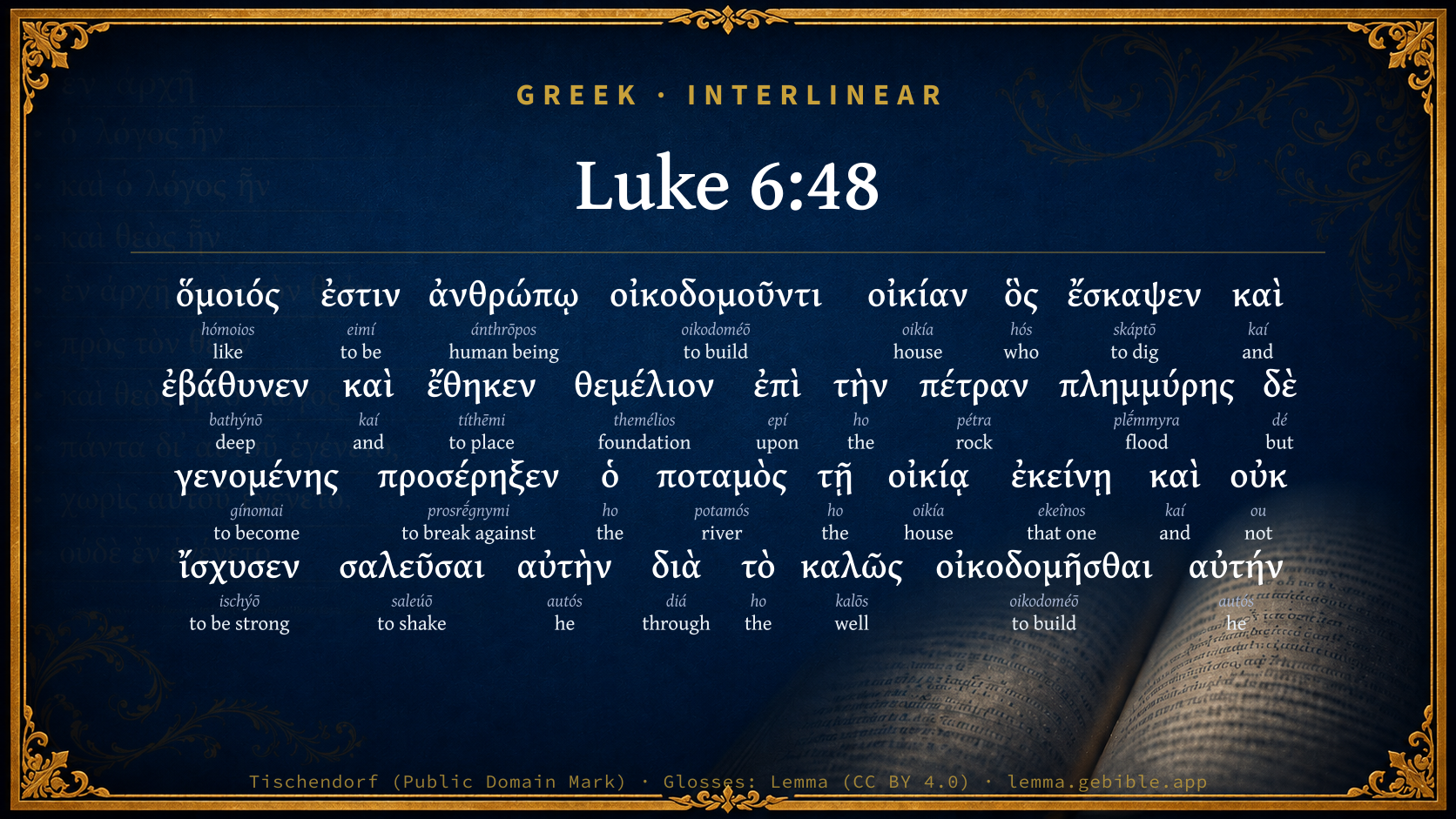
He is like a man building a house, who dug and went deep, and laid a foundation on the rock. When a flood arose, the stream broke against that house, and could not shake it, because it was founded on the rock.
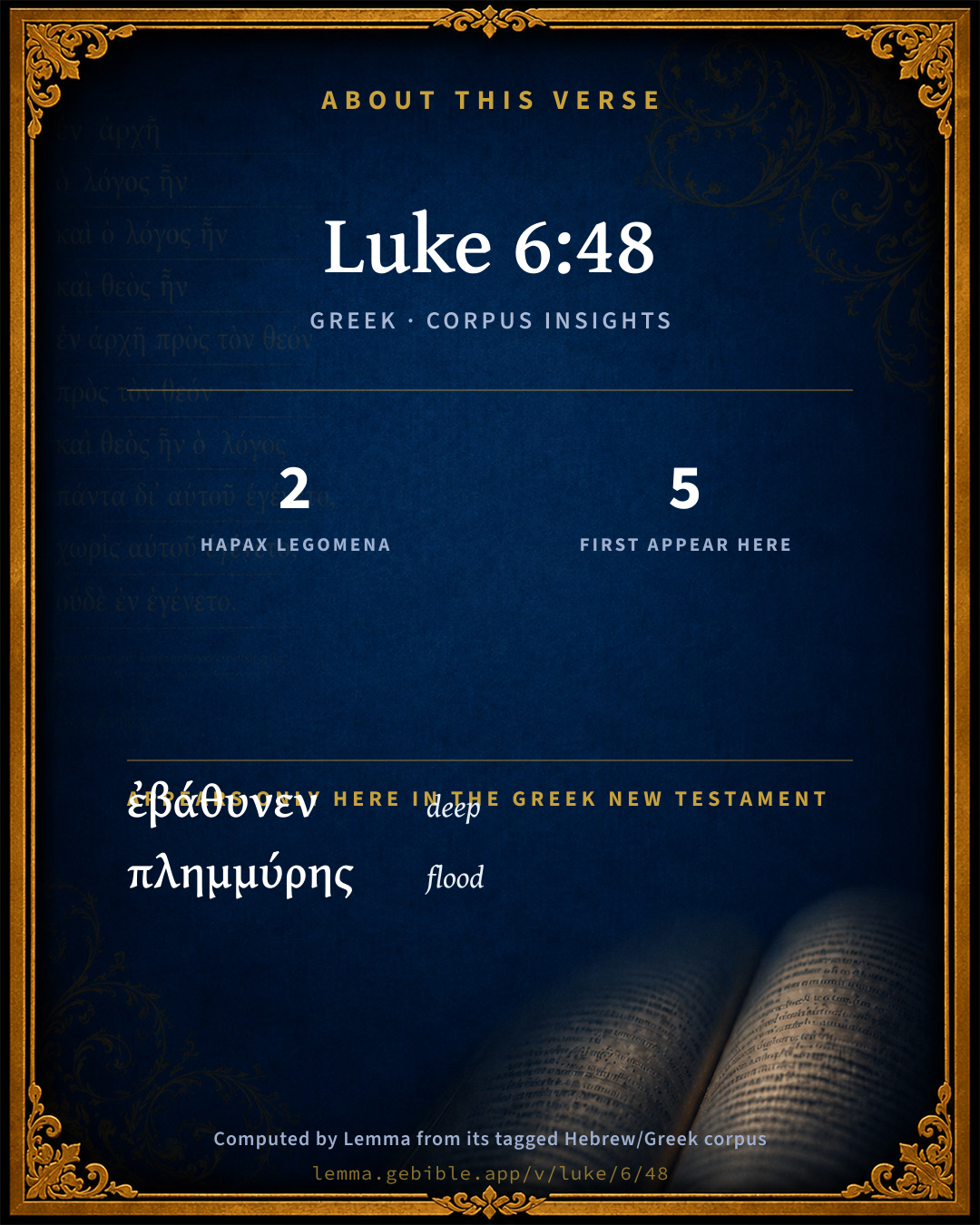
- 2 hapax legomena — only here in the Greek New Testament
- 5 first appearances in the Greek New Testament
Download a study sheet
One document with this verse’s original text, its word-by-word gloss line, the meaning frame, cross-references with their text, attributed commentary, and full source and license credits — printable, and it pastes into notes with its structure intact.
This verse Autodidact and up
A passage Seminary Student
Up to 50 verses in one chapter. A passage sheet keeps up to 6 commentary sources and 12 cross-references per verse, in the order this page ranks them, and says so on the sheet whenever that leaves anything out. Ask for a single verse and you get the Autodidact verse sheet above.
Everything on this page stays free to read, with no account — the sheet is a download of what is already on screen, not access to it.
Compare translations 3
The same verse in 3 English versions, stacked beneath the original-language interlinear above. Click any original word for its lexicon entry.
Each is an independent rendering of the whole verse — the interlinear is not word-aligned to these translations.
Highlighted words mark where these versions differ — a whole-verse word diff, not a word-by-word alignment.
-
World English Bible Public Domain
He is like a man building a house, who dug and went deep, and laid a foundation on the rock. When a flood arose, the stream broke against that house, and could not shake it, because it was founded on the rock.
-
King James Version Public Domain
He is like a man which built an house, and digged deep, and laid the foundation on a rock: and when the flood arose, the stream beat vehemently upon that house, and could not shake it: for it was founded upon a rock.
-
unfoldingWord Literal Text CC BY-SA 4.0
He is like a man building a house, who dug down and dug deep and laid a foundation on the rock. Then a flood having come, the torrent of water flowed against that house, but it could not shake it, because it had been built well.
unfoldingWord Literal Text — © unfoldingWord, licensed CC BY-SA 4.0. Word-aligned USFM3 via Door43 (git.door43.org/unfoldingWord/en_ult).
Show all 19 translations
Every available English version of this verse, each an independent rendering of the whole verse.
-
World English Bible Public Domain
He is like a man building a house, who dug and went deep, and laid a foundation on the rock. When a flood arose, the stream broke against that house, and could not shake it, because it was founded on the rock.
-
Berean Standard Bible Public Domain
He is like a man building a house, who dug down deep and laid his foundation on the rock. When the flood came, the torrent crashed against that house but could not shake it, because it was well built.
-
Majority Standard Bible Public Domain
He is like a man building a house, who dug down deep and laid his foundation on the rock. When the flood came, the torrent crashed against that house but could not shake it, because its foundation was on the rock.
-
King James Version Public Domain
He is like a man which built an house, and digged deep, and laid the foundation on a rock: and when the flood arose, the stream beat vehemently upon that house, and could not shake it: for it was founded upon a rock.
-
American Standard Version (1901) Public Domain
he is like a man building a house, who digged and went deep, and laid a foundation upon the rock: and when a flood arose, the stream brake against that house, and could not shake it: because it had been well builded.
-
Revised Version (1885) Public Domain
he is like a man building a house, who digged and went deep, and laid a foundation upon the rock: and when a flood arose, the stream brake against that house, and could not shake it: because it had been well builded.
-
Geneva Bible (1599) Public Domain
He is like a man which built an house, and digged deepe, and layde the fundation on a rocke: and when the waters arose, the flood beat vpon that house, and coulde not shake it: for it was grounded vpon a rocke.
-
Douay-Rheims (1899) Public Domain
He is like to a man building a house, who digged deep, and laid the foundation upon a rock. And when a flood came, the stream beat vehemently upon that house, and it could not shake it; for it was founded on a rock.
-
Young's Literal Translation Public Domain
he is like to a man building a house, who did dig, and deepen, and laid a foundation upon the rock, and a flood having come, the stream broke forth on that house, and was not able to shake it, for it had been founded upon the rock.
-
Literal Standard Version CC BY-SA 4.0
he is like to a man building a house, who dug and deepened, and laid a foundation on the rock, and a flood having come, the stream broke forth on that house, and was not able to shake it, for it had been founded on the rock.
-
Unlocked Literal Bible CC BY-SA 4.0
He is like a man building a house, who dug down deep in the ground and built the house's foundation on solid rock. When a flood came, the torrent of water flowed against that house, but could not shake it, because it had been well built.
-
unfoldingWord Literal Text CC BY-SA 4.0
He is like a man building a house, who dug down and dug deep and laid a foundation on the rock. Then a flood having come, the torrent of water flowed against that house, but it could not shake it, because it had been built well.
-
Darby Bible Public Domain
He is like a man building a house, who dug and went deep, and laid a foundation on the rock; but a great rain coming, the stream broke upon that house, and could not shake it, for it had been founded on the rock.
-
World Messianic Bible Public Domain
He is like a man building a house, who dug and went deep and laid a foundation on the rock. When a flood arose, the stream broke against that house, and could not shake it, because it was founded on the rock.
-
Webster's Bible Public Domain
He is like a man who built a house, and digged deep, and laid the foundation on a rock: and when the flood arose, the stream beat vehemently upon that house, and could not shake it: for it was founded upon a rock.
-
Free Bible Version CC BY-SA 4.0
That person is like a man building a house. He digs down deep and lays the foundations on solid rock. When the river bursts its banks and the floodwater breaks against the house it's not damaged because it's built so well.
-
Bible in Basic English Public Domain
He is like a man building a house, who went deep and put the base of it on a rock; and when the water came up and the river was driving against that house, it was not moved, because the building was good.
-
Text-Critical English NT CC BY 4.0
He is like a man building a house, who dug deep and laid a foundation on the rock. When a flood came, the river burst against that house but could not shake it, for it was founded on the rock.
-
Tyndale New Testament (1534) Public Domain
He is like a man which bilt an housse: and digged depe and layde the foundacion on a rocke. When the waters arose the fludde bet apon that housse and coulde not move that. For it was grounded apon a rocke.
Literal Standard Version (2020), Covenant Press — licensed CC BY-SA 4.0. Text via the HelloAO Bible API (eBible.org). Unlocked Literal Bible (unfoldingWord) — licensed CC BY-SA 4.0. Text via the HelloAO Bible API (eBible.org). unfoldingWord Literal Text — © unfoldingWord, licensed CC BY-SA 4.0. Word-aligned USFM3 via Door43 (git.door43.org/unfoldingWord/en_ult). Free Bible Version, Dr. Jonathan Gallagher — licensed CC BY-SA 4.0. Text via the HelloAO Bible API (eBible.org).
Word by word
More ways to search: Search by grammar → Find every occurrence → Compare this word →
Practice this passage: Drill this verse → Learn its vocabulary →
- Appears 1× in the Greek New Testament
- First appears here
- Part of Speech
- Verb
- Tense
- Aorist
- Voice
- Active
- Mood
- Indicative
- Person
- 3rd person
- Number
- Singular
Full Thayer's Definition
- ὅμοιός hómoios G3664 “like” Adjective, Nominative, Singular, Masculine
- ἐστιν eimí G1510 “to be” Verb, Present, Active, Indicative, 3rd person, Singular
- ἀνθρώπῳ ánthrōpos G444 “human being” Noun, Dative, Singular, Masculine
- οἰκοδομοῦντι oikodoméō G3618 “to build” Verb, Present, Active, Participle, Dative, Singular, Masculine
- οἰκίαν oikía G3614 “house” Noun, Accusative, Singular, Feminine
- ὃς hós G3739 “who” Relative pronoun, Nominative, Singular, Masculine
- ἔσκαψεν skáptō G4626 “to dig” Verb, Aorist, Active, Indicative, 3rd person, Singular
- καὶ kaí G2532 “and” Conjunction
- ἐβάθυνεν bathýnō G900 “deep” Verb, Aorist, Active, Indicative, 3rd person, Singular
- καὶ kaí G2532 “and” Conjunction
- ἔθηκεν títhēmi G5087 “to place” Verb, Aorist, Active, Indicative, 3rd person, Singular
- θεμέλιον themélios G2310 “foundation” Noun, Accusative, Singular, Masculine
- ἐπὶ epí G1909 “upon” Preposition
- τὴν ho G3588 “the” Article, Accusative, Singular, Feminine
- πέτραν pétra G4073 “rock” Noun, Accusative, Singular, Feminine
- πλημμύρης plḗmmyra G4132 “flood” Noun, Genitive, Singular, Feminine
- δὲ dé G1161 “but” Conjunction
- γενομένης gínomai G1096 “to become” Verb, Aorist, Middle deponent, Participle, Genitive, Singular, Feminine
- προσέρηξεν prosrḗgnymi G4366 “to break against” Verb, Aorist, Active, Indicative, 3rd person, Singular
- ὁ ho G3588 “the” Article, Nominative, Singular, Masculine
- ποταμὸς potamós G4215 “river” Noun, Nominative, Singular, Masculine
- τῇ ho G3588 “the” Article, Dative, Singular, Feminine
- οἰκίᾳ oikía G3614 “house” Noun, Dative, Singular, Feminine
- ἐκείνῃ ekeînos G1565 “that one” Demonstrative pronoun, Dative, Singular, Feminine
- καὶ kaí G2532 “and” Conjunction
- οὐκ ou G3756 “not” Particle, Negative
- ἴσχυσεν ischýō G2480 “to be strong” Verb, Aorist, Active, Indicative, 3rd person, Singular
- σαλεῦσαι saleúō G4531 “to shake” Verb, Aorist, Active, Infinitive
- αὐτὴν autós G846 “he” Personal pronoun, Accusative, Singular, Feminine
- διὰ diá G1223 “through” Preposition
- τὸ ho G3588 “the” Article, Accusative, Singular, Neuter
- καλῶς kalōs G2573 “well” Adverb
- οἰκοδομῆσθαι oikodoméō G3618 “to build” Verb, Perfect, Passive, Infinitive
- αὐτήν autós G846 “he” Personal pronoun, Accusative, Singular, Feminine
About this verse
These counts appear in no published source. They are computed here, from the morphology-tagged text and Lemma’s own curated glosses. What Lemma adds →
- 34
- words
- 26
- distinct lemmas
- Gospels
- section
Notable vocabulary
2 hapax legomena — words that appear only here in the entire Greek New Testament:
First appearance in Scripture
These words make their first canonical appearance in the Greek New Testament here:
Shared distinctive vocabulary
προσέρηξεν to break against G4366 occurs in 2 verses of the Greek New Testament. Also found in:
Cross-references
35Topical passages linked to Luke 6:48 in the Treasury of Scripture Knowledge — connected by theme and wording, ordered by reader-vote popularity; previews shown in the World English Bible.
- 1 Corinthians 3:10–15 According to the grace of God which was given to me, as a wise master builder I laid a foundation, and another builds on it. But let each man be careful how he builds on it.
- Psalms 62:2 He alone is my rock and my salvation, my fortress-- I will never be greatly shaken.
- Matthew 7:25–26 The rain came down, the floods came, and the winds blew, and beat on that house; and it didn't fall, for it was founded on the rock.
- Isaiah 28:16 therefore thus says the Lord Yahweh, Behold, I lay in Zion for a foundation a stone, a tried stone, a precious corner -[stone] of sure foundation: he who believes shall not be in haste.
- Jude 1:24 Now to him who is able to keep them from stumbling, and to present you faultless before the presence of his glory in great joy,
- Isaiah 26:4 Trust in Yahweh forever; for in Yah, Yahweh, is an everlasting Rock.
- Ephesians 2:20 being built on the foundation of the apostles and prophets, Christ Jesus himself being the chief cornerstone;
- 1 Peter 2:4–6 coming to him, a living stone, rejected indeed by men, but chosen by God, precious.
- 2 Samuel 22:32 For who is God, save Yahweh? Who is a rock, save our God?
- Psalms 32:6 For this, let everyone who is godly pray to you in a time when you may be found. Surely when the great waters overflow, they shall not reach to him.
- 2 Timothy 2:19 However God's firm foundation stands, having this seal, "The Lord knows those who are his," and, "Let every one who names the name of the Lord depart from unrighteousness."
- 1 John 2:28 Now, little children, remain in him, that when he appears, we may have boldness, and not be ashamed before him at his coming.
- 2 Samuel 22:47 Yahweh lives; Blessed be my rock; Exalted be God, the rock of my salvation,
- Revelation 6:14–17 The sky was removed like a scroll when it is rolled up. Every mountain and island were moved out of their places.
- Psalms 95:1 Oh come, let's sing to Yahweh. Let's shout aloud to the rock of our salvation!
- Psalms 125:1–2 Those who trust in Yahweh are as Mount Zion, Which can't be moved, but remains forever.
- Proverbs 10:25 When the whirlwind passes, the wicked is no more; But the righteous stand firm forever.
- Isaiah 59:19 So shall they fear the name of Yahweh from the west, and his glory from the rising of the sun; for he will come as a rushing stream, which the breath of Yahweh drives.
- Romans 8:35–38 Who shall separate us from the love of Christ? Could oppression, or anguish, or persecution, or famine, or nakedness, or peril, or sword?
- 1 Corinthians 15:55–58 "Death, where is your sting? Hades, where is your victory?"
- Deuteronomy 32:15 But Jeshurun grew fat, and kicked: You have grown fat, you are grown thick, you are become sleek; Then he forsook God who made him, Lightly esteemed the Rock of his salvation.
- 2 Samuel 22:5 For the waves of death compassed me; The floods of ungodliness made me afraid:
- Nahum 1:8 But with an overflowing flood, he will make a full end of her place, and will pursue his enemies into darkness.
- John 16:33 I have told you these things, that in me you may have peace. In the world you have oppression; but cheer up! I have overcome the world."
- Acts 14:22 confirming the souls of the disciples, exhorting them to continue in the faith, and that through many afflictions we must enter into the Kingdom of God.
- 2 Peter 1:10 Therefore, brothers, be more diligent to make your calling and election sure. For if you do these things, you will never stumble.
- Deuteronomy 32:31 For their rock is not as our Rock, Even our enemies themselves being judges.
- 1 Samuel 2:2 There is none holy as Yahweh; For there is none besides you, Neither is there any rock like our God.
- 2 Samuel 22:2 and he said, Yahweh is my rock, and my fortress, and my deliverer, even mine;
- 2 Samuel 23:3 The God of Israel said, The Rock of Israel spoke to me: One who rules over men righteously, Who rules in the fear of God,
- Psalms 46:1–3 God is our refuge and strength, A very present help in trouble.
- Psalms 93:3–4 The floods have lifted up, Yahweh, The floods have lifted up their voice. The floods lift up their waves.
- 2 Peter 3:10–14 But the day of the Lord will come as a thief in the night; in which the heavens will pass away with a great noise, and the elements will be dissolved with fervent heat, and the earth and the works that are in it will be burned up.
- Revelation 20:11–15 I saw a great white throne, and him who sat on it, from whose face the earth and the heaven fled away. There was found no place for them.
- Deuteronomy 32:18 Of the Rock that became your father, you are unmindful, Have forgotten God who gave you birth.
Cross-references courtesy of OpenBible.info (CC BY 4.0).
Where the printed editions differ
1 variantPlaces in this verse where the major printed Greek editions disagree on the wording in a way that affects the translation — a comparison of editions, not a manuscript-by-manuscript collation. The editions are the modern critical texts (Nestlé-Aland 28/27, SBL, Westcott-Hort, Tregelles, Tyndale House) and the traditional texts behind the KJV (the Textus Receptus and the Byzantine/Majority text). It is not a claim about which reading is original.
-
Extra text
καλῶς οἰκοδομῆσθαι
“well to have been built”
In NA28NA27TynSBLWHTreg Not in TRByzκαλῶς (kalōs) 'well' is only in older manuscripts (NA28+NA27+Tyn+SBL+WH+Treg)
Textual data: Translators Amalgamated Greek New Testament (STEPBible TAGNT) · CC BY 4.0.
Lesson kit
Teaching starters — assembled from the data on this page, not authored interpretation. Every prompt links to the verse data it draws on. Edit before teaching.
Luke, in the Gospels, opens this verse with 34 words (26 distinct Greek lemmas). Its most distinctive word is bathýnō (“deep”). A historical commentator’s framing appears above. Read the whole chapter for the surrounding context.
Discussion questions
- What does “deep” (bathýnō) contribute to the verse as a whole?
- 2 words here appear nowhere else in the Greek New Testament. Why might the author reach for such rare wording?
- 5 words make their first appearance in Scripture here. What does this debut establish?
- How does Luke 6:49, which shares the word «to break against», read alongside this verse?
- What does the repetition of “to build” (2× in this one verse) do in this verse?
- The translations on this page render this verse differently — a whole-verse word diff, not a word-by-word alignment. What might account for the different wordings?
- Compare how Bengel's Gnomon and Expositor's Greek Testament read this verse. Where do they agree or differ?
Things to notice
- 2 words in this verse appear nowhere else in the Greek New Testament.
- 5 words make their first canonical appearance in Scripture here.
- These translations choose different wording for 26 words in this verse.
- “to build” occurs 2× in this single verse.
- 26 distinct Greek lemmas span 34 words in this verse.
Commentary
Notes on Luke 6:48 from classic Christian and Jewish commentators (each source and its license shown beneath its notes). The classic Christian expositions comment on the surrounding passage and are grouped to its opening verse, so a note may address several verses; the Jewish commentaries on the Tanakh (Rashi and others) are per-verse, so they appear only where the commentator wrote on this verse.
Lemma curates 59 commentaries, every one of them public domain or Creative Commons licensed, each selected and text-cleaned for this edition rather than reprinted as found. About our sources →
Bengel's Gnomon
Johann Albrecht Bengel
Bengel's Gnomon of the New Testament — English translation (T&T Clark, Edinburgh, 1860) — public domain. Text from a community e-Sword module.
Expositor's Greek Testament
ed. W. Robertson Nicoll
The Expositor's Greek Testament, edited by W. Robertson Nicoll (1897–1910) — public domain. Text from a community e-Sword module.
Adam Clarke's Commentary
Adam Clarke's Commentary on the Bible (1810–1826) — public domain. Text from a community e-Sword/MySword module.
Ellicott's Commentary for English Readers
A Bible Commentary for English Readers, edited by Charles John Ellicott (1878–1897) — public domain. Text from a community e-Sword module.
The Cambridge Bible for Schools and Colleges
gen. ed. J. J. S. Perowne
The Cambridge Bible for Schools and Colleges (gen. ed. J. J. S. Perowne; Cambridge University Press, 1878–1918) — public domain. Text from a community e-Sword module.
John Gill's Exposition
John Gill's Exposition of the Whole Bible (1746–1763) — public domain (CC PDM 1.0). Text via the HelloAO Bible API.
Trapp's Complete Commentary
John Trapp
John Trapp, A Commentary or Exposition upon All the Books of the Old and New Testament (1647–1656) — public domain. Text from a community e-Sword module.
Haydock's Catholic Bible Commentary
George Leo Haydock (1774–1849), Haydock's Catholic Family Bible and Commentary, 1859 edition — public domain. Excludes Psalms (Douay-Rheims chapter numbering differs from Protestant) and Deuterocanonical books (Catholic canon only).
Cambridge Greek Testament for Schools and Colleges
Cambridge Greek Testament for Schools and Colleges (Cambridge University Press, 1896; 21 vols, various authors incl. Carr, Maclear, Plummer, Farrar, Lumby, Moule, M. R. James, Simcox) — public domain. Text from a community e-Sword module.
Alford’s Greek Testament
Henry Alford
Henry Alford, The Greek Testament (1849–1861) — public domain. Text from a community e-Sword module.
International Critical Commentary
International Critical Commentary — older volumes (1896–1929), various authors — public domain. Text from a community e-Sword module.
Vincent's Word Studies in the New Testament
Marvin R. Vincent
Marvin R. Vincent, Word Studies in the New Testament (1887–1900) — public domain. Text from a community e-Sword/MySword module.