
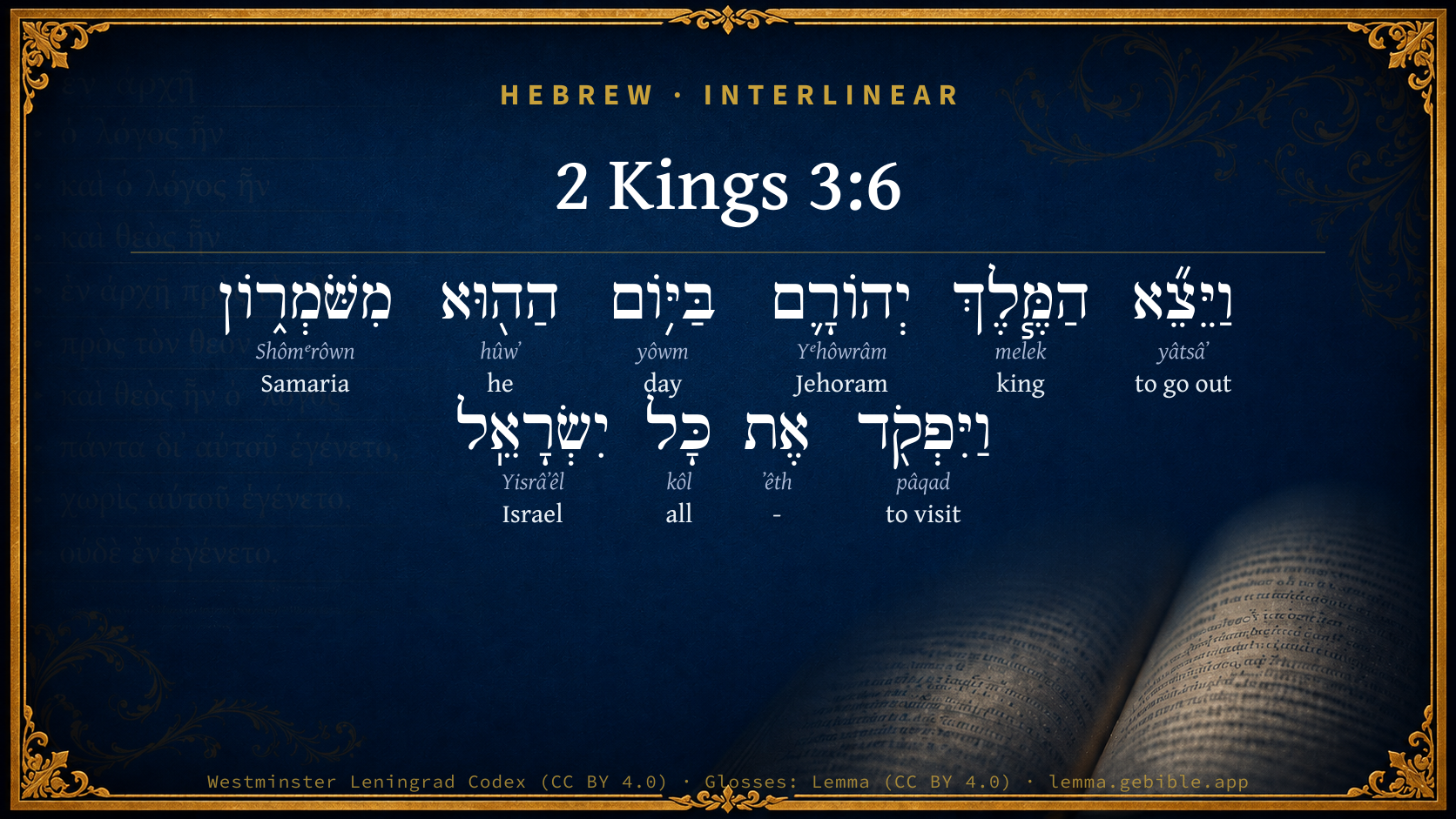
2 Kings 3:6

Hebrew (Westminster Leningrad Codex) 2 Kings 3:6 appears in the Hebrew Old Testament. The text above is from the Westminster Leningrad Codex. Each word links to its Strong’s number, a concise gloss, and parsing drawn from the Open Scriptures Hebrew Bible morphology. Click any word for its full Brown-Driver-Briggs (BDB) entry.
Download image
Cite this verse

2 Kings 3:6 (World English Bible). Public Domain. Lemma interlinear Bible study tool, https://lemma.gebible.app/v/2-kings/3/6.

Show BibTeX & RIS
BibTeX
RIS
English Translation
King Jehoram went out of Samaria at that time, and mustered all Israel.
World English Bible · Public Domain
Download a study sheet

One document with this verse’s original text, its word-by-word gloss line, the meaning frame, cross-references with their text, attributed commentary, and full source and license credits — printable, and it pastes into notes with its structure intact.

This verse Autodidact and up

Study sheet (.html) Plain text (.txt)

A passage Seminary Student

Up to 50 verses in one chapter. A passage sheet keeps up to 6 commentary sources and 12 cross-references per verse, in the order this page ranks them, and says so on the sheet whenever that leaves anything out. Ask for a single verse and you get the Autodidact verse sheet above.

Everything on this page stays free to read, with no account — the sheet is a download of what is already on screen, not access to it.

Want to remove ads? Support Godless Engineer
Compare translations 3

The same verse in 3 English versions, stacked beneath the original-language interlinear above. Click any original word for its lexicon entry.

Each is an independent rendering of the whole verse — the interlinear is not word-aligned to these translations.

Highlighted words mark where these versions differ — a whole-verse word diff, not a word-by-word alignment.

  • World English Bible Public Domain
    King Jehoram went out of Samaria at that time, and mustered all Israel.
  • King James Version Public Domain
    And king Jehoram went out of Samaria the same time, and numbered all Israel.
  • unfoldingWord Literal Text CC BY-SA 4.0
    And King Jehoram went out from Samaria on that day, and he mustered all of Israel.

unfoldingWord Literal Text — © unfoldingWord, licensed CC BY-SA 4.0. Word-aligned USFM3 via Door43 (git.door43.org/unfoldingWord/en_ult).

Versions to compare (up to 4)

3 of 4 selected

Show all 18 translations

Every available English version of this verse, each an independent rendering of the whole verse.

  • World English Bible Public Domain
    King Jehoram went out of Samaria at that time, and mustered all Israel.
  • Berean Standard Bible Public Domain
    So at that time King Jehoram set out from Samaria and mobilized all Israel.
  • Majority Standard Bible Public Domain
    So at that time King Jehoram set out from Samaria and mobilized all Israel.
  • King James Version Public Domain
    And king Jehoram went out of Samaria the same time, and numbered all Israel.
  • American Standard Version (1901) Public Domain
    And king Jehoram went out of Samaria at that time, and mustered all Israel.
  • Revised Version (1885) Public Domain
    And king Jehoram went out of Samaria at that time, and mustered all Israel.
  • Geneva Bible (1599) Public Domain
    Therefore King Iehoram went out of Samaria the same season, and nombred all Israel,
  • Douay-Rheims (1899) Public Domain
    And king Joram went out that day from Samaria, and mustered all Israel.
  • Young's Literal Translation Public Domain
    And king Jehoram goeth out in that day from Samaria, and inspecteth all Israel,
  • Literal Standard Version CC BY-SA 4.0
    And King Jehoram goes out from Samaria in that day, and inspects all Israel,
  • Unlocked Literal Bible CC BY-SA 4.0
    So King Joram left Samaria at that time to mobilize all Israel for war.
  • unfoldingWord Literal Text CC BY-SA 4.0
    And King Jehoram went out from Samaria on that day, and he mustered all of Israel.
  • Darby Bible Public Domain
    And at that time king Jehoram went out of Samaria and inspected all Israel.
  • World Messianic Bible Public Domain
    King Jehoram went out of Samaria at that time, and mustered all Israel.
  • Webster's Bible Public Domain
    And king Jehoram went out of Samaria the same time, and numbered all Israel.
  • Free Bible Version CC BY-SA 4.0
    Immediately King Joram called up the whole Israelite army and left Samaria.
  • Bible in Basic English Public Domain
    At that time, King Jehoram went out from Samaria and got all Israel together in fighting order.
  • JPS Tanakh (1917) Public Domain
    And king Jehoram went out of Samaria at that time, and mustered all Israel.

Literal Standard Version (2020), Covenant Press — licensed CC BY-SA 4.0. Text via the HelloAO Bible API (eBible.org). Unlocked Literal Bible (unfoldingWord) — licensed CC BY-SA 4.0. Text via the HelloAO Bible API (eBible.org). unfoldingWord Literal Text — © unfoldingWord, licensed CC BY-SA 4.0. Word-aligned USFM3 via Door43 (git.door43.org/unfoldingWord/en_ult). Free Bible Version, Dr. Jonathan Gallagher — licensed CC BY-SA 4.0. Text via the HelloAO Bible API (eBible.org).

Word by word

More ways to search: Search by grammar → Find every occurrence → Compare this word →

Practice this passage: Drill this verse → Learn its vocabulary →

יְהוֹרָ֛ם
Yᵉhôwrâm
H3088
“Jehoram”
Noun, Proper
Part of Speech
Noun
Type
Proper
Full BDB Definition

Origin: from H3068 and H7311

TWOT: None

Jehoram or Joram = "Jehovah is exalted" - son of king Jehoshaphat of Judah and himself king of Judah for 8 years; his wife was the wicked Athaliah who was probably the instigator for his returning the nation of Judah to the worship of Baal - son of king Ahab of the northern kingdom of Israel and king of Israel himself for 12 years; he was murdered by Jehu on the plot of land for which his father had murdered Naboth thus fulfilling the prophecy of Elijah to the very letter - a priest in the reign of Jehoshaphat
  1. וַיֵּצֵ֞א yâtsâʼ H3318 “and · to go out” Conjunction + Verb, Qal, Sequential Imperfect, 3rd Person, Masculine, Singular
  2. הַמֶּ֧לֶךְ melek H4428 “the · king” Particle, Definite Article + Noun, Common, Masculine, Singular, Absolute
  3. בַּיּ֥וֹם yôwm H3117 “in/at the · day” Preposition, Determined + Noun, Common, Masculine, Singular, Absolute
  4. הַה֖וּא hûwʼ H1931 “the · he” Particle, Definite Article + Pronoun, Personal, 3rd Person, Masculine, Singular
  5. מִשֹּׁמְר֑וֹן Shômᵉrôwn H8111 “from · Samaria” Preposition + Noun, Proper
  6. וַיִּפְקֹ֖ד pâqad H6485 “and · to visit” Conjunction + Verb, Qal, Sequential Imperfect, 3rd Person, Masculine, Singular
  7. אֶת ʼêth H853 “-” Particle, Direct Object
  8. כָּל kôl H3605 “all of” Noun, Common, Masculine, Singular, Construct
  9. יִשְׂרָאֵֽל Yisrâʼêl H3478 “Israel” Noun, Proper

About this verse

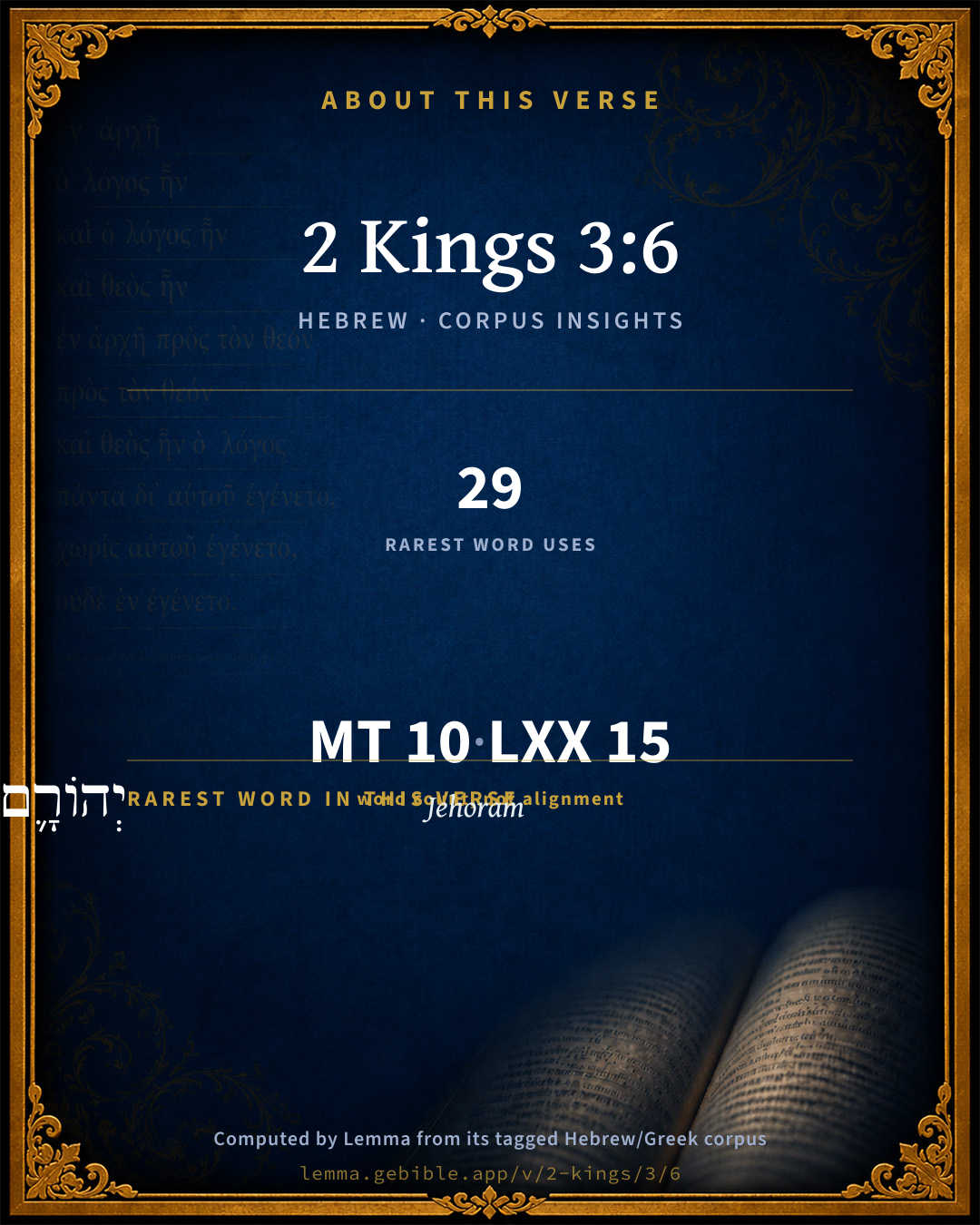
These counts appear in no published source. They are computed here, from the morphology-tagged text and Lemma’s own curated glosses. What Lemma adds →

10
words
10
distinct lemmas
Historical
section

Shared distinctive vocabulary

יְהוֹרָ֛ם Jehoram H3088 occurs in 26 verses of the Hebrew Bible. Also found in:

Grammatical profile

  • 2 verbs
  • 6 nouns
  • 1 pronoun
  • 1 particle

Verb forms

  • וַיֵּצֵ֞א Qal · Sequential Imperfect
  • וַיִּפְקֹ֖ד Qal · Sequential Imperfect

Hebrew & Septuagint length

In English translation the verse runs 13 words from the Hebrew and 14 from the Septuagint (LXX English) — closely comparable.

A rough comparison of the two English renderings, which tokenize alike — not a word-level alignment.

Word counts can differ between the Hebrew and the Greek without any difference in meaning — e.g. the Hebrew direct-object marker אֵת has no separate Greek word, and Greek often adds the article ὁ.

In the original languages it is 10 Hebrew tokens and 15 Greek tokens — but the two are counted differently (Hebrew bundles its prefixes and suffixes into one token; the Greek is in lemma form), so that isn’t a like-for-like length.

Cross-references

4

Topical passages linked to 2 Kings 3:6 in the Treasury of Scripture Knowledge — connected by theme and wording, ordered by reader-vote popularity; previews shown in the World English Bible.

  • 1 Samuel 11:8 He numbered them in Bezek; and the children of Israel were three hundred thousand, and the men of Judah thirty thousand.
  • 1 Samuel 15:4 Saul summoned the people, and numbered them in Telaim, two hundred thousand footmen, and ten thousand men of Judah.
  • 2 Samuel 24:1–25 Again the anger of Yahweh was kindled against Israel, and he moved David against them, saying, Go, number Israel and Judah.
  • 1 Kings 20:27 The children of Israel were mustered, and were provisioned, and went against them: and the children of Israel encamped before them like two little flocks of kids; but the Syrians filled the country.

Cross-references courtesy of OpenBible.info (CC BY 4.0).

Hebrew and Greek witnesses Masoretic Hebrew ↔ Greek Septuagint

The same verse in the two great witnesses to the Old Testament, shown verse-for-verse.

These are two independent witnesses, not word-aligned to each other, and the Septuagint is shown in lemma (dictionary) form.

Hebrew 2 Kings 3:6 Masoretic · Westminster Leningrad Codex

וַיֵּצֵ֞א הַמֶּ֧לֶךְ יְהוֹרָ֛ם בַּיּ֥וֹם הַה֖וּא מִשֹּׁמְר֑וֹן וַיִּפְקֹ֖ד אֶת כָּל יִשְׂרָאֵֽל

King Jehoram went out of Samaria at that time, and mustered all Israel.

World English Bible · Public Domain

Greek LXX 2 Kings 3:6 Septuagint · lemma form

καί ἐκἔρχομαι ὁ βασιλεύς ιωραμ ἐν ὁ ἡμέρα ἐκεῖνος ἐκ σαμαρεία καί ἐπισκέπτομαι ὁ ἰσραήλ

And king Joram went forth in that day out of Samaria, and numbered Israel.

LXX2012 (modern English Septuagint) · Public Domain

On this verse, The Pulpit Commentary discusses the Septuagint’s reading. Read the note in Commentary ↓

Hebrew: Westminster Leningrad Codex (CC BY 4.0). Greek: Septuagint (public domain); English from LXX2012 (modern English Septuagint) (Public Domain). How the Septuagint differs from the Hebrew →

Targum (Aramaic paraphrase)

1

The Targum is the ancient Jewish Aramaic paraphrase of the Hebrew Scriptures — an interpretive translation, not the Hebrew text itself. Onkelos (literal) and Pseudo-Jonathan (expansive) render the Torah, and Jonathan the Prophets. Coverage is partial: where no permissively-licensed English translation exists for a verse, only the Aramaic is shown. This is verse-level text, not a word-by-word alignment to the Hebrew.

  1. Targum Jonathan Prophets (Joshua–Malachi)
    וּנְפַק מַלְכָּא יְהוֹרָם בְּיוֹמָא הַהוּא מִשֹׁמְרוֹן וּמְנָא יַת כָּל יִשְׂרָאֵל:

    (no public-domain English translation for this verse)

    Targum Jonathan — Aramaic: “Mikraot Gedolot” (public domain). English: “Sefaria Community Translation” (CC0 1.0 (public-domain dedication)); “London "Chaldee Paraphrase," 1871” (public domain). Text via Sefaria.

Commentary

Notes on 2 Kings 3:6 from classic Christian and Jewish commentators (each source and its license shown beneath its notes). The classic Christian expositions comment on the surrounding passage and are grouped to its opening verse, so a note may address several verses; the Jewish commentaries on the Tanakh (Rashi and others) are per-verse, so they appear only where the commentator wrote on this verse.

Lemma curates 59 commentaries, every one of them public domain or Creative Commons licensed, each selected and text-cleaned for this edition rather than reprinted as found. About our sources →

Matthew Henry's Commentary

Jehoram has no sooner got the sceptre into his hand than he takes the sword into his hand, to reduce Moab. Crowns bring great cares and perils to the heads that wear them; no sooner in honour than in war. Now here we have,

I. The concerting of this expedition between Jehoram king of Israel and Jehoshaphat king of Judah. Jehoram levied an army (Kg2 3:6), and such an opinion he had of the godly king of Judah that, 1. He courted him to be his confederate: Wilt thou go with me against Moab? And he gained him. Jehoshaphat said, I will go up. I am as thou art, Kg2 3:7. Judah and Israel, though unhappily divided from each other, yet can unite against Moab a common enemy. Jehoshaphat upbraids them not with their revolt from the house of David, nor makes it an article of their alliance that they shall return to their allegiance, though he had good reason to insist upon it, but treats with Israel as a sister-kingdom. Those are no friends to their own peace and strength who can never find in their hearts to forgive and forget an old injury, and unite with those that have formerly broken in upon their rights. Quod initio non vulvit, tractu temporis invalescit - That which was originally destitute of authority in the progress of time acquires it. 2. He consulted him as his confidant, Kg2 3:8. He took advice of Jehoshaphat, who had more wisdom and experience than himself, which way they should make their descent upon the country of Moab; and he advised that they should not march against them the nearest way, over Jordan, but go round through the wilderness of Edom, that they might take the king of Edom (who was tributary to him) and his forces along with them If two be better than one, much more will not a three-fold cord be easily broken. Jehoshaphat had like to have paid dearly for joining with Ahab, yet he joined with his son, and this expedition also had like to have been fatal to him. There is nothing got by being yoked with unbelievers.

II. The great straits that the army of the confederates was reduced to in this expedition. Before they saw the face of an enemy they were all in danger of perishing for want of water, Kg2 3:9. This ought to have been considered before they ventured a march through the wilderness, the same wilderness (or very near it) where their ancestors wanted water, Num 20:2. God suffers his people, by their own improvidence, to bring themselves into distress, that the wisdom, power, and goodness of his providence may be glorified in their relief. What is more cheap and common than water? It is drink to every beast of the field, Psa 104:11. Yet the want of it will soon humble and ruin kings and armies. The king of Israel sadly lamented the present distress, and the imminent danger it put them in of falling into the hands of their enemies the Moabites, to whom, when weakened by thirst, they would be an easy prey, Kg2 3:10. it was he that had called these kings together; yet he charges it upon Providence, and reflects upon that as unkind: The Lord has called them together. Thus the foolishness of man perverteth his way, and then his heart fretteth against the Lord, Pro 19:3.

III. Jehoshaphat's good motion to ask counsel of God in this exigency, Kg2 3:11. The place they were now in could not but remind them of the wonders of which their fathers told them, the waters fetched out of the rock for Israel's seasonable supply. The thought of this, we may suppose, encouraged Jehoshaphat to ask, Is there not here a prophet of the Lord, like unto Moses? He was the more concerned because it was by his advice that they fetched this compass through the wilderness, Kg2 3:8. It was well that Jehoshaphat enquired of the Lord now, but it would have been much better if he had done it sooner, before he engaged in this war, or steered this course; so the distress might have been prevented. Good men are sometimes remiss and forgetful, and neglect their duty till necessity and affliction drive them to it.

IV. Elisha recommended as a proper person for them to consult with Kg2 3:11. And here we may wonder, 1. That Elisha should follow the camp, especially in such a tedious march as this, as a volunteer, unasked, unobserved, and in no post of honour at all; not in the office of priest of the war (Deu 20:2) or president of the council of war, but in such obscurity that none of the kings knew they had such a jewel in the treasures of their camp, nor so good a friend in their retinue. We may suppose it was by special direction from heaven that Elisha attended the war, as the chariot of Israel and the horsemen thereof. Thus does God anticipate his people with the blessings of his goodness and provide his oracles for those that provide them not for themselves. It would often be bad with us if God did not take more care of us, both for soul and body, than we take for ourselves. 2. That a servant of the king of Israel knew of his being there when the king himself did not. Probably it was such a servant as Obadiah was to his father Ahab, one that feared the Lord; to such a one Elisha made himself known, not to the kings. The account he gives of him is that it was he that poured water on the hands of Elijah, that is, he was his servant, and particularly attended him when he washed his hands. He that will be great, let him learn to minister: he that will rise high, let him begin low.

V. The application which the kings made to Elisha. They went down to him to his quarters, Kg2 3:12. Jehoshaphat had such an esteem for a prophet with whom the word of the Lord was that he would condescend to visit him in his own person and not send for him up to him. The other two were moved by the straits they were in to make their court to the prophet. He that humbled himself was thus exalted, and looked great, when three kings came to knock at his door, and beg his assistance; see Rev 3:9.

VI. The entertainment which Elisha gave them. 1. He was very plain with the wicked king of Israel (Kg2 3:13): "What have I to do with thee? How canst thou expect an answer of peace from me? Get thee to the prophets of thy father and mother, whom thou hast countenanced and maintained in thy prosperity, and let them help thee now in thy distress." Elisha was not imposed upon, as Jehoshaphat was, by his partial and hypocritical reformation; he knew that, though he had put away the image of Baal, Baal's prophets were still dear to him, and perhaps some of the were now in his camp. "Go," said he, "go to them. Get you to the gods whom you have served, Jdg 10:14. The world and the flesh have ruled you, let them help you; why should God be enquired of by you?" Eze 14:3. Elisha tells him to his face, in a holy indignation at his wickedness, that he can scarcely find in his heart to look towards him or to see him, Kg2 3:14. Jehoram is to be respected as a prince, but as a wicked man he is a vile person, and is to be condemned, Psa 15:4. Elisha, as a subject, will honour him, but as a prophet he will cause him to know his iniquity. For those that had such an extraordinary commission it was fit (though not for a common person) to say to a king, Thou art wicked, Job 34:18. Jehoram has so much self-command as to take this plain dealing patiently; he cares not now for hearing of the prophets of Baal, but is a humble suitor to the God of Israel and his prophet, representing the present case as very deplorable and humbly recommending it to the prophet's compassionate consideration. In effect, he owns himself unworthy, but let not the other kings be ruined for his sake. 2. Elisha showed a great respect to the godly king of Judah, regarded his presence, and, for his sake, would enquire of the Lord for them all. It is good being with those that have God's favour and his prophet's love. Wicked people often fare the better for the friendship and society of those that are godly. 3. He composed himself to receive instructions from God. His mind was somewhat ruffled and disturbed at the sight of Jehoram; though he was not put into a sinful heat or passion, nor had spoken unadvisedly, yet his zeal for the present indisposed him for prayer and the operations of the Spirit, which required a mind very calm and sedate. He therefore called for a musician (Kg2 3:15), a devout musician, one accustomed to play upon his harp and sign psalms to it. To hear God's praises sweetly sung, as David had appointed, would cheer his spirits, and settle his mind, and help to put him into a right frame both to speak to him and to hear from him. We find a company of prophets prophesying with a psaltery and a tabret before them, Sa1 10:5. Those that desire communion with God must keep their spirits quiet and serene. Elisha being refreshed, and having the tumult of his spirits laid by this divine music, the hand of the Lord came upon him, and his visit did him more honour than that of three kings. 4. God, by him, gave them assurance that the issue of the present distress would be comfortable and glorious. (1.) They should speedily be supplied with water, Kg2 3:16, Kg2 3:17. To try their faith and obedience, he bids them make the valley full of ditches to receive the water. Those that expect God's blessings must prepare room for them, dig the pools for the rain to fill, as they did in the valley of Baca, and so made even that a well, Psa 84:6. To raise the wonder, he tells them they shall have water enough, and yet there shall be neither wind nor rain. Elijah, by prayer, obtained water out of the clouds, but Elisha fetches it nobody knows whence. The spring of these waters shall be as secret as the head of the Nile. God is not tied to second causes. Ordinarily it is by a plentiful rain that God confirms his inheritance (Psa 68:9), but here it is done without rain, at least without rain in that place. Some of the fountains of the great deep, it is likely, were broken up on this occasion; and, to increase the miracle, that valley only (as it should seem) was filled with water, and no other place had any share of it. (2.) That supply should be an earnest of victory (Kg2 3:18): "This is but a light thing in the sight of the Lord; you shall not only be saved from perishing, but shall return in triumph." As God gives freely to the unworthy, so he gives richly, like himself, more than we are able to ask or think. His grants out-do our requests and expectations. Those that sincerely seek for the dew of God's grace shall have it, and by it be made more than conquerors. It is promised that they shall be masters of the rebellious country, and they are permitted to lay it waste and ruin it, Kg2 3:19. The law forbade them to fell fruit-trees to be employed in their sieges (Deu 20:19), but not when it was intended, in justice, for the starving of a country that had forfeited its fruits, by denying tribute to those to whom tribute was due.

Matthew Henry's Commentary on the Whole Bible (1708–1710) — public domain (CC PDM 1.0). Text via the HelloAO Bible API.

Jamieson, Fausset & Brown

Robert Jamieson, A. R. Fausset & David Brown

ELISHA PROMISES WATER AND VICTORY OVER MOAB. (2Ki. 3:6-24)

King Jehoram . . . numbered Israel--made a levy from his own subjects, and at the same time sought an alliance with Jehoshaphat, which, as on the former occasion with Ahab, was readily promised (Kg1 22:4).

Jamieson, Fausset & Brown — Commentary Critical and Explanatory on the Whole Bible (1871) — public domain (CC PDM 1.0). Text via the HelloAO Bible API.

Trapp's Complete Commentary

John Trapp

2Ki 3:6 And king Jehoram went out of Samaria the same time, and numbered all Israel.

Ver. 6. The same time.] That is, So soon as by the death of his brother he came to the kingdom.

John Trapp, A Commentary or Exposition upon All the Books of the Old and New Testament (1647–1656) — public domain. Text from a community e-Sword module.

Joseph Benson's Commentary

2Ki 3:6-8. King Jehoram went out and numbered all Israel — As soon as he was settled in his kingdom, his first business was to raise an army to reduce Moab to obedience, and to engage Jehoshaphat to join him as an ally. And he said, I will go up — Jehoshaphat unites with him in this war; because the war was just in itself, and convenient for Jehoshaphat, both in the general, that revolters should be chastised, lest the example should pass into his dominions, and the Edomites be encouraged to revolt from him, as they did from his son; and in particular, that the Moabites should be humbled, who had invaded his land before this time, (2Ch 20:1,) and might do so again if they were not brought low; for which a fair opportunity now offered. He answered, The way through the wilderness of Edom — Which Jehoshaphat chose, because he wished to have the assistance of the Edomites, who were his tributaries. And it is probable Moab was but weakly fortified on that side.

Joseph Benson's Commentary on the Old and New Testaments (1811–1818) — public domain. Text from a community e-Sword module.

Tyndale Open Study Notes

Tyndale Open Resources

3:6-7 Jehoshaphat’s ready compliance with Joram’s appeal was typical of his participation in the undertakings of the northern kings (1 Kgs 22:4; 2 Chr 20:35-37). The marriage of Jehoshaphat’s son Jehoram to Ahab’s daughter Athaliah (2 Chr 18:1; 21:6) heightened Jehoshaphat’s entanglement with Israel.

Tyndale Open Study Notes — © Tyndale Open Resources, licensed CC BY-SA 4.0. Text via the HelloAO Bible API.

Ellicott's Commentary for English Readers

(6) The same time.—Literally, in that day; which, in Hebrew, is a much less definite phrase than in English. The time intended is that when the Moabite refusal of tribute was received by Jehoram, who, on his accession, would demand it afresh.

Numbered.—Mustered, made a levy of.

A Bible Commentary for English Readers, edited by Charles John Ellicott (1878–1897) — public domain. Text from a community e-Sword module.

The Cambridge Bible for Schools and Colleges

gen. ed. J. J. S. Perowne

6. went out of Samaria the same time] R.V. at that time. The time indicated is probably the occasion of the first refusal of the tribute to Jehoram. He might perhaps regard the former refusal, which no doubt had been given to Ahaziah, as prompted by the knowledge that the king of Israel was weak and unfit for war, and so there was a good opportunity to strive for freedom. Hence he would wait till the season came round, and prepare his campaign when he found that he was to be treated with the same measure as his brother.

and numbered] R.V. mustered. The verb implies a good deal more than the mere numbering. It includes all the inspection necessary to find whether an army is ready for war. Hence the king gathered the troops outside Samaria. The word ‘muster’ is the rendering of one form of this verb in A.V. (Isa_13:4) but in most other passages ‘number’ is used for it. What Jehoram did was to gather together all the men of war from the ten tribes to a camp near Samaria and when all was arranged to start on his march.

The Cambridge Bible for Schools and Colleges (gen. ed. J. J. S. Perowne; Cambridge University Press, 1878–1918) — public domain. Text from a community e-Sword module.

John Gill's Exposition

And he said, which way shall we go up.... That is, Jehoram said so to Jehoshaphat, consulting with him which was the best way to take to the land of Moab, whether the shortest way, over Jordan; or some other:

and he answered, the way through the wilderness of Edom; which bordered upon it, and the same through which the Israelites passed; for Kadesh was on the extreme border of Edom, whither they came, Num 20:1 and this Jehoshaphat proposed, partly that they might come upon Moab unawares, and attack them where they were weakest, and not on their guard; and partly, to take the king of Edom with them, who was no other than Jehoshaphat's deputy, and so be assisting to them, and prevent him from revolting, which otherwise he might take this opportunity of doing.

John Gill's Exposition of the Whole Bible (1746–1763) — public domain (CC PDM 1.0). Text via the HelloAO Bible API.

Matthew Poole's English Annotations

Out of Samaria, to some place appointed for the rendezvous of his people.

All Israel, to wit, such as were fit for war.

Matthew Poole's English Annotations on the Holy Bible (1683–1685) — public domain. Text from a community e-Sword/MySword module.

The Pulpit Commentary

And King Jehoram went out of Samaria the same time literally, the same dayand numbered all Israel; rather, mustered or reviewed (ejpeskeyato, LXX) all Israel. "Numbering" was forbidden, (1Sa_24:1) and is not here intended, the verb used being dqp, and not hnm.

Vers. 6-12.

Faith and unfaith tested by danger and difficulty.

Jehoshaphat and Jehoram are associates, allies, brothers-in-arms. They are united in one cause, have one object, one aim. And they fall into one and the same danger and difficulty. A failure of water at the spot where they had fully expected to find it brings them and their armies into peril of almost instant destruction. But how differently are they affected under the same circumstances! Jehoram at once despairs, sees no way out of the difficulty, has no plan, no counsel, to suggest. Far from flying to God for succor, he only thinks of him to reproach him. Jehovah, he says, has called three kings together, only to deliver them into the hand of Moab. The reproach is as unfounded as it is useless. Jehovah had not called the three kings together. He had not been consulted on the subject of the expedition, and he had not spoken. The three kings had come together of their own free will, and of their own mere motion. And Jehovah was not about to deliver them into the hand of Moab, but was about to give them a great victory over Moab a victory which would prevent Moab from causing any further trouble for half a century. (2Ki_13:20) But Jehoram, being the embodiment of unfaith, is blind, hopeless, and helpless. It is otherwise with Jehoshaphat, who all his life "has prepared his heart to seek. (2Ch_19:3) Danger and difficulty draw forth what is best in him, rouse him out of a sort of trance of religious indifference into which he had fallen, and cause him to fall back upon Jehovah as the only sure Refuge in time of trouble, and to ask, "Is there not here a prophet of the Lord, that we may inquire of the Lord by him?" Jehoshaphat"s faith makes him both hopeful and helpful. He suggests a course which leads to a happy result. Bat for him, so far as appears, the danger might have terminated in disaster.

Vers. 6-12.

Worldly rulers men in trial seeking help from a godly man.

King Jehoram went out of Samaria the same time, and numbered all Israel," etc.

I Here we have WORLDLY RULERS IN GREAT TRIAL. "And King Jehoram went out of Samaria the same time, and numbered all Israel. And he went and sent to Jehoshaphat the King of Judah, saying, The King of Moab hath rebelled against me." The revolt of Moab threatened the ruin of Jehoram and his empire, and he, smitten with alarm, numbers, or rather, musters, all Israel, and hurries to Jehoshaphat to seek his aid. They, with their armies, go forth to meet in battle their enemy on a seven days" journey, enduring the privation of water for themselves and their cattle. At the end of their journey, disheartened and exhausted, they reached a crisis of terrible anxiety and danger. Worldly rulers have their trials. "Uneasy lies the head that wears a crown." What terrible ends in past ages kings have come to! and today all the thrones of Europe seem to be tottering to their fall. Providence destines that a man who aspires to the highest office must pay a terrible price for it. The trials of high office, added to the natural trials of man as man, are often overwhelming. Here we have worldly rulers in great trial

II SEEKING HELP FROM A GODLY MAN. "But Jehoshaphat said, Is there not here a prophet of the Lord, that we may inquire of the Lord by him? And one of the King of Israel"s servants answered and said, Here is Elisha," etc. Mark the cry, "Is there not here a prophet of the Lord?" The question is answered, and the three kings those of Israel, of Judah, and of Edom go in earnest quest of him. They "went down to him." This:

1. Proved their instinctive belief in the existence of one God, the Maker and Manager of worlds. Man always, in overwhelming distress, turns away from his systems and theories, and looks up to the Everlasting One.

2. Proved their faith in the power of a truly good man with that God. This is common; skeptics and worldlings on their death-beds are continually sending for those to visit them whom they believe to be men of God. The evil must ever bow before the good. What an illustration we have of this in the case of the two hundred and seventy-five men on board the ship tossed in the dangerous tempest on her way from Caesarea to Rome, with the Apostle Paul on board! Paul was a poor prisoner in chains, and the passengers were made up of soldiers and merchants and men of science; but to whom did they look in the turmoil? Paul, who at the outset, when "the south wind blew softly," was nothing in that vessel, became the moral commander during the tempest. Amidst the wild roaring of the elements, the cries of his fellow-voyagers, the crashes of the plunging ship, the awful howl of death, in all he walked upon the creaking deck with a moral majesty, before which captain, merchant, soldier, and centurion bowed with loyal awe. So it has ever been; so it must ever be. The good show their greatness in trials, and in their trials, the evil, however exalted their worldly position, are compelled to appreciate them. How often do the world"s great men on death-beds seek the attendance, sympathies, counsel, and prayers of those godly ones whom they despised in health! D.T.

Vers. 6-8.

The alliance of the three kings.

No time was to be lost, if the King of Israel was to check the progress of this formidable rebel, who, from the inscription on his stone, appears to have had some remarkable successes.

I JEHORAM"S PROPOSAL.

1. Jehoram"s first step was to muster for the expedition the whole army of Israel. His trust was in chariots and horses. How little they could do for him, apart from God"s help, was soon to be made manifest.

2. He next sent a message to Jehoshaphat, inviting him to accompany him. This shows, at least, that he took a sufficiently serious view of the difficulty of his enterprise. He did not enter on it lightly. Perhaps also he had the inward feeling that it would be likelier to go well with him if this godly king were on his side. A wicked man is always glad when he can get a good one to lend his countenance to any of his doings.

II JEHOSHAPHAT"S CONSENT. This was at once and freely given. Jehoshaphat had refused partnership with Ahaziah. (1Ki_22:49) But:

1. Jehoram was a man of less impious character.

2. The war seemed just.

3. He had to secure the safety of his own kingdom. This had already been menaced, and would no doubt be menaced again, if Mesha continued his victorious career.

4. There was further the unfortunate bond of kinship Jehoram"s sister Athaliah being married to Jehoshaphat"s son. Entanglements with the wicked lead into many a snare. Jehoshaphat"s chief error was in deciding on his own responsibility, and not doing first what he was glad enough to do after inquire of the Lord." How many troubles we often get into through simply neglecting to seek Divine guidance! Secular things ought to be made the subjects of prayer as much as spiritual things. "In everything by prayer and supplication," etc.. (Php_4:6)

III THE WAY BY EDOM. Which way would they take? Jehoshaphat urged that they should go by the wilderness of Edom, that is, round the foot of the Dead Sea. This route would be the longer, but it enabled Moab to be attacked from a safer side, and had the further advantage that it would secure to the allies the services of the deputy-king of Edom, who, as a vassal of Jehoshaphat, could not refuse to accompany them. (2Ki_8:20) The Edomites had, indeed, but lately joined in the confederacy against Judah, but they were now probably burning to be avenged on the Moabites, who, in that expedition, had proved to be their worst enemies. (2Ch_20:23) Thus providence overrules the passions of men to work out its own ends. J.O.

The Pulpit Commentary (1880–1919), ed. H.D.M. Spence-Jones & Joseph S. Exell — public domain. Text from a community e-Sword module.

Lesson kit

Teaching starters — assembled from the data on this page, not authored interpretation. Every prompt links to the verse data it draws on. Edit before teaching.

2 Kings, in the Historical, opens this verse with 10 words (10 distinct Hebrew lemmas). Its most distinctive word is Yᵉhôwrâm (“Jehoram”). A historical commentator’s framing appears above. Read the whole chapter for the surrounding context.

Discussion questions

  1. The word Yᵉhôwrâm carries the sense “Jehoram.” How does it shape the verse?
  2. How does 1 Kings 22:50, which shares the word «Jehoram», read alongside this verse?
  3. These translations render this verse differently; the difference is in the English rendering, not the original. What questions does that raise?
  4. «וַיֵּצֵ֞א» is a Qal Sequential Imperfect verb. How does that grammatical form shape the action described?
  5. Compare how Matthew Henry's Commentary and Jamieson, Fausset & Brown read this verse. Where do they agree or differ?

Things to notice

Reading settings

Reading text

Shown beneath each verse's original-language words.

Old Testament
Old Testament edition

Read the OT as the Masoretic Hebrew (MT) or the Greek Septuagint (LXX).

English shown for the Greek Septuagint (in the Hebrew ↔ Greek comparison).

Comparing translations? Open the Compare panel on any verse page to stack up to four side by side.