

Mark 14:21
Greek (Tischendorf 8th ed.) Mark 14:21 appears in the Greek New Testament. The text above is from the Tischendorf 8th edition. Each word links to its Strong’s number and a concise gloss. Click any word for its full Thayer’s Greek Lexicon entry.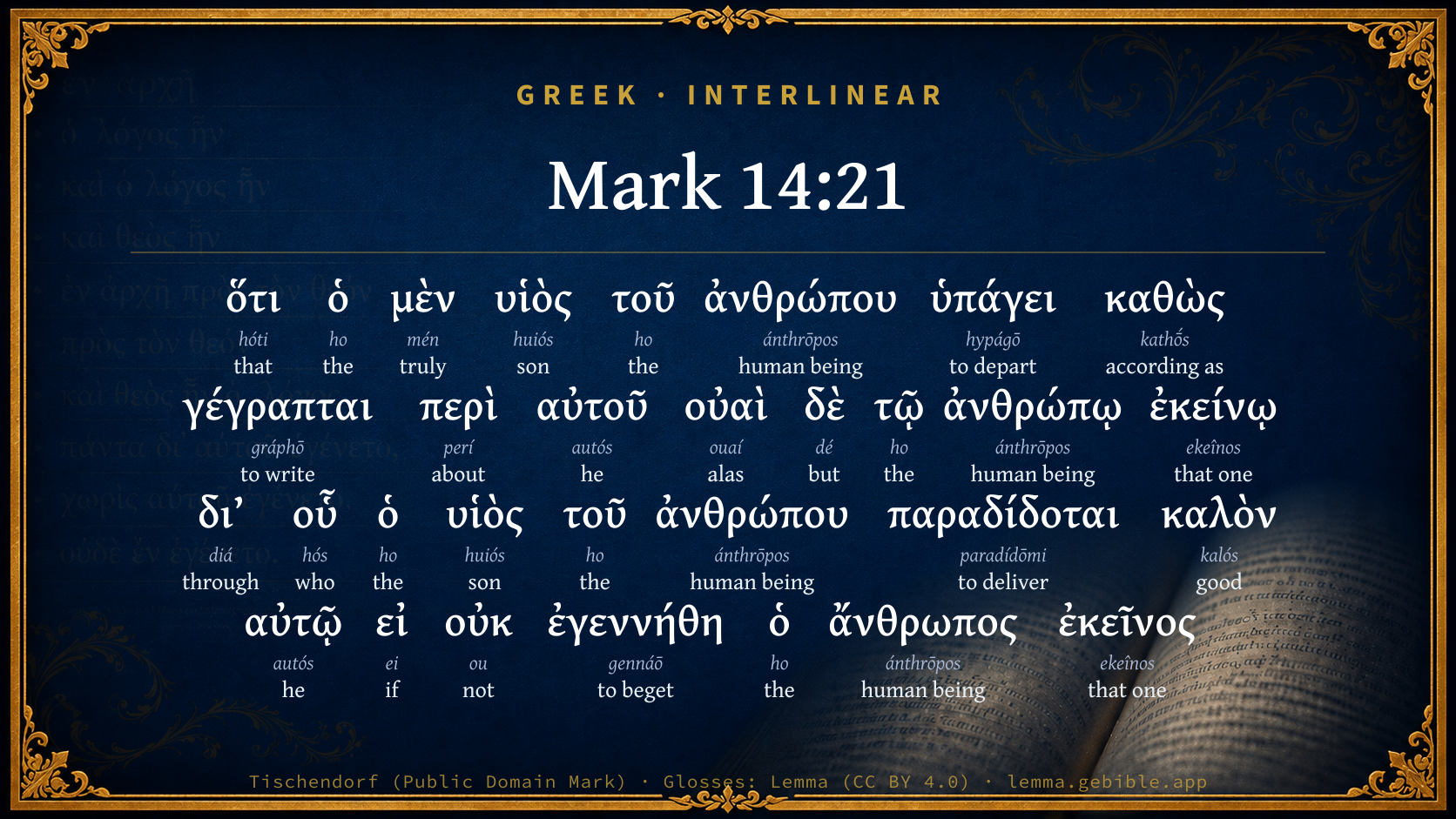
For the Son of Man goes, even as it is written about him, but woe to that man by whom the Son of Man is betrayed! It would be better for that man if he had not been born."
Download a study sheet
One document with this verse’s original text, its word-by-word gloss line, the meaning frame, cross-references with their text, attributed commentary, and full source and license credits — printable, and it pastes into notes with its structure intact.
This verse Autodidact and up
A passage Seminary Student
Up to 50 verses in one chapter. A passage sheet keeps up to 6 commentary sources and 12 cross-references per verse, in the order this page ranks them, and says so on the sheet whenever that leaves anything out. Ask for a single verse and you get the Autodidact verse sheet above.
Everything on this page stays free to read, with no account — the sheet is a download of what is already on screen, not access to it.
Compare translations 3
The same verse in 3 English versions, stacked beneath the original-language interlinear above. Click any original word for its lexicon entry.
Each is an independent rendering of the whole verse — the interlinear is not word-aligned to these translations.
Highlighted words mark where these versions differ — a whole-verse word diff, not a word-by-word alignment.
-
World English Bible Public Domain
For the Son of Man goes, even as it is written about him, but woe to that man by whom the Son of Man is betrayed! It would be better for that man if he had not been born."
-
King James Version Public Domain
The Son of man indeed goeth, as it is written of him: but woe to that man by whom the Son of man is betrayed! good were it for that man if he had never been born.
-
unfoldingWord Literal Text CC BY-SA 4.0
For the Son of Man departs just as it has been written about him, but woe to that man through whom the Son of Man is handed over! It would have been good for him if that man had not been born.”
unfoldingWord Literal Text — © unfoldingWord, licensed CC BY-SA 4.0. Word-aligned USFM3 via Door43 (git.door43.org/unfoldingWord/en_ult).
Show all 19 translations
Every available English version of this verse, each an independent rendering of the whole verse.
-
World English Bible Public Domain
For the Son of Man goes, even as it is written about him, but woe to that man by whom the Son of Man is betrayed! It would be better for that man if he had not been born."
-
Berean Standard Bible Public Domain
The Son of Man will go just as it is written about Him, but woe to that man by whom He is betrayed! It would be better for him if he had not been born.”
-
Majority Standard Bible Public Domain
The Son of Man will go just as it is written about Him, but woe to that man by whom He is betrayed! It would be better for him if he had not been born.”
-
King James Version Public Domain
The Son of man indeed goeth, as it is written of him: but woe to that man by whom the Son of man is betrayed! good were it for that man if he had never been born.
-
American Standard Version (1901) Public Domain
For the Son of man goeth, even as it is written of him: but woe unto that man through whom the Son of man is betrayed! good were it for that man if he had not been born.
-
Revised Version (1885) Public Domain
For the Son of man goeth, even as it is written of him: but woe unto that man through whom the Son of man is betrayed! good were it for that man if he had not been born.
-
Geneva Bible (1599) Public Domain
Truely the Sonne of man goeth his way, as it is written of him: but woe bee to that man, by whome the Sonne of man is betrayed: it had beene good for that man, if hee had neuer beene borne.
-
Douay-Rheims (1899) Public Domain
And the Son of man indeed goeth, as it is written of him: but woe to that man by whom the Son of man shall be betrayed. It were better for him, if that man had not been born.
-
Young's Literal Translation Public Domain
the Son of Man doth indeed go, as it hath been written concerning him, but wo to that man through whom the Son of Man is delivered up; good were it to him if that man had not been born.'
-
Literal Standard Version CC BY-SA 4.0
the Son of Man indeed goes, as it has been written concerning Him, but woe to that man through whom the Son of Man is delivered up; it were good to him if that man had not been born.”
-
Unlocked Literal Bible CC BY-SA 4.0
For the Son of Man will go the way that the scripture says about him. But woe to that man through whom the Son of Man is betrayed! It would have been better for him if he had not been born.”
-
unfoldingWord Literal Text CC BY-SA 4.0
For the Son of Man departs just as it has been written about him, but woe to that man through whom the Son of Man is handed over! It would have been good for him if that man had not been born.”
-
Darby Bible Public Domain
The Son of man goes indeed as it is written concerning him, but woe to that man by whom the Son of man is delivered up; [it were] good for that man if he had not been born.
-
World Messianic Bible Public Domain
For the Son of Man goes as it is written about him, but woe to that man by whom the Son of Man is betrayed! It would be better for that man if he had not been born.”
-
Webster's Bible Public Domain
The Son of man indeed goeth, as it is written concerning him: but woe to that man by whom the Son of man is betrayed! good were it for that man if he had never been born.
-
Free Bible Version CC BY-SA 4.0
“The Son of man will die, just as the Scriptures predicted. But how terrible it will be for the man who betrays the Son of man! It would be better for that man if he'd never been born.”
-
Bible in Basic English Public Domain
The Son of man goes, even as the Writings say of him: but cursed is that man through whom the Son of man is given up! It would have been well for that man if he had never been given birth.
-
Text-Critical English NT CC BY 4.0
The Son of Man indeed goes just as it is written of him, but woe to that man by whom the Son of Man is betrayed. It would have been better for that man if he had not been born.”
-
Tyndale New Testament (1534) Public Domain
The sonne of man goeth as it ys written of him: but woo be to that man by whome the sonne of man is betrayed. Good were it for him if that man had never bene borne.
Literal Standard Version (2020), Covenant Press — licensed CC BY-SA 4.0. Text via the HelloAO Bible API (eBible.org). Unlocked Literal Bible (unfoldingWord) — licensed CC BY-SA 4.0. Text via the HelloAO Bible API (eBible.org). unfoldingWord Literal Text — © unfoldingWord, licensed CC BY-SA 4.0. Word-aligned USFM3 via Door43 (git.door43.org/unfoldingWord/en_ult). Free Bible Version, Dr. Jonathan Gallagher — licensed CC BY-SA 4.0. Text via the HelloAO Bible API (eBible.org).
Word by word
More ways to search: Search by grammar → Find every occurrence → Compare this word →
Practice this passage: Drill this verse → Learn its vocabulary →
- Appears 46× in the Greek New Testament
- First appears at Matthew 11:21
- Part of Speech
- Interjection
Full Thayer's Definition
- ὅτι hóti G3754 “that” Conjunction
- ὁ ho G3588 “the” Article, Nominative, Singular, Masculine
- μὲν mén G3303 “truly” Particle
- υἱὸς huiós G5207 “son” Noun, Nominative, Singular, Masculine
- τοῦ ho G3588 “the” Article, Genitive, Singular, Masculine
- ἀνθρώπου ánthrōpos G444 “human being” Noun, Genitive, Singular, Masculine
- ὑπάγει hypágō G5217 “to depart” Verb, Present, Active, Indicative, 3rd person, Singular
- καθὼς kathṓs G2531 “according as” Adverb
- γέγραπται gráphō G1125 “to write” Verb, Perfect, Passive, Indicative, 3rd person, Singular
- περὶ perí G4012 “about” Preposition
- αὐτοῦ autós G846 “he” Personal pronoun, Genitive, Singular, Masculine
- οὐαὶ ouaí G3759 “alas” Interjection
- δὲ dé G1161 “but” Conjunction
- τῷ ho G3588 “the” Article, Dative, Singular, Masculine
- ἀνθρώπῳ ánthrōpos G444 “human being” Noun, Dative, Singular, Masculine
- ἐκείνῳ ekeînos G1565 “that one” Demonstrative pronoun, Dative, Singular, Masculine
- δι’ diá G1223 “through” Preposition
- οὗ hós G3739 “who” Relative pronoun, Genitive, Singular, Masculine
- ὁ ho G3588 “the” Article, Nominative, Singular, Masculine
- υἱὸς huiós G5207 “son” Noun, Nominative, Singular, Masculine
- τοῦ ho G3588 “the” Article, Genitive, Singular, Masculine
- ἀνθρώπου ánthrōpos G444 “human being” Noun, Genitive, Singular, Masculine
- παραδίδοται paradídōmi G3860 “to deliver” Verb, Present, Passive, Indicative, 3rd person, Singular
- καλὸν kalós G2570 “good” Adjective, Nominative, Singular, Neuter
- αὐτῷ autós G846 “he” Personal pronoun, Dative, Singular, Masculine
- εἰ ei G1487 “if” Conditional
- οὐκ ou G3756 “not” Particle, Negative
- ἐγεννήθη gennáō G1080 “to beget” Verb, Aorist, Passive, Indicative, 3rd person, Singular
- ὁ ho G3588 “the” Article, Nominative, Singular, Masculine
- ἄνθρωπος ánthrōpos G444 “human being” Noun, Nominative, Singular, Masculine
- ἐκεῖνος ekeînos G1565 “that one” Demonstrative pronoun, Nominative, Singular, Masculine
About this verse
These counts appear in no published source. They are computed here, from the morphology-tagged text and Lemma’s own curated glosses. What Lemma adds →
- 31
- words
- 20
- distinct lemmas
- Gospels
- section
Shared distinctive vocabulary
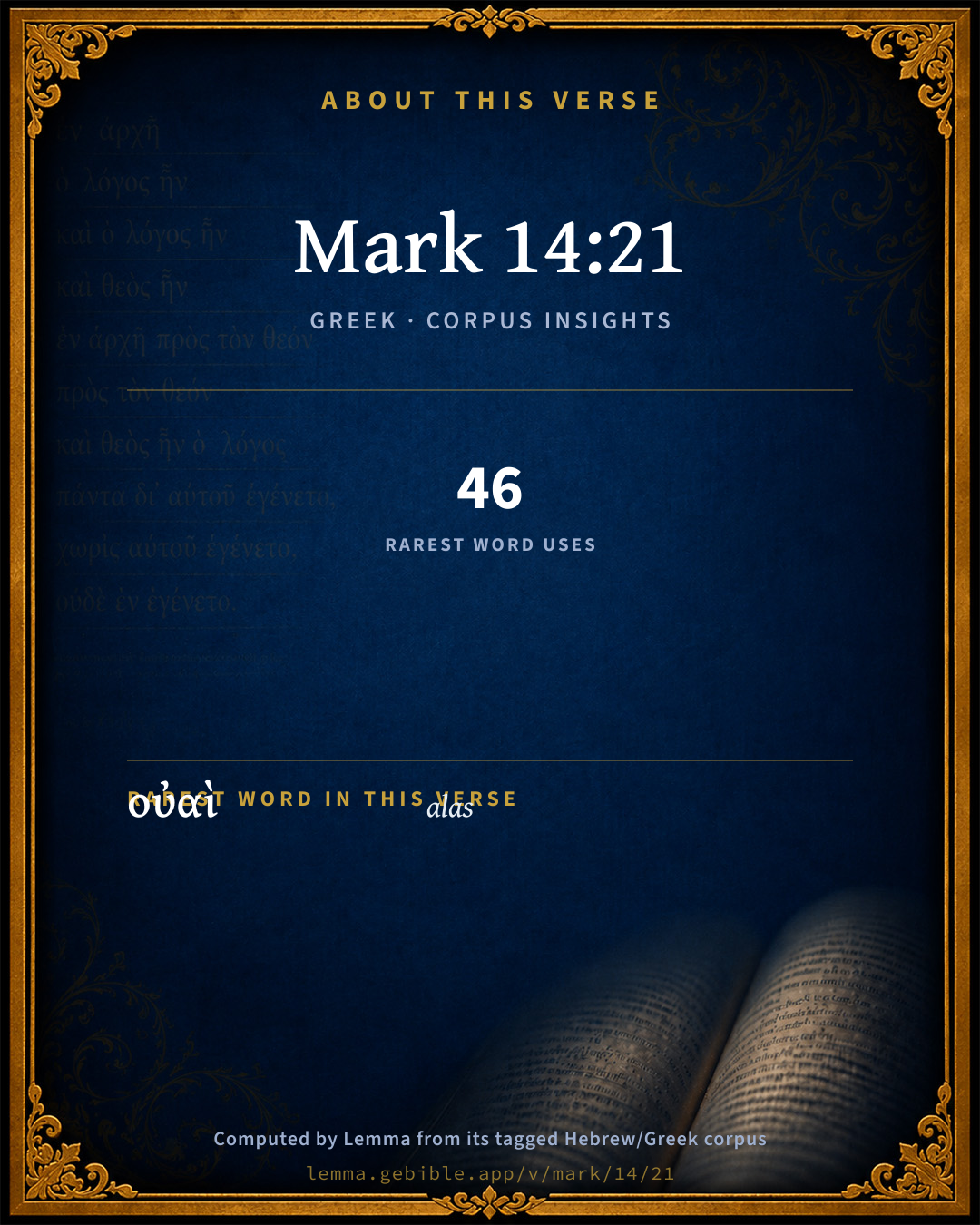
οὐαὶ alas G3759 occurs in 35 verses of the Greek New Testament. Also found in:
Cross-references
26Topical passages linked to Mark 14:21 in the Treasury of Scripture Knowledge — connected by theme and wording, ordered by reader-vote popularity; previews shown in the World English Bible.
- Isaiah 53:1–12 Who has believed our message? and to whom has the arm of Yahweh been revealed?
- Matthew 26:24–25 The Son of Man goes, even as it is written of him, but woe to that man through whom the Son of Man is betrayed! It would be better for that man if he had not been born."
- Genesis 3:15 I will put enmity between you and the woman, and between your offspring and her offspring. He will bruise your head, and you will bruise his heel."
- Daniel 9:24 Seventy weeks are decreed on your people and on your holy city, to finish disobedience, and to make an end of sins, and to make reconciliation for iniquity, and to bring in everlasting righteousness, and to seal up vision and prophecy, and to anoint the most holy.
- Zechariah 13:7 "Awake, sword, against my shepherd, And against the man who is close to me," says Yahweh of Hosts. Strike the shepherd, and the sheep will be scattered; And I will turn my hand against the little ones.
- Matthew 18:6–7 but whoever causes one of these little ones who believe in me to stumble, it would be better for him that a huge millstone should be hung around his neck, and that he should be sunk in the depths of the sea.
- Psalms 22:1–31 My God, my God, why have you forsaken me? Why are you so far from helping me, and from the words of my groaning?
- Psalms 55:15 Let death come suddenly on them. Let them go down alive into Sheol. For wickedness is in their dwelling, in the midst of them.
- Psalms 69:1–36 Save me, God, For the waters have come up to my neck!
- Psalms 109:6–20 Set a wicked man over him. Let an adversary stand at his right hand.
- Isaiah 52:14 Like as many were astonished at you (his visage was so marred more than any man, and his form more than the sons of men),
- Daniel 9:26 After the sixty-two weeks the Anointed One shall be cut off, and shall have nothing: and the people of the prince who shall come shall destroy the city and the sanctuary; and the end of it shall be with a flood, and even to the end shall be war; desolations are determined.
- Matthew 26:54 How then would the Scriptures be fulfilled that it must be so?"
- Matthew 26:56 But all this has happened, that the Scriptures of the prophets might be fulfilled." Then all the disciples left him, and fled.
- Matthew 27:3–5 Then Judas, who betrayed him, when he saw that Jesus was condemned, felt remorse, and brought back the thirty pieces of silver to the chief priests and elders,
- John 19:28 After this, Jesus, seeing that all things were now finished, that the Scripture might be fulfilled, said, "I am thirsty."
- John 19:36–37 For these things happened, that the Scripture might be fulfilled, "A bone of him will not be broken."
- Acts 1:25 to take part in this ministry and apostleship from which Judas fell away, that he might go to his own place."
- Acts 2:23 him, being delivered up by the determined counsel and foreknowledge of God, you have taken by the hand of lawless men, crucified and killed;
- Acts 4:27 For truly, in this city against your holy servant, Jesus, whom you anointed, both Herod and Pontius Pilate, with the Gentiles and the people of Israel, were gathered together
- Acts 13:27–29 For those who dwell in Jerusalem, and their rulers, because they didn't know him, nor the voices of the prophets which are read every Sabbath, fulfilled them by condemning him.
- Mark 14:49 I was daily with you in the temple teaching, and you didn't arrest me. But this is so that the Scriptures might be fulfilled."
- Luke 22:22 The Son of Man indeed goes, as it has been determined, but woe to that man through whom he is betrayed!"
- Luke 24:26–27 Didn't the Christ have to suffer these things and to enter into his glory?"
- Luke 24:44 He said to them, "This is what I told you, while I was still with you, that all things which are written in the law of Moses, the prophets, and the psalms, concerning me must be fulfilled."
- Acts 1:16–20 "Brothers, it was necessary that this Scripture should be fulfilled, which the Holy Spirit spoke before by the mouth of David concerning Judas, who was guide to those who took Jesus.
Cross-references courtesy of OpenBible.info (CC BY 4.0).
Lesson kit
Teaching starters — assembled from the data on this page, not authored interpretation. Every prompt links to the verse data it draws on. Edit before teaching.
Mark, in the Gospels, opens this verse with 31 words (20 distinct Greek lemmas). Its most distinctive word is ouaí (“alas”). A historical commentator’s framing appears above. Read the whole chapter for the surrounding context.
Discussion questions
- What does “alas” (ouaí) contribute to the verse as a whole?
- How does Matthew 11:21, which shares the word «alas», read alongside this verse?
- What does the repetition of “human being” (4× in this one verse) do in this verse?
- These translations render this verse differently; the difference is in the English rendering, not the original. What questions does that raise?
- Compare how Tyndale Open Study Notes and Expositor's Greek Testament read this verse. Where do they agree or differ?
Things to notice
- These translations choose different wording for 17 words in this verse.
- “human being” occurs 4× in this single verse.
- 20 distinct Greek lemmas span 31 words in this verse.
Commentary
Notes on Mark 14:21 from classic Christian and Jewish commentators (each source and its license shown beneath its notes). The classic Christian expositions comment on the surrounding passage and are grouped to its opening verse, so a note may address several verses; the Jewish commentaries on the Tanakh (Rashi and others) are per-verse, so they appear only where the commentator wrote on this verse.
Lemma curates 59 commentaries, every one of them public domain or Creative Commons licensed, each selected and text-cleaned for this edition rather than reprinted as found. About our sources →
Tyndale Open Study Notes
Tyndale Open Resources
Tyndale Open Study Notes — © Tyndale Open Resources, licensed CC BY-SA 4.0. Text via the HelloAO Bible API.
Expositor's Greek Testament
ed. W. Robertson Nicoll
The Expositor's Greek Testament, edited by W. Robertson Nicoll (1897–1910) — public domain. Text from a community e-Sword module.
Adam Clarke's Commentary
Adam Clarke's Commentary on the Bible (1810–1826) — public domain. Text from a community e-Sword/MySword module.
Ellicott's Commentary for English Readers
A Bible Commentary for English Readers, edited by Charles John Ellicott (1878–1897) — public domain. Text from a community e-Sword module.
The Cambridge Bible for Schools and Colleges
gen. ed. J. J. S. Perowne
The Cambridge Bible for Schools and Colleges (gen. ed. J. J. S. Perowne; Cambridge University Press, 1878–1918) — public domain. Text from a community e-Sword module.
John Gill's Exposition
John Gill's Exposition of the Whole Bible (1746–1763) — public domain (CC PDM 1.0). Text via the HelloAO Bible API.
Trapp's Complete Commentary
John Trapp
John Trapp, A Commentary or Exposition upon All the Books of the Old and New Testament (1647–1656) — public domain. Text from a community e-Sword module.
The Pulpit Commentary
The Pulpit Commentary (1880–1919), ed. H.D.M. Spence-Jones & Joseph S. Exell — public domain. Text from a community e-Sword module.
Cambridge Greek Testament for Schools and Colleges
Cambridge Greek Testament for Schools and Colleges (Cambridge University Press, 1896; 21 vols, various authors incl. Carr, Maclear, Plummer, Farrar, Lumby, Moule, M. R. James, Simcox) — public domain. Text from a community e-Sword module.
International Critical Commentary
International Critical Commentary — older volumes (1896–1929), various authors — public domain. Text from a community e-Sword module.