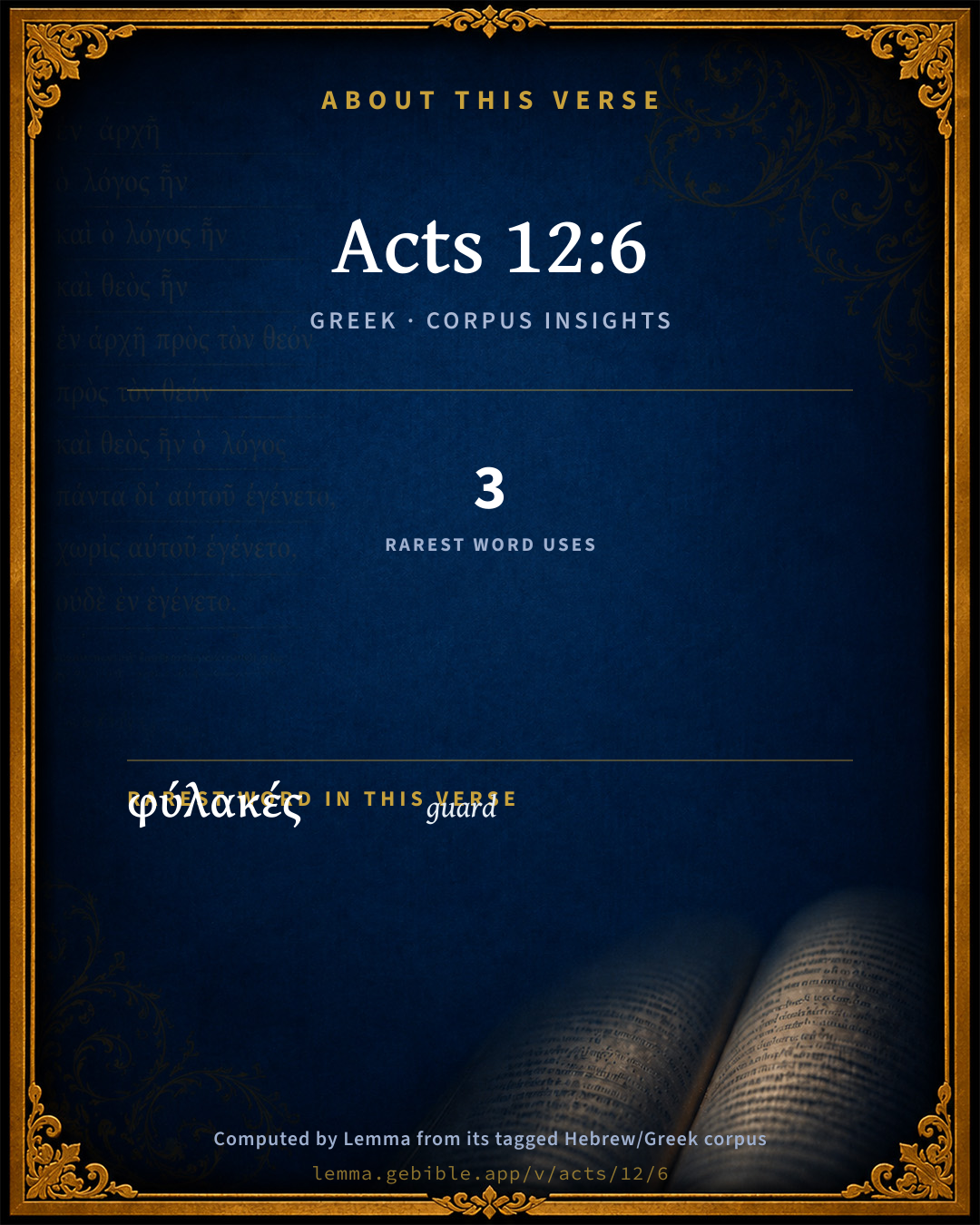
Acts 12:6

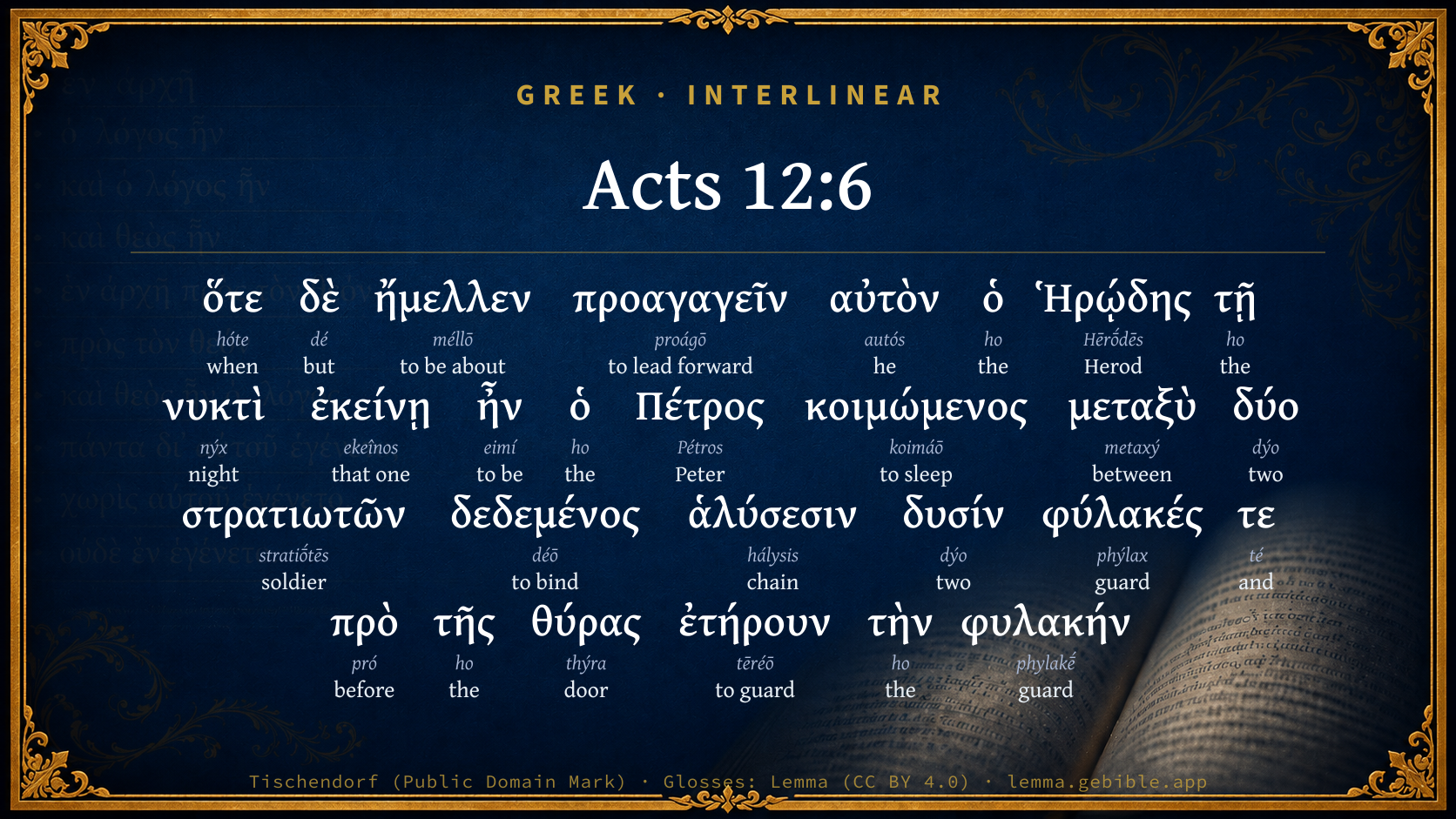
Greek (Tischendorf 8th ed.) Acts 12:6 appears in the Greek New Testament. The text above is from the Tischendorf 8th edition. Each word links to its Strong’s number and a concise gloss. Click any word for its full Thayer’s Greek Lexicon entry.
Download image
Cite this verse

Acts 12:6 (World English Bible). Public Domain. Lemma interlinear Bible study tool, https://lemma.gebible.app/v/acts/12/6.

Show BibTeX & RIS
BibTeX
RIS
English Translation
The same night when Herod was about to bring him out, Peter was sleeping between two soldiers, bound with two chains. Guards in front of the door kept the prison.
World English Bible · Public Domain
Download a study sheet

One document with this verse’s original text, its word-by-word gloss line, the meaning frame, cross-references with their text, attributed commentary, and full source and license credits — printable, and it pastes into notes with its structure intact.

This verse Autodidact and up

Study sheet (.html) Plain text (.txt)

A passage Seminary Student

Up to 50 verses in one chapter. A passage sheet keeps up to 6 commentary sources and 12 cross-references per verse, in the order this page ranks them, and says so on the sheet whenever that leaves anything out. Ask for a single verse and you get the Autodidact verse sheet above.

Everything on this page stays free to read, with no account — the sheet is a download of what is already on screen, not access to it.

Want to remove ads? Support Godless Engineer
Compare translations 3

The same verse in 3 English versions, stacked beneath the original-language interlinear above. Click any original word for its lexicon entry.

Each is an independent rendering of the whole verse — the interlinear is not word-aligned to these translations.

Highlighted words mark where these versions differ — a whole-verse word diff, not a word-by-word alignment.

  • World English Bible Public Domain
    The same night when Herod was about to bring him out, Peter was sleeping between two soldiers, bound with two chains. Guards in front of the door kept the prison.
  • King James Version Public Domain
    And when Herod would have brought him forth, the same night Peter was sleeping between two soldiers, bound with two chains: and the keepers before the door kept the prison.
  • unfoldingWord Literal Text CC BY-SA 4.0
    And when Herod was going to bring him out, that night Peter was sleeping between two soldiers, bound with two chains, and guards before the door were watching the prison.

unfoldingWord Literal Text — © unfoldingWord, licensed CC BY-SA 4.0. Word-aligned USFM3 via Door43 (git.door43.org/unfoldingWord/en_ult).

Versions to compare (up to 4)

3 of 4 selected

Show all 19 translations

Every available English version of this verse, each an independent rendering of the whole verse.

  • World English Bible Public Domain
    The same night when Herod was about to bring him out, Peter was sleeping between two soldiers, bound with two chains. Guards in front of the door kept the prison.
  • Berean Standard Bible Public Domain
    On the night before Herod was to bring him to trial, Peter was sleeping between two soldiers, bound with two chains, with sentries standing guard at the entrance to the prison.
  • Majority Standard Bible Public Domain
    On the night before Herod was to bring him to trial, Peter was sleeping between two soldiers, bound with two chains, with sentries standing guard at the entrance to the prison.
  • King James Version Public Domain
    And when Herod would have brought him forth, the same night Peter was sleeping between two soldiers, bound with two chains: and the keepers before the door kept the prison.
  • American Standard Version (1901) Public Domain
    And when Herod was about to bring him forth, the same night Peter was sleeping between two soldiers, bound with two chains: and guards before the door kept the prison.
  • Revised Version (1885) Public Domain
    And when Herod was about to bring him forth, the same night Peter was sleeping between two soldiers, bound with two chains: and guards before the door kept the prison.
  • Geneva Bible (1599) Public Domain
    And when Herod woulde haue brought him out vnto the people, the same night slept Peter betweene two souldiers, bound with two chaines, and the keepers before the doore, kept the prison.
  • Douay-Rheims (1899) Public Domain
    And when Herod would have brought him forth, the same night Peter was sleeping between two soldiers, bound with two chains: and the keepers before the door kept the prison.
  • Young's Literal Translation Public Domain
    and when Herod was about to bring him forth, the same night was Peter sleeping between two soldiers, having been bound with two chains, guards also before the door were keeping the prison,
  • Literal Standard Version CC BY-SA 4.0
    and when Herod was about to bring him forth, the same night was Peter sleeping between two soldiers, having been bound with two chains, guards were also keeping the prison before the door,
  • Unlocked Literal Bible CC BY-SA 4.0
    On the night before Herod was going to bring him out for trial, Peter was sleeping between two soldiers, bound with two chains, while guards in front of the door were keeping watch over the prison.
  • unfoldingWord Literal Text CC BY-SA 4.0
    And when Herod was going to bring him out, that night Peter was sleeping between two soldiers, bound with two chains, and guards before the door were watching the prison.
  • Darby Bible Public Domain
    And when Herod was going to bring him forth, that night Peter was sleeping between two soldiers, bound with two chains, and guards before the door kept the prison.
  • World Messianic Bible Public Domain
    The same night when Herod was about to bring him out, Peter was sleeping between two soldiers, bound with two chains. Guards in front of the door kept the prison.
  • Webster's Bible Public Domain
    And when Herod would have brought him forth, the same night Peter was sleeping between two soldiers, bound with two chains; and the keepers before the door kept the prison.
  • Free Bible Version CC BY-SA 4.0
    The night before Herod was to have him put on trial, Peter was sleeping between two soldiers, chained to each of them, and with guards at the door keeping watch.
  • Bible in Basic English Public Domain
    And when Herod was about to take him out, the same night Peter was sleeping in chains between two armed men, and the watchmen were keeping watch before the door of the prison.
  • Text-Critical English NT CC BY 4.0
    The very night before Herod was going to bring him out, Peter was sleeping between two soldiers, bound with two chains, while the guards in front of the door were keeping watch over the prison.
  • Tyndale New Testament (1534) Public Domain
    And when Herode wolde have brought him oute vnto the people the same nyght slepte Peter bitwene two soudiers bounde with two chaynes and the kepers before the dore kepte the preson.

Literal Standard Version (2020), Covenant Press — licensed CC BY-SA 4.0. Text via the HelloAO Bible API (eBible.org). Unlocked Literal Bible (unfoldingWord) — licensed CC BY-SA 4.0. Text via the HelloAO Bible API (eBible.org). unfoldingWord Literal Text — © unfoldingWord, licensed CC BY-SA 4.0. Word-aligned USFM3 via Door43 (git.door43.org/unfoldingWord/en_ult). Free Bible Version, Dr. Jonathan Gallagher — licensed CC BY-SA 4.0. Text via the HelloAO Bible API (eBible.org).

Word by word

More ways to search: Search by grammar → Find every occurrence → Compare this word →

Practice this passage: Drill this verse → Learn its vocabulary →

φύλακές
phýlax
G5441
“guard”
Noun, Nominative, Plural, Masculine
Part of Speech
Noun
Case
Nominative
Number
Plural
Gender
Masculine
Full Thayer's Definition

Origin: from G5442

TDNT: None

1. a guard, keeper
  1. ὅτε hóte G3753 “when” Adverb
  2. δὲ dé G1161 “but” Conjunction
  3. ἤμελλεν méllō G3195 “to be about” Verb, Imperfect, Active, Indicative, 3rd person, Singular, Attic form
  4. προαγαγεῖν proágō G4254 “to lead forward” Verb, Aorist, Active, Infinitive
  5. αὐτὸν autós G846 “he” Personal pronoun, Accusative, Singular, Masculine
  6. ὁ ho G3588 “the” Article, Nominative, Singular, Masculine
  7. Ἡρῴδης Hērṓdēs G2264 “Herod” Noun, Nominative, Singular, Masculine
  8. τῇ ho G3588 “the” Article, Dative, Singular, Feminine
  9. νυκτὶ nýx G3571 “night” Noun, Dative, Singular, Feminine
  10. ἐκείνῃ ekeînos G1565 “that one” Demonstrative pronoun, Dative, Singular, Feminine
  11. ἦν eimí G1510 “to be” Verb, Imperfect, Active, Indicative, 3rd person, Singular
  12. ὁ ho G3588 “the” Article, Nominative, Singular, Masculine
  13. Πέτρος Pétros G4074 “Peter” Noun, Nominative, Singular, Masculine
  14. κοιμώμενος koimáō G2837 “to sleep” Verb, Present, Passive, Participle, Nominative, Singular, Masculine
  15. μεταξὺ metaxý G3342 “between” Adverb
  16. δύο dýo G1417 “two” Adjective, Numeral (indeclinable)
  17. στρατιωτῶν stratiṓtēs G4757 “soldier” Noun, Genitive, Plural, Masculine
  18. δεδεμένος déō G1210 “to bind” Verb, Perfect, Passive, Participle, Nominative, Singular, Masculine
  19. ἁλύσεσιν hálysis G254 “chain” Noun, Dative, Plural, Feminine
  20. δυσίν dýo G1417 “two” Adjective, Dative, Plural, Feminine
  21. τε té G5037 “and” Particle
  22. πρὸ pró G4253 “before” Preposition
  23. τῆς ho G3588 “the” Article, Genitive, Singular, Feminine
  24. θύρας thýra G2374 “door” Noun, Genitive, Singular, Feminine
  25. ἐτήρουν tēréō G5083 “to guard” Verb, Imperfect, Active, Indicative, 3rd person, Plural
  26. τὴν ho G3588 “the” Article, Accusative, Singular, Feminine
  27. φυλακήν phylakḗ G5438 “guard” Noun, Accusative, Singular, Feminine

About this verse

These counts appear in no published source. They are computed here, from the morphology-tagged text and Lemma’s own curated glosses. What Lemma adds →

28
words
23
distinct lemmas
Acts
section

Notable vocabulary

The rarest word here is φύλακές guard G5441 — appearing just 3 times in the whole Greek New Testament.

Shared distinctive vocabulary

φύλακές guard G5441 occurs in 3 verses of the Greek New Testament. Also found in:

Repetition

Words recur within this verse:

Cross-references

14

Topical passages linked to Acts 12:6 in the Treasury of Scripture Knowledge — connected by theme and wording, ordered by reader-vote popularity; previews shown in the World English Bible.

  • Acts 21:33 Then the commanding officer came near, arrested him, commanded him to be bound with two chains, and inquired who he was and what he had done.
  • Hebrews 13:6 So that with good courage we say, "The Lord is my helper. I will not fear. What can man do to me?"
  • 1 Samuel 23:26–27 Saul went on this side of the mountain, and David and his men on that side of the mountain: and David made haste to get away for fear of Saul; for Saul and his men compassed David and his men round about to take them.
  • Ephesians 6:20 for which I am an ambassador in chains; that in it I may speak boldly, as I ought to speak.
  • Philippians 4:6–7 In nothing be anxious, but in everything, by prayer and petition with thanksgiving, let your requests be made known to God.
  • 2 Timothy 1:16 May the Lord grant mercy to the house of Onesiphorus, for he often refreshed me, and was not ashamed of my chain,
  • Genesis 22:14 Abraham called the name of that place Yahweh-Jireh. As it is said to this day, "In Yahweh's mountain it will be provided.
  • Psalms 3:5–6 I laid myself down and slept. I awakened; for Yahweh sustains me.
  • Psalms 4:8 In peace I will both lay myself down and sleep, For you, Yahweh alone, make me live in safety.
  • Jeremiah 40:4 Now, behold, I loose you this day from the chains which are on your hand. If it seem good to you to come with me into Babylon, come, and I will look well to you; but if it seem ill to you to come with me into Babylon, forbear: behold, all the land is before you; where it seems good and right to you to go, there go.
  • Matthew 28:4 For fear of him, the guards shook, and became like dead men.
  • Acts 5:23 "We found the prison shut and locked, and the guards standing before the doors, but when we opened them, we found no one inside!"
  • Acts 28:20 For this cause therefore I asked to see you and to speak with you. For because of the hope of Israel I am bound with this chain."
  • Isaiah 26:3–4 You will keep [him] in perfect peace, [whose] mind [is] stayed [on you]; because he trusts in you.

Cross-references courtesy of OpenBible.info (CC BY 4.0).

Commentary

Notes on Acts 12:6 from classic Christian and Jewish commentators (each source and its license shown beneath its notes). The classic Christian expositions comment on the surrounding passage and are grouped to its opening verse, so a note may address several verses; the Jewish commentaries on the Tanakh (Rashi and others) are per-verse, so they appear only where the commentator wrote on this verse.

Lemma curates 59 commentaries, every one of them public domain or Creative Commons licensed, each selected and text-cleaned for this edition rather than reprinted as found. About our sources →

Tyndale Open Study Notes

Tyndale Open Resources

12:6-19 God, through an angel, led Peter out, reunited him with his praying friends, and sent him out to carry on the work of spreading the Good News. The message advanced despite determined opposition.

Tyndale Open Study Notes — © Tyndale Open Resources, licensed CC BY-SA 4.0. Text via the HelloAO Bible API.

Bengel's Gnomon

Johann Albrecht Bengel

Act 12:6. Ὅτε, when) The aid sent, when the danger was come to its height, shows that the result was not accidental [ch. Act 23:11].—κοιμώμενος, sleeping) There is frequent mention of men sleeping in danger, either with faith or with torpor.—μεταξὺ, between) The enemy had supposed all to have been made secure.—τὴν φυλακὴν, the prison, the place of watching) The place is meant [not “kept watch”].

Bengel's Gnomon of the New Testament — English translation (T&T Clark, Edinburgh, 1860) — public domain. Text from a community e-Sword module.

Expositor's Greek Testament

ed. W. Robertson Nicoll

Act 12:6 . τῇ νυκτὶ ἐκείνῃ : “that very night,” i.e. , the night before the trial. κοιμώμενος , cf. 1Pe 5:7 and Psa 127:2 : “for so He giveth His beloved sleep”: “and there too it is beautiful that Paul sings hymns, whilst here Peter sleeps,” Chrys., Hom. , xxvi.: cf. Act 16:25 . to τὸ πᾶν ῥίψας ἐπὶ τὸν Κύριον , Oecumenius ( cf. Blass, in loco ). ἁλύσεσι δυσί , cf. Act 21:33 ; on the usual Roman custom see Jos., Ant. , xviii., 6, 7, in the account of Herod’s own imprisonment by Tiberius; cf. Pliny, Epist. , x., 65; Seneca, Epist. , i., 5, “eadem catena et custodiam (vinctum) et militem copulabat,” perhaps most natural to suppose that Peter was bound on either hand to each of the soldiers, the two chains being used perhaps for greater security on account of the former escape. φύλακες , i.e. , the other two of the quaternion to make escape impossible.

The Expositor's Greek Testament, edited by W. Robertson Nicoll (1897–1910) — public domain. Text from a community e-Sword module.

Jamieson, Fausset & Brown

Robert Jamieson, A. R. Fausset & David Brown

And when Herod would have brought him forth--"was going to bring him forth."

the same night--but a few hours before the intended execution. Thus long were the disciples kept waiting; their prayers apparently unavailing, and their faith, as would seem from the sequel, waxing feeble. Such, however, is the "law" of God's procedure (Deu 32:36 and see on Joh 21:3).

Peter was sleeping between two soldiers, bound with two chains--Roman prisoners had a chain fastened at one end to the wrist of their fight hand, and at the other to the wrist of a soldier's left hand, leaving the right arm of the keeper free in case of any attempt to escape. For greater security the prisoner was sometimes, as here, chained to two soldiers, one on each side. (See Act 21:23.) Ye think your prey secure, bloodthirsty priests and thou obsequious tyrant who, to "please the Jews," hast shut in this most eminent of the servants of Christ within double gates, guarded by double sentinels, while double keepers and double chains seem to defy all rescue! So thought the chief priests, who "made the sepulchre of the Lord sure, sealing the stone and setting a watch." But "He that sitteth in heaven shall laugh at you." Meanwhile, "Peter is sleeping!" In a few hours he expects a stingless death; "neither counts he his life dear unto him, so that he may finish his course with joy and the ministry which he has received of the Lord Jesus." In this frame of spirit he has dropped asleep, and lies the picture of peace.

Jamieson, Fausset & Brown — Commentary Critical and Explanatory on the Whole Bible (1871) — public domain (CC PDM 1.0). Text via the HelloAO Bible API.

Adam Clarke's Commentary

Verse 6. Sleeping between two soldiers, bound with two chains] Two soldiers guarded his person; his right hand being bound to the left hand of one, and his left hand bound to the right hand of the other. This was the Roman method of guarding their prisoners, and appears to be what is intimated in the text.

Adam Clarke's Commentary on the Bible (1810–1826) — public domain. Text from a community e-Sword/MySword module.

John Calvin's Commentaries

6. When he was about to bring him forth. It seemeth at the first blush that the Church prayeth to small purpose, for the day was now appointed wherein Peter should be put to death, and he is within one night of death, and yet the faithful cease not to pray, because they know that when the Lord doth purpose to deliver his, he taketh his time oftentimes in the last and farthest point of necessity, and that he hath in his hand diverse ways to deliver. Secondly, we may think that they did not so much pray for Peter’s life, as that the Lord would arm him with invincible fortitude, for the glory of the gospel, and that God would [not] set the gospel of his Son open to the reproaches and slanders of the wicked.

That night he slept. All these circumstances do more set forth the wonderful power of God, for who would not have thought that Peter was already swallowed up of death? for though he drew breath as yet, yet he had no chinch [chink] to creep out at, for as much as he was beset with many deaths. Therefore, whereas he escapeth from amidst deaths, whereas he goeth safely among the hands of his hangmen, whereas the chains are molten and are loosed, whereas the iron gate openeth itself to him; hereby it appeareth that it was a mere divine kind of deliverance, and it was profitable for Peter to be thus taught by these signs, that he might with more assurance forthwith declare unto men the grace of God thus known. Again, it appeareth by this strait keeping that Herod meant nothing less than to let Peter go away alive.

John Calvin's Commentaries (1540-1563) — public domain. Text from the Calvin Translation Society English edition (1840s-50s) via the Christian Classics Ethereal Library (ccel.org). Calvin's coverage is partial (roughly two-thirds of the Bible); uncommented books and verses are honest gaps, never fabricated. The 19th-century editor's footnotes and remarks are omitted so the notes are faithfully Calvin's own voice.

Ellicott's Commentary for English Readers

(6) Peter was sleeping between two soldiers.—The picture of the calm repose of the Apostle as of one to whom God had given the sleep of His beloved (Psa_127:2), undisturbed by the fear of coming suffering and death, will be felt by most readers to be one of singular interest.

A Bible Commentary for English Readers, edited by Charles John Ellicott (1878–1897) — public domain. Text from a community e-Sword module.

The Cambridge Bible for Schools and Colleges

gen. ed. J. J. S. Perowne

6. And when Herod would have brought him forth] Literally, “was about to bring him forth,” and this should be expressed, because it is an additional note of the delay and lapse of time between the arrest and the intended punishment.

and the keepers before the door] Read, “and guards before the door,” i.e. the two soldiers of the quaternion who were not chained to the prisoner.

The Cambridge Bible for Schools and Colleges (gen. ed. J. J. S. Perowne; Cambridge University Press, 1878–1918) — public domain. Text from a community e-Sword module.

John Gill's Exposition

And when Herod would have brought him forth,.... The next morning; so he had determined not to dismiss him, but to expose him to the people, and to put him to such a death they should choose:

the same night, Peter was sleeping between two soldiers; fearless of death, being in a good cause, and having nothing to ruffle and disturb his mind; and though he was in a prison, and in such company, God gave him, his beloved, sleep:

bound with two chains; one on one hand, and one on the other, each of which were fastened to the soldiers; that on his right hand was fastened to the left hand of the soldier, that was on that side; and that on his left hand to the right hand of the soldier, on the other side him; such security was made, that he might not get away from them; to which is added,

and the keepers before the door kept the prison; or watched it, that nobody went in, or came out.

John Gill's Exposition of the Whole Bible (1746–1763) — public domain (CC PDM 1.0). Text via the HelloAO Bible API.

Trapp's Complete Commentary

John Trapp

6 And when Herod would have brought him forth, the same night Peter was sleeping between two soldiers, bound with two chains: and the keepers before the door kept the prison.

Ver. 6. Peter was sleeping] As having cast himself into God’s everlasting arms. So did David, Psa 3:5. So did Mr Rogers, our protomartyr in Queen Mary’s days, when he was warned suddenly to prepare for the fire, he then being found asleep, scarcely with much shogging could be awakened; at length being raised and bidden to make haste, then (said he) if it be so, I need not to tie my points.

John Trapp, A Commentary or Exposition upon All the Books of the Old and New Testament (1647–1656) — public domain. Text from a community e-Sword module.

Albert Barnes' Notes on the Bible

And when Herod would have brought him forth - When he was about to bring him to be put to death.

The same night - That is, the night preceding. The intention of Herod was to bring him out as soon as the Passover was over; but during the night which immediately preceded the day in which he intended to bring him to punishment, Peter was rescued.

Peter was sleeping - Here is an instance of remarkable composure, and an illustration of the effects of peace of conscience and of confidence in God. It was doubtless known to Peter what the intention of Herod was. James had just been put to death, and Peter had no reason to expect a better fate. And yet in this state he slept as quietly as if there had been no danger, and it was necessary that he should be roused even by an angel to contemplate his condition and to make his escape. There is nothing that will give quiet rest and gentle sleep so certainly as a conscience void of offence; and in the midst of imminent dangers, he who confides in God may rest securely and calmly. Compare Psa 3:5; Psa 4:8.

Between two soldiers - See the notes on Act 12:4. Peter was bound to the two. His left hand was chained to the right hand of one of the soldiers, and his right hand to the left hand of the other. This was a common mode of securing prisoners among the Romans. See abundant authorities for this quoted in Lardner’s Credibility, part 1, chapter 10: section 9, London edition, 1829, vol. i. p. 242, 243, etc.

And the keepers ... - See Act 12:4. Two soldiers were stationed at the door. We may see now that every possible precaution was used to ensure the safe custody of Peter:

(1) He was in prison.

(2) He was under the charge of sixteen men, who could relieve each other when weary, and thus every security was given that he could not escape by inattention on their part.

(3) He was bound fast between two men. And,

(4) He was further guarded by two others, whose business it was to watch the door of the prison. It is to be remembered, also, that it was death for a Roman soldier to be found sleeping at his post. But God can deliver in spite of all the precautions of people; and it is easy for him to overcome the most cunning devices of his enemies.

Albert Barnes' Notes on the Bible (1834–1885) — public domain. Text from a community e-Sword/MySword module.

Haydock's Catholic Bible Commentary

With these two chains, according to the Roman custom, St. Peter must have been fastened to the two soldiers, that guarded him. Yet Peter slept secure, trusting in that Providence which sleepeth not.

George Leo Haydock (1774–1849), Haydock's Catholic Family Bible and Commentary, 1859 edition — public domain. Excludes Psalms (Douay-Rheims chapter numbering differs from Protestant) and Deuterocanonical books (Catholic canon only).

Matthew Poole's English Annotations

Brought him forth, to be put to death.

The same night: this is a night to be remembered, as that in which God delivered his Israel out of Egypt: when both were come to the utmost extremity, and at the pit’s brink, then so God does his marvellous work of deliverance, that it ought to be had in remembrance, Psa 105:5.

Peter was sleeping: innocency hath this advantage, and a good conscience acquiesces in the providence of God; it hath God to its friend; and if he be for us, who can be against us?

Bound with two chains: see Act 12:4; to which may be added, that with one chain St. Peter’s right hand was bound to the soldier’s left; with the other chain his left hand to the other soldier’s right; for so was their manner for their greater security, that they might not let the prisoner escape: thus persecutors are skilful to destroy; but no device can avail against any whom God will save.

Matthew Poole's English Annotations on the Holy Bible (1683–1685) — public domain. Text from a community e-Sword/MySword module.

Whedon's Commentary on the Bible

Daniel D. Whedon

6. Two chains—A light chain each, attached by the one end to the prisoner, by the other to a soldier. “The same chain,” says Seneca, “couples the prisoner and the guard.”

Daniel D. Whedon (gen. ed.), Commentary on the Old and New Testaments (1874–1909) — public domain. Text from a community e-Sword module.

The Pulpit Commentary

Was about to bring for would have brought, A.V.; guards for the keepers, A.V. What a picture we have here! The dungeon; the double chain fastening the prisoner to two soldiers; the other two soldiers of the quaternion keeping watch at the first and second ward, or station; the iron gate securely fastened; the population of the great city expecting with the morning light to be gratified with the blood of the victim of their bigotry; the king having made his arrangements for the imposing spectacle which was to ingratiate him with his people and obtain the applause he so dearly loved; and then the servant of Jesus Christ sleeping calmly under the shadow of God"s wings; and, a little way off, the Church keeping her solemn watch and pouring forth her intensest prayers through the silence of the night! And the issue, the triumph of the few and the weak over all the power of the many and the strong.

Vers. 6-17. One instance of the manner of Divine working.

When we read the "mighty works" of Jesus or of those commissioned by him, whether apostles or angels, it is an easy thing to permit our attention to be diverted from anything else contained in them, under the influence of the fascination of the power which they display. For this very thing is often done, and the moral quality: the moral beauty, and even the moral imitableness of what we call the miracle, is ignored. The loss is as gratuitous as it is wasteful, nor is it free from an element of perverseness, when it exhibits us stricken by the wonder of the power we cannot, negligent of the grace we might, learn, Meantime the various character and aspect of the miracles recorded in Scripture are neither less astonishing nor less pleasing than the various color and hue and fragrance of the flowers of the garden. The impression may be described as a whole as the charm latent, or sometimes less latent than evident, in the Divine working. To contemplate this must ever add to our sense of Divine gracefulness, may in some degree improve our own approach to it and growth in it. Let us in this sense consider the Divine interposition here recorded. For whatever reason, it is mercifully resolved on. Prayer unceasing has brought help. The Divine wisdom has determined the trenchant and decisive character of the help. And in humbled yet grateful and joyous feeling nevertheless, we may note the contrasts suggested by the Divine work and too much of our own. Observe

I THE ACTUAL LIGHT WHICH IS THROWN ROUND ABOUT DIVINE WORK. (Ver. 7.) "Clouds and darkness are round about" God himself, his incomprehensible character, his hidden purposes, his sovereign will. This is very true. But when he comes to work distinctly for men and among them, his footsteps are not in the stealthy dark. The angel comes in light, and the prison is lighted up, whoever is awake to see and whoever has eyes to see.

II THE FINISHED COMPLETENESS OF WHAT WORKING. The angel brings all necessary instruction; does all that could be needful, or helpful; condescends to the meanest instructions. He strikes Peter so as to awake him; he gives him a hand; he tells him to be quiet; he snaps the chains off his hands; he bids him dress and put on his shoes, and throw his garment about him, and follow whither he would lead. All the work is known and facile, and orderly and swift, without grating or a jar, and to such a degree that the very subject of it can think it is a vision and dream of an unbroken sleep.

III THE LOVING-KINDNESS OF DIVINE WORKING. Often as we murmuringly and impatiently may chide what seems its lingering, halting step, when it comes how grateful its advent! how true to exact need and to the nick of occasion! How simple in its helpfulness and real in its usefulness! There is so little sound of profession about it, but all is deed.

IV ITS CONDESCENDING WILLINGNESS TO FORM PART OF HUMAN WORKING. The interposition that is most marked for its superhuman element does not hold itself in lofty and haughty isolation, but begins from some human suggestion, and leaves just as though it put the rest trustingly into man"s hand again. The angel did all that was needful to get Peter outside the prison, and passed with him safely the first ward and the second ward, and through the iron gate that knew the step of its master and opened of its own accord, and "through one street," and then departed. And Peter sees after that for himself, and understands and carries on the work, showing himself to many praying friends (ver. 12), sending express word to "James and the brethren" (ver. 17), and putting himself beyond present danger, as one more mindful of Divine protection and goodness than rashly courting danger and notoriety.

V THE JOYFUL SURPRISE IT WILL REPEATEDLY SPREAD. From the rescued Peter himself to the delighted damsel Rhoda, to the party of the pious praying at the house of her of the auspicious name, Mary, to the fellow-apostle James and to the brethren, the tones of gladsome surprise die down, only to wake and revive again and again. The echoes of human sorrows, sighs, wails, are not, after all, the only echoes heard in this world. These others ring through the circles of the earth"s air and the heaven"s with lighter, merrier bound, and fail not to give some forewarning of the endless echoes of "gladness and joy and singing" that shall be ere long.

VI AFTER ALL, ITS SUPREME AND DECISIVE CONFUSION OF HUMAN OPPOSITION. Many an earthly conflict, settled with all the wisdom and devotion that human mind and heart can bring to hear, seems still left an unsettled conflict. The wound is not certainly healed up; the difference is not absolutely removed; the victory is not really satisfactory. But how is it when God interposes? How is it when Jesus speaks, whether to wind and sea or to saint or sinner? How is it when the Spirit comes upon the scene into the heart? And this was well illustrated now. Where now are the prison, and the chains, and the soldiers, and the keepers? And where is the guilty temporizer himself, Herod? They none of them can bear the light of that next morning. They cannot "abide the day of His coming." After no "small stir," the soldiers lose rank, the keepers lose life, Herod abundantly loses dignity, and "goes down from Judaea to Caesarea, and there abides," probably sorry he ever went up or began to care "to please the Jews." And past the storm, the song of the servant of Christ is heard, repeating itself and confirmed, "Now I know of a surety, that the Lord hath sent his angel, and hath delivered me out of the hand of Herod, and from all the expectation of the people of the Jews." Who so safe, who so blessed as those "delivered" by the Lord from their foes and his, and kept thenceforth in his sure place and the secret hiding-place of his pavilion? B.

The Pulpit Commentary (1880–1919), ed. H.D.M. Spence-Jones & Joseph S. Exell — public domain. Text from a community e-Sword module.

John Wesley's Explanatory Notes

Peter was sleeping - Easy and void of fear; between two soldiers - Sufficiently secured to human appearance.

John Wesley, Explanatory Notes Upon the Whole Bible (1754–1765) — public domain. Text via the GEBible commentary corpus.

Kretzmann's Popular Commentary

Paul E. Kretzmann

The miraculous deliverance:

v. 6. And when Herod would have brought him forth, the same night Peter was sleeping between two soldiers, bound with two chains; and the keepers before the door kept the prison.

v. 7. And, behold, the angel of the Lord came upon him, and a light shined in the prison; and he smote Peter on the side, and raised him up, saying, Arise up quickly. And his chains fell off from his hands.

v. 8. And the angel said unto him, Gird thy self, and bind on thy sandals. And so he did. And he saith unto him, Cast thy garment about thee and follow me.

v. 9. And he went out and followed him, and wist not that it was true which was done by the angel, but thought he saw a vision.

v. 10. When they were past the first and the second ward, they came unto their on gate that leadeth unto the city, which opened to them of his own accord; and they went out, and passed on through one street; and forth with the angel departed from him.

In the meantime, while the tyrant Herod was anticipating new triumphs, and the members of the congregation were making prayer unceasing for Peter, the last day of the festival was brought to a close. And that very night, the night before Herod intended to produce is prisoner before the people to be put to death in their presence, extraordinary precautions were taken lest Peter escape. But Peter seemed little concerned about the events of the next day. He was sleeping between two soldiers delegated for that purpose, fastened to them with two chains, probably so that he was bound on either hand to each of the soldiers, "the two chains being used perhaps for greater security on account of the former escape," chap. 5:19. In addition to this, sentries before the doors guarded the prison, to forestall any attempt at deliverance from without. But the Lord cannot be hindered and deterred in His plans by such flimsy precautions. The angel of the Lord, whose coming neither guards nor locked doors can prevent, suddenly appeared, standing by the side of Peter. Incidentally, a light shone in the cell, for it was needed in the dense darkness of the inner prison. It was necessary for the angel to give Peter a sharp blow on the side to rouse him from his deep sleep, for so completely did the apostle place his trust for the coming day in the Lord that he rested and slept as soundly as ever in the quietness of his own home, Psa 127:2. Having roused Peter, the angel raised him up, bidding him, at the same time, to get up in haste. This was made possible, at the same moment, by the fact that the chains fell from his hands. But Peter was still in a half-dreamy, dazed state, not realizing what was happening, and the angel was obliged to give him directions. He was to fasten his girdle about his tunic and lace up his sandals. Peter automatically obeyed. He was to put on his thick upper mantle, throwing it around him before going out into the cold night. And Peter, in the same detached, automatic manner, followed. Note the vivid narrative, the picturesque description. Peter now followed the angel out, but his mind was not yet clear enough to tell whether that which was done to him by the messenger of God was real; he still imagined that he was seeing a vision. In this manner they passed through the first ward, where the sentries of the watch were stationed, then also through the second, where the guards of the whole prison were on duty. They came to the great iron door which leads to the city, heavy and solid enough to bar the way effectually at ordinary times. But now the heavy gate opened of its own accord, automatically, yielding them a wide opening for escape. Stepping out, they went along one street, until there were no further hindrances to the apostle’s flight, when the angel, just as suddenly as he had appeared, made his departure. It was a miraculous deliverance from prison and martyrdom which the Lord here granted to His servant, because it pleased Him to use him for the spread of His Gospel. If the Lord’s plans are to be carried out, He will deliver them that are His from chains and prison and from the very mouth of death. The army of the angels about the small band of believers protects them against all assaults and persecutions, but by the permission of the Lord.

Paul E. Kretzmann, Popular Commentary of the Bible (1921–1924) — public domain. Text from a community e-Sword module.

Burkitt's Expository Notes on the New Testament

William Burkitt

Observe, Peter continued in prison till the very night before Herod intended to bring him out to the people: And if they desired it, it is probable he intended to put him to death the next day.

Learn thence, That God oft-times suffers his children to come to the pit’s brink, and then delivers them, that they may be the more sensible of his mercy, and have the greater cause to magnify his power. Peter was now come to his last night; the tyrant Herod probably intended his execution next morning. Now was the time for God to step in: Our extremity is his opportunity.

Observe farther, That notwithstanding Peter’s imminent and impending danger, he sleeps very soundly, resigning up himself into the hands of Christ, and resolving, if he may no longer live Christ’s servant, that he will die his sacrifice. I question whether Herod that imprisoned him slept half so soundly.

Lord! how soft and secure a pillow is a good conscience, even in the confines of death, and in the very jaws of danger!

Observe lastly, That God takes most care of Peter, when he was able to take least care of himself: When he was asleep, and altogether insensible of his danger, God was awake, and acting effectually in order to his deliverance.

Happy prisoners! who have God with them in prison; such are prisoners of hope indeed, and shall certainly experience divine help.

William Burkitt's Expository Notes on the New Testament (1700–1703) — public domain. Text from a community e-Sword module.

McGarvey & Pendleton's Commentaries

J. W. McGarvey

6. Time wore away in painful suspense until the Passover was gone by. (6) " And when Herod was about to bring him forth, in that night Peter was sleeping between two soldiers, bound with two chains, and the guards before the door were guarding the prison. " He was securely kept, according to the most ingenious method of the Roman army. Besides the prison-doors, and the guards without, his arms were pinioned by two chains, each to the arm of a soldier on the right and left, so that he could not move without disturbing one or both. If Herod was actuated, in adopting these precautions, by a desire to prevent a rescue, he ought to have known that Peter's brethren never fought with carnal weapons, even to save the life of a brother. Or if he feared a miraculous escape of his prisoner, and intended that the guards should kill him upon the first movement of that kind, he ought to have remembered that all the twelve had once walked out of a prison in that city without hindrance either from the iron doors or the armed soldiers. But wicked men are prone to forget the warnings of the past, and continue to repeat, in endless succession, the blunders of their predecessors.

J. W. McGarvey (with Philip Y. Pendleton), Commentaries on the New Testament (The Fourfold Gospel, 1914; Acts; and the epistles) — public domain. Text from a community e-Sword/MySword module.

The People's New Testament

B. W. Johnson

6. When Herod would have brought him forth. To execution, probably on the day after the passover week ended. The Jews thought that executions during this week were a desecration. Peter was sleeping … bound with two chains. The Roman method was adopted. He was chained to the soldiers who slept on each side of him, while the other two soldiers of the watch stood before the prison door. These precautions were taken for fear of a rescue.

B. W. Johnson's The People's New Testament with Notes (1889–1891) — public domain. Electronic text from the Christian Classics Ethereal Library (CCEL) ThML edition.

Cambridge Greek Testament for Schools and Colleges

6. ὅτε δὲ ἤμελλεν προαγαγεῖν αὐτὸν ὁ Ἡρώδης, and when Herod was about to bring him forth. This is an additional note of the lapse of some space between the arrest and the intended punishment of the Apostle.

φύλακές τε πρὸ τῆς θύρας, and guards before the door, i.e. those two soldiers of the quaternion who were not chained to the prisoner. See above on Act 12:4.

Cambridge Greek Testament for Schools and Colleges (Cambridge University Press, 1896; 21 vols, various authors incl. Carr, Maclear, Plummer, Farrar, Lumby, Moule, M. R. James, Simcox) — public domain. Text from a community e-Sword module.

Alford’s Greek Testament

Henry Alford

6. ἐκείνῃ] emphatic: that very night, viz. which preceded the day of trial.

The practice of attaching a prisoner to one keeper or more by a chain is alluded to by several ancient authors: e.g. Seneca, de Tranquill. 10, ‘Eadem custodia universos circumdedit, alligatique sunt etiam qui alligaverunt, nisi tu forte leviorem in sinistra catenam putas:’ and Epist. 5: ‘Quemadmodum eadem catena et militem et custodiam copulat.’ In the account of the imprisonment of Herod Agrippa himself by Tiberius, Jos. Antt. xviii. 6. 7, we read of the συνδεδεμένος αὐτῷ στρατιώτης. And we have an edict of Constantius, commanding, for binding prisoners, ‘prolixiores catenas, si criminis qualitas etiam catenarum acerbitatem postulaverit, ut et cruciatio desit, et permaneat sub fida custodia.’ (Wieseler, p. 414.) See note on ch. 24:23; see also ch. 28:16, 20.

ἐτήρουν τὴν φυλ.] not, kept the watch (Raphel, Wolf, al.),—but guarded the prison.

Henry Alford, The Greek Testament (1849–1861) — public domain. Text from a community e-Sword module.

Vincent's Word Studies in the New Testament

Marvin R. Vincent

Would have brought. Rev., correctly, was about to bring.

Kept [ετηρουν] . See on reserved, 1Pe 1:4. The imperfect, were keeping.

Marvin R. Vincent, Word Studies in the New Testament (1887–1900) — public domain. Text from a community e-Sword/MySword module.

Lesson kit

Teaching starters — assembled from the data on this page, not authored interpretation. Every prompt links to the verse data it draws on. Edit before teaching.

Acts, in the Acts, opens this verse with 28 words (23 distinct Greek lemmas). Its most distinctive word is phýlax (“guard”). A historical commentator’s framing appears above. Read the whole chapter for the surrounding context.

Discussion questions

  1. What does “guard” (phýlax) contribute to the verse as a whole?
  2. Acts 5:23 shares the word «guard» with this verse. How do the two illuminate each other?
  3. “two” occurs 2× in this one verse. What is the effect of the repetition?
  4. These translations render this verse differently. What is at stake in choosing one wording over another?
  5. Reading how Tyndale Open Study Notes and Bengel's Gnomon read this verse, where do the two commentators agree and where do they part?

Things to notice

Reading settings

Reading text

Shown beneath each verse's original-language words.

Old Testament
Old Testament edition

Read the OT as the Masoretic Hebrew (MT) or the Greek Septuagint (LXX).

English shown for the Greek Septuagint (in the Hebrew ↔ Greek comparison).

Comparing translations? Open the Compare panel on any verse page to stack up to four side by side.