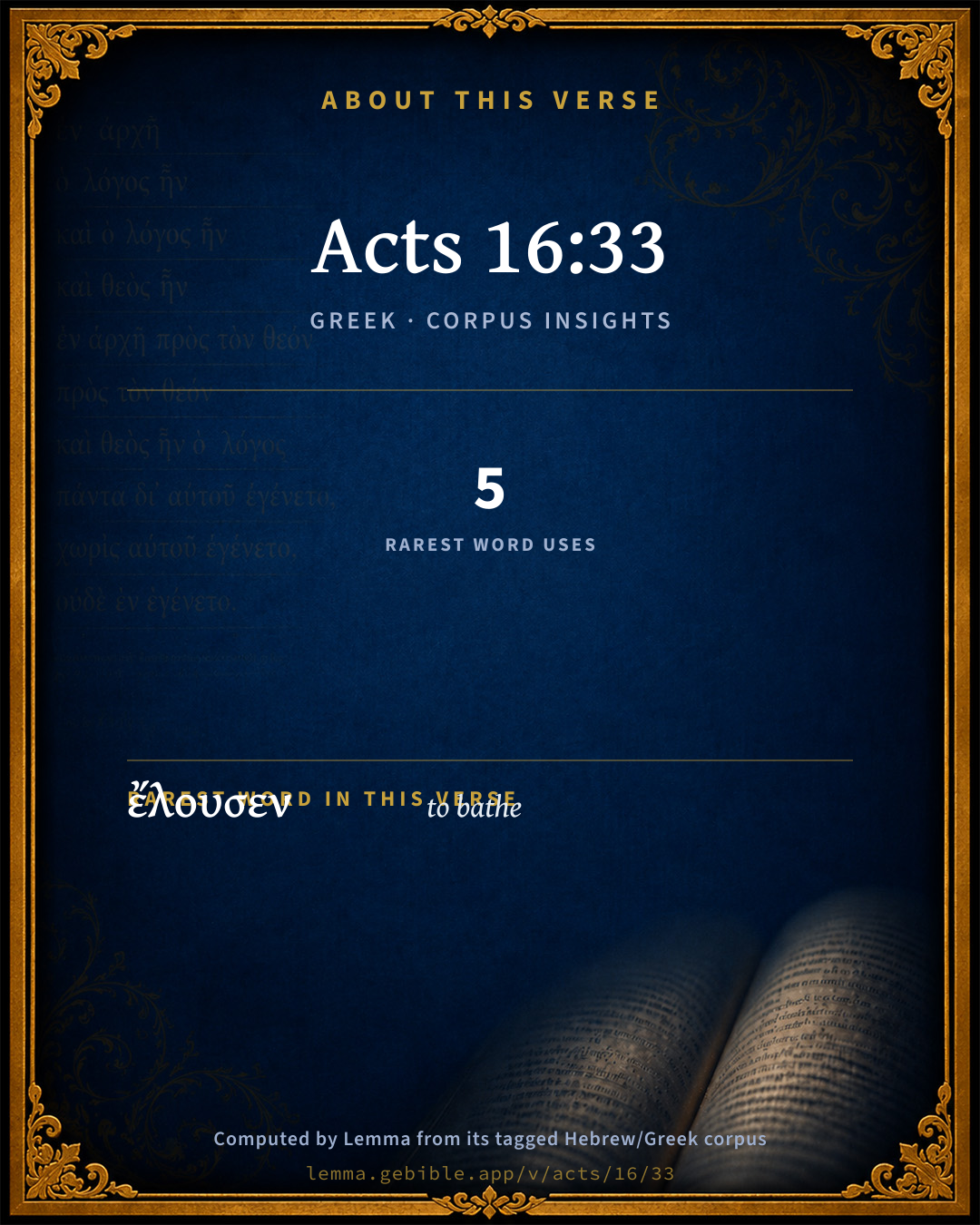
Acts 16:33

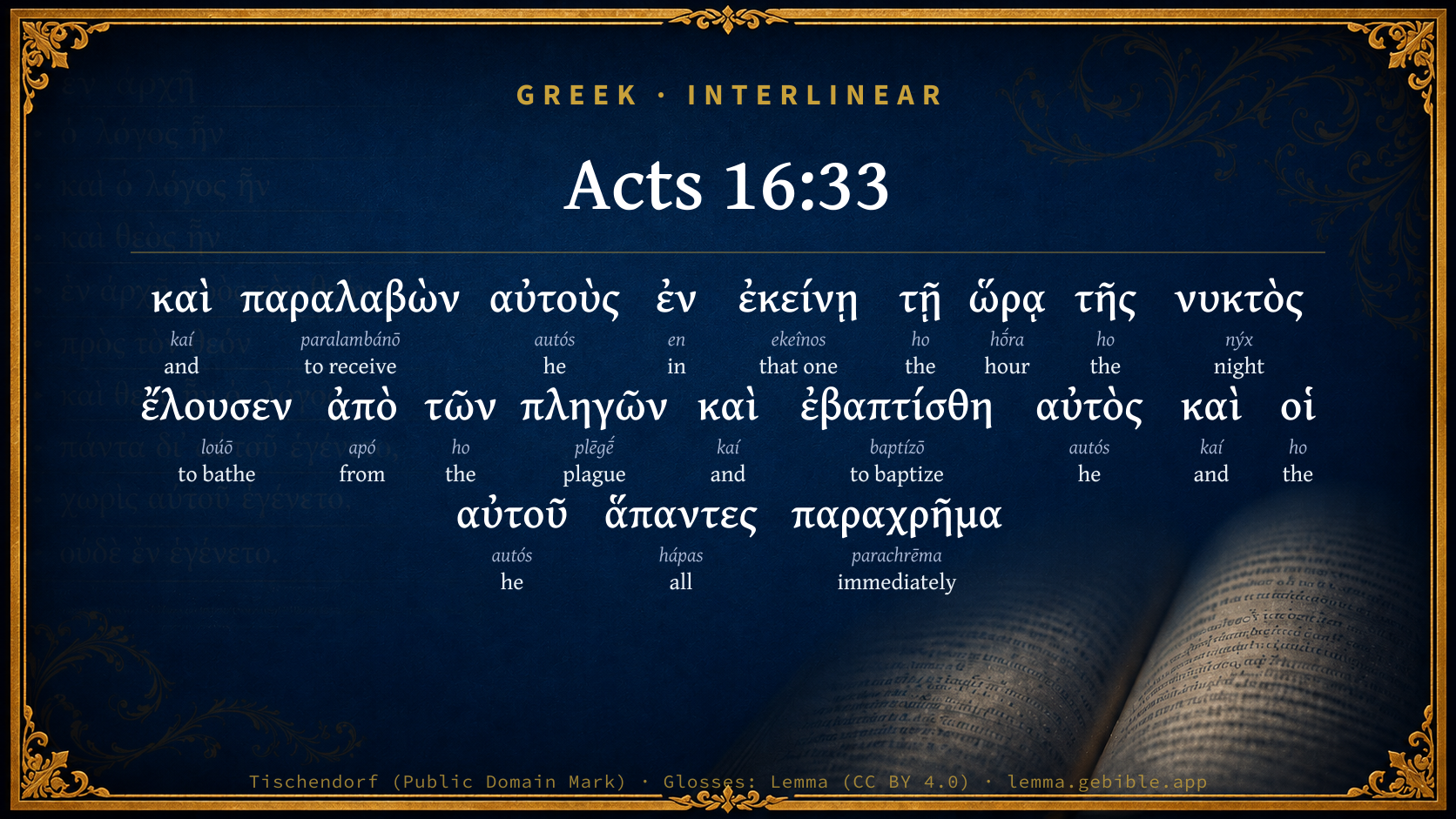
Greek (Tischendorf 8th ed.) Acts 16:33 appears in the Greek New Testament. The text above is from the Tischendorf 8th edition. Each word links to its Strong’s number and a concise gloss. Click any word for its full Thayer’s Greek Lexicon entry.
Download image
Cite this verse

Acts 16:33 (World English Bible). Public Domain. Lemma interlinear Bible study tool, https://lemma.gebible.app/v/acts/16/33.

Show BibTeX & RIS
BibTeX
RIS
English Translation
He took them the same hour of the night, and washed their stripes, and was immediately baptized, he and all his household.
World English Bible · Public Domain
Download a study sheet

One document with this verse’s original text, its word-by-word gloss line, the meaning frame, cross-references with their text, attributed commentary, and full source and license credits — printable, and it pastes into notes with its structure intact.

This verse Autodidact and up

Study sheet (.html) Plain text (.txt)

A passage Seminary Student

Up to 50 verses in one chapter. A passage sheet keeps up to 6 commentary sources and 12 cross-references per verse, in the order this page ranks them, and says so on the sheet whenever that leaves anything out. Ask for a single verse and you get the Autodidact verse sheet above.

Everything on this page stays free to read, with no account — the sheet is a download of what is already on screen, not access to it.

Want to remove ads? Support Godless Engineer
Compare translations 3

The same verse in 3 English versions, stacked beneath the original-language interlinear above. Click any original word for its lexicon entry.

Each is an independent rendering of the whole verse — the interlinear is not word-aligned to these translations.

Highlighted words mark where these versions differ — a whole-verse word diff, not a word-by-word alignment.

  • World English Bible Public Domain
    He took them the same hour of the night, and washed their stripes, and was immediately baptized, he and all his household.
  • King James Version Public Domain
    And he took them the same hour of the night, and washed their stripes; and was baptized, he and all his, straightway.
  • unfoldingWord Literal Text CC BY-SA 4.0
    And taking them at that hour of the night, he washed them from the blows, and he was baptized immediately—he and all the ones of him.

unfoldingWord Literal Text — © unfoldingWord, licensed CC BY-SA 4.0. Word-aligned USFM3 via Door43 (git.door43.org/unfoldingWord/en_ult).

Versions to compare (up to 4)

3 of 4 selected

Show all 19 translations

Every available English version of this verse, each an independent rendering of the whole verse.

  • World English Bible Public Domain
    He took them the same hour of the night, and washed their stripes, and was immediately baptized, he and all his household.
  • Berean Standard Bible Public Domain
    At that hour of the night, the jailer took them and washed their wounds. And without delay, he and all his household were baptized.
  • Majority Standard Bible Public Domain
    At that hour of the night, the jailer took them and washed their wounds. And without delay, he and all his household were baptized.
  • King James Version Public Domain
    And he took them the same hour of the night, and washed their stripes; and was baptized, he and all his, straightway.
  • American Standard Version (1901) Public Domain
    And he took them the same hour of the night, and washed their stripes; and was baptized, he and all his, immediately.
  • Revised Version (1885) Public Domain
    And he took them the same hour of the night, and washed their stripes; and was baptized, he and all his, immediately.
  • Geneva Bible (1599) Public Domain
    Afterwarde he tooke them the same houre of the night, and washed their stripes, and was baptized with all that belonged vnto him, straigthway.
  • Douay-Rheims (1899) Public Domain
    And he, taking them the same hour of the night, washed their stripes, and himself was baptized, and all his house immediately.
  • Young's Literal Translation Public Domain
    and having taken them, in that hour of the night, he did bathe `them' from the blows, and was baptized, himself and all his presently,
  • Literal Standard Version CC BY-SA 4.0
    and having taken them, in that hour of the night, he bathed [them] from the blows, and immediately he and all of his were immersed,
  • Unlocked Literal Bible CC BY-SA 4.0
    Then the jailer took them at the same hour of the night, and washed their wounds, and he and those in his entire house were baptized immediately.
  • unfoldingWord Literal Text CC BY-SA 4.0
    And taking them at that hour of the night, he washed them from the blows, and he was baptized immediately—he and all the ones of him.
  • Darby Bible Public Domain
    And he took them the same hour of the night and washed [them] from their stripes; and was baptised, he and all his straightway.
  • World Messianic Bible Public Domain
    He took them the same hour of the night and washed their stripes, and was immediately immersed, he and all his household.
  • Webster's Bible Public Domain
    And he took them the same hour of the night, and washed their stripes; and was baptized, he and all his, without delay.
  • Free Bible Version CC BY-SA 4.0
    Even though it was late at night he bathed their wounds, and he was baptized right away, along with all his family.
  • Bible in Basic English Public Domain
    And that same hour of the night, he took them, and when he had given attention to their wounds, he and all his family had baptism straight away.
  • Text-Critical English NT CC BY 4.0
    He then took them in that hour of the night and washed their wounds. Then he was baptized at once, along with his entire household.
  • Tyndale New Testament (1534) Public Domain
    And he toke them the same houre of the nyght and wasshed their woundes and was baptised with all that belonged vnto him strayght waye.

Literal Standard Version (2020), Covenant Press — licensed CC BY-SA 4.0. Text via the HelloAO Bible API (eBible.org). Unlocked Literal Bible (unfoldingWord) — licensed CC BY-SA 4.0. Text via the HelloAO Bible API (eBible.org). unfoldingWord Literal Text — © unfoldingWord, licensed CC BY-SA 4.0. Word-aligned USFM3 via Door43 (git.door43.org/unfoldingWord/en_ult). Free Bible Version, Dr. Jonathan Gallagher — licensed CC BY-SA 4.0. Text via the HelloAO Bible API (eBible.org).

Word by word

More ways to search: Search by grammar → Find every occurrence → Compare this word →

Practice this passage: Drill this verse → Learn its vocabulary →

ἔλουσεν
loúō
G3068
“to bathe”
Verb, Aorist, Active, Indicative, 3rd person, Singular
Part of Speech
Verb
Tense
Aorist
Voice
Active
Mood
Indicative
Person
3rd person
Number
Singular
Full Thayer's Definition

Origin: a root verb

TDNT: 08:55,5

1. to bathe, wash a. of a dead person b. washing to cleanse blood out of wounds
  1. καὶ kaí G2532 “and” Conjunction
  2. παραλαβὼν paralambánō G3880 “to receive” Verb, Aorist, Active, Participle, Nominative, Singular, Masculine
  3. αὐτοὺς autós G846 “he” Personal pronoun, Accusative, Plural, Masculine
  4. ἐν en G1722 “in” Preposition
  5. ἐκείνῃ ekeînos G1565 “that one” Demonstrative pronoun, Dative, Singular, Feminine
  6. τῇ ho G3588 “the” Article, Dative, Singular, Feminine
  7. ὥρᾳ hṓra G5610 “hour” Noun, Dative, Singular, Feminine
  8. τῆς ho G3588 “the” Article, Genitive, Singular, Feminine
  9. νυκτὸς nýx G3571 “night” Noun, Genitive, Singular, Feminine
  10. ἀπὸ apó G575 “from” Preposition
  11. τῶν ho G3588 “the” Article, Genitive, Plural, Feminine
  12. πληγῶν plēgḗ G4127 “plague” Noun, Genitive, Plural, Feminine
  13. καὶ kaí G2532 “and” Conjunction
  14. ἐβαπτίσθη baptízō G907 “to baptize” Verb, Aorist, Passive, Indicative, 3rd person, Singular
  15. αὐτὸς autós G846 “he” Personal pronoun, Nominative, Singular, Masculine
  16. καὶ kaí G2532 “and” Conjunction
  17. οἱ ho G3588 “the” Article, Nominative, Plural, Masculine
  18. αὐτοῦ autós G846 “he” Personal pronoun, Genitive, Singular, Masculine
  19. ἅπαντες hápas G537 “all” Adjective, Nominative, Plural, Masculine
  20. παραχρῆμα parachrēma G3916 “immediately” Adverb

About this verse

These counts appear in no published source. They are computed here, from the morphology-tagged text and Lemma’s own curated glosses. What Lemma adds →

21
words
14
distinct lemmas
Acts
section

Notable vocabulary

The rarest word here is ἔλουσεν to bathe G3068 — appearing just 5 times in the whole Greek New Testament.

Shared distinctive vocabulary

ἔλουσεν to bathe G3068 occurs in 5 verses of the Greek New Testament. Also found in:

Repetition

Words recur within this verse:

  • τῇ the G3588 ×4
  • καὶ and G2532 ×3
  • αὐτοὺς he G846 ×3

Cross-references

11

Topical passages linked to Acts 16:33 in the Treasury of Scripture Knowledge — connected by theme and wording, ordered by reader-vote popularity; previews shown in the World English Bible.

  • 1 Corinthians 1:16 (I also baptized the household of Stephanas; besides them, I don't know whether I baptized any other.)
  • Acts 16:15 When she and her household were baptized, she begged us, saying, "If you have judged me to be faithful to the Lord, come into my house, and stay." So she persuaded us.
  • Luke 10:33–34 But a certain Samaritan, as he traveled, came where he was. When he saw him, he was moved with compassion,
  • Acts 16:25 But about midnight Paul and Silas were praying and singing hymns to God, and the prisoners were listening to them.
  • Proverbs 16:7 When a man's ways please Yahweh, He makes even his enemies to be at peace with him.
  • Isaiah 11:6–9 The wolf shall dwell with the lamb, and the leopard shall lie down with the kid; and the calf and the young lion and the fattened calf together; and a little child shall lead them.
  • Matthew 25:35–40 for I was hungry, and you gave me food to eat; I was thirsty, and you gave me drink; I was a stranger, and you took me in;
  • Luke 19:9 Jesus said to him, "Today, salvation has come to this house, because he also is a son of Abraham.
  • Acts 16:23 When they had laid many stripes on them, they threw them into prison, charging the jailer to keep them safely,
  • Galatians 5:6 For in Christ Jesus neither circumcision amounts to anything, nor uncircumcision, but faith working through love.
  • Galatians 5:13 For you, brothers, were called for freedom. Only don't use your freedom for gain to the flesh, but through love be servants to one another.

Cross-references courtesy of OpenBible.info (CC BY 4.0).

Commentary

Notes on Acts 16:33 from classic Christian and Jewish commentators (each source and its license shown beneath its notes). The classic Christian expositions comment on the surrounding passage and are grouped to its opening verse, so a note may address several verses; the Jewish commentaries on the Tanakh (Rashi and others) are per-verse, so they appear only where the commentator wrote on this verse.

Lemma curates 59 commentaries, every one of them public domain or Creative Commons licensed, each selected and text-cleaned for this edition rather than reprinted as found. About our sources →

Bengel's Gnomon

Johann Albrecht Bengel

Act 16:33. Ἔλουσεν, washed: ἐβαπτίσθη, he was baptized) A beautiful interchange (correspondence) of offices of love.—παραχεῆμα, straightway) A wonderful turning-point of time (momentum).

Bengel's Gnomon of the New Testament — English translation (T&T Clark, Edinburgh, 1860) — public domain. Text from a community e-Sword module.

Meyer's Critical & Exegetical Commentary

Heinrich August Wilhelm Meyer

Act_16:33-34. Παραλαβ. αὐτοὺς … ἔλουσεν] he took and washed them. Vividness of delineation. Probably he led them to a neighbouring water, perhaps in the court of the house, in which his baptism and that of his household was immediately completed.[60]

ἀπὸ τῶν πληγῶν] a pregnant expression: so that they were cleansed from the stripes (from the blood of the inflicted wounds, Act_16:22 f.). See Buttmann, neut. Gr. p. 276 f. [E. T. 322].

παραχρῆμα] the adverb emphatically placed at the end; comp. on Mat_2:10, and Kühner, § 863. 1.

ἀναγαγών] We are to think of the official dwelling of the jailor as being built above the prison-cells; comp. Act_9:39; Luk_4:5; Luk_22:67.

παρέθηκε τράπεζαν] quite the Latin apposuit mensam, i.e. he gave a repast; to be explained from the custom of setting out the table before those who were to be entertained, Hom. Od. v. 92, xxi. 29; Polyb. xxxix. 2. 11.

πανοικί] σὺν ὅλῳ τῷ οἴκῳ, Phavorinus. It belongs to πεπιστ. A more classical form (yet see Plat. Eryx. p. 392 C), according to the Atticists, would have been πανοικίᾳ or πανοικησίᾳ, Lobeck, ad Phryn. p. 514 ff. See examples from Philo in Loesner, p. 208.

πεπιστευκὼς τῷ Θεῷ] because he had become and was a believer on God (perfect). He, the Gentile, now believed the divine promises of salvation announced to him by Paul and Silas (Act_16:32); comp. Act_16:15; Act_18:8. That this his πιστεύειν was definitely Christian faith, and accordingly equivalent to πιστεύειν τῷ Κυρίῳ, was self-evident to the reader; see also Act_16:32.

That, after Act_16:34, Paul and Silas had returned to prison, follows from Act_16:36-40.

[60] This is confirmed by the fact that baptism took place by complete immersion,in opposition to Baumgarten, p. 515, who, transferring the performance of baptism to the house, finds here an approximation to the later custom of simplifying the ceremony, according to which complete immersion did not take place. Immersion was, in fact, quite an essential part of the symbolism of baptism (Romans 6).

Meyer — Critical and Exegetical Commentary on the New Testament — English translation by Peter Christie, edited by Frederick Crombie (T&T Clark, 1880) — public domain. Text from a community e-Sword module.

Expositor's Greek Testament

ed. W. Robertson Nicoll

Act 16:33 . ἐν ἐκείνῃ τῇ ὥρᾳ τῆς νυκτὸς , cf. Act 16:18 , “at that hour of the night”; the jailor will not delay for a moment his first Christian duty, Mat 25:36 . ἔλουσεν ἀπὸ τῶν πληγῶν : “and washed them of their stripes,” Ramsay; i.e. , the stains of the wounds caused by the lictors (for similar construction of λούειν ἀπό see Deissmann, Neue Bibelstudien , p. 54). Hobart, p. 112, compares Galen’s words, τὸ αἷμα τοῦ τετρωμένου μέρους ἀποπλῦναι . καὶ οἱ αὐτοῦ πάντες : for the bearing of the words on Infant Baptism, see on Act 16:15 . It may of course be said that the expression evidently implies the same persons who are instructed in Act 16:32 , but it cannot be said that the phrase may not include any other members of the household. The two washings are put in striking juxtaposition: the waters of baptism washed the jailor from deeper stains and more grievous wounds than those of the lictors’ rods, Chrys., Hom. , xxxvi. παραχρῆμα , emphatic, see above on p. 106.

The Expositor's Greek Testament, edited by W. Robertson Nicoll (1897–1910) — public domain. Text from a community e-Sword module.

Geneva Bible (1599)

Geneva Bible translators

God with one selfsame hand woundeth and healeth, when it pleaseth him.

Geneva Bible (1599) marginal notes — public domain. Text via Bolls.life.

Jamieson, Fausset & Brown

Robert Jamieson, A. R. Fausset & David Brown

And he took them--the word implies change of place.

the same hour of the night, and washed their stripes--in the well or fountain which was within or near the precincts of the prison [HOWSON]. The mention of "the same hour of the night" seems to imply that they had to go forth into the open air, which, unseasonable as the hour was, they did. These bleeding wounds had never been thought of by the indifferent jailer. But now, when his whole heart was opened to his spiritual benefactors, he cannot rest until he has done all in his power for their bodily relief.

and was baptized, he and all his, straightway--probably at the same fountain, since it took place "straightway"; the one washing on his part being immediately succeeded by the other on theirs.

Jamieson, Fausset & Brown — Commentary Critical and Explanatory on the Whole Bible (1871) — public domain (CC PDM 1.0). Text via the HelloAO Bible API.

Adam Clarke's Commentary

Verse 33. Washed their stripes] Ελουσεν απο των πληγων, He washed from the stripes: i.e. he washed the blood from the wounds; and this would not require putting them into a pool, or bath, as some have ridiculously imagined.

Adam Clarke's Commentary on the Bible (1810–1826) — public domain. Text from a community e-Sword/MySword module.

John Calvin's Commentaries

33. He was baptized, and all his household. Luke doth again commend the godly zeal of the keeper, that he did consecrate all his whole house to the Lord; wherein doth also appear the grace of God, in that he brought all his whole family unto a godly consent. And we must also note the notable exchange: he was of late about to murder himself, because he thought that Paul and the rest were escaped; but now laying aside all fear, he bringeth them home. So that we see how faith doth animate and encourage those to behave themselves stoutly who before had no heart. And surely, when we droop through fear and doubtfulness, there is no better matter of boldness than to be able to cast all our cares into God’s bosom; that no danger may terrify us from doing our duty, whilst that we look for an end at God’s hand, such as he shall see to be most profitable.

John Calvin's Commentaries (1540-1563) — public domain. Text from the Calvin Translation Society English edition (1840s-50s) via the Christian Classics Ethereal Library (ccel.org). Calvin's coverage is partial (roughly two-thirds of the Bible); uncommented books and verses are honest gaps, never fabricated. The 19th-century editor's footnotes and remarks are omitted so the notes are faithfully Calvin's own voice.

Ellicott's Commentary for English Readers

(33) He . . . washed their stripes; and was baptized . . .—The two-fold washings, that which testified of the repentance of the gaoler and his kindly reverence for his prisoners, and that which they administered to him as the washing of regeneration, are placed in suggestive juxtaposition. He, too, was cleansed from wounds which were worse than those inflicted by the rods of the Roman lictors. No certain answer can be given to the question whether the baptism was by immersion or affusion. A public prison was likely enough to contain a bath or pool of some kind, where the former would be feasible. What has been said above (see Note on Act_16:15) as to the bearing of these narratives on the question of infant baptism applies here also, with the additional fact that those who are said to have been baptised are obviously identical with those whom St. Paul addressed (the word “all” is used in each case), and must, therefore, have been of an age to receive instruction together with the gaoler himself.

A Bible Commentary for English Readers, edited by Charles John Ellicott (1878–1897) — public domain. Text from a community e-Sword module.

The Cambridge Bible for Schools and Colleges

gen. ed. J. J. S. Perowne

33. the same hour of the night] It was midnight, see Act_16:25. But a new day, a birthday, had already begun for him and it must be kept as a feast, and he does his utmost to shew his rejoicing by care for those who had caused it.

washed their stripes] An act of attendance that had not been bestowed before. They were thrust into the inner prison, with all their wounds bleeding and uncared for.

The Cambridge Bible for Schools and Colleges (gen. ed. J. J. S. Perowne; Cambridge University Press, 1878–1918) — public domain. Text from a community e-Sword module.

John Gill's Exposition

And he took them the same hour of the night,.... After they had done preaching to him, and to his family:

and washed their stripes; which were very many and heavy, and whereby they were covered with blood; and which by this time began to fester, and to produce corrupt matter; and all this in a pool, which Grotius supposes was within the bounds of the prison, he washed off from them: his faith worked by love, and showed itself in fruits of charity and righteousness, and in obedience to Christ, and submission to his ordinance, as follows:

and was baptized, he and all his, straightway; by immersion, that being the only way in which baptism was administered, or can be, so as to be called a baptism: and which might be administered, either in the pool, which Grotius supposes to have been in the prison; or in the river near the city, where the oratory was, Act 16:13 and it is no unreasonable thought to suppose, that they might go out of the prison thither, and administer the ordinance, and return to the prison again before morning unobserved by any; and after that, enter into the jailer's house and be refreshed, as in the following verse; and as this instance does not at all help the cause of sprinkling, so neither the baptism of infants; for as the jailer's family were baptized as well as he, so they had the word of the Lord spoken to them as well as he, and believed as well as he, and rejoiced as he did; all which cannot be said of infants; and besides, it must be proved that he had infants in his house, and that these were taken out of their beds in the middle of the night, and baptized by Paul, ere the instance can be thought to be of any service to infant baptism.

John Gill's Exposition of the Whole Bible (1746–1763) — public domain (CC PDM 1.0). Text via the HelloAO Bible API.

Trapp's Complete Commentary

John Trapp

33 And he took them the same hour of the night, and washed their stripes; and was baptized, he and all his, straightway.

Ver. 33. He and all his straightway] God’s work is of great importance, and must be presently done, whatever else is left undone. "If ye will inquire, inquire, return, come," Isa 21:12.

John Trapp, A Commentary or Exposition upon All the Books of the Old and New Testament (1647–1656) — public domain. Text from a community e-Sword module.

Albert Barnes' Notes on the Bible

And he took them - To a convenient place for washing. It is evident from this that, though the apostles had the gift of miracles, they did not exercise it in regard to their own sufferings or to heal their own wounds. They restored others to health, not themselves.

And washed their stripes - The wounds which had been inflicted by the severe scourging which they had received the night before. We have here a remarkable instance of the effect of religion in producing humanity and tenderness. This same man, a few hours before, had thrust them into the inner prison, and made them fast in the stocks. He evidently had then no concern about their stripes or their wounds. But no sooner was he converted than one of his first acts was an act of humanity. He saw them suffering; he pitied them, and hastened to minister to them and to heal their wounds. Until the time of Christianity there never had been a hospital or an almshouse. Nearly all the hospitals for the sick since have been reared by Christians. They who are most ready to minister to the sick and dying are Christians. They who are most willing to encounter the pestilential damps of dungeons to aid the prisoner are, like Howard, Christians. Who ever saw an infidel attending a dying bed if he could help it? and where has infidelity ever reared a hospital or an almshouse, or made provision for the widow and the fatherless? Often one of the most striking changes that occurs in conversion is seen in the disposition to be kind and humane to the suffering. Compare Jam 1:27.

And was baptized - This was done straightway; that is, immediately. As it is altogether improbable that either in his house or in the prison there would be water sufficient for immersing them, there is every reason to suppose that this was performed in some other mode. All the circumstances lead us to suppose that it was not by immersion. It was at the dead of night; in a prison; amidst much agitation; and was evidently performed in haste.

Albert Barnes' Notes on the Bible (1834–1885) — public domain. Text from a community e-Sword/MySword module.

Haydock's Catholic Bible Commentary

Was baptized, being first told what he was to believe, and do. (Witham) --- Hence Catholics draw a very plausible argument for the baptism of infants, as it is very probable there were some infants in the family. See Estius, in different location.

George Leo Haydock (1774–1849), Haydock's Catholic Family Bible and Commentary, 1859 edition — public domain. Excludes Psalms (Douay-Rheims chapter numbering differs from Protestant) and Deuterocanonical books (Catholic canon only).

Matthew Poole's English Annotations

The same hour of the night; he did not delay to show forth the fruits of his faith, and real conversion.

And washed their stripes; which his stripes had made, using such means as might assuage their pain, and heal their wounds.

He and all his: See Poole on "Act 16:15", See Poole on "Act 16:32". Of baptism administered without any delay, upon their profession of faith in Christ, we have had examples, Act 8:38; 10:47, and in Act 16:15.

Matthew Poole's English Annotations on the Holy Bible (1683–1685) — public domain. Text from a community e-Sword/MySword module.

Whedon's Commentary on the Bible

Daniel D. Whedon

33. He took them—From among the cells, as we conceive, into the court, where the well or fountain often was.

The same hour of the night— Unseasonable as it may have seemed.

Washed their stripes—The word ελουσεν probably signifies a plentiful application of water in successive parts to their entire persons. The vessels in the vestibules of the ancient churches for washing hands were called λουτηρες; the water in pitchers for purifying brides by sprinkling was called λουτρον; the boy who brought it was called λουτροφορος? and a bath wash-basin is called a λουτηριον, pp. 208-211. In all these cases λουω signifies the application of water to the person.

Baptized—It can hardly be supposed that so many persons should be successively immersed at midnight in the same well, fountain, or tank. Nor could they all have gone down to the river, for Paul’s message to the magistrates (Act_16:37) clearly implies that he had not left the prison limits. Smith’s “Dictionary of Classical Antiquities.” p. 148, has the following words: “The word baptisterium is not a bath sufficiently large to immerse the whole body, but a vessel or labrum containing cold water for pouring over the head,” p. 336. As this present baptism was performed by one Roman citizen upon another, the passage is in point. There is the purifying of the body and the purifying of the soul reciprocally applied.

Daniel D. Whedon (gen. ed.), Commentary on the Old and New Testaments (1874–1909) — public domain. Text from a community e-Sword module.

The Pulpit Commentary

Immediately for straightway, A.V. Washed their stripes. Mark the jailor"s faith working by love. He and all his. The phrase seems purposely adapted to include family, slaves, and all under his roof. If the conversion of the jailor and his house was sudden, the circumstances which led to it were of unusual power the earthquake, the loosing of the prisoners" bands, the midnight hour, the words of grace and love and lifo from the apostle"s mouth.

The Pulpit Commentary (1880–1919), ed. H.D.M. Spence-Jones & Joseph S. Exell — public domain. Text from a community e-Sword module.

John Wesley's Explanatory Notes

He washed their stripes - It should not be forgot, that the apostles had not the power of working miraculous cures when they pleased, either on themselves, or their dearest friends. Nor was it expedient they should, since it would have frustrated many wise designs of God, which were answered by their sufferings.

John Wesley, Explanatory Notes Upon the Whole Bible (1754–1765) — public domain. Text via the GEBible commentary corpus.

Burkitt's Expository Notes on the New Testament

William Burkitt

Behold how sudden and strange a change was wrought in this gaoler. Before his conversion he was cruel, barbarous, and hard-hearted; now he is meek, merciful, and compassionate. He that before had beaten, imprisoned, and hurt the holy apostles’ feet in the stocks, now pities them, mourns over them, and washes their stripes.

Learn thence, That religion, and the grace of God, soften and mollify the hardest hearts, sweeten the sourest natures, and change the most barbarous and bloody dispositions. Behold this gaoler, before his conversion, a savage persecutor, a tiger, and a vulture, like the demoniac in the gospel, exceeding fierce: but now dispossessed of his fury, and by grace turned into a lamb for meekness, and a dove for innocency.

Observe, 2. How the gaoler believing, he and all his house were baptized. The apostle denied not baptism to the gaoler’s household, upon the gaoler’s sincere profession of the Christian faith; yet no doubt he promised to use his utmost endeavours to bring them to the knowledge and obedience of Jesus Christ.

Observe, lastly, How improbable it is that the gaoler and his household were baptized by dipping. We do not deny the lawfulness of baptizing by immersion; but we cannot assert the absolute and indispensable necessity of it. St. Paul, who was newly washed, and his sores dress, occasioned by stripes, cannot be supposed either to go out himself, or to carry the gaoler and all his family, in the dead of the night, to the river or a pond to baptize them; neither is it in the least probable, that St. Paul himself was baptized by dipping. He arose, and was baptized; and when he had received meat, he was strengthened. Act 9:18-19

The context may convince us, that he was baptized in his lodgings, being sick and weak, having fasted three days, and being in a very low condition, partly by his miraculous vision, and partly by his extraordinary fasting: it was no ways probable that Ananias should carry him out to a river in that condition, to plunge him in cold water. Dipping, then surely, cannot be so essential unto baptism, as for want of it to pronounce the baptism of all the reformed churches throughout the world to be null and void, as some amongst us do.

William Burkitt's Expository Notes on the New Testament (1700–1703) — public domain. Text from a community e-Sword module.

McGarvey & Pendleton's Commentaries

J. W. McGarvey

33, 34. The preaching, as would be expected under circumstances so favorable, had the desired effect both upon the jailer and his household. (33) " And he took them the same hour of the night, and washed their stripes, and was immersed, he and all his, immediately. (34) And having led them into his house, he set food before them, and rejoiced, believing in God with all his house. "

Those pedobaptist writers who claim the example of the apostles in favor of affusion and infant baptism attempt to find support for these practices in this case of conversion. Their argument for affusion depends entirely upon the assumption that the baptism was performed within the prison. If this assumption were admitted, it would prove nothing in favor of affusion so long as it is possible that there were conveniences for immersion within the prison. But the assumption is in direct conflict with the facts in the case. The facts are briefly as follows: First, When the jailer was about to commit suicide, Paul saw him, which shows that he was then outside of his dungeon, in the more part of the prison. Second, Hearing Paul's voice, the jailer sprang into the prison, and " led them out "-not dungeon, but out of the prison. Third, Being now out of the prison, "they spoke the word of the Lord to him and to all who were in his house." While speaking, then, they were in the house, and not in the prison. Fourth, "He took them and washed their stripes, and was baptized." The verb took, in this connection, implies the removal of the parties to some other spot for the washing and baptizing. Whether to some other part of the house, or out of the house, it does not determine. But, fifth, when the baptizing was concluded, "he led them into his house," which shows that, before it was done, he had taken them out of the house. Between the moment at which he took them out of the house and the moment he brought them into it, the baptizing was done. But they would not, at this hour of the night, have gone out, unless there was some necessity for it, which the demands of affusion could not supply. The circumstances, though not in itself a proof of immersion, afford strong circumstantial evidence in its favor, and is suggestive of that river on the banks of which Lydia first heard the gospel, and in which she was immersed.

It has been suggested that the party could not have passed through the gates of the city at this hour of the night; but there is no evidence that Philippi was a walled town. Again, it is sometimes objected, that the jailer had no right to take his prisoners outside the jail; and that Paul and Silas showed, by their conduct on the next morning, that they would not go out without the consent of the authorities. But this is to assume that the jailer would rather obey men than God, and that Paul and Silas were so punctilious about their personal dignity that they would refuse to immerse a penitent sinner through fear of compromising it. Such assumptions are certainly too absurd to be entertained when once observed; but, even if we cling to them, they can not set aside the fact, so clearly established above, that the jailer did lead them out of the prison.

As for the assumption that infants were baptized here, we have already observed, in commenting on Lydia's conversion, that it is precluded by the fact that all the household believed. "He rejoiced, believing in God with all his house. " Moreover, Paul and Silas spoke the Word to " all who were in the house," yet they certainly did not preach to infants. As there were no infants in the house while hearing, and none while subsequently believing and rejoicing, there could be none at the intermediate baptizing.

Before dismissing this case of conversion, which is the last we will consider in detail in the course of this work, we propose a brief review of its leading features, that we may trace its essential uniformity with those already considered. The influence which first took effect upon him was that of the earthquake, and the attendant opening of the prison-doors. This produced a feeling of alarm and heathenish desperation. It awakened within him no religious thought or emotions until the voice of Paul had recalled all that he had known of the apostolic preaching, when he instantly perceived that the miracle had been wrought by the God whom Paul and Silas preached. The proper effect of miraculous attestation of a messenger of God is next apparent in his rushing forward, falling before them, and exclaiming, "Sirs, what must I do to be saved?" He is now a believer in the divine mission of the apostles, but not yet a believer in Jesus Christ. Whatever he hears from these men, however, he is ready to receive as God's truth. He hears from them the "word of the Lord," and the next we see, he is washing from the neglected stripes of the prisoners the clotted blood, and submitting to immersion. That he was immersed proves that he was both a believer and a penitent. After immersion, he rejoices. The case exhibits the same essential features which we have found in all others; the same word of the Lord spoken and attested by miraculous evidence; the same faith in the Lord Jesus Christ, followed by repentance, and the same immersion, followed by the same rejoicing. Thus we trace a perfect uniformity in the apostolic procedure, and in the experience of their converts.

J. W. McGarvey (with Philip Y. Pendleton), Commentaries on the New Testament (The Fourfold Gospel, 1914; Acts; and the epistles) — public domain. Text from a community e-Sword/MySword module.

Cambridge Greek Testament for Schools and Colleges

33. ἐν ἐκείνῃ τῇ ὥρᾳ τῆς νυκτός, in that same hour of the night. It was midnight, see Act 16:25. But a new day, a birthday, had already begun for him and it must be kept as a feast. So he does his utmost to shew his rejoicing by care for those who had caused it.

ἔλουσεν ἀπὸ τῶν πληγῶν, he washed their stripes. An act of attention which had not been bestowed before. They were thrust into the inner prison with their wounds all bleeding and uncared for. The literal sense is ‘washed (them) from their wounds,’ i.e. from the stains and blood which their wounds had caused. Cf. Rev 1:5, λούσαντι ἡμᾶς ἀπὸ τῶν ἁμαρτιῶν ἡμῶν.

Chrysostom here remarks: ἐκείνους μὲν ἀπὸ τῶν πληγῶν ἔλουσεν, αὐτὸς δὲ ἀπὸ τῶν ἁμαρτιῶν ἐλούθη, ἔθρεψε καὶ ἐτράφη.

Cambridge Greek Testament for Schools and Colleges (Cambridge University Press, 1896; 21 vols, various authors incl. Carr, Maclear, Plummer, Farrar, Lumby, Moule, M. R. James, Simcox) — public domain. Text from a community e-Sword module.

Alford’s Greek Testament

Henry Alford

33. ἔλουσεν ἀπό] A pregnant construction: ‘washed them, so that they were purified from the blood occasioned by their stripes:’ see reff. This is much more natural than to take ἀπό (as in ἀπὸ τῆς χαρᾶς (ch. 12:14) and the like) as signifying ‘on account of’ (see Bernhardy, Syntax, p. 225).

Henry Alford, The Greek Testament (1849–1861) — public domain. Text from a community e-Sword module.

Vincent's Word Studies in the New Testament

Marvin R. Vincent

He took [παραλαβων] . Strictly, "took them along with [παρα] him :" to some other part of the prison.

Washed their stripes [ελουσεν απο των πληγων] . Properly, "washed them from [απο] their stripes." The verb louein expresses the bathing of the entire body (Heb 10:23; Act 9:37; 2Pe 2:22); while niptein commonly means the washing of a part of the body (Mt 6:17; Mr 8:3; Joh 13:5). The jailer bathed them; cleansing them from the blood with which they were besprinkled from the stripes.

Marvin R. Vincent, Word Studies in the New Testament (1887–1900) — public domain. Text from a community e-Sword/MySword module.

Lesson kit

Teaching starters — assembled from the data on this page, not authored interpretation. Every prompt links to the verse data it draws on. Edit before teaching.

Acts, in the Acts, opens this verse with 21 words (14 distinct Greek lemmas). Its most distinctive word is loúō (“to bathe”). A historical commentator’s framing appears above. Read the whole chapter for the surrounding context.

Discussion questions

  1. The word loúō carries the sense “to bathe.” How does it shape the verse?
  2. John 13:10 shares the word «to bathe» with this verse. How do the two illuminate each other?
  3. “the” occurs 4× in this one verse. What is the effect of the repetition?
  4. The translations on this page render this verse differently — a whole-verse word diff, not a word-by-word alignment. What might account for the different wordings?
  5. Reading how Bengel's Gnomon and Meyer's Critical & Exegetical Commentary read this verse, where do the two commentators agree and where do they part?

Things to notice

Reading settings

Reading text

Shown beneath each verse's original-language words.

Old Testament
Old Testament edition

Read the OT as the Masoretic Hebrew (MT) or the Greek Septuagint (LXX).

English shown for the Greek Septuagint (in the Hebrew ↔ Greek comparison).

Comparing translations? Open the Compare panel on any verse page to stack up to four side by side.