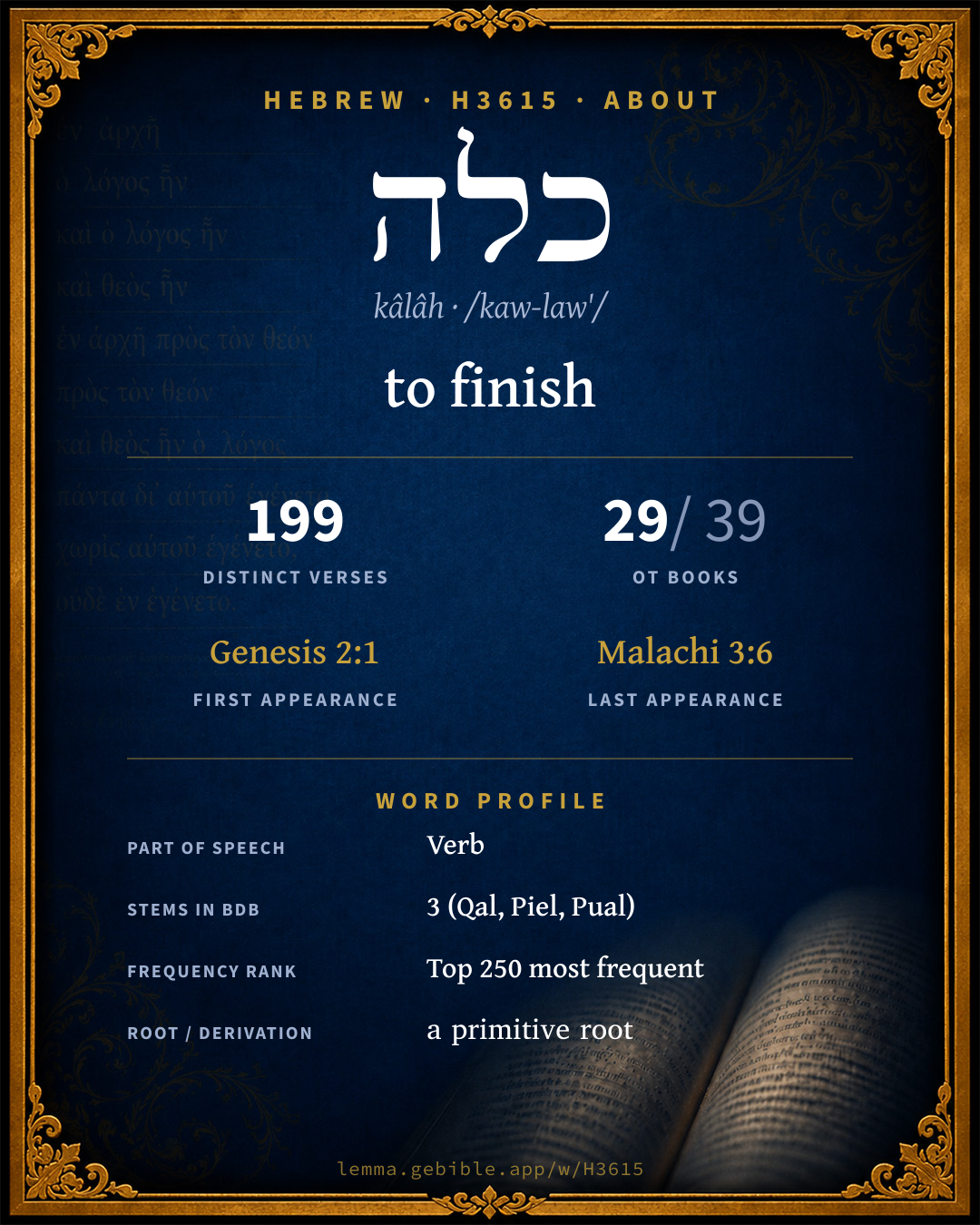
כָּלָה
to finish
‘to finish’ is one of 2 main senses fuller range ↓
Full lexicon entry — Brown-Driver-Briggs (BDB)
From Brown-Driver-Briggs (BDB)
Where this word appears
See every Piel verb in the Hebrew Bible →
Grammar key — what these labels mean
Part of speech
- Verb
- An action or state-of-being word.
Noun type
- Common
- A common noun — a general class of person, place, or thing (“king,” “city,” “water”), not a specific name.
Stem
- Piel
- An intensive or resultative active stem. Here: ‘complete’
- Qal
- The basic, simple active stem — the plain form of the verb (“he wrote”). Here: ‘be complete’
- Pual
- The passive counterpart of the Piel.
Form
- Sequential Imperfect
- An imperfect with prefixed waw — the standard past-narrative form (waw-consecutive imperfect).
- Infinitive Construct
- A bound verbal noun, frequently with prepositions (“to write / in writing”).
- Perfect
- A completed action or state — Hebrew marks aspect (completeness) more than strict tense (“he wrote”).
- Sequential Perfect
- A perfect with prefixed waw continuing a preceding imperfect or command (waw-consecutive perfect).
- Imperfect
- An incomplete, ongoing, or future action (“he will / would write”).
- Imperative
- A direct command (“write!”).
- Infinitive Absolute
- An unbound verbal noun, often intensifying or standing in for a finite verb.
- Participle Active
- A verbal adjective expressing ongoing or characteristic action (“writing / one who writes”).
- Cohortative
- A first-person volitional form expressing wish or resolve (“let me / let us write”).
- Jussive
- A third- or second-person volitional form expressing wish or command (“let him write”).
State
- Absolute
- The independent form of a noun, not bound to a following word.
Person
- 3rd Person
- The one spoken about (“he / she / it / they”).
- 1st Person
- The speaker (“I / we”).
- 2nd Person
- The one addressed (“you”).
Gender
- Masculine
- Grammatically masculine.
- Common
- Either gender — not distinguished for this form.
- Feminine
- Grammatically feminine.
Number
- Singular
- One.
- Plural
- More than one (in Hebrew, generally three or more).
Grammatical forms 44 distinct
- Verb, Piel, Infinitive Construct 49 times (24%)
- Verb, Piel, Sequential Imperfect, 3rd Person, Masculine, Singular 16 times (8%)
- Verb, Piel, Perfect, 3rd Person, Masculine, Singular 13 times (6%)
- Verb, Qal, Perfect, 3rd Person, Common, Plural 11 times (5%)
- Verb, Qal, Infinitive Construct 10 times (5%)
- Verb, Qal, Perfect, 3rd Person, Masculine, Singular 9 times (4%)
- Verb, Piel, Perfect, 3rd Person, Common, Plural 9 times (4%)
- Verb, Qal, Perfect, 3rd Person, Feminine, Singular 8 times (4%)
+36 more forms (80 occurrences)
Parsed forms decoded from the imported morphology (morphhb / Westminster Leningrad Codex — WLC text public domain, morphhb tagging CC BY 4.0), counted across 205 parsed occurrences — not distinct verses.
Every verse where H3615 appears — 199 distinct verses across 29 books. Click any verse to open its interlinear word-by-word view. Verse text shown in the World English Bible for context — . Each verse’s Hebrew form is shown with its reference; the English is not keyword-highlighted, since the data carries no word-level English alignment. Use “Compare translations” on any verse to read it across multiple English versions. This concordance covers the Hebrew Bible; Septuagint (Greek Old Testament) occurrences are not indexed here.
Genesis 16 verses
- Genesis 2:1 וַ/יְכֻלּ֛וּ conj + Pual wimpf 3mp The heavens and the earth were finished, and all the host of them.
- Genesis 2:2 וַ/יְכַ֤ל conj + Piel wimpf 3ms On the seventh day God finished his work which he had made; and he rested on the seventh day from all his work which he had made.
- Genesis 6:16 תְּכַלֶ֣/נָּה Piel impf 2ms + sfx pers 3fs You shall make a roof in the ark, and to a cubit shall you finish it upward. You shall set the door of the ark in the side of it. You shall make it with lower, second, and third levels.
- Genesis 17:22 וַ/יְכַ֖ל conj + Piel wimpf 3ms When he finished talking with him, God went up from Abraham.
- Genesis 18:33 כִּלָּ֔ה Piel pf 3ms Yahweh went his way, as soon as he had finished communing with Abraham, and Abraham returned to his place.
- Genesis 21:15 וַ/יִּכְל֥וּ conj + Qal wimpf 3mp The water in the bottle was spent, and she cast the child under one of the shrubs.
- Genesis 24:15 כִּלָּ֣ה Piel pf 3ms It happened, before he had done speaking, that behold, Rebekah came out, who was born to Bethuel the son of Milcah, the wife of Nahor, Abraham's brother, with her pitcher on her shoulder.
- Genesis 24:19 וַ/תְּכַ֖ל כִּלּ֖וּ conj + Piel wimpf 3fs Piel pf 3cp When she had done giving him drink, she said, "I will also draw for your camels, until they have done drinking."
- Genesis 24:22 כִּלּ֤וּ Piel pf 3cp It happened, as the camels had done drinking, that the man took a golden ring of half a shekel weight, and two bracelets for her hands of ten shekels weight of gold,
- Genesis 24:45 אֲכַלֶּ֜ה Piel impf 1cs Before I had done speaking in my heart, behold, Rebekah came forth with her pitcher on her shoulder. She went down to the spring, and drew. I said to her, 'Please let me drink.'
- Genesis 27:30 כִּלָּ֣ה Piel pf 3ms It happened, as soon as Isaac had made an end of blessing Jacob, and Jacob had just gone out from the presence of Isaac his father, that Esau his brother came in from his hunting.
- Genesis 41:30 וְ/כִלָּ֥ה conj + Piel wpf 3ms There will arise after them seven years of famine, and all the plenty will be forgotten in the land of Egypt. The famine will consume the land,
- Genesis 41:53 וַ/תִּכְלֶ֕ינָה conj + Qal wimpf 3fp The seven years of plenty, that was in the land of Egypt, came to an end.
- Genesis 43:2 כִּלּוּ֙ Piel pf 3cp It happened, when they had eaten up the grain which they had brought out of Egypt, their father said to them, "Go again, buy us a little more food."
- Genesis 44:12 כִּלָּ֑ה Piel pf 3ms He searched, beginning with the eldest, and ending at the youngest. The cup was found in Benjamin's sack.
- Genesis 49:33 וַ/יְכַ֤ל conj + Piel wimpf 3ms When Jacob made an end of charging his sons, he gathered up his feet into the bed, and yielded up the spirit, and was gathered to his people.
Exodus 10 verses
- Exodus 5:13 כַּלּ֤וּ Piel impv 2mp The taskmasters were urgent saying, "Fulfill your work quota daily, as when there was straw!"
- Exodus 5:14 כִלִּיתֶ֨ם Piel pf 2mp The officers of the children of Israel, whom Pharaoh's taskmasters had set over them, were beaten, and demanded, "Why haven't you fulfilled your quota both yesterday and today, in making brick as before?"
- Exodus 31:18 כְּ/כַלֹּת/וֹ֙ prep + Piel inf.cs + sfx pers 3ms He gave to Moses, when he finished speaking with him on Mount Sinai, the two tablets of the testimony, stone tablets, written with God's finger.
- Exodus 32:10 וַ/אֲכַלֵּ֑/ם conj + Piel coh 1cs + sfx pers 3mp Now therefore leave me alone, that my wrath may burn hot against them, and that I may consume them; and I will make of you a great nation."
- Exodus 32:12 וּ֨/לְ/כַלֹּתָ֔/ם conj + prep + Piel inf.cs + sfx pers 3mp Why should the Egyptians speak, saying, 'He brought them forth for evil, to kill them in the mountains, and to consume them from the surface of the earth?' Turn from your fierce wrath, and repent of this evil against your people.
- Exodus 33:3 אֲכֶלְ/ךָ֖ Piel impf 1cs + sfx pers 2ms to a land flowing with milk and honey: for I will not go up in the midst of you, for you are a stiff-necked people, lest I consume you in the way."
- Exodus 33:5 וְ/כִלִּיתִ֑י/ךָ conj + Piel wpf 1cs + sfx pers 2ms Yahweh said to Moses, "Tell the children of Israel, 'You are a stiff-necked people. If I were to go up into your midst for one moment, I would consume you. Therefore now take off your jewelry from you, that I may know what to do to you."
- Exodus 34:33 וַ/יְכַ֣ל conj + Piel wimpf 3ms When Moses was done speaking with them, he put a veil on his face.
- Exodus 39:32 וַ/תֵּ֕כֶל conj + Qal wimpf 3fs Thus all the work of the tent of the tent of meeting was finished. The children of Israel did according to all that Yahweh commanded Moses; so they did.
- Exodus 40:33 וַ/יְכַ֥ל conj + Piel wimpf 3ms He raised up the court around the tent and the altar, and set up the screen of the gate of the court. So Moses finished the work.
Leviticus 5 verses
- Leviticus 16:20 וְ/כִלָּה֙ conj + Piel wpf 3ms "When he has made an end of atoning for the Holy Place, the Tent of Meeting, and the altar, he shall present the live goat.
- Leviticus 19:9 תְכַלֶּ֛ה Piel impf 2ms "'When you reap the harvest of your land, you shall not wholly reap the corners of your field, neither shall you gather the gleanings of your harvest.
- Leviticus 23:22 תְכַלֶּ֞ה Piel impf 2ms "'When you reap the harvest of your land, you shall not wholly reap into the corners of your field, neither shall you gather the gleanings of your harvest: you shall leave them for the poor, and for the foreigner. I am Yahweh your God.'"
- Leviticus 26:16 מְכַלּ֥וֹת Piel ptcp.act fp I also will do this to you: I will appoint terror over you, even consumption and fever, that shall consume the eyes, and make the soul to pine away; and you will sow your seed in vain, for your enemies will eat it.
- Leviticus 26:44 לְ/כַלֹּתָ֔/ם prep + Piel inf.cs + sfx pers 3mp Yet for all that, when they are in the land of their enemies, I will not reject them, neither will I abhor them, to destroy them utterly, and to break my covenant with them; for I am Yahweh their God;
Numbers 7 verses
- Numbers 4:15 וְ/כִלָּ֣ה conj + Piel wpf 3ms "When Aaron and his sons have finished covering the sanctuary, and all the furniture of the sanctuary, as the camp moves forward; after that, the sons of Kohath shall come to carry it: but they shall not touch the sanctuary, lest they die. These things are the burden of the sons of Kohath in the Tent of Meeting.
- Numbers 7:1 כַּלּ֨וֹת Piel inf.cs It happened on the day that Moses had finished setting up the tabernacle, and had anointed it and sanctified it, with all its furniture, and the altar with all its vessels, and had anointed and sanctified them;
- Numbers 16:21 וַ/אַכַלֶּ֥ה conj + Piel coh 1cs Separate yourselves from among this congregation, that I may consume them in a moment.
- Numbers 16:31 כְּ/כַלֹּת֔/וֹ prep + Piel inf.cs + sfx pers 3ms It happened, as he made an end of speaking all these words, that the ground split apart that was under them;
- Numbers 16:45 וַ/אֲכַלֶּ֥ה conj + Piel impf 1cs Get away from among this congregation, that I may consume them in a moment. They fell on their faces.
- Numbers 17:10 וּ/תְכַ֧ל conj + Piel impf 2ms Yahweh said to Moses, Put back the rod of Aaron before the testimony, to be kept for a token against the children of rebellion; that you may make an end of their murmurings against me, that they not die.
- Numbers 25:11 כִלִּ֥יתִי Piel pf 1cs Phinehas, the son of Eleazar, the son of Aaron the priest, has turned my wrath away from the children of Israel, in that he was jealous with my jealousy among them, so that I didn't consume the children of Israel in my jealousy.
Deuteronomy 7 verses
- Deuteronomy 7:22 כַּלֹּתָ֣/ם Piel inf.cs + sfx pers 3mp Yahweh your God will cast out those nations before you by little and little: you may not consume them at once, lest the animals of the field increase on you.
- Deuteronomy 20:9 כְּ/כַלֹּ֥ת prep + Piel inf.cs It shall be, when the officers have made an end of speaking to the people, that they shall appoint captains of hosts at the head of the people.
- Deuteronomy 26:12 תְכַלֶּ֞ה Piel impf 2ms When you have made an end of tithing all the tithe of your increase in the third year, which is the year of tithing, then you shall give it to the Levite, to the foreigner, to the fatherless, and to the widow, that they may eat within your gates, and be filled.
- Deuteronomy 28:21 כַּלֹּת֣/וֹ Piel inf.cs + sfx pers 3ms Yahweh will make the pestilence cleave to you, until he have consumed you from off the land, where you go in to possess it.
- Deuteronomy 31:24 כְּ/כַלּ֣וֹת prep + Piel inf.cs It happened, when Moses had made an end of writing the words of this law in a book, until they were finished,
- Deuteronomy 32:23 אֲכַלֶּה Piel impf 1cs I will heap evils on them; I will spend my arrows on them:
- Deuteronomy 32:45 וַ/יְכַ֣ל conj + Piel wimpf 3ms Moses made an end of speaking all these words to all Israel;
Joshua 5 verses
- Joshua 8:24 כְּ/כַלּ֣וֹת prep + Piel inf.cs It happened, when Israel had made an end of killing all the inhabitants of Ai in the field, in the wilderness in which they pursued them, and they were all fallen by the edge of the sword, until they were consumed, that all Israel returned to Ai, and struck it with the edge of the sword.
- Joshua 10:20 כְּ/כַלּ֨וֹת prep + Piel inf.cs It happened, when Joshua and the children of Israel had made an end of killing them with a very great slaughter, until they were consumed, and the remnant which remained of them had entered into the fortified cities,
- Joshua 19:49 וַ/יְכַלּ֥וּ conj + Piel wimpf 3mp So they made an end of distributing the land for inheritance by the borders of it; and the children of Israel gave an inheritance to Joshua the son of Nun in the midst of them:
- Joshua 19:51 וַ/יְכַלּ֕וּ conj + Piel wimpf 3mp These are the inheritances, which Eleazar the priest, and Joshua the son of Nun, and the heads of the fathers' [houses] of the tribes of the children of Israel, distributed for inheritance by lot in Shiloh before Yahweh, at the door of the tent of meeting. So they made an end of dividing the land.
- Joshua 24:20 וְ/כִלָּ֣ה conj + Piel wpf 3ms If you forsake Yahweh, and serve foreign gods, then he will turn and do you evil, and consume you, after that he has done you good.
Judges 2 verses
- Judges 3:18 כִּלָּ֔ה Piel pf 3ms When he had made an end of offering the tribute, he sent away the people who bore the tribute.
- Judges 15:17 כְּ/כַלֹּת֣/וֹ prep + Piel inf.cs + sfx pers 3ms It happened, when he had made an end of speaking, that he cast away the jawbone out of his hand; and that place was called Ramath Lehi.
Ruth 4 verses
- Ruth 2:21 כִּלּ֔וּ Piel pf 3cp Ruth the Moabitess said, Yes, he said to me, You shall keep fast by my young men, until they have ended all my harvest.
- Ruth 2:23 כְּל֥וֹת Qal inf.cs So she kept fast by the maidens of Boaz, to glean to the end of barley harvest and of wheat harvest; and she lived with her mother-in-law.
- Ruth 3:3 כַּלֹּת֖/וֹ Piel inf.cs + sfx pers 3ms Wash yourself therefore, and anoint you, and put your clothing on you, and get you down to the threshing floor, but don't make yourself known to the man, until he shall have done eating and drinking.
- Ruth 3:18 כִּלָּ֥ה Piel pf 3ms Then said she, "Sit still, my daughter, until you know how the matter will fall; for the man will not rest, until he has finished the thing this day."
1 Samuel 10 verses
- 1 Samuel 2:33 לְ/כַלּ֥וֹת prep + Piel inf.cs The man of yours, [whom] I shall not cut off from my altar, [shall be] to consume your eyes, and to grieve your heart; and all the increase of your house shall die in the flower of their age.
- 1 Samuel 3:12 וְ/כַלֵּֽה conj + Piel inf.abs In that day I will perform against Eli all that I have spoken concerning his house, from the beginning even to the end.
- 1 Samuel 10:13 וַ/יְכַל֙ conj + Piel wimpf 3ms When he had made an end of prophesying, he came to the high place.
- 1 Samuel 13:10 כְּ/כַלֹּת/וֹ֙ prep + Piel inf.cs + sfx pers 3ms It came to pass that as soon as he had made an end of offering the burnt offering, behold, Samuel came; and Saul went out to meet him, that he might greet him.
- 1 Samuel 15:18 כַּלּוֹתָ֖/ם Piel inf.cs + sfx pers 3mp and Yahweh sent you on a journey, and said, 'Go, and utterly destroy the sinners the Amalekites, and fight against them until they are consumed.'
- 1 Samuel 18:1 כְּ/כַלֹּת/וֹ֙ prep + Piel inf.cs + sfx pers 3ms It happened, when he had made an end of speaking to Saul, that the soul of Jonathan was knit with the soul of David, and Jonathan loved him as his own soul.
- 1 Samuel 20:7 כָלְתָ֥ה Qal pf 3fs If he says, 'It is well;' your servant shall have peace: but if he be angry, then know that evil is determined by him.
- 1 Samuel 20:9 כָלְתָ֨ה Qal pf 3fs Jonathan said, Far be it from you; for if I should at all know that evil were determined by my father to come on you, then wouldn't I tell you that?
- 1 Samuel 24:16 כְּ/כַלּ֣וֹת prep + Piel inf.cs It came to pass, when David had made an end of speaking these words to Saul, that Saul said, Is this your voice, my son David? Saul lifted up his voice, and wept.
- 1 Samuel 25:17 כָלְתָ֧ה Qal pf 3fs Now therefore know and consider what you will do; for evil is determined against our master, and against all his house: for he is such a worthless fellow that one can't speak to him.
2 Samuel 6 verses
- 2 Samuel 6:18 וַ/יְכַ֣ל conj + Piel wimpf 3ms When David had made an end of offering the burnt offering and the peace-offerings, he blessed the people in the name of Yahweh of Hosts.
- 2 Samuel 11:19 כְּ/כַלּוֹתְ/ךָ֗ prep + Piel inf.cs + sfx pers 2ms and he charged the messenger, saying, "When you have made an end of telling all the things concerning the war to the king,
- 2 Samuel 13:36 כְּ/כַלֹּת֣/וֹ prep + Piel inf.cs + sfx pers 3ms It happened, as soon as he had made an end of speaking, that behold, the king's sons came, and lifted up their voice, and wept: and the king also and all his servants wept very sore.
- 2 Samuel 13:39 וַ/תְּכַל֙ conj + Piel wimpf 3fs [the soul of] king David longed to go forth to Absalom: for he was comforted concerning Amnon, seeing he was dead.
- 2 Samuel 21:5 כִּלָּ֔/נוּ Piel pf 3ms + sfx pers 1cp They said to the king, The man who consumed us, and who devised against us, [that] we should be destroyed from remaining in any of the borders of Israel,
- 2 Samuel 22:38 כַּלּוֹתָֽ/ם Piel inf.cs + sfx pers 3mp I have pursued my enemies, and destroyed them; Neither did I turn again until they were consumed.
1 Kings 12 verses
- 1 Kings 1:41 כִּלּ֣וּ Piel pf 3cp Adonijah and all the guests who were with him heard it as they had made an end of eating. When Joab heard the sound of the trumpet, he said, Why is this noise of the city being in an uproar?
- 1 Kings 3:1 כַּלֹּת֗/וֹ Piel inf.cs + sfx pers 3ms Solomon made affinity with Pharaoh king of Egypt, and took Pharaoh's daughter, and brought her into the city of David, until he had made an end of building his own house, and the house of Yahweh, and the wall of Jerusalem round about.
- 1 Kings 6:9 וַ/יְכַלֵּ֑/הוּ conj + Piel wimpf 3ms + sfx pers 3ms So he built the house, and finished it; and he covered the house with beams and planks of cedar.
- 1 Kings 6:14 וַ/יְכַלֵּֽ/הוּ conj + Piel wimpf 3ms + sfx pers 3ms So Solomon built the house, and finished it.
- 1 Kings 6:38 כָּלָ֣ה Qal pf 3ms In the eleventh year, in the month Bul, which is the eighth month, was the house finished throughout all the parts of it, and according to all the fashion of it. So was he seven years in building it.
- 1 Kings 7:1 וַ/יְכַ֖ל conj + Piel wimpf 3ms Solomon was building his own house thirteen years, and he finished all his house.
- 1 Kings 7:40 וַ/יְכַ֣ל conj + Piel wimpf 3ms Hiram made the basins, and the shovels, and the basins. So Hiram made an end of doing all the work that he worked for king Solomon in the house of Yahweh:
- 1 Kings 8:54 כְּ/כַלּ֣וֹת prep + Piel inf.cs It was so, that when Solomon had made an end of praying all this prayer and supplication to Yahweh, he arose from before the altar of Yahweh, from kneeling on his knees with his hands spread forth toward heaven.
- 1 Kings 9:1 כְּ/כַלּ֣וֹת prep + Piel inf.cs It happened, when Solomon had finished the building of the house of Yahweh, and the king's house, and all Solomon's desire which he was pleased to do,
- 1 Kings 17:14 תִכְלָ֔ה Qal impf 3fs For thus says Yahweh, the God of Israel, The jar of meal shall not empty, neither shall the jar of oil fail, until the day that Yahweh sends rain on the earth.
- 1 Kings 17:16 כָלָ֔תָה Qal pf 3fs The jar of meal didn't empty, neither did the jar of oil fail, according to the word of Yahweh, which he spoke by Elijah.
- 1 Kings 22:11 כַּלֹּתָֽ/ם Piel inf.cs + sfx pers 3mp Zedekiah the son of Chenaanah made him horns of iron, and said, Thus says Yahweh, With these shall you push the Syrians, until they be consumed.
2 Kings 3 verses
- 2 Kings 10:25 כְּ/כַלֹּת֣/וֹ prep + Piel inf.cs + sfx pers 3ms It happened, as soon as he had made an end of offering the burnt offering, that Jehu said to the guard and to the captains, Go in, and kill them; let none come forth. They struck them with the edge of the sword; and the guard and the captains cast them out, and went to the city of the house of Baal.
- 2 Kings 13:17 כַּלֵּֽה Piel inf.abs He said, Open the window eastward; and he opened it. Then Elisha said, Shoot; and he shot. He said, Yahweh's arrow of victory, even the arrow of victory over Syria; for you shall strike the Syrians in Aphek, until you have consumed them.
- 2 Kings 13:19 כַּלֵּ֑ה Piel inf.abs The man of God was angry with him, and said, You should have struck five or six times: then had you struck Syria until you had consumed it, whereas now you shall strike Syria but thrice.
1 Chronicles 3 verses
- 1 Chronicles 16:2 וַ/יְכַ֣ל conj + Piel wimpf 3ms When David had made an end of offering the burnt offering and the peace-offerings, he blessed the people in the name of Yahweh.
- 1 Chronicles 27:24 כִלָּ֔ה Piel pf 3ms Joab the son of Zeruiah began to number, but didn't finish; and there came wrath for this on Israel; neither was the number put into the account in the chronicles of king David.
- 1 Chronicles 28:20 לִ/כְל֕וֹת prep + Qal inf.cs David said to Solomon his son, Be strong and of good courage, and do it: don't be afraid, nor be dismayed; for Yahweh God, even my God, is with you; he will not fail you, nor forsake you, until all the work for the service of the house of Yahweh is finished.
2 Chronicles 16 verses
- 2 Chronicles 4:11 וַ/יְכַ֣ל conj + Piel wimpf 3ms Huram made the pots, and the shovels, and the basins. So Huram made an end of doing the work that he did for king Solomon in the house of God:
- 2 Chronicles 7:1 וּ/כְ/כַלּ֤וֹת conj + prep + Piel inf.cs Now when Solomon had made an end of praying, the fire came down from heaven, and consumed the burnt offering and the sacrifices; and the glory of Yahweh filled the house.
- 2 Chronicles 7:11 וַ/יְכַ֧ל conj + Piel wimpf 3ms Thus Solomon finished the house of Yahweh, and the king's house: and all that came into Solomon's heart to make in the house of Yahweh, and in his own house, he prosperously effected.
- 2 Chronicles 8:8 כִלּ֖וּ/ם Piel pf 3cp + sfx pers 3mp of their children who were left after them in the land, whom the children of Israel didn't consume, of them did Solomon raise a levy [of bondservants] to this day.
- 2 Chronicles 8:16 כְּלֹת֑/וֹ Qal inf.cs + sfx pers 3ms Now all the work of Solomon was prepared to the day of the foundation of the house of Yahweh, and until it was finished. [So] the house of Yahweh was completed.
- 2 Chronicles 18:10 כַּלּוֹתָֽ/ם Piel inf.cs + sfx pers 3mp Zedekiah the son of Chenaanah made him horns of iron, and said, Thus says Yahweh, With these shall you push the Syrians, until they be consumed.
- 2 Chronicles 20:23 וּ/כְ/כַלּוֹתָ/ם֙ conj + prep + Piel inf.cs + sfx pers 3mp For the children of Ammon and Moab stood up against the inhabitants of Mount Seir, utterly to kill and destroy them: and when they had made an end of the inhabitants of Seir, everyone helped to destroy another.
- 2 Chronicles 24:10 לְ/כַלֵּֽה prep + Piel inf.cs All the princes and all the people rejoiced, and brought in, and cast into the chest, until they had made an end.
- 2 Chronicles 24:14 וּֽ/כְ/כַלּוֹתָ֡/ם conj + prep + Piel inf.cs + sfx pers 3mp When they had made an end, they brought the rest of the money before the king and Jehoiada, of which were made vessels for the house of Yahweh, even vessels with which to minister and to offer, and spoons, and vessels of gold and silver. They offered burnt offerings in the house of Yahweh continually all the days of Jehoiada.
- 2 Chronicles 29:17 כִּלּֽוּ Piel pf 3cp Now they began on the first [day] of the first month to sanctify, and on the eighth day of the month came they to the porch of Yahweh; and they sanctified the house of Yahweh in eight days: and on the sixteenth day of the first month they made an end.
- 2 Chronicles 29:28 לִ/כְל֥וֹת prep + Qal inf.cs All the assembly worshiped, and the singers sang, and the trumpeters sounded; all this [continued] until the burnt offering was finished.
- 2 Chronicles 29:29 וּ/כְ/כַלּ֖וֹת conj + prep + Piel inf.cs When they had made an end of offering, the king and all who were present with him bowed themselves and worshiped.
- 2 Chronicles 29:34 כְּל֤וֹת Qal inf.cs But the priests were too few, so that they could not flay all the burnt offerings: therefore their brothers the Levites helped them, until the work was ended, and until the priests had sanctified themselves; for the Levites were more upright in heart to sanctify themselves than the priests.
- 2 Chronicles 31:1 וּ/כְ/כַלּ֣וֹת לְ/כַלֵּ֑ה conj + prep + Piel inf.cs prep + Piel inf.cs Now when all this was finished, all Israel who were present went out to the cities of Judah, and broke in pieces the pillars, and hewed down the Asherim, and broke down the high places and the altars out of all Judah and Benjamin, in Ephraim also and Manasseh, until they had destroyed them all. Then all the children of Israel returned, every man to his possession, into their own cities.
- 2 Chronicles 31:7 כִּלּֽוּ Piel pf 3cp In the third month they began to lay the foundation of the heaps, and finished them in the seventh month.
- 2 Chronicles 36:22 לִ/כְל֥וֹת prep + Qal inf.cs Now in the first year of Cyrus king of Persia, that the word of Yahweh by the mouth of Jeremiah might be accomplished, Yahweh stirred up the spirit of Cyrus king of Persia, so that he made a proclamation throughout all his kingdom, and [put it] also in writing, saying,
Ezra 4 verses
- Ezra 1:1 לִ/כְל֥וֹת prep + Qal inf.cs Now in the first year of Cyrus king of Persia, that the word of Yahweh by the mouth of Jeremiah might be accomplished, Yahweh stirred up the spirit of Cyrus king of Persia, so that he made a proclamation throughout all his kingdom, and [put it] also in writing, saying,
- Ezra 9:1 וּ/כְ/כַלּ֣וֹת conj + prep + Piel inf.cs Now when these things were done, the princes drew near to me, saying, The people of Israel, and the priests and the Levites, have not separated themselves from the peoples of the lands, [doing] according to their abominations, even of the Canaanites, the Hittites, the Perizzites, the Jebusites, the Ammonites, the Moabites, the Egyptians, and the Amorites.
- Ezra 9:14 כַּלֵּ֔ה Piel inf.cs shall we again break your commandments, and join in affinity with the peoples that do these abominations? would not you be angry with us until you had consumed us, so that there should be no remnant, nor any to escape?
- Ezra 10:17 וַ/יְכַלּ֣וּ conj + Piel wimpf 3mp They made an end with all the men who had married foreign women by the first day of the first month.
Nehemiah 1 verse
Esther 1 verse
Job 11 verses
- Job 4:9 יִכְלֽוּ Qal impf 3mp By the breath of God they perish, By the blast of his anger are they consumed.
- Job 7:6 וַ֝/יִּכְל֗וּ conj + Qal wimpf 3mp My days are swifter than a weaver's shuttle, And are spent without hope.
- Job 7:9 כָּלָ֣ה Qal pf 3ms As the cloud is consumed and vanishes away, So he who goes down to Sheol shall come up no more.
- Job 9:22 מְכַלֶּֽה Piel ptcp.act ms "It is all the same. Therefore I say, He destroys the blameless and the wicked.
- Job 11:20 תִּ֫כְלֶ֥ינָה Qal impf 3fp But the eyes of the wicked shall fail, They shall have no way to flee; Their hope shall be the giving up of the spirit."
- Job 17:5 תִּכְלֶֽנָה Qal impf 3fp He who denounces his friends for a prey, Even the eyes of his children shall fail.
- Job 19:27 כָּל֖וּ Qal pf 3cp Whom I, even I, shall see on my side. My eyes shall see, and not as a stranger. "My heart is consumed within me.
- Job 21:13 יְכַלּ֣וּ Piel impf 3mp They spend their days in prosperity. In an instant they go down to Sheol.
- Job 31:16 אֲכַלֶּֽה Piel impf 1cs "If I have withheld the poor from their desire, Or have caused the eyes of the widow to fail,
- Job 33:21 יִ֣כֶל Qal juss 3ms His flesh is so consumed away, that it can't be seen; His bones that were not seen stick out.
- Job 36:11 יְכַלּ֣וּ Piel impf 3mp If they listen and serve him, They shall spend their days in prosperity, And their years in pleasures.
Psalms 21 verses
- Psalms 18:37 כַּלּוֹתָֽ/ם Piel inf.cs + sfx pers 3mp I will pursue my enemies, and overtake them. Neither will I turn again until they are consumed.
- Psalms 31:10 כָל֪וּ Qal pf 3cp For my life is spent with sorrow, My years with sighing. My strength fails because of my iniquity. My bones are wasted away.
- Psalms 37:20 כָּל֖וּ כָּֽלוּ Qal pf 3cp Qal pf 3cp But the wicked shall perish. The enemies of Yahweh shall be like the beauty of the fields. They will vanish-- Vanish like smoke.
- Psalms 39:10 כָלִֽיתִי Qal pf 1cs Remove your scourge away from me. I am overcome by the blow of your hand.
- Psalms 59:13 כַּלֵּ֥ה כַּלֵּ֪ה Piel impv 2ms Piel impv 2ms Consume them in wrath. Consume them, and they will be no more. Let them know that God rules in Jacob, To the ends of the earth. Selah.
- Psalms 69:3 כָּל֥וּ Qal pf 3cp I am weary with my crying. My throat is dry. My eyes fail, looking for my God.
- Psalms 71:9 כִּ/כְל֥וֹת prep + Qal inf.cs Don't reject me in my old age. Don't forsake me when my strength fails.
- Psalms 71:13 יִכְלוּ֮ Qal impf 3mp Let my accusers be disappointed and consumed. Let them be covered with disgrace and scorn who want to harm me.
- Psalms 72:20 כָּלּ֥וּ Pual pf 3cp This ends the prayers by David, the son of Jesse.
- Psalms 73:26 כָּלָ֥ה Qal pf 3ms My flesh and my heart fails, But God is the strength of my heart and my portion forever.
- Psalms 74:11 כַלֵּֽה Piel impv 2ms Why do you draw back your hand, even your right hand? Take it out of your pocket and consume them!
- Psalms 78:33 וַ/יְכַל conj + Piel wimpf 3ms Therefore he consumed their days in vanity, And their years in terror.
- Psalms 84:2 כָּלְתָ֨ה Qal pf 3fs My soul longs, and even faints for the courts of Yahweh. My heart and my flesh cry out for the living God.
- Psalms 90:7 כָלִ֥ינוּ Qal pf 1cp For we are consumed in your anger. We are troubled in your wrath.
- Psalms 90:9 כִּלִּ֖ינוּ Piel pf 1cp For all our days have passed away in your wrath. We bring our years to an end as a sigh.
- Psalms 102:3 כָל֣וּ Qal pf 3cp For my days consume away like smoke. My bones are burned as a firebrand.
- Psalms 119:81 כָּלְתָ֣ה Qal pf 3fs My soul faints for your salvation. I hope in your word.
- Psalms 119:82 כָּל֣וּ Qal pf 3cp My eyes fail for your word. I say, "When will you comfort me?"
- Psalms 119:87 כִּלּ֣וּ/נִי Piel pf 3cp + sfx pers 1cs They had almost wiped me from the earth, But I didn't forsake your precepts.
- Psalms 119:123 כָּל֣וּ Qal pf 3cp My eyes fail looking for your salvation, For your righteous word.
- Psalms 143:7 כָּלְתָ֪ה Qal pf 3fs Hurry to answer me, Yahweh. My spirit fails. Don't hide your face from me, So that I don't become like those who go down into the pit.
Proverbs 3 verses
- Proverbs 5:11 בִּ/כְל֥וֹת prep + Qal inf.cs You will groan at your latter end, When your flesh and your body are consumed,
- Proverbs 16:30 כִּלָּ֥ה Piel pf 3ms One who winks his eyes to plot perversities, One who compresses his lips, is bent on evil.
- Proverbs 22:8 יִכְלֶֽה Qal impf 3ms He who sows wickedness reaps trouble, And the rod of his fury will be destroyed.
Isaiah 12 verses
- Isaiah 1:28 יִכְלֽוּ Qal impf 3mp But the destruction of transgressors and sinners shall be together, And those who forsake Yahweh shall be consumed.
- Isaiah 10:18 יְכַלֶּ֑ה Piel impf 3ms He will consume the glory of his forest, and of his fruitful field, both soul and body: and it shall be as when a standard-bearer faints.
- Isaiah 10:25 וְ/כָ֣לָה conj + Qal wpf 3ms For yet a very little while, and the indignation [against you] shall be accomplished, and my anger [shall be directed] to his destruction.
- Isaiah 15:6 כָּ֣לָה Qal pf 3ms For the waters of Nimrim shall be desolate; for the grass is withered away, the tender grass fails, there is no green thing.
- Isaiah 16:4 כָּ֣לָה Qal pf 3ms Let my outcasts dwell with you; as for Moab, be a covert to him from the face of the destroyer. For the extortioner is brought to nothing, destruction ceases, the oppressors are consumed out of the land.
- Isaiah 21:16 וְ/כָלָ֖ה conj + Qal wpf 3ms For thus has the Lord said to me, Within a year, according to the years of a hireling, all the glory of Kedar shall fail;
- Isaiah 24:13 כָּלָ֥ה Qal pf 3ms For thus shall it be in the midst of the earth among the peoples, as the shaking of an olive tree, as the gleanings when the vintage is done.
- Isaiah 27:10 וְ/כִלָּ֥ה conj + Piel wpf 3ms For the fortified city is solitary, a habitation deserted and forsaken, like the wilderness: there shall the calf feed, and there shall he lie down, and consume the branches of it.
- Isaiah 29:20 וְ/כָ֣לָה conj + Qal wpf 3ms For the terrible one is brought to nothing, and the scoffer ceases, and all those who watch for iniquity are cut off;
- Isaiah 31:3 יִכְלָיֽוּ/ן Qal impf 3mp + sfx n Now the Egyptians are men, and not God; and their horses flesh, and not spirit: and when Yahweh shall stretch out his hand, both he who helps shall stumble, and he who is helped shall fall, and they all shall be consumed together.
- Isaiah 32:10 כָּלָ֣ה Qal pf 3ms For days beyond a year shall you be troubled, you careless women; for the vintage shall fail, the harvest shall not come.
- Isaiah 49:4 כִלֵּ֑יתִי Piel pf 1cs But I said, I have labored in vain, I have spent my strength for nothing and vanity; yet surely the justice [due] to me is with Yahweh, and my recompense with my God.
Jeremiah 13 verses
- Jeremiah 5:3 כִּלִּיתָ֕/ם Piel pf 2ms + sfx pers 3mp O Yahweh, don't your eyes look on truth? you have stricken them, but they were not grieved; you have consumed them, but they have refused to receive correction: they have made their faces harder than a rock; they have refused to return.
- Jeremiah 8:20 כָּ֣לָה Qal pf 3ms The harvest is past, the summer is ended, and we are not saved.
- Jeremiah 9:16 כַּלּוֹתִ֖/י Piel inf.cs + sfx pers 1cs I will scatter them also among the nations, whom neither they nor their fathers have known; and I will send the sword after them, until I have consumed them.
- Jeremiah 10:25 וַ/יְכַלֻּ֔/הוּ conj + Piel wimpf 3mp + sfx pers 3ms Pour out your wrath on the nations that don't know you, and on the families that don't call on your name: for they have devoured Jacob, yes, they have devoured him and consumed him, and have laid waste his habitation.
- Jeremiah 14:6 כָּל֥וּ Qal pf 3cp The wild donkeys stand on the bare heights, they pant for air like jackals; their eyes fail, because there is no herbage.
- Jeremiah 14:12 מְכַלֶּ֥ה Piel ptcp.act ms When they fast, I will not hear their cry; and when they offer burnt offering and meal-offering, I will not accept them; but I will consume them by the sword, and by the famine, and by the pestilence.
- Jeremiah 16:4 יִכְל֔וּ Qal impf 3mp They shall die grievous deaths: they shall not be lamented, neither shall they be buried; they shall be as dung on the surface of the ground; and they shall be consumed by the sword, and by famine; and their dead bodies shall be food for the birds of the sky, and for the animals of the earth.
- Jeremiah 20:18 וַ/יִּכְל֥וּ conj + Qal wimpf 3mp Why came I forth out of the womb to see labor and sorrow, that my days should be consumed with shame?
- Jeremiah 26:8 כְּ/כַלּ֣וֹת prep + Piel inf.cs It happened, when Jeremiah had made an end of speaking all that Yahweh had commanded him to speak to all the people, that the priests and the prophets and all the people laid hold on him, saying, You shall surely die.
- Jeremiah 43:1 כְּ/כַלּ֨וֹת prep + Piel inf.cs It happened that, when Jeremiah had made an end of speaking to all the people all the words of Yahweh their God, with which Yahweh their God had sent him to them, even all these words,
- Jeremiah 44:27 כְּלוֹתָֽ/ם Qal inf.cs + sfx pers 3mp Behold, I watch over them for evil, and not for good; and all the men of Judah who are in the land of Egypt shall be consumed by the sword and by the famine, until there be an end of them.
- Jeremiah 49:37 כַּלּוֹתִ֖/י Piel inf.cs + sfx pers 1cs I will cause Elam to be dismayed before their enemies, and before those who seek their life; and I will bring evil on them, even my fierce anger, says Yahweh; and I will send the sword after them, until I have consumed them;
- Jeremiah 51:63 כְּ/כַלֹּ֣תְ/ךָ֔ prep + Piel inf.cs + sfx pers 2ms It shall be, when you have made an end of reading this book, that you shall bind a stone to it, and cast it into the midst of the Euphrates:
Lamentations 5 verses
- Lamentations 2:11 כָּל֨וּ Qal pf 3cp My eyes do fail with tears, my heart is troubled; My liver is poured on the earth, because of the destruction of the daughter of my people, Because the young children and the infants swoon in the streets of the city.
- Lamentations 2:22 כִלָּֽ/ם Piel pf 3ms + sfx pers 3mp You have called, as in the day of a solemn assembly, my terrors on every side; There was none that escaped or remained in the day of Yahweh's anger: Those that I have dandled and brought up has my enemy consumed.
- Lamentations 3:22 כָל֖וּ Qal pf 3cp [It is of] Yahweh's loving kindnesses that we are not consumed, because his compassion doesn't fail.
- Lamentations 4:11 כִּלָּ֤ה Piel pf 3ms Yahweh has accomplished his wrath, he has poured out his fierce anger; He has kindled a fire in Zion, which has devoured the foundations of it.
- Lamentations 4:17 תִּכְלֶ֣ינָה Qal impf 3fp Our eyes do yet fail [in looking] for our vain help: In our watching we have watched for a nation that could not save.
Ezekiel 15 verses
- Ezekiel 4:6 וְ/כִלִּיתָ֣ conj + Piel wpf 2ms Again, when you have accomplished these, you shall lie on your right side, and shall bear the iniquity of the house of Judah: forty days, each day for a year, have I appointed it to you.
- Ezekiel 4:8 כַּלּוֹתְ/ךָ֖ Piel inf.cs + sfx pers 2ms Behold, I lay bands on you, and you shall not turn you from one side to the other, until you have accomplished the days of your siege.
- Ezekiel 5:12 יִכְל֣וּ Qal impf 3mp A third part of you shall die with the pestilence, and with famine shall they be consumed in the midst of you; and a third part shall fall by the sword round about you; and a third part I will scatter to all the winds, and will draw out a sword after them.
- Ezekiel 5:13 וְ/כָלָ֣ה בְּ/כַלּוֹתִ֥/י conj + Qal wpf 3ms prep + Piel inf.cs + sfx pers 1cs Thus shall my anger be accomplished, and I will cause my wrath toward them to rest, and I shall be comforted; and they shall know that I, Yahweh, have spoken in my zeal, when I have accomplished my wrath on them.
- Ezekiel 6:12 וְ/כִלֵּיתִ֥י conj + Piel wpf 1cs He who is far off shall die of the pestilence; and he who is near shall fall by the sword; and he who remains and is besieged shall die by the famine: thus will I accomplish my wrath on them.
- Ezekiel 7:8 וְ/כִלֵּיתִ֤י conj + Piel wpf 1cs Now will I shortly pour out my wrath on you, and accomplish my anger against you, and will judge you according to your ways; and I will bring on you all your abominations.
- Ezekiel 13:14 וּ/כְלִיתֶ֣ם conj + Qal wpf 2mp So will I break down the wall that you have daubed with whitewash, and bring it down to the ground, so that the foundation of it shall be uncovered; and it shall fall, and you shall be consumed in the midst of it: and you shall know that I am Yahweh.
- Ezekiel 13:15 וְ/כִלֵּיתִ֤י conj + Piel wpf 1cs Thus will I accomplish my wrath on the wall, and on those who have daubed it with whitewash; and I will tell you, The wall is no more, neither those who daubed it;
- Ezekiel 20:8 לְ/כַלּ֤וֹת prep + Piel inf.cs But they rebelled against me, and would not listen to me; they did not every man cast away the abominations of their eyes, neither did they forsake the idols of Egypt. Then I said I would pour out my wrath on them, to accomplish my anger against them in the midst of the land of Egypt.
- Ezekiel 20:13 לְ/כַלּוֹתָֽ/ם prep + Piel inf.cs + sfx pers 3mp But the house of Israel rebelled against me in the wilderness: they didn't walk in my statutes, and they rejected my ordinances, which if a man keep, he shall live in them; and my Sabbaths they greatly profaned. Then I said I would pour out my wrath on them in the wilderness, to consume them.
- Ezekiel 20:21 לְ/כַלּ֥וֹת prep + Piel inf.cs But the children rebelled against me; they didn't walk in my statutes, neither kept my ordinances to do them, which if a man do, he shall live in them; they profaned my Sabbaths. Then I said I would pour out my wrath on them, to accomplish my anger against them in the wilderness.
- Ezekiel 22:31 כִּלִּיתִ֑י/ם Piel pf 1cs + sfx pers 3mp Therefore have I poured out my indignation on them; I have consumed them with the fire of my wrath: their own way have I brought on their heads, says the Lord Yahweh.
- Ezekiel 42:15 וְ/כִלָּ֗ה conj + Piel pf 3ms Now when he had made an end of measuring the inner house, he brought me forth by the way of the gate whose prospect is toward the east, and measured it round about.
- Ezekiel 43:23 בְּ/כַלּוֹתְ/ךָ֖ prep + Piel inf.cs + sfx pers 2ms When you have made an end of cleansing it, you shall offer a young bull without blemish, and a ram out of the flock without blemish.
- Ezekiel 43:27 וִֽ/יכַלּ֖וּ conj + Piel impf 3mp When they have accomplished the days, it shall be that on the eighth day, and forward, the priests shall make your burnt offerings on the altar, and your peace-offerings; and I will accept you, says the Lord Yahweh.
Daniel 3 verses
- Daniel 11:16 וְ/כָלָ֥ה conj + n c fs But he who comes against him shall do according to his own will, and none shall stand before him; and he shall stand in the glorious land, and in his hand shall be destruction.
- Daniel 11:36 כָּ֣לָה Qal pf 3ms The king shall do according to his will; and he shall exalt himself, and magnify himself above every god, and shall speak marvelous things against the God of gods; and he shall prosper until the indignation be accomplished; for that which is determined shall be done.
- Daniel 12:7 וּ/כְ/כַלּ֛וֹת תִּכְלֶ֥ינָה conj + prep + Piel inf.cs Qal impf 3fp I heard the man clothed in linen, who was above the waters of the river, when he held up his right hand and his left hand to heaven, and swore by him who lives forever that it shall be for a time, times, and a half; and when they have made an end of breaking in pieces the power of the holy people, all these things shall be finished.
Hosea 1 verse
Amos 1 verse
Zechariah 1 verse
Malachi 1 verse
About this entry
At a glance — auto-summarized from this page’s data, not written by a person. Every figure links to its source below. This summary describes the numbers; it doesn’t interpret them.
At its core, כלה (kâlâh) means “to finish.” Older and newer Bibles part ways — “had made an end” in the King James Version, “had finished” (Berean Standard Bible) and “finished” (unfoldingWord Literal Text) in modern versions. See the renderings breakdown. It appears 199 verses across 29 books of the Hebrew Bible, among its common vocabulary. Scripture first uses it in Genesis 2:1. Read the stem: it spans 3 stems, including Qal and Piel. Dig into 199-verse concordance and the renderings breakdown below.
Gloss history
Strong's 1890 vs modern scholarship

About this word
Strong's H3615 catalogs a Hebrew word from the Hebrew Old Testament.
These counts are not copied from any lexicon or concordance. They are computed here, from the morphology-tagged Hebrew Old Testament. What Lemma adds →
- 199
- distinct verses
- The word appears in 199 distinct verses.
- 29 / 39
- OT books
- The word appears in 29 of 39 Old Testament books.
- #234
- by frequency
- Top 250 most frequent Hebrew words (rank 234 of 8,640 Hebrew words by occurrence).
View all 199 occurrences in the concordance →
Most concentrated in
- Psalms 21 verses 11%
- Genesis 16 verses 8%
- 2 Chronicles 16 verses 8%
By section of the Old Testament
By traditional corpus
Conventional, traditional groupings — biblical authorship is debated, so this is a traditional corpus grouping, not an authorship claim. Each share is this word’s portion of its verses in that division of the Hebrew canon. Each figure is a share of the word’s 199 distinct verses.
- Prophets (Nevi'im) 82 verses · 41%
- Writings (Ketuvim) 72 verses · 36%
- Torah (Pentateuch) 45 verses · 23%
How translations render this word
Counts come from each version’s own published word-to-Strong’s tagging or interlinear alignment — an approximate guide to how each version renders this word, not a word-level alignment the data otherwise carries. Because each total is that version’s own tagged count, the per-version totals vary from one another and need not match the appearance or distinct-verse counts above. These counts may also differ from a printed concordance because Lemma counts each distinctly tagged rendering and does not collapse phrase taggings into a single head-word total. This is a fixed set of word-tagged versions (KJV, ASV, BSB, ULT) and does not change with the reading translation you choose elsewhere. Each version’s license is shown beside its name below (and on Sources).
BDB lists this Strong’s number as 4 distinct words (homographs). Each count above pools all of them and is not split by sense — see the Senses section below. A low-frequency rendering may belong to a different one of those words, not the primary meaning.
- King James Version†: Had made an end 12×, Consume 8×, Finished 8×
- American Standard Version†: Them 9×, Came to pass 7×, Consume 7×
- Berean Standard Bible†: Had finished 22×, Fail 8×, Finished 5×
- unfoldingWord Literal Text†: Finished 18×, And 16×, When 12×
King James Version Public Domain
Renders H3615 across 207† tagged occurrences — most commonly:
Plus other, less common renderings. Plus 111 renderings that appear only once — usually multi-word phrases or single function words the recovered tagging swept in, not distinct renderings.
American Standard Version Public Domain
Renders H3615 across 206† tagged occurrences — most commonly:
Plus other, less common renderings. Plus 109 renderings that appear only once — usually multi-word phrases or single function words the recovered tagging swept in, not distinct renderings.
Berean Standard Bible Public Domain
Renders H3615 across 206† tagged occurrences — most commonly:
Plus other, less common renderings. Plus 114 renderings that appear only once — usually multi-word phrases or single function words the recovered tagging swept in, not distinct renderings. Not rendered by a distinct English word in 1 further occurrence.
unfoldingWord Literal Text CC BY-SA 4.0
Renders H3615 across 256† tagged occurrences — most commonly:
Plus other, less common renderings. Plus 85 renderings that appear only once — usually multi-word phrases or single function words the recovered tagging swept in, not distinct renderings.
23 senses and sub-senses in the full BDB
Hebrew verbs can shift meaning by stem (binyan): Qal is the basic action, Niphal is often passive or reflexive, Piel often intensifies or makes it factitive, and Hiphil is typically causative. The senses below are grouped under the stem BDB assigns to each. This entry also uses Pual (the passive of Piel).
What do BDB’s symbols mean?
BDB uses these scholarly abbreviations:
| Symbol | Meaning |
|---|---|
| 𝔊 | the Septuagint (the ancient Greek translation, LXX) |
| 𝔙 | the Vulgate (the Latin translation) |
| 𝔖 | the Syriac version (the Peshitta) |
| 𝔗 | the Targum (the Aramaic translation) |
| ψ | the Psalms |
| √ | root (the underlying root or stem) |
| ‖ | parallel passage (a synonymous or contrasted parallel) |
| † | the dagger: every passage where the word occurs is cited |
The 23 senses and sub-senses the full Brown-Driver-Briggs lexicon distinguishes for this word, in lexicon order (not ranked by frequency), with BDB’s own verbatim wording and sub-sense lettering. Shown in Hebrew script with BDB’s own scholarly abbreviations. The condensed entry is in the Lexicon Entry tab. See also the Forms in the corpus table below.
כלה I be complete, at an end, finished, accomplished, spent (NH id., Pi.
Qal
- Pf. כ׳ 1 K 6:38 +; 3 fs. כָּֽלְתָה 1 S 20:7 +; 1 s. כָּלִיתִי ψ 39:11; 3 pl. כָּלוּ Jb 19:27 +; 2 mpl. כְּלִיתֶם Mal 3:6; וּכְלִיתֶם consec. Ez 13:14; 1 pl. כָּלִינוּ ψ 90:7, etc.; Impf. יִכְלֶה Pr 22:8; juss. יִ֫כֶל Jb 33:21 (v. Dr§ 171–173 Ges§ 109. 2 b Anm. Da Synt. § 51 R. 5; 64 R. 6); 3 fs. תִּכְלָה 1 K 17:14; וַתֵּ֫כֶל Ex 39:32 + 2 S 13:39 (v. infr.); 3 mpl. יִכְלוּ Is 1:28 +, יִכְלָי֑וּן Is 31:3, etc.; Inf. cstr. כְּלוֹת Ru 2:23 +, etc.;— e.g. 1 Kings 6:38
- 1.
- a. be complete, at an end, of a period of time Gn 41:53 (E; opp. iii. חלל Hiph. begin v 54), Je 8:20 (‖ עבר); so of action or event, with emphasis on time Is 10:25; 24:13; Ru 2:23; 2 Ch 29:28 (opp. הֵחֵל v 27), v 34 Dn 12:7 (‖ קֵץ v 6, 9);—vid. also 2 b infr. e.g. Genesis 41:53
- b. be completed, finished, of a work: temple 1 K 6:38 1 Ch 28:20; 2 Ch 8:16 (‖ שָׁלֵם), tabernacle Ex 39:32 (P). e.g. 1 Kings 6:38
- c. be accomplished, fulfilled, only of purposed wrath, or prediction of י׳, Ez 5:13 (‖ כַּלּוֹתִי v b see Pi.), Dn 11:36 2 Ch 36:22 = Ezr 1:1. e.g. Ezekiel 5:13
- d. be ideally complete, be determined, always in bad sense, plotted, subj. הָרָעָה: sq. מֵעִם of agent 1 S 20:7, also v 9 (+ לָבוֹא עַל), + v 33 (read כָּֽלְתָה, for MT כָּלָה הִיא, 𝔊 We Dr Kit Bu); כ׳ הָרָעָה אֶל־אֲדֹנֵינוּ וְעַל־כָּל־בֵּיתוֹ 25:17; sq. מֵאֵת of agent Est 7:7 (+ אֵלָיו). e.g. 1 Samuel 20:7
- 2.
- a. be spent, used up (proposes come to an end), of water Gn 21:15 (E) meal 1 K 17:14, 16. e.g. Genesis 21:15
- b. waste away, be exhausted, fail, lit. of fading grass Is 15:6 (‖ יָבֵשׁ, לֹא היה), of vintage 32:10 (opp. בּוֹא), of vanishing cloud Jb 7:9 (in sim., ‖ הלך); fig. of fleeting days of life v 6 (‖ קלל), cf. ψ 102:4 and כָּלוּ בְיָגוֹן חַיַּי ψ 31:11, Je 20:18; v. also 1 a supr.; of flesh Jb 33:21, cf. of vital strength ψ 71:9, בָּשָׂר וּשְׁאֵר Pr 5:11, כ׳ שְׁאֵרִי וּלְבָבִי ψ 73:26, subj. רוּחִי 143:7; once of י׳’s compassion לֹא־כָלוּ רִחֲמָיו La 3:22 (‖ תמם, on text. see VB); especially of eyes exhausted by weeping La 2:11, strained by looking (fig.) for relief or refreshment, fail, languish 4:17 ψ 69:4; Jb 11:20; 17:5; Je 14:6 (of wild asses); sq. אֶל La 4:17; sq. לְ in spiritual sense ψ 119:82, 123; similarly (sq. לִ) of נפשׁ exhausted by longing ψ 84:3 (‖ נכסף), 119:81, כָּלוּ כִלְיֹתַי בְּחֵקִי Jb 19:27; so also 2 S 13:39 where read וַתֵּכֶל רוּחַ הַמֶּלֶךְ (for MT וַתְּכַל דָּוִד הַמּ׳) and the spirit of the king pined to go forth unto Absalom, cf. 𝔊L We Klo Dr Kit Bu. e.g. Isaiah 15:6
- c. come to an end, vanish = perish, be destroyed, by י׳’s judgment Is 1:28 (‖ שֶׁבֶר), 16:4 (‖ אָפֵם, תָּמַם), 29:20 (‖ אָפֵם, נִכְרַת), 31:3 (‖ כשׁל, נפל), וּבַחֶרֶב וּבָרָעָב יִכְלוּ Je 16:4, cf. 44:27 (‖ תָּמַם), Ez 5:12 (‖ מוּת, נָפַל), 13:14 Mal 3:6 ψ 37:20(×2) (‖ אבד), Jb 4:9 (‖ id.), ψ 71:13 (‖ בּוֹשׁ); hyperbol., of severe discipline 39:11; 90:7 (‖ נבהל); of prosperity of a people Is 21:16; שֵׁבֶט עֶבְרָתוֹ יִכְלֶה Pr 22:8 the rod of his wrath perishes (> Ew al. is accomplished, of God’s wrath).—Dn 12:7 read perhaps וְכִכְלוֹת יַד נֹפֵץ עַם קֹדֶשׁ and when the power of the shatterer of the holy people should come to an end, so Bev after 𝔊 (for difficult MT וּכְכַלּוֹת נַפֵּץ יַד־עַם־קֹדֶשׁ)†. e.g. Isaiah 1:28
Piel
- Pf. כִּלָּה Gn 18:33 +, כִּלָּא Pr 16:30 Baer (van d. H. כִּלָּה), sf. כִּלָּנוּ 2 S 21:5, כִּלָּם La 2:22; 3 fs. וְכִלְּתָה consec. Ho 11:6, sf. וְכִ֫לַּתּוּ consec. Zc 5:4; 1 s. כִּלִּיתִי Nu 25:11, כִּלֵּיתִי Is 49:4, וְכִלֵּיתִ֫י Ez 6:12 + 2 times; sf. כִּלִּיתִים Ez 22:31, וְכִלִּיתִיךָ consec. Ex 33:5; 3 pl. כִּלּוּ Gn 24:19 +, etc.; Impf. יְכַלֶּה Is 10:18; וַיְכַל Gn 2:2; 3 fs. וַתְּכַל Gn 24:19 + 2 S 13:39 (but read וַתֵּכֶל We Dr al., and v. Qal 2 b); 1 s. אֲכַלֶּה Gn 24:25 + 4 times; וָאֲכַל Ez 43:8; sf. אֲכֶלְךָ Ex 33:3 (Kö i 545); 3 mpl. יְכַלּוּ Jb 36:11 + 21:13 Qr (Kt יבלו; v. בלה p. 115 supr.), + etc.; Imv. כַּלֵּה ψ 59:14(×2) + 74:11 (but text dub., v. infr., 2); mpl. כַּלּוּ Ex 5:13; Inf. abs. כַּלֵּה 1 S 3:12 + 5 times; cstr. לְכַלֵּא Dn 9:24 (metapl. form), כַּלּוֹת 1 S 2:33 +, etc.; Pt. מְכַלֶּה Je 14:12; Jb 9:22; fpl. מְכַלּוֹת Lv 26:16;— e.g. Genesis 18:33
- 1.
- a. complete, bring to an end, finish a thing, task, work, etc., c. acc. rei Ex 5:13, 14 (+ inf.; both J), 1 K 6:9, 14; 7:1; Ez 42:15, Gn 2:6; 6:16; Ex 40:33 (P), Ru 2:21; 2 Ch 31:1; 2 Ch 7:11; Ezr 9:1, so לְכַלֵּא הַפֶּשַׁע Dn 9:24 to make an end of the transgression (cf. VB Bev); Lv 23:22 (modified from 19:9 q.v. infr.); acc. om. 2 Ch 31:7 (opp. הֵחֵל לְ), 24:10, 14; Ne 3:34. e.g. Exodus 5:13
- b. complete a period of time יָמִים Ez 4:6, 8; complete one’s days, enjoy the full measure of human life Jb 21:13; 36:11, or bring one’s years to an end ψ 90:9, with added idea of transitoriness. e.g. Ezekiel 4:6
- c. finish doing a thing, usually sq. ל inf. Gn 18:33; 24:15, 19(×2), 22 (all J), 17:22; Ex 31:18; Nu 4:15 (all P), Am 7:2 1 K 1:41; 2 Ch 29:29; Ru 3:3 + 31 times incl. 2 S 11:19, where obj. of infin. precedes it, v. Dr, so Lv 19:9 (cf. 23:22 supr.); + 1 Ch 27:24 (לְ inf. om.; opp. הֵחֵל לְ), 2 Ch 29:17; + Dn 12:7 (inf. without לְ; but see Qal 2 c ad fin.); sq. מִן inf., 1 S 10:13 2 S 6:18 = 1 Ch 16:2, Ex 34:33; Lv 16:20; Jos 19:51 (all P), Ez 43:23. e.g. Genesis 18:33
- d. make an end, end, sq. בְּ make an end with, finish dealing with 2 Ch 20:23; Ezr 10:17; abs., opp. הֵחֵל, בַּגָּדוֹל הֵחֵל וּבַקָּטֹן כִּלָּה Gn 44:12 (J) he began with the eldest and with the youngest he ended; so inf. abs. adverb. הָחֵל וְכַלֵּה 1 S 3:12 a beginning and an ending, i.e. doing it thoroughly (v. Dr); also עַד־כַּלֵּה = utterly 2 K 13:17, 19, to extremity Ezr 9:14 (of י׳’s anger), עַד־לְכַלֵּה (late) = completely 2 Ch 24:10 (until all had given), 31:1 (until all were destroyed). e.g. 2 Chronicles 20:23
- e. accomplish, fulfil, bring to pass, a thing Ru 3:18; c. acc. of י׳’s wrath (חֲמָתוֹ) La 4:11; so (חֲמָתִי, אַפִּי) + ב pers. Ez 5:13; 6:12; 7:8; 13:15; 20:8, 21. e.g. Ruth 3:18
- f. accomplish in thought, determine (cf. Qal 1 d) sq. רָעָה Pr 16:30 (‖ חשׁב). e.g. Proverbs 16:30
- 2.
- a. put an end to, cause to cease Nu 17:25 (+ מֵעָלַי); וַיְכַל־בַּהֶבֶל יְמֵיהֶם ψ 78:33 and he consumed (caused to vanish) in vanity their days. e.g. Numbers 17:25
- b. cause to fail, exhaust, use up, spend, חִצַּי אֲכַלֶּה־בָּם Dt 32:23 my arrows will I exhaust against them; exhaust one’s strength כֹּחַ Is 49:4 (‖ יָגַע); the eyes (by weeping; cf. Qal 2 b) 1 S 2:33; Jb 31:16; of a disease, consume the eyes Lv 26:16 (H). e.g. Deuteronomy 32:23
- c. destroy, sometimes exterminate: (1) men subj., c. acc. pers. 2 S 21:5; 22:39 (‖ מחץ), Dt 7:22 2 Ch 8:8; Je 10:25 (‖ אכל), La 2:22 ψ 119:87; especially in phr. עַד כַּלּוֹתָם 1 S 15:18 (on text. v. Dr), 2 S 22:38 (‖ השׁמיד) = ψ 18:38, 1 K 22:11 = 2 Ch 18:10; (2) God subj., c. acc. pers. Jos 24:20 (E), Is 10:18 (Assyrian host, under fig. of forest); Je 5:3; Ex 32:10; 33:3, 5 (JE), Nu 16:21; 17:10; 25:11 (all P), Lv 26:44 (H), Ez 20:13; 22:31; 43:8 Jb 9:22; עַד כַּלֹּתוֹ אֹתְךָ Dt 28:21, עַד כַּלּוֹתִי אוֹתָם Je 9:15; 49:37; abs. ψ 59:14(×2); so also (si vera l.) 74:11 (see VB; Bi Che בְּקֶרֶב חֵקְךָ תִּכְלָא and thy right hand (why) keepest thou in thy bosom); acc. + ב instr. Je 14:12 (by sword, famine, and pestilence); sometimes the instrument of י׳’s judgment becomes grammat. subj.; subj. הַחֶרֶב Ho 11:6 (obj. בַּדָּיו, of city; ‖ אכל), subj. עֵגֶל Is 27:10 (obj. סְעִפֶֿיהָ; ‖ רָעָה), subj. flying roll Zc 5:4 (obj. house). e.g. 2 Samuel 21:5
Pual
- Pf. 3 pl. כָּלּוּ ψ 72:20 be finished, ended; Impf. 3 mpl. וַיְכֻלּוּ Gn 2:1 be completed (P). e.g. Psalms 72:20
כלה II completion, complete destruction, consumption, annihilation
- 1. completion, but only as adv., and dubious: completely, altogether Gn 18:21 (J; read כֻּלָּם Ol Kau Buhl), Ex 11:1 (si vera l.) e.g. Genesis 18:21
- 2. complete destruction, consumption, annihilation:
- a. almost always by God, especially עָשָׂה כ׳ Is 10:23 (+ וְנֶחֱרָצָה), Na 1:8 (2 acc., si vera l.; Buhl ZAW 1885, 181 proposes בְּקָמָיו for מְקוֹמָהּ v. Id.HWB 12 KauAT, Text Krit. Erläut. p. 65; v. also מָקוֹם sub קום), v 9 Je 4:27 Ne 9:31 (2 acc.); + אֵת pers. = with, pergn. sense, = in dealing with (cf. II. אֵת 1 d), Zp 1:18 (כ׳ אַךְ נִבְהָלָה), Je 5:18; 30:11 = 46:28 (אֹתְךָ = אִתְּךָ), Ez 11:13; 20:17 (אוֹתָם = אִתָּם); + בְּכָל־גּוֹיִם Je 30:11; 46:28; without עשׂה: כ׳ וְנֶחֱרָצָה שָׁמַעְתִּי Is 28:22, עַד־כ׳ וְנ׳ Dn 9:27 (on both cf. Is 10:23; Zp 1:18); לְכָלָה for annihilation Ez 13:13 (si vera l., v. Co), וְלֹא לְהַשְׁחִית לְכ׳ 2 Ch 12:12. e.g. Isaiah 10:23
- b. by men, וְכ׳ אַל־תַּעֲשׂוּ Je 5:10; וְכ׳ בְיָדוֹ Dn 11:16 and (i.e. with) annihilation in his hand. e.g. Jeremiah 5:10
כלה III (√ of foll.
כלה IV (√ of i. כֶּלַח, meaning dub.
Senses from the full Brown-Driver-Briggs lexicon (Brown, Driver, Briggs; Oxford 1906 — public domain), digitized via Sefaria, supplemented by the OpenScriptures HebrewLexicon (CC BY 4.0). Full attribution on Sources.
Word origin
I. vb. be complete, at an end, finished, accomplished, spent (NH id., Pi.; Ph. כלה; Assyrian kalû, put an end to, and cease, vanish Dl HWB 329; late Aramaic כְּלָא cease, perish (not 𝔗); on root-meaning enclose cf. כלא and Ba ZMG 1887, 605)—
II. n.f. completion, complete destruction, consumption, annihilation; always this form;—
I. (√ of foll.; meaning unknown).
I. (√ of i. כֶּלַח, meaning dub.; Arabic كَلَحَ is contract the face, look hard, stern; كَلَاحِ, كُلَاحٌ a hard year (through dearth, etc.)).
— Brown-Driver-Briggs (Oxford 1906, public domain), digitized via Sefaria, supplemented by the OpenScriptures HebrewLexicon (CC BY 4.0). See Sources.
Origin: a primitive root
Jastrow Dictionary
A second Hebrew/Aramaic lexicon for comparison, covering Aramaic and post-biblical (Talmudic, Targumic, Midrashic) usage that the biblical-Hebrew BDB does not. Matched by lemma rather than by Strong’s number, so a lemma may carry more than one Jastrow headword (shown separately below), and the entries cover usage well beyond the Bible.
*כְּלָה
- (v. אוּכְלָא, עוּכְלָא)K’lah, a measure for spices. Y. Bets. III, end, 62ᵇ תן לי כ׳ וכ׳ give me a k’lah of spices, for housekeepers are in the habit of putting a k. of spices &c. Y. Peah VIII, 20ᵈ bot. כולה תבלין a K. is the ordinary quantity for spices; (Erub. 29ᵃ; R. S. to Peah VIII, 5 עוכלא).
כַּלָּה
- 1. [crown, ornament, v. Is. XLIX, 18,] (sub. בעלת or בת, cmp. אִיתּוּ, חוֹרִים a. בֶּן חוֹרִים) bride; daughter-in-law. Yeb. I, 1 וכַלָּתוֹ and his (deceased) son’s wife. Sot. IX, 14 שתצא הב׳ וכ׳ that the bride on her wedding day may be taken around in procession, v. אַפִּרְיוֹן. Keth. 71ᵇ; Pes. 87ᵃ ככ׳ שנמצאת וכ׳ like a bride (daughter-in-law) found perfect in the house of her father-in-law. Ib. כ׳ בבית אביה a bride in her father’s house (not yet taken to her husband’s paternal house). Ex. R. s. 41 (play on ככלתו, Ex. XXXI, 18, cmp. כְּלַל Pa.) מה כ׳ זו מקושטת וכ׳ as the bride is adorned &c.; a. fr. [Tanḥ. Ki Thissa 18 כ׳ נופי, read with ed. Bub. ib. 9 קלי נינפי.]—Pl. כַּלּוֹת. Sot. l. c. עטרות כ׳ (Talm. ed. sing.) the bridal wreaths. Ib. 49ᵇ; a. fr e.g. Isaiah 49:18
- 2. general assembly, esp. Kallah, the assembly of Babylonian students in the months of Elul and Adar. Ber. 8ᵇ פרשייתא דכ׳ Ar. (Ms. Paris דכַלָּא, v. Rabb. D. S., Vol. I, p. 384; ed. דכולא שתא) the weekly Scripture lessons of the Kallah weeks (during which R. Bibi could not find time to peruse the section of each week). Ib. 6ᵃ, v. דּוּחֲקָא. Ib. 57ᵃ ראש לבני כ׳; B. Bath. 22ᵃ ריש כ׳ the president of the Kallah.—Pl. (of כַּלָּא) כַּלֵּי. Ḥull. 49ᵃ רישי כ׳.—מסכת כלה, מסכתא דכ׳ a (small) treatise of the Talmud named Kallah (from its first word). Sabb. 114ᵃ; Kidd. 49ᵇ; Taan. 10ᵇ; [oth. opin.: a subject which has been discussed in the general assembly].
כָּלָה
- , v. כלי
כלי
- v. כָּלַל)
- 1. to enclose; to restrain, keep back. Midr. Till. to Ps. CXIII לִכְלוֹת את המכה וכ׳ to ward this plague off from thee. Midd. IV, 6 כֹּלֵה עֹרֵב ‘keeping off the raven’, an arrangement of iron points on the roof of the Temple; Sabb. 90ᵃ כּוֹלֵי עורב (pl.) Ms. M. (ed. כַּלְיָיא ch.; v. Rabb. D. S. a. l. note); Men. 107ᵃ כולי Ms. M. (ed. כַּלְיָה); M. Kat. 9ᵃ כולי Ms. M. (ed. כליא); Arakh. 6ᵃ כליה.—Part. pass. כָּלוּי. Y. Naz. II, beg. 51ᵈ כ׳ אני ממנו I will be restrained from it (for ‘I will abstain’).
- 2. (cmp. שלם) to be full, to be finished, to cease. Ber. 39ᵃ צריך שתִּכְלֶה ברכה וכ׳ the benediction must be finished simultaneously with breaking the bread. Tanḥ. Ki Thissa 5 כבר כָּלוּ ישראל וכ׳ Israel would have ceased to exist; (Pesik. Shek., p. 13ᵇ חיו … מְכוּלִּין, v. infra). Snh. 97ᵇ כלו כל הקצין all the predicted terms of redemption are ended (have passed by); a. fr.—[Pesik. R. s. 12 מת וכלה בקבר, read: ובלה.]—Part. (fr. כּוּל, cmp. חוּל, part. חולות a. חלות) כָּל. Snh. 17ᵃ (ref. to כלאם, Num. XI, 28) הטל … והן כָּלִין מאליהם throw upon them the care for the public, and they will cease (to prophesy) of themselves; a. fr. e.g. Numbers 11:28
- 1. to finish, cease. Yoma 60ᵇ (ref to Lev. XVI, 20) אם כפר כ׳ when he has atoned (for the sanctuary &c.), he has finished (his task). Ib. אם כ׳ כפר when he has done all (the prescribed ritual), he has achieved atonement; Sifra Aḥăré ch. IV, Par. 4; a. e.—Tanḥ. Vayetse 2 מְכַלִּין את שדותיהן they reap their fields entirely (leaving no corners for the poor). Snh. 67ᵇ כַּלֵּה מִדַּבְּרוֹתֶיךָ ולך וכ׳ (some ed. כלך, v. Rab. D. S. a. l. note) cease from thy homiletical interpretations, and turn to &c.; Midr. Till. to Ps. CIV, 6; Ex. R. s. 10, v. כַּלֵּךְ. e.g. Leviticus 16:20
- 2. to finish, destroy. Y. Shek. VI, 50ᵇ top (ref. to מכלות, II Chr. IV, 21) הן כִּילּוּ וכ׳ they (these vessels) consumed all the gold (of the country); Men. 29ᵃ שכִּילַּתּוֹ וכ׳ it consumed &c. Pesik. R. s. 2 שכי׳ אותה וכ׳ whom the Lord destroyed. Num. R. s. 3 היה הארון מְכַלֶּה בבני וכ׳ the Ark made havoc among the sons of Kehath (who had charge of it; cmp. II Sam. VI, 7). Mekh. B’shall., Amalek, s. 2 לכַלָּן to destroy them. Y. Ḥag. II, 78ᵃ bot. (cited in Tosaf. to Ḥag. 17ᵇ a. v. אלא) ובלבד שיְכַלֶּה עיסתו (ed. שיבלים) provided he has used up all his dough for the day; a. fr.—Part. pass. מְכוּלֶּה, pl. מְכוּלִּין. Pesik. Shek., p. 13ᵇ כבר היו ישראל מ׳ וכ׳ Israel would then have been destroyed; a. e. e.g. 2 Chronicles 4:21
- to be destroyed, visited by death. Num. R. s. 5 היו מִתְכַּלִּין they were diminished. Ib. שלא יִתְכַּלּוּ מן וכ׳ that they may not be destroyed from the world. Num. R. s. 3 לא נ׳ וכ׳ not one of them was missing on being counted &c.; a. e.
A Dictionary of the Targumim, the Talmud Babli and Yerushalmi, and the Midrashic Literature (Marcus Jastrow; London, Luzac, 1903) — Public Domain. Digitized via Sefaria. Digitized via Sefaria. Full attribution on Sources.
Forms in the corpus
The 159 distinct written forms H3615 takes in the Hebrew Bible, most frequent first — each parse links to that stem’s occurrences in the concordance. Hebrew forms include their vowel points and cantillation, so a single lemma takes many written forms.
The 60 most common forms are shown; 99 rarer forms follow in the full concordance.
Same root — word family
Other BDB entries built from the same root as H3615, grouped by Strong’s listed origin. These share a root / origin per the lexicon — not necessarily a shared meaning. Each links to that word’s own entry.
Derived from this word
- כלה kâleh H3616 longing
- כלה kâlâh H3617 completion
- כלי kᵉlîy H3627 vessel
- כליון killâyôwn H3631 pining
- מכלה miklâh H4357 perfection
- תכלה tiklâh H8502 perfection
- תכלית taklîyth H8503 end
Proper names from this root
People and places named from this root — a name, not an additional meaning of the word.
Compare all same-root words → Showing 4 of 9 — not the complete family. 1 of the same-root words is a proper name (a person or place). They share a root, not necessarily a meaning.
Septuagint verse parallels
This word appears in 181 verses that also exist in the Greek Old Testament (Septuagint), out of the 199 Hebrew verses it occurs in. You can read those verses in Greek by switching the Old Testament edition to the Septuagint.
Read these verses in the Septuagint
- Genesis 2:1
- Exodus 5:13
- Leviticus 16:20
- Numbers 4:15
- Deuteronomy 7:22
- Joshua 8:24
- Judges 3:18
- Ruth 2:21
- 1 Samuel 2:33
- 2 Samuel 6:18
- 1 Kings 1:41
- 2 Kings 10:25
This is a verse-level parallel only — the same verses exist in both the Hebrew and Greek Old Testaments. No word-level Hebrew↔Greek correspondence is claimed: the data carries no such alignment, so no Greek word is shown as this Hebrew word’s translation. Coverage is not total — the Septuagint omits the deuterocanon and renumbers the Psalms, so some Hebrew verses have no direct Greek parallel.