
Ezekiel 43:27

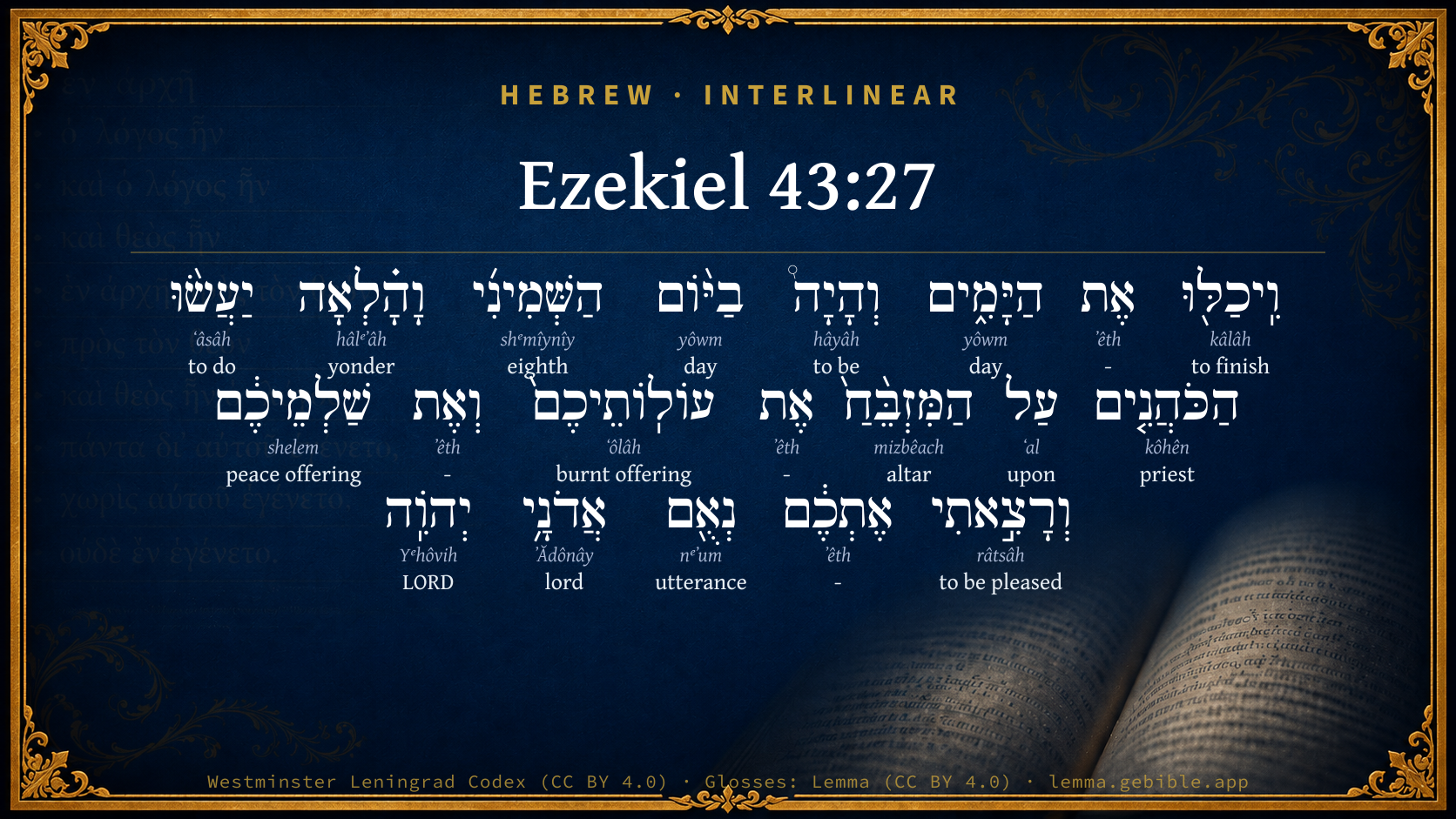
Hebrew (Westminster Leningrad Codex) Ezekiel 43:27 appears in the Hebrew Old Testament. The text above is from the Westminster Leningrad Codex. Each word links to its Strong’s number, a concise gloss, and parsing drawn from the Open Scriptures Hebrew Bible morphology. Click any word for its full Brown-Driver-Briggs (BDB) entry.
Download image
Cite this verse

Ezekiel 43:27 (World English Bible). Public Domain. Lemma interlinear Bible study tool, https://lemma.gebible.app/v/ezekiel/43/27.

Show BibTeX & RIS
BibTeX
RIS
English Translation
When they have accomplished the days, it shall be that on the eighth day, and forward, the priests shall make your burnt offerings on the altar, and your peace-offerings; and I will accept you, says the Lord Yahweh.
World English Bible · Public Domain
Download a study sheet

One document with this verse’s original text, its word-by-word gloss line, the meaning frame, cross-references with their text, attributed commentary, and full source and license credits — printable, and it pastes into notes with its structure intact.

This verse Autodidact and up

Study sheet (.html) Plain text (.txt)

A passage Seminary Student

Up to 50 verses in one chapter. A passage sheet keeps up to 6 commentary sources and 12 cross-references per verse, in the order this page ranks them, and says so on the sheet whenever that leaves anything out. Ask for a single verse and you get the Autodidact verse sheet above.

Everything on this page stays free to read, with no account — the sheet is a download of what is already on screen, not access to it.

Want to remove ads? Support Godless Engineer
Compare translations 3

The same verse in 3 English versions, stacked beneath the original-language interlinear above. Click any original word for its lexicon entry.

Each is an independent rendering of the whole verse — the interlinear is not word-aligned to these translations.

Highlighted words mark where these versions differ — a whole-verse word diff, not a word-by-word alignment.

  • World English Bible Public Domain
    When they have accomplished the days, it shall be that on the eighth day, and forward, the priests shall make your burnt offerings on the altar, and your peace-offerings; and I will accept you, says the Lord Yahweh.
  • King James Version Public Domain
    And when these days are expired, it shall be, that upon the eighth day, and so forward, the priests shall make your burnt offerings upon the altar, and your peace offerings; and I will accept you, saith the Lord GOD.
  • unfoldingWord Literal Text CC BY-SA 4.0
    They must complete these days, and on the eighth day and onward it will come about that the priests will prepare your burnt offerings and your peace offerings on the altar, and I will accept you—this is the Lord Yahweh’s declaration.”

unfoldingWord Literal Text — © unfoldingWord, licensed CC BY-SA 4.0. Word-aligned USFM3 via Door43 (git.door43.org/unfoldingWord/en_ult).

Versions to compare (up to 4)

3 of 4 selected

Show all 18 translations

Every available English version of this verse, each an independent rendering of the whole verse.

  • World English Bible Public Domain
    When they have accomplished the days, it shall be that on the eighth day, and forward, the priests shall make your burnt offerings on the altar, and your peace-offerings; and I will accept you, says the Lord Yahweh.
  • Berean Standard Bible Public Domain
    At the end of these days, from the eighth day on, the priests are to present your burnt offerings and peace offerings on the altar. Then I will accept you, declares the Lord GOD.’”
  • Majority Standard Bible Public Domain
    At the end of these days, from the eighth day on, the priests are to present your burnt offerings and peace offerings on the altar. Then I will accept you, declares the Lord GOD.’”
  • King James Version Public Domain
    And when these days are expired, it shall be, that upon the eighth day, and so forward, the priests shall make your burnt offerings upon the altar, and your peace offerings; and I will accept you, saith the Lord GOD.
  • American Standard Version (1901) Public Domain
    And when they have accomplished the days, it shall be that upon the eighth day, and forward, the priests shall make your burnt-offerings upon the altar, and your peace-offerings; and I will accept you, saith the Lord Jehovah.
  • Revised Version (1885) Public Domain
    And when they have accomplished the days, it shall be that upon the eighth day, and forward, the priests shall make your burnt offerings upon the altar, and your peace offerings; and I will accept you, saith the Lord GOD.
  • Geneva Bible (1599) Public Domain
    And when these dayes are expired, vpon the eight day and so forth, the Priests shall make your burnt offrings vpon the altar, and your peace offrings, and I will accept you, saith the Lord God.
  • Douay-Rheims (1899) Public Domain
    Seven days shall they expiate the altar, and shall cleanse it: and they shall consecrate it.
  • Young's Literal Translation Public Domain
    And the days are completed, and it hath come to pass on the eighth day, and henceforth, the priests prepare on the altar your burnt-offerings and your peace-offerings, and I have accepted you -- an affirmation of the Lord Jehovah.'
  • Literal Standard Version CC BY-SA 4.0
    And the days are completed, and it has come to pass on the eighth day, and from now on, the priests prepare your burnt-offerings and your peace-offerings on the altar, and I have accepted you—a declaration of Lord YHWH.”
  • Unlocked Literal Bible CC BY-SA 4.0
    They must complete these days, and on the eighth day and onward it will come about that the priests will prepare your burnt offerings and your peace offerings on the altar, and I will accept you—this is the Lord Yahweh's declaration.”
  • unfoldingWord Literal Text CC BY-SA 4.0
    They must complete these days, and on the eighth day and onward it will come about that the priests will prepare your burnt offerings and your peace offerings on the altar, and I will accept you—this is the Lord Yahweh’s declaration.”
  • Darby Bible Public Domain
    And when these days are ended, it shall be that upon the eighth day and onwards the priests shall offer your burnt-offerings upon the altar, and your peace-offerings; and I will accept you, saith the Lord Jehovah.
  • World Messianic Bible Public Domain
    When they have accomplished the days, it shall be that on the eighth day and onward, the priests shall make your burnt offerings on the altar and your peace offerings. Then I will accept you,’ says the Lord GOD.”
  • Webster's Bible Public Domain
    And when these days have expired, it shall be, that upon the eighth day, and so forward, the priests shall make your burnt-offerings upon the altar, and your peace-offerings: and I will accept you, saith the Lord GOD.
  • Free Bible Version CC BY-SA 4.0
    Once these days are over, then from the eighth day the priests are to present the burnt offerings and peace offerings of your people on the altar. Then I will accept all of you, declares the Lord God.”
  • Bible in Basic English Public Domain
    And when these days have come to an end, then on the eighth day and after, the priests will make your burned offerings on the altar and your peace-offerings; and I will take pleasure in you, says the Lord.
  • JPS Tanakh (1917) Public Domain
    And when they have accomplished the days, it shall be that upon the eighth day, and forward, the priests shall make your burnt-offerings upon the altar, and your peace-offerings; and I will accept you, saith the Lord GOD.'

Literal Standard Version (2020), Covenant Press — licensed CC BY-SA 4.0. Text via the HelloAO Bible API (eBible.org). Unlocked Literal Bible (unfoldingWord) — licensed CC BY-SA 4.0. Text via the HelloAO Bible API (eBible.org). unfoldingWord Literal Text — © unfoldingWord, licensed CC BY-SA 4.0. Word-aligned USFM3 via Door43 (git.door43.org/unfoldingWord/en_ult). Free Bible Version, Dr. Jonathan Gallagher — licensed CC BY-SA 4.0. Text via the HelloAO Bible API (eBible.org).

Word by word

More ways to search: Search by grammar → Find every occurrence → Compare this word →

Practice this passage: Drill this verse → Learn its vocabulary →

וָהָ֗לְאָה
hâlᵉʼâh
H1973
“and · yonder”
Conjunction + Adverb
Part of Speech
Conjunction + Adverb
Full BDB Definition

Origin: from the primitive form of the article [hal]

TWOT: 496a

out there, onwards, further - yonder, beyond (of place) - onwards (of time)
  1. וִֽיכַלּ֖וּ kâlâh H3615 “and · to finish” Conjunction + Verb, Piel, Imperfect, 3rd Person, Masculine, Plural
  2. אֶת ʼêth H853 “-” Particle, Direct Object
  3. הַיָּמִ֑ים yôwm H3117 “the · days” Particle, Definite Article + Noun, Common, Masculine, Plural, Absolute
  4. וְהָיָה֩ hâyâh H1961 “and · to be” Conjunction + Verb, Qal, Sequential Perfect, 3rd Person, Masculine, Singular
  5. בַיּ֨וֹם yôwm H3117 “in/at the · day” Preposition, Determined + Noun, Common, Masculine, Singular, Absolute
  6. הַשְּׁמִינִ֜י shᵉmîynîy H8066 “the · eighth” Particle, Definite Article + Adjective, Ordinal number, Masculine, Singular, Absolute
  7. יַעֲשׂ֨וּ ʻâsâh H6213 “to do” Verb, Qal, Imperfect, 3rd Person, Masculine, Plural
  8. הַכֹּהֲנִ֤ים kôhên H3548 “the · priests” Particle, Definite Article + Noun, Common, Masculine, Plural, Absolute
  9. עַל ʻal H5921 “upon” Preposition
  10. הַמִּזְבֵּ֨חַ֙ mizbêach H4196 “the · altar” Particle, Definite Article + Noun, Common, Masculine, Singular, Absolute
  11. אֶת ʼêth H853 “-” Particle, Direct Object
  12. עוֹלֽוֹתֵיכֶם֙ ʻôlâh H5930 “burnt offerings · your” Noun, Common, Feminine, Plural, Construct + Suffix, Personal, 2nd Person, Masculine, Plural
  13. וְאֶת ʼêth H853 “and · -” Conjunction + Particle, Direct Object
  14. שַׁלְמֵיכֶ֔ם shelem H8002 “peace offerings · your” Noun, Common, Masculine, Plural, Construct + Suffix, Personal, 2nd Person, Masculine, Plural
  15. וְרָצִ֣אתִי râtsâh H7521 “and · to be pleased” Conjunction + Verb, Qal, Sequential Perfect, 1st Person, Common, Singular
  16. אֶתְכֶ֔ם ʼêth H853 “- · you” Particle, Direct Object + Suffix, Personal, 2nd Person, Masculine, Plural
  17. נְאֻ֖ם nᵉʼum H5002 “utterance of” Noun, Common, Masculine, Singular, Construct
  18. אֲדֹנָ֥י ʼĂdônây H136 “Lord · my” Noun, Common, Masculine, Plural, Construct + Suffix, Personal, 1st Person, Common, Singular
  19. יְהֹוִֽה Yᵉhôvih H3069 “LORD” Noun, Proper

About this verse

These counts appear in no published source. They are computed here, from the morphology-tagged text and Lemma’s own curated glosses. What Lemma adds →

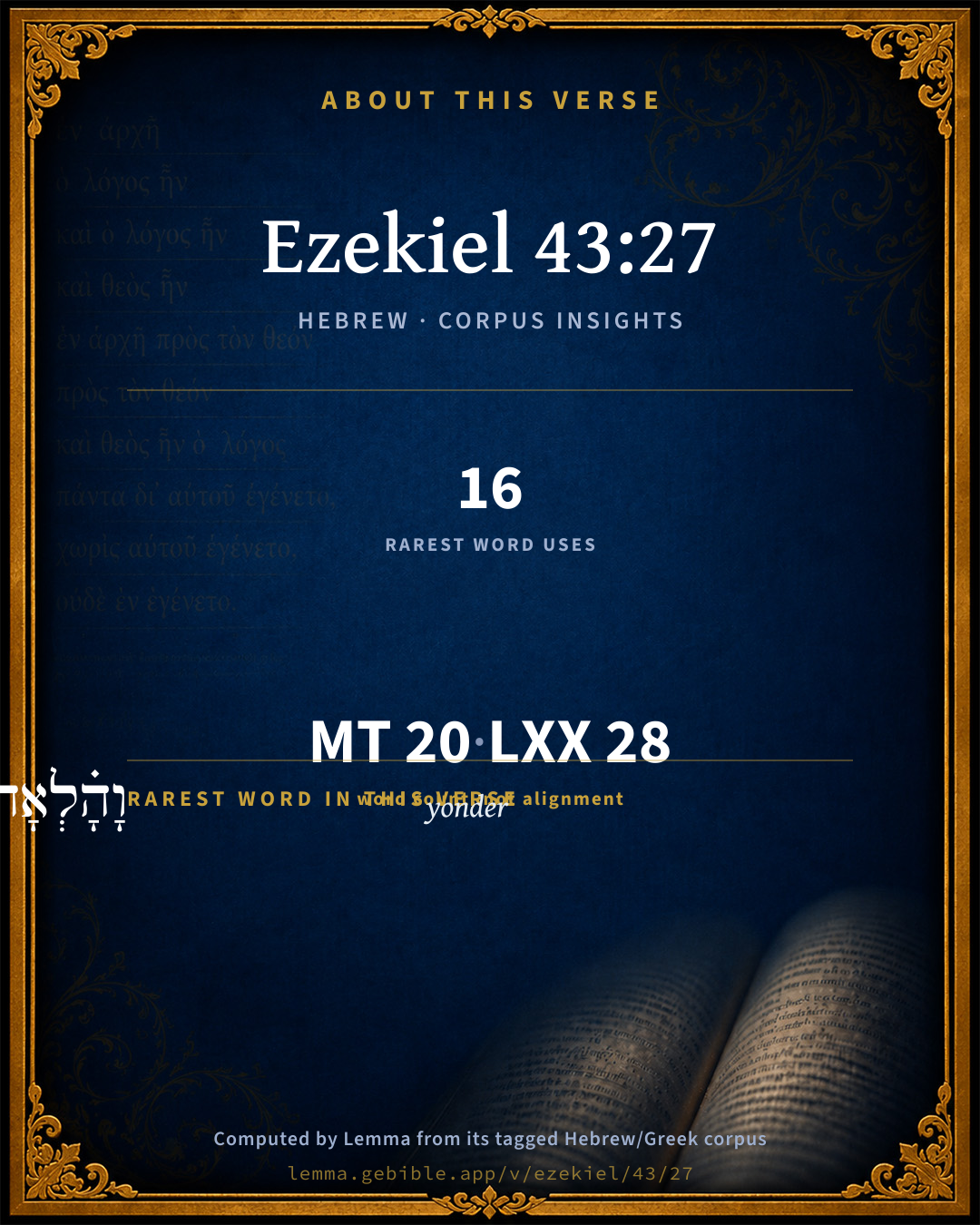
20
words
16
distinct lemmas
Prophets
section

Notable vocabulary

The rarest word here is וָהָ֗לְאָה yonder H1973 — appearing just 16 times in the whole Hebrew Bible.

Shared distinctive vocabulary

וָהָ֗לְאָה yonder H1973 occurs in 16 verses of the Hebrew Bible. Also found in:

Grammatical profile

  • 4 verbs
  • 9 nouns
  • 1 adjective
  • 1 preposition
  • 1 adverb
  • 4 particles

Verb forms

  • וִֽיכַלּ֖וּ Piel · Imperfect
  • וְהָיָה֩ Qal · Sequential Perfect
  • יַעֲשׂ֨וּ Qal · Imperfect
  • וְרָצִ֣אתִי Qal · Sequential Perfect

Repetition

A word recurs within this verse — often emphatic in Hebrew:

  • הַיָּמִ֑ים day H3117 ×2

Hebrew & Septuagint length

In English translation the verse runs 38 words from the Hebrew and 35 from the Septuagint (LXX English) — closely comparable.

A rough comparison of the two English renderings, which tokenize alike — not a word-level alignment.

Word counts can differ between the Hebrew and the Greek without any difference in meaning — e.g. the Hebrew direct-object marker אֵת has no separate Greek word, and Greek often adds the article ὁ.

In the original languages it is 20 Hebrew tokens and 28 Greek tokens — but the two are counted differently (Hebrew bundles its prefixes and suffixes into one token; the Greek is in lemma form), so that isn’t a like-for-like length.

Cross-references

13

Topical passages linked to Ezekiel 43:27 in the Treasury of Scripture Knowledge — connected by theme and wording, ordered by reader-vote popularity; previews shown in the World English Bible.

  • Leviticus 9:1 It happened on the eighth day, that Moses called Aaron and his sons, and the elders of Israel;
  • Leviticus 3:1 "'If his offering is a sacrifice of peace offerings; if he offers it from the herd, whether male or female, he shall offer it without blemish before Yahweh.
  • Leviticus 17:5 This is to the end that the children of Israel may bring their sacrifices, which they sacrifice in the open field, that they may bring them to Yahweh, to the door of the Tent of Meeting, to the priest, and sacrifice them for sacrifices of peace offerings to Yahweh.
  • Job 42:8 Now therefore, take to yourselves seven bulls and seven rams, and go to my servant Job, and offer up for yourselves a burnt offering; and my servant Job shall pray for you, for I will accept him, that I not deal with you according to your folly. For you have not spoken of me the thing that is right, as my servant Job has."
  • Ezekiel 20:40–41 For in my holy mountain, in the mountain of the height of Israel, says the Lord Yahweh, there shall all the house of Israel, all of them, serve me in the land: there will I accept them, and there will I require your offerings, and the first fruits of your offerings, with all your holy things.
  • Hosea 8:13 As for the sacrifices of my offerings, they sacrifice flesh and eat it; But Yahweh doesn't accept them. Now he will remember their iniquity, And punish their sins. They will return to Egypt.
  • Romans 12:1 Therefore I urge you, brothers, by the mercies of God, to present your bodies a living sacrifice, holy, acceptable to God, which is your spiritual service.
  • Romans 15:16 that I should be a servant of Christ Jesus to the Gentiles, ministering as a priest the Gospel of God, that the offering up of the Gentiles might be made acceptable, sanctified by the Holy Spirit.
  • Ephesians 1:6 to the praise of the glory of his grace, by which he freely bestowed favor on us in the Beloved,
  • Philippians 2:17 Yes, and if I am poured out on the sacrifice and service of your faith, I rejoice, and rejoice with you all.
  • Colossians 1:20–21 and through him to reconcile all things to himself, by him, whether things on the earth, or things in the heavens, having made peace through the blood of his cross.
  • Hebrews 13:15 Through him, then, let us offer up a sacrifice of praise to God continually, that is, the fruit of lips which make confession to his name.
  • 1 Peter 2:5 You also, as living stones, are built up as a spiritual house, to be a holy priesthood, to offer up spiritual sacrifices, acceptable to God through Jesus Christ.

Cross-references courtesy of OpenBible.info (CC BY 4.0).

Hebrew and Greek witnesses Masoretic Hebrew ↔ Greek Septuagint

The same verse in the two great witnesses to the Old Testament, shown verse-for-verse.

These are two independent witnesses, not word-aligned to each other, and the Septuagint is shown in lemma (dictionary) form.

Hebrew Ezekiel 43:27 Masoretic · Westminster Leningrad Codex

וִֽיכַלּ֖וּ אֶת הַיָּמִ֑ים וְהָיָה֩ בַיּ֨וֹם הַשְּׁמִינִ֜י וָהָ֗לְאָה יַעֲשׂ֨וּ הַכֹּהֲנִ֤ים עַל הַמִּזְבֵּ֨חַ֙ אֶת עוֹלֽוֹתֵיכֶם֙ וְאֶת שַׁלְמֵיכֶ֔ם וְרָצִ֣אתִי אֶתְכֶ֔ם נְאֻ֖ם אֲדֹנָ֥י יְהֹוִֽה

When they have accomplished the days, it shall be that on the eighth day, and forward, the priests shall make your burnt offerings on the altar, and your peace-offerings; and I will accept you, says the Lord Yahweh.

World English Bible · Public Domain

Greek LXX Ezekiel 43:27 Septuagint · lemma form

καί εἰμί ἀπό ὁ ἡμέρα ὁ ὄγδοος καί ἐπέκεινα ποιέω ὁ ἱερεύς ἐπί ὁ θυσιαστήριον ὁ ὁλοκαύτωμα σύ καί ὁ ὁ σωτήριον σύ καί προςδέχομαι σύ λέγω κύριος

And it shall come to pass from the eighth day and onward, that the priests shall offer your whole burnt offerings on the altar, and your peace-offerings; and I will accept you, says the Lord.

LXX2012 (modern English Septuagint) · Public Domain

Hebrew: Westminster Leningrad Codex (CC BY 4.0). Greek: Septuagint (public domain); English from LXX2012 (modern English Septuagint) (Public Domain). How the Septuagint differs from the Hebrew →

Targum (Aramaic paraphrase)

1

The Targum is the ancient Jewish Aramaic paraphrase of the Hebrew Scriptures — an interpretive translation, not the Hebrew text itself. Onkelos (literal) and Pseudo-Jonathan (expansive) render the Torah, and Jonathan the Prophets. Coverage is partial: where no permissively-licensed English translation exists for a verse, only the Aramaic is shown. This is verse-level text, not a word-by-word alignment to the Hebrew.

  1. Targum Jonathan Prophets (Joshua–Malachi)
    וְיִשְׁלְמוּן יַת יוֹמַיָא וִיהֵי בְּיוֹמָא תְמִינָאָה וּלְהָלָא יַעַבְדוּן כַּהֲנַיָא עַל מַדְבְּחָא יַת עַלְוָתְכוֹן וְיַת נִכְסַת קוּדְשֵׁיכוֹן וְיִתְקַבְּלוּן קוּרְבָּנֵיכוֹן בְּרַעֲוָא אֲמַר יְיָ אֱלֹהִים:

    (no public-domain English translation for this verse)

    Targum Jonathan — Aramaic: “Mikraot Gedolot” (public domain). English: “Sefaria Community Translation” (CC0 1.0 (public-domain dedication)); “London "Chaldee Paraphrase," 1871” (public domain). Text via Sefaria.

Commentary

Notes on Ezekiel 43:27 from classic Christian and Jewish commentators (each source and its license shown beneath its notes). The classic Christian expositions comment on the surrounding passage and are grouped to its opening verse, so a note may address several verses; the Jewish commentaries on the Tanakh (Rashi and others) are per-verse, so they appear only where the commentator wrote on this verse.

Lemma curates 59 commentaries, every one of them public domain or Creative Commons licensed, each selected and text-cleaned for this edition rather than reprinted as found. About our sources →

Trapp's Complete Commentary

John Trapp

Eze 43:27 And when these days are expired, it shall be, [that] upon the eighth day, and [so] forward, the priests shall make your burnt offerings upon the altar, and your peace offerings; and I will accept you, saith the Lord GOD.

Ver. 27. It shall be upon the eighth day.] The services of mortified men shall be accepted, on the eighth day especially, the Christian Sabbath, in the holy assemblies.

John Trapp, A Commentary or Exposition upon All the Books of the Old and New Testament (1647–1656) — public domain. Text from a community e-Sword module.

Jamieson, Fausset & Brown

Robert Jamieson, A. R. Fausset & David Brown

I will accept you-- (Eze 20:40-41; Rom 12:1; Pe1 2:5).

Next: Ezekiel Chapter 44

Jamieson, Fausset & Brown — Commentary Critical and Explanatory on the Whole Bible (1871) — public domain (CC PDM 1.0). Text via the HelloAO Bible API.

John Gill's Exposition

And when these days are expired,.... The seven days of consecration, and all these rites and sacrifices observed:

it shall be, that upon the eighth day, and so forward; that is, on the first day of the week, or Lord's day, the Christian sabbath, the next day after the seventh, and so upon every return of it; in which Christian ministrations are exercised, the word preached, ordinances administered, and works of righteousness and charity done; see Joh 20:19.

The priests shall make your burnt offerings upon the altar, and your peace offerings; or "thank offerings" (c); preach Christ and him crucified to the people, and offer up the sacrifices of prayer and praise unto God for them:

and I will accept you, saith the Lord God; through Christ the Mediator, in whom he is well pleased; who is the altar on which such sacrifices are accepted, and become well pleasing to God, Isa 56:7.

(c) "eucharistica vestraz", Junius & Tremellius, Polanus, Piscator.

Next: Ezekiel Chapter 44

John Gill's Exposition of the Whole Bible (1746–1763) — public domain (CC PDM 1.0). Text via the HelloAO Bible API.

Albert Barnes' Notes on the Bible

After this inauguration the regular service shall be resumed, and be acceptable unto God (compare Mal 1:11).

The Epistle to the Hebrews Heb. 8–10 helps us to recognize in this vision the symbol of the purification of the Church of God by the cleansing blood of Christ, Victim and priest.

Albert Barnes' Notes on the Bible (1834–1885) — public domain. Text from a community e-Sword/MySword module.

Matthew Poole's English Annotations

When these days are expired; when you have on every day of these seven offered the sacrifices as appointed, and for the ends mentioned.

Upon the eighth day, which begins a new week and it is probable the first of these seven days for sacrifice might be the sabbath, and end on our Friday; however, the first week is spent in solemn consecration of altar and priests; all weeks after are to have, day by day, the usual appointed sacrifices.

Burnt-offerings; which were sacrifices expiatory, and for atonement of sin.

Upon the altar of burnt-offering, the great brazen altar described in this chapter, Eze 43:13-17.

Peace-offerings; sacrifices of praise and thanksgiving unto God for his goodness.

I will accept you; be well-pleased with your persons, pardon your sins, smell a savour of rest in your thanksgiving, and own you with signal tokens of my favour and kindness; I will show my good-will and delight in you.

Matthew Poole's English Annotations on the Holy Bible (1683–1685) — public domain. Text from a community e-Sword/MySword module.

The Pulpit Commentary

The eighth day, and so forward. Omit "so." With this day the regular sacrificial service should commence. Thenceforward the priests should offer upon the altar the burnt offerings and peace offerings of the people. The omission of sin offerings is explained by Keil, on the principle that "burnt offerings" and "peace offerings" were "the principal and most frequent sacrifices, whilst sin offerings and meat offerings were implied therein;" Kliefoth adding that Eze_44:27, 29 45:17, 19, 22, 23, 25; and Eze_46:20 show it cannot be inferred that sin offerings were no more to be offered on this altar. At the same time, the prominence given to "burnt" and "peace" as distinguished from "sin offerings" may, as Schroder suggests, have pointed to the fact that the sacrificers who should use this altar would be "a people in a state of grace," to whom Jehovah was prepared to say, I will accept you, not your offerings alone, but your persons as well; and not these because of those, but contrariwise, these on account of these. Kliefoth"s idea, that the first day symbolized the future day of Christ"s sacrifice, that the seven intermediate days (on his hypothesis) pointed to the period of the Christian Church, and that the eighth day looked forward to the time of the end, while not without elements of truth, is open to this objection, that in the period of the Christian Church there should have been "no more sacrifice for sin;" and yet, as Kliefoth admits, "sin offerings" were afterwards to be made upon this altar.

Ver. 27 (last clause, "And I will accept you, saith the Lord God"). Accepted by God.

I CONSIDER THE MOTIVES THAT MAY INDUCE GOD TO ACCEPT MEN. It might be supposed that God was self-sufficient and would not look beyond the range of his own infinite Being; or that, if he took note of what was other than himself, he would be satisfied with the high intelligence and pure character of angel-beings, and not condescend to notice such feeble and sinful creatures as mortal men. Yet God has reasons for accepting men.

1. His infinity. This, which has been raised as an objection, really works the other way, for an infinite Being is not simply vast and only concerned with vast things. To him the greatest finite thing is infinitely small. If he attends to the greatest he may as easily stoop to the smallest. But, further, his very infinity embraces all things, the moat minute as much as the most gigantic.

2. His royalty. God is the supreme Sovereign of the universe; therefore he is concerned with all the subjects of his realm.

3. His justice. Having made men, he will not desert his own creatures.

4. His love. God is love, and love is full of sympathy. From this supreme motive God must be ever yearning to gather his children to himself, ever longing to give them a welcome home.

II OBSERVE THE GREAT HINDRANCE THAT MAY PREVENT GOD FROM ACCEPTING MEN. If God is the infinite Sovereign of the universe, what is to hinder his welcoming whomsoever he will? The Greeks dreamed of a fate ruling supreme even over the dread Olympian deities; but we hold that there is no power above that of God. No power, it is true. Yet there is the awful principle of righteousness, and even God follows and does not bend that supreme principle. It may be identified with his own holy nature. Then we must say that God cannot but be true to himself. This being so, a great obstruction stands in the way of man"s being accepted by God, viz. man"s sin. The holy God cannot give a free welcome to the unholy man. It would be to contradict his own being and character.

III NOTE THE CONDITIONS OF WHICH GOD ACCEPTS MEN. The Divine act of receiving men is placed by Ezekiel after the sacrificial ritual. God accepts on condition of sacrifice. There were first of all sin offerings, and then dedication (burnt) offerings and thank (peace) offerings. With us the first grand condition is fulfilled. Christ is the one Sacrifice for the world"s sin. In Christ"s great surrender of his pure soul to God through death, God sees the sacrifice of man by his Representative, and therefore, accepting the sacrifice, accepts man on whose behalf it is offered. We must make the sacrifice our own by entering into the spirit of it, by ourselves dying to sin and yielding our hearts and wills to the crucified Savior. Then God accepts his penitent children. But for full acceptance thank and dedication offerings were added. God expects us to come to him with grateful hearts, and to yield our souls to him in obedient service. When we approach him thus, as it were with our peace and our burnt offerings, he accepts us.

IV LOOK AT THE RESULTS OF BEING ACCEPTED BY GOD. The first is immediate and personal the reconciliation of the child with his father, and the glad return of the wanderer to the home of his childhood. But from this follow other consequences. We desire that God will accept us as his servants; when he does we have the privilege of living and laboring for him. We would have our work and gift accepted by God; for him to receive our offerings of service or sacrifice is to be most honored by God. At death he will receive his faithful servants to the heavenly rest.

Acceptance.

The purpose of the temple is the establishment and maintenance of harmonious relations between God and the sons of men. By sin those relations have been interrupted; by religion they are restored. What was symbolized by the material temple at Jerusalem its priesthood and services and sacrifices is realized in the spiritual temple of the new covenant, in which Christ is the Sacrifice and the Priest, and in which the Holy Spirit sheds the Shechinah-glory through the holiest of all. Acceptance thus takes the place of estrangement.

I ACCEPTANCE IS OF GOD"S GRACE, AND IS UNDESERVED.

II ACCEPTANCE IS IN VIRTUE OF THE HIGH PRIEST"S MEDIATION AND INTERCESSION.

III ACCEPTANCE IS FOR THE OBEDIENT, THE COMPLIANT, THE SUBMISSIVE.

IV ACCEPTANCE IS ALIKE OF THE PERSON AND OF THE SERVICE.

V ACCEPTANCE INVOLVES THE ENJOYMENT OF ALL THE MANIFESTATIONS AND CONSEQUENCES OF THE DIVINE FAVOR

APPLICATION.

1. One aim of a spiritual ministry to men is to convince them that in their sinful state they are without acceptance with God.

2. Another aim of such a ministry is to exhibit the divinely appointed method of obtaining and enjoying acceptance with God.

3. Yet another aim is to expose false and delusive representations of the way of acceptance. "There is one God, and one Mediator between God and man, the Man Christ Jesus; who gave himself a ransom for all, to be testified in due time. T.

Foundation of acceptance with God.

It is a question vital to the interests of men, "How to find reconciliation with God." If the Bible contains no authentic information on this head, it contains no real gospel. Martin Luther tersely described this doctrine of justification as the hinge of a standing or a falling Church. It is the pivot of salvation or perdition for every man. What the sun is in the midst of the solar system, what the heart is to the human body, what the mainspring is to a watch, the doctrine of man"s justification before God is to all the other doctrines of religion. On this momentous matter God has clearly revealed to us his will. It is so plainly unfolded that he "may run who reads." The Old Testament is in complete accord with the New. Acceptance is based on vicarious sacrifice. On the part of man active and implicit faith is required.

I ACCEPTANCE WITH GOD IS MAN"S PRESSING WANT. All other needs are subordinate to this. God"s favor converts man"s hell into heaven. To bring men into reconciliation with God, all these visions were vouchsafed to Ezekiel. For this, all the sacrifice of animal life had been made. For this, the temple had been erected, and was now to be reconstructed. For this, the office of priesthood had been instituted. For this, every written revelation has been given. For this, God"s mind has been deeply concerned.

II FOR MAN"S ACCEPTANCE WITH GOD A MEDIATING PRIEST IS REQUIRED. The work of bringing men back to God is so full of difficulty that it must be accomplished by distinct stages. A priest serves many useful purposes. He is an instructor, by deed, if not by utterance. He is a sympathizing helper. He has near access to God, and interest with him. The priest must be, of all men, the least erring. His mission must be marked as specially sacred. Every circumstance which can lend sanctity to his office must be provided. He must be mature in years, experienced in human needs. His person must be free from blemish. Frequent ablutions must be practiced. Exact obedience to the commands of God must be observed. He must be a pattern man. God has been pleased to do for us through a Priest what he will not do without a Priest. And all the complicated arrangements of the priesthood were designed to impress men"s minds with the gigantic evil of rebellion, and with the difficulty of regaining the lost place in God"s regard.

III FOR MAN"S ACCEPTANCE VICARIOUS DEATH IS NEEDED. The necessity for substitution for the endurance of penalty prior to reconciliation with God may be a necessity on God"s rode as well as a necessity on man"s side. The maintenance of the Divine government throughout the universe is an object of supreme moment. To make pardon cheap and easy would loosen the bonds of loyalty, and depreciate the value of righteousness, in men"s esteem. As law had expressed the moral relations between God and men, law must be maintained. The penalty of sin must be met. Innocent lambs and heifers must die that sentiments of penitence may be deepened in the human soul. So valuable is reconciliation between man and God that it is worthwhile to sacrifice hecatombs of inferior animals in order to gain the end. This was an educational process, that men might perceive how devoid of efficacy any sacrifice must be, short of the perfect sacrifice of God"s Son. Whether our minds can comprehend the reason of the atonement or not, it is clearly the will of God that restoration of man can come only by the channel of vicarious sacrifice.

IV FOR MAN"S ACCEPTANCE A COMPLETE CYCLE OF TIME FOR PREPARATION MUST ELAPSE. "When these days are expired, it shall be." Day after day, for seven days, a victim slain was demanded in order to purify the altar. The Jewish altar had been grievously desecrated and polluted; hence a complete purgation was required. Not until the completion of the week could the priests proceed to present any offerings for guilty men. A cycle of time was to be spent in the work of preparation. In like manner, the patriarchal and Levitical periods were a time of preparation for Messiah"s work. Until men have learnt the tremendous evil there is in sin, until they have learnt that without Divine interposition moral renovation is impossible, they will not value a Savior from sin; they will not listen to him. Therefore "in the fullness time then, and not till then Son of God came forth.

V FOR MAN"S ACCEPTANCE COMPLETE CONSECRATION OF SELF IS DEMANDED. The offerings appointed to be laid upon the altar were "burnt offerings." The burnt offerings must precede the peace offerings. By a burnt offering is meant that which must be wholly consumed. The sacrifice must be complete. A profound moral lesson is here inculcated; it should be written in capitals. Salvation means complete surrender to God, complete devotion to his service. If we keep back anything from God, we still grieve his heart, we mar our characters, we imperil our salvation. If one foe remains in the citadel, the city is not safe. One weed left in the garden may spread and spoil the whole. One germ of disease in the system may issue in death. Loyalty, to be worth anything, must be complete. In order to be saved, the Son of God must reign supremely in us, King over every thought. D.

The Pulpit Commentary (1880–1919), ed. H.D.M. Spence-Jones & Joseph S. Exell — public domain. Text from a community e-Sword module.

John Wesley's Explanatory Notes

I will accept you - Those that give themselves to God, shall be accepted of God, their persons first, and then their performances, through the mediator.

John Wesley, Explanatory Notes Upon the Whole Bible (1754–1765) — public domain. Text via the GEBible commentary corpus.

Rashi

Rabbi Shlomo Yitzchaki (Rashi)

and I will accept you with satisfaction [Heb. וְרָצִאתִי,] from רָצוֹן will.

Rashi on the Tanakh — English translations: “The Judaica Press complete Tanach with Rashi, translated by A. J. Rosenberg” (CC BY 4.0); “Pentateuch with Rashi's commentary by M. Rosenbaum and A.M. Silbermann, 1929-1934” (public domain); “The Metsudah Tanach series, Lakewood, N.J” (CC BY 4.0); and “The Book of Joshua, Metsudah Publications, 1997” (CC BY 4.0). Text via Sefaria.

Lesson kit

Teaching starters — assembled from the data on this page, not authored interpretation. Every prompt links to the verse data it draws on. Edit before teaching.

Ezekiel, in the Prophets, opens this verse with 20 words (16 distinct Hebrew lemmas). Its most distinctive word is hâlᵉʼâh (“yonder”). A historical commentator’s framing appears above. Read the whole chapter for the surrounding context.

Discussion questions

  1. The word hâlᵉʼâh carries the sense “yonder.” How does it shape the verse?
  2. How does Genesis 19:9, which shares the word «yonder», read alongside this verse?
  3. What does the repetition of “day” (2× in this one verse) do in this verse?
  4. These translations render this verse differently; the difference is in the English rendering, not the original. What questions does that raise?
  5. «וִֽיכַלּ֖וּ» is a Piel Imperfect verb. How does that grammatical form shape the action described?
  6. Compare how Trapp's Complete Commentary and Jamieson, Fausset & Brown read this verse. Where do they agree or differ?

Things to notice

Reading settings

Reading text

Shown beneath each verse's original-language words.

Old Testament
Old Testament edition

Read the OT as the Masoretic Hebrew (MT) or the Greek Septuagint (LXX).

English shown for the Greek Septuagint (in the Hebrew ↔ Greek comparison).

Comparing translations? Open the Compare panel on any verse page to stack up to four side by side.