
Proverbs 16:30

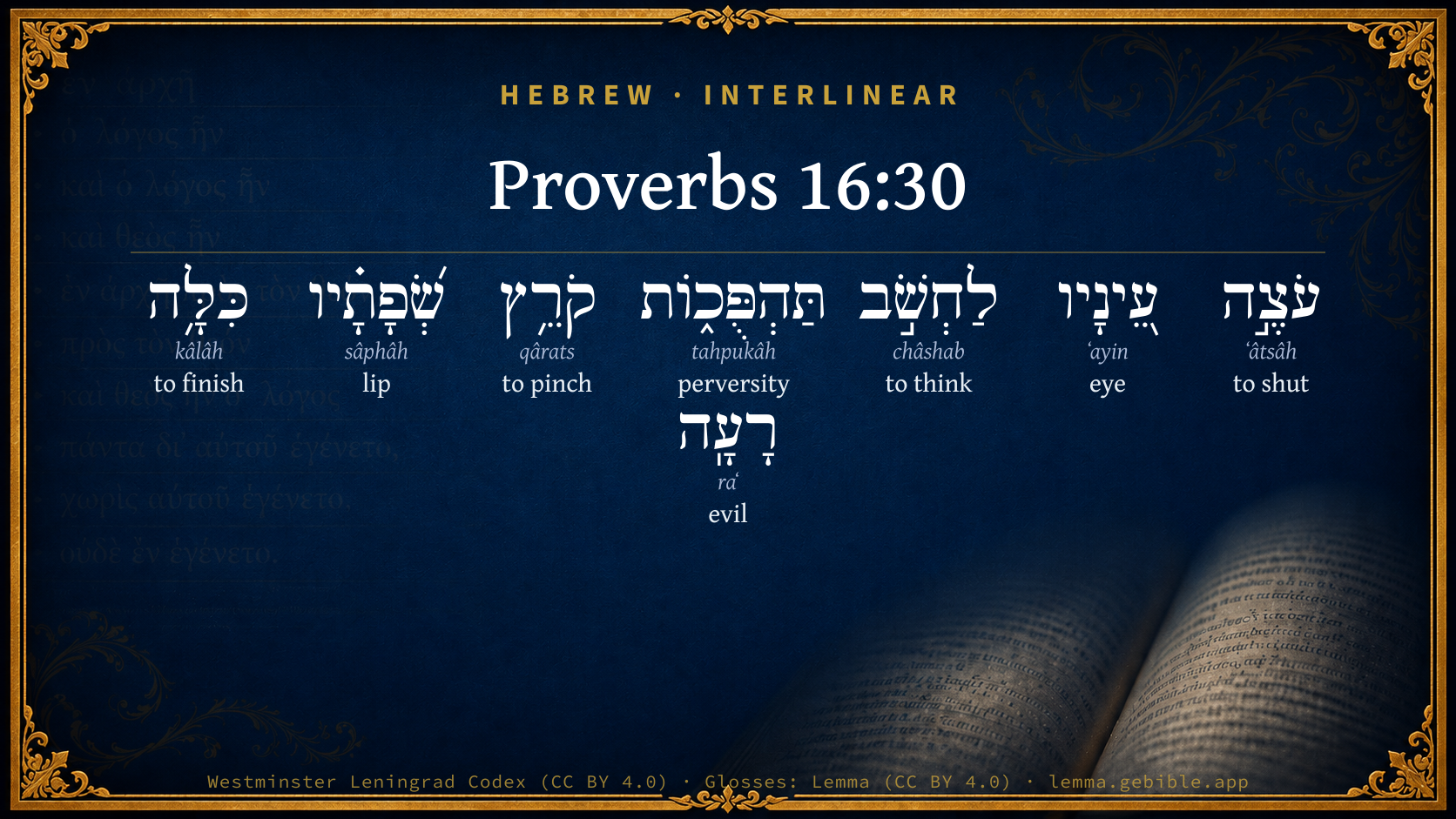
Hebrew (Westminster Leningrad Codex) Proverbs 16:30 appears in the Hebrew Old Testament. The text above is from the Westminster Leningrad Codex. Each word links to its Strong’s number, a concise gloss, and parsing drawn from the Open Scriptures Hebrew Bible morphology. Click any word for its full Brown-Driver-Briggs (BDB) entry.
Download image
Cite this verse

Proverbs 16:30 (World English Bible). Public Domain. Lemma interlinear Bible study tool, https://lemma.gebible.app/v/proverbs/16/30.

Show BibTeX & RIS
BibTeX
RIS
English Translation
One who winks his eyes to plot perversities, One who compresses his lips, is bent on evil.
World English Bible · Public Domain
Highlights Full analysis ↓
Download a study sheet

One document with this verse’s original text, its word-by-word gloss line, the meaning frame, cross-references with their text, attributed commentary, and full source and license credits — printable, and it pastes into notes with its structure intact.

This verse Autodidact and up

Study sheet (.html) Plain text (.txt)

A passage Seminary Student

Up to 50 verses in one chapter. A passage sheet keeps up to 6 commentary sources and 12 cross-references per verse, in the order this page ranks them, and says so on the sheet whenever that leaves anything out. Ask for a single verse and you get the Autodidact verse sheet above.

Everything on this page stays free to read, with no account — the sheet is a download of what is already on screen, not access to it.

Want to remove ads? Support Godless Engineer
Compare translations 3

The same verse in 3 English versions, stacked beneath the original-language interlinear above. Click any original word for its lexicon entry.

Each is an independent rendering of the whole verse — the interlinear is not word-aligned to these translations.

Highlighted words mark where these versions differ — a whole-verse word diff, not a word-by-word alignment.

  • World English Bible Public Domain
    One who winks his eyes to plot perversities, One who compresses his lips, is bent on evil.
  • King James Version Public Domain
    He shutteth his eyes to devise froward things: moving his lips he bringeth evil to pass.
  • unfoldingWord Literal Text CC BY-SA 4.0
    One who shuts his eyes plans perverse things; one who compresses his lips brings evil to completion.

unfoldingWord Literal Text — © unfoldingWord, licensed CC BY-SA 4.0. Word-aligned USFM3 via Door43 (git.door43.org/unfoldingWord/en_ult).

Versions to compare (up to 4)

3 of 4 selected

Show all 18 translations

Every available English version of this verse, each an independent rendering of the whole verse.

  • World English Bible Public Domain
    One who winks his eyes to plot perversities, One who compresses his lips, is bent on evil.
  • Berean Standard Bible Public Domain
    He who winks his eye devises perversity; he who purses his lips is bent on evil.
  • Majority Standard Bible Public Domain
    He who winks his eye devises perversity; he who purses his lips is bent on evil.
  • King James Version Public Domain
    He shutteth his eyes to devise froward things: moving his lips he bringeth evil to pass.
  • American Standard Version (1901) Public Domain
    He that shutteth his eyes, `it is' to devise perverse things: He that compresseth his lips bringeth evil to pass.
  • Revised Version (1885) Public Domain
    He that shutteth his eyes, it is to devise froward things: he that compresseth his lips bringeth evil to pass.
  • Geneva Bible (1599) Public Domain
    He shutteth his eyes to deuise wickednes: he moueth his lippes, and bringeth euil to passe.
  • Douay-Rheims (1899) Public Domain
    He that with fixed eyes deviseth wicked things, biting his lips, bringeth: evil to pass.
  • Young's Literal Translation Public Domain
    Consulting his eyes to devise froward things, Moving his lips he hath accomplished evil.
  • Literal Standard Version CC BY-SA 4.0
    Consulting his eyes to devise contrary things, || Moving his lips he has accomplished evil.
  • Unlocked Literal Bible CC BY-SA 4.0
    The one who winks the eye is plotting perverse things; those who purse the lips will bring evil to pass.
  • unfoldingWord Literal Text CC BY-SA 4.0
    One who shuts his eyes plans perverse things; one who compresses his lips brings evil to completion.
  • Darby Bible Public Domain
    He that shutteth his eyes, [it is] to devise froward things; biting his lips, he bringeth evil to pass.
  • World Messianic Bible Public Domain
    One who winks his eyes to plot perversities, one who compresses his lips, is bent on evil.
  • Webster's Bible Public Domain
    He shutteth his eyes to devise froward things: moving his lips he bringeth evil to pass.
  • Free Bible Version CC BY-SA 4.0
    People who give you a sly wink are plotting bad things; they purse their lips and make evil happen.
  • Bible in Basic English Public Domain
    He whose eyes are shut is a man of twisted purposes, and he who keeps his lips shut tight makes evil come about.
  • JPS Tanakh (1917) Public Domain
    He that shutteth his eyes, it is to devise froward things; he that biteth his lips bringeth evil to pass.

Literal Standard Version (2020), Covenant Press — licensed CC BY-SA 4.0. Text via the HelloAO Bible API (eBible.org). Unlocked Literal Bible (unfoldingWord) — licensed CC BY-SA 4.0. Text via the HelloAO Bible API (eBible.org). unfoldingWord Literal Text — © unfoldingWord, licensed CC BY-SA 4.0. Word-aligned USFM3 via Door43 (git.door43.org/unfoldingWord/en_ult). Free Bible Version, Dr. Jonathan Gallagher — licensed CC BY-SA 4.0. Text via the HelloAO Bible API (eBible.org).

Word by word

More ways to search: Search by grammar → Find every occurrence → Compare this word →

Practice this passage: Drill this verse → Learn its vocabulary →

About this verse

These counts appear in no published source. They are computed here, from the morphology-tagged text and Lemma’s own curated glosses. What Lemma adds →

8
words
8
distinct lemmas
Wisdom
section

Notable vocabulary

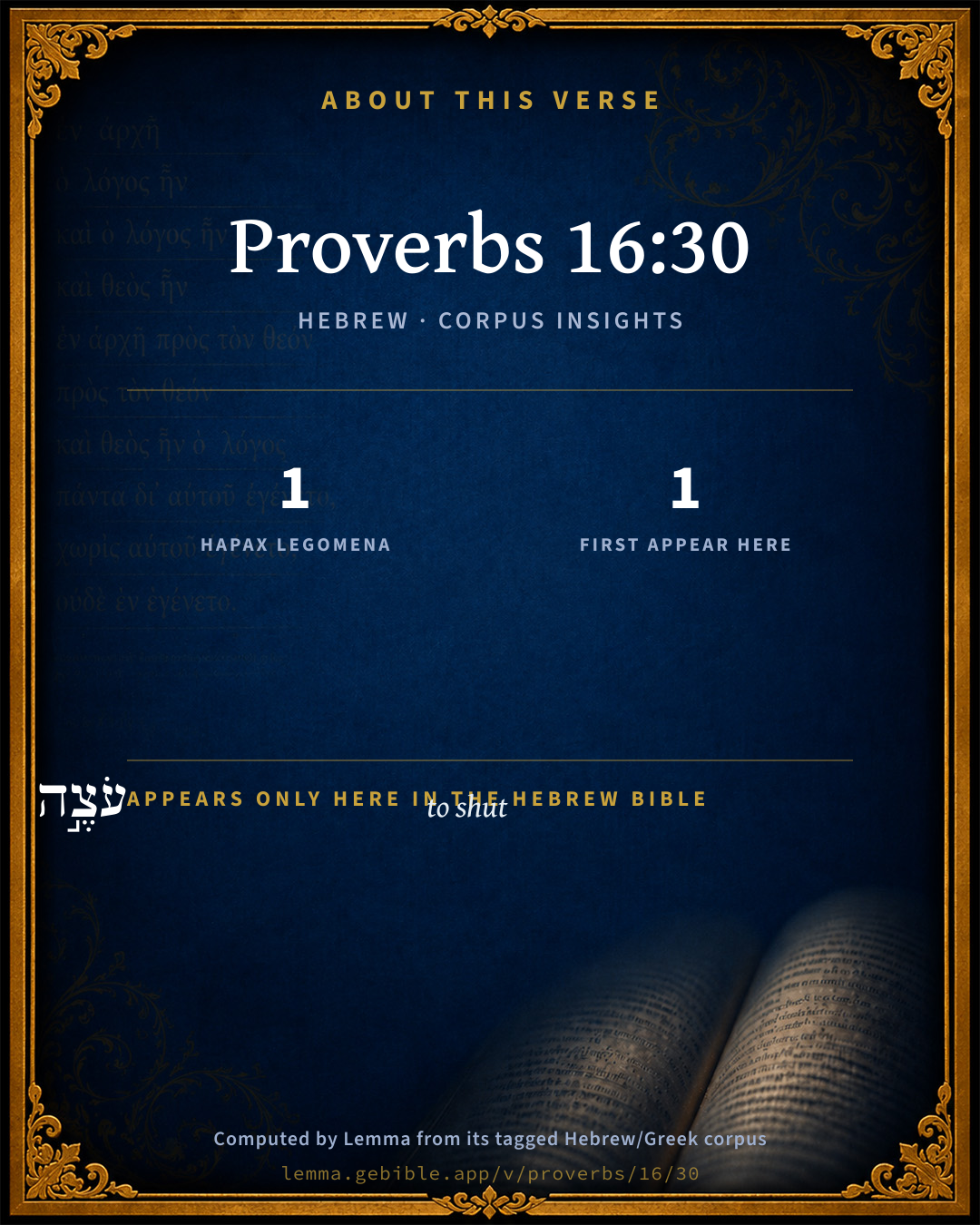
1 hapax legomenon — a word that appears only here in the entire Hebrew Bible:

  • עֹצֶ֣ה to shut H6095

First appearance in Scripture

This word makes its first canonical appearance in the Hebrew Bible here:

  • עֹצֶ֣ה to shut H6095

Shared distinctive vocabulary

קֹרֵ֥ץ to pinch H7169 occurs in 5 verses of the Hebrew Bible. Also found in:

Grammatical profile

  • 4 verbs
  • 4 nouns

Verb forms

  • עֹצֶ֣ה Qal · Participle Active
  • לַחְשֹׁ֣ב Qal · Infinitive Construct
  • קֹרֵ֥ץ Qal · Participle Active
  • כִּלָּ֥ה Piel · Perfect

Hebrew & Septuagint length

In English translation the verse runs 17 words from the Hebrew and 24 from the Septuagint (LXX English) — the Septuagint runs noticeably longer here. See the side-by-side →

A rough comparison of the two English renderings, which tokenize alike — not a word-level alignment.

Word counts can differ between the Hebrew and the Greek without any difference in meaning — e.g. the Hebrew direct-object marker אֵת has no separate Greek word, and Greek often adds the article ὁ.

Cross-references

9

Topical passages linked to Proverbs 16:30 in the Treasury of Scripture Knowledge — connected by theme and wording, ordered by reader-vote popularity; previews shown in the World English Bible.

  • Proverbs 6:12–14 A worthless person, a man of iniquity, Is he who walks with a perverse mouth;
  • Matthew 13:15 For this people's heart has grown callous, Their ears are dull of hearing, They have closed their eyes; Or else perhaps they might perceive with their eyes, Hear with their ears, Understand with their heart, And should turn again; And I would heal them.'
  • Proverbs 10:10 One winking with the eye causes sorrow, But a chattering fool will fall.
  • Proverbs 16:27 A worthless man devises mischief. His speech is like a scorching fire.
  • Isaiah 6:10 Make the heart of this people fat; Make their ears heavy, and shut their eyes; Lest they see with their eyes, And hear with their ears, And understand with their heart, And turn again, and be healed."
  • Micah 7:3 Their hands are on that which is evil to do it diligently. The ruler and judge ask for a bribe; And the powerful man dictates the evil desire of his soul. Thus they conspire together.
  • Matthew 14:7–8 Whereupon he promised with an oath to give her whatever she should ask.
  • Matthew 27:23–26 But the governor said, "Why? What evil has he done?" But they cried out exceedingly, saying, "Let him be crucified!"
  • John 3:20 For everyone who does evil hates the light, and doesn't come to the light, lest his works would be exposed.

Cross-references courtesy of OpenBible.info (CC BY 4.0).

Hebrew and Greek witnesses Masoretic Hebrew ↔ Greek Septuagint

The same verse in the two great witnesses to the Old Testament, shown verse-for-verse.

Here the Septuagint runs noticeably longer than the Hebrew — LXX2012 (modern English Septuagint) 24 words vs World English Bible 17. A rough length comparison of the two English translations, not a word-level alignment — read both below.

These are two independent witnesses, not word-aligned to each other, and the Septuagint is shown in lemma (dictionary) form.

Hebrew Proverbs 16:30 Masoretic · Westminster Leningrad Codex

עֹצֶ֣ה עֵ֭ינָיו לַחְשֹׁ֣ב תַּהְפֻּכ֑וֹת קֹרֵ֥ץ שְׂ֝פָתָ֗יו כִּלָּ֥ה רָעָֽה

One who winks his eyes to plot perversities, One who compresses his lips, is bent on evil.

World English Bible · Public Domain

Greek LXX Proverbs 16:30 Septuagint · lemma form
And the man that fixes his eyes devises perverse things, and marks out with his lips all evil: he is a furnace of wickedness.

LXX2012 (modern English Septuagint) · Public Domain

On this verse, The Cambridge Bible for Schools and Colleges discusses the Septuagint’s reading. Read the note in Commentary ↓

Hebrew: Westminster Leningrad Codex (CC BY 4.0). Greek: Septuagint (public domain); English from LXX2012 (modern English Septuagint) (Public Domain). How the Septuagint differs from the Hebrew →

Commentary

Notes on Proverbs 16:30 from classic Christian and Jewish commentators (each source and its license shown beneath its notes). The classic Christian expositions comment on the surrounding passage and are grouped to its opening verse, so a note may address several verses; the Jewish commentaries on the Tanakh (Rashi and others) are per-verse, so they appear only where the commentator wrote on this verse.

Lemma curates 59 commentaries, every one of them public domain or Creative Commons licensed, each selected and text-cleaned for this edition rather than reprinted as found. About our sources →

Trapp's Complete Commentary

John Trapp

Pro 16:30 He shutteth his eyes to devise froward things: moving his lips he bringeth evil to pass.

Ver. 30. He shutteth his eyes to devise froward things.] Wicked men are great students; they beat their brains and close their eyes that they may revolve and excogitate mischief with more freedom of mind. They search the devil’s skull for new devices, and are very intentive to invent that which may do harm; their wits will better serve them to find out a hundred shifts or carnal arguments, than to yield to one saving truth, though never so much cleared up to them.

Moving his lips, he bringeth evil to pass.] Mumbling and muttering to himself, and so calling the devil into counsel, he hath him at hand to bring about the business. Bartolus {a} writes of Doctor Gabriel Nele, that by the only motion of the lips, without any utterance, he understood all men, perceived and read every man’s mind in his countenance. If Nele could do so, how much more the devil? who, besides his natural sagacity, hath had so long experience, and both knows and furthers those evil plots and practices that he himself hath injected into wicked hearts.

{a} Lib. i. De Ver. Oblig.

John Trapp, A Commentary or Exposition upon All the Books of the Old and New Testament (1647–1656) — public domain. Text from a community e-Sword module.

Geneva Bible (1599)

Geneva Bible translators

With his whole endeavor he laboreth to bring his wickedness to pass.

Geneva Bible (1599) marginal notes — public domain. Text via Bolls.life.

Jamieson, Fausset & Brown

Robert Jamieson, A. R. Fausset & David Brown

He shutteth his eyes--denoting deep thought (Psa 64:6).

moving his lips--or, "biting his lips"--a determined purpose (Pro 6:13).

Jamieson, Fausset & Brown — Commentary Critical and Explanatory on the Whole Bible (1871) — public domain (CC PDM 1.0). Text via the HelloAO Bible API.

Adam Clarke's Commentary

Verse 30. He shutteth his eyes to devise, &c.] He meditates deeply upon ways and means to commit sin. He shuts his eyes that he may shut out all other ideas, that his whole soul may be in this.

Adam Clarke's Commentary on the Bible (1810–1826) — public domain. Text from a community e-Sword/MySword module.

Ellicott's Commentary for English Readers

(30) He shutteth his eyes. . . .—By the movement of eyes and lips he gives the signal for mischief to his confederates. (Comp. Pro_6:13.)

A Bible Commentary for English Readers, edited by Charles John Ellicott (1878–1897) — public domain. Text from a community e-Sword module.

The Cambridge Bible for Schools and Colleges

gen. ed. J. J. S. Perowne

30. shutteth] Or, fixeth, or setteth firmly, στηρίζων, LXX. He closes or fixes his eyes, as though in deep thought, and tightens his lips, as if to keep back words which he could utter. Comp. Pro_6:12-14 for a further description of the same character.

It is better to regard this verse with R.V. as a separate proverb,

He that shutteth his eyes, it is to devise froward things:

He that compresseth his lips bringeth evil to pass,

than with A.V. as a continuation of the preceding proverb.

The Cambridge Bible for Schools and Colleges (gen. ed. J. J. S. Perowne; Cambridge University Press, 1878–1918) — public domain. Text from a community e-Sword module.

John Gill's Exposition

The hoary head is a crown of glory,.... Gray hairs, white locks through age are very ornamental; look very beautiful, bespeak gravity, wisdom, and prudence, and command reverence and respect; with the ancient Romans (s), greater honour was paid to age than to family or wealth; and the elder were revered by the younger next to God, and in the stead of parents; See Gill on Lev 19:32;

if it be found in the way of righteousness; that is, if such who are old and stricken in years are like Zacharias and Elisabeth, walking in all the commandments and ordinances of the Lord blameless; when they are found in Christ, having on his righteousness; and when they live soberly, righteously, and godly; when they walk in the ways of God and true religion; keep up family worship, and private devotion; as well as constantly attend the ministry of the word and ordinances; then are they very venerable and respectable; their old age is a good old age; and in a short time they shall have the crown of glory which fadeth not away: but otherwise a sinner a hundred years old shall be accursed; an old man in the open ways of sin and vice, laden with iniquity, is a very contemptible and shocking sight.

(s) Vid. A. Gell. Noct. Attic. l. 2. c. 15.

John Gill's Exposition of the Whole Bible (1746–1763) — public domain (CC PDM 1.0). Text via the HelloAO Bible API.

Haydock's Catholic Bible Commentary

Lips. These motions indicate fury and pensiveness.

George Leo Haydock (1774–1849), Haydock's Catholic Family Bible and Commentary, 1859 edition — public domain. Excludes Psalms (Douay-Rheims chapter numbering differs from Protestant) and Deuterocanonical books (Catholic canon only).

Matthew Poole's English Annotations

Shutteth his eyes, that his thoughts may be more free and intent to contrive mischief.

Moving his lips; which is the gesture, either,

1. Of one whose thoughts are deeply engaged. Or,

2. Of one that speaketh or maketh signs to others to assist him in executing that wickedness which he hath contrived.

Matthew Poole's English Annotations on the Holy Bible (1683–1685) — public domain. Text from a community e-Sword/MySword module.

Whedon's Commentary on the Bible

Daniel D. Whedon

30. He shutteth his eyes — Or, fixes his eyes.

To devise froward things — Perversities. Compare Pro_2:12; Pro_6:14.

Moving his lips — He bites his lips as a sign of malice, (Pro_6:13; Pro_10:10;) he bringeth evil to pass. The Hebrew is emphatic, the preter for the future, to indicate the certainty of that which is predicted: “he has accomplished evil.” Conant reads: “When he shuts his eyes he is devising perverseness; when he bites his lips, he has perfected mischief.”

Daniel D. Whedon (gen. ed.), Commentary on the Old and New Testaments (1874–1909) — public domain. Text from a community e-Sword module.

The Pulpit Commentary

This verse is better taken as one sentence (so the Septuagint), and translated, as Nowack, "He that shutteth his eyes in order to contrive froward things, he that compresseth his lips, hath already brought evil to pass;" he has virtually effected it. From such a crafty, malignant man you need not expect any more open tokens of his intentions. He shutteth his eyes; (comp. Isa_33:15) either that he may better think out his evil plans, or else he cannot look his neighbour in the face while he is plotting against him. The Vulgate has, attonitis oculis; Septuagint, "fixing (sthrizwn ) his eyes." Moving his lips; rather, he who compresseth his lips, to hide the malignant smile with which he might greet his neighbour"s calamity, (comp. Pro_6:13, etc.; Pro_10:10) or that neither by word nor expression he may betray his thoughts. Others take the two outward expressions mentioned as signals to confederates; but this is not so suitable, as they are the man"s own feelings and sentiments that are meant. One who gives these tokens bringeth evil to pass; he has perfected his designs, and deems them as good as accomplished, and you will do well to note what his bearing signifies. Some take the meaning to be, brings punishment on himself; but the warning is not given for the sinner"s sake. Septuagint, "He defines (orizei ) all evils with his lips; he is a furnace of evil."

The Pulpit Commentary (1880–1919), ed. H.D.M. Spence-Jones & Joseph S. Exell — public domain. Text from a community e-Sword module.

John Wesley's Explanatory Notes

Shutteth - That his thoughts may be more intent. Moving - Which is the gesture of one whose thoughts are deeply engaged.

John Wesley, Explanatory Notes Upon the Whole Bible (1754–1765) — public domain. Text via the GEBible commentary corpus.

Keil & Delitzsch

C. F. Keil & F. Delitzsch

30 He who shutteth his eyes to devise falsehood;

He who biteth his lips bringeth evil to pass.

A physiognomical Caveto. The ἁπ. λεγ. עצה is connected with עצם, Isa 33:15 (Arab. transp. ghamḍ), comprimere, formed from it. Regarding קרץ of lips or eyes, vid., p. 144; the biting of the lips is the action of the deceitful, and denotes scorn, malice, knavery. The perf. denotes that he who is seen doing this has some evil as good as accomplished, for he is inwardly ready for it; Hitzig suitably compares Sa1 20:7, Sa1 20:33. Our editions (also Lwenstein) have כּלּה, but the Masora (vid., Mas. finalis, p. 1) numbers the word among those which terminate in א, and always writes כּלּא.

Keil & Delitzsch — Biblical Commentary on the Old Testament (1861–1891) — public domain (CC PDM 1.0). Text via the HelloAO Bible API. (Old Testament only.)

Kretzmann's Popular Commentary

Paul E. Kretzmann

v. 30. He shutteth his eyes, to keep away any good influence, to devise froward things, to meditate mischief and craftiness; moving his lips, he bringeth evil to pass, the act or gesture of pressing together the lips being evidence of malice, and so he carries out his wicked intentions.

Paul E. Kretzmann, Popular Commentary of the Bible (1921–1924) — public domain. Text from a community e-Sword module.

Rashi

Rabbi Shlomo Yitzchaki (Rashi)

He winks his eyes Heb. עצה, an expression of winking, and so (Ps. 32:8): “I will wink (איעצה) to you my eye.”

bringing evil to pass כלה, as in (Esther 7:7) “that the evil was determined (כלתה) against him by the king.” He causes evil to come to the world.

Rashi on the Tanakh — English translations: “The Judaica Press complete Tanach with Rashi, translated by A. J. Rosenberg” (CC BY 4.0); “Pentateuch with Rashi's commentary by M. Rosenbaum and A.M. Silbermann, 1929-1934” (public domain); “The Metsudah Tanach series, Lakewood, N.J” (CC BY 4.0); and “The Book of Joshua, Metsudah Publications, 1997” (CC BY 4.0). Text via Sefaria.

Lesson kit

Teaching starters — assembled from the data on this page, not authored interpretation. Every prompt links to the verse data it draws on. Edit before teaching.

Proverbs, in the Wisdom, opens this verse with 8 words (8 distinct Hebrew lemmas). Its most distinctive word is ʻâtsâh (“to shut”). The Greek Septuagint runs longer here. A historical commentator’s framing appears above. Read the whole chapter for the surrounding context.

Discussion questions

  1. The word ʻâtsâh carries the sense “to shut.” How does it shape the verse?
  2. 1 word here appears nowhere else in the Hebrew Bible. Why might the author reach for such rare wording?
  3. This is the first place “to shut” appears in Scripture (first appears here). What does its debut here establish?
  4. How does Job 33:6, which shares the word «to pinch», read alongside this verse?
  5. The Septuagint runs longer here than the Hebrew. What might account for the difference?
  6. These translations render this verse differently. What is at stake in choosing one wording over another?
  7. «עֹצֶ֣ה» is a Qal Participle Active verb. How does that grammatical form shape the action described?
  8. Compare how Trapp's Complete Commentary and Geneva Bible (1599) read this verse. Where do they agree or differ?

Things to notice

  • 1 word in this verse appears nowhere else in the Hebrew Bible.
  • 1 word makes its first canonical appearance in Scripture here.
  • These translations choose different wording for 19 words in this verse.
  • 8 distinct Hebrew lemmas span 8 words in this verse.

Reading settings

Reading text

Shown beneath each verse's original-language words.

Old Testament
Old Testament edition

Read the OT as the Masoretic Hebrew (MT) or the Greek Septuagint (LXX).

English shown for the Greek Septuagint (in the Hebrew ↔ Greek comparison).

Comparing translations? Open the Compare panel on any verse page to stack up to four side by side.