Isaiah 15:6

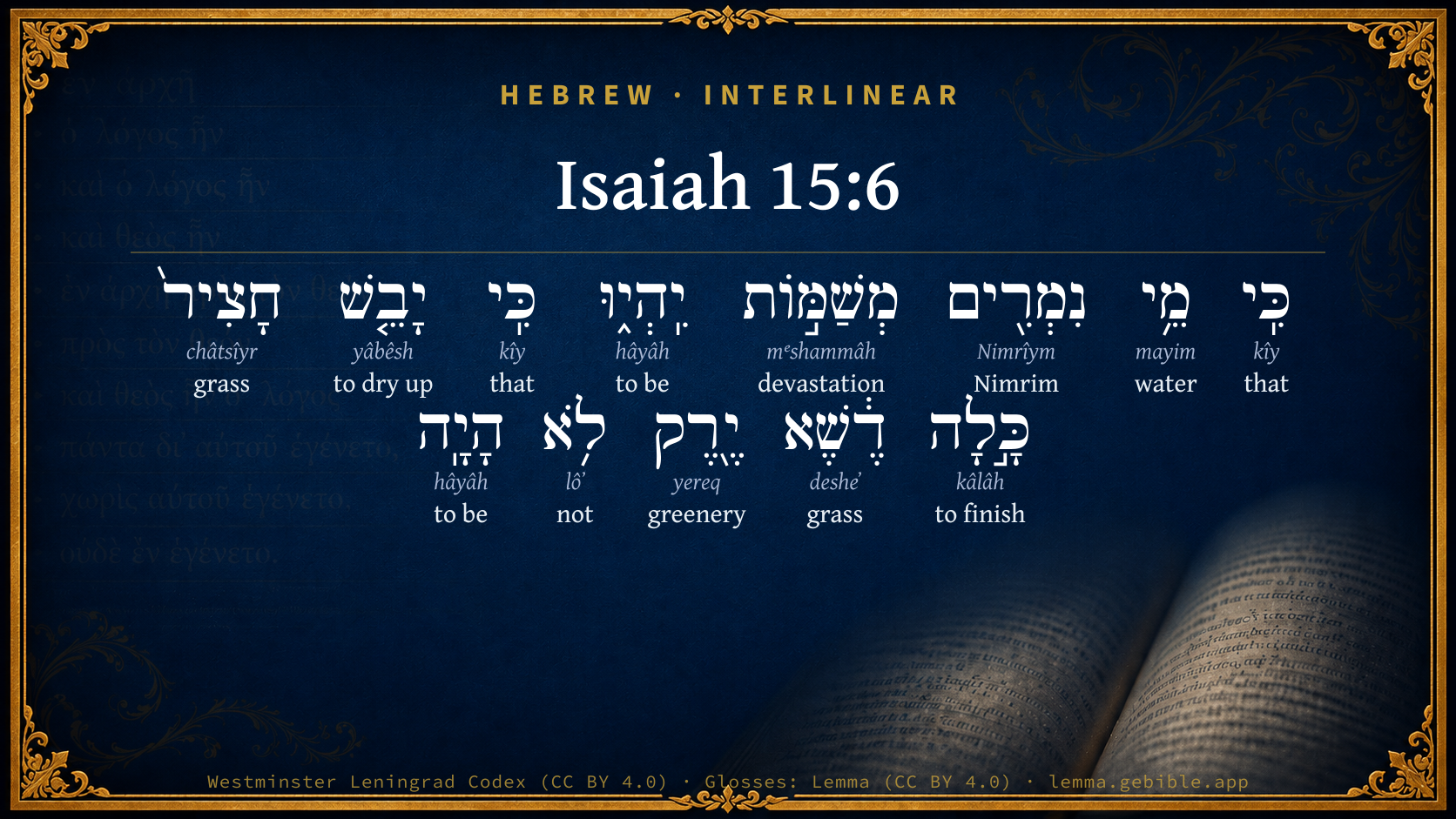
Hebrew (Westminster Leningrad Codex) Isaiah 15:6 appears in the Hebrew Old Testament. The text above is from the Westminster Leningrad Codex. Each word links to its Strong’s number, a concise gloss, and parsing drawn from the Open Scriptures Hebrew Bible morphology. Click any word for its full Brown-Driver-Briggs (BDB) entry.
Download image
Cite this verse

Isaiah 15:6 (World English Bible). Public Domain. Lemma interlinear Bible study tool, https://lemma.gebible.app/v/isaiah/15/6.

Show BibTeX & RIS
BibTeX
RIS
English Translation
For the waters of Nimrim shall be desolate; for the grass is withered away, the tender grass fails, there is no green thing.
World English Bible · Public Domain
Highlights
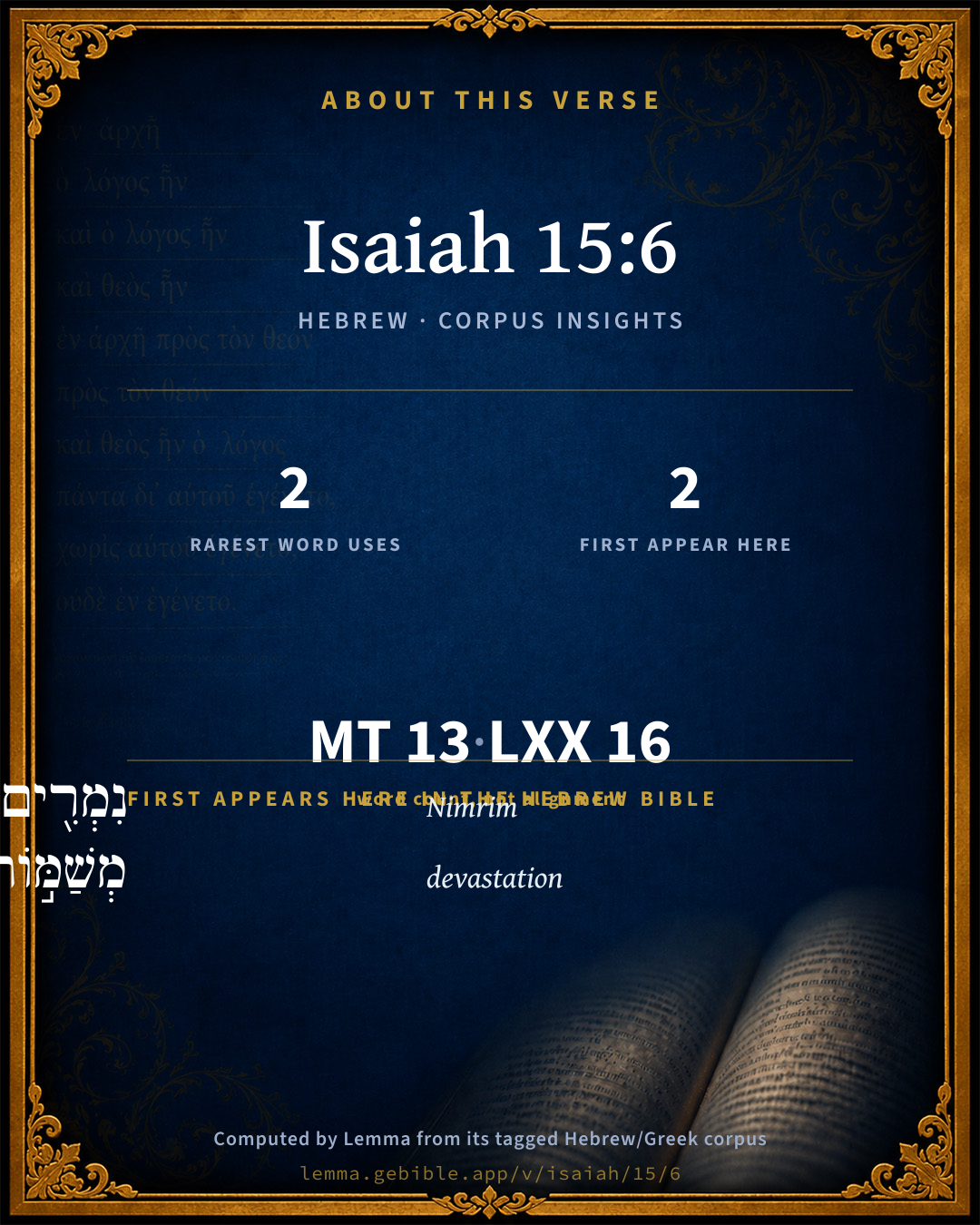
  • 2 first appearances in the Hebrew Bible
Full analysis ↓
Download a study sheet

One document with this verse’s original text, its word-by-word gloss line, the meaning frame, cross-references with their text, attributed commentary, and full source and license credits — printable, and it pastes into notes with its structure intact.

This verse Autodidact and up

Study sheet (.html) Plain text (.txt)

A passage Seminary Student

Up to 50 verses in one chapter. A passage sheet keeps up to 6 commentary sources and 12 cross-references per verse, in the order this page ranks them, and says so on the sheet whenever that leaves anything out. Ask for a single verse and you get the Autodidact verse sheet above.

Everything on this page stays free to read, with no account — the sheet is a download of what is already on screen, not access to it.

Want to remove ads? Support Godless Engineer
Compare translations 3

The same verse in 3 English versions, stacked beneath the original-language interlinear above. Click any original word for its lexicon entry.

Each is an independent rendering of the whole verse — the interlinear is not word-aligned to these translations.

Highlighted words mark where these versions differ — a whole-verse word diff, not a word-by-word alignment.

  • World English Bible Public Domain
    For the waters of Nimrim shall be desolate; for the grass is withered away, the tender grass fails, there is no green thing.
  • King James Version Public Domain
    For the waters of Nimrim shall be desolate: for the hay is withered away, the grass faileth, there is no green thing.
  • unfoldingWord Literal Text CC BY-SA 4.0
    For the waters of Nimrim are desolations, for the grass withers, the vegetation ends, is no greenery.

unfoldingWord Literal Text — © unfoldingWord, licensed CC BY-SA 4.0. Word-aligned USFM3 via Door43 (git.door43.org/unfoldingWord/en_ult).

Versions to compare (up to 4)

3 of 4 selected

Show all 18 translations

Every available English version of this verse, each an independent rendering of the whole verse.

  • World English Bible Public Domain
    For the waters of Nimrim shall be desolate; for the grass is withered away, the tender grass fails, there is no green thing.
  • Berean Standard Bible Public Domain
    The waters of Nimrim are dried up, and the grass is withered; the vegetation is gone, and the greenery is no more.
  • Majority Standard Bible Public Domain
    The waters of Nimrim are dried up, and the grass is withered; the vegetation is gone, and the greenery is no more.
  • King James Version Public Domain
    For the waters of Nimrim shall be desolate: for the hay is withered away, the grass faileth, there is no green thing.
  • American Standard Version (1901) Public Domain
    For the waters of Nimrim shall be desolate; for the grass is withered away, the tender grass faileth, there is no green thing.
  • Revised Version (1885) Public Domain
    For the waters of Nimrim shall be desolate: for the grass is withered away, the tender grass faileth, there is no green thing.
  • Geneva Bible (1599) Public Domain
    For the waters of Nimrim shall be dried vp: therefore the grasse is withered, the herbes consumed, and there was no greene herbe.
  • Douay-Rheims (1899) Public Domain
    For the waters of Nemrim shall be desolate, for the grass is withered away, the spring is faded, all the greenness is perished.
  • Young's Literal Translation Public Domain
    For, the waters of Nimrim are desolations, For, withered hath been the hay, Finished hath been the tender grass, A green thing there hath not been.
  • Literal Standard Version CC BY-SA 4.0
    For the waters of Nimrim are desolations, || For the hay has been withered, || The tender grass has been finished, || There has not been a green thing.
  • Unlocked Literal Bible CC BY-SA 4.0
    The waters of Nimrim are a desolation; the grass is withered; the vegetation has dried up; there is no more green grass.
  • unfoldingWord Literal Text CC BY-SA 4.0
    For the waters of Nimrim are desolations, for the grass withers, the vegetation ends, is no greenery.
  • Darby Bible Public Domain
    For the waters of Nimrim shall be desolate; for the herbage is withered away, the grass hath failed, there is no green thing.
  • World Messianic Bible Public Domain
    For the waters of Nimrim will be desolate; for the grass has withered away, the tender grass fails, there is no green thing.
  • Webster's Bible Public Domain
    For the waters of Nimrim shall be desolate: for the herb is withered away, the grass faileth, there is no green thing.
  • Free Bible Version CC BY-SA 4.0
    The waters of Nimrim have all dried up. The grass is withered, all the vegetation has disappeared—nothing green is left.
  • Bible in Basic English Public Domain
    The waters of Nimrim will become dry: for the grass is burned up, the young grass is coming to an end, every green thing is dead.
  • JPS Tanakh (1917) Public Domain
    For the Waters of Nimrim shall be desolate; for the grass is withered away, the herbage faileth, there is no green thing.

Literal Standard Version (2020), Covenant Press — licensed CC BY-SA 4.0. Text via the HelloAO Bible API (eBible.org). Unlocked Literal Bible (unfoldingWord) — licensed CC BY-SA 4.0. Text via the HelloAO Bible API (eBible.org). unfoldingWord Literal Text — © unfoldingWord, licensed CC BY-SA 4.0. Word-aligned USFM3 via Door43 (git.door43.org/unfoldingWord/en_ult). Free Bible Version, Dr. Jonathan Gallagher — licensed CC BY-SA 4.0. Text via the HelloAO Bible API (eBible.org).

Word by word

More ways to search: Search by grammar → Find every occurrence → Compare this word →

Practice this passage: Drill this verse → Learn its vocabulary →

About this verse

These counts appear in no published source. They are computed here, from the morphology-tagged text and Lemma’s own curated glosses. What Lemma adds →

13
words
11
distinct lemmas
Prophets
section

Notable vocabulary

The rarest word here is נִמְרִ֖ים Nimrim H5249 — appearing just 2 times in the whole Hebrew Bible.

First appearance in Scripture

These words make their first canonical appearance in the Hebrew Bible here:

  • נִמְרִ֖ים Nimrim H5249
  • מְשַׁמּ֣וֹת devastation H4923

Shared distinctive vocabulary

נִמְרִ֖ים Nimrim H5249 occurs in 2 verses of the Hebrew Bible. Also found in:

Grammatical profile

  • 4 verbs
  • 6 nouns
  • 2 conjunctions
  • 1 particle

Verb forms

  • יִֽהְי֑וּ Qal · Imperfect
  • יָבֵ֤שׁ Qal · Perfect
  • כָּ֣לָה Qal · Perfect
  • הָיָֽה Qal · Perfect

Repetition

Words recur within this verse — often emphatic in Hebrew:

  • יִֽהְי֑וּ to be H1961 ×2
  • כִּֽי that H3588 ×2

Hebrew & Septuagint length

In English translation the verse runs 23 words from the Hebrew and 20 from the Septuagint (LXX English) — closely comparable.

A rough comparison of the two English renderings, which tokenize alike — not a word-level alignment.

Word counts can differ between the Hebrew and the Greek without any difference in meaning — e.g. the Hebrew direct-object marker אֵת has no separate Greek word, and Greek often adds the article ὁ.

In the original languages it is 13 Hebrew tokens and 16 Greek tokens — but the two are counted differently (Hebrew bundles its prefixes and suffixes into one token; the Greek is in lemma form), so that isn’t a like-for-like length.

Cross-references

9

Topical passages linked to Isaiah 15:6 in the Treasury of Scripture Knowledge — connected by theme and wording, ordered by reader-vote popularity; previews shown in the World English Bible.

  • Numbers 32:36 and Beth Nimrah, and Beth Haran: fortified cities, and folds for sheep.
  • Isaiah 19:5–7 The waters shall fail from the sea, and the river shall be wasted and become dry.
  • Joel 1:10–12 The field is laid waste. The land mourns, for the grain is destroyed, The new wine has dried up, And the oil languishes.
  • Numbers 32:3 Ataroth, and Dibon, and Jazer, and Nimrah, and Heshbon, and Elealeh, and Sebam, and Nebo, and Beon,
  • Joshua 13:27 and in the valley, Beth Haram, and Beth Nimrah, and Succoth, and Zaphon, the rest of the kingdom of Sihon king of Heshbon, the Jordan and the border [of it], to the uttermost part of the sea of Chinnereth beyond the Jordan eastward.
  • Isaiah 16:9–10 Therefore I will weep with the weeping of Jazer for the vine of Sibmah; I will water you with my tears, Heshbon, and Elealeh: for on your summer fruits and on your harvest the [battle] shout is fallen.
  • Habakkuk 3:17–18 For though the fig tree doesn't flourish, Nor fruit be in the vines; The labor of the olive fails, The fields yield no food; The flocks are cut off from the fold, And there is no herd in the stalls:
  • Revelation 8:7 The first sounded, and there followed hail and fire, mixed with blood, and they were thrown to the earth. One third of the earth was burnt up, and one third of the trees were burnt up, and all green grass was burnt up.
  • Jeremiah 48:34 From the cry of Heshbon even to Elealeh, even to Jahaz have they uttered their voice, from Zoar even to Horonaim, to Eglath Shelishiyah: for the waters of Nimrim also shall become desolate.

Cross-references courtesy of OpenBible.info (CC BY 4.0).

Hebrew and Greek witnesses Masoretic Hebrew ↔ Greek Septuagint

The same verse in the two great witnesses to the Old Testament, shown verse-for-verse.

These are two independent witnesses, not word-aligned to each other, and the Septuagint is shown in lemma (dictionary) form.

Hebrew Isaiah 15:6 Masoretic · Westminster Leningrad Codex

כִּֽי מֵ֥י נִמְרִ֖ים מְשַׁמּ֣וֹת יִֽהְי֑וּ כִּֽי יָבֵ֤שׁ חָצִיר֙ כָּ֣לָה דֶ֔שֶׁא יֶ֖רֶק לֹ֥א הָיָֽה

For the waters of Nimrim shall be desolate; for the grass is withered away, the tender grass fails, there is no green thing.

World English Bible · Public Domain

Greek LXX Isaiah 15:6 Septuagint · lemma form

ὁ ὕδωρ ὁ νεμριμ ἔρημος εἰμί καί ὁ χόρτος αὐτός ἐκλείπω χόρτος γάρ χλωρός οὐ εἰμί

The water of Nemerim shall be desolate, and the grass thereof shall fail: for there shall be no green grass.

LXX2012 (modern English Septuagint) · Public Domain

Hebrew: Westminster Leningrad Codex (CC BY 4.0). Greek: Septuagint (public domain); English from LXX2012 (modern English Septuagint) (Public Domain). How the Septuagint differs from the Hebrew →

Targum (Aramaic paraphrase)

1

The Targum is the ancient Jewish Aramaic paraphrase of the Hebrew Scriptures — an interpretive translation, not the Hebrew text itself. Onkelos (literal) and Pseudo-Jonathan (expansive) render the Torah, and Jonathan the Prophets. Coverage is partial: where no permissively-licensed English translation exists for a verse, only the Aramaic is shown. This is verse-level text, not a word-by-word alignment to the Hebrew.

  1. Targum Jonathan Prophets (Joshua–Malachi)
    אֲרֵי מֵי נִמְרִים לְצָדוּ יְהוֹן אֲרֵי יָבֵשׁ עִסְבָּא סַף דְתָאָה יְרוֹק לָא הֲוָה:

    For the waters of Nimrim shall become desolate; for the herbage is withered away; the grass faileth, there is no green herb.

    Targum Jonathan — Aramaic: “Mikraot Gedolot” (public domain). English: “Sefaria Community Translation” (CC0 1.0 (public-domain dedication)); “London "Chaldee Paraphrase," 1871” (public domain). Text via Sefaria.

Commentary

Notes on Isaiah 15:6 from classic Christian and Jewish commentators (each source and its license shown beneath its notes). The classic Christian expositions comment on the surrounding passage and are grouped to its opening verse, so a note may address several verses; the Jewish commentaries on the Tanakh (Rashi and others) are per-verse, so they appear only where the commentator wrote on this verse.

Lemma curates 59 commentaries, every one of them public domain or Creative Commons licensed, each selected and text-cleaned for this edition rather than reprinted as found. About our sources →

Matthew Henry's Commentary

Here the prophet further describes the woeful and piteous lamentations that should be heard throughout all the country of Moab when it should become a prey to the Assyrian army. "By this time the cry has gone round about all the borders of Moab," Isa 15:8. Every corner of the country has received the alarm, and is in the utmost confusion upon it. It has reached to Eglaim, a city at one end of the country, and to Beer-elim, a city as far the other way. Where sin has been general, and all flesh have corrupted their way, what can be expected but a general desolation? Two things are here spoken of as causes of this lamentation: -

I. The waters of Nimrim are desolate (Isa 15:6), that is, the country is plundered and impoverished, and all the wealth and substance of it swept away by the victorious army. Famine is usually the sad effect of war. Look into the fields that were well watered, the fruitful meadows that yielded delightful prospects and more delightful products, and there all is eaten up, or carried off by the enemy's foragers, and the remainder trodden to dirt by their horses. If an army encamp upon green fields, their greenness is soon gone. Look into the houses, and they are stripped too (Isa 15:7): The abundance of wealth that they had gotten with a great deal of art and industry, and that which they had laid up with a great deal of care and confidence, shall they carry away to the brook of the willows. Either the owners shall carry it thither to hide it or the enemies shall carry it thither to pack it up and send it home, by water perhaps, to their own country. Note, 1. Those that are eager to get abundance of this world, and solicitous to lay up what they have gotten, little consider what may become of it and in how short a time it may be all taken from them. Great abundance, by tempting the robbers, exposes the owners; and those who depend upon it to protect them often find it does but betray them. 2. In times of distress great riches are often great burdens, and do but increase the owner's care or the enemies' strength. Cantabit vacuus coram latrone viator - The penniless traveller will exult, when accosted by a robber, in having nothing about him.

II. The waters of Dimon are turned into blood (Isa 15:9), that is, the inhabitants of the country are slain in great numbers, so that the waters adjoining to the cities, whether rivers or pools, are discoloured with human gore, inhumanly shed like water. Dimon signifies bloody; the place shall answer to its name. Perhaps it was that place in the country of Moab where the waters seemed to the Moabites as blood (Kg2 3:22, Kg2 3:23), which occasioned their overthrow. But now, says God, I will bring more upon Dimon, more blood than was shed, or thought to be seen, at that time. I will bring additions upon Dimon (so the word is), additional plagues; I have yet more judgments in reserve for them. For all this, God's anger is not turned away. When he judges he will overcome; and to the roll of curses shall be added many like words, Jer 36:32. See here what is the yet more evil to be brought upon Dimon, upon Moab, which is now to be made a land of blood. Some flee, and make their escape, others sit still, and are overlooked, and are as a remnant of the land; but upon both God will bring lions, beasts of prey (which are reckoned one of God's four judgments, Eze 14:21), and these shall glean up those that have escaped the sword of the enemy. Those that continue impenitent in sin, when they are preserved from one judgment, are but reserved for another.

Matthew Henry's Commentary on the Whole Bible (1708–1710) — public domain (CC PDM 1.0). Text via the HelloAO Bible API.

Trapp's Complete Commentary

John Trapp

Isa 15:6 For the waters of Nimrim shall be desolate: for the hay is withered away, the grass faileth, there is no green thing.

Ver. 6. For the waters of Nimrim shall be desolate.] What these waters of Nimrim were it doth not appear. Jerome saith that Nimrim is a town near the Dead Sea, where the waters are salt, and the country about it barren; so should the land of Moab now be forlorn and fruitless.

John Trapp, A Commentary or Exposition upon All the Books of the Old and New Testament (1647–1656) — public domain. Text from a community e-Sword module.

Joseph Benson's Commentary

Isa 15:6-8. For the waters, &c. — The prophet, in these verses, sets forth the causes of lamentation among the inhabitants of the southern part of Moab. The first is the desolation of their fruitful fields, Isa 15:6. The waters of Nimrim, or, the waterish, or well-watered grounds, shall be desolate — Such grounds, being very fruitful, are commonly most inhabited and cultivated; but now they also, and much more the dry and barren grounds, should be desolate, and without inhabitant. That which they have laid up, &c. — Here we have a second cause of their grief: the property which they had acquired and reserved for their future use, and that of their offspring, should be seized and carried away by the Assyrians their enemies. To the brook of the willows — Or, rather, to the valley of the willows, as Bishop Lowth translates it, that is, to Babylon: see note on Psa 137:2. The cry is gone round about the borders, &c. — “The prophet, contemplating with the most lively imagination the consternation of all Moab, as if present to his view, scarcely satisfies himself in painting the scene. He repeats again the proposition, and supplies, by a general declaration, what he might seem not to have expressed with sufficient perfection before. He therefore declares, that this lamentation, of which he speaks, shall not be private, nor peculiar to one place, or to a few, but common to all: and that the tempest shall not break upon this or that part of the country only, but shall afflict all Moab, every corner and boundary of it, and take in the whole land from Eglaim to Beer-elim, two cities in the extremities of Moab.” — Vitringa.

Joseph Benson's Commentary on the Old and New Testaments (1811–1818) — public domain. Text from a community e-Sword module.

Tyndale Open Study Notes

Tyndale Open Resources

15:6 Identification of the waters of Nimrim is uncertain (see also Jer 48:34). • dried up . . . scorched . . . tender plants: For the theme of natural resources drying up as a form of judgment, see study note on Isa 24:4.

Tyndale Open Study Notes — © Tyndale Open Resources, licensed CC BY-SA 4.0. Text via the HelloAO Bible API.

Jamieson, Fausset & Brown

Robert Jamieson, A. R. Fausset & David Brown

For--the cause of their flight southwards (Kg2 3:19, Kg2 3:25). "For" the northern regions and even the city Nimrim (the very name of which means "limpid waters," in Gilead near Jordan) are without water or herbage.

Jamieson, Fausset & Brown — Commentary Critical and Explanatory on the Whole Bible (1871) — public domain (CC PDM 1.0). Text via the HelloAO Bible API.

Ellicott's Commentary for English Readers

(6) The waters of Nimrim . . .—These also appear in Jer_48:34. They were probably a reservoir from which the fields were irrigated so as to be conspicuous for their verdure Eusebius (Onomast.) places it north of Zoar. The name appears to survive in the Wady en Nemeirah on the south-eastern shore of the Dead Sea (De Saulcy, Voyage, i. 284; Tristram, Land of Israel, 340). Beth-Nimrah appears as the name of a town in Num_32:36). The desolation predicted was probably thought of as caused by the stoppage of the wells, one of the common acts of an invading army (2Ki_3:25).

A Bible Commentary for English Readers, edited by Charles John Ellicott (1878–1897) — public domain. Text from a community e-Sword module.

The Cambridge Bible for Schools and Colleges

gen. ed. J. J. S. Perowne

6. (Jer_48:34) the waters of Nimrim are generally supposed to be connected with Beth-nimrah (Num_32:36), now Tell-nimrin, on the Wadi Shaib, flowing into the Jordan about 8 miles from its mouth. A place in the south of Moab would perhaps suit the context better, and explorers have found a Wadi Numeirah running into the Dead Sea a little south of Kerak. Eusebius also (Onomast.) says that the place was known in his day under the name Βηνναμαρείμ (= the Heb. mê Nimrîm, “waters of N.”), and lay to the N. of Zoar. On the stopping of the waters by an enemy, see 2Ki_3:25.

hay … grass] Better: grass … tender grass (R.V.).

The Cambridge Bible for Schools and Colleges (gen. ed. J. J. S. Perowne; Cambridge University Press, 1878–1918) — public domain. Text from a community e-Sword module.

John Gill's Exposition

For the waters of Nimrim shall be desolate,.... Or dried up, through a great drought that should come upon the land at this time; or being defiled with the blood of the slain, as Jarchi: it may denote the well watered pastures about Nimrim, that should become the forage of the enemy, and be trodden under foot by its army, or be forsaken by the proprietors of them. Josephus (m) speaks of fountains of hot water springing up in the country of Peraea, where Nimrim was, of a different taste, some bitter, and others sweet; which, Dr. Lightfoot (n) suggests, might be these waters of Nimrim; and, according to the Jerusalem Talmud (o), Bethnimrah was in that part of the country which was called the valley, and so was very fruitful with springs of water. The word is in the plural number, and may design more places of the same name; and we read of Nimrah and Bethnimrah, Num 32:3. Jerom (p) calls it Nemra, and says it was a large village in his time; it seems to have its name from panthers or leopards, of which there might be many in these parts:

for the hay is withered away, the grass faileth, there is no green thing; by which it seems that the desolation spoken of was not merely through the forage and trampling of the enemy's army, but by a drought.

(m) De Bello Jud. l. 7. c. 6. sect. 3. Ed. Hudson. (n) Ut supra (See his Works, vol. 2.) p. 50. (o) T. Hieros. Sheviith, fol. 38. 4. (p) De locis Hebraicis, fol. 93. I.

John Gill's Exposition of the Whole Bible (1746–1763) — public domain (CC PDM 1.0). Text via the HelloAO Bible API.

Albert Barnes' Notes on the Bible

For the waters of Nimrim - It is supposed by some that the prophet here states the cause why the Moabites would flee to the cities of the south, to wit, that the “waters” of the northern cities would fail, and the country become desolate, and that they would seek support in the south. But it is more probable that he is simply continuing the description of the desolation that would come upon Moab. Nimrah, or Beth Nimra, meaning a “house of limpid waters,” was a city of Reuben east of the Dead Sea (Num 32:3; compare Jer 48:34). It was, doubtless, a city celebrated for its pure fountains and springs of water. Here Seetzen’s chart shows a brook flowing into the Jordan called “Nahr Nimrim, or Wady Shoaib.” ‘On the east of the Jordan over against Jericho, there is now a stream called Nimlim - doubtless the ancient Nimrim. This flows into the Jordan, and as it flows along gives fertility to that part of the country of Moab.’ (Eli Smith.) It is possible that the waters failed by a common practice in times of war when an enemy destroyed the fountains of a country by diverting their waters, or by casting into them stones, trees, etc. This destructive measure of war occurs, with reference to Moab, in 2Ki 3:25, when the Israelites, during an incursion into Moab, felled the fruit trees, cast stones into the plowed grounds, and “closed the fountains, or wells.”

For the hay is withered away - The waters are dried up, and the land yields nothing to support life.

Albert Barnes' Notes on the Bible (1834–1885) — public domain. Text from a community e-Sword/MySword module.

Haydock's Catholic Bible Commentary

Nemrim. Or Nemra, (Numbers xxxii. 3.) to the north of Segor. (Calmet) --- The country around hence became barren. (St. Jerome)

George Leo Haydock (1774–1849), Haydock's Catholic Family Bible and Commentary, 1859 edition — public domain. Excludes Psalms (Douay-Rheims chapter numbering differs from Protestant) and Deuterocanonical books (Catholic canon only).

Matthew Poole's English Annotations

The waters; either,

1. Properly, they shall be dried up; or,

2. Figuratively, the waterish grounds, as waters seem to be taken, Ecc 11:1; Isa 32:20. These being very fruitful, are commonly most inhabited and cultivated; but now they also, and much more the dry and barren grounds, shall be desolate, and without inhabitant.

There is no green thing, by the just and special judgment of God. Thus God and man conspire together to destroy them.

Matthew Poole's English Annotations on the Holy Bible (1683–1685) — public domain. Text from a community e-Sword/MySword module.

Whedon's Commentary on the Bible

Daniel D. Whedon

6. Nimrim — For “Nimrim” see Num_31:35-36, and Joshua 12:27, whose indications are that this was a well-watered valley. Tristram, with some hesitation, locates it at the southeast end of the Dead Sea. The text shows that the waters here give out, and every green thing is parched — a figure of devastating war.

Daniel D. Whedon (gen. ed.), Commentary on the Old and New Testaments (1874–1909) — public domain. Text from a community e-Sword module.

The Pulpit Commentary

The waters of Nimrim shall be desolate. The Wady Numeira is a watercourse running into the Dead Sea from the east, hallway between the promontory called the "Lisan" and the sea"s southern extremity. It is fed by "six or seven springs" ("Quarterly Statement" of Palest. Expl. Fatal, October, 1880, p. 254) brooks gushing from the lofty hills" (Tristram), and boasts along its banks a number of "well-watered gardens." There is no reason to doubt the identity of this stream with "the waters of Nimrim." Their "desolation" was probably caused by the enemy stopping up the sources. (2Ki_3:19, 25 2Ch_32:3, 2Ch_32:4) The hay is withered away. There is luxuriant vegetation in the wadys and ghors at the southern end of the Dead Sea, especially in the Ghor-es-Safiyeh, the Wady Numeira, and the Wady el-Mantara ("Quarterly Statement" of Palest. Expl. Fund, October, 1880, pp. 252, 254).

Divine judgments in precise adaptations.

The point which arrests attention here is that Moab, being so largely a sheep-feeding country, was dependent on its pastures, and these were dependent on the dews, and rains, and fountains, and streams. To a grazing country no greater calamity, no more precisely adapted calamity, could come than is described in this verse: "The waters of Nimrim shall be desolate: for the hay is withered away, the grass faileth, there is no green thing." Possibly the mischief was wrought in part by the malicious act of the invaders in stopping the wells and defiling the streams. If one thing more than another is impressed on devout minds by a review of life, it is the marvelous way in which Divine wisdom has found the best, most adapted forms for judgment and chastisement to take. Chastisement sent by the Divine Father is always precisely corrective of the evil which has called for it, and always precisely corrective to the individual and to the particular nation. This general subject may be opened out thus

I DIVINE JUDGMENTS HAVE PRECISE AIMS. The aim expressed in general terms is humiliation with a view to exaltation.

II DIVINE JUDGMENTS ARE DIRECTED TO SECURE THOSE AIMS. And this decides the form and the degree of the humiliation that is found to be necessary.

III DIVINE JUDGMENTS ARE ADAPTED IN WAYS THAT MAY ESCAPE PRESENT NOTICE. And this occasions some of the gravest perplexities, and sternest struggles of life.

IV THE ADAPTATION OF ALL DIVINE JUDGMENTS, TO THE SECURING OF THEIR PRECISE AIMS, WILL BE THE DELIGHTFUL DISCOVERY OF THE FUTURE. It will be our reading of our own history, and. of the world"s history, when we have learned how to read aright. R.T.

The Pulpit Commentary (1880–1919), ed. H.D.M. Spence-Jones & Joseph S. Exell — public domain. Text from a community e-Sword module.

John Wesley's Explanatory Notes

Waters - Watery grounds being very fruitful, are commonly most inhabited; but now they also, much more the dry and barren grounds, shall be desolate and without inhabitant.

John Wesley, Explanatory Notes Upon the Whole Bible (1754–1765) — public domain. Text via the GEBible commentary corpus.

J. A. Alexander on Isaiah

Joseph Addison Alexander

“For the waters of Nimrin (are and) shall be desolations; for withered is the grass, gone is the herbage, verdure there is none.” The description is continued, the desolation of the country being added to the capture of the cities and the flight of the inhabitants. The waters meant may be streams which met there, or the springs and running streams of that locality. The translation of the first verb as a future and the others as preterits seems to make the desolation of the waters not the cause but the effect of the decay of vegetation. It is better, therefore, to adopt the present or descriptive form throughout the verse, as all the latest writers do.

Joseph Addison Alexander, The Prophecies of Isaiah (1846–1847; New York: Scribner, 1870–1878) — public domain. Text from a community e-Sword module.

Rashi

Rabbi Shlomo Yitzchaki (Rashi)

the waters of Nimrim The river of that place.

shall be a waste from the blood of the fallen that was mixed and fell into it.

for the grass has dried up meaning their heroes and their kings and their rulers, and since the land of Moab is noted for its good pastureland, as we learned (Menachoth 87a): “Rams from Moab,” he therefore compared its retribution to the destruction of its pastureland.

Rashi on the Tanakh — English translations: “The Judaica Press complete Tanach with Rashi, translated by A. J. Rosenberg” (CC BY 4.0); “Pentateuch with Rashi's commentary by M. Rosenbaum and A.M. Silbermann, 1929-1934” (public domain); “The Metsudah Tanach series, Lakewood, N.J” (CC BY 4.0); and “The Book of Joshua, Metsudah Publications, 1997” (CC BY 4.0). Text via Sefaria.

Ibn Ezra

Rabbi Abraham ibn Ezra

Nimrim. Name of a place.

משמות Desolation. It is a noun; for were it participle Hiphil of a verb (שמם) ע״ע, the ש would have Hirek (מְשִׁמּוֹת)

Ibn Ezra on the Tanakh — English translations: “Sefaria Community Translation” (CC0 1.0 (public-domain dedication)); “Yalkut, Sifsei Chachomim Chumash, Metsudah Publications, 2009” (CC BY 4.0); and “Commentary of Ibn Ezra on Isaiah - trans. by M. Friedlander, 1873” (public domain). Text via Sefaria.

Lesson kit

Teaching starters — assembled from the data on this page, not authored interpretation. Every prompt links to the verse data it draws on. Edit before teaching.

Isaiah, in the Prophets, opens this verse with 13 words (11 distinct Hebrew lemmas). Its most distinctive word is Nimrîym (“Nimrim”). A historical commentator’s framing appears above. Read the whole chapter for the surrounding context.

Discussion questions

  1. How does “Nimrim” (Nimrîym) shape what this verse is saying?
  2. 2 words make their first appearance in Scripture here. What does this debut establish?
  3. How does Jeremiah 48:34, which shares the word «Nimrim», read alongside this verse?
  4. What does the repetition of “to be” (2× in this one verse) do in this verse?
  5. These translations render this verse differently; the difference is in the English rendering, not the original. What questions does that raise?
  6. «יִֽהְי֑וּ» is a Qal Imperfect verb. How does that grammatical form shape the action described?
  7. Compare how Matthew Henry's Commentary and Trapp's Complete Commentary read this verse. Where do they agree or differ?

Things to notice

Reading settings

Reading text

Shown beneath each verse's original-language words.

Old Testament
Old Testament edition

Read the OT as the Masoretic Hebrew (MT) or the Greek Septuagint (LXX).

English shown for the Greek Septuagint (in the Hebrew ↔ Greek comparison).

Comparing translations? Open the Compare panel on any verse page to stack up to four side by side.