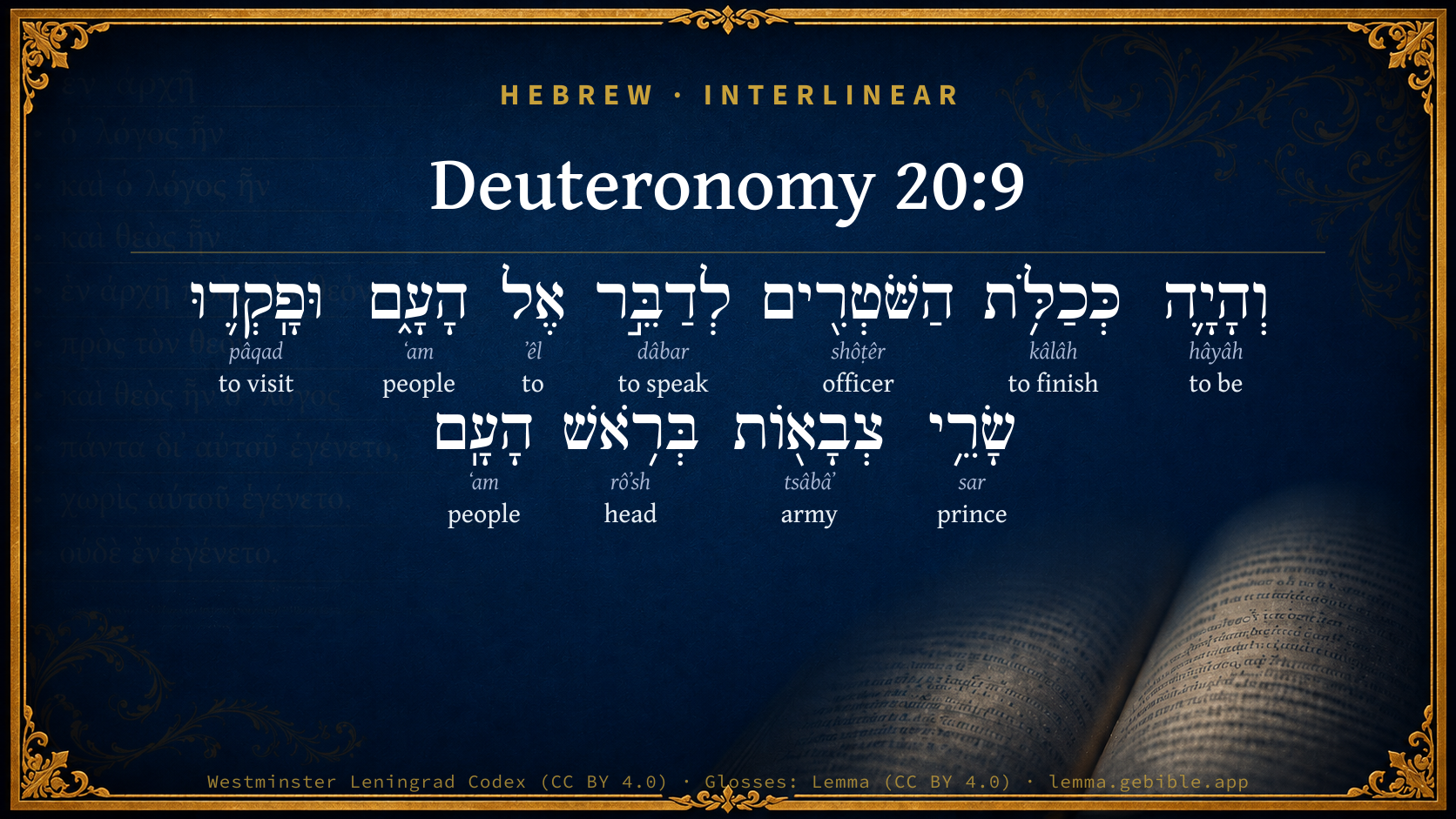
Deuteronomy 20:9

Hebrew (Westminster Leningrad Codex) Deuteronomy 20:9 appears in the Hebrew Old Testament. The text above is from the Westminster Leningrad Codex. Each word links to its Strong’s number, a concise gloss, and parsing drawn from the Open Scriptures Hebrew Bible morphology. Click any word for its full Brown-Driver-Briggs (BDB) entry.
Download image
Cite this verse

Deuteronomy 20:9 (World English Bible). Public Domain. Lemma interlinear Bible study tool, https://lemma.gebible.app/v/deuteronomy/20/9.

Show BibTeX & RIS
BibTeX
RIS
English Translation
It shall be, when the officers have made an end of speaking to the people, that they shall appoint captains of hosts at the head of the people.
World English Bible · Public Domain
Download a study sheet

One document with this verse’s original text, its word-by-word gloss line, the meaning frame, cross-references with their text, attributed commentary, and full source and license credits — printable, and it pastes into notes with its structure intact.

This verse Autodidact and up

Study sheet (.html) Plain text (.txt)

A passage Seminary Student

Up to 50 verses in one chapter. A passage sheet keeps up to 6 commentary sources and 12 cross-references per verse, in the order this page ranks them, and says so on the sheet whenever that leaves anything out. Ask for a single verse and you get the Autodidact verse sheet above.

Everything on this page stays free to read, with no account — the sheet is a download of what is already on screen, not access to it.

Want to remove ads? Support Godless Engineer
Compare translations 3

The same verse in 3 English versions, stacked beneath the original-language interlinear above. Click any original word for its lexicon entry.

Each is an independent rendering of the whole verse — the interlinear is not word-aligned to these translations.

Highlighted words mark where these versions differ — a whole-verse word diff, not a word-by-word alignment.

  • World English Bible Public Domain
    It shall be, when the officers have made an end of speaking to the people, that they shall appoint captains of hosts at the head of the people.
  • King James Version Public Domain
    And it shall be, when the officers have made an end of speaking unto the people that they shall make captains of the armies to lead the people.
  • unfoldingWord Literal Text CC BY-SA 4.0
    And it will be, as the officers finish speaking to the people, then they shall appoint leaders of the armies as heads of the people.

unfoldingWord Literal Text — © unfoldingWord, licensed CC BY-SA 4.0. Word-aligned USFM3 via Door43 (git.door43.org/unfoldingWord/en_ult).

Versions to compare (up to 4)

3 of 4 selected

Show all 18 translations

Every available English version of this verse, each an independent rendering of the whole verse.

  • World English Bible Public Domain
    It shall be, when the officers have made an end of speaking to the people, that they shall appoint captains of hosts at the head of the people.
  • Berean Standard Bible Public Domain
    When the officers have finished addressing the army, they are to appoint commanders to lead it.
  • Majority Standard Bible Public Domain
    When the officers have finished addressing the army, they are to appoint commanders to lead it.
  • King James Version Public Domain
    And it shall be, when the officers have made an end of speaking unto the people that they shall make captains of the armies to lead the people.
  • American Standard Version (1901) Public Domain
    And it shall be, when the officers have made an end of speaking unto the people, that they shall appoint captains of hosts at the head of the people.
  • Revised Version (1885) Public Domain
    And it shall be, when the officers have made an end of speaking unto the people, that they shall appoint captains of hosts at the head of the people.
  • Geneva Bible (1599) Public Domain
    And after that the officers haue made an ende of speaking vnto the people, they shall make captaines of the armie to gouerne the people.
  • Douay-Rheims (1899) Public Domain
    And when the captains of the army shall hold their peace, and have made an end of speaking, every man shall prepare their bands to fight.
  • Young's Literal Translation Public Domain
    and it hath come to pass as the authorities finish to speak unto the people, that they have appointed princes of the hosts at the head of the people.
  • Literal Standard Version CC BY-SA 4.0
    And it has come to pass, as the authorities finish to speak to the people, that they have appointed princes of the hosts at the head of the people.
  • Unlocked Literal Bible CC BY-SA 4.0
    When the officers have finished speaking to the people, they must appoint commanders over them.
  • unfoldingWord Literal Text CC BY-SA 4.0
    And it will be, as the officers finish speaking to the people, then they shall appoint leaders of the armies as heads of the people.
  • Darby Bible Public Domain
    And it shall be, when the officers have ended speaking unto the people, that they shall place captains of the hosts at the head of the people.
  • World Messianic Bible Public Domain
    It shall be, when the officers have finished speaking to the people, that they shall appoint captains of armies at the head of the people.
  • Webster's Bible Public Domain
    And it shall be, when the officers have made an end of speaking to the people, that they shall make captains of the armies to lead the people.
  • Free Bible Version CC BY-SA 4.0
    After the officers have finished speaking to the army, they are to put commanders in charge to lead it into battle.
  • Bible in Basic English Public Domain
    Then, after saying these words to the people, let the overseers put captains over the army.
  • JPS Tanakh (1917) Public Domain
    And it shall be, when the officers have made an end of speaking unto the people, that captains of hosts shall be appointed at the head of the people.

Literal Standard Version (2020), Covenant Press — licensed CC BY-SA 4.0. Text via the HelloAO Bible API (eBible.org). Unlocked Literal Bible (unfoldingWord) — licensed CC BY-SA 4.0. Text via the HelloAO Bible API (eBible.org). unfoldingWord Literal Text — © unfoldingWord, licensed CC BY-SA 4.0. Word-aligned USFM3 via Door43 (git.door43.org/unfoldingWord/en_ult). Free Bible Version, Dr. Jonathan Gallagher — licensed CC BY-SA 4.0. Text via the HelloAO Bible API (eBible.org).

Word by word

More ways to search: Search by grammar → Find every occurrence → Compare this word →

Practice this passage: Drill this verse → Learn its vocabulary →

הַשֹּׁטְרִ֖ים
shôṭêr
H7860
“the · officer”
Particle, Definite Article + Verb, Qal, Participle Active, Masculine, Plural, Absolute
Part of Speech
Particle + Verb
Stem
Qal
Form
Participle Active
Gender
Masculine
Number
Plural
State
Absolute
Full BDB Definition

Origin: act part of an otherwise unused root probably meaning to write

TWOT: TWOT - 2374a

(Qal) official, officer
  1. וְהָיָ֛ה hâyâh H1961 “and · to be” Conjunction + Verb, Qal, Sequential Perfect, 3rd Person, Masculine, Singular
  2. כְּכַלֹּ֥ת kâlâh H3615 “like/as · to finish” Preposition + Verb, Piel, Infinitive Construct
  3. לְדַבֵּ֣ר dâbar H1696 “to speak” Preposition + Verb, Piel, Infinitive Construct
  4. אֶל ʼêl H413 “to” Preposition
  5. הָעָ֑ם ʻam H5971 “the · people” Particle, Definite Article + Noun, Common, Masculine, Singular, Absolute
  6. וּפָֽקְד֛וּ pâqad H6485 “and · to visit” Conjunction + Verb, Qal, Sequential Perfect, 3rd Person, Common, Plural
  7. שָׂרֵ֥י sar H8269 “princes of” Noun, Common, Masculine, Plural, Construct
  8. צְבָא֖וֹת tsâbâʼ H6635 “armies” Noun, Common, Both, Plural, Absolute
  9. בְּרֹ֥אשׁ rôʼsh H7218 “in/at · head of” Preposition + Noun, Common, Masculine, Singular, Construct
  10. הָעָֽם ʻam H5971 “the · people” Particle, Definite Article + Noun, Common, Masculine, Singular, Absolute

About this verse

These counts appear in no published source. They are computed here, from the morphology-tagged text and Lemma’s own curated glosses. What Lemma adds →

11
words
10
distinct lemmas
Pentateuch
section

Notable vocabulary

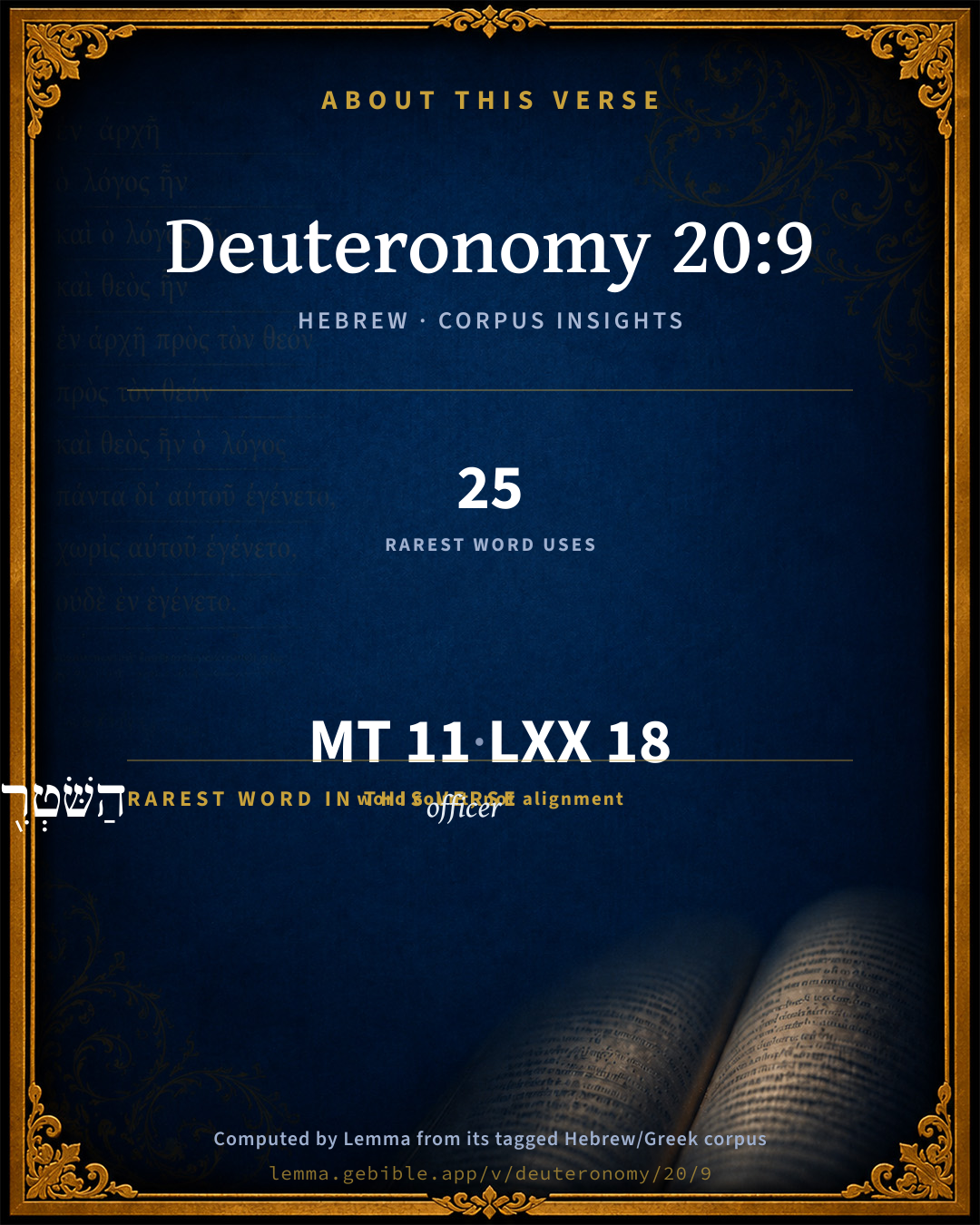
The rarest word here is הַשֹּׁטְרִ֖ים officer H7860 — appearing just 25 times in the whole Hebrew Bible.

Shared distinctive vocabulary

הַשֹּׁטְרִ֖ים officer H7860 occurs in 25 verses of the Hebrew Bible. Also found in:

Grammatical profile

  • 5 verbs
  • 5 nouns
  • 1 preposition

Verb forms

  • וְהָיָ֛ה Qal · Sequential Perfect
  • כְּכַלֹּ֥ת Piel · Infinitive Construct
  • הַשֹּׁטְרִ֖ים Qal · Participle Active
  • לְדַבֵּ֣ר Piel · Infinitive Construct
  • וּפָֽקְד֛וּ Qal · Sequential Perfect

Repetition

A word recurs within this verse — often emphatic in Hebrew:

  • הָעָ֑ם people H5971 ×2

Hebrew & Septuagint length

In English translation the verse runs 28 words from the Hebrew and 30 from the Septuagint (LXX English) — closely comparable.

A rough comparison of the two English renderings, which tokenize alike — not a word-level alignment.

Word counts can differ between the Hebrew and the Greek without any difference in meaning — e.g. the Hebrew direct-object marker אֵת has no separate Greek word, and Greek often adds the article ὁ.

In the original languages it is 11 Hebrew tokens and 18 Greek tokens — but the two are counted differently (Hebrew bundles its prefixes and suffixes into one token; the Greek is in lemma form), so that isn’t a like-for-like length.

Hebrew and Greek witnesses Masoretic Hebrew ↔ Greek Septuagint

The same verse in the two great witnesses to the Old Testament, shown verse-for-verse.

These are two independent witnesses, not word-aligned to each other, and the Septuagint is shown in lemma (dictionary) form.

Hebrew Deuteronomy 20:9 Masoretic · Westminster Leningrad Codex

וְהָיָ֛ה כְּכַלֹּ֥ת הַשֹּׁטְרִ֖ים לְדַבֵּ֣ר אֶל הָעָ֑ם וּפָֽקְד֛וּ שָׂרֵ֥י צְבָא֖וֹת בְּרֹ֥אשׁ הָעָֽם

It shall be, when the officers have made an end of speaking to the people, that they shall appoint captains of hosts at the head of the people.

World English Bible · Public Domain

Greek LXX Deuteronomy 20:9 Septuagint · lemma form

καί εἰμί ὅταν παύω ὁ γραμματεύς λαλέω πρός ὁ λαός καί καταἵστημι ἄρχων ὁ στρατιά προἡγέομαι ὁ λαός

And it shall come to pass when the scribes shall have ceased speaking to the people, that they shall appoint generals of the army to be leaders of the people.

LXX2012 (modern English Septuagint) · Public Domain

On this verse, Haydock's Catholic Bible Commentary discusses the Septuagint’s reading. Read the note in Commentary ↓

Hebrew: Westminster Leningrad Codex (CC BY 4.0). Greek: Septuagint (public domain); English from LXX2012 (modern English Septuagint) (Public Domain). How the Septuagint differs from the Hebrew →

Targum (Aramaic paraphrase)

2

The Targum is the ancient Jewish Aramaic paraphrase of the Hebrew Scriptures — an interpretive translation, not the Hebrew text itself. Onkelos (literal) and Pseudo-Jonathan (expansive) render the Torah, and Jonathan the Prophets. Coverage is partial: where no permissively-licensed English translation exists for a verse, only the Aramaic is shown. This is verse-level text, not a word-by-word alignment to the Hebrew.

  1. Targum Onkelos Torah (Genesis–Deuteronomy)
    וִיהֵי כַּד יְשֵׁצוּן סָרְכַיָא לְמַלָלָא עִם עַמָא וִימַנוּן רַבָּנֵי חֵילָא בְּרֵישׁ עַמָא

    (no public-domain English translation for this verse)

    Targum Onkelos — Aramaic: “Onkelos Genesis” (public domain); “Onkelos Exodus” (public domain); “Onkelos Leviticus” (public domain); “Onkelos Numbers” (public domain); “Onkelos Deuteronomy” (public domain). English: “Sefaria Community Translation” (CC0 1.0 (public-domain dedication)); “J.W. Etheridge. The Targums of Onkelos and Jonathan Ben Uzziel on the Pentateuch. London: Longmans, Green, 1862” (public domain). Text via Sefaria.

  2. Targum Pseudo-Jonathan Torah (Genesis–Deuteronomy)
    וִיהֵי כַּד פַּסְקִין סַרְכַיָא לְמַלָּלָא עִם עַמָּא וְיִמְנוּן רַבְרְבָנֵי חֵילִין בְּרֵישׁ עַמָּא

    And when the officers shall have finished to speak with the people, they shall appoint the captains of the host at the head of the people.

    Targum Pseudo-Jonathan — Aramaic: “Targum Jonathan on Genesis” (public domain); “Targum Jonathan on Exodus” (public domain); “Targum Jonathan on Leviticus” (public domain); “Targum Jonathan on Numbers” (public domain); “Targum Jonathan on Deuteronomy” (public domain). English: “The Targum of Jonathan ben Uzziel, trans. J. W. Etheridge, London, 1862” (public domain). Text via Sefaria.

Commentary

Notes on Deuteronomy 20:9 from classic Christian and Jewish commentators (each source and its license shown beneath its notes). The classic Christian expositions comment on the surrounding passage and are grouped to its opening verse, so a note may address several verses; the Jewish commentaries on the Tanakh (Rashi and others) are per-verse, so they appear only where the commentator wrote on this verse.

Lemma curates 59 commentaries, every one of them public domain or Creative Commons licensed, each selected and text-cleaned for this edition rather than reprinted as found. About our sources →

Joseph Benson's Commentary

Deu 20:9. They shall make captains — Or rather, as the Hebrew is, they shall set or place the captains of the armies in the head or front of the people under their charge, that they may conduct them, and, by their example, encourage their soldiers. It is not likely they had their captain to make when they were just going to battle.

Joseph Benson's Commentary on the Old and New Testaments (1811–1818) — public domain. Text from a community e-Sword module.

Jamieson, Fausset & Brown

Robert Jamieson, A. R. Fausset & David Brown

they shall make captains of the armies to lead the people--When the exempted parties have withdrawn, the combatants shall be ranged in order of battle.

Jamieson, Fausset & Brown — Commentary Critical and Explanatory on the Whole Bible (1871) — public domain (CC PDM 1.0). Text via the HelloAO Bible API.

Ellicott's Commentary for English Readers

(9) Captains of the armies—i.e., special leaders for the campaigns, whose command would probably cease when it was over. We may suppose from mention of the “thousands” in the army—“the captain of their thousand” (1Sa_17:18)—that the military divisions corresponded with the civil organization of the people so far as this, that the men of the same “thousand,” according to Jethro’s arrangement, would be brigaded together, and have one captain. If, as is also possible, the word “thousand” in military language signifies the contingent furnished by a “thousand” in Israel, irrespective of its number, it would remove many difficulties; for the whole thousand would very rarely be in the field together, and the contingent sent by a given “thousand” might consist of a very few men. If, therefore, the contingent of sixty “thousands” were to be described as 60,000, and the sixty companies were all cut up or annihilated, it might be reported as a slaughter of 60,000 men, while the lives actually lost would be nothing like so many.

A Bible Commentary for English Readers, edited by Charles John Ellicott (1878–1897) — public domain. Text from a community e-Sword module.

The Cambridge Bible for Schools and Colleges

gen. ed. J. J. S. Perowne

9. they shall appoint] They, not necessarily the officers of the previous clause, but indefinite: those whose duty it is to appoint, or the people as a whole. Cp. 1Ma_3:55 f.

captains of hosts] The chiefs of the main divisions, cp. 1Ki_2:5. These are not appointed till the host has been sifted of all whom it was not proper to allow to accompany it, because the exemptions apply to all ranks. With these rules for sifting the host, cp. Cromwell’s measures with the recruits for his Ironsides.

The Cambridge Bible for Schools and Colleges (gen. ed. J. J. S. Perowne; Cambridge University Press, 1878–1918) — public domain. Text from a community e-Sword module.

John Gill's Exposition

And it shall be, when the officers have made an end of speaking unto the people,.... By reciting what the anointed of war said unto them, and by speeches of their own framing, to encourage to the battle; and all were dismissed that had leave to depart, and chose to take it:

that they shall make captains of armies to lead on the people; on to battle; that is, either the officers should do this, which may seem to confirm what has been hinted, that they might be generals of the army, who constituted captains under them, to lead the people on to battle: unless this is to be understood of the princes of Israel, or of the king when they had one, and his ministers; for it does not appear in any instance that the people chose their own officers over them, to go out before them, and lead them on to battle; or "to be at the head of them" (z); which the Jewish writers understand in a very different sense; not to head them, or be at the head of them, to direct and command them, but to keep them from deserting: their sense is, that the officers having dismissed persons in the circumstances before described, and set stout men before them, and others behind them (i.e. the army of the people), with iron hatchets in their hands, and every one that sought to return, they had power to cut off his legs; since flight is the beginning of falling before their enemies (a).

(z) "in capite populi", Pagninus, Montanus. (a) Misn. ut supra (Sotah, c. 8.), sect. 6.

John Gill's Exposition of the Whole Bible (1746–1763) — public domain (CC PDM 1.0). Text via the HelloAO Bible API.

Albert Barnes' Notes on the Bible

The meaning is that the “officers” should then subdivide the levies, and appoint leaders of the smaller divisions thus constituted.

Albert Barnes' Notes on the Bible (1834–1885) — public domain. Text from a community e-Sword/MySword module.

Haydock's Catholic Bible Commentary

Man. Hebrew and Septuagint, "when the officers have made an end of speaking to the people, they shall appoint captains of the armies to lead forth the people." (Haydock) --- It seems rather late to have this to do, when the battle was ready to commence, unless perhaps the whole was arranged in a general assembly, when no one was at the head of the people, (Calmet) as was sometimes the case in the days of the judges. (Haydock) --- Hebrew of the Massorets implies, "The princes of the army shall make a review (or take down the numbers) at the head of the people."

George Leo Haydock (1774–1849), Haydock's Catholic Family Bible and Commentary, 1859 edition — public domain. Excludes Psalms (Douay-Rheims chapter numbering differs from Protestant) and Deuterocanonical books (Catholic canon only).

Matthew Poole's English Annotations

Or rather, as the Hebrew hath it, they shall set or place the captains of the armies in the head or front of the people under their charge, that they may conduct and manage them, and by their example encourage their soldiers. But it is not likely they had their captains to make or choose when they were just going to battle.

Matthew Poole's English Annotations on the Holy Bible (1683–1685) — public domain. Text from a community e-Sword/MySword module.

Whedon's Commentary on the Bible

Daniel D. Whedon

9. Captains of the armies to lead the people — The shoterim, or officers, after the elimination of the above-ordered army, are to appoint captains to lead the force that is now ready for the contest.

Daniel D. Whedon (gen. ed.), Commentary on the Old and New Testaments (1874–1909) — public domain. Text from a community e-Sword module.

The Pulpit Commentary

The next thing the shoterim had to do was to appoint captains to head the people who were going to war. The army was divided into bands or companies, and over each of these a captain was placed, whose it was to command and lead. (cf. Num_31:14, Num_31:48; 1Sa_8:12; 2Sa_18:1) Captains of the armies. The phrase, "captain of a host" (abx rc), usually designates the general or commander-in-chief of the entire army (Gen_21:22; 2Sa_2:8; 1Ki_16:16, etc.) but here the phrase is used in the plural of the chiefs of the companies or detachments of which the whole was composed.

The Pulpit Commentary (1880–1919), ed. H.D.M. Spence-Jones & Joseph S. Exell — public domain. Text from a community e-Sword module.

John Wesley's Explanatory Notes

Make captains - Or rather, as the Hebrew hath it, they shall set or place the captains of the armies in the head or front of the people under their charge, that they may conduct them, and by their example encourage their soldiers. It is not likely they had their captains to make when they were just going to battle.

John Wesley, Explanatory Notes Upon the Whole Bible (1754–1765) — public domain. Text via the GEBible commentary corpus.

Rashi

Rabbi Shlomo Yitzchaki (Rashi)

שרי צבאות [THEY SHALL APPOINT] OFFICERS OF THE HOSTS — This means that they shall place guards (זוקפין from זקף “to stand erect”) in front of and behind them (the troops), with iron axes in their hands, and if anybody attempted to desert he (the guard) was empowered to chop off his legs. זוקפין are men who stood in the wings of the battle-line to raise (זקף) those who fall and to strengthen them by encouraging words: “Go back to the battle and do not flee, for flight is the first step to defeat” (Sifrei Devarim 198; Sotah 44).

Rashi on the Tanakh — English translations: “The Judaica Press complete Tanach with Rashi, translated by A. J. Rosenberg” (CC BY 4.0); “Pentateuch with Rashi's commentary by M. Rosenbaum and A.M. Silbermann, 1929-1934” (public domain); “The Metsudah Tanach series, Lakewood, N.J” (CC BY 4.0); and “The Book of Joshua, Metsudah Publications, 1997” (CC BY 4.0). Text via Sefaria.

Ramban (Nachmanides)

Rabbi Moshe ben Nachman (Ramban / Nachmanides)

AND CAPTAINS OF HOSTS SHALL BE APPOINTED AT THE HEAD OF THE PEOPLE. He so commanded because the Torah enjoins in accordance with the way of the world while G-d does miracles for those who fear Him secretly. There is no desire before Him to change the natural order of the world, unless there is no other way for salvation, or in order to make His Name known to His adversaries at certain times as at the splitting of the Red Sea and similar events.

Ramban (Nachmanides) on the Tanakh — English translation: “Commentary on the Torah by Ramban (Nachmanides). Translated and annotated by Charles B. Chavel. New York, Shilo Pub. House, 1971-1976” (CC BY 4.0). Text via Sefaria.

Lesson kit

Teaching starters — assembled from the data on this page, not authored interpretation. Every prompt links to the verse data it draws on. Edit before teaching.

Deuteronomy, in the Pentateuch, opens this verse with 11 words (10 distinct Hebrew lemmas). Its most distinctive word is shôṭêr (“officer”). A historical commentator’s framing appears above. Read the whole chapter for the surrounding context.

Discussion questions

  1. How does “officer” (shôṭêr) shape what this verse is saying?
  2. Exodus 5:6 shares the word «officer» with this verse. How do the two illuminate each other?
  3. “people” occurs 2× in this one verse. What is the effect of the repetition?
  4. These translations render this verse differently; the difference is in the English rendering, not the original. What questions does that raise?
  5. The verb «וְהָיָ֛ה» is Qal Sequential Perfect. How does its form color the action?
  6. Reading how Joseph Benson's Commentary and Jamieson, Fausset & Brown read this verse, where do the two commentators agree and where do they part?

Things to notice

Reading settings

Reading text

Shown beneath each verse's original-language words.

Old Testament
Old Testament edition

Read the OT as the Masoretic Hebrew (MT) or the Greek Septuagint (LXX).

English shown for the Greek Septuagint (in the Hebrew ↔ Greek comparison).

Comparing translations? Open the Compare panel on any verse page to stack up to four side by side.