
Job 33:21

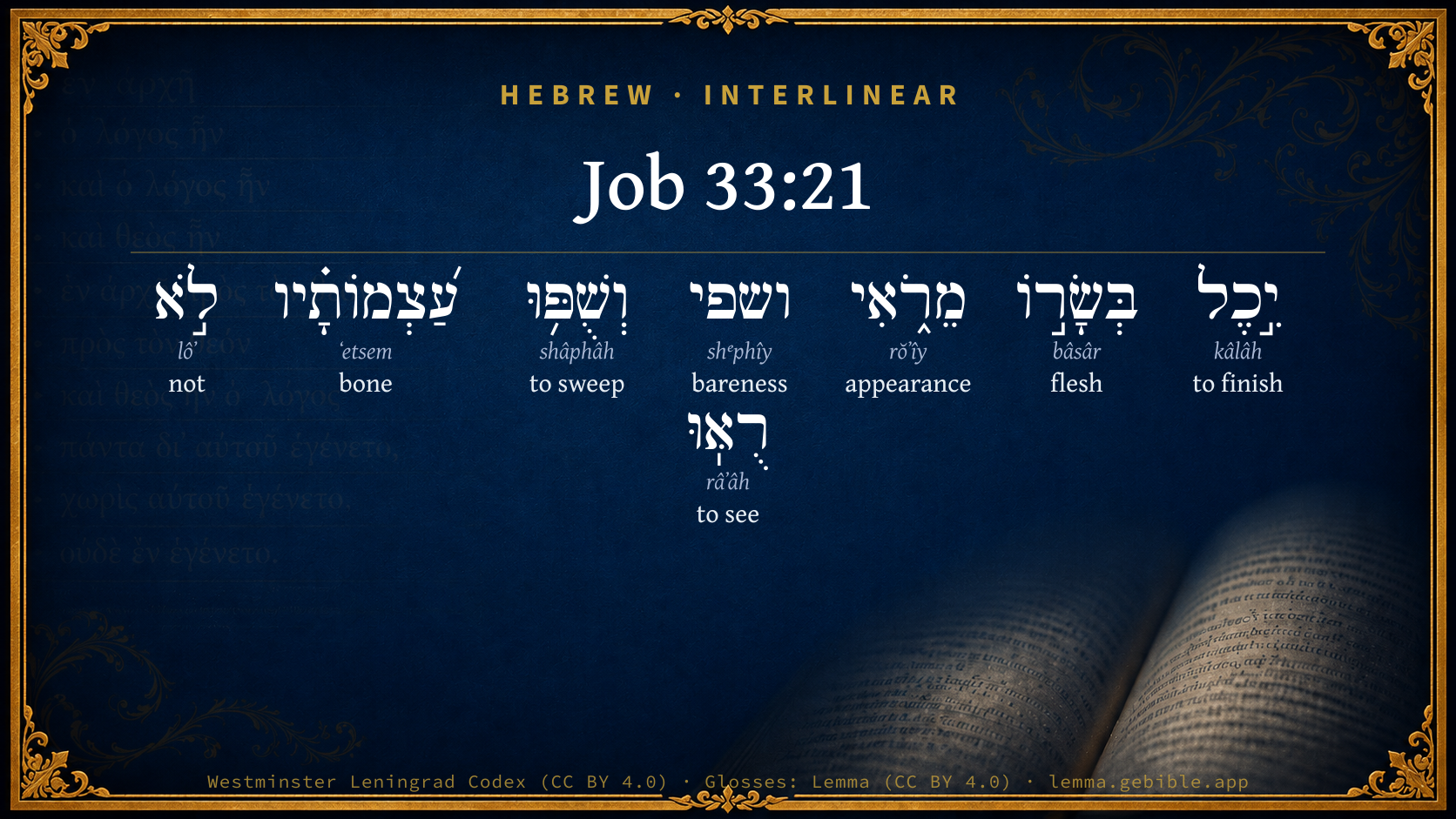
Hebrew (Westminster Leningrad Codex) Job 33:21 appears in the Hebrew Old Testament. The text above is from the Westminster Leningrad Codex. Each word links to its Strong’s number, a concise gloss, and parsing drawn from the Open Scriptures Hebrew Bible morphology. Click any word for its full Brown-Driver-Briggs (BDB) entry.
Download image
Cite this verse

Job 33:21 (World English Bible). Public Domain. Lemma interlinear Bible study tool, https://lemma.gebible.app/v/job/33/21.

Show BibTeX & RIS
BibTeX
RIS
English Translation
His flesh is so consumed away, that it can't be seen; His bones that were not seen stick out.
World English Bible · Public Domain
Highlights Full analysis ↓
Download a study sheet

One document with this verse’s original text, its word-by-word gloss line, the meaning frame, cross-references with their text, attributed commentary, and full source and license credits — printable, and it pastes into notes with its structure intact.

This verse Autodidact and up

Study sheet (.html) Plain text (.txt)

A passage Seminary Student

Up to 50 verses in one chapter. A passage sheet keeps up to 6 commentary sources and 12 cross-references per verse, in the order this page ranks them, and says so on the sheet whenever that leaves anything out. Ask for a single verse and you get the Autodidact verse sheet above.

Everything on this page stays free to read, with no account — the sheet is a download of what is already on screen, not access to it.

Want to remove ads? Support Godless Engineer
Compare translations 3

The same verse in 3 English versions, stacked beneath the original-language interlinear above. Click any original word for its lexicon entry.

Each is an independent rendering of the whole verse — the interlinear is not word-aligned to these translations.

Highlighted words mark where these versions differ — a whole-verse word diff, not a word-by-word alignment.

  • World English Bible Public Domain
    His flesh is so consumed away, that it can't be seen; His bones that were not seen stick out.
  • King James Version Public Domain
    His flesh is consumed away, that it cannot be seen; and his bones that were not seen stick out.
  • unfoldingWord Literal Text CC BY-SA 4.0
    His flesh wastes from sight, and his bones, not seen, are exposed,

unfoldingWord Literal Text — © unfoldingWord, licensed CC BY-SA 4.0. Word-aligned USFM3 via Door43 (git.door43.org/unfoldingWord/en_ult).

Versions to compare (up to 4)

3 of 4 selected

Show all 18 translations

Every available English version of this verse, each an independent rendering of the whole verse.

  • World English Bible Public Domain
    His flesh is so consumed away, that it can't be seen; His bones that were not seen stick out.
  • Berean Standard Bible Public Domain
    His flesh wastes away from sight, and his hidden bones protrude.
  • Majority Standard Bible Public Domain
    His flesh wastes away from sight, and his hidden bones protrude.
  • King James Version Public Domain
    His flesh is consumed away, that it cannot be seen; and his bones that were not seen stick out.
  • American Standard Version (1901) Public Domain
    His flesh is consumed away, that it cannot be seen; And his bones that were not seen stick out.
  • Revised Version (1885) Public Domain
    His flesh is consumed away, that it cannot be seen; and his bones that were not seen stick out.
  • Geneva Bible (1599) Public Domain
    His flesh faileth that it can not be seene, and his bones which were not seene, clatter.
  • Douay-Rheims (1899) Public Domain
    His flesh shall be consumed away, and his bones that were covered shall be made bare.
  • Young's Literal Translation Public Domain
    His flesh is consumed from being seen, And high are his bones, they were not seen!
  • Literal Standard Version CC BY-SA 4.0
    His flesh is consumed from being seen, || And his bones are high, they were not seen!
  • Unlocked Literal Bible CC BY-SA 4.0
    His flesh is consumed away so that it cannot be seen; his bones, once not seen, now stick out.
  • unfoldingWord Literal Text CC BY-SA 4.0
    His flesh wastes from sight, and his bones, not seen, are exposed,
  • Darby Bible Public Domain
    His flesh is consumed away from view, and his bones that were not seen stick out;
  • World Messianic Bible Public Domain
    His flesh is so consumed away that it can’t be seen. His bones that were not seen stick out.
  • Webster's Bible Public Domain
    His flesh is consumed away, that it cannot be seen; and his bones that were not seen stick out.
  • Free Bible Version CC BY-SA 4.0
    Their flesh wastes away to nothing; all that's left is skin and bones.
  • Bible in Basic English Public Domain
    His flesh is so wasted away, that it may not be seen, and his bones....
  • JPS Tanakh (1917) Public Domain
    His flesh is consumed away, that it cannot be seen; and his bones corrode to unsightliness.

Literal Standard Version (2020), Covenant Press — licensed CC BY-SA 4.0. Text via the HelloAO Bible API (eBible.org). Unlocked Literal Bible (unfoldingWord) — licensed CC BY-SA 4.0. Text via the HelloAO Bible API (eBible.org). unfoldingWord Literal Text — © unfoldingWord, licensed CC BY-SA 4.0. Word-aligned USFM3 via Door43 (git.door43.org/unfoldingWord/en_ult). Free Bible Version, Dr. Jonathan Gallagher — licensed CC BY-SA 4.0. Text via the HelloAO Bible API (eBible.org).

Word by word

More ways to search: Search by grammar → Find every occurrence → Compare this word →

Practice this passage: Drill this verse → Learn its vocabulary →

וְשֻׁפּ֥וּ
shâphâh
H8192
“and · to sweep”
Conjunction + Verb, Pual, Sequential Perfect, 3rd Person, Common, Plural
Part of Speech
Conjunction + Verb
Stem
Pual
Form
Sequential Perfect
Person
3rd Person
Gender
Common
Number
Plural
Full BDB Definition

Origin: a primitive root

TWOT: 2440

to sweep bare, scrape - (Niphal) to be wind-swept, be bare, be scraped barren (by wind) - (Pual) to be bare, be laid bare
  1. יִ֣כֶל kâlâh H3615 “to finish” Verb, Qal, Jussive, 3rd Person, Masculine, Singular
  2. בְּשָׂר֣וֹ bâsâr H1320 “flesh · his” Noun, Common, Masculine, Singular, Construct + Suffix, Personal, 3rd Person, Masculine, Singular
  3. מֵרֹ֑אִי rŏʼîy H7210 “from · appearance” Preposition + Noun, Common, Masculine, Singular, Absolute
  4. ושפי shᵉphîy H8205 “and · bareness of” Conjunction + Noun, Common, Masculine, Singular, Construct
  5. עַ֝צְמוֹתָ֗יו ʻetsem H6106 “bones · his” Noun, Common, Feminine, Plural, Construct + Suffix, Personal, 3rd Person, Masculine, Singular
  6. לֹ֣א lôʼ H3808 “not” Particle, Negative
  7. רֻאּֽוּ râʼâh H7200 “to see” Verb, Qal Passive, Perfect, 3rd Person, Common, Plural

About this verse

These counts appear in no published source. They are computed here, from the morphology-tagged text and Lemma’s own curated glosses. What Lemma adds →

8
words
8
distinct lemmas
Wisdom
section

Notable vocabulary

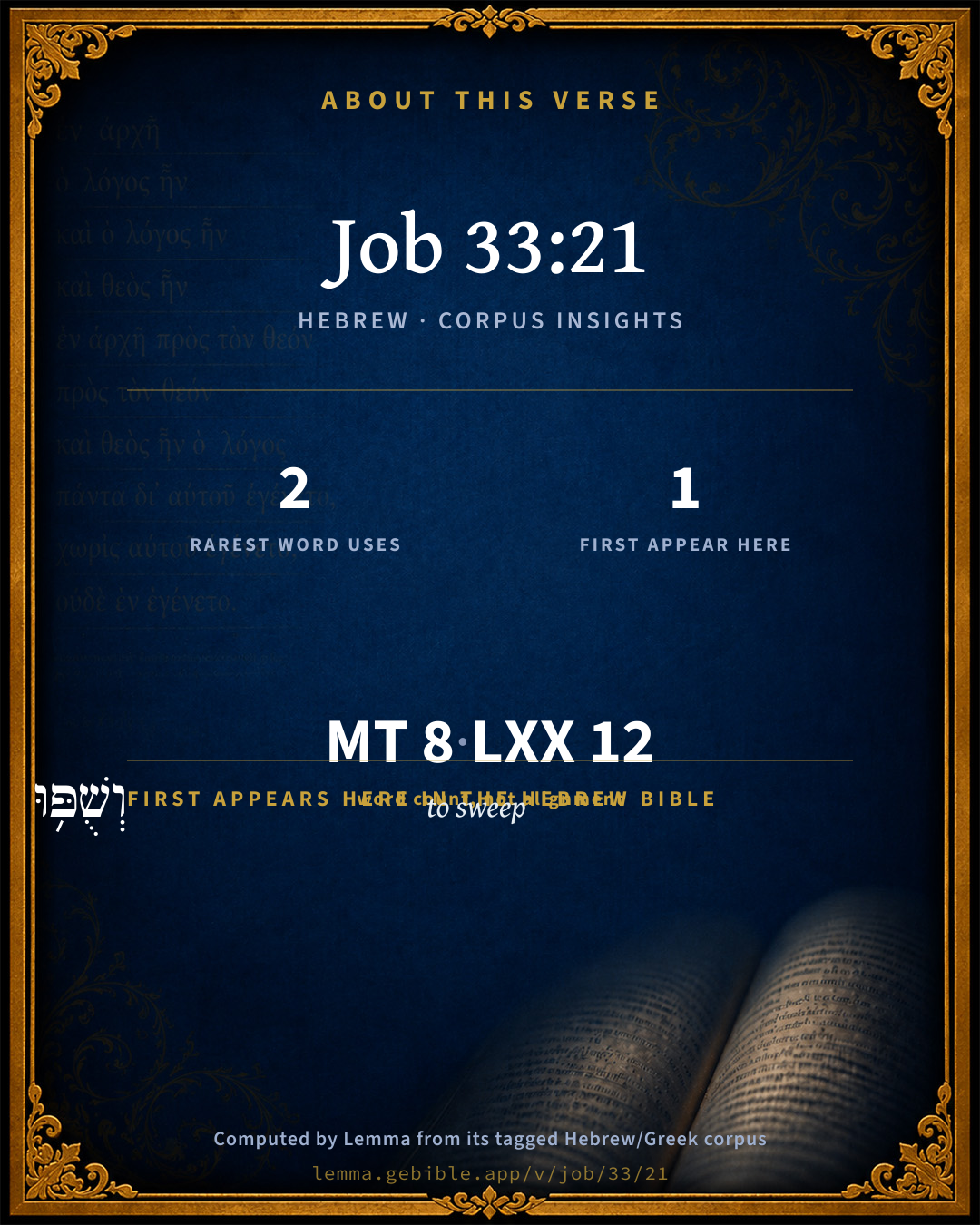
The rarest word here is וְשֻׁפּ֥וּ to sweep H8192 — appearing just 2 times in the whole Hebrew Bible.

First appearance in Scripture

This word makes its first canonical appearance in the Hebrew Bible here:

  • וְשֻׁפּ֥וּ to sweep H8192

Shared distinctive vocabulary

וְשֻׁפּ֥וּ to sweep H8192 occurs in 2 verses of the Hebrew Bible. Also found in:

Grammatical profile

  • 3 verbs
  • 4 nouns
  • 1 particle

Verb forms

  • יִ֣כֶל Qal · Jussive
  • וְשֻׁפּ֥וּ Pual · Sequential Perfect
  • רֻאּֽוּ Qal Passive · Perfect

Hebrew & Septuagint length

In English translation the verse runs 19 words from the Hebrew and 13 from the Septuagint (LXX English) — the Septuagint runs noticeably shorter here. See the side-by-side →

A rough comparison of the two English renderings, which tokenize alike — not a word-level alignment.

Word counts can differ between the Hebrew and the Greek without any difference in meaning — e.g. the Hebrew direct-object marker אֵת has no separate Greek word, and Greek often adds the article ὁ.

In the original languages it is 8 Hebrew tokens and 12 Greek tokens — but the two are counted differently (Hebrew bundles its prefixes and suffixes into one token; the Greek is in lemma form), so that isn’t a like-for-like length.

Cross-references

11

Topical passages linked to Job 33:21 in the Treasury of Scripture Knowledge — connected by theme and wording, ordered by reader-vote popularity; previews shown in the World English Bible.

  • Job 19:20 My bones stick to my skin and to my flesh. I have escaped by the skin of my teeth.
  • Job 7:5 My flesh is clothed with worms and clods of dust. My skin closes up, and breaks out afresh.
  • Job 13:28 Though I am decaying like a rotten thing, Like a garment that is moth-eaten.
  • Proverbs 5:11 You will groan at your latter end, When your flesh and your body are consumed,
  • Job 14:20 You forever prevail against him, and he passes; You change his face, and send him away.
  • Job 14:22 But his flesh on him has pain; His soul within him mourns."
  • Job 16:8 You have shriveled me up. This is a witness against me. My leanness rises up against me, It testifies to my face.
  • Psalms 22:15–17 My strength is dried up like a potsherd. My tongue sticks to the roof of my mouth. You have brought me into the dust of death.
  • Psalms 32:3–4 When I kept silence, my bones wasted away through my groaning all day long.
  • Psalms 39:11 When you rebuke and correct man for iniquity, You consume his wealth like a moth. Surely every man is but a breath." Selah.
  • Psalms 102:3–5 For my days consume away like smoke. My bones are burned as a firebrand.

Cross-references courtesy of OpenBible.info (CC BY 4.0).

Hebrew and Greek witnesses Masoretic Hebrew ↔ Greek Septuagint

The same verse in the two great witnesses to the Old Testament, shown verse-for-verse.

Here the Septuagint runs noticeably shorter than the Hebrew — LXX2012 (modern English Septuagint) 13 words vs World English Bible 19. A rough length comparison of the two English translations, not a word-level alignment — read both below.

These are two independent witnesses, not word-aligned to each other, and the Septuagint is shown in lemma (dictionary) form.

Hebrew Job 33:21 Masoretic · Westminster Leningrad Codex

יִ֣כֶל בְּשָׂר֣וֹ מֵרֹ֑אִי ושפי וְשֻׁפּ֥וּ עַ֝צְמוֹתָ֗יו לֹ֣א רֻאּֽוּ

His flesh is so consumed away, that it can't be seen; His bones that were not seen stick out.

World English Bible · Public Domain

Greek LXX Job 33:21 Septuagint · lemma form

ἕως ἄν σήπω αὐτός ὁ σάρξ καί ἀποδεικνύω ὁ ὀστέον αὐτός κενός

until his flesh shall be consumed, and he shall show his bones bare.

LXX2012 (modern English Septuagint) · Public Domain

Hebrew: Westminster Leningrad Codex (CC BY 4.0). Greek: Septuagint (public domain); English from LXX2012 (modern English Septuagint) (Public Domain). How the Septuagint differs from the Hebrew →

Commentary

Notes on Job 33:21 from classic Christian and Jewish commentators (each source and its license shown beneath its notes). The classic Christian expositions comment on the surrounding passage and are grouped to its opening verse, so a note may address several verses; the Jewish commentaries on the Tanakh (Rashi and others) are per-verse, so they appear only where the commentator wrote on this verse.

Lemma curates 59 commentaries, every one of them public domain or Creative Commons licensed, each selected and text-cleaned for this edition rather than reprinted as found. About our sources →

Trapp's Complete Commentary

John Trapp

Job 33:21 His flesh is consumed away, that it cannot be seen; and his bones [that] were not seen stick out.

Ver. 21. His flesh is consumed away, that it cannot be seen] He that was habilior paulo, corpulent and well lined within, as we say, is so pined with long sickness, that you can hardly know him for the same man, and he may well cry out with the prophet, My leanness, my leanness! Of Christ it is said (though not through sickness), that he had "no form nor comeliness" (and yet he was the fairest among men, Psa 45:2), through grief and sufferances, "neither was there any beauty left that we should desire him," for his outside, Isa 53:2. And of Mr Fox, the martyrologue, it is reported, that having with infinite pains finished that elaborate work of his, the Acts and Monuments of the Church, in eleven years’ time, never using the help of any other man, he grew thereupon so lean and withered, that his friends knew him not (Mr Clark in his Life). Now if sorrow and hard study will so macerate a man, what marvel if long and sharp sickness, and thereby extreme stomachlessness, cause leanness and deformity?

And his bones that were not seen] But could hardly be felt for flesh and fat; now they stick out as in an anatomy, so that you may count them, as also the veins and sinews; his body is become a very bag of bones, a skin bottle in the smoke, as David hath it.

John Trapp, A Commentary or Exposition upon All the Books of the Old and New Testament (1647–1656) — public domain. Text from a community e-Sword module.

Jamieson, Fausset & Brown

Robert Jamieson, A. R. Fausset & David Brown

His flesh once prominent "can no more be seen." His bones once not seen now appear prominent.

stick out--literally, "are bare." The Margin, Hebrew (Keri) reading. The text (Chetib) reads it a noun "(are become) bareness." The Keri was no doubt an explanatory reading of transcribers.

Jamieson, Fausset & Brown — Commentary Critical and Explanatory on the Whole Bible (1871) — public domain (CC PDM 1.0). Text via the HelloAO Bible API.

Adam Clarke's Commentary

Verse 21. His flesh is consumed away] As in atrophy, marasmus, and consumptive complaints in general.

Adam Clarke's Commentary on the Bible (1810–1826) — public domain. Text from a community e-Sword/MySword module.

John Gill's Exposition

His flesh is consumed away, that it cannot be seen,.... All being gone, none left to be seen, nothing but skin and bones; and this partly through the vehemence of strong pain, and partly through the nausea of food; not being able to take anything for nourishment and the support of the fluids, and so quite emaciated:

and his bones that were not seen stick out: which before were covered with flesh and fat, so that they could not be seen; but now the flesh and fat being wasted, they seem as if they rose up in an eminence, and stood out to be beheld; this was also Job's case, being reduced to a mere skeleton, Job 19:20. Elihu, in this description of an afflicted man, seems to have Job chiefly in view, and by this would intimate to him that God had been, and was speaking to him by those afflictions, which he would do well to advert unto.

John Gill's Exposition of the Whole Bible (1746–1763) — public domain (CC PDM 1.0). Text via the HelloAO Bible API.

Albert Barnes' Notes on the Bible

His flesh is consumed away, that it cannot be seen - He wastes away. His flesh, once vigorous, beautiful, and fair, now disappears. This is not a mere description of the nature of his sickness, but it is a description of the disciplinary arrangements of God. It is an important part of his affliction, as a part of the discipline, that his flesh vanishes, and that his appearance is so changed that he becomes repulsive to the view.

And his bones that were not seen, stick out - His bones were before invisible. They were carefully concealed by the rounded muscle, and by the fat which filled up the interstices, so that they were not offensive to the view. But now the protuberances of his bones can be seen, for God has reduced him to the condition of a skeleton. This is one of the common effects of disease, and this shows the strength of the discipline which God contemplates. The parts of the human frame which in health are carefully hid from the view, as being unsightly, become now prominent, and can be hidden no longer. One design is to humble us; to take away the pride which delighted in the round and polished limb, the rose on the cheek, the ruby lip, and the smooth forehead; and to show us what we shall soon be in the grave.

Albert Barnes' Notes on the Bible (1834–1885) — public domain. Text from a community e-Sword/MySword module.

Haydock's Catholic Bible Commentary

Bare. The skin will scarcely cover them. He will appear ghastly, like a skeleton. (Calmet) --- Hebrew, "his bones....shall stick out." (Protestants) (Haydock)

George Leo Haydock (1774–1849), Haydock's Catholic Family Bible and Commentary, 1859 edition — public domain. Excludes Psalms (Douay-Rheims chapter numbering differs from Protestant) and Deuterocanonical books (Catholic canon only).

Matthew Poole's English Annotations

His flesh is consumed away, through pain and pining sickness.

That it cannot be seen; because there is none left to be seen; but he who before was fat and flourishing, is now become a mere skeleton.

That were not seen, formerly, because they were covered with flesh and fat. But this clause, is and may be rendered thus, and his bones are broken, and are not seen; which is to be metaphorically understood.

Matthew Poole's English Annotations on the Holy Bible (1683–1685) — public domain. Text from a community e-Sword/MySword module.

Whedon's Commentary on the Bible

Daniel D. Whedon

21. Bones that were not seen — “Wasted are his bones, they no more are seen” — thus the Kethib.

Daniel D. Whedon (gen. ed.), Commentary on the Old and New Testaments (1874–1909) — public domain. Text from a community e-Sword module.

The Pulpit Commentary

His flesh is consumed away, that it cannot be seen; literally, from the sight; but the Authorized Version gives probably the correct meaning. And his bones that were not seen stick out. These are general features of a wasting illness. (comp. Psa_22:17, "I may tell all my bones Such illness gives the sufferer time to review thoroughly his life and cow duct, and see to it "if there be any way of wickedness in him," or any particular form of sin to which he is tempted.

The Pulpit Commentary (1880–1919), ed. H.D.M. Spence-Jones & Joseph S. Exell — public domain. Text from a community e-Sword module.

unfoldingWord translationNotes

Door43 World Missions Community

General Information:

Elihu continues speaking to Job.

His flesh is consumed away so that it cannot be seen; his bones, once not seen, now stick out

This can be stated in active form. "His flesh" refers to his fat and muscles, not to his body's outer skin. AT: "Disease makes his body weak and thin so that a person can see his bones" (See: Active or Passive)

his soul draws close to the pit

Here a person is represented by his "soul." AT: "he is close to going into the grave" (See: Synecdoche)

the pit

The place where people go when they die is referred to here as "the pit." AT: "the place where dead people are" (See: Metaphor)

his life to those who wish to destroy it

Here the person is represented by his "life." The phrase "those who wish to destroy it" refers to the place where people go after they die. AT: "and he is close to going to the place where dead people go" or "and he will soon go to the place of the dead" (See: Synecdoche and Metonymy)

translationWords

flesh

consume

soul

pit

unfoldingWord translationNotes — © Distant Shores Media and the Door43 World Missions Community, licensed CC BY-SA 4.0. Source: git.door43.org/Door43/en_tn.

Rashi

Rabbi Shlomo Yitzchaki (Rashi)

His flesh is consumed from sight Heb. יכל בשרו מראי, His flesh is withdrawn from sight, like (Lam 2:11): “My eyes are spent (כלו) with tears”; (Lev. 26:16), “that cause the eyes to pine way (מכלות).

and his bones are dislocated Heb. ושפו. They are dislocated from their place. [The word] שֻׁפּוּ is like (Hullin 42b), “that sprung (שף) from its place.”

to unsightliness They have neither appearance nor form.

Rashi on the Tanakh — English translations: “The Judaica Press complete Tanach with Rashi, translated by A. J. Rosenberg” (CC BY 4.0); “Pentateuch with Rashi's commentary by M. Rosenbaum and A.M. Silbermann, 1929-1934” (public domain); “The Metsudah Tanach series, Lakewood, N.J” (CC BY 4.0); and “The Book of Joshua, Metsudah Publications, 1997” (CC BY 4.0). Text via Sefaria.

Lesson kit

Teaching starters — assembled from the data on this page, not authored interpretation. Every prompt links to the verse data it draws on. Edit before teaching.

Job, in the Wisdom, opens this verse with 8 words (8 distinct Hebrew lemmas). Its most distinctive word is shâphâh (“to sweep”). The Greek Septuagint runs shorter here. A historical commentator’s framing appears above. Read the whole chapter for the surrounding context.

Discussion questions

  1. What does “to sweep” (shâphâh) contribute to the verse as a whole?
  2. The word “to sweep” first appears here in Scripture. What is being introduced at this debut?
  3. Isaiah 13:2 shares the word «to sweep» with this verse. How do the two illuminate each other?
  4. Compared with the Hebrew, the Septuagint runs shorter here. What questions does that raise?
  5. These translations render this verse differently. What is at stake in choosing one wording over another?
  6. The verb «יִ֣כֶל» is Qal Jussive. How does its form color the action?
  7. Reading how Trapp's Complete Commentary and Jamieson, Fausset & Brown read this verse, where do the two commentators agree and where do they part?

Things to notice

Reading settings

Reading text

Shown beneath each verse's original-language words.

Old Testament
Old Testament edition

Read the OT as the Masoretic Hebrew (MT) or the Greek Septuagint (LXX).

English shown for the Greek Septuagint (in the Hebrew ↔ Greek comparison).

Comparing translations? Open the Compare panel on any verse page to stack up to four side by side.