Isaiah 10:18

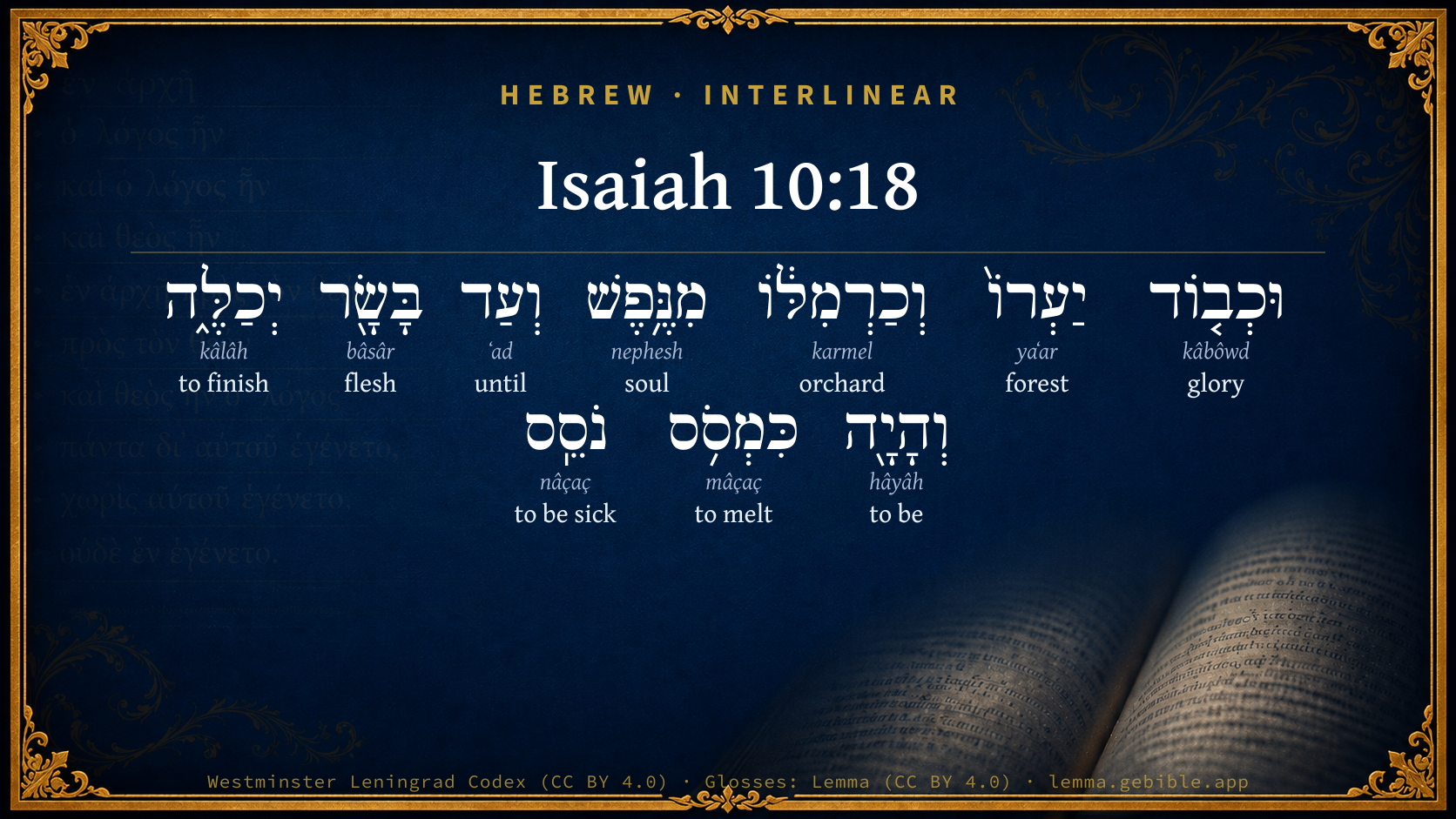
Hebrew (Westminster Leningrad Codex) Isaiah 10:18 appears in the Hebrew Old Testament. The text above is from the Westminster Leningrad Codex. Each word links to its Strong’s number, a concise gloss, and parsing drawn from the Open Scriptures Hebrew Bible morphology. Click any word for its full Brown-Driver-Briggs (BDB) entry.
Download image
Cite this verse

Isaiah 10:18 (World English Bible). Public Domain. Lemma interlinear Bible study tool, https://lemma.gebible.app/v/isaiah/10/18.

Show BibTeX & RIS
BibTeX
RIS
English Translation
He will consume the glory of his forest, and of his fruitful field, both soul and body: and it shall be as when a standard-bearer faints.
World English Bible · Public Domain
Highlights
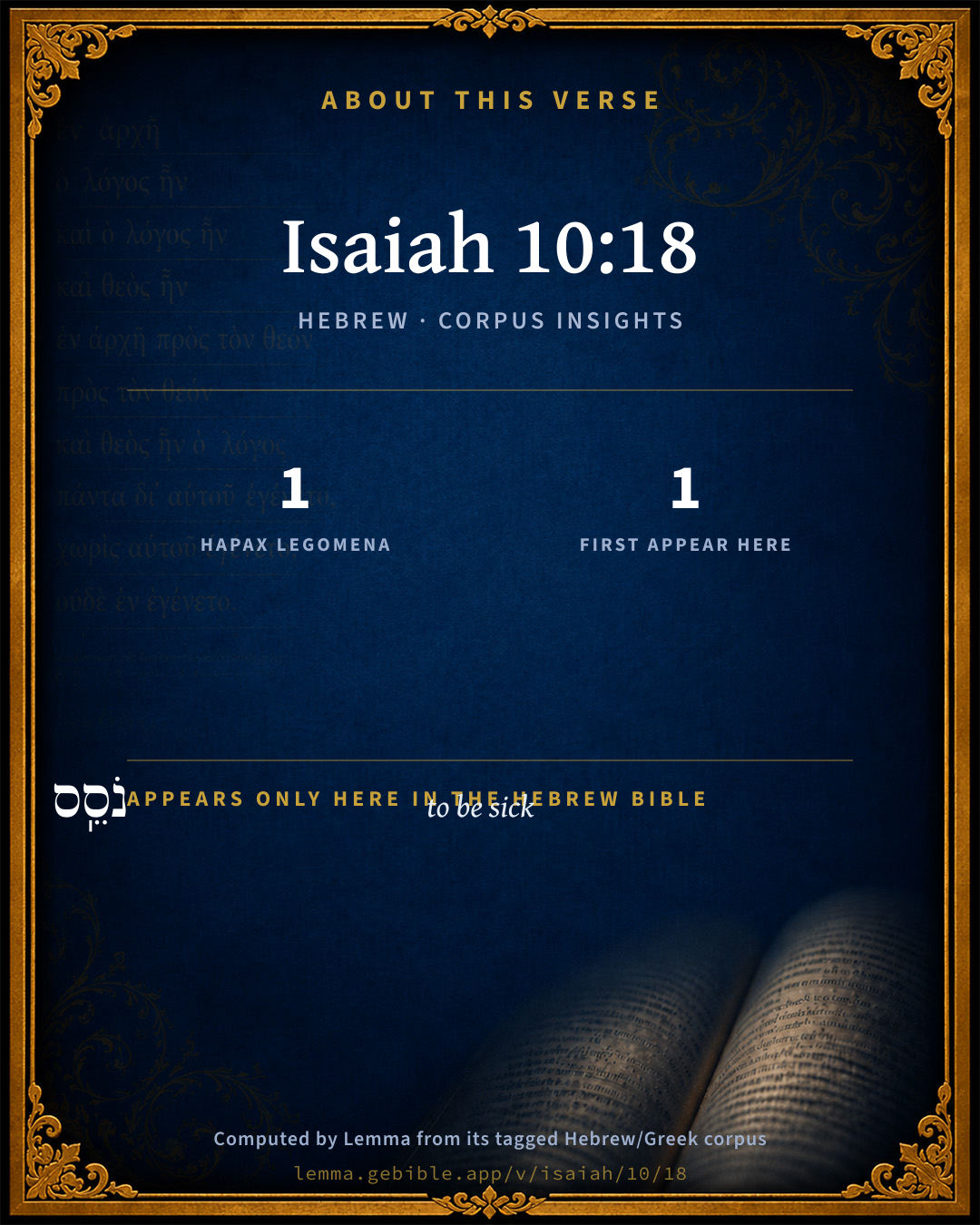
  • 1 hapax legomenon — only here in the Hebrew Bible
  • 1 first appearance in the Hebrew Bible
Full analysis ↓
Download a study sheet

One document with this verse’s original text, its word-by-word gloss line, the meaning frame, cross-references with their text, attributed commentary, and full source and license credits — printable, and it pastes into notes with its structure intact.

This verse Autodidact and up

Study sheet (.html) Plain text (.txt)

A passage Seminary Student

Up to 50 verses in one chapter. A passage sheet keeps up to 6 commentary sources and 12 cross-references per verse, in the order this page ranks them, and says so on the sheet whenever that leaves anything out. Ask for a single verse and you get the Autodidact verse sheet above.

Everything on this page stays free to read, with no account — the sheet is a download of what is already on screen, not access to it.

Want to remove ads? Support Godless Engineer
Compare translations 3

The same verse in 3 English versions, stacked beneath the original-language interlinear above. Click any original word for its lexicon entry.

Each is an independent rendering of the whole verse — the interlinear is not word-aligned to these translations.

Highlighted words mark where these versions differ — a whole-verse word diff, not a word-by-word alignment.

  • World English Bible Public Domain
    He will consume the glory of his forest, and of his fruitful field, both soul and body: and it shall be as when a standard-bearer faints.
  • King James Version Public Domain
    And shall consume the glory of his forest, and of his fruitful field, both soul and body: and they shall be as when a standard-bearer fainteth.
  • unfoldingWord Literal Text CC BY-SA 4.0
    And the glory of his forest and his agricultural land, from soul and unto flesh, he will consume, and it will be like the melting of one wasting away.

unfoldingWord Literal Text — © unfoldingWord, licensed CC BY-SA 4.0. Word-aligned USFM3 via Door43 (git.door43.org/unfoldingWord/en_ult).

Versions to compare (up to 4)

3 of 4 selected

Show all 18 translations

Every available English version of this verse, each an independent rendering of the whole verse.

  • World English Bible Public Domain
    He will consume the glory of his forest, and of his fruitful field, both soul and body: and it shall be as when a standard-bearer faints.
  • Berean Standard Bible Public Domain
    The splendor of its forests and orchards, both soul and body, it will completely destroy, as a sickness consumes a man.
  • Majority Standard Bible Public Domain
    The splendor of its forests and orchards, both soul and body, it will completely destroy, as a sickness consumes a man.
  • King James Version Public Domain
    And shall consume the glory of his forest, and of his fruitful field, both soul and body: and they shall be as when a standard-bearer fainteth.
  • American Standard Version (1901) Public Domain
    And he will consume the glory of his forest, and of his fruitful field, both soul and body: and it shall be as when a standard-bearer fainteth.
  • Revised Version (1885) Public Domain
    And he shall consume the glory of his forest, and of his fruitful field, both soul and body: and it shall be as when a standardbearer fainteth.
  • Geneva Bible (1599) Public Domain
    And shall consume the glory of his forest, and of his fruitfull fieldes both soule and flesh: and he shalbe as ye fainting of a standard bearer.
  • Douay-Rheims (1899) Public Domain
    And the glory of his forest, and of his beautiful hill, shall be consumed from the soul even to the flesh, and he shall run away through fear.
  • Young's Literal Translation Public Domain
    And the honour of his forest, and his fruitful field, From soul even unto flesh He doth consume, And it hath been as the fainting of a standard-bearer.
  • Literal Standard Version CC BY-SA 4.0
    And the glory of his forest, and his fruitful field, || He consumes from soul even to flesh, || And it has been as the fainting of a standard-bearer.
  • Unlocked Literal Bible CC BY-SA 4.0
    Yahweh will consume the glory of his forest and of his fruitful land, both soul and body; it will be like when a sick man's life wastes away.
  • unfoldingWord Literal Text CC BY-SA 4.0
    And the glory of his forest and his agricultural land, from soul and unto flesh, he will consume, and it will be like the melting of one wasting away.
  • Darby Bible Public Domain
    and it shall consume the glory of his forest, and of his fruitful field, both soul and body; and they shall be as when a sick man fainteth.
  • World Messianic Bible Public Domain
    He will consume the glory of his forest and of his fruitful field, both soul and body. It will be as when a standard bearer faints.
  • Webster's Bible Public Domain
    And shall consume the glory of his forest, and of his fruitful field, both soul and body: and they shall be as when a standard-bearer fainteth.
  • Free Bible Version CC BY-SA 4.0
    It will totally destroy its splendid forests and orchards. Assyria will waste away, staggering off like someone sick.
  • Bible in Basic English Public Domain
    And he will put an end to the glory of his woods and of his planted fields, soul and body together; and it will be as when a man is wasted by disease.
  • JPS Tanakh (1917) Public Domain
    And the glory of his forest and of his fruitful field, he will consume both soul and body; and it shall be as when a sick man wasteth away.

Literal Standard Version (2020), Covenant Press — licensed CC BY-SA 4.0. Text via the HelloAO Bible API (eBible.org). Unlocked Literal Bible (unfoldingWord) — licensed CC BY-SA 4.0. Text via the HelloAO Bible API (eBible.org). unfoldingWord Literal Text — © unfoldingWord, licensed CC BY-SA 4.0. Word-aligned USFM3 via Door43 (git.door43.org/unfoldingWord/en_ult). Free Bible Version, Dr. Jonathan Gallagher — licensed CC BY-SA 4.0. Text via the HelloAO Bible API (eBible.org).

Word by word

More ways to search: Search by grammar → Find every occurrence → Compare this word →

Practice this passage: Drill this verse → Learn its vocabulary →

נֹסֵֽס
nâçaç
H5263
“being sick”
Verb, Qal, Participle Active, Masculine, Singular, Absolute
Part of Speech
Verb
Stem
Qal
Form
Participle Active
Gender
Masculine
Number
Singular
State
Absolute
Full BDB Definition

Origin: a primitive root

TWOT: 1378

(Qal) to be sick
  1. וּכְב֤וֹד kâbôwd H3519 “and · glory of” Conjunction + Noun, Common, Both, Singular, Construct
  2. יַעְרוֹ֙ yaʻar H3293 “forest · his” Noun, Common, Masculine, Singular, Construct + Suffix, Personal, 3rd Person, Masculine, Singular
  3. וְכַרְמִלּ֔וֹ karmel H3759 “and · orchard · his” Conjunction + Noun, Common, Masculine, Singular, Construct + Suffix, Personal, 3rd Person, Masculine, Singular
  4. מִנֶּ֥פֶשׁ nephesh H5315 “from · soul” Preposition + Noun, Common, Both, Singular, Absolute
  5. וְעַד ʻad H5704 “and · until” Conjunction + Preposition
  6. בָּשָׂ֖ר bâsâr H1320 “flesh” Noun, Common, Masculine, Singular, Absolute
  7. יְכַלֶּ֑ה kâlâh H3615 “to finish” Verb, Piel, Imperfect, 3rd Person, Masculine, Singular
  8. וְהָיָ֖ה hâyâh H1961 “and · to be” Conjunction + Verb, Qal, Sequential Perfect, 3rd Person, Masculine, Singular
  9. כִּמְסֹ֥ס mâçaç H4549 “like/as · to melt” Preposition + Verb, Qal, Infinitive Construct

About this verse

These counts appear in no published source. They are computed here, from the morphology-tagged text and Lemma’s own curated glosses. What Lemma adds →

10
words
10
distinct lemmas
Prophets
section

Notable vocabulary

1 hapax legomenon — a word that appears only here in the entire Hebrew Bible:

  • נֹסֵֽס to be sick H5263

First appearance in Scripture

This word makes its first canonical appearance in the Hebrew Bible here:

  • נֹסֵֽס to be sick H5263

Shared distinctive vocabulary

וְכַרְמִלּ֔וֹ orchard H3759 occurs in 13 verses of the Hebrew Bible. Also found in:

Grammatical profile

  • 4 verbs
  • 5 nouns
  • 1 preposition

Verb forms

  • יְכַלֶּ֑ה Piel · Imperfect
  • וְהָיָ֖ה Qal · Sequential Perfect
  • כִּמְסֹ֥ס Qal · Infinitive Construct
  • נֹסֵֽס Qal · Participle Active

Hebrew & Septuagint length

In English translation the verse runs 26 words from the Hebrew and 34 from the Septuagint (LXX English) — closely comparable.

A rough comparison of the two English renderings, which tokenize alike — not a word-level alignment.

Word counts can differ between the Hebrew and the Greek without any difference in meaning — e.g. the Hebrew direct-object marker אֵת has no separate Greek word, and Greek often adds the article ὁ.

Cross-references

6

Topical passages linked to Isaiah 10:18 in the Treasury of Scripture Knowledge — connected by theme and wording, ordered by reader-vote popularity; previews shown in the World English Bible.

  • 2 Kings 19:23 By your messengers you have defied the Lord, and have said, With the multitude of my chariots am I come up to the height of the mountains, to the innermost parts of Lebanon; and I will cut down the tall cedars of it, and the choice fir trees of it; and I will enter into his farthest lodging-place, the forest of his fruitful field.
  • Isaiah 10:33–34 Behold, the Lord, Yahweh of Hosts, will lop the boughs with terror: and the high of stature shall be hewn down, and the lofty shall be brought low.
  • 2 Kings 19:28 Because of your raging against me, and because your arrogance is come up into my ears, therefore will I put my hook in your nose, and my bridle in your lips, and I will turn you back by the way by which you came.
  • Isaiah 9:18 For wickedness burns as the fire; it devours the briers and thorns; yes, it kindles in the thickets of the forest, and they roll upward in a column of smoke.
  • Jeremiah 21:14 I will punish you according to the fruit of your doings, says Yahweh; and I will kindle a fire in her forest, and it shall devour all that is round about her.
  • Ezekiel 20:47–48 and tell the forest of the South, Hear the word of Yahweh: Thus says the Lord Yahweh, Behold, I will kindle a fire in you, and it shall devour every green tree in you, and every dry tree: the flaming flame shall not be quenched, and all faces from the south to the north shall be burnt thereby.

Cross-references courtesy of OpenBible.info (CC BY 4.0).

Hebrew and Greek witnesses Masoretic Hebrew ↔ Greek Septuagint

The same verse in the two great witnesses to the Old Testament, shown verse-for-verse.

These are two independent witnesses, not word-aligned to each other, and the Septuagint is shown in lemma (dictionary) form.

Hebrew Isaiah 10:18 Masoretic · Westminster Leningrad Codex

וּכְב֤וֹד יַעְרוֹ֙ וְכַרְמִלּ֔וֹ מִנֶּ֥פֶשׁ וְעַד בָּשָׂ֖ר יְכַלֶּ֑ה וְהָיָ֖ה כִּמְסֹ֥ס נֹסֵֽס

He will consume the glory of his forest, and of his fruitful field, both soul and body: and it shall be as when a standard-bearer faints.

World English Bible · Public Domain

Greek LXX Isaiah 10:18 Septuagint · lemma form

ἀποσβέννυμι ὁ ὄρος καί ὁ βουνός καί ὁ δρυμός καί καταἐσθίω ἀπό ψυχή ἕως σάρξ καί εἰμί ὁ φεύγω ὡς ὁ φεύγω ἀπό φλόξ καίω

In that day the mountains shall be consumed, and the hills, and the forests, and fire shall devour both soul and body: and he that flees shall be as one fleeing from burning flame.

LXX2012 (modern English Septuagint) · Public Domain

On this verse, Albert Barnes' Notes on the Bible discusses the Septuagint’s reading. Read the note in Commentary ↓

Hebrew: Westminster Leningrad Codex (CC BY 4.0). Greek: Septuagint (public domain); English from LXX2012 (modern English Septuagint) (Public Domain). How the Septuagint differs from the Hebrew →

Targum (Aramaic paraphrase)

1

The Targum is the ancient Jewish Aramaic paraphrase of the Hebrew Scriptures — an interpretive translation, not the Hebrew text itself. Onkelos (literal) and Pseudo-Jonathan (expansive) render the Torah, and Jonathan the Prophets. Coverage is partial: where no permissively-licensed English translation exists for a verse, only the Aramaic is shown. This is verse-level text, not a word-by-word alignment to the Hebrew.

  1. Targum Jonathan Prophets (Joshua–Malachi)
    וִיקַר סַגִי מַשִׁרְיָתֵיהּ נַפְשֵׁיהוֹן עִם פִּגְרֵיהוֹן יִשֵׁיצֵי וִיהֵי תְּבִיר וַעֲרִיק:

    And it shall consume the glory of the multitud of his army, and their souls with their bodies, and he shall be broken, and be a fugitive.

    Targum Jonathan — Aramaic: “Mikraot Gedolot” (public domain). English: “Sefaria Community Translation” (CC0 1.0 (public-domain dedication)); “London "Chaldee Paraphrase," 1871” (public domain). Text via Sefaria.

Commentary

Notes on Isaiah 10:18 from classic Christian and Jewish commentators (each source and its license shown beneath its notes). The classic Christian expositions comment on the surrounding passage and are grouped to its opening verse, so a note may address several verses; the Jewish commentaries on the Tanakh (Rashi and others) are per-verse, so they appear only where the commentator wrote on this verse.

Lemma curates 59 commentaries, every one of them public domain or Creative Commons licensed, each selected and text-cleaned for this edition rather than reprinted as found. About our sources →

Trapp's Complete Commentary

John Trapp

Isa 10:18 And shall consume the glory of his forest, and of his fruitful field, both soul and body: and they shall be as when a standardbearer fainteth.

Ver. 18. And he shall consume the glory of his forest,] i.e., Of his army, cutting his way through a wood of men, and felling the very glory of his glory, even his best soldiers. All this God shall do to his stout warriors and stately princes.

Both soul and body,] i.e., Full and whole, both here and in hell. {a}

And they shall be as when a standard-bearer fainteth.] Heb., Melteth - i.e., through fear casting away his colours: soon after which the whole regiment is routed, and cannot be rallied.

{a} Ecce hic habes animam ardere. - Oecolamp.

John Trapp, A Commentary or Exposition upon All the Books of the Old and New Testament (1647–1656) — public domain. Text from a community e-Sword module.

The Biblical Illustrator

Joseph S. Exell

Isa_10:18

They shall be as when a standard bearer fainteth

A different rendering

As the pining away of a sick man, better suits a connection in which there is no reference to battle.

Assyria shall be utterly consumed. Thorns and thistles, lordly woods and fruitful fields shall alike perish; or, if any remain, they shall waste away as a man smitten by an incurable disease. (Talbot W. Chambers, D. D.)

The Christian standard bearer

Let me endeavour to present to you one or two features by which a leader in the Christian army ought to be distinguished.

I. THERE MUST BE FIXED AND STRONG PRINCIPLE. The man who is to bear the standard in any army must be devotedly attached to the cause for which the army is contending. The man who is to be a guide and leader in the Christian Church ought certainly to have very definite convictions as to what Christianity is, and as to what the Church is. There are other qualities which may be of eminent service to him--a capacity to take a broad view of all questions, a ready sympathy with all who are struggling after truth, though they may be at present in darkness.

II. THE SECOND QUALIFICATION OF A STANDARD BEARER IS COURAGE. A true standard bearer may be described in a single epithet, taken from one of the prophets, as valiant for the truth. That means that truth is his law. Truth is not with him a thing to be toyed with. It is not so much his possession, but rather he is possessed by the truth; it has laid hold of his reason, enthralled his affections, quickened and inspired his conscience.

III. THERE IS A STILL HIGHER ELEMENT, A STILL NOBLER, MIGHTIER FORCE BY WHICH THE STANDARD BEARER IN THE CHRISTIAN ARMY IS DIRECTED AND GOVERNED, AND THAT IS PERSONAL DEVOTION TO CHRIST. Christ is to him the truth, and Christ only is his law. The most illustrious of the standard bearers of the Christian army, I suppose it would be universally confessed, was the apostle of the Gentiles; and if we study his life and character, we shall perhaps arrive at the best and truest conception of an ideal leader in the Christian army. (J. G. Rogers, B. A.)

A standard bearer

In a sermon on the death of the Rev. G.M. Murphy preached by the Rev. P.J. Turquand, Mr. Turquand said: He carried--

1. The standard of the Cross.

2. The standard of temperance.

3. The standard of education.

4. The standard of justice. (Christian World Pulpit.)

The Biblical Illustrator, edited by Joseph S. Exell (c. 1880s–1900s) — public domain. Text from a community e-Sword module.

Geneva Bible (1599)

Geneva Bible translators

To wit, body and soul utterly.

When the battle is lost and the standard taken.

Geneva Bible (1599) marginal notes — public domain. Text via Bolls.life.

Jamieson, Fausset & Brown

Robert Jamieson, A. R. Fausset & David Brown

glory of his forest--The common soldiers, the princes, officers, &c., all alike together, shall be consumed (see on Isa 9:18).

in one day-- (Isa 37:36).

fruitful field--literally, "Carmel," a rich mountain in the tribe of Asher. Figurative for Sennacherib's mighty army. Perhaps alluding to his own boasting words about to be uttered (Isa 37:24), "I will enter the forest of his Carmel."

soul and body--proverbial for utterly; the entire man is made up of soul and body.

as when a standard bearer fainteth--rather, "they shall be as when a sick man" (from a Syriac root) wastes away." Compare "leanness," that is, wasting destruction (Isa 10:16) [MAURER]. Or, "there shall be an entire dissipation, like a perfect melting" (namely, of the Assyrian army) [HORSLEY].

Jamieson, Fausset & Brown — Commentary Critical and Explanatory on the Whole Bible (1871) — public domain (CC PDM 1.0). Text via the HelloAO Bible API.

Ellicott's Commentary for English Readers

(18) Both soul and body.—Literally, from the soul even to the flesh. The metaphor is for a moment dropped, and the reality is unveiled.

As when a standardbearer fainteth.—The Authorised version represents the extremity of misery and exhaustion. The “standard-bearer” was chosen for his heroic strength and stature. When he “fainted” and gave way, what hope was there that others would survive? A more correct rendering, however, gives As a sick man pineth away.

A Bible Commentary for English Readers, edited by Charles John Ellicott (1878–1897) — public domain. Text from a community e-Sword module.

John Gill's Exposition

And the rest of the trees of his forest shall be few,.... Which were left unconsumed, that escaped this destruction, those of the Assyrian army that fled with Sennacherib their king; which, the Rabbins say (r), were no more than ten, as Jarchi and Kimchi observe; yea, some say there were but five left who escaped, and name them, Sennacherib and his two sons, Nebuchadnezzar and Nebuzaradan:

that a child may write them; count them, and take down their names; and it may be understood of a military muster, and the sense be, that the army should be reduced to so small a number by this stroke upon them, that there would be no need of an able muster master to take the account of them, a child would be equal to such a task. The Targum is,

"and the rest of his warriors shall fail, that the people shall be a small number, and shall be reckoned a weak kingdom.''

(r) T. Bab. ib. fol. 95. 2. Praefat. Echa Rabbati, fol. 41. 1.

John Gill's Exposition of the Whole Bible (1746–1763) — public domain (CC PDM 1.0). Text via the HelloAO Bible API.

Albert Barnes' Notes on the Bible

The glory of his forest - In these expressions, the army of Sennacherib is compared with a beautiful grove thick set with trees; and as all the beauty of a grove which the fire overruns is destroyed, so, says the prophet, it will be with the army of the Assyrian under the judgments of God. If the ‘briers and thorns’ Isa 10:17 refer to the common soldiers of his army, then the glory of the forest - the tall, majestic trees - refer to the princes and nobles. But this mode of interpretation should not be pressed too far.

And of his fruitful field - וכרמלו vekaremilô. The word used here - “carmel” - is applied commonly to a rich mountain or promontory on the Mediterranean, on the southern boundary of the tribe of Asher. The word, however, properly means a fruitful field, a finely cultivated country, and Was given to Mount Carmel on this account, In this place it has no reference to that mountain, but is given to the army of Sennacherib to “keep up the figure” which the prophet commenced in Isa 10:17. That army, numerous, mighty, and well disciplined, was compared to an extensive region of hill and vale; of forests and fruitful fields; but it should all be destroyed as when the fire runs over fields and forests, and consumes all their beauty. Perhaps in all this, there may be allusion to the proud boast of Sennacherib 2Ki 19:23, that he would ‘go up the sides of Lebanon, and cut down the cedars thereof, and the choice fir-trees thereof’, and enter into the forest of Carmel.’ In allusion, possibly, to this, the prophet says that God would cut down the tall trees and desolate the fruitful field - the ‘carmel’ of his army, and would lay all waste.

Both soul and body - Hebrew, ‘From the soul to the flesh;’ that is, entirely. As the soul and the flesh, or body, compose the entire man, so the phrase denotes the entireness or totality of anything. The army would be totally ruined.

And they shall be as when a standard-bearer fainteth - There is here a great variety of interpretation. The Septuagint reads it: ‘And he shall flee as one that flees from a burning flame.’ This reading Lowth has followed; but for this there is not the slightest authority in the Hebrew. The Vulgate reads it, ‘And he shall fly for terror, “et crit terrore profugus.” The Chaldee, ‘And he shall be broken, and shall fly.’ The Syriac, ‘And he shall be as if he had never been.’ Probably the correct idea is, “and they shall be as when a sick man wastes away.” The words which are used (נסס כמסס kı̂mesos nosēs) are brought together for the sake of a paranomasia - a figure of speech common in the Hebrew. The word rendered in our version “fainteth” (מסס mesos) is probably the infinitive construct of the verb מסס mâsas, “to melt, dissolve, faint.” It is applied to the manna that was dissolved by the heat of the sun, Exo 16:21; to wax melted by the fire, Psa 68:2; to a snail that consumes away, Psa 58:8; or to water that evaporates, Psa 58:7.

Hence, it is applied to the heart, exhausted of its vigor and spirit, Job 7:5; to things decayed that have lost their strength, 1Sa 15:9; to a loan or tax laid upon a people that wastes and exhausts their wealth. It has the general notion, therefore, of melting, fainting, sinking away with the loss of strength; Psa 22:14; Psa 112:10; Psa 97:5; Isa 19:1; Isa 13:7; Jos 2:11; Jos 5:1; Jos 7:5. The word rendered “standard-bearer” (נסס nosēs) is from the verb נסס nāsas. This word signifies sometimes “to lift up,” to elevate, or to erect a flag or standard to public view, to call men to arms; Isa 5:26; Isa 11:10, Isa 11:12; Isa 13:2; Isa 18:3; Isa 49:22; and also to lift up, or to exhibit anything as a judgment or public warning, and may thus be applied to divine judgments. Gesenius renders the verb, “to waste away, to be sick.” In Syriac it has this signification. Taylor (“Heb. Con.”) says, that it does not appear that this word ever has the signification of a military standard under which armies fight, but refers to a standard or ensign to “call” men together, or to indicate alarm and danger. The probable signification here, is that which refers it to a man wasting away with sickness, whose strength and vigor are gone, and who becomes weak and helpless. Thus applied to the Assyrian army, it is very striking. Though mighty, confident, and vigorous-like a man in full health - yet it would be like a vigorous man when disease comes upon him, and he pines away and sinks to the grave.

Albert Barnes' Notes on the Bible (1834–1885) — public domain. Text from a community e-Sword/MySword module.

Haydock's Catholic Bible Commentary

Glory. Officers. --- Flesh. Or body. All shall perish. (Haydock) --- Fear. Sennacherib escaped alone, and fell by the sword of his own sons.

George Leo Haydock (1774–1849), Haydock's Catholic Family Bible and Commentary, 1859 edition — public domain. Excludes Psalms (Douay-Rheims chapter numbering differs from Protestant) and Deuterocanonical books (Catholic canon only).

Matthew Poole's English Annotations

Of his forrest; of his great army, which may not unfitly be compared to a forest, either for the multitude of their spears, which, when lifted up together, resemble the trees of a wood or forest; or for the numbers of men, which stood as thick as trees do in a forest. Of his fruitful field; of his soldiers, which stood as thick as ears of corn do in a fruitful field. Heb. of his Carmel; wherein it is not improbably conjectured by our late most learned Mr. Gataker, that there is an allusion to that brag of the Assyrian, who threatens that he would go up to the sides of (Israel’s) Lebanon, and to the forest of his Carmel, and there cut down the tall cedars thereof: which though it was not uttered by the Assyrian till some years after this time, yet was exactly foreknown to God, who understandeth men’s thoughts, and much more their words, afar off, Psa 139:2-4, and therefore might direct the prophet to use the same words, and to turn them against himself; Whereas thou threatenest to destroy Israel’s Carmel, I will destroy thy Carmel

Both soul and body, i.e. totally, both inwardly and outwardly, both strength and life. Heb. from the soul to the flesh; which may possibly signify the manner of their death, which should be by a sudden stroke of the destroying angel upon their inward and vital parts, which was speedily followed by the consumption of their flesh. See Isa 37:35,36.

They shall be, the state of that king, and of his great and valiant army, shall be,

as when a standard-bearer fainteth; like that of an army when their standard-bearer either is slain, or rather flees away, which strikes a panic terror into the whole army, and puts them to flight.

Matthew Poole's English Annotations on the Holy Bible (1683–1685) — public domain. Text from a community e-Sword/MySword module.

Whedon's Commentary on the Bible

Daniel D. Whedon

18. The glory of his forest — The army, compared to a forest for the great number of men, their compact body when in array, and their upraised lances.

His fruitful field — Parallel to “forest;” denoting a park stocked with noble trees; or else, antithetic to “forest,” and meaning a cleared and cultivated field, but applied still to the army in its apparently prosperous state, though soon to be destroyed.

Both soul and body — Literally, from soul even to the flesh; beginning at the vitals and working to the outward frame; that is, the consumption shall be total.

As when a standardbearer fainteth — And in consequence the whole line of battle melts away in panic. (Kimchi.)

Daniel D. Whedon (gen. ed.), Commentary on the Old and New Testaments (1874–1909) — public domain. Text from a community e-Sword module.

The Pulpit Commentary

Forest... fruitful field. "Forest" and "fruitful field" (carmel) are sometimes united together, sometimes contrasted. Literally, they denote wild and cultivated woodland. Used symbolically, as here, they are not so much intended to designate different parts of Assyria"s glory, as to convey the idea that the destruction will be universal. Both soul and body. Here metaphor is suddenly dropped, and Isaiah shows that he is speaking of the Assyrian people , not of the land or its products. Their destruction, wicked as they were, would be one both of body and soul. As when a standard-bearer fainteth; rather, as when one that is faint fainteth. Utter prostration and exhaustion is indicated, whichever way the passage is translated.

The Pulpit Commentary (1880–1919), ed. H.D.M. Spence-Jones & Joseph S. Exell — public domain. Text from a community e-Sword module.

John Wesley's Explanatory Notes

The glory - Of his great army, which may not unfitly be compared to a forest, for the numbers of men, who stood as thick as trees do in a forest. Field - Of his soldiers, who stood as thick as ears of corn in a fruitful field. Soul and body - Totally, both inwardly and outwardly. They shall be - Like that of an army when their standard-bearer is slain or flees away, which strikes a panic into the whole army.

John Wesley, Explanatory Notes Upon the Whole Bible (1754–1765) — public domain. Text via the GEBible commentary corpus.

Keil & Delitzsch

C. F. Keil & F. Delitzsch

"And the glory of his forest and his garden-ground will He destroy, even to soul and flesh, so that it is as when a sick man dieth. And the remnant of the trees of his forest can be numbered, and a boy could write them." The army of Asshur, composed as it was of many and various nations, was a forest (ya‛ar); and, boasting as it did of the beauty of both men and armour, a garden ground (carmel), a human forest and park. Hence the idea of "utterly" is expressed in the proverbial "even to soul and flesh," which furnishes the occasion for a leap to the figure of the wasting away of a נסס (hap. leg. the consumptive man, from nâsas, related to nūsh, 'ânash, Syr. n‛sı̄so, n‛shisho, a sick man, based upon the radical notion of melting away, cf., mâsas, or of reeling to and fro, cf., mūt, nūt, Arab. nâsa, nâta). Only a single vital spark would still glimmer in the gigantic and splendid colossus, and with this its life would threaten to become entirely extinct. Or, what is the same thing, only a few trees of the forest, such as could be easily numbered (mispâr as in Deu 33:6, cf., Isa 21:17), would still remain, yea, so few, that a boy would be able to count and enter them. And this really came to pass. Only a small remnant of the army that marched against Jerusalem ever escaped. With this small remnant of an all-destroying power the prophet now contrasts the remnant of Israel, which is the seed of a new power that is about to arise.

Keil & Delitzsch — Biblical Commentary on the Old Testament (1861–1891) — public domain (CC PDM 1.0). Text via the HelloAO Bible API. (Old Testament only.)

J. A. Alexander on Isaiah

Joseph Addison Alexander

“And the glory (i.e., beauty) of his (the Assyrian’s) forest and his fruitful field, from soul to body (i.e., totally), will he (the Lord) consume, and it shall be like the wasting away of a sick man.” The Prophet meant to represent the greatness of Assyria under figures borrowed from the vegetable world, and for that purpose uses terms descriptive of the most impressive aspects under which a fruitful land presents itself, forests and harvest-fields, the two together making a complete picture, without the necessity of giving to each part a distinctive import. The forest and the fruitful field, here applied to Assyria, are applied by Sennacherib himself to Israel (Isa 37:24). As the terms soul and flesh are strictly inapplicable to the trees and fields, we must either suppose that the Prophet here discards his metaphor, and goes on to speak of the Assyrians as men, or that the phrase is a proverbial one, meaning body and soul, (i.e., altogether), and is here applied without regard to the primary import of the terms, or their agreement with the foregoing figures. The various ways in which the last clause is explained may serve to show how difficult and doubtful it has seemed to all interpreters, ancient and modern.

Joseph Addison Alexander, The Prophecies of Isaiah (1846–1847; New York: Scribner, 1870–1878) — public domain. Text from a community e-Sword module.

Rashi

Rabbi Shlomo Yitzchaki (Rashi)

And the glory of his forest and his stately forest They are his numerous armies.

כַּרְמֶל is a tall forest.

as a tree eaten to powder by the worms Since he compared them to forest trees, he compared their retribution to the worm that saws with his mouth and grinds the tree. He called him סָס, as (infra 51:8): “Like wool, the worm (סָס) shall devour them.”

as a tree eaten to powder by the worms As the grinder grinds.

as a tree eaten to powder by the worms Heb. כִּמְסֹס נֹסֵס, [lit.] as that which is sawed by the sawyer, which is pulverized very finely, which the worm grinds. So fine were the ashes of their burnt bodies. מְסֹס is that which is ground and falls off because of the worm. נֹסֵס is the worm.

Rashi on the Tanakh — English translations: “The Judaica Press complete Tanach with Rashi, translated by A. J. Rosenberg” (CC BY 4.0); “Pentateuch with Rashi's commentary by M. Rosenbaum and A.M. Silbermann, 1929-1934” (public domain); “The Metsudah Tanach series, Lakewood, N.J” (CC BY 4.0); and “The Book of Joshua, Metsudah Publications, 1997” (CC BY 4.0). Text via Sefaria.

Ibn Ezra

Rabbi Abraham ibn Ezra

And the glory of his forest and of his fruitful field. A figure, signifying that his armies would be as numerous as the trees of the forest, and as the ears of a fruitful field.

Both soul and body. He destroyed them as if it were by burning.

מְסוֹס, Destruction. A noun like יְקׂד; it is not in the construct state.

נוסס. Wonderful; appearing as a miracle (נֵס)

Ibn Ezra on the Tanakh — English translations: “Sefaria Community Translation” (CC0 1.0 (public-domain dedication)); “Yalkut, Sifsei Chachomim Chumash, Metsudah Publications, 2009” (CC BY 4.0); and “Commentary of Ibn Ezra on Isaiah - trans. by M. Friedlander, 1873” (public domain). Text via Sefaria.

Lesson kit

Teaching starters — assembled from the data on this page, not authored interpretation. Every prompt links to the verse data it draws on. Edit before teaching.

Isaiah, in the Prophets, opens this verse with 10 words (10 distinct Hebrew lemmas). Its most distinctive word is nâçaç (“to be sick”). A historical commentator’s framing appears above. Read the whole chapter for the surrounding context.

Discussion questions

  1. The word nâçaç carries the sense “to be sick.” How does it shape the verse?
  2. 1 word here appears nowhere else in the Hebrew Bible. Why might the author reach for such rare wording?
  3. This is the first place “to be sick” appears in Scripture (first appears here). What does its debut here establish?
  4. How does Leviticus 2:14, which shares the word «orchard», read alongside this verse?
  5. The translations on this page render this verse differently — a whole-verse word diff, not a word-by-word alignment. What might account for the different wordings?
  6. «יְכַלֶּ֑ה» is a Piel Imperfect verb. How does that grammatical form shape the action described?
  7. Compare how Trapp's Complete Commentary and The Biblical Illustrator read this verse. Where do they agree or differ?

Things to notice

  • 1 word in this verse appears nowhere else in the Hebrew Bible.
  • 1 word makes its first canonical appearance in Scripture here.
  • These translations choose different wording for 18 words in this verse.
  • 10 distinct Hebrew lemmas span 10 words in this verse.

Reading settings

Reading text

Shown beneath each verse's original-language words.

Old Testament
Old Testament edition

Read the OT as the Masoretic Hebrew (MT) or the Greek Septuagint (LXX).

English shown for the Greek Septuagint (in the Hebrew ↔ Greek comparison).

Comparing translations? Open the Compare panel on any verse page to stack up to four side by side.