Ezra 10:17

Hebrew (Westminster Leningrad Codex) Ezra 10:17 appears in the Hebrew Old Testament. The text above is from the Westminster Leningrad Codex. Each word links to its Strong’s number, a concise gloss, and parsing drawn from the Open Scriptures Hebrew Bible morphology. Click any word for its full Brown-Driver-Briggs (BDB) entry.
Download image
Cite this verse

Ezra 10:17 (World English Bible). Public Domain. Lemma interlinear Bible study tool, https://lemma.gebible.app/v/ezra/10/17.

Show BibTeX & RIS
BibTeX
RIS
English Translation
They made an end with all the men who had married foreign women by the first day of the first month.
World English Bible · Public Domain
Download a study sheet

One document with this verse’s original text, its word-by-word gloss line, the meaning frame, cross-references with their text, attributed commentary, and full source and license credits — printable, and it pastes into notes with its structure intact.

This verse Autodidact and up

Study sheet (.html) Plain text (.txt)

A passage Seminary Student

Up to 50 verses in one chapter. A passage sheet keeps up to 6 commentary sources and 12 cross-references per verse, in the order this page ranks them, and says so on the sheet whenever that leaves anything out. Ask for a single verse and you get the Autodidact verse sheet above.

Everything on this page stays free to read, with no account — the sheet is a download of what is already on screen, not access to it.

Want to remove ads? Support Godless Engineer
Compare translations 3

The same verse in 3 English versions, stacked beneath the original-language interlinear above. Click any original word for its lexicon entry.

Each is an independent rendering of the whole verse — the interlinear is not word-aligned to these translations.

Highlighted words mark where these versions differ — a whole-verse word diff, not a word-by-word alignment.

  • World English Bible Public Domain
    They made an end with all the men who had married foreign women by the first day of the first month.
  • King James Version Public Domain
    And they made an end with all the men that had taken strange wives by the first day of the first month.
  • unfoldingWord Literal Text CC BY-SA 4.0
    And they finished with all the men, the ones who had caused foreign women to dwell, by day one of the first month.

unfoldingWord Literal Text — © unfoldingWord, licensed CC BY-SA 4.0. Word-aligned USFM3 via Door43 (git.door43.org/unfoldingWord/en_ult).

Versions to compare (up to 4)

3 of 4 selected

Show all 18 translations

Every available English version of this verse, each an independent rendering of the whole verse.

  • World English Bible Public Domain
    They made an end with all the men who had married foreign women by the first day of the first month.
  • Berean Standard Bible Public Domain
    and by the first day of the first month they had dealt with all the men who had married foreign women.
  • Majority Standard Bible Public Domain
    and by the first day of the first month they had dealt with all the men who had married foreign women.
  • King James Version Public Domain
    And they made an end with all the men that had taken strange wives by the first day of the first month.
  • American Standard Version (1901) Public Domain
    And they made an end with all the men that had married foreign women by the first day of the first month.
  • Revised Version (1885) Public Domain
    And they made an end with all the men that had married strange women by the first day of the first month.
  • Geneva Bible (1599) Public Domain
    And vntill the first day of the first moneth they were finishing the businesse with al the men that had taken strange wiues.
  • Douay-Rheims (1899) Public Domain
    And they made an end with all the men that had taken strange wives by the first day of the first month.
  • Young's Literal Translation Public Domain
    and they finish with all the men who have settled strange women unto the first day of the first month.
  • Literal Standard Version CC BY-SA 4.0
    and they finish with all the men who have settled strange women to the first day of the first month.
  • Unlocked Literal Bible CC BY-SA 4.0
    By the first day of the first month they had finished discovering which men had lived with foreign women.
  • unfoldingWord Literal Text CC BY-SA 4.0
    And they finished with all the men, the ones who had caused foreign women to dwell, by day one of the first month.
  • Darby Bible Public Domain
    And they ended with all the men that had taken foreign wives by the first day of the first month.
  • World Messianic Bible Public Domain
    They finished with all the men who had married foreign women by the first day of the first month.
  • Webster's Bible Public Domain
    And they made an end with all the men that had taken foreign wives by the first day of the first month.
  • Free Bible Version CC BY-SA 4.0
    and by the first day of the first month they had finished handling all the cases of men who had married foreign women.
  • Bible in Basic English Public Domain
    And they got to the end of all the men who were married to strange women by the first day of the first month.
  • JPS Tanakh (1917) Public Domain
    And they were finished with all the men that had married foreign women by the first day of the first month.

Literal Standard Version (2020), Covenant Press — licensed CC BY-SA 4.0. Text via the HelloAO Bible API (eBible.org). Unlocked Literal Bible (unfoldingWord) — licensed CC BY-SA 4.0. Text via the HelloAO Bible API (eBible.org). unfoldingWord Literal Text — © unfoldingWord, licensed CC BY-SA 4.0. Word-aligned USFM3 via Door43 (git.door43.org/unfoldingWord/en_ult). Free Bible Version, Dr. Jonathan Gallagher — licensed CC BY-SA 4.0. Text via the HelloAO Bible API (eBible.org).

Word by word

More ways to search: Search by grammar → Find every occurrence → Compare this word →

Practice this passage: Drill this verse → Learn its vocabulary →

נָכְרִיּ֑וֹת
nokrîy
H5237
“foreign”
Adjective, Adjective, Feminine, Plural, Absolute
Part of Speech
Adjective
Type
Adjective
Gender
Feminine
Number
Plural
State
Absolute
Full BDB Definition

Origin: from H5235 (second form)

TWOT: 1368c

foreign, alien - foreign - foreigner (substantive) - foreign woman, harlot - unknown, unfamiliar (figuratively)
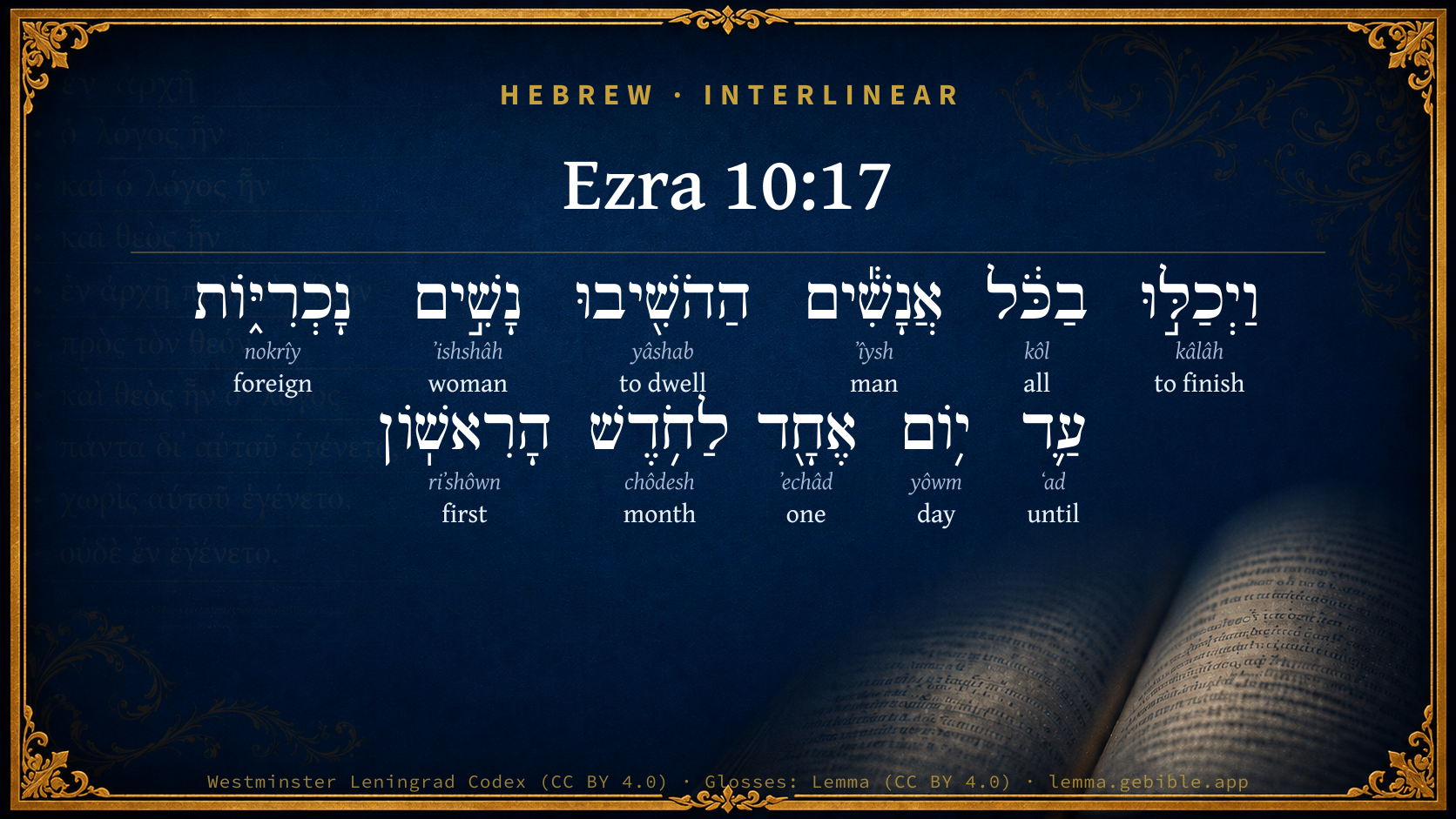
  1. וַיְכַלּ֣וּ kâlâh H3615 “and · to finish” Conjunction + Verb, Piel, Sequential Imperfect, 3rd Person, Masculine, Plural
  2. בַכֹּ֔ל kôl H3605 “in/at the · all” Preposition, Determined + Noun, Common, Masculine, Singular, Absolute
  3. אֲנָשִׁ֕ים ʼîysh H376 “men” Noun, Common, Masculine, Plural, Absolute
  4. הַהֹשִׁ֖יבוּ yâshab H3427 “the · to dwell” Particle, Definite Article + Verb, Hiphil, Perfect, 3rd Person, Common, Plural
  5. נָשִׁ֣ים ʼishshâh H802 “women” Noun, Common, Feminine, Plural, Absolute
  6. עַ֛ד ʻad H5704 “until” Preposition
  7. י֥וֹם yôwm H3117 “day” Noun, Common, Masculine, Singular, Absolute
  8. אֶחָ֖ד ʼechâd H259 “one” Adjective, Cardinal number, Masculine, Singular, Absolute
  9. לַחֹ֥דֶשׁ chôdesh H2320 “to/for the · month” Preposition, Determined + Noun, Common, Masculine, Singular, Absolute
  10. הָרִאשֽׁוֹן riʼshôwn H7223 “the · first” Particle, Definite Article + Adjective, Ordinal number, Masculine, Singular, Absolute

About this verse

These counts appear in no published source. They are computed here, from the morphology-tagged text and Lemma’s own curated glosses. What Lemma adds →

11
words
11
distinct lemmas
Historical
section

Shared distinctive vocabulary

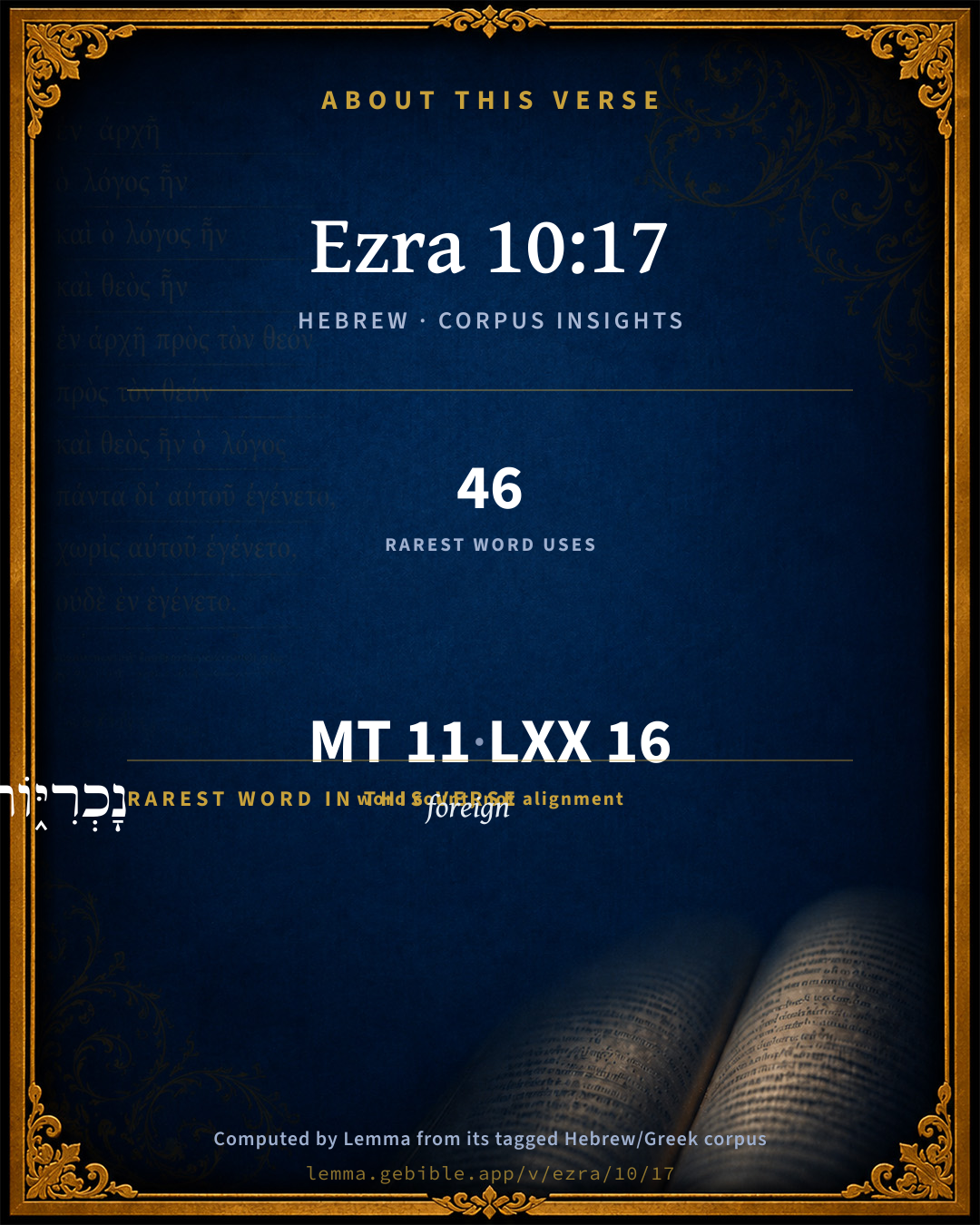
נָכְרִיּ֑וֹת foreign H5237 occurs in 45 verses of the Hebrew Bible. Also found in:

Grammatical profile

  • 2 verbs
  • 5 nouns
  • 3 adjectives
  • 1 preposition

Verb forms

  • וַיְכַלּ֣וּ Piel · Sequential Imperfect
  • הַהֹשִׁ֖יבוּ Hiphil · Perfect

Hebrew & Septuagint length

In English translation the verse runs 21 words from the Hebrew and 22 from the Septuagint (LXX English) — closely comparable.

A rough comparison of the two English renderings, which tokenize alike — not a word-level alignment.

Word counts can differ between the Hebrew and the Greek without any difference in meaning — e.g. the Hebrew direct-object marker אֵת has no separate Greek word, and Greek often adds the article ὁ.

In the original languages it is 11 Hebrew tokens and 16 Greek tokens — but the two are counted differently (Hebrew bundles its prefixes and suffixes into one token; the Greek is in lemma form), so that isn’t a like-for-like length.

Hebrew and Greek witnesses Masoretic Hebrew ↔ Greek Septuagint

The same verse in the two great witnesses to the Old Testament, shown verse-for-verse.

These are two independent witnesses, not word-aligned to each other, and the Septuagint is shown in lemma (dictionary) form.

Hebrew Ezra 10:17 Masoretic · Westminster Leningrad Codex

וַיְכַלּ֣וּ בַכֹּ֔ל אֲנָשִׁ֕ים הַהֹשִׁ֖יבוּ נָשִׁ֣ים נָכְרִיּ֑וֹת עַ֛ד י֥וֹם אֶחָ֖ד לַחֹ֥דֶשׁ הָרִאשֽׁוֹן

They made an end with all the men who had married foreign women by the first day of the first month.

World English Bible · Public Domain

Greek LXX Ezra 10:17 Septuagint · lemma form

καί τελέω ἐν πᾶς ἀνήρ ὅς καταἵζω γυνή ἀλλότριος ἕως ἡμέρα εἷς ὁ μήν ὁ πρῶτος

And they made an end with all the men who had taken strange wives by the first day of the first month.

LXX2012 (modern English Septuagint) · Public Domain

In the Septuagint this is one book — Esdras B (2 Esdras): Ezra is chapters 1–10, Nehemiah 11–23.

Hebrew: Westminster Leningrad Codex (CC BY 4.0). Greek: Septuagint (public domain); English from LXX2012 (modern English Septuagint) (Public Domain). How the Septuagint differs from the Hebrew →

Commentary

Notes on Ezra 10:17 from classic Christian and Jewish commentators (each source and its license shown beneath its notes). The classic Christian expositions comment on the surrounding passage and are grouped to its opening verse, so a note may address several verses; the Jewish commentaries on the Tanakh (Rashi and others) are per-verse, so they appear only where the commentator wrote on this verse.

Lemma curates 59 commentaries, every one of them public domain or Creative Commons licensed, each selected and text-cleaned for this edition rather than reprinted as found. About our sources →

Trapp's Complete Commentary

John Trapp

Ezr 10:17 And they made an end with all the men that had taken strange wives by the first day of the first month.

Ver. 17. By the first day of the first month] So that it was not the work of one day or two, as Ezr 10:13, but of full three months; and yet they were not slothful in that business, but fervent in spirit, serving the Lord. In the work of repentance take time enough, dig deep enough by thorough humiliation; lest the fall of the house be great. The English are not sick soon enough, saith one, and they are well too soon; this is true of their minds, as well as of their bodies.

John Trapp, A Commentary or Exposition upon All the Books of the Old and New Testament (1647–1656) — public domain. Text from a community e-Sword module.

Adam Clarke's Commentary

Verse 17. The first day of the first month] So they were three whole months in examining into this affair, and making those separations which the law required.

Adam Clarke's Commentary on the Bible (1810–1826) — public domain. Text from a community e-Sword/MySword module.

The Cambridge Bible for Schools and Colleges

gen. ed. J. J. S. Perowne

17. And they made an end with all the men, &c.] The Hebrew runs ‘And they made an end with the whole (business), i.e. the men that had, &c.’ The English rendering expresses the meaning. But the wording of the present Hebrew text can hardly be correct, and there is some ground for the conjecture that the words’ the men that had married strange wives ‘found their way into the text from a heading or a marginal gloss.

that had taken strange wives] R.V. that had married strange women.

by the first day of the first month] The investigation had lasted precisely three months. It lasted until the 1st of Nisan, having been continued throughout the months of Tebeth, Shebat (Zec_1:7) and Adar (Ezr_6:15).

The Cambridge Bible for Schools and Colleges (gen. ed. J. J. S. Perowne; Cambridge University Press, 1878–1918) — public domain. Text from a community e-Sword module.

John Gill's Exposition

And they made an end with all the men that had taken strange wives,.... Finished their inquiry and examination of them:

by the first day of the first month; the month Nisan, answering to part of March and April; so that they were three months about this work.

John Gill's Exposition of the Whole Bible (1746–1763) — public domain (CC PDM 1.0). Text via the HelloAO Bible API.

Albert Barnes' Notes on the Bible

The business occupied the commission full two months. In some cases, it may be presumed, they had to summon persons before them who did not wish to part with their foreign wives; in all, they had to assure themselves that the wives were foreign; finally, they had in every case where they decreed a divorce to make out the “writing of divorcement” Ezr 10:3.

Albert Barnes' Notes on the Bible (1834–1885) — public domain. Text from a community e-Sword/MySword module.

Whedon's Commentary on the Bible

Daniel D. Whedon

17. End… first month — So that they were employed three months in the matter.

Daniel D. Whedon (gen. ed.), Commentary on the Old and New Testaments (1874–1909) — public domain. Text from a community e-Sword module.

The Pulpit Commentary

They made an end with all the men. They ran through the whole list of those who were accused of having taken strange wives, and adjudicated on every case, by the first day of the first month, Nisan, corresponding nearly with our April. Deducting Sabbaths, the number of days in the three months would be seventy-five or seventy-six; but it is of course possible that the court did not sit continuously.

The Pulpit Commentary (1880–1919), ed. H.D.M. Spence-Jones & Joseph S. Exell — public domain. Text from a community e-Sword module.

Keil & Delitzsch

C. F. Keil & F. Delitzsch

And they made an end with all, with respect to the men who had brought home strange wives. בּכּל (with the article) cannot be so connected with אנשׁים, from which it is separated by the accentuation of the latter, as to admit of the repetition, as by older expositors, of the preposition בּ before אנשׁים: with all, namely, with the men. Still less can בּכּל, as Bertheau thinks, be taken in the sense of "in every place," and אנשׁים connected as an accusative with ויכלּוּ: they finished in every place the men (!); for כּלּה with an accusative of the person signifies to annihilate, to make an end of, while ב כּלּה means to finish, to make an end with, comp. Gen 44:12. If, as the accentuation requires, we take בּכּל independently, אנשׁים can only be an accusative of more exact definition: in respect of the men (אנשׁים being without the article, because words which define it follow). As this gives a suitable meaning, it seems unnecessary to alter the punctuation and read בּכל־אנשׁים, or with Ewald, 290, c, note 1, to regard אנשׁים בּכּל as a singular combination. - Till the first day of the first month (of the next year), therefore in three months, their sittings having begun, according to Ezr 10:13, on the first day of the tenth month. - The account of this transaction closes with -

The list of the men who had taken strange wives, vv. 18-44; among whom were priests (Ezr 10:18-22), Levites (Ezr 10:23, Ezr 10:24), and Israelites, i.e., laymen (vv. 25-43).

Keil & Delitzsch — Biblical Commentary on the Old Testament (1861–1891) — public domain (CC PDM 1.0). Text via the HelloAO Bible API. (Old Testament only.)

Scofield Reference Notes

C. I. Scofield

first month

i.e. April.

The Scofield Reference Bible (1917 edition), notes by C. I. Scofield — public domain. Text from a community e-Sword module.

Rashi

Rabbi Shlomo Yitzchaki (Rashi)

And they completed everything And they completed the rectification of the matter of the men who had brought in heathen wives, for they cast them out.

of the first month until the first day of Nissan.

Rashi on the Tanakh — English translations: “The Judaica Press complete Tanach with Rashi, translated by A. J. Rosenberg” (CC BY 4.0); “Pentateuch with Rashi's commentary by M. Rosenbaum and A.M. Silbermann, 1929-1934” (public domain); “The Metsudah Tanach series, Lakewood, N.J” (CC BY 4.0); and “The Book of Joshua, Metsudah Publications, 1997” (CC BY 4.0). Text via Sefaria.

Lesson kit

Teaching starters — assembled from the data on this page, not authored interpretation. Every prompt links to the verse data it draws on. Edit before teaching.

Ezra, in the Historical, opens this verse with 11 words (11 distinct Hebrew lemmas). Its most distinctive word is nokrîy (“foreign”). A historical commentator’s framing appears above. Read the whole chapter for the surrounding context.

Discussion questions

  1. What does “foreign” (nokrîy) contribute to the verse as a whole?
  2. How does Genesis 31:15, which shares the word «foreign», read alongside this verse?
  3. The translations on this page render this verse differently — a whole-verse word diff, not a word-by-word alignment. What might account for the different wordings?
  4. «וַיְכַלּ֣וּ» is a Piel Sequential Imperfect verb. How does that grammatical form shape the action described?
  5. Compare how Trapp's Complete Commentary and Adam Clarke's Commentary read this verse. Where do they agree or differ?

Things to notice

Reading settings

Reading text

Shown beneath each verse's original-language words.

Old Testament
Old Testament edition

Read the OT as the Masoretic Hebrew (MT) or the Greek Septuagint (LXX).

English shown for the Greek Septuagint (in the Hebrew ↔ Greek comparison).

Comparing translations? Open the Compare panel on any verse page to stack up to four side by side.