Ruth 2:23

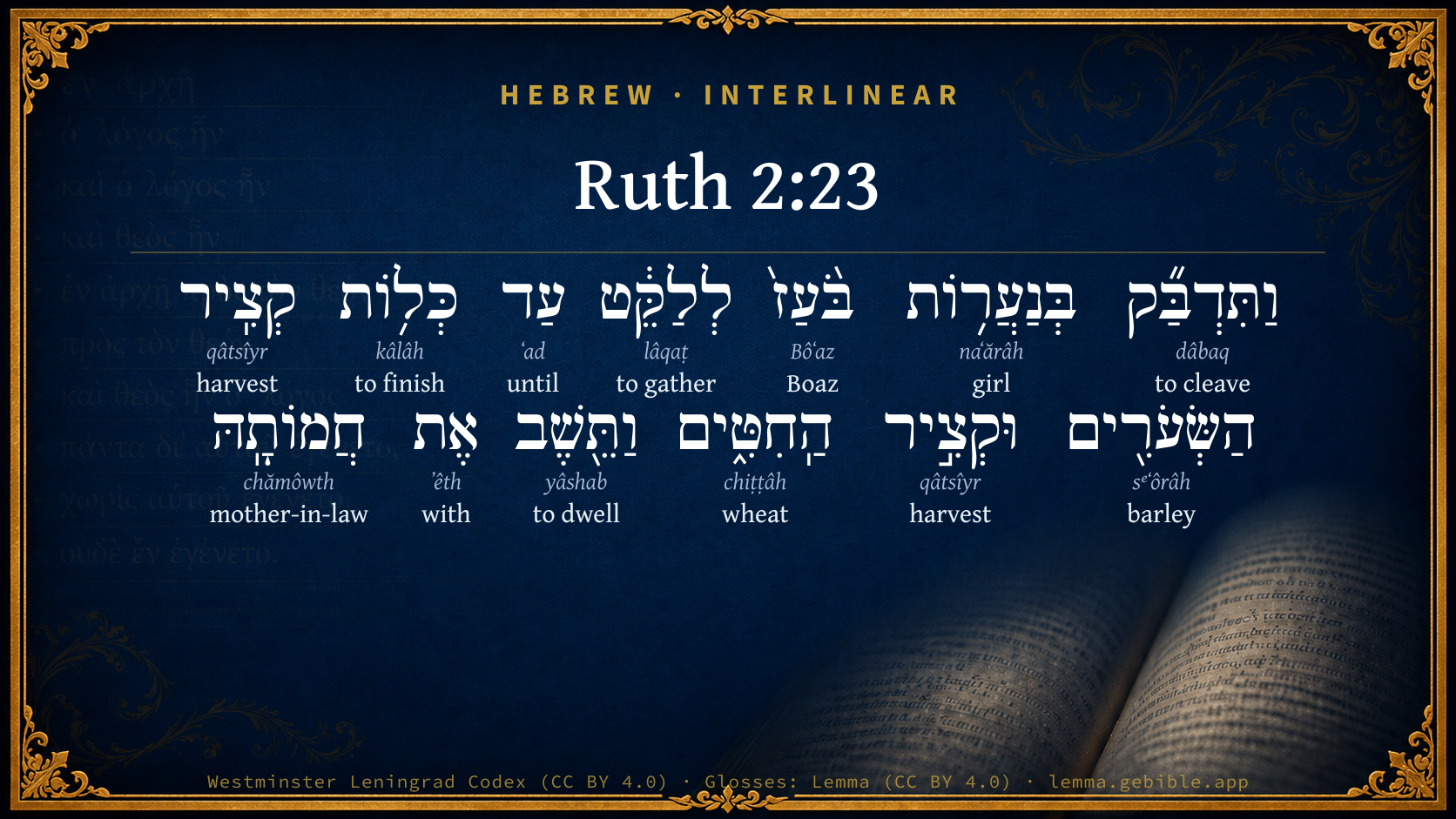
Hebrew (Westminster Leningrad Codex) Ruth 2:23 appears in the Hebrew Old Testament. The text above is from the Westminster Leningrad Codex. Each word links to its Strong’s number, a concise gloss, and parsing drawn from the Open Scriptures Hebrew Bible morphology. Click any word for its full Brown-Driver-Briggs (BDB) entry.
Download image
Cite this verse

Ruth 2:23 (World English Bible). Public Domain. Lemma interlinear Bible study tool, https://lemma.gebible.app/v/ruth/2/23.

Show BibTeX & RIS
BibTeX
RIS
English Translation
So she kept fast by the maidens of Boaz, to glean to the end of barley harvest and of wheat harvest; and she lived with her mother-in-law.
World English Bible · Public Domain
Download a study sheet

One document with this verse’s original text, its word-by-word gloss line, the meaning frame, cross-references with their text, attributed commentary, and full source and license credits — printable, and it pastes into notes with its structure intact.

This verse Autodidact and up

Study sheet (.html) Plain text (.txt)

A passage Seminary Student

Up to 50 verses in one chapter. A passage sheet keeps up to 6 commentary sources and 12 cross-references per verse, in the order this page ranks them, and says so on the sheet whenever that leaves anything out. Ask for a single verse and you get the Autodidact verse sheet above.

Everything on this page stays free to read, with no account — the sheet is a download of what is already on screen, not access to it.

Want to remove ads? Support Godless Engineer
Compare translations 3

The same verse in 3 English versions, stacked beneath the original-language interlinear above. Click any original word for its lexicon entry.

Each is an independent rendering of the whole verse — the interlinear is not word-aligned to these translations.

Highlighted words mark where these versions differ — a whole-verse word diff, not a word-by-word alignment.

  • World English Bible Public Domain
    So she kept fast by the maidens of Boaz, to glean to the end of barley harvest and of wheat harvest; and she lived with her mother-in-law.
  • King James Version Public Domain
    So she kept fast by the maidens of Boaz to glean unto the end of barley harvest and of wheat harvest; and dwelt with her mother in law.
  • unfoldingWord Literal Text CC BY-SA 4.0
    So she stayed close by the young female workers of Boaz to glean until the harvest of barley and the harvest of wheat were finished. And she lived with her mother-in-law.

unfoldingWord Literal Text — © unfoldingWord, licensed CC BY-SA 4.0. Word-aligned USFM3 via Door43 (git.door43.org/unfoldingWord/en_ult).

Versions to compare (up to 4)

3 of 4 selected

Show all 18 translations

Every available English version of this verse, each an independent rendering of the whole verse.

  • World English Bible Public Domain
    So she kept fast by the maidens of Boaz, to glean to the end of barley harvest and of wheat harvest; and she lived with her mother-in-law.
  • Berean Standard Bible Public Domain
    So Ruth stayed close to the servant girls of Boaz to glean grain until the barley and wheat harvests were finished. And she lived with her mother-in-law.
  • Majority Standard Bible Public Domain
    So Ruth stayed close to the servant girls of Boaz to glean grain until the barley and wheat harvests were finished. And she lived with her mother-in-law.
  • King James Version Public Domain
    So she kept fast by the maidens of Boaz to glean unto the end of barley harvest and of wheat harvest; and dwelt with her mother in law.
  • American Standard Version (1901) Public Domain
    So she kept fast by the maidens of Boaz, to glean unto the end of barley harvest and of wheat harvest; and she dwelt with her mother-in-law.
  • Revised Version (1885) Public Domain
    So she kept fast by the maidens of Boaz to glean unto the end of barley harvest and of wheat harvest; and she dwelt with her mother in law.
  • Geneva Bible (1599) Public Domain
    Then she kept her by the maides of Boaz, to gather vnto the end of barly haruest, and of wheate haruest, and dwelt with her mother in lawe.
  • Douay-Rheims (1899) Public Domain
    So she kept close to the maids of Booz: and continued to glean with them, till all the barley and the wheat were laid up in the barns.
  • Young's Literal Translation Public Domain
    And she cleaveth to the young women of Boaz to glean, till the completion of the barley-harvest, and of the wheat-harvest, and she dwelleth with her mother-in-law.
  • Literal Standard Version CC BY-SA 4.0
    And she cleaves to the young women of Boaz to glean, until the completion of the barley-harvest, and of the wheat-harvest, and she dwells with her mother-in-law.
  • Unlocked Literal Bible CC BY-SA 4.0
    So she stayed close to Boaz's female workers in order to glean to the end of the barley harvest and the wheat harvest. She lived with her mother-in-law.
  • unfoldingWord Literal Text CC BY-SA 4.0
    So she stayed close by the young female workers of Boaz to glean until the harvest of barley and the harvest of wheat were finished. And she lived with her mother-in-law.
  • Darby Bible Public Domain
    So she kept with the maidens of Boaz to glean, until the end of the barley-harvest and of the wheat-harvest. And she dwelt with her mother-in-law.
  • World Messianic Bible Public Domain
    So she stayed close to the maidens of Boaz, to glean to the end of barley harvest and of wheat harvest; and she lived with her mother-in-law.
  • Webster's Bible Public Domain
    So she kept fast by the maidens of Boaz to glean to the end of barley-harvest and of wheat-harvest; and dwelt with her mother-in-law.
  • Free Bible Version CC BY-SA 4.0
    So Ruth stayed with Boaz's women workers, picking up grain until the end of the barley harvest, and then on to the end of the wheat harvest. She lived with her mother-in-law the whole time.
  • Bible in Basic English Public Domain
    So she kept near the servant-girls of Boaz to take up the grain till the cutting of the early grain and the cutting of the late grain were ended; and she went on living with her mother-in-law.
  • JPS Tanakh (1917) Public Domain
    So she kept fast by the maidens of Boaz to glean unto the end of barley harvest and of wheat harvest; and she dwelt with her mother-in-law.

Literal Standard Version (2020), Covenant Press — licensed CC BY-SA 4.0. Text via the HelloAO Bible API (eBible.org). Unlocked Literal Bible (unfoldingWord) — licensed CC BY-SA 4.0. Text via the HelloAO Bible API (eBible.org). unfoldingWord Literal Text — © unfoldingWord, licensed CC BY-SA 4.0. Word-aligned USFM3 via Door43 (git.door43.org/unfoldingWord/en_ult). Free Bible Version, Dr. Jonathan Gallagher — licensed CC BY-SA 4.0. Text via the HelloAO Bible API (eBible.org).

Word by word

More ways to search: Search by grammar → Find every occurrence → Compare this word →

Practice this passage: Drill this verse → Learn its vocabulary →

חֲמוֹתָֽהּ
chămôwth
H2545
“mother-in-law · her”
Noun, Common, Feminine, Singular, Construct + Suffix, Personal, 3rd Person, Feminine, Singular
Part of Speech
Noun
Type
Common
Gender
Feminine
Number
Singular
State
Construct
Full BDB Definition

Origin: from H2524

TWOT: 674b

mother-in-law, husband's mother
  1. וַתִּדְבַּ֞ק dâbaq H1692 “and · to cleave” Conjunction + Verb, Qal, Sequential Imperfect, 3rd Person, Feminine, Singular
  2. בְּנַעֲר֥וֹת naʻărâh H5291 “in/at · girls of” Preposition + Noun, Common, Feminine, Plural, Construct
  3. בֹּ֨עַז֙ Bôʻaz H1162 “Boaz” Noun, Proper
  4. לְלַקֵּ֔ט lâqaṭ H3950 “to gather” Preposition + Verb, Piel, Infinitive Construct
  5. עַד ʻad H5704 “until” Preposition
  6. כְּל֥וֹת kâlâh H3615 “to finish” Verb, Qal, Infinitive Construct
  7. קְצִֽיר qâtsîyr H7105 “harvest of” Noun, Common, Masculine, Singular, Construct
  8. הַשְּׂעֹרִ֖ים sᵉʻôrâh H8184 “the · barley” Particle, Definite Article + Noun, Common, Feminine, Plural, Absolute
  9. וּקְצִ֣יר qâtsîyr H7105 “and · harvest of” Conjunction + Noun, Common, Masculine, Singular, Construct
  10. הַֽחִטִּ֑ים chiṭṭâh H2406 “the · wheat” Particle, Definite Article + Noun, Common, Feminine, Plural, Absolute
  11. וַתֵּ֖שֶׁב yâshab H3427 “and · to dwell” Conjunction + Verb, Qal, Sequential Imperfect, 3rd Person, Feminine, Singular
  12. אֶת ʼêth H854 “with” Preposition

About this verse

These counts appear in no published source. They are computed here, from the morphology-tagged text and Lemma’s own curated glosses. What Lemma adds →

13
words
12
distinct lemmas
Historical
section

Notable vocabulary

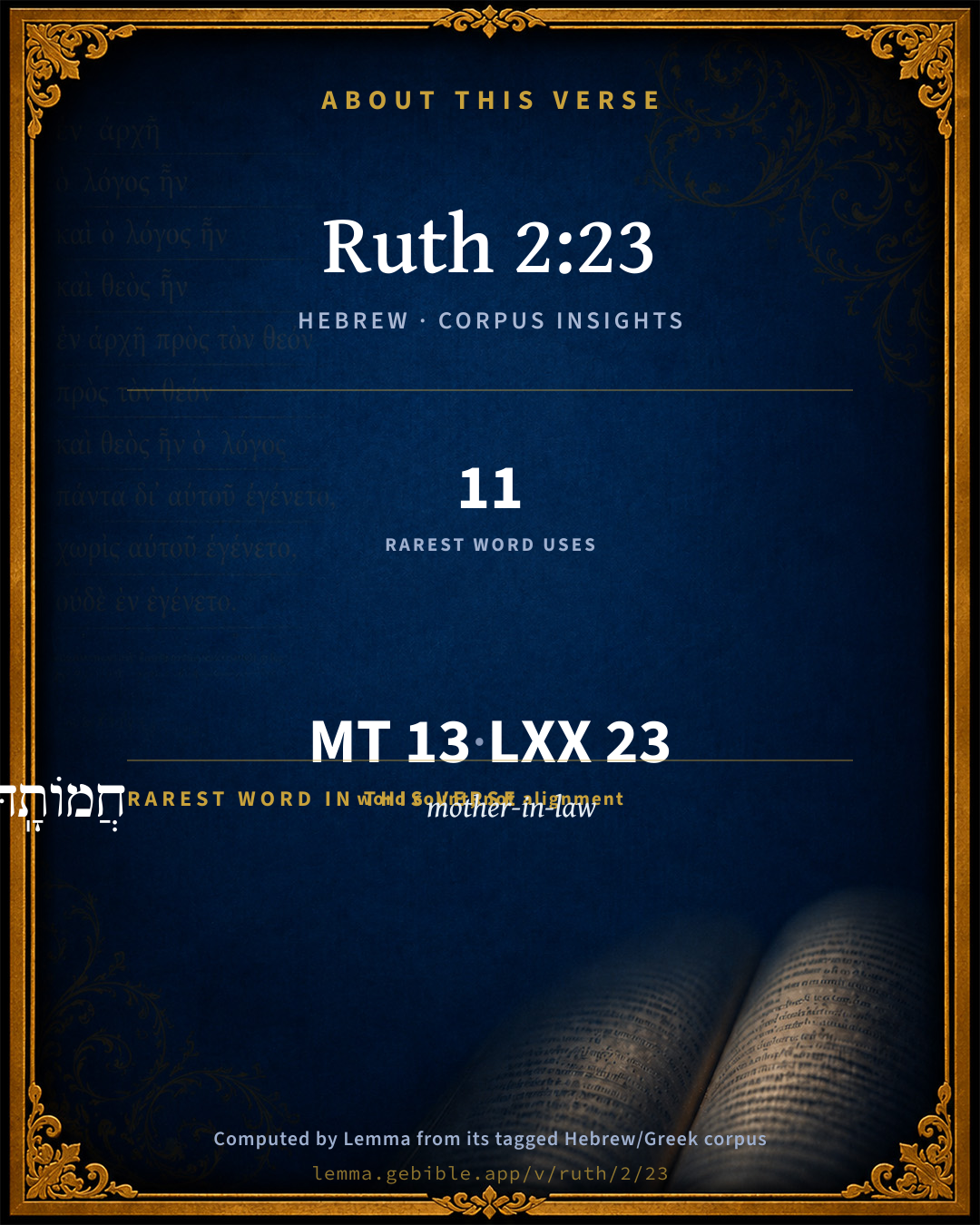
The rarest word here is חֲמוֹתָֽהּ mother-in-law H2545 — appearing just 11 times in the whole Hebrew Bible.

Shared distinctive vocabulary

חֲמוֹתָֽהּ mother-in-law H2545 occurs in 10 verses of the Hebrew Bible. Also found in:

Grammatical profile

  • 4 verbs
  • 7 nouns
  • 2 prepositions

Verb forms

  • וַתִּדְבַּ֞ק Qal · Sequential Imperfect
  • לְלַקֵּ֔ט Piel · Infinitive Construct
  • כְּל֥וֹת Qal · Infinitive Construct
  • וַתֵּ֖שֶׁב Qal · Sequential Imperfect

Repetition

A word recurs within this verse — often emphatic in Hebrew:

  • קְצִֽיר harvest H7105 ×2

Hebrew & Septuagint length

In English translation the verse runs 27 words from the Hebrew and 22 from the Septuagint (LXX English) — closely comparable.

A rough comparison of the two English renderings, which tokenize alike — not a word-level alignment.

Word counts can differ between the Hebrew and the Greek without any difference in meaning — e.g. the Hebrew direct-object marker אֵת has no separate Greek word, and Greek often adds the article ὁ.

In the original languages it is 13 Hebrew tokens and 23 Greek tokens — but the two are counted differently (Hebrew bundles its prefixes and suffixes into one token; the Greek is in lemma form), so that isn’t a like-for-like length.

Cross-references

6

Topical passages linked to Ruth 2:23 in the Treasury of Scripture Knowledge — connected by theme and wording, ordered by reader-vote popularity; previews shown in the World English Bible.

  • Ephesians 6:1–3 Children, obey your parents in the Lord, for this is right.
  • Deuteronomy 16:9 Seven weeks shall you number to you: from the time you begin to put the sickle to the standing grain shall you begin to number seven weeks.
  • Proverbs 6:6–8 Go to the ant, you sluggard. Consider her ways, and be wise;
  • Proverbs 13:1 A wise son listens to his father's instruction, But a scoffer doesn't listen to rebuke.
  • Proverbs 13:20 One who walks with wise men grows wise, But a companion of fools suffers harm.
  • 1 Corinthians 15:33 Don't be deceived! "Evil companionships corrupt good morals."

Cross-references courtesy of OpenBible.info (CC BY 4.0).

Hebrew and Greek witnesses Masoretic Hebrew ↔ Greek Septuagint

The same verse in the two great witnesses to the Old Testament, shown verse-for-verse.

These are two independent witnesses, not word-aligned to each other, and the Septuagint is shown in lemma (dictionary) form.

Hebrew Ruth 2:23 Masoretic · Westminster Leningrad Codex

וַתִּדְבַּ֞ק בְּנַעֲר֥וֹת בֹּ֨עַז֙ לְלַקֵּ֔ט עַד כְּל֥וֹת קְצִֽיר הַשְּׂעֹרִ֖ים וּקְצִ֣יר הַֽחִטִּ֑ים וַתֵּ֖שֶׁב אֶת חֲמוֹתָֽהּ

So she kept fast by the maidens of Boaz, to glean to the end of barley harvest and of wheat harvest; and she lived with her mother-in-law.

World English Bible · Public Domain

Greek LXX Ruth 2:23 Septuagint · lemma form

καί προςκολλάω ρουθ ὁ κοράσιον βοος συνλέγω ἕως ὅς συντελέω ὁ θερισμός ὁ κριθή καί ὁ πυρά καί καταἵζω μετά ὁ πενθερά αὐτός

And Ruth joined herself to the damsels of Booz to glean until they had finished the barley harvest and the wheat harvest.

LXX2012 (modern English Septuagint) · Public Domain

On this verse, Haydock's Catholic Bible Commentary discusses the Septuagint’s reading. Read the note in Commentary ↓

Hebrew: Westminster Leningrad Codex (CC BY 4.0). Greek: Septuagint (public domain); English from LXX2012 (modern English Septuagint) (Public Domain). How the Septuagint differs from the Hebrew →

Commentary

Notes on Ruth 2:23 from classic Christian and Jewish commentators (each source and its license shown beneath its notes). The classic Christian expositions comment on the surrounding passage and are grouped to its opening verse, so a note may address several verses; the Jewish commentaries on the Tanakh (Rashi and others) are per-verse, so they appear only where the commentator wrote on this verse.

Lemma curates 59 commentaries, every one of them public domain or Creative Commons licensed, each selected and text-cleaned for this edition rather than reprinted as found. About our sources →

Trapp's Complete Commentary

John Trapp

Rth 2:23 So she kept fast by the maidens of Boaz to glean unto the end of barley harvest and of wheat harvest; and dwelt with her mother in law.

Ver. 23. So she kept fast.] According to her mother’s counsel, which she esteemed as an oracle.

John Trapp, A Commentary or Exposition upon All the Books of the Old and New Testament (1647–1656) — public domain. Text from a community e-Sword module.

Geneva Bible (1599)

Geneva Bible translators

Or, returned to her mother-in-law.

Geneva Bible (1599) marginal notes — public domain. Text via Bolls.life.

Adam Clarke's Commentary

Verse 23. And of wheat harvest] That is, she was to continue gleaning in the farm of Boaz to the end of the barley harvest; and then, when the wheat harvest began, to continue to its conclusion in the same way. In the interim, as well as each night, she lodged with her mother-in-law.

1. RUTH seems to have been a woman of a very amiable mind: she was modest, and she was industrious, and most probably a comely woman; and all these things served to attract the attention of Boaz, and to engage his affection. Her attachment also to her mother-in-law could not fail to secure his esteem. All these things worked together in the course of Providence, to bring about a matrimonial connection, which in its issue was intimately connected with the salvation of a lost world; for, from this very line, Jesus Christ, according to the flesh, sprang; and Ruth showed herself as worthy to be one of His progenitors as the Virgin Mary was to be His mother. See the notes on Mt 1:1-16

2. We should carefully attend to the leadings and to the workings of God's providence; it is our duty and our interest to do both, for the path of duty is ever the way of safety. Had not Ruth acted thus, how dreary and uncomfortable must her life have been! but she followed God fully, and in a path apparently dangerous, and yet, not only sustained no injury, but succeeded well in all things: from this, as well as from innumerable other circumstances, we see the truth of that word, Acknowledge him in all thy ways, and he will direct thy steps; and with this we may ever connect, Trust in the Lord with thy whole heart, and lean not to thy own understanding. Whosoever follows God in simplicity of heart, will most assuredly be guided into all truth.

Adam Clarke's Commentary on the Bible (1810–1826) — public domain. Text from a community e-Sword/MySword module.

Ellicott's Commentary for English Readers

(23) And dwelt.—Unspoiled by mixing with her new society, she stops on quietly at the end of her task, and tends her mother-in-law at home with the same fidelity with which she had worked for her abroad.

III.

A Bible Commentary for English Readers, edited by Charles John Ellicott (1878–1897) — public domain. Text from a community e-Sword module.

The Cambridge Bible for Schools and Colleges

gen. ed. J. J. S. Perowne

23. wheat harvest] followed two or three weeks later.

she dwelt with] Or, with a slight change, she returned unto; so Vulg.

The Cambridge Bible for Schools and Colleges (gen. ed. J. J. S. Perowne; Cambridge University Press, 1878–1918) — public domain. Text from a community e-Sword module.

John Gill's Exposition

So she kept fast by the maidens of Boaz to glean,.... Accepting the kindness of Boaz, and attending to the advice of her mother-in-law, as well as using all diligence to get a livelihood for her mother and herself; in which she was a wonderful instance of dutiful affection, humility, and industry: and so she continued

unto the end of barley harvest, and of wheat harvest; which latter began at Pentecost, as the former did at the passover; and, according to the Midrash (l), from the beginning of the one, to the end of the other, were three months; though it may be, they were gathered in sooner: indeed from the passover to Pentecost were seven weeks, which was the difference between the beginning of one harvest, and the beginning of the other:

and dwelt with her mother in law; which is to be understood either of her coming home at night, after she had been gleaning all day, and lodging with her mother-in-law, which was her constant custom during both harvests; or that after the harvests were ended, she continued to dwell with her mother-in-law; which seems to be added for the sake of carrying on the history in the following chapter.

(l) Midrash Ruth, fol. 33. so Alshech in loc.

Next: Ruth Chapter 3

John Gill's Exposition of the Whole Bible (1746–1763) — public domain (CC PDM 1.0). Text via the HelloAO Bible API.

Haydock's Catholic Bible Commentary

And the wheat. Hebrew, Syriac and Arabic, "It is good that thou keep close to the maidens of Booz, and continue to glean with them till," &c. This was the advice of Noemi: but Providence ordered that Ruth should be married to Booz before the commencement of the wheat harvest. (Calmet) --- The Protestant agree with the Vulgate and Septuagint. "So she kept fast by, &c., unto the end of the barley harvest, and of the wheat harvest, and dwelt with her mother-in-law." These last words are expressed by the Vulgate in the following chapter. (Haydock).

George Leo Haydock (1774–1849), Haydock's Catholic Family Bible and Commentary, 1859 edition — public domain. Excludes Psalms (Douay-Rheims chapter numbering differs from Protestant) and Deuterocanonical books (Catholic canon only).

Matthew Poole's English Annotations

Heb. sat or continued at home, when she had despatched her occasions abroad, and did not wander or gad abroad, after the manner of idle persons and harlots, Pro 7:11,12.

Matthew Poole's English Annotations on the Holy Bible (1683–1685) — public domain. Text from a community e-Sword/MySword module.

The Pulpit Commentary

And she kept close by Boaz"s young women to glean. Wright translates thus: "And she kept gleaning along with the maidens of Boaz." But the maidens of Boaz are not represented as gleaning. The historical statement of the verse is to be explained from the hortatory statement of ver. 8: "Keep close to my young women." Till the end of the barley-harvest and the wheat-harvest. Ruth"s gleaning labors extended to the close of the wheat-harvest, during which time, no doubt, there would be frequent opportunities for a growing intimacy between the beautiful gleaner and the worthy proprietor. Often too, we may rest assured, would Boaz be a visitor in the humble home of Naomi. "The harvest upon the mountains," says Dr. Robinson, ripens of course later than in the plains of the Jordan and the sea-coast. The barley-harvest precedes the wheat-harvest by a week or fortnight. On the 4th and 5th of June the people of Hebron were just beginning to gather their wheat; on the 11th and 12th the threshing-floors on the Mount of Olives were in full operation. We had already seen the harvest in the same stage of progress on the plains of Gaza on the 19th of May; while at Jericho, on the 12th of May, the threshing-floors had nearly completed their work" ("Biblical Researches," vol. 2. p. 99). "The Syrian harvest," says Dr. W. M. Thomson, ex tends through several months. On the plain of Philistia it commences in April and ends in June; and this not only gives ample time, but it has this great advantage, that the villagers from the mountains can assist the farmers on the plain, since their own crops are not yet ripe. I was struck with this fact while at Mesmia. Several Christians from Bethlehem, who had thus come to reap, spent the evening at my tent, and one of them explained to me the advantages from thus laboring on the plain. He not only, received wages for his own and his wife s labor, but his children were permitted to follow after them and glean on their own account, as Boaz allowed Ruth to do in their native village" ("The Land and the Book," p. 544). When it is said, in the last clause of the verse, and she dwelt with her mother-in-law, the reference is not to be restricted to the time that succeeded the period of harvesting. The Vulgate indeed connects the clause with the following verse, and renders it, "After she returned to her mother-in-law," pointing the verb thus bvTw instead of bvTew. The same translation is given to the verb by Luther and Coverdale. But there is no evidence whatever that Ruth slept anywhere else than under her mother-in-law"s roof. The clause was written, apparently, for the very purpose of bringing out clearly before the mind of the reader her stainless innocence, and sweet simplicity, and never-tiring devotion to her noble mother-in-law.

Harvest-time.

This Book of Ruth is emphatically the book of the husbandman. It pictures the barley-harvest and the wheat-harvest of ancient days. The primitive manners and usages are interesting, and deserve attentive study. But harvest as here so vividly brought before us is full of lessons of a spiritual kind. E.g.

I HARVEST WITNESSES TO THE ATTRIBUTES OF THE DIVINE CREATOR. To his power and wisdom. To his goodness. To his faithfulness to his promise: "Seed-time and harvest shall not cease.

II HARVEST IS A SUMMONS TO MAN"S GRATITUDE AND CONFIDENCE.

III HARVEST IS SUGGESTIVE OF GREAT SPIRITUAL TRUTHS. There is a moral harvest in the history of the human character and of human society. Seed and soil are presumed. Development and growth are evidenced. The law operates: Whatsoever a man soweth, that shall he also reap." The fruit is matured and gathered in. The Husbandman God himself is interested in the result. To us the result is infinitely important. T.

The Pulpit Commentary (1880–1919), ed. H.D.M. Spence-Jones & Joseph S. Exell — public domain. Text from a community e-Sword module.

unfoldingWord translationNotes

Door43 World Missions Community

she stayed close

Ruth worked in Boaz's fields with his workers during the day, so she would be safe.

She lived with her mother-in-law

Ruth went to Naomi's home to sleep at night.

translationWords

Boaz

glean

barley

harvest

wheat

unfoldingWord translationNotes — © Distant Shores Media and the Door43 World Missions Community, licensed CC BY-SA 4.0. Source: git.door43.org/Door43/en_tn.

Ibn Ezra

Rabbi Abraham ibn Ezra

And dwelt with her mother in law. Like, with her mother-in-law.

Ibn Ezra on the Tanakh — English translations: “Sefaria Community Translation” (CC0 1.0 (public-domain dedication)); “Yalkut, Sifsei Chachomim Chumash, Metsudah Publications, 2009” (CC BY 4.0); and “Commentary of Ibn Ezra on Isaiah - trans. by M. Friedlander, 1873” (public domain). Text via Sefaria.

Lesson kit

Teaching starters — assembled from the data on this page, not authored interpretation. Every prompt links to the verse data it draws on. Edit before teaching.

Ruth, in the Historical, opens this verse with 13 words (12 distinct Hebrew lemmas). Its most distinctive word is chămôwth (“mother-in-law”). A historical commentator’s framing appears above. Read the whole chapter for the surrounding context.

Discussion questions

  1. How does “mother-in-law” (chămôwth) shape what this verse is saying?
  2. Ruth 1:14 shares the word «mother-in-law» with this verse. How do the two illuminate each other?
  3. “harvest” occurs 2× in this one verse. What is the effect of the repetition?
  4. The translations on this page render this verse differently — a whole-verse word diff, not a word-by-word alignment. What might account for the different wordings?
  5. The verb «וַתִּדְבַּ֞ק» is Qal Sequential Imperfect. How does its form color the action?
  6. Reading how Trapp's Complete Commentary and Geneva Bible (1599) read this verse, where do the two commentators agree and where do they part?

Things to notice

Reading settings

Reading text

Shown beneath each verse's original-language words.

Old Testament
Old Testament edition

Read the OT as the Masoretic Hebrew (MT) or the Greek Septuagint (LXX).

English shown for the Greek Septuagint (in the Hebrew ↔ Greek comparison).

Comparing translations? Open the Compare panel on any verse page to stack up to four side by side.