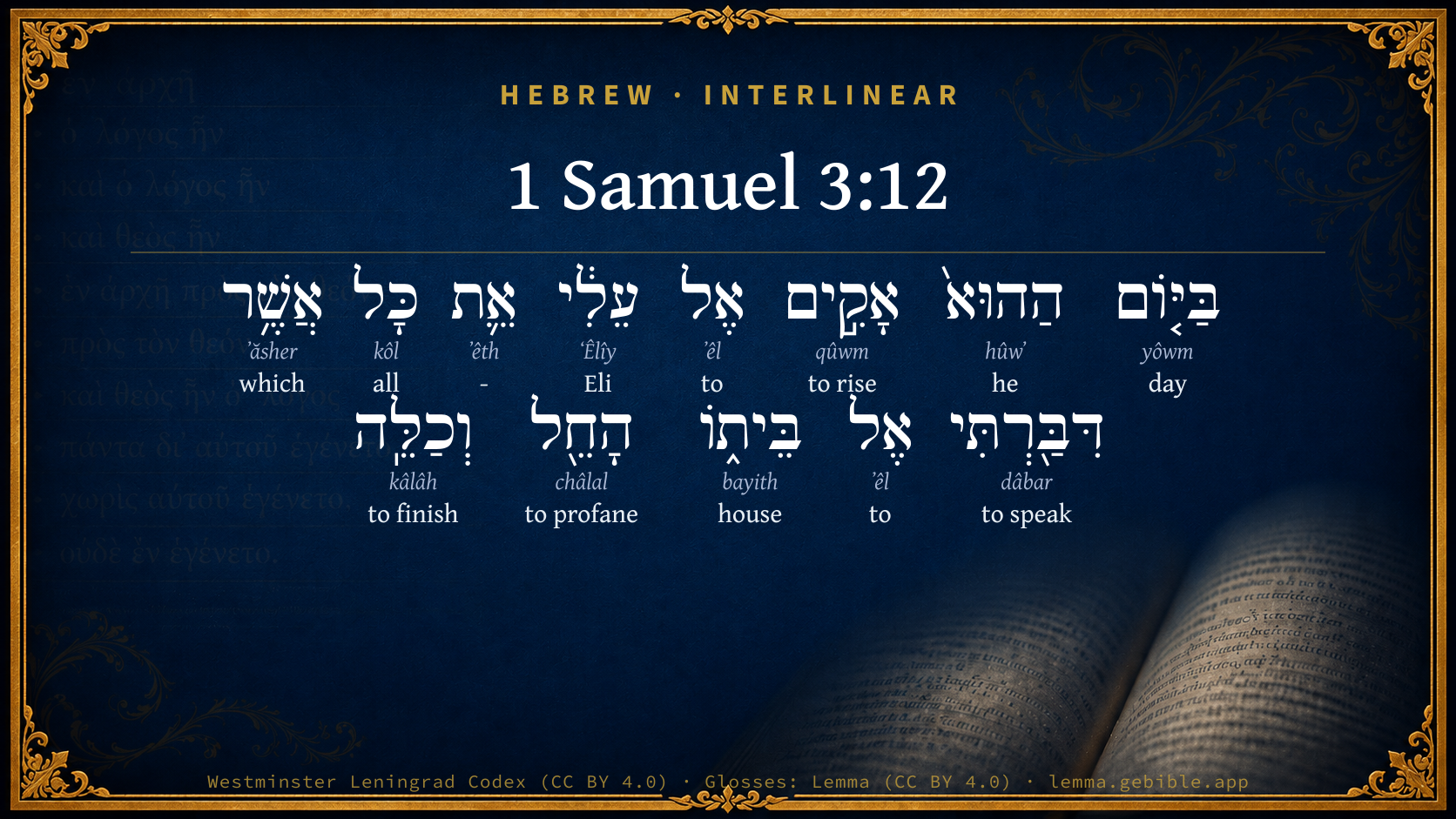
1 Samuel 3:12

Hebrew (Westminster Leningrad Codex) 1 Samuel 3:12 appears in the Hebrew Old Testament. The text above is from the Westminster Leningrad Codex. Each word links to its Strong’s number, a concise gloss, and parsing drawn from the Open Scriptures Hebrew Bible morphology. Click any word for its full Brown-Driver-Briggs (BDB) entry.
Download image
Cite this verse

1 Samuel 3:12 (World English Bible). Public Domain. Lemma interlinear Bible study tool, https://lemma.gebible.app/v/1-samuel/3/12.

Show BibTeX & RIS
BibTeX
RIS
English Translation
In that day I will perform against Eli all that I have spoken concerning his house, from the beginning even to the end.
World English Bible · Public Domain
Download a study sheet

One document with this verse’s original text, its word-by-word gloss line, the meaning frame, cross-references with their text, attributed commentary, and full source and license credits — printable, and it pastes into notes with its structure intact.

This verse Autodidact and up

Study sheet (.html) Plain text (.txt)

A passage Seminary Student

Up to 50 verses in one chapter. A passage sheet keeps up to 6 commentary sources and 12 cross-references per verse, in the order this page ranks them, and says so on the sheet whenever that leaves anything out. Ask for a single verse and you get the Autodidact verse sheet above.

Everything on this page stays free to read, with no account — the sheet is a download of what is already on screen, not access to it.

Want to remove ads? Support Godless Engineer
Compare translations 3

The same verse in 3 English versions, stacked beneath the original-language interlinear above. Click any original word for its lexicon entry.

Each is an independent rendering of the whole verse — the interlinear is not word-aligned to these translations.

Highlighted words mark where these versions differ — a whole-verse word diff, not a word-by-word alignment.

  • World English Bible Public Domain
    In that day I will perform against Eli all that I have spoken concerning his house, from the beginning even to the end.
  • King James Version Public Domain
    In that day I will perform against Eli all things which I have spoken concerning his house: when I begin, I will also make an end.
  • unfoldingWord Literal Text CC BY-SA 4.0
    In that day I will raise up against Eli all of what I have spoken against his house, beginning and ending.

unfoldingWord Literal Text — © unfoldingWord, licensed CC BY-SA 4.0. Word-aligned USFM3 via Door43 (git.door43.org/unfoldingWord/en_ult).

Versions to compare (up to 4)

3 of 4 selected

Show all 18 translations

Every available English version of this verse, each an independent rendering of the whole verse.

  • World English Bible Public Domain
    In that day I will perform against Eli all that I have spoken concerning his house, from the beginning even to the end.
  • Berean Standard Bible Public Domain
    On that day I will carry out against Eli everything I have spoken about his family, from beginning to end.
  • Majority Standard Bible Public Domain
    On that day I will carry out against Eli everything I have spoken about his house, from beginning to end.
  • King James Version Public Domain
    In that day I will perform against Eli all things which I have spoken concerning his house: when I begin, I will also make an end.
  • American Standard Version (1901) Public Domain
    In that day I will perform against Eli all that I have spoken concerning his house, from the beginning even unto the end.
  • Revised Version (1885) Public Domain
    In that day I will perform against Eli all that I have spoken concerning his house, from the beginning even unto the end.
  • Geneva Bible (1599) Public Domain
    In that day I will raise vp against Eli all things which I haue spoken concerning his house: when I begin, I will also make an ende.
  • Douay-Rheims (1899) Public Domain
    In that day I will raise up against Heli all the things I have spoken concerning his house: I will begin, and I will make an end.
  • Young's Literal Translation Public Domain
    In that day I establish unto Eli all that I have spoken unto his house, beginning and completing;
  • Literal Standard Version CC BY-SA 4.0
    In that day I establish to Eli all that I have spoken to his house, beginning and completing;
  • Unlocked Literal Bible CC BY-SA 4.0
    On that day I will carry out against Eli everything I have said about his house, from beginning to end.
  • unfoldingWord Literal Text CC BY-SA 4.0
    In that day I will raise up against Eli all of what I have spoken against his house, beginning and ending.
  • Darby Bible Public Domain
    In that day I will perform against Eli all that I have spoken concerning his house; I will begin and make an end.
  • World Messianic Bible Public Domain
    In that day I will perform against Eli all that I have spoken concerning his house, from the beginning even to the end.
  • Webster's Bible Public Domain
    In that day I will perform against Eli all things which I have spoken concerning his house: when I begin, I will also make an end.
  • Free Bible Version CC BY-SA 4.0
    That's when I will carry out against Eli and his family everything I have said, from beginning to end.
  • Bible in Basic English Public Domain
    In that day I will do to Eli everything which I have said about his family, from first to last.
  • JPS Tanakh (1917) Public Domain
    In that day I will perform against Eli all that I have spoken concerning his house, from the beginning even unto the end.

Literal Standard Version (2020), Covenant Press — licensed CC BY-SA 4.0. Text via the HelloAO Bible API (eBible.org). Unlocked Literal Bible (unfoldingWord) — licensed CC BY-SA 4.0. Text via the HelloAO Bible API (eBible.org). unfoldingWord Literal Text — © unfoldingWord, licensed CC BY-SA 4.0. Word-aligned USFM3 via Door43 (git.door43.org/unfoldingWord/en_ult). Free Bible Version, Dr. Jonathan Gallagher — licensed CC BY-SA 4.0. Text via the HelloAO Bible API (eBible.org).

Word by word

More ways to search: Search by grammar → Find every occurrence → Compare this word →

Practice this passage: Drill this verse → Learn its vocabulary →

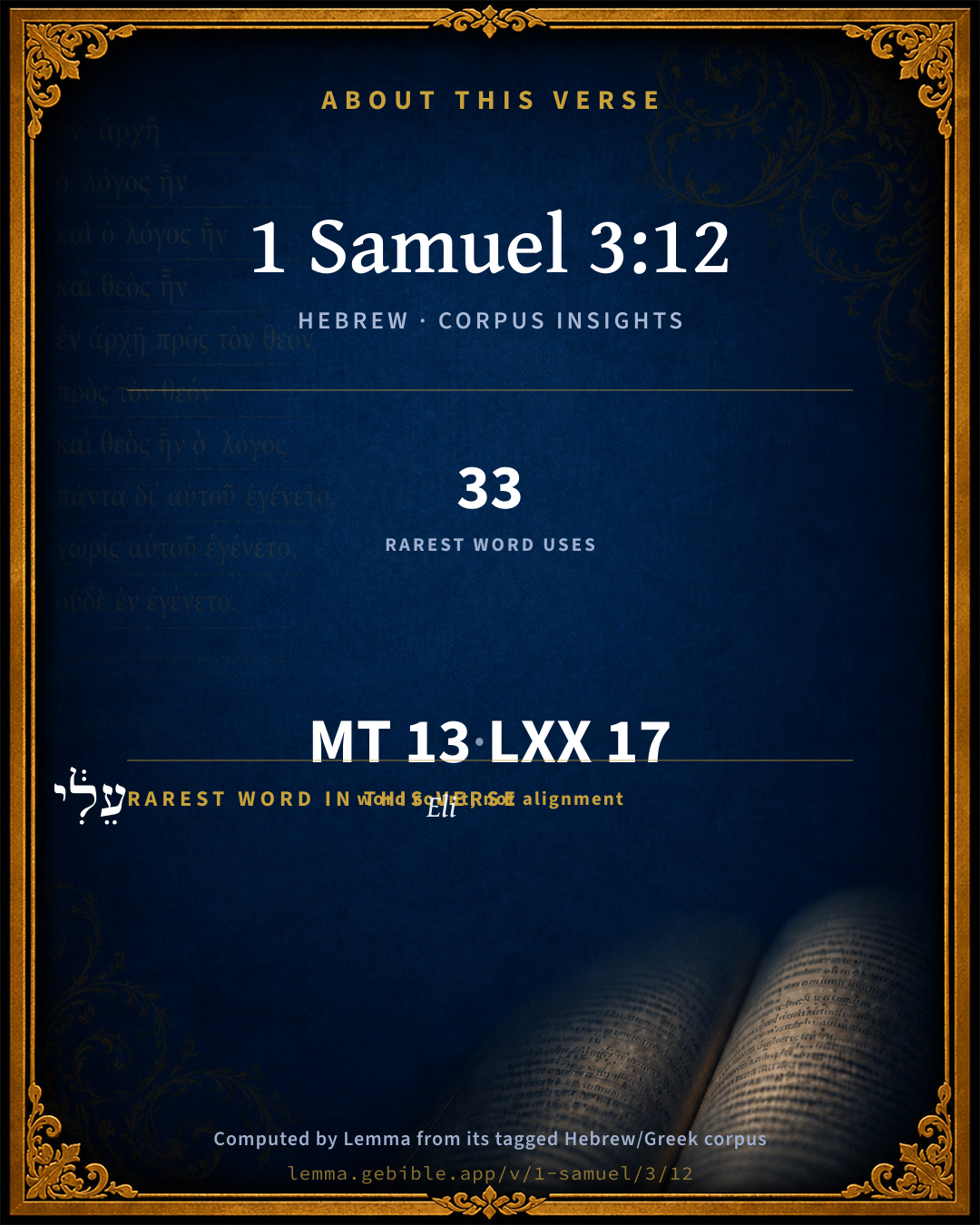
עֵלִ֔י
ʻÊlîy
H5941
“Eli”
Noun, Proper
Part of Speech
Noun
Type
Proper
Full BDB Definition

Origin: from H5927

TWOT: None

Eli = "ascension" - descendant of Aaron through Ithamar and high priest and judge of Israel when Samuel entered service as a child
  1. בַּיּ֤וֹם yôwm H3117 “in/at the · day” Preposition, Determined + Noun, Common, Masculine, Singular, Absolute
  2. הַהוּא֙ hûwʼ H1931 “the · he” Particle, Definite Article + Pronoun, Personal, 3rd Person, Masculine, Singular
  3. אָקִ֣ים qûwm H6965 “to rise” Verb, Hiphil, Imperfect, 1st Person, Common, Singular
  4. אֶל ʼêl H413 “to” Preposition
  5. אֵ֛ת ʼêth H853 “-” Particle, Direct Object
  6. כָּל kôl H3605 “all of” Noun, Common, Masculine, Singular, Construct
  7. אֲשֶׁ֥ר ʼăsher H834 “which” Particle, Relative
  8. דִּבַּ֖רְתִּי dâbar H1696 “to speak” Verb, Piel, Perfect, 1st Person, Common, Singular
  9. אֶל ʼêl H413 “to” Preposition
  10. בֵּית֑וֹ bayith H1004 “house · his” Noun, Common, Masculine, Singular, Construct + Suffix, Personal, 3rd Person, Masculine, Singular
  11. הָחֵ֖ל châlal H2490 “to profane” Verb, Hiphil, Infinitive Absolute
  12. וְכַלֵּֽה kâlâh H3615 “and · to finish” Conjunction + Verb, Piel, Infinitive Absolute

About this verse

These counts appear in no published source. They are computed here, from the morphology-tagged text and Lemma’s own curated glosses. What Lemma adds →

13
words
12
distinct lemmas
Historical
section

Shared distinctive vocabulary

עֵלִ֔י Eli H5941 occurs in 30 verses of the Hebrew Bible. Also found in:

Grammatical profile

  • 4 verbs
  • 4 nouns
  • 1 pronoun
  • 2 prepositions
  • 2 particles

Verb forms

  • אָקִ֣ים Hiphil · Imperfect
  • דִּבַּ֖רְתִּי Piel · Perfect
  • הָחֵ֖ל Hiphil · Infinitive Absolute
  • וְכַלֵּֽה Piel · Infinitive Absolute

Repetition

A word recurs within this verse — often emphatic in Hebrew:

  • אֶל to H413 ×2

Hebrew & Septuagint length

In English translation the verse runs 23 words from the Hebrew and 27 from the Septuagint (LXX English) — closely comparable.

A rough comparison of the two English renderings, which tokenize alike — not a word-level alignment.

Word counts can differ between the Hebrew and the Greek without any difference in meaning — e.g. the Hebrew direct-object marker אֵת has no separate Greek word, and Greek often adds the article ὁ.

In the original languages it is 13 Hebrew tokens and 17 Greek tokens — but the two are counted differently (Hebrew bundles its prefixes and suffixes into one token; the Greek is in lemma form), so that isn’t a like-for-like length.

Cross-references

5

Topical passages linked to 1 Samuel 3:12 in the Treasury of Scripture Knowledge — connected by theme and wording, ordered by reader-vote popularity; previews shown in the World English Bible.

  • 1 Samuel 2:27–36 There came a man of God to Eli, and said to him, Thus says Yahweh, Did I reveal myself to the house of your father, when they were in Egypt [in bondage] to Pharaoh's house?
  • Numbers 23:19 God is not a man, that he should lie, Neither the son of man, that he should repent: Has he said, and will he not do it? Or has he spoken, and will he not make it good?
  • Joshua 23:15 It shall happen, that as all the good things are come on you of which Yahweh your God spoke to you, so will Yahweh bring on you all the evil things, until he have destroyed you from off this good land which Yahweh your God has given you.
  • Zechariah 1:6 But my words and my decrees, which I commanded my servants the prophets, didn't they overtake your fathers? "Then they repented and said, 'Just as Yahweh of Hosts determined to do to us, according to our ways, and according to our practices, so he has dealt with us.'"
  • Luke 21:33 Heaven and earth will pass away, but my words will by no means pass away.

Cross-references courtesy of OpenBible.info (CC BY 4.0).

Hebrew and Greek witnesses Masoretic Hebrew ↔ Greek Septuagint

The same verse in the two great witnesses to the Old Testament, shown verse-for-verse.

These are two independent witnesses, not word-aligned to each other, and the Septuagint is shown in lemma (dictionary) form.

Hebrew 1 Samuel 3:12 Masoretic · Westminster Leningrad Codex

בַּיּ֤וֹם הַהוּא֙ אָקִ֣ים אֶל עֵלִ֔י אֵ֛ת כָּל אֲשֶׁ֥ר דִּבַּ֖רְתִּי אֶל בֵּית֑וֹ הָחֵ֖ל וְכַלֵּֽה

In that day I will perform against Eli all that I have spoken concerning his house, from the beginning even to the end.

World English Bible · Public Domain

Greek LXX 1 Samuel 3:12 Septuagint · lemma form

ἐν ὁ ἡμέρα ἐκεῖνος ἐπιἐγείρω ἐπί ηλι πᾶς ὅσος λαλέω εἰς ὁ οἶκος αὐτός ἄρχω καί ἐπιτελέω

In that day I will raise up against Heli all things that I have said against his house; I will begin, and I will make an end.

LXX2012 (modern English Septuagint) · Public Domain

Hebrew: Westminster Leningrad Codex (CC BY 4.0). Greek: Septuagint (public domain); English from LXX2012 (modern English Septuagint) (Public Domain). How the Septuagint differs from the Hebrew →

Targum (Aramaic paraphrase)

1

The Targum is the ancient Jewish Aramaic paraphrase of the Hebrew Scriptures — an interpretive translation, not the Hebrew text itself. Onkelos (literal) and Pseudo-Jonathan (expansive) render the Torah, and Jonathan the Prophets. Coverage is partial: where no permissively-licensed English translation exists for a verse, only the Aramaic is shown. This is verse-level text, not a word-by-word alignment to the Hebrew.

  1. Targum Jonathan Prophets (Joshua–Malachi)
    בְּיוֹמָא הַהוּא אֲקַיֵם עַל עֵלִי יַת כָּל דִי מַלֵלִית עַל בֵּיתֵיהּ אֱגַמֵר וְאֵישֵׁיצֵי:

    (no public-domain English translation for this verse)

    Targum Jonathan — Aramaic: “Mikraot Gedolot” (public domain). English: “Sefaria Community Translation” (CC0 1.0 (public-domain dedication)); “London "Chaldee Paraphrase," 1871” (public domain). Text via Sefaria.

Commentary

Notes on 1 Samuel 3:12 from classic Christian and Jewish commentators (each source and its license shown beneath its notes). The classic Christian expositions comment on the surrounding passage and are grouped to its opening verse, so a note may address several verses; the Jewish commentaries on the Tanakh (Rashi and others) are per-verse, so they appear only where the commentator wrote on this verse.

Lemma curates 59 commentaries, every one of them public domain or Creative Commons licensed, each selected and text-cleaned for this edition rather than reprinted as found. About our sources →

Trapp's Complete Commentary

John Trapp

1Sa 3:12 In that day I will perform against Eli all [things] which I have spoken concerning his house: when I begin, I will also make an end.

Ver. 12. When I begin, I will also make an end.] Praestabo reipsa quod verbis minitor. Execution of justice is God’s work, though his strange work, {Isa 28:21} and when be once beginneth, he will go thorough stitch with it: he will neither dally nor desist till it be done.

John Trapp, A Commentary or Exposition upon All the Books of the Old and New Testament (1647–1656) — public domain. Text from a community e-Sword module.

Joseph Benson's Commentary

1Sa 3:12. In that day I will perform against Eli, &c. — In that time which I have appointed for this work, which was about twenty or thirty years after this threatening. So long space of repentance God allows to this wicked generation. When I begin, &c. — Though this vengeance shall be delayed for a season, to manifest my patience, and incite them to repentance; yet when once I begin to inflict, I shall not desist till I have made a full end; or, have fully accomplished all my threatenings, which was done in the death of Eli and his sons; and the slaughter of eighty-five priests of this family by Doeg, and the thrusting Abiathar, who escaped that slaughter, out of his office, and so depriving that family of its dignity and honour.

Joseph Benson's Commentary on the Old and New Testaments (1811–1818) — public domain. Text from a community e-Sword module.

Tyndale Open Study Notes

Tyndale Open Resources

3:12 my threats: See 2:27-36.

Tyndale Open Study Notes — © Tyndale Open Resources, licensed CC BY-SA 4.0. Text via the HelloAO Bible API.

Adam Clarke's Commentary

Verse 12. I will perform - all things which I have spoken] That is, what He had declared by the prophet, whose message is related 1Sa 2:27, &c.

When I begin, I will also make an end.] I will not delay the execution of my purpose: when I begin, nothing shall deter me from bringing all my judgments to a conclusion.

Adam Clarke's Commentary on the Bible (1810–1826) — public domain. Text from a community e-Sword/MySword module.

The Cambridge Bible for Schools and Colleges

gen. ed. J. J. S. Perowne

12. all things which I have spoken] See ch. 1Sa_2:27-36.

when I begin, I will also make an end] Literally, ‘beginning and ending,’ i.e. from beginning to end, fully and completely.

The Cambridge Bible for Schools and Colleges (gen. ed. J. J. S. Perowne; Cambridge University Press, 1878–1918) — public domain. Text from a community e-Sword module.

John Gill's Exposition

In that day I will perform against Eli all things which I have spoken concerning his house,.... Or family, that is, by the man of God, Sa1 2:27 as that he would cut off the strength of it, that there should not be an old man in it; and such as remained should be reduced to the utmost poverty and meanness; this shows that that prophecy was antecedent to this, contrary to the sense of some:

when I begin, I will also make an end; not immediately, and at once, but by degrees; he began in the death of Hophni and Phinehas, and went on in the slaughter of Abimelech, and the eighty five priests at Nob, in the times of Saul, and finished in the thrusting out of Abiathar from the priesthood, in the times of Solomon, whereby that family was brought to disgrace and poverty.

John Gill's Exposition of the Whole Bible (1746–1763) — public domain (CC PDM 1.0). Text via the HelloAO Bible API.

Albert Barnes' Notes on the Bible

When I begin ... - literally, as in the margin: meaning, I will go through with the performance from first to last.

Albert Barnes' Notes on the Bible (1834–1885) — public domain. Text from a community e-Sword/MySword module.

Haydock's Catholic Bible Commentary

House, by the prophet, chap. ii. 27.

George Leo Haydock (1774–1849), Haydock's Catholic Family Bible and Commentary, 1859 edition — public domain. Excludes Psalms (Douay-Rheims chapter numbering differs from Protestant) and Deuterocanonical books (Catholic canon only).

Matthew Poole's English Annotations

In that day; in that time which I have appointed for this work, which was about twenty or thirty years after this threatening. So long space of repentance God allows to this wicked generation to make their peace with God, and prevent the execution, as others did in like cases.

All things which I have spoken, by that prophet, 1Sa 2:27.

When I begin, I will also make an end; though this vengeance may and shall be delayed for a season, to manifest my patience, and incite them to repentance; yet when once I begin to inflict, I shall certainly go on with it, and not desist till I have made a full end.

Matthew Poole's English Annotations on the Holy Bible (1683–1685) — public domain. Text from a community e-Sword/MySword module.

Whedon's Commentary on the Bible

Daniel D. Whedon

12. All… I have spoken — In the message recorded 1Sa_2:27-36.

Begin… make an end — That is, commencing and finishing all. I will execute what I have spoken against Eli’s house completely — from beginning to end.

Daniel D. Whedon (gen. ed.), Commentary on the Old and New Testaments (1874–1909) — public domain. Text from a community e-Sword module.

The Pulpit Commentary

I will perform. Literally, "I will raise up," i.e. I will excite and stir up into active energy all the denunciations of the man of God, (1Sa_2:27) which hitherto have been as it were asleep and at rest. All things which. Better, quite literally, all that I have spoken. When I begin, I will also make an end. In the Hebrew two infinitives used as gerunds, "beginning and ending," i.e. from beginning to end. The Hebrew language constantly thus uses infinitives with great force; as, for instance, in Jer_7:9: "What! stealing, murdering, committing adultery," etc.

The Pulpit Commentary (1880–1919), ed. H.D.M. Spence-Jones & Joseph S. Exell — public domain. Text from a community e-Sword module.

John Wesley's Explanatory Notes

In that day - In that time which I have appointed for this work, which was about twenty or thirty years after this threatning. So long space of repentance God allows to this wicked generation. When I begin, &c. - Tho' this vengeance shall be delayed for a season, to manifest my patience, and incite them to repentance; yet when once I begin to inflict, I shall not desist 'till I have made a full end.

John Wesley, Explanatory Notes Upon the Whole Bible (1754–1765) — public domain. Text via the GEBible commentary corpus.

Keil & Delitzsch

C. F. Keil & F. Delitzsch

On that day I will perform against Eli all that I have spoken concerning his house (see Sa1 2:30.), beginning and finishing it," i.e., completely. דּבּר את־אשׁר הקים, to set up the word spoken, i.e., to carry it out, or accomplish it. In Sa1 3:13 this word is communicated to Samuel, so far as its essential contents are concerned. God would judge "the house of Eli for ever because of the iniquity, that he knew his sons were preparing a curse for themselves and did not prevent them." To judge on account of a crime, is the same as to punish it. עד־עולם, i.e., without the punishment being ever stopped or removed. להם מקללים, cursing themselves, i.e., bringing a curse upon themselves. "Therefore I have sworn to the house of Eli, that the iniquity of the house of Eli shall not (אם, a particle used in an oath, equivalent to assuredly not) be expiated by slain-offerings and meat-offerings (through any kind of sacrifice) for ever." The oath makes the sentence irrevocable. (On the facts themselves, see the commentary on Sa1 2:27-36.)

Keil & Delitzsch — Biblical Commentary on the Old Testament (1861–1891) — public domain (CC PDM 1.0). Text via the HelloAO Bible API. (Old Testament only.)

unfoldingWord translationNotes

Door43 World Missions Community

from beginning to end

This is a merism for completeness. AT: "absolutely everything" (See: Merism)

brought a curse upon themselves

"did those things which Yahweh had said he would punish those who did them"

the sins of his house will never be atoned for by sacrifice or offering

This can be translated in active form. AT: "there is no sacrifice or offering that anyone can offer that will atone for the sins of his house" (See: Active or Passive)

the sins of his house

"the sins that the people in his family have committed"

translationWords

house

judge

sin

curse

oath

atonement

sacrifice

unfoldingWord translationNotes — © Distant Shores Media and the Door43 World Missions Community, licensed CC BY-SA 4.0. Source: git.door43.org/Door43/en_tn.

Rashi

Rabbi Shlomo Yitzchaki (Rashi)

I will begin to destroy. On that day, My decree upon Eili's family will begin, for Chofni and Pinchas shall die, and from then on, I shall finish my decree and complete it upon them from generation to generation, and cause them to die as young men at the age of eighteen years.

I will begin to destroy. Commencant e espleiant, in O. F.

Rashi on the Tanakh — English translations: “The Judaica Press complete Tanach with Rashi, translated by A. J. Rosenberg” (CC BY 4.0); “Pentateuch with Rashi's commentary by M. Rosenbaum and A.M. Silbermann, 1929-1934” (public domain); “The Metsudah Tanach series, Lakewood, N.J” (CC BY 4.0); and “The Book of Joshua, Metsudah Publications, 1997” (CC BY 4.0). Text via Sefaria.

Lesson kit

Teaching starters — assembled from the data on this page, not authored interpretation. Every prompt links to the verse data it draws on. Edit before teaching.

1 Samuel, in the Historical, opens this verse with 13 words (12 distinct Hebrew lemmas). Its most distinctive word is ʻÊlîy (“Eli”). A historical commentator’s framing appears above. Read the whole chapter for the surrounding context.

Discussion questions

  1. What does “Eli” (ʻÊlîy) contribute to the verse as a whole?
  2. 1 Samuel 1:3 shares the word «Eli» with this verse. How do the two illuminate each other?
  3. “to” occurs 2× in this one verse. What is the effect of the repetition?
  4. These translations render this verse differently; the difference is in the English rendering, not the original. What questions does that raise?
  5. The verb «אָקִ֣ים» is Hiphil Imperfect. How does its form color the action?
  6. Reading how Trapp's Complete Commentary and Joseph Benson's Commentary read this verse, where do the two commentators agree and where do they part?

Things to notice

Reading settings

Reading text

Shown beneath each verse's original-language words.

Old Testament
Old Testament edition

Read the OT as the Masoretic Hebrew (MT) or the Greek Septuagint (LXX).

English shown for the Greek Septuagint (in the Hebrew ↔ Greek comparison).

Comparing translations? Open the Compare panel on any verse page to stack up to four side by side.