Ezekiel 4:8

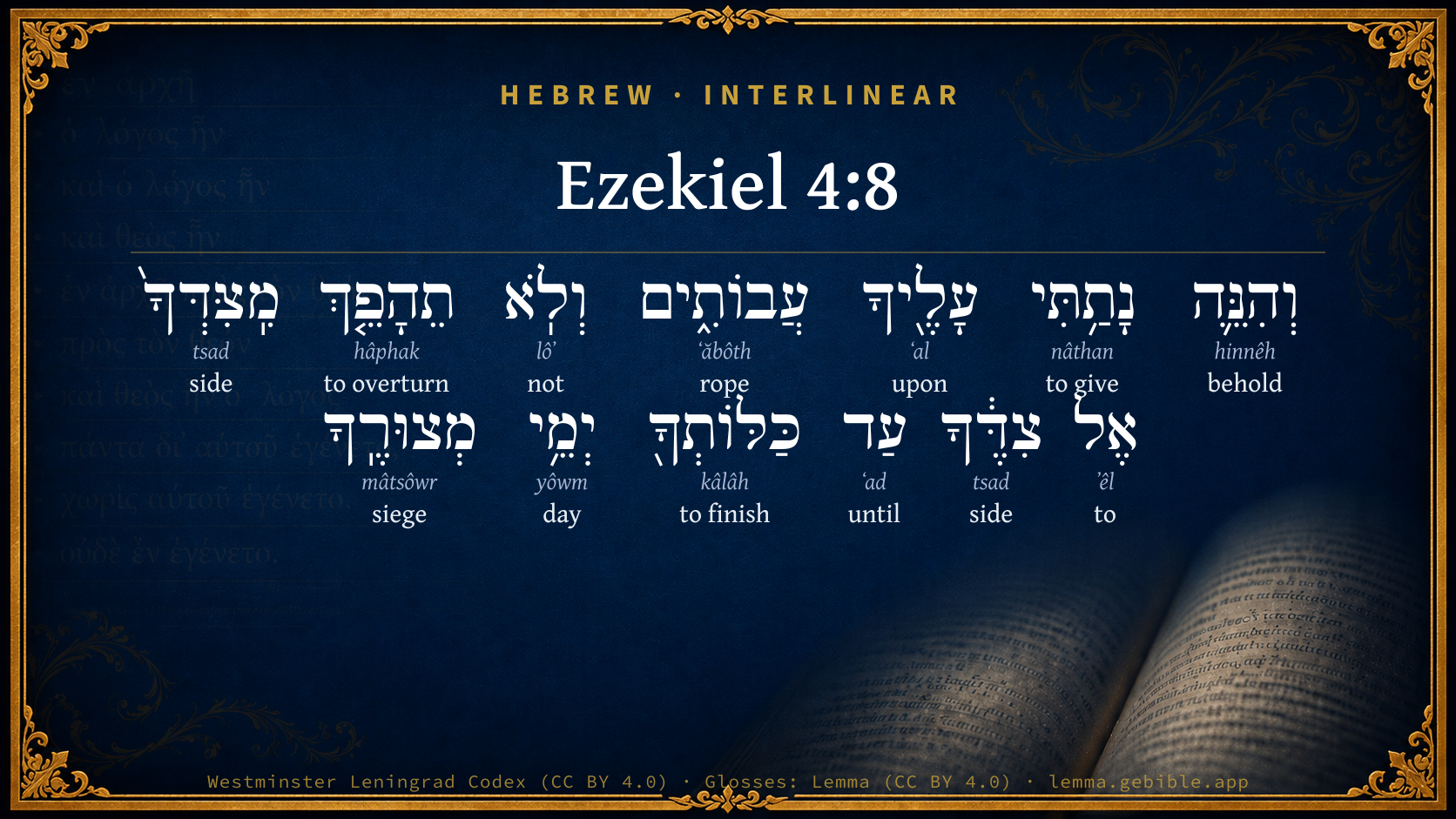
Hebrew (Westminster Leningrad Codex) Ezekiel 4:8 appears in the Hebrew Old Testament. The text above is from the Westminster Leningrad Codex. Each word links to its Strong’s number, a concise gloss, and parsing drawn from the Open Scriptures Hebrew Bible morphology. Click any word for its full Brown-Driver-Briggs (BDB) entry.
Download image
Cite this verse

Ezekiel 4:8 (World English Bible). Public Domain. Lemma interlinear Bible study tool, https://lemma.gebible.app/v/ezekiel/4/8.

Show BibTeX & RIS
BibTeX
RIS
English Translation
Behold, I lay bands on you, and you shall not turn you from one side to the other, until you have accomplished the days of your siege.
World English Bible · Public Domain
Download a study sheet

One document with this verse’s original text, its word-by-word gloss line, the meaning frame, cross-references with their text, attributed commentary, and full source and license credits — printable, and it pastes into notes with its structure intact.

This verse Autodidact and up

Study sheet (.html) Plain text (.txt)

A passage Seminary Student

Up to 50 verses in one chapter. A passage sheet keeps up to 6 commentary sources and 12 cross-references per verse, in the order this page ranks them, and says so on the sheet whenever that leaves anything out. Ask for a single verse and you get the Autodidact verse sheet above.

Everything on this page stays free to read, with no account — the sheet is a download of what is already on screen, not access to it.

Want to remove ads? Support Godless Engineer
Compare translations 3

The same verse in 3 English versions, stacked beneath the original-language interlinear above. Click any original word for its lexicon entry.

Each is an independent rendering of the whole verse — the interlinear is not word-aligned to these translations.

Highlighted words mark where these versions differ — a whole-verse word diff, not a word-by-word alignment.

  • World English Bible Public Domain
    Behold, I lay bands on you, and you shall not turn you from one side to the other, until you have accomplished the days of your siege.
  • King James Version Public Domain
    And, behold, I will lay bands upon thee, and thou shalt not turn thee from one side to another, till thou hast ended the days of thy siege.
  • unfoldingWord Literal Text CC BY-SA 4.0
    For behold! I am placing bonds on you so you will not turn from one side to the other until you have completed the days of your siege.

unfoldingWord Literal Text — © unfoldingWord, licensed CC BY-SA 4.0. Word-aligned USFM3 via Door43 (git.door43.org/unfoldingWord/en_ult).

Versions to compare (up to 4)

3 of 4 selected

Show all 18 translations

Every available English version of this verse, each an independent rendering of the whole verse.

  • World English Bible Public Domain
    Behold, I lay bands on you, and you shall not turn you from one side to the other, until you have accomplished the days of your siege.
  • Berean Standard Bible Public Domain
    Now behold, I will tie you up with ropes so you cannot turn from side to side until you have finished the days of your siege.
  • Majority Standard Bible Public Domain
    Now behold, I will tie you up with ropes so you cannot turn from side to side until you have finished the days of your siege.
  • King James Version Public Domain
    And, behold, I will lay bands upon thee, and thou shalt not turn thee from one side to another, till thou hast ended the days of thy siege.
  • American Standard Version (1901) Public Domain
    And, behold, I lay bands upon thee, and thou shalt not turn thee from one side to the other, till thou hast accomplished the days of thy siege.
  • Revised Version (1885) Public Domain
    And, behold, I lay bands upon thee, and thou shalt not turn thee from one side to another, till thou hast accomplished the days of thy siege.
  • Geneva Bible (1599) Public Domain
    And beholde, I will lay bands vpon thee, and thou shalt not turne thee from one side to another, till thou hast ended the dayes of thy siege.
  • Douay-Rheims (1899) Public Domain
    Behold I have encompassed thee with bands: and thou shalt not turn thyself from one side to the other, till thou hast ended the days of thy siege.
  • Young's Literal Translation Public Domain
    And lo, I have put on thee thick bands, and thou dost not turn from side to side till thy completing the days of thy siege.
  • Literal Standard Version CC BY-SA 4.0
    And behold, I have put thick bands on you, and you do not turn from side to side until your completing the days of your siege.
  • Unlocked Literal Bible CC BY-SA 4.0
    For behold! I am placing bonds on you so you will not turn from one side to the other until you have completed the days of your siege.
  • unfoldingWord Literal Text CC BY-SA 4.0
    For behold! I am placing bonds on you so you will not turn from one side to the other until you have completed the days of your siege.
  • Darby Bible Public Domain
    And behold, I lay bands upon thee, and thou shalt not turn thyself from one side to the other, till thou hast ended the days of thy siege.
  • World Messianic Bible Public Domain
    Behold, I put ropes on you, and you shall not turn yourself from one side to the other, until you have accomplished the days of your siege.
  • Webster's Bible Public Domain
    And behold, I will lay bands upon thee, and thou shalt not turn thee from one side to another, till thou hast ended the days of thy siege.
  • Free Bible Version CC BY-SA 4.0
    Be ready, because now I'm going to tie you up with ropes so you can't move from side to side until the days of your siege are over.
  • Bible in Basic English Public Domain
    And see, I will put bands on you; and you will be stretched out without turning from one side to the other till the days of your attack are ended.
  • JPS Tanakh (1917) Public Domain
    And, behold, I lay bands upon thee, and thou shalt not turn thee from one side to another, till thou hast accomplished the days of thy siege.

Literal Standard Version (2020), Covenant Press — licensed CC BY-SA 4.0. Text via the HelloAO Bible API (eBible.org). Unlocked Literal Bible (unfoldingWord) — licensed CC BY-SA 4.0. Text via the HelloAO Bible API (eBible.org). unfoldingWord Literal Text — © unfoldingWord, licensed CC BY-SA 4.0. Word-aligned USFM3 via Door43 (git.door43.org/unfoldingWord/en_ult). Free Bible Version, Dr. Jonathan Gallagher — licensed CC BY-SA 4.0. Text via the HelloAO Bible API (eBible.org).

Word by word

More ways to search: Search by grammar → Find every occurrence → Compare this word →

Practice this passage: Drill this verse → Learn its vocabulary →

עֲבוֹתִ֑ים
ʻăbôth
H5688
“ropes”
Noun, Common, Both, Plural, Absolute
Part of Speech
Noun
Type
Common
Gender
Both
Number
Plural
State
Absolute
Full BDB Definition

Origin: the same as H5687

TWOT: 1558b

cord, rope, cordage, foliage, interwoven foliage - cord, rope, cordage, chain - interwoven foliage
  1. וְהִנֵּ֛ה hinnêh H2009 “and · behold” Conjunction + Particle, Demonstrative
  2. נָתַ֥תִּי nâthan H5414 “to give” Verb, Qal, Perfect, 1st Person, Common, Singular
  3. עָלֶ֖יךָ ʻal H5921 “upon · you” Preposition + Suffix, Personal, 2nd Person, Masculine, Singular
  4. וְלֹֽא lôʼ H3808 “and · not” Conjunction + Particle, Negative
  5. תֵהָפֵ֤ךְ hâphak H2015 “to overturn” Verb, Niphal, Imperfect, 2nd Person, Masculine, Singular
  6. מִֽצִּדְּךָ֙ tsad H6654 “from · side · your” Preposition + Noun, Common, Masculine, Singular, Construct + Suffix, Personal, 2nd Person, Masculine, Singular
  7. אֶל ʼêl H413 “to” Preposition
  8. צִדֶּ֔ךָ tsad H6654 “side · your” Noun, Common, Masculine, Singular, Construct + Suffix, Personal, 2nd Person, Masculine, Singular
  9. עַד ʻad H5704 “until” Preposition
  10. כַּלּוֹתְךָ֖ kâlâh H3615 “to finish · you” Verb, Piel, Infinitive Construct + Suffix, Personal, 2nd Person, Masculine, Singular
  11. יְמֵ֥י yôwm H3117 “days of” Noun, Common, Masculine, Plural, Construct
  12. מְצוּרֶֽךָ mâtsôwr H4692 “siege · your” Noun, Common, Masculine, Singular, Construct + Suffix, Personal, 2nd Person, Masculine, Singular

About this verse

These counts appear in no published source. They are computed here, from the morphology-tagged text and Lemma’s own curated glosses. What Lemma adds →

13
words
12
distinct lemmas
Prophets
section

Notable vocabulary

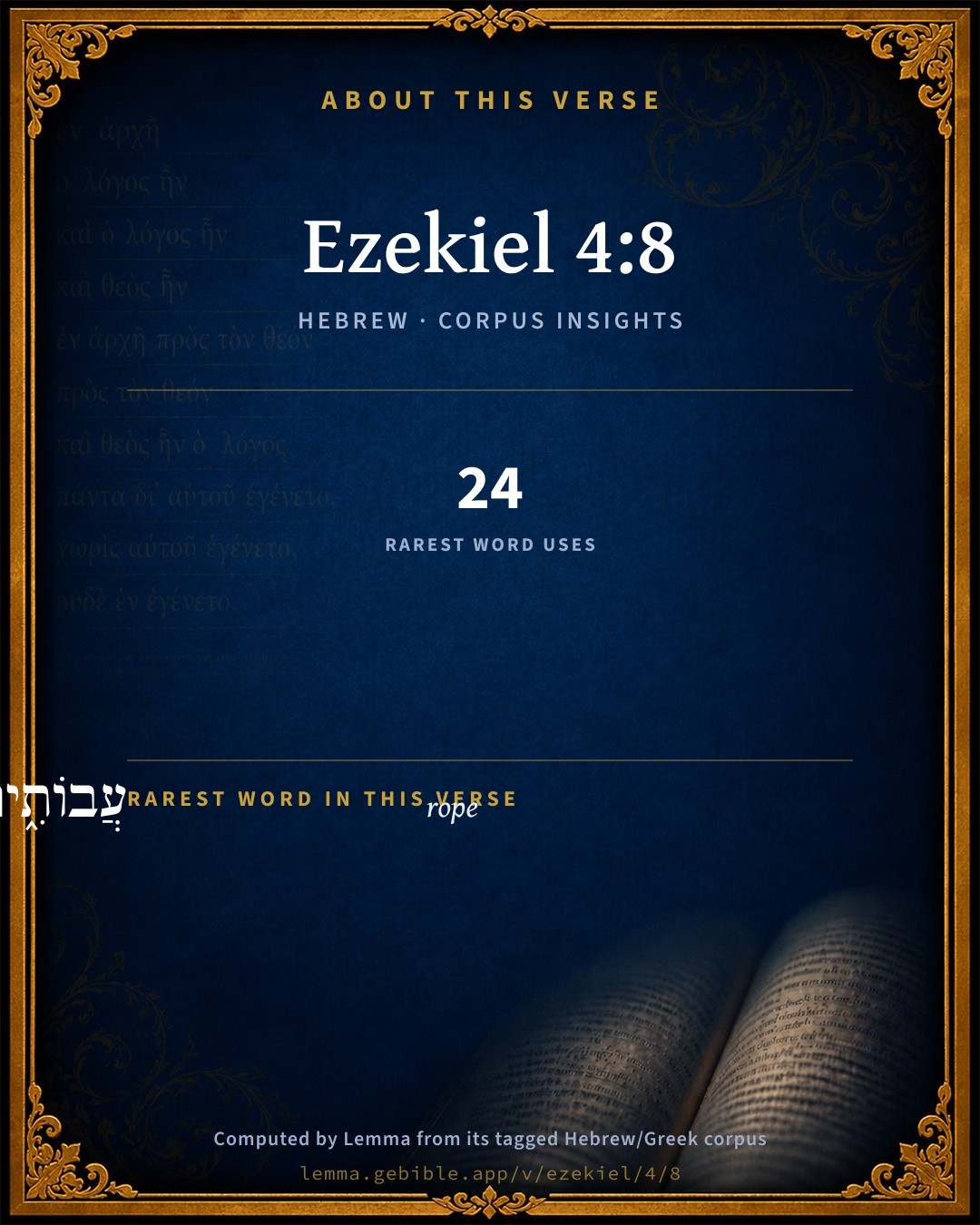
The rarest word here is עֲבוֹתִ֑ים rope H5688 — appearing just 24 times in the whole Hebrew Bible.

Shared distinctive vocabulary

עֲבוֹתִ֑ים rope H5688 occurs in 23 verses of the Hebrew Bible. Also found in:

Grammatical profile

  • 3 verbs
  • 5 nouns
  • 3 prepositions
  • 2 particles

Verb forms

  • נָתַ֥תִּי Qal · Perfect
  • תֵהָפֵ֤ךְ Niphal · Imperfect
  • כַּלּוֹתְךָ֖ Piel · Infinitive Construct

Repetition

A word recurs within this verse — often emphatic in Hebrew:

  • מִֽצִּדְּךָ֙ side H6654 ×2

Hebrew & Septuagint length

In English translation the verse runs 27 words from the Hebrew and 29 from the Septuagint (LXX English) — closely comparable.

A rough comparison of the two English renderings, which tokenize alike — not a word-level alignment.

Word counts can differ between the Hebrew and the Greek without any difference in meaning — e.g. the Hebrew direct-object marker אֵת has no separate Greek word, and Greek often adds the article ὁ.

Cross-references

1

Topical passages linked to Ezekiel 4:8 in the Treasury of Scripture Knowledge — connected by theme and wording, ordered by reader-vote popularity; previews shown in the World English Bible.

  • Ezekiel 3:25 But you, son of man, behold, they shall lay bands on you, and shall bind you with them, and you shall not go out among them:

Cross-references courtesy of OpenBible.info (CC BY 4.0).

Hebrew and Greek witnesses Masoretic Hebrew ↔ Greek Septuagint

The same verse in the two great witnesses to the Old Testament, shown verse-for-verse.

These are two independent witnesses, not word-aligned to each other, and the Septuagint is shown in lemma (dictionary) form.

Hebrew Ezekiel 4:8 Masoretic · Westminster Leningrad Codex

וְהִנֵּ֛ה נָתַ֥תִּי עָלֶ֖יךָ עֲבוֹתִ֑ים וְלֹֽא תֵהָפֵ֤ךְ מִֽצִּדְּךָ֙ אֶל צִדֶּ֔ךָ עַד כַּלּוֹתְךָ֖ יְמֵ֥י מְצוּרֶֽךָ

Behold, I lay bands on you, and you shall not turn you from one side to the other, until you have accomplished the days of your siege.

World English Bible · Public Domain

Greek LXX Ezekiel 4:8 Septuagint · lemma form

καί ἐγώ ἰδού δίδωμι ἐπί σύ δεσμός καί μή στρέφω ἀπό ὁ πλευρόν σύ ἐπί ὁ πλευρόν σύ ἕως ὅς συντελέω ὁ ἡμέρα ὁ συγκλεισμός σύ

And, behold, I have prepared bonds for you, land you may not turn from your one side to the other, until the days of your siege shall be accomplished.

LXX2012 (modern English Septuagint) · Public Domain

Hebrew: Westminster Leningrad Codex (CC BY 4.0). Greek: Septuagint (public domain); English from LXX2012 (modern English Septuagint) (Public Domain). How the Septuagint differs from the Hebrew →

Targum (Aramaic paraphrase)

1

The Targum is the ancient Jewish Aramaic paraphrase of the Hebrew Scriptures — an interpretive translation, not the Hebrew text itself. Onkelos (literal) and Pseudo-Jonathan (expansive) render the Torah, and Jonathan the Prophets. Coverage is partial: where no permissively-licensed English translation exists for a verse, only the Aramaic is shown. This is verse-level text, not a word-by-word alignment to the Hebrew.

  1. Targum Jonathan Prophets (Joshua–Malachi)
    וְהָא גְזָרֵית פִּתְגָמֵי עֲלָךְ כֶּאֱסוּר גְדִילָן וְלָא תִתְהַפֵּיךְ מִסִטְרָךְ לְסִטְרָךְ עַד אַשְׁלְמוּתָךְ יוֹמֵי צַיְרָךְ:

    (no public-domain English translation for this verse)

    Targum Jonathan — Aramaic: “Mikraot Gedolot” (public domain). English: “Sefaria Community Translation” (CC0 1.0 (public-domain dedication)); “London "Chaldee Paraphrase," 1871” (public domain). Text via Sefaria.

Commentary

Notes on Ezekiel 4:8 from classic Christian and Jewish commentators (each source and its license shown beneath its notes). The classic Christian expositions comment on the surrounding passage and are grouped to its opening verse, so a note may address several verses; the Jewish commentaries on the Tanakh (Rashi and others) are per-verse, so they appear only where the commentator wrote on this verse.

Lemma curates 59 commentaries, every one of them public domain or Creative Commons licensed, each selected and text-cleaned for this edition rather than reprinted as found. About our sources →

Trapp's Complete Commentary

John Trapp

Eze 4:8 And, behold, I will lay bands upon thee, and thou shalt not turn thee from one side to another, till thou hast ended the days of thy siege.

Ver. 8. And, behold, I will lay bands upon thee.] To show that he was unchangeably resolved to ruin Judah, {a} whom the prophet here personateth. Some make the sense to be this, I will give thee strength to hold out in that thy long lying on one side till the city be taken. Of a nobleman of Louvain it is told, that he lay sixteen years in one posture - viz., with his face upwards. And Pradus saith he saw a madman who had lain upon one side fifteen years.

{a} Pertinacis poenae simulachrum est. - Oecolamp.

John Trapp, A Commentary or Exposition upon All the Books of the Old and New Testament (1647–1656) — public domain. Text from a community e-Sword module.

Geneva Bible (1599)

Geneva Bible translators

The people should so straightly be besieged, that they should not be able, to turn them.

Geneva Bible (1599) marginal notes — public domain. Text via Bolls.life.

Jamieson, Fausset & Brown

Robert Jamieson, A. R. Fausset & David Brown

bands-- (Eze 3:25).

not turn from . . . side--to imply the impossibility of their being able to shake off the punishment.

Jamieson, Fausset & Brown — Commentary Critical and Explanatory on the Whole Bible (1871) — public domain (CC PDM 1.0). Text via the HelloAO Bible API.

Ellicott's Commentary for English Readers

(8) I will lay bands upon thee.—See on Eze_3:25. This is a fresh feature of the unrelenting character of the judgment foretold: God’s power should interpose to keep the prophet to his work. Not only pity, but even human weakness and weariness, should be excluded from interfering. The prophet is spoken of as besieging the city, because he is doing so in figure.

A Bible Commentary for English Readers, edited by Charles John Ellicott (1878–1897) — public domain. Text from a community e-Sword module.

The Cambridge Bible for Schools and Colleges

gen. ed. J. J. S. Perowne

8. from one side to another] lit. from thy side to thy side. Here the prophet represents those pressed by the rigours of the siege, as in Eze_4:4-6. The “days of thy siege” most naturally means the days of thy suffering siege (ch. Eze_5:2).

The Cambridge Bible for Schools and Colleges (gen. ed. J. J. S. Perowne; Cambridge University Press, 1878–1918) — public domain. Text from a community e-Sword module.

John Gill's Exposition

And, behold, I will lay hands upon thee,.... Representing either the besieged, signifying that they should be taken and bound as he was; or rather the besiegers, the Chaldean army, which should be so held by the power and providence of God, that they should not break up the siege until they had taken the city, and fulfilled the whole will and pleasure of God; for these bands were an emblem of the firm and unalterable decree of God, respecting the siege and taking of Jerusalem; and so the Targum paraphrases it,

"and, lo, the decree of my word is upon thee, as a band of ropes;''

and to this sense Jarchi interprets it; and which is confirmed by what follows:

and thou shall not turn thee from one side to another till thou hast ended the days of thy siege; showing that the Chaldean army should not depart from Jerusalem until it was taken; for though, upon the report of the Egyptian army coming against them, they went forth to meet it; yet they returned to Jerusalem, and never left the siege till the city fell into their hands, according to the purpose and appointment of God. Kimchi that the word for siege is in the plural number, and signifies both the "siege" of Samaria and the siege of Jerusalem; but the former was over many years before this time: by this it appears that the siege of Jerusalem should last three hundred and ninety days; indeed, from the beginning to the end of it, were seventeen months, Kg2 25:1; but the siege being raised by the army of the king of Egypt for some time, Jer 37:5, may reduce it to thirteen months, or thereabout; for three hundred and ninety days are not only intended to signify the years of Israel's sin and wickedness, but also to show how long the city would be besieged; and so long the prophet in this symbolical way was besieging it.

John Gill's Exposition of the Whole Bible (1746–1763) — public domain (CC PDM 1.0). Text via the HelloAO Bible API.

Albert Barnes' Notes on the Bible

I will lay bands upon thee - Contrast margin reference. The Lord will put constraint upon him, to cause him to exercise his office. In the retirement of his house, figuratively bound and under constraint, he shall not cease to proclaim the doom of the city.

The days of thy siege - Those during which he should thus foretell the approaching calamity.

Albert Barnes' Notes on the Bible (1834–1885) — public domain. Text from a community e-Sword/MySword module.

Matthew Poole's English Annotations

Whoever were the persons that laid bonds on Ezekiel, in Eze 3:25, here it is plain that the Lord doth it. If the prophet represent the besieged citizens who must be captives in bonds, then it is likely these bonds were visible and material, that they might be a teaching sign and admonition, that as they saw the prophet in them, so certainly he should see that come to pass which was signified by them. If he represent the Chaldeans, as those who were by Divine power as fast bound to this siege, till the city be taken, as he was tied to the place whence he could not stir a foot, then invisible bonds, which none feel or see but the prophet, may suffice these, assuring him that those could move no more from the siege than he from that side he lay on. And though the Egyptian army make some diversion, yet it is very like the siege was not quite raised, but they kept the city blocked up, whilst the gross of the army drew off to fight Pharaoh’s army, according to that Jer 37:9, the Chaldeans shall not depart.

Thy siege, Heb. plural, sieges, either because it was like two sieges by that little interruption of three or four months, or else because of the length and soreness thereof.

Matthew Poole's English Annotations on the Holy Bible (1683–1685) — public domain. Text from a community e-Sword/MySword module.

Whedon's Commentary on the Bible

Daniel D. Whedon

8. To have turned from one side to the other during the continuance of this tableau would have ruined its symbolic reference to Israel and Judah (Eze_4:4; Eze_4:6). It is not stated that he must not rise up from the earth during this long period. The next verse proves that at least occasionally he is expected to get up, not only to attend to necessary duties, but to prepare for other symbolical actions. Every day, however, for one hundred and ninety days the prophet is seen lying upon his left side before the besieged city, “crushed to the ground” under the weight of Israel’s punishment. The more suffering entailed, by his speechlessness and seeming paralysis, the more intensely effective would be the impression produced by it. Many ancient Simeon stylites and modern Indian devotees have depended for their influence chiefly on such a conquest of the physical nature.

Daniel D. Whedon (gen. ed.), Commentary on the Old and New Testaments (1874–1909) — public domain. Text from a community e-Sword module.

The Pulpit Commentary

I will lay bands upon thee, etc. The words point to the supernatural constraint which would support the prophet in a position as trying as that of an Indian yogi or a Stylite monk. He would himself be powerless to move (exceptis excipiendis, as before) from the prescribed position. There is, perhaps, a reference to Eze_3:25. The people would have "put bands" upon the prophet to hinder his work; Jehovah will "put bands" upon him to help, nay, to constrain, him to finish it.

The Pulpit Commentary (1880–1919), ed. H.D.M. Spence-Jones & Joseph S. Exell — public domain. Text from a community e-Sword module.

John Wesley's Explanatory Notes

Bands - An invisible restraint assuring him, that those could no more remove from the siege, than he from that side he lay on.

John Wesley, Explanatory Notes Upon the Whole Bible (1754–1765) — public domain. Text via the GEBible commentary corpus.

Rashi

Rabbi Shlomo Yitzchaki (Rashi)

I have placed ropes upon you The decree of My commandments shall be stringent upon you as you were bound with ropes so that you should not turn from side to side.

until you complete the days of your siege The number of these days that I decreed upon you.

Rashi on the Tanakh — English translations: “The Judaica Press complete Tanach with Rashi, translated by A. J. Rosenberg” (CC BY 4.0); “Pentateuch with Rashi's commentary by M. Rosenbaum and A.M. Silbermann, 1929-1934” (public domain); “The Metsudah Tanach series, Lakewood, N.J” (CC BY 4.0); and “The Book of Joshua, Metsudah Publications, 1997” (CC BY 4.0). Text via Sefaria.

Lesson kit

Teaching starters — assembled from the data on this page, not authored interpretation. Every prompt links to the verse data it draws on. Edit before teaching.

Ezekiel, in the Prophets, opens this verse with 13 words (12 distinct Hebrew lemmas). Its most distinctive word is ʻăbôth (“rope”). A historical commentator’s framing appears above. Read the whole chapter for the surrounding context.

Discussion questions

  1. How does “rope” (ʻăbôth) shape what this verse is saying?
  2. How does Exodus 28:14, which shares the word «rope», read alongside this verse?
  3. What does the repetition of “side” (2× in this one verse) do in this verse?
  4. The translations on this page render this verse differently — a whole-verse word diff, not a word-by-word alignment. What might account for the different wordings?
  5. «נָתַ֥תִּי» is a Qal Perfect verb. How does that grammatical form shape the action described?
  6. Compare how Trapp's Complete Commentary and Geneva Bible (1599) read this verse. Where do they agree or differ?

Things to notice

Reading settings

Reading text

Shown beneath each verse's original-language words.

Old Testament
Old Testament edition

Read the OT as the Masoretic Hebrew (MT) or the Greek Septuagint (LXX).

English shown for the Greek Septuagint (in the Hebrew ↔ Greek comparison).

Comparing translations? Open the Compare panel on any verse page to stack up to four side by side.