Daniel 11:16

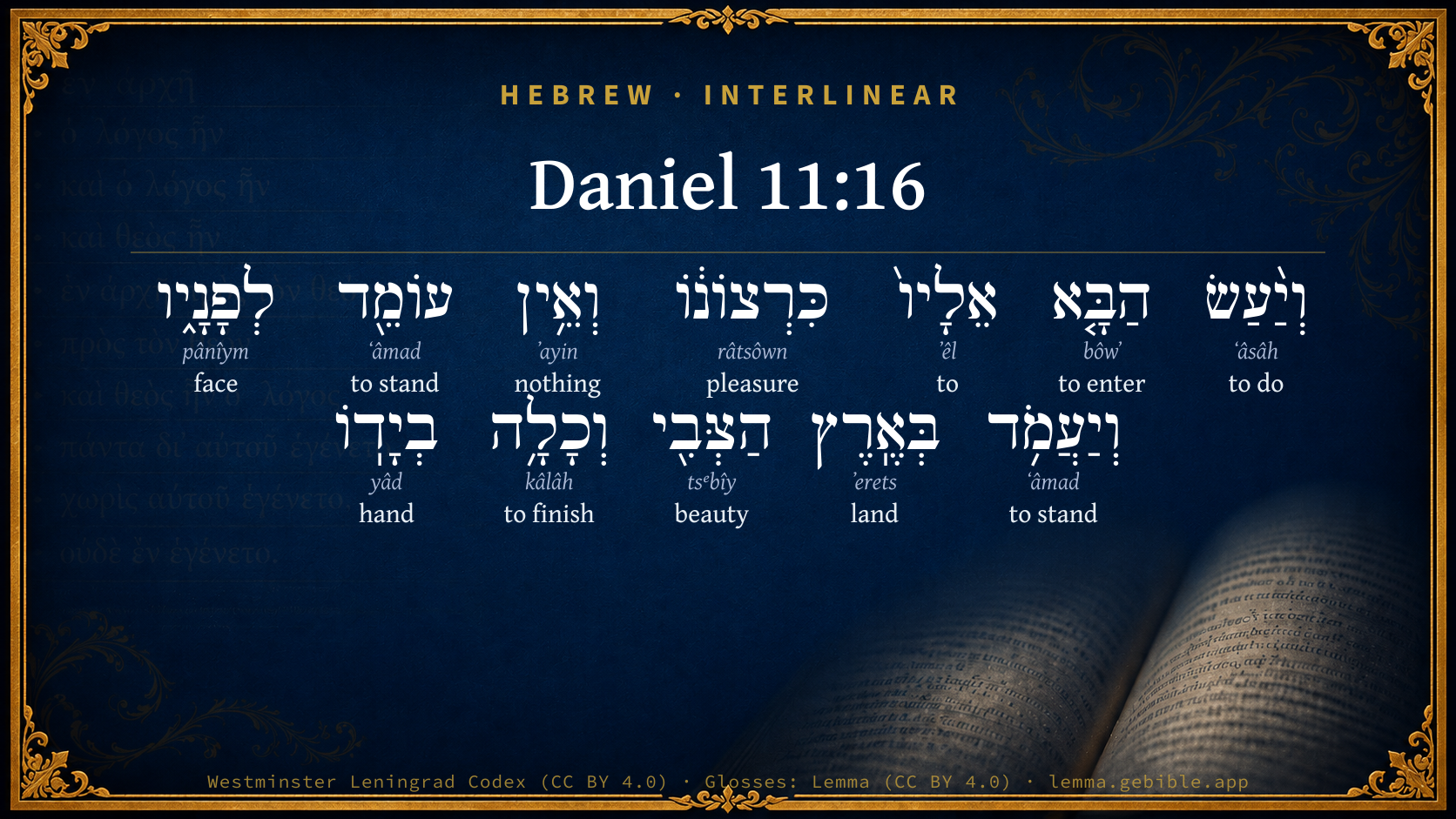
Hebrew (Westminster Leningrad Codex) Daniel 11:16 appears in the Hebrew Old Testament. The text above is from the Westminster Leningrad Codex. Each word links to its Strong’s number, a concise gloss, and parsing drawn from the Open Scriptures Hebrew Bible morphology. Click any word for its full Brown-Driver-Briggs (BDB) entry.
Download image
Cite this verse

Daniel 11:16 (World English Bible). Public Domain. Lemma interlinear Bible study tool, https://lemma.gebible.app/v/daniel/11/16.

Show BibTeX & RIS
BibTeX
RIS
English Translation
But he who comes against him shall do according to his own will, and none shall stand before him; and he shall stand in the glorious land, and in his hand shall be destruction.
World English Bible · Public Domain
Download a study sheet

One document with this verse’s original text, its word-by-word gloss line, the meaning frame, cross-references with their text, attributed commentary, and full source and license credits — printable, and it pastes into notes with its structure intact.

This verse Autodidact and up

Study sheet (.html) Plain text (.txt)

A passage Seminary Student

Up to 50 verses in one chapter. A passage sheet keeps up to 6 commentary sources and 12 cross-references per verse, in the order this page ranks them, and says so on the sheet whenever that leaves anything out. Ask for a single verse and you get the Autodidact verse sheet above.

Everything on this page stays free to read, with no account — the sheet is a download of what is already on screen, not access to it.

Want to remove ads? Support Godless Engineer
Compare translations 3

The same verse in 3 English versions, stacked beneath the original-language interlinear above. Click any original word for its lexicon entry.

Each is an independent rendering of the whole verse — the interlinear is not word-aligned to these translations.

Highlighted words mark where these versions differ — a whole-verse word diff, not a word-by-word alignment.

  • World English Bible Public Domain
    But he who comes against him shall do according to his own will, and none shall stand before him; and he shall stand in the glorious land, and in his hand shall be destruction.
  • King James Version Public Domain
    But he that cometh against him shall do according to his own will, and none shall stand before him: and he shall stand in the glorious land, which by his hand shall be consumed.
  • unfoldingWord Literal Text CC BY-SA 4.0
    But he who comes against him will act according to his desires; no one will stand before him. He will stand in the Beautiful Land, with destruction in his hand.

unfoldingWord Literal Text — © unfoldingWord, licensed CC BY-SA 4.0. Word-aligned USFM3 via Door43 (git.door43.org/unfoldingWord/en_ult).

Versions to compare (up to 4)

3 of 4 selected

Show all 18 translations

Every available English version of this verse, each an independent rendering of the whole verse.

  • World English Bible Public Domain
    But he who comes against him shall do according to his own will, and none shall stand before him; and he shall stand in the glorious land, and in his hand shall be destruction.
  • Berean Standard Bible Public Domain
    The invader will do as he pleases, and no one will stand against him. He will establish himself in the Beautiful Land, with destruction in his hand.
  • Majority Standard Bible Public Domain
    The invader will do as he pleases, and no one will stand against him. He will establish himself in the Beautiful Land, with destruction in his hand.
  • King James Version Public Domain
    But he that cometh against him shall do according to his own will, and none shall stand before him: and he shall stand in the glorious land, which by his hand shall be consumed.
  • American Standard Version (1901) Public Domain
    But he that cometh against him shall do according to his own will, and none shall stand before him; and he shall stand in the glorious land, and in his hand shall be destruction.
  • Revised Version (1885) Public Domain
    But he that cometh against him shall do according to his own will, and none shall stand before him: and he shall stand in the glorious land, and in his hand shall be destruction.
  • Geneva Bible (1599) Public Domain
    But he that shall come, shall doe vnto him as he list, and none shall stand against him: and he shall stand in the pleasant land, which by his hand shalbe consumed.
  • Douay-Rheims (1899) Public Domain
    And he shall come upon him and do according to his pleasure, and there shall be none to stand against his face: and he shall stand in the glorious land, and it shall be consumed by his hand.
  • Young's Literal Translation Public Domain
    And he who is coming unto him doth according to his will, and there is none standing before him; and he standeth in the desirable land, and `it is' wholly in his hand.
  • Literal Standard Version CC BY-SA 4.0
    And he who is coming to him does according to his will, and there is none standing before him; and he stands in the desirable land, and [it is] wholly in his hand.
  • Unlocked Literal Bible CC BY-SA 4.0
    Instead, the one who comes will act according to his desires against him; no one will stand in his way. He will stand in the land of beauty, and destruction will be in his hand.
  • unfoldingWord Literal Text CC BY-SA 4.0
    But he who comes against him will act according to his desires; no one will stand before him. He will stand in the Beautiful Land, with destruction in his hand.
  • Darby Bible Public Domain
    And he that cometh against him shall do according to his own will, and none shall stand before him; and he shall stand in the land of beauty, and destruction shall be in his hand.
  • World Messianic Bible Public Domain
    But he who comes against him will do according to his own will, and no one will stand before him. He will stand in the glorious land, and destruction will be in his hand.
  • Webster's Bible Public Domain
    But he that cometh against him shall do according to his own will, and none shall stand before him: and he shall stand in the glorious land, which by his hand shall be consumed.
  • Free Bible Version CC BY-SA 4.0
    The invader will do whatever he wants; no one will be able to oppose him. He will stand in the Beautiful Land with the power to destroy it.
  • Bible in Basic English Public Domain
    And he who comes against him will do his pleasure, and no one will be able to keep his place before him: he will take up his position in the beautiful land and in his hand there will be destruction.
  • JPS Tanakh (1917) Public Domain
    But he that cometh against him shall do according to his own will, and none shall stand before him; and he shall stand in the beauteous land, and in his hand shall be extermination.

Literal Standard Version (2020), Covenant Press — licensed CC BY-SA 4.0. Text via the HelloAO Bible API (eBible.org). Unlocked Literal Bible (unfoldingWord) — licensed CC BY-SA 4.0. Text via the HelloAO Bible API (eBible.org). unfoldingWord Literal Text — © unfoldingWord, licensed CC BY-SA 4.0. Word-aligned USFM3 via Door43 (git.door43.org/unfoldingWord/en_ult). Free Bible Version, Dr. Jonathan Gallagher — licensed CC BY-SA 4.0. Text via the HelloAO Bible API (eBible.org).

Word by word

More ways to search: Search by grammar → Find every occurrence → Compare this word →

Practice this passage: Drill this verse → Learn its vocabulary →

הַצְּבִ֖י
tsᵉbîy
H6643
“the · beauty”
Particle, Definite Article + Noun, Common, Masculine, Singular, Absolute
Part of Speech
Particle + Noun
Type
Common
Gender
Masculine
Number
Singular
State
Absolute
Full BDB Definition

Origin: from H6638 in the sense of prominence

TWOT: 1869a , 1870a

beauty, glory, honour - beauty, decoration - honour - roebuck, gazelle - perhaps an extinct animal, exact meaning unknown
  1. וְיַ֨עַשׂ ʻâsâh H6213 “and · to do” Conjunction + Verb, Qal, Jussive, 3rd Person, Masculine, Singular
  2. הַבָּ֤א bôwʼ H935 “the · entering” Particle, Definite Article + Verb, Qal, Participle Active, Masculine, Singular, Absolute
  3. אֵלָיו֙ ʼêl H413 “to · him” Preposition + Suffix, Personal, 3rd Person, Masculine, Singular
  4. כִּרְצוֹנ֔וֹ râtsôwn H7522 “like/as · pleasure · his” Preposition + Noun, Common, Masculine, Singular, Construct + Suffix, Personal, 3rd Person, Masculine, Singular
  5. וְאֵ֥ין ʼayin H369 “and · nothing” Conjunction + Particle, Negative
  6. עוֹמֵ֖ד ʻâmad H5975 “standing” Verb, Qal, Participle Active, Masculine, Singular, Absolute
  7. לְפָנָ֑יו pânîym H6440 “to/for · face(s) · his” Preposition + Noun, Common, Both, Plural, Construct + Suffix, Personal, 3rd Person, Masculine, Singular
  8. וְיַעֲמֹ֥ד ʻâmad H5975 “and · to stand” Conjunction + Verb, Qal, Imperfect, 3rd Person, Masculine, Singular
  9. בְּאֶֽרֶץ ʼerets H776 “in/at · land of” Preposition + Noun, Common, Both, Singular, Construct
  10. וְכָלָ֥ה kâlâh H3615 “and · destruction” Conjunction + Noun, Common, Feminine, Singular, Absolute
  11. בְיָדֽוֹ yâd H3027 “in/at · hand · his” Preposition + Noun, Common, Both, Singular, Construct + Suffix, Personal, 3rd Person, Masculine, Singular

About this verse

These counts appear in no published source. They are computed here, from the morphology-tagged text and Lemma’s own curated glosses. What Lemma adds →

12
words
11
distinct lemmas
Prophets
section

Shared distinctive vocabulary

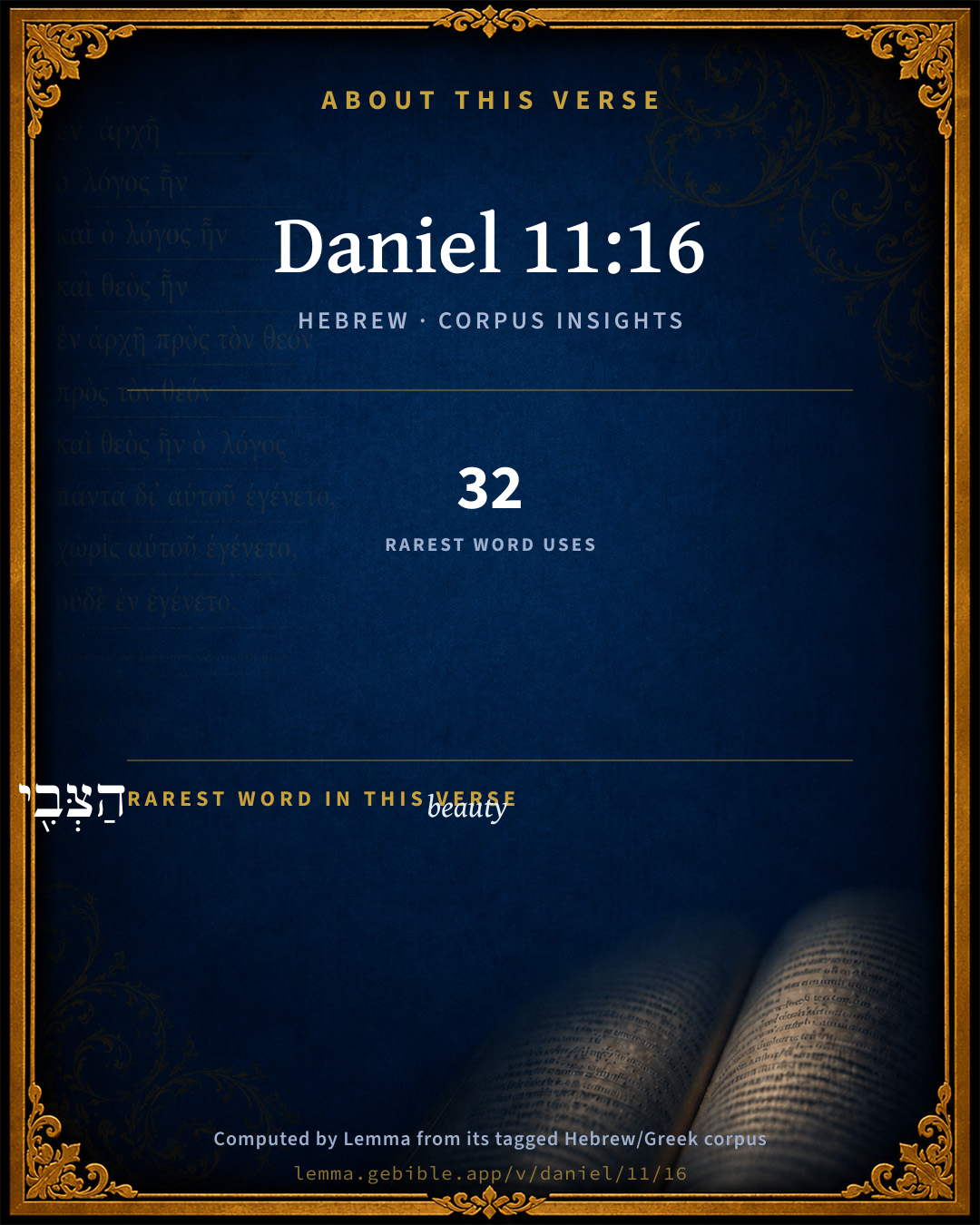
הַצְּבִ֖י beauty H6643 occurs in 32 verses of the Hebrew Bible. Also found in:

Grammatical profile

  • 4 verbs
  • 6 nouns
  • 1 preposition
  • 1 particle

Verb forms

  • וְיַ֨עַשׂ Qal · Jussive
  • הַבָּ֤א Qal · Participle Active
  • עוֹמֵ֖ד Qal · Participle Active
  • וְיַעֲמֹ֥ד Qal · Imperfect

Repetition

A word recurs within this verse — often emphatic in Hebrew:

  • עוֹמֵ֖ד to stand H5975 ×2

Hebrew & Septuagint length

In English translation the verse runs 34 words from the Hebrew and 39 from the Septuagint (LXX English) — closely comparable.

A rough comparison of the two English renderings, which tokenize alike — not a word-level alignment.

Word counts can differ between the Hebrew and the Greek without any difference in meaning — e.g. the Hebrew direct-object marker אֵת has no separate Greek word, and Greek often adds the article ὁ.

Cross-references

10

Topical passages linked to Daniel 11:16 in the Treasury of Scripture Knowledge — connected by theme and wording, ordered by reader-vote popularity; previews shown in the World English Bible.

  • Daniel 8:9 Out of one of them came forth a little horn, which grew exceeding great, toward the south, and toward the east, and toward the glorious [land].
  • Daniel 11:3 A mighty king shall stand up, who shall rule with great dominion, and do according to his will.
  • Daniel 11:36 The king shall do according to his will; and he shall exalt himself, and magnify himself above every god, and shall speak marvelous things against the God of gods; and he shall prosper until the indignation be accomplished; for that which is determined shall be done.
  • Daniel 11:41 He shall enter also into the glorious land, and many [countries] shall be overthrown; but these shall be delivered out of his hand: Edom, and Moab, and the chief of the children of Ammon.
  • Daniel 8:4 I saw the ram pushing westward, and northward, and southward; and no animals could stand before him, neither was there any who could deliver out of his hand; but he did according to his will, and magnified himself.
  • Daniel 8:7 I saw him come close to the ram, and he was moved with anger against him, and struck the ram, and broke his two horns; and there was no power in the ram to stand before him; but he cast him down to the ground, and trampled on him; and there was none who could deliver the ram out of his hand.
  • Joshua 1:5 There shall not any man be able to stand before you all the days of your life. As I was with Moses, so I will be with you; I will not fail you, nor forsake you.
  • Isaiah 8:8 and it shall sweep onward into Judah; it shall overflow and pass through; it shall reach even to the neck; and the stretching out of its wings shall fill the breadth of your land, Immanuel.
  • Jeremiah 3:19 But I said, How I will put you among the children, and give you a pleasant land, a goodly heritage of the hosts of the nations! and I said, You shall call me My Father, and shall not turn away from following me.
  • Daniel 11:45 He shall plant the tents of his palace between the sea and the glorious holy mountain; yet he shall come to his end, and none shall help him.

Cross-references courtesy of OpenBible.info (CC BY 4.0).

Hebrew and Greek witnesses Masoretic Hebrew ↔ Greek Septuagint

The same verse in the two great witnesses to the Old Testament, shown verse-for-verse.

These are two independent witnesses, not word-aligned to each other, and the Septuagint is shown in lemma (dictionary) form.

Hebrew Daniel 11:16 Masoretic · Westminster Leningrad Codex

וְיַ֨עַשׂ הַבָּ֤א אֵלָיו֙ כִּרְצוֹנ֔וֹ וְאֵ֥ין עוֹמֵ֖ד לְפָנָ֑יו וְיַעֲמֹ֥ד בְּאֶֽרֶץ הַצְּבִ֖י וְכָלָ֥ה בְיָדֽוֹ

But he who comes against him shall do according to his own will, and none shall stand before him; and he shall stand in the glorious land, and in his hand shall be destruction.

World English Bible · Public Domain

Greek LXX Daniel 11:16 Septuagint · lemma form

καί ποιέω ὁ εἰςπορεύομαι ἐπί αὐτός κατά ὁ θέλημα αὐτός καί οὐ εἰμί ὁ ἀντιἵστημι ἐναντίον αὐτός καί ἵστημι ἐν ὁ χώρα καί ἐπιτελέω πᾶς ἐν ὁ χείρ αὐτός

And he that comes in against him shall do according to his will, and there is no one to stand before him: and he shall stand in the land of beauty, and it shall be consumed by his hand.

LXX2012 (modern English Septuagint) · Public Domain

On this verse, Matthew Poole's English Annotations discusses the Septuagint’s reading. Read the note in Commentary ↓

Hebrew: Westminster Leningrad Codex (CC BY 4.0). Greek: Septuagint (public domain); English from LXX2012 (modern English Septuagint) (Public Domain). How the Septuagint differs from the Hebrew →

Commentary

Notes on Daniel 11:16 from classic Christian and Jewish commentators (each source and its license shown beneath its notes). The classic Christian expositions comment on the surrounding passage and are grouped to its opening verse, so a note may address several verses; the Jewish commentaries on the Tanakh (Rashi and others) are per-verse, so they appear only where the commentator wrote on this verse.

Lemma curates 59 commentaries, every one of them public domain or Creative Commons licensed, each selected and text-cleaned for this edition rather than reprinted as found. About our sources →

Jamieson, Fausset & Brown

Robert Jamieson, A. R. Fausset & David Brown

he that cometh against him--Antiochus coming against Ptolemy Epiphanes.

glorious land--Judea (Dan 11:41, Dan 11:45; Dan 8:9; Eze 20:6, Eze 20:15).

by his hand shall be consumed--literally, "perfected," that is, completely brought under his sway. JOSEPHUS [Antiquities, 12:3.3] shows that the meaning is not, that the Jews should be utterly consumed: for Antiochus favored them for taking his part against Ptolemy, but that their land should be subjected to him [LENGKERKE]. GROTIUS translates, "shall be perfected by him," that is, shall flourish under him. English Version gives a good sense; namely, that Judea was much "consumed" or "desolated" by being the arena of conflict between the combatants, Syria and Egypt. TREGELLES refers (Dan 11:14), "robbers of thy people," to the Gentiles, once oppressors, attempting to restore the Jews to their land by mere human effort, whereas this is to be effected only by divine interposition: their attempt is frustrated (Dan 11:16) by the wilful king, who makes Judea the scene of his military operations.

Jamieson, Fausset & Brown — Commentary Critical and Explanatory on the Whole Bible (1871) — public domain (CC PDM 1.0). Text via the HelloAO Bible API.

Trapp's Complete Commentary

John Trapp

Dan 11:16 But he that cometh against him shall do according to his own will, and none shall stand before him: and he shall stand in the glorious land, which by his hand shall be consumed.

Ver. 16. And he shall stand in the glorious land.] Heb., The land of ornaments - that is, Judea, which, lying between these two potent princes, was perpetually afflicted, as grain is ground asunder lying between two heavy millstones. Now Judea is called the "glorious" or beautiful land, {a} not so much for the fertility thereof (Babylon was much more fertile), nor for the miracles done therein (many great works had been likewise done in Egypt), as for the sincere service of God there set up; this is the beauty and bulwark of any nation. Foreign writers have termed England, the fortunate island, the terra florida, the kingdom of God, the paradise of pleasure, &c. Plato commendeth the Attic country for this, that the inhabitants were αυτοχθονες - the right natives that grew out of it at first {b} - but especially for this, that it was θεοφιλης, a place that loved God, and was interchangeably beloved of God. {c} May that be evermore England’s commendation!

Which by his hand shall be consumed.] God’s Church goes to wreck, both by south and north; all the comfort is, that whether north or south wind blow on God’s garden, they shall blow good to it at length. {Son 4:16}

{a} In Eze 20:6; Eze 20:15, it is called the comeliness of all countries.

{b} ανθρωποι ωκουν οι αυτοι αει. - Thucyd.

{c} τυγχανει ουσα θεοφιλης. - Plato.

John Trapp, A Commentary or Exposition upon All the Books of the Old and New Testament (1647–1656) — public domain. Text from a community e-Sword module.

Keil & Delitzsch

C. F. Keil & F. Delitzsch

The Further Undertakings of the King of the North - Dan 11:16-19

Having penetrated into the kingdom of the south, he shall act there according to his own pleasure, without any one being able to withstand him; just as before this the king of the south did in the kingdom of the north (Dan 11:7). With ויעשׂ the jussive appears instead of the future - cf. וישׂם, יתּן (Dan 11:17), ישׁב (Dan 11:18 and Dan 11:19) - to show that the further actions and undertakings of the king of the north are carried on under the divine decree. אליו הבּא is he that comes into the land of the south, the king of the north (Dan 11:14, Dan 11:15). Having reached the height of victory, he falls under the dominion of pride and haughtiness, by which he hastens on his ruin and overthrow. After he has subdued the kingdom of the southern king, he will go into the land of beauty, i.e., into the Holy Land (with reference to הצּבי ארץ, Dan 8:9). בּידו וכלה, and destruction is in his hand (an explanatory clause), כלה being here not a verb, but a substantive. Only this meaning of כלה is verbally established, see under Dan 9:27, but not the meaning attributed to the word, from the unsuitable introduction of historical events, accomplishing, perfection, according to which Hv., v. Leng., Maur., and Kliefoth translate the clause: and it (the Holy Land) is wholly given into his hand. כלה means finishing, conclusion, only in the sense of destruction, also in Ch2 12:2 and Eze 13:13. For the use of בּידו of spiritual things which one intends or aims at, cf. Job 11:14, Isa. 54:20. The destruction, however, refers not to the Egyptians (Hitzig), but to the Holy Land, in which violent (rapacious) people (Dan 11:14) make common cause with the heathen king, and thereby put arms into his hands by which he may destroy the land.

Keil & Delitzsch — Biblical Commentary on the Old Testament (1861–1891) — public domain (CC PDM 1.0). Text via the HelloAO Bible API. (Old Testament only.)

Tyndale Open Study Notes

Tyndale Open Resources

11:16 intent on destroying it: Antiochus III sought to hellenize the Jews and destroy their ancient customs, but he was flattered by Jews who received him well, and he granted them special privileges. They were allowed to live according to their own laws. His son Antiochus IV was not so accommodating (11:21-39).

Tyndale Open Study Notes — © Tyndale Open Resources, licensed CC BY-SA 4.0. Text via the HelloAO Bible API.

Geneva Bible (1599)

Geneva Bible translators

He showeth that he shall not only afflict the Egyptians, but also the Jews, and shall enter into their country, whereof he admonisheth them before, that they may know that all these things came by God’s providence.

Geneva Bible (1599) marginal notes — public domain. Text via Bolls.life.

Adam Clarke's Commentary

Verse 16. He shall stand in the glorious land] Judea. For he reduced Palestine; and the Jews supplied him with provisions, and assisted him to reduce the garrison that Scopas had left in the citadel of Jerusalem.

Which by his hand shall be consumed] Or, which shall be perfected in his hand. For Antiochus showed the Jews great favour: he brought back those that were dispersed, and re-established them in the land; freed the priests and Levites from all tribute, &c.

Adam Clarke's Commentary on the Bible (1810–1826) — public domain. Text from a community e-Sword/MySword module.

John Calvin's Commentaries

The angel proceeds with the same discourse. He says, Antiochus the Great should accomplish his wishes, and should spread the terror of his arms in every direction, and thus no one would dare to oppose him. He shall do therefore according to his will, he says, and none shall stand before his face; and he shall stand in the desirable land; meaning, he shall bring his victorious army into Judea, and there shall be a great consumption under his hand, or Judea shall be consumed and ruined under his hand. We originally stated, that the angel’s mission did not authorize him to great these events as military exploits are usually narrated by historians. Enough is revealed to lead the faithful to acknowledge God’s continual regard for their safety. Experience also assures us of every occurrence being divinely foreseen, and thus they would acknowledge how everything tended to promote their welfare. God’s predictions of future events were never in vain, and the angel now declares the future coming of Antiochus to the desirable land. We have previously given the reason for the use of this epithet as applied to Judea, — not through any natural excellence over other lands, but because God had chosen it for himself as his seat and dwelling-place. The excellence of this land depended entirely on the gratuitous beneficence of God. It might seem inconsistent to grant such license to an impious tyrant and robber, and to allow him to overrun Judea, which God had marked out with peculiar honor, in adopting it as his dwelling-place, and calling it his residence. (Psalm 132:14.) But we know that the Church, while on its pilgrimage in this world, enjoys no freedom from many infliction’s; for it is profitable for the sons of God to be humbled under the cross, lest they should grow restive in the world, and give themselves up to luxuries, and sleep upon the desires of the flesh. The angel, indeed, omits the reason why God suffered Antiochus thus cruelly to oppress the sacred land; but the faithful had been taught by the Law and the Prophets how the Church was subject to various tribulations. It is sufficient, then, to relate the event with simplicity: and the pleasant land shall be consumed under his hand, or there shall be a consumption. It matters but little which way we read it as far as the sense is concerned. The angel here encourages Daniel and all others to the exercise of patience, lest they should faint under this divine scourge; for he permitted Antiochus to wander about like a robber, and to exercise severe tyranny and cruelty against the Jews I need not discuss these events at greater length, as they are found in the Books of the Maccabees I will only touch on one point briefly; Antiochus did not of his own accord harass the Jews by leading his army into their country, but he was stirred up by impious priests. So great was their perfidy and barbarity that they willingly betrayed God’s Temple, and exposed their nation to the most distressing calamities. That was a severe trial: hence God consulted the interests of his own worshippers by predicting events which might weaken their confidence and cause them to indulge in despair. It follows, —

John Calvin's Commentaries (1540-1563) — public domain. Text from the Calvin Translation Society English edition (1840s-50s) via the Christian Classics Ethereal Library (ccel.org). Calvin's coverage is partial (roughly two-thirds of the Bible); uncommented books and verses are honest gaps, never fabricated. The 19th-century editor's footnotes and remarks are omitted so the notes are faithfully Calvin's own voice.

Ellicott's Commentary for English Readers

(16) But he that cometh.—We now hear of further proceedings of the northern king. He follows up the vision mentioned in the last verse, enters the glorious land (i.e., Palestine), and commits great ravages in it. The king is described in language which reminds us of Dan_11:3. He acts just as he pleases after his entrance to the southern kingdom. This has been applied to the conduct of Antiochus the Great, but history does not speak of any acts of destruction committed by him in Palestine. On the contrary, it is recorded of him that he treated the Jews with kindness. (On the “glorious land,” see Dan_8:9.)

Which by his hand . . .—Literally, destruction being in his hand.

A Bible Commentary for English Readers, edited by Charles John Ellicott (1878–1897) — public domain. Text from a community e-Sword module.

The Cambridge Bible for Schools and Colleges

gen. ed. J. J. S. Perowne

16. But he (Antiochus) that cometh against him (Ptolemy) shall do according to his own will] so greatly will he be superior to him: the phrase, as Dan_11:3.

stand before him] Dan_8:4; Dan_8:7.

shall stand in the beauteous land (the land of Israel: see on Dan_8:9), with destruction in his hand] aimed, viz., against Egypt; possessed of Palestine (Dan_11:14), he will ‘stand’ in it, menacing Egypt with ruin. Or (with a change of points), with all of it (the land) in his hand (power) (Bertholdt, Kamph., Prince).

The Cambridge Bible for Schools and Colleges (gen. ed. J. J. S. Perowne; Cambridge University Press, 1878–1918) — public domain. Text from a community e-Sword module.

John Gill's Exposition

But he that cometh against him shall do according to his own will, and none shall stand before him,.... Antiochus the great, who came against Ptolemy king of Egypt, would do in those parts where he came as he pleased; take cities, and dispose of them at his pleasure; the army of the king of Egypt not being able to oppose him, and stop his conquests in Coelesyria and Phoenicia; nor should they hinder his entrance into Judea:

and he shall stand in the glorious land; Judea, so called, not only because of its fertility, but chiefly because of the worship of God in it; here Antiochus stood as a victorious conqueror; the Jews readily submitting to him, and received him into their city, and assisted him in reducing the castle where Scopas had placed a garrison of soldiers:

which by his hand shall be consumed; by his numerous army, and the foraging of his soldiers, eating up and destroying the fruits of the earth wherever they came; otherwise the land of Judea, and the inhabitants of it, were not consumed and destroyed by him at this time; but rather brought into more flourishing circumstances, having many favours and privileges bestowed on them by him, on account of the respect they showed him; for, on his coming to Jerusalem, the priests and elders went out to meet him, and gladly received him and his army, and furnished him with horses and elephants, and helped him in reducing the garrison Scopas had left (y), as before observed: hence some render the words, "which by his hand was perfected" (z); restored to perfect peace and prosperity, which had been for some years harassed and distressed by the Egyptians and Syrians, in their turns being masters of it; the elders, priests, and Levites, he freed from tribute, gave them leave to live according to their own laws, granted them cattle and other things for sacrifice, and wood for the repairing and perfecting of their temple. The letters he wrote on this account are to be seen in Josephus (a).

(y) Josephus, ut supra. (Antiqu. l. 12. c. 3. sect. 3.) (z) "et perficietur per eum", Grotius. (a) Josephus, ut supra. (Antiqu. l. 12. c. 3. sect. 3.)

John Gill's Exposition of the Whole Bible (1746–1763) — public domain (CC PDM 1.0). Text via the HelloAO Bible API.

Albert Barnes' Notes on the Bible

But he that cometh against him shall do according to his own will - That is, Antiochus, who “came against” Scopas, the Egyptian general, sent out by Ptolemy. The idea is, that Antiochus would be entirely successful in the countries of Coelo-Syria and Palestine. As a matter of fact, as stated above, he drove Scopas out of those regions, and compelled him to take refuge in Sidon, and then besieged him, and compelled him to surrender.

And none shall stand before him - That is, neither the forces that Scopas had under his command, nor the choice and select armies sent out from Egypt for his rescue, under Eropus, Menocles, and Damoxenus.

And he shall stand in the glorious land - Margin, “the land of ornament,” or, “goodly land.” The Hebrew word צבי tsebı̂y means, properly, “splendor, beauty,” and was given to the holy land, or Palestine, on account of its beauty, as being a land of beauty or fertility. Compare Eze 20:6, Eze 20:15; Eze 26:12; Jer 3:19, and Dan 11:45. The meaning here is, that he would obtain possession of the land of Israel, and that no one would be able to stand against him. By the defeat of Scopas, and of the forces sent to aid him when entrenched in Sidon, this was accomplished.

Which by his hand shall be consumed - As would be natural when his invading army should pass through it. The angel does not seem to refer to any “wanton.” destruction of the land, but only to what would necessarily occur in its invasion, and in securing provision for the wants of an army. As a matter of fact, Antiochus did many things to conciliate the favor of the Jews, and granted to them many privileges. See Josephus, “Ant.” b. xii. ch. iii. Section 3. But, according to Josephus, these favors were granted subsequently to the wars with Scopas, and as a compensation for the injuries which their country had suffered in the wars which had been waged between him and Scopas within their borders. The following language of Josephus respecting the effect of these wars will justify and explain what is here said by the angel: “Now it happened that, in the reign of Antiochus the Great, who ruled over all Asia, the Jews, as well as the inhabitants of Coelo-Syria, suffered greatly, and their land was sorely harassed, for while he was at war with Ptolemy Philopater, and with his son who was called “Epiphanes,” it fell out that these nations were equally sufferers, both when he was beaten, and when he beat the others; so that they were like to a ship in a storm, which is tossed by the waves on both sides; and just thus were they in their situation in the middle between Antiochus’ prosperity and its change to adversity.” - “Ant.” b. xii. ch. iii. Section 3.

When Antiochus was successful against Scopas, however, the Jews “went over to him,” says Josephus, “of their own accord,” and received him into Jerusalem; and as a consequence of the aid which they rendered him, he granted them the favors and privileges mentioned by Josephus. The immediate consequence of the wars, however, was extended desolation; and it is this to which the passage before us refers. Lengerke, however, supposes that the meaning of the passage is, that the whole land would be subdued under him. The Hebrew word rendered “shall be consumed” - כלה kâlâh - means, properly, “to be completed, finished, closed;” then to be “consumed, wasted, spent, destroyed;” Gen 21:15; 1Ki 17:16; Jer 16:4; Eze 5:13. The destruction caused by invading and conflicting armies in a land would answer to all that is properly implied in the use of the word.

Albert Barnes' Notes on the Bible (1834–1885) — public domain. Text from a community e-Sword/MySword module.

Haydock's Catholic Bible Commentary

Upon him. Antiochus shall come upon the king of the south. --- Land: Judea. (Challoner) --- Consumed, or "perfected." Antiochus was very favourable to the Jews; (Calmet) invited all to return to Jerusalem, and furnished what was requisite for the sacrifices. (Josephus, Antiquities xii. 3.)

George Leo Haydock (1774–1849), Haydock's Catholic Family Bible and Commentary, 1859 edition — public domain. Excludes Psalms (Douay-Rheims chapter numbering differs from Protestant) and Deuterocanonical books (Catholic canon only).

Matthew Poole's English Annotations

He that cometh against him, i.e. Antiochus,

shall do after his own will, as he listeth, without control.

In the glorious land, i.e. Judea; the word may be rendered pleasant,

desirable, noble, Dan 8:9. Antiochus held all Judea, the Jews not opposing, and with the provision and product of it maintained his army. — Josephus. And to win them to his side from the Egyptians, he gave them liberties, as to their religion, encouraging their sacrifices, and easing their taxes. For so Josephus translates כלה by τελειουν, to consummate and make perfect, and not to consume, as some render it; and thus the LXX. likewise.

Matthew Poole's English Annotations on the Holy Bible (1683–1685) — public domain. Text from a community e-Sword/MySword module.

The Pulpit Commentary

But he that cometh against him shall do according to his own will, and none shall stand before him: and he shall stand in the glorious land, which by his hand shall be consumed. The rendering of the Septuagint is quite different, "And he who entereth in shall do to him according to his will, and there shall be none to resist before him, and he shall stand in the province in the place of his will, and all things shall be fulfilled in his hands." Some of the variations may be understood by a slightly different vocalization, but others resist this explanation. Theodotion renders in a way that suggests a text between that used by the Septuagint translator and the Massoretic, "And he who entereth in shall do to him according to his will, and there shall not be one that standeth before him, and he shall stand in the land of Sabei, and it shall be perfected (telesqhsetai) by his hand." The Peshitta has, "cometh against him," as in the Massoretic, "the glorious land" is put down directly as "the laud of Israel." The Vulgate renders exactly as our Authorized Version does. But he that cometh against him shall do according to his own will, and none shall stand before him.. This is a fair description of the advance of Antiochus the Great through Coele-Syria and Palestine. Fortress after fortress fell before his arms. And he shall stand in the glorious land; "the land of delight." Ewald would render, "land of the ornament." It is certainly the land of Judea. Which by his hand shall be consumed. This certainly contradicts history as we have it elsewhere. The Revised is little better, "And in his hand shall be destruction," which is the rendering of Behrmann, Keil, Hitzig, and Bevan. The rendering of von Lengcrke, Ewald, Stuart, and Fuller seems better to take hlk (kalah) as meaning "completely." The answer to the historical objection that Antiochus did not destroy Palestine, is that this distinction refers to Egypt; but as little did he destroy Egypt.

The Pulpit Commentary (1880–1919), ed. H.D.M. Spence-Jones & Joseph S. Exell — public domain. Text from a community e-Sword module.

John Wesley's Explanatory Notes

But he - Antiochus, that comes against Ptolemy. The glorious land - Judea. Antiochus held all Judea, and with the provision and product of it, maintained his army.

John Wesley, Explanatory Notes Upon the Whole Bible (1754–1765) — public domain. Text via the GEBible commentary corpus.

Rashi

Rabbi Shlomo Yitzchaki (Rashi)

will do The king of the north, who comes to the king of the south, [will do] as he wishes.

in the land of beauty in the land of Israel.

and he will destroy it He will destroy the land with his army.

Rashi on the Tanakh — English translations: “The Judaica Press complete Tanach with Rashi, translated by A. J. Rosenberg” (CC BY 4.0); “Pentateuch with Rashi's commentary by M. Rosenbaum and A.M. Silbermann, 1929-1934” (public domain); “The Metsudah Tanach series, Lakewood, N.J” (CC BY 4.0); and “The Book of Joshua, Metsudah Publications, 1997” (CC BY 4.0). Text via Sefaria.

Lesson kit

Teaching starters — assembled from the data on this page, not authored interpretation. Every prompt links to the verse data it draws on. Edit before teaching.

Daniel, in the Prophets, opens this verse with 12 words (11 distinct Hebrew lemmas). Its most distinctive word is tsᵉbîy (“beauty”). A historical commentator’s framing appears above. Read the whole chapter for the surrounding context.

Discussion questions

  1. What does “beauty” (tsᵉbîy) contribute to the verse as a whole?
  2. Deuteronomy 12:15 shares the word «beauty» with this verse. How do the two illuminate each other?
  3. “to stand” occurs 2× in this one verse. What is the effect of the repetition?
  4. These translations render this verse differently. What is at stake in choosing one wording over another?
  5. The verb «וְיַ֨עַשׂ» is Qal Jussive. How does its form color the action?
  6. Reading how Jamieson, Fausset & Brown and Trapp's Complete Commentary read this verse, where do the two commentators agree and where do they part?

Things to notice

Reading settings

Reading text

Shown beneath each verse's original-language words.

Old Testament
Old Testament edition

Read the OT as the Masoretic Hebrew (MT) or the Greek Septuagint (LXX).

English shown for the Greek Septuagint (in the Hebrew ↔ Greek comparison).

Comparing translations? Open the Compare panel on any verse page to stack up to four side by side.