Job 19:27

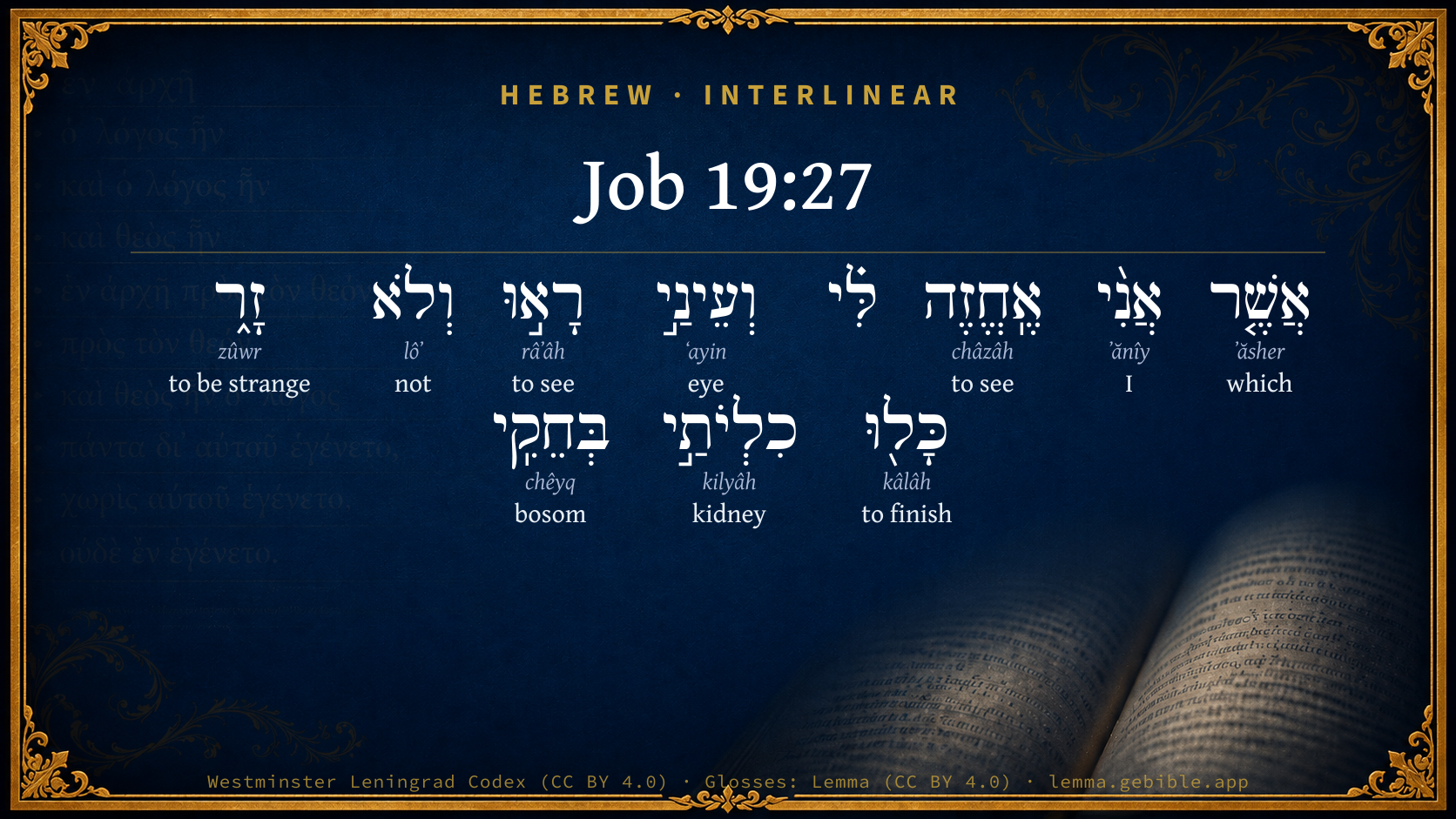
Hebrew (Westminster Leningrad Codex) Job 19:27 appears in the Hebrew Old Testament. The text above is from the Westminster Leningrad Codex. Each word links to its Strong’s number, a concise gloss, and parsing drawn from the Open Scriptures Hebrew Bible morphology. Click any word for its full Brown-Driver-Briggs (BDB) entry.
Download image
Cite this verse

Job 19:27 (World English Bible). Public Domain. Lemma interlinear Bible study tool, https://lemma.gebible.app/v/job/19/27.

Show BibTeX & RIS
BibTeX
RIS
English Translation
Whom I, even I, shall see on my side. My eyes shall see, and not as a stranger. "My heart is consumed within me.
World English Bible · Public Domain
Download a study sheet

One document with this verse’s original text, its word-by-word gloss line, the meaning frame, cross-references with their text, attributed commentary, and full source and license credits — printable, and it pastes into notes with its structure intact.

This verse Autodidact and up

Study sheet (.html) Plain text (.txt)

A passage Seminary Student

Up to 50 verses in one chapter. A passage sheet keeps up to 6 commentary sources and 12 cross-references per verse, in the order this page ranks them, and says so on the sheet whenever that leaves anything out. Ask for a single verse and you get the Autodidact verse sheet above.

Everything on this page stays free to read, with no account — the sheet is a download of what is already on screen, not access to it.

Want to remove ads? Support Godless Engineer
Compare translations 3

The same verse in 3 English versions, stacked beneath the original-language interlinear above. Click any original word for its lexicon entry.

Each is an independent rendering of the whole verse — the interlinear is not word-aligned to these translations.

Highlighted words mark where these versions differ — a whole-verse word diff, not a word-by-word alignment.

  • World English Bible Public Domain
    Whom I, even I, shall see on my side. My eyes shall see, and not as a stranger. "My heart is consumed within me.
  • King James Version Public Domain
    Whom I shall see for myself, and mine eyes shall behold, and not another; though my reins be consumed within me.
  • unfoldingWord Literal Text CC BY-SA 4.0
    whom I will behold for myself and my eyes will see, and not a stranger. My kidneys fail within my belly.

unfoldingWord Literal Text — © unfoldingWord, licensed CC BY-SA 4.0. Word-aligned USFM3 via Door43 (git.door43.org/unfoldingWord/en_ult).

Versions to compare (up to 4)

3 of 4 selected

Show all 18 translations

Every available English version of this verse, each an independent rendering of the whole verse.

  • World English Bible Public Domain
    Whom I, even I, shall see on my side. My eyes shall see, and not as a stranger. "My heart is consumed within me.
  • Berean Standard Bible Public Domain
    I will see Him for myself; my eyes will behold Him, and not as a stranger. How my heart yearns within me!
  • Majority Standard Bible Public Domain
    I will see Him for myself; my eyes will behold Him, and not as a stranger. How my heart yearns within me!
  • King James Version Public Domain
    Whom I shall see for myself, and mine eyes shall behold, and not another; though my reins be consumed within me.
  • American Standard Version (1901) Public Domain
    Whom I, even I, shall see, on my side, And mine eyes shall behold, and not as a stranger. My heart is consumed within me.
  • Revised Version (1885) Public Domain
    Whom I shall see for myself, and mine eyes shall behold, and not another. My reins are consumed within me.
  • Geneva Bible (1599) Public Domain
    Whome I my selfe shall see, and mine eyes shall beholde, and none other for me, though my reynes are consumed within me.
  • Douay-Rheims (1899) Public Domain
    Whom I myself shall see, and my eyes shall behold, and not another: this my hope is laid up in my bosom.
  • Young's Literal Translation Public Domain
    Whom I -- I see on my side, And mine eyes have beheld, and not a stranger, Consumed have been my reins in my bosom.
  • Literal Standard Version CC BY-SA 4.0
    Whom I see on my side, || And my eyes have beheld, and not a stranger, || My reins have been consumed in my bosom.
  • Unlocked Literal Bible CC BY-SA 4.0
    I will see him with my own eyes—I, and not someone else. My heart fails within me.
  • unfoldingWord Literal Text CC BY-SA 4.0
    whom I will behold for myself and my eyes will see, and not a stranger. My kidneys fail within my belly.
  • Darby Bible Public Domain
    Whom I shall see for myself, and mine eyes shall behold, and not another: -- my reins are consumed within me.
  • World Messianic Bible Public Domain
    whom I, even I, will see on my side. My eyes will see, and not as a stranger. “My heart is consumed within me.
  • Webster's Bible Public Domain
    Whom I shall see for myself, and my eyes shall behold, and not another; though my reins be consumed within me.
  • Free Bible Version CC BY-SA 4.0
    I myself will see him—with my own eyes, and not those of someone else! The thought overcomes me!
  • Bible in Basic English Public Domain
    Whom I will see on my side, and not as one strange to me. My heart is broken with desire.
  • JPS Tanakh (1917) Public Domain
    Whom I, even I, shall see for myself, and mine eyes shall behold, and not another's. My reins are consumed within me.

Literal Standard Version (2020), Covenant Press — licensed CC BY-SA 4.0. Text via the HelloAO Bible API (eBible.org). Unlocked Literal Bible (unfoldingWord) — licensed CC BY-SA 4.0. Text via the HelloAO Bible API (eBible.org). unfoldingWord Literal Text — © unfoldingWord, licensed CC BY-SA 4.0. Word-aligned USFM3 via Door43 (git.door43.org/unfoldingWord/en_ult). Free Bible Version, Dr. Jonathan Gallagher — licensed CC BY-SA 4.0. Text via the HelloAO Bible API (eBible.org).

Word by word

More ways to search: Search by grammar → Find every occurrence → Compare this word →

Practice this passage: Drill this verse → Learn its vocabulary →

כִלְיֹתַ֣י
kilyâh
H3629
“kidneys · my”
Noun, Common, Feminine, Plural, Construct + Suffix, Personal, 1st Person, Common, Singular
Part of Speech
Noun
Type
Common
Gender
Feminine
Number
Plural
State
Construct
Full BDB Definition

Origin: from H3627 (only pl.)

TWOT: 983a

kidneys - of physical organ (literally) - of seat of emotion and affection (figuratively) - of sacrificial animals - (TWOT) reins
  1. אֲשֶׁ֤ר ʼăsher H834 “which” Particle, Relative
  2. אֲנִ֨י ʼănîy H589 “I” Pronoun, Personal, 1st Person, Common, Singular
  3. אֶֽחֱזֶה châzâh H2372 “to see” Verb, Qal, Imperfect, 1st Person, Common, Singular
  4. וְעֵינַ֣י ʻayin H5869 “and · eyes · my” Conjunction + Noun, Common, Both, Dual, Construct + Suffix, Personal, 1st Person, Common, Singular
  5. רָא֣וּ râʼâh H7200 “to see” Verb, Qal, Perfect, 3rd Person, Common, Plural
  6. וְלֹא lôʼ H3808 “and · not” Conjunction + Particle, Negative
  7. זָ֑ר zûwr H2114 “strange” Adjective, Adjective, Masculine, Singular, Absolute
  8. כָּל֖וּ kâlâh H3615 “to finish” Verb, Qal, Perfect, 3rd Person, Common, Plural
  9. בְּחֵקִֽי chêyq H2436 “in/at · bosom · my” Preposition + Noun, Common, Masculine, Singular, Construct + Suffix, Personal, 1st Person, Common, Singular

About this verse

These counts appear in no published source. They are computed here, from the morphology-tagged text and Lemma’s own curated glosses. What Lemma adds →

11
words
10
distinct lemmas
Wisdom
section

Shared distinctive vocabulary

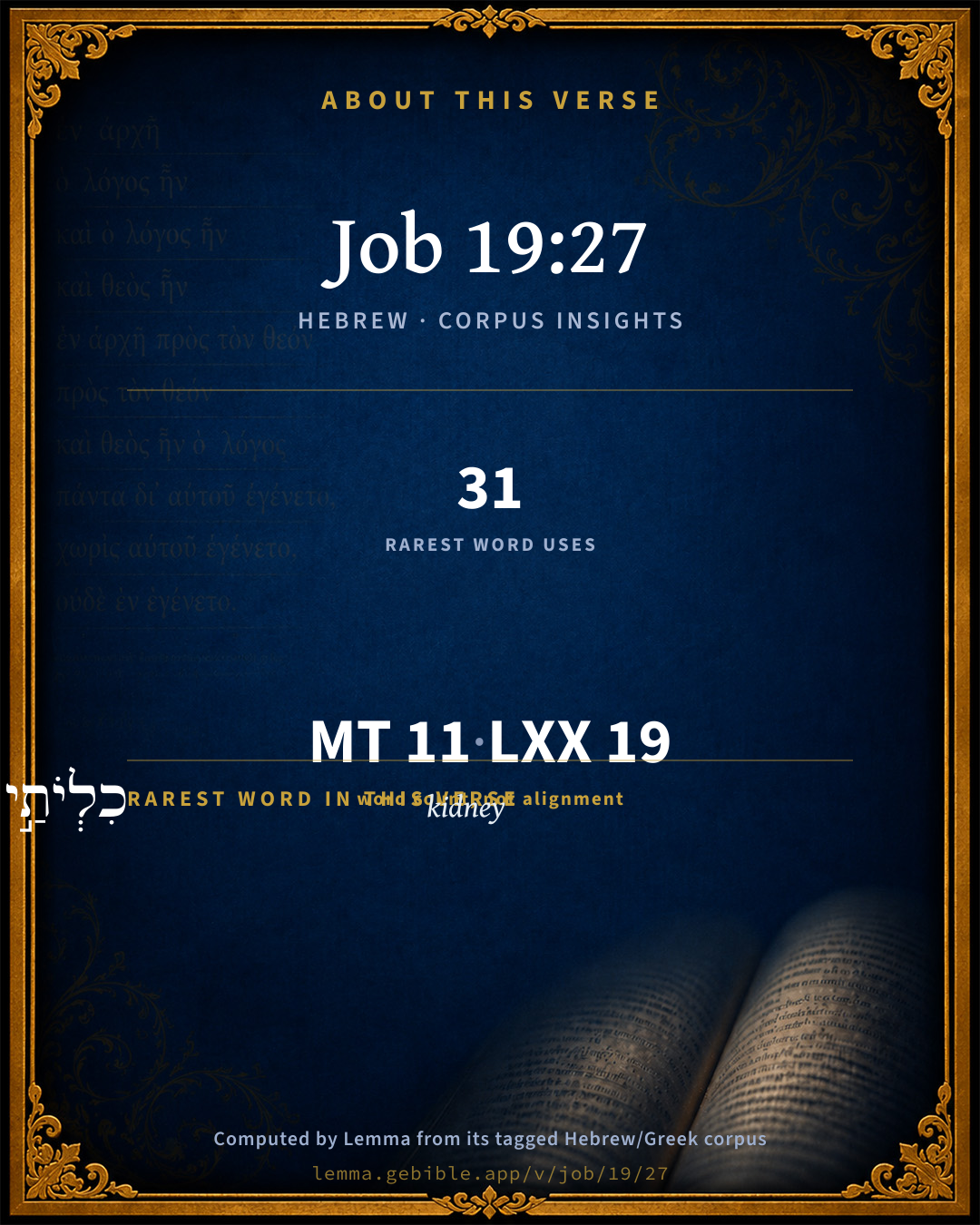
כִלְיֹתַ֣י kidney H3629 occurs in 26 verses of the Hebrew Bible. Also found in:

Grammatical profile

  • 3 verbs
  • 3 nouns
  • 1 adjective
  • 1 pronoun
  • 1 preposition
  • 2 particles

Verb forms

  • אֶֽחֱזֶה Qal · Imperfect
  • רָא֣וּ Qal · Perfect
  • כָּל֖וּ Qal · Perfect

Hebrew & Septuagint length

In English translation the verse runs 24 words from the Hebrew and 25 from the Septuagint (LXX English) — closely comparable.

A rough comparison of the two English renderings, which tokenize alike — not a word-level alignment.

Word counts can differ between the Hebrew and the Greek without any difference in meaning — e.g. the Hebrew direct-object marker אֵת has no separate Greek word, and Greek often adds the article ὁ.

In the original languages it is 11 Hebrew tokens and 19 Greek tokens — but the two are counted differently (Hebrew bundles its prefixes and suffixes into one token; the Greek is in lemma form), so that isn’t a like-for-like length.

Cross-references

3

Topical passages linked to Job 19:27 in the Treasury of Scripture Knowledge — connected by theme and wording, ordered by reader-vote popularity; previews shown in the World English Bible.

  • Psalms 73:26 My flesh and my heart fails, But God is the strength of my heart and my portion forever.
  • Isaiah 26:19 Your dead shall live; my dead bodies shall arise. Awake and sing, you who dwell in the dust; for your dew is [as] the dew of herbs, and the earth shall cast forth the dead.
  • Numbers 24:17 I see him, but not now; I see him, but not near: There shall come forth a star out of Jacob, A scepter shall rise out of Israel, Shall strike through the corners of Moab, Break down all the sons of tumult.

Cross-references courtesy of OpenBible.info (CC BY 4.0).

Hebrew and Greek witnesses Masoretic Hebrew ↔ Greek Septuagint

The same verse in the two great witnesses to the Old Testament, shown verse-for-verse.

These are two independent witnesses, not word-aligned to each other, and the Septuagint is shown in lemma (dictionary) form.

Hebrew Job 19:27 Masoretic · Westminster Leningrad Codex

אֲשֶׁ֤ר אֲנִ֨י אֶֽחֱזֶה לִּ֗י וְעֵינַ֣י רָא֣וּ וְלֹא זָ֑ר כָּל֖וּ כִלְיֹתַ֣י בְּחֵקִֽי

Whom I, even I, shall see on my side. My eyes shall see, and not as a stranger. "My heart is consumed within me.

World English Bible · Public Domain

Greek LXX Job 19:27 Septuagint · lemma form

ὅς ἐγώ ἐμαυτοῦ συν ἐπιἵσταμαι ὅς ὁ ὀφθαλμός ἐγώ ὁράω καί οὐ ἄλλος πᾶς δέ ἐγώ συντελέω ἐν κόλπος

which I am conscious of in myself, which my eye has seen, and not another, but all have been fulfilled to me in my bosom.

LXX2012 (modern English Septuagint) · Public Domain

On this verse, Albert Barnes' Notes on the Bible discusses the Septuagint’s reading. Read the note in Commentary ↓

Hebrew: Westminster Leningrad Codex (CC BY 4.0). Greek: Septuagint (public domain); English from LXX2012 (modern English Septuagint) (Public Domain). How the Septuagint differs from the Hebrew →

Commentary

Notes on Job 19:27 from classic Christian and Jewish commentators (each source and its license shown beneath its notes). The classic Christian expositions comment on the surrounding passage and are grouped to its opening verse, so a note may address several verses; the Jewish commentaries on the Tanakh (Rashi and others) are per-verse, so they appear only where the commentator wrote on this verse.

Lemma curates 59 commentaries, every one of them public domain or Creative Commons licensed, each selected and text-cleaned for this edition rather than reprinted as found. About our sources →

Trapp's Complete Commentary

John Trapp

Job 19:27 Whom I shall see for myself, and mine eyes shall behold, and not another; [though] my reins be consumed within me.

Ver. 27. Whom I shall see for myself] He speaketh confidently, as one fully assured of a resurrection; which, if it should not be, how should there be a remuneration of the body? Say not, we cannot see how it is possible. See we not a yearly resurrection of grass, grain, herbs, flowers, fruits, every spring time? Know we not that men can of ashes make glasses? that a chemist can of several metals, mixed together, extract the one from the other, and reduce every metal to its own species or kind? Etiam animalculae quaedam typi Resurrectionis sunt, saith Lavater: Some little living creatures are types of the resurrection. He instanceth in dormancey, which sleep all winter, and revive in the spring; in silkworms, which, dying, leave nothing behind them but a certain excrement, which, being borne about in the bosoms of women, takes heat and reviveth. Wherefore, if nature do such things, shall it be held hard for the God of nature to raise the dead? The keeping green of Noah’s olive tree in the time of the flood; the blossoming of Aaron’s dry rod; the flesh and sinews coming to Ezekiel’s dry bones; what were these but living emblems of the resurrection?

And mine eyes shall behold, and not another] Here he maintaineth the identity of his flesh and body in the resurrection; an identity, I say, not specific only, but numeric or individual. The self-same particular body which fell shall rise. This was denied of old by the Marcionists, Basilidians, and Valentinians (those semi-Sadducees, as Tertullian termeth them); and after them Eutychius, bishop of Constantinople, who, as Gregory saith, taught that men, rising again, should have airy bodies, and not fleshly, yea, more subtile than the air, abusing that place of the apostle, "It is sown a natural body; it is raised again a spiritual body," &c.: but his book was burnt as heretical. A spiritual body it is called, for its great strength and activity wherewith it shall be endowed, and whereby it is enabled to bear a weight of glory; as also, for that it shall have no need of food, sleep, or other natural helps, but we shall be as the angels of God, Mat 22:30, yet still the same men that now we are. Let no man say, with Nicodemus, How can this be? There is no difficulty to Omnipotence, Php 3:21. Besides, there is a substance still preserved, even when the body is turned to dust, and this shall be raised, clarified, and reunited to the soul. He that made man at first of nothing, can easily remake him of something. And what though his dust be scattered hither and thither, and mixed with that of others? The skilful gardener, having various sorts of seeds mixed together, can soon separate them; and shall not he, who hath the whole earth in his fist, discern the dust of his saints one from another? Little balls or pickles of quicksilver, being scattered on the ground, mix not themselves with any of another kind; but if any man gather them, they run together into one of their own accord; so it is here, saith Greg. Nyssen.

Though my reins be consumed within me] Though, from my skin outward to my reins inward, all be wasted, yet all shall be raised and restored. The Vulgate rendereth these words thus, This hope is laid up in my bosom; and is by Burgensis expounded thus, This is the only thing that I do most earnestly wish and wait for; viz. to see Christ in the flesh at the last day: the reins are the seat of strong desires.

John Trapp, A Commentary or Exposition upon All the Books of the Old and New Testament (1647–1656) — public domain. Text from a community e-Sword module.

Joseph Benson's Commentary

Job 19:27. Whom I shall see — In the manner before and after expressed. No wonder that he repeats it again, because the meditation of it was most sweet to him; for myself — For my own benefit and comfort, as the phrase is often used. Or, which is of much the same importance, on my behalf, to plead my cause and vindicate me from all your reproaches. Mine eyes shall behold, and not another — Namely, for me, or in my stead. I shall not see God by another’s eyes, but by my own, and by this self-same body which now I have. Hebrew, ולא זר, velo zar, not a stranger, that is, this privilege shall be granted to me, and to all other sincere servants of God, but not to such as are strangers to God and his people, being alienated from him and his service. And, if I were such a one as you suppose me to be, I could never hope to enjoy that happiness. Though my reins be consumed within me — This I do confidently expect, though at present my case seems hopeless, my very inward parts being consumed with grief; and though, as I have said, the grave and the worms will consume my whole body. Or, without though, for which there is nothing in the Hebrew, My reins are consumed within me: which may be considered as a passionate exclamation, such as we find Gen 48:18, and often in the book of Psalms, arising from his confident expectation of this his unspeakable happiness, and expressing his vehement desire and longing for that blessed time and state. The intelligent reader will be glad to see father Houbigant’s translation of these three important verses, which is as follows: Job 19:25, For I know that my Redeemer liveth, and that he shall hereafter arise over the dust: Job 19:26, And that even I, after my skin is consumed, shall behold my God in my flesh: Job 19:27, Yes, I shall behold him: my eyes, and not another’s, shall see him. This my hope is reposed in my bosom.

Joseph Benson's Commentary on the Old and New Testaments (1811–1818) — public domain. Text from a community e-Sword module.

Tyndale Open Study Notes

Tyndale Open Resources

19:27 I will see him for myself: The thought is the same as the psalmist’s in “when I awake” (Ps 17:15). For Job, this hope could only be fulfilled in seeing God at the end of time (Matt 5:8; 1 Cor 13:12; 1 Jn 3:2; Rev 1:7) in transformed flesh (1 Cor 15:43-53; Phil 3:21).

Tyndale Open Study Notes — © Tyndale Open Resources, licensed CC BY-SA 4.0. Text via the HelloAO Bible API.

Jamieson, Fausset & Brown

Robert Jamieson, A. R. Fausset & David Brown

for myself--for my advantage, as my friend.

not another--Mine eyes shall behold Him, but no longer as one estranged from me, as now [BENGEL].

though--better omitted.

my reins--inward recesses of the heart.

be consumed within me--that is, pine with longing desire for that day (Psa 84:2; Psa 119:81). The Gentiles had but few revealed promises: how gracious that the few should have been so explicit (compare Num 24:17; Mat 2:2).

Jamieson, Fausset & Brown — Commentary Critical and Explanatory on the Whole Bible (1871) — public domain (CC PDM 1.0). Text via the HelloAO Bible API.

Adam Clarke's Commentary

Verse 27. Whom I shall see for myself] Have a personal interest in the resurrection, as I shall have in the Redeemer.

And mine eyes shall behold] That very person who shall be the resurrection, as he is the life.

And not another] ולא זר velo zar, and not a stranger, one who has no relation to human nature; but גאלי goali, my redeeming Kinsman.

Though my reins be consumed within me.] Though I am now apparently on the brink of death, the thread of life being spun out to extreme tenuity.

This, on the mode of interpretation which I have assumed, appears to be the meaning of this passage. The words may have a somewhat different colouring put on them; but the basis of the interpretation will be the same.

I shall conclude with the version of Coverdale: -

For I am sure that my Redeemer liveth;

And that I shal ryse out of the earth in the latter daye;

That I shal be clothed againe with this skynne

And se God in my flesh.

Yee, I myself shal beholde him,

Not with other, but with these same eyes.

My reins are consumed within me, when ye saye,

Why do not we persecute him?

We have founde an occasion against him.

Adam Clarke's Commentary on the Bible (1810–1826) — public domain. Text from a community e-Sword/MySword module.

Ellicott's Commentary for English Readers

(27) My reins be consumed within me.—i.e., with longing to see Him; literally, my reins are consumed in my bosom. The words “in my flesh” may mean from my flesh, or, without my flesh. Taken in the former sense and applied to the future, it is hard not to recognise in them, at the least, some dim conception of a resurrection.

(27) Whom I shall see for myself.—The words “see for myself” may mean see on my side, i.e., as my Judge and Avenger; or they may be the personal intensifying of the conviction which seems confirmed by the words, “and not a stranger.” Do Job’s words then teach the doctrine of the resurrection? Possibly not directly, but they express the firm conviction of that faith of which the resurrection is the only natural justification; they express a living trust in a living personal God, who, if He is to come into contact with man, cannot suffer His Holy One to see corruption nor leave His soul in hell. How far Job believed in the resurrection of the flesh hereafter, he certainly believed there was life out of death and through death here; and no man can believe in a living God and not believe that He must and will triumph over death. It is possible for us to believe in some dogma about the resurrection, and yet not believe in God. In this respect we shall be unlike Job. It is impossible for us to believe as he did and not be ready and thankful to believe in the resurrection of Christ, and of those who belong to Christ, as soon as the fact is proclaimed to us on sufficient authority. In this way, and for this reason, the confession of Job rightly stands at the head of the Christian Office for the Burial of the Dead, which looks forward to the resurrection, and lays fast hold thereon. Those who decline to see in Job’s confession any knowledge or hope of a resurrection, must not forget that they have also to explain and account for Isa_26:19.

A Bible Commentary for English Readers, edited by Charles John Ellicott (1878–1897) — public domain. Text from a community e-Sword module.

The Cambridge Bible for Schools and Colleges

gen. ed. J. J. S. Perowne

27. Whom I shall see for myself] These words might mean merely, whom I myself shall see; or, for myself may mean, favourable to me, on my side and to my joy.

and not another] i. e. I and not another (shall see). Job heaps up phrases to express his assurance that he shall see God, “I shall see for myself,” “mine eyes shall behold,” “I and not another.” The whole of his misery might be expressed in saying that God hid Himself from him, and the whole of his redemption and joy will consist in seeing God. Others take the words “not another,” lit. not a stranger, to refer to God—whom I shall see not as a stranger, i. e. no more estranged or hostile. The position of the words, however, close beside the phrase “mine eyes,” is rather in favour of the other view.

though my reins be consumed] Rather, my reins consume within me, lit. in my bosom (marg.). The words are an exclamation, meaning I faint, cf. Psa_73:26; Psa_84:2; Psa_119:81; Psa_119:123. The reins are the seat of the deepest feelings and experiences, especially of those toward God. Job began with expressing his assurance that he should see God, but as he proceeds so vivid is his hope that it becomes almost reality, the intensity of his thought creates an ecstatic condition of mind in which the vision of God seems almost realized, and he faints in the presence of it. See Additional Note on ch. Job_19:23-27 at the end of the Volume.

The Cambridge Bible for Schools and Colleges (gen. ed. J. J. S. Perowne; Cambridge University Press, 1878–1918) — public domain. Text from a community e-Sword module.

John Gill's Exposition

But ye should say,.... Here Job directs his friends what use they should make of this confession of his faith; they should upon this say within themselves, and to one another,

why persecute we him, seeing the root of the matter is found in me? Why should we pursue him with hard words, and load him with censures and reproaches, as if he was an hypocrite, when it appears, by what he says, that he has truth in the inward parts, the true grace of God is in him; that he is rooted in the love of God, and in the person of the Redeemer; that he has the Spirit of God in him, and the divine seed which has taken root in him, and brings forth fruit: or that "the root of the word" (k) is in him; the word of God has a place in him, and is become the ingrafted word; the root doctrines, the principal and fundamental truths of religion, are believed and professed by him, such as respect the incarnation of the Messiah, his resurrection from the dead, and coming to judgment, the resurrection of all the dead in the same body, a future state of happiness, in which saints will enjoy the beatific vision; since these things are firmly believed by him, though he may differ from us in some points about the methods of divine Providence, let us cease from persecuting him any further; see Rom 10:8.

(k) "radix verbi", Montanus, Mercerus, Schmidt, Michaelis; "radix sermonis", Cocceius; "fundamenta negotii salutis", Tigurine version.

John Gill's Exposition of the Whole Bible (1746–1763) — public domain (CC PDM 1.0). Text via the HelloAO Bible API.

Albert Barnes' Notes on the Bible

Whom I shall see for myself - It will not come to be by mere report. I shall not merely hear of the decision of God in my favor, but I shall myself behold him. He will at length come forth, and I shall be permitted to see him, and shall have the delightful assurance that he settles this controversy in my favor, and declares that I am his friend. Job was thus permitted to see God Job 42:5, and hear his voice in his favor. He spake to him from the whirlwind Job 38:1, and pronounced the sentence in his favor which he had desired.

And not another - Margin, a stranger. So in the Hebrew. The meaning is, that his own eyes would be permitted to see him. He would have the satisfaction of seeing God himself, and of hearing the sentence in his favor. That expectation he deemed worthy of a permanent record, and wished it transmitted to future times, that in his darkest days and severest trials - when God overwhelmed him, and man forsook him, he still firmly maintained his confidence in God, and his belief that he would come forth to vindicate his cause.

Though my reins - The margin renders this, “my reins within me are consumed with earnest desire for that day.” Noyes translates it, “For this my soul panteth within me.” Herder,

I shall see him as my deliverer,

Mine eyes shall behold him, as mine,

For whom my heart so long fainted.

So Wemyss, “My reins faint with desire of his arrival.” Jerome renders it (Vulgate), reposita est hoec spes mea in sinu meo - “this, my hope, is laid up in my bosom.” The Septuagint, “All which things have been done - συντετέλεσται suntetelestai - in my bosom,” but what they understood by this it is difficult to say. The word rendered “reins” כליה kı̂lyâh - or in the plural כליות kı̂lyôth - in which form only it is found), means properly the reins, or the kidneys Job 16:13. and then comes to denote the inward parts, and then the seat of the desires and affections, because in strong emotions the inward parts are affected. We speak of the heart as the seat of the affections, but with no more propriety than the Hebrews did of the upper viscera in general, or of the reins. In the Scriptures the heart and the reins are united as the seat of the affections. Thus, Jer 11:20, God “trieth the reins and the heart;” Jer 17:10; Jer 20:12; Psa 7:10. I see no reason why the word here may not be used to denote the viscera in general, and that the idea may be, that he felt that his disease was invading the seat of life, and his body, in all its parts, was wasting away. Our word vitals, perhaps, expresses the idea.

Be consumed - Gesenius renders this, “Pine away.” So Noyes, Wemyss, and some others. But the proper meaning of the word is, to consume, to be wasted, to be destroyed. The word כלה kâlâh strictly means to finish, complete, render entire; and thence has the notion of completion or finishing - whether by making a thing perfect, or by destroying it. It is used with reference to the eyes that fail or waste away with weeping, Lam 2:11, or to the spirit or heart. as fainting with grief and sorrow. Psa 84:3; Psa 143:7; Psa 69:4. It is used often in the sense of destroying. Jer 16:4; Ezr 5:13; Psa 39:11; Isa 27:10; Isa 49:4; Gen 41:30; Jer 14:12; et soepe al. This, I think, is the meaning here. Job affirms that his whole frame, external and internal, was wasting away, yet he had confidence that he would see God.

Within me - Margin, in my bosom. So the Hebrew. The word bosom is used here as we use the word chest - and is not improperly rendered “within me.” In view of this exposition of the words, I would translate the whole passage as follows:

For I know that my Avenger liveth,

And that hereafter he shall stand upon the earth;

And though after my skin this (flesh) shall be destroyed,

Yet even without my flesh shall I see God:

Whom I shall see for myself,

And mine eyes shall behold, and not another,

Though my vitals are wasting away within me.

It has already been observed, that very various views have been entertained of this important passage of Scripture. The great question has been, whether it refers to the Messiah, and to the resurrection of the dead, or to an expectation which Job had that God would come forth as his vindicator in some such way as he is declared afterward to have done. It may be proper, therefore. to give a summary of the arguments by which these opinions would be defended. I have not found many arguments stated for the former opinion, though the belief is held by many, but they would be probably such as the following: -

I. Arguments which would be adduced to show that the passage refers to the Messiah and to the future resurrection of the dead.

(1) The language which is used is such as would appropriately describe such events. This is undoubted, though more so in our translation than in the original; but the original would appropriately express such an expectation.

(2) The impression which it would make on the mass of readers, and particularly those of plain, sober sense, who had no theory to defend. It is probably a fact, that the great body of the readers of the Bible suppose that it has such a reference. It is usually a very strong presumptive proof of the correctness of an interpretation of Scripture when this can be alleged in its favor, though it is not an infallible guide.

(3) The probability that some knowledge of the Messiah would prevail in Arabia in the time of Job. This must be admitted, though it cannot be certainly demonstrated; compare Num 24:17. The amount of this is, that it could not be regarded as so improbable that any such knowledge would prevail as to demonstrate certainly that this could not be referred to the Messiah.

(4) The probability that there would be found in this book some allusion to the Redeemer - the great hope of the ancient saints, and the burden of the Old Testament But this is not conclusive or very weighty, for there are several of the books of the Old Testament which contain no distinct allusion to him.

(5) The pertinency of such a view to the case, and its adaptedness to give to Job the kind of consolation which he needed. There can be no doubt of the truth of this; but the question is, not what would have imparted consolation, but what knowledge he actually had. There are many of the doctrines of the Christian religion which would have been eminently fitted to give comfort in such circumstances to a man in affliction, which it would be exceedingly unreasonable to expect to find in the book of Job, and which it is certain were wholly unknown to him and his friends.

(6) The importance which he himself attached to his declaration, and the solemnity of the manner in which he introduced it. His profession of faith on the subject he wished to have engraved in the eternal rocks. he wished it transmitted to future times. He wished a permanent record to be made, that succeeding ages might read it, and see the ground of his confidence and his hope. This, to my mind, is the strongest argument which has occurred in favor of the opinion that the passage refers to the Redeemer and to the resurrection. These are all the considerations which have occurred to me, or which I have found stated, which would go to sustain the position that the passage referred to the resurrection. Some of them have weight; but the prevailing opinion, that the passage has such a reference. will be found to be sustained, probably, more by the feelings of piety than by solid argument and sound exegesis. It is favored, doubtless, by our common version, and there can be no doubt that the translators supposed that it had such a reference.

II. On the other hand, weighty considerations are urged to show that the passage does not refer to the Messiah, and to the resurrection of the dead. They are such as the following:

(1) The language, fairly interpreted and translated, does not necessarily imply this. It is admitted that our translators had this belief, and without doing intentional or actual violence to the passage, or designing to make a forced translation, they have allowed their feelings to give a complexion to their language which the original does not necessarily convey. Hence, the word “Redeemer,” which is now used technically to denote the Messiah, is employed, though the original “may,” and commonly “does,” have a much more general signification; and hence, the phrase “at the latter day,” also a technical phrase, occurs, though the original means no more than “afterward” or “after this;” and hence, they have employed the phrase “in my flesh,” though the original means no more than “though my flesh be all wasted away.” The following I believe to express fairly the meaning of the Hebrew:” I know that my deliverer, or avenger, lives, and that he will yet appear in some public manner on the earth; and though after the destruction of my skin, the process of corruption shall go on until “all” my flesh shall be destroyed, yet when my flesh is entirely wasted away, I shall see God; I shall have the happiness of seeing him for myself, and beholding him with my own eyes, even though my very vitals shall be consumed. He will come and vindicate me and my cause. I have such confidence in his justice, that I do not doubt that he will yet show himself to be the friend of him who puts his trust in him.”

(2) It is inconsistent with the argument, and the whole scope and connection of the book, to suppose that this refers to the Messiah and to the resurrection of the body after death. The book of Job is strictly an “argument” - a train of clear, consecutive reasoning. It discusses a great inquiry about the doctrines of divine Providence and the divine dealings with people. The three friends of Job maintained that God deals with men strictly according to their character in this life - that eminent wickedness is attended with eminent suffering; and that when people experience any great calamity, it is proof of eminent wickedness. All this they meant to apply to Job, and all this Job denied. Yet he was perplexed and confounded. He did not know what to do with the “facts” in the case; but still he felt embarrassed. All that he could say was, that God would “yet” come forth and show himself to be the friend of those who loved him and that though they suffered now, yet he had confidence that be would appear for their relief.

Now, had they possessed the knowledge of the doctrine of the “resurrection of the dead,” it would have ended the whole debate. it would not only have met all the difficulties of Job, but we should have found him perpetually recurring to it - placing it in every variety of form - appealing to it as relieving his embarrassments, and as demanding an answer from his friends. But, on the supposition that this refers to the resurrection, it is remarkable that the passage here stands alone. Job never adverted to it before, but allowed himself to be greatly embarrassed for the lack of just such an argument, and he never refers to it again. He goes on to argue again “as if” he believed no such doctrine. He does not ask his friends to notice this: he expresses no surprise that they should pass by, in entire neglect, an argument which “must have been seen” to be decisive of the controversy. It is equally unaccountable that his friends should not have noticed it.

If the doctrine of the resurrection was true, it settled the case. It rendered all their arguments worthless, and would have met the case just as we meet similar cases now. It was incumbent on them to show that there was no evidence of the truth of any such doctrine as the resurrection, and that this could not be urged to meet their arguments. Yet they never allude to so important and unanswerable an argument, and evidently did not suppose that Job referred to any such event. It is equally remarkable that neither Elihu nor God himself, in the close of the book, make any such allusion, or refer to the doctrine of the resurrection at all, as meeting the difficulties of the case. In the argument with which the Almighty is represented as closing the book, the whole thing is resolved into a matter of “sovereignty,” and people are required to submit because God is great, and is inscrutable in his ways - not because the dead will be raised, and the inequalities of the present life will be recompensed in a future state. The doctrine of a “resurrection” - a great and glorious doctrine, such as, if once suggested, could not have escaped the profound attention of these sages - would have solved the whole difficulty; and yet, confessedly, it is never alluded to by them - never introduced - never examined - never admitted or rejected - never becomes a matter of inquiry, and is never referred to by God himself as settling the matter - never occurs in the book in any form, unless it be in this. This is wholly unaccountable on the supposition that this refers to the resurrection.

(3) The interpretation which refers this to the resurrection of the dead, is inconsistent with numerous passages where Job expresses a contrary belief. Of this nature are the following: Job 7:9,” As the cloud is consumed, and vanisheth away, so he that goeth down to the grave shall come up no more;” Job 7:21, “I shall sleep in the dust thou shalt seek me in the morning, but I shall not be;” see Job 10:21-22, “I go whence I shall not return - to the land of darkness, and the shadow of death; a land of darkness as darkness itself;” Job 14 throughout, particularly Job 14:7, Job 14:9,Job 14:11-12,” For there is hope of a tree, if it be cut down, that it will sprout again, and that the tender branch thereof will not cease. But man dieth, and wasteth away; yea, man giveth up the ghost, and where is he? As the waters fail from the sea, and the flood decayeth and drieth up, so man lieth down and riseth not; until the heavens be no more, they shall not awake, nor be raised out of their sleep.”

Job 16:22, “when a few years are come, then I shall go the way whence I shall not return.” These passages all imply that when he should die, he would not appear again on the earth. This is not such language as one would use who believed in the resurrection of the dead. It is true, that in the discourses of Job, various and sometimes apparently contradictory feelings are expressed. He was a severe sufferer; and under strong conflicting emotions he sometimes expressed himself in a manner which he at other times regrets, and gives vent to feelings which, on mature reflection, he confesses to have been wrong. But how is it “possible” to believe that a man, in his circumstances, would ever deny the doctrine of the resurrection if he held it? How could he forget it? How could he throw out a remark that “seemed” to imply a doubt of it? If he had known of this, it would have been a sheet-anchor to his soul in all the storms of adversity - an unanswerable argument to all that his friends advanced - atopic of consolation which he could never have lost sight of, much less denied. He would have clung to that hope as the refuge of his soul, and not for one moment would he have denied it, or expressed a doubt of its truth.

(4) I may urge as a distinct argument what has before been hinted at, that this is not referred to as a topic of consolation by either of the friends of Job, by Elihu, or by God himself. Had it been a doctrine of those times, his friends would have understood it, and it would have reversed all their theology. Had it been understood by Elihu, he would have urged it as a reason for resignation in affliction. Had God designed that it should be known in that age, no more favorable opportunity could be conceived for the purpose than at the end of the arguments in this book. What a flood of light would it have thrown on the design of afflictions! How effectually would it have rebuked the arguments of the friends of Job! And how clear is it, therefore, that God did not “intend” that it should then be revealed to man, but meant that it should be reserved for a more advanced state of the world, and particularly that it should be reserved as the grand doctrine of the Christian revelation.

(5) A fifth consideration is, that on the supposition that it refers to the resurrection, it would be inconsistent with the views which prevailed in the age when Job is supposed to have lived. It is wholly in advance of that age. It makes little difference in regard to this whether we suppose him to have lived in the time of Abraham, Jacob, or Moses, or even at a later period - such a supposition would be equally at variance with the revelations which had then been given. The clear doctrine of the resurrection of the dead, is one of the unique doctrines of Christianity - one of the last truths of revelation, and is one of the glorious truths which seem to have been reserved for the Redeemer himself to make known to man. There are, indeed, obscure traces of it in the Old Testament. Occasionally we meet with a hint on the subject that was sufficient to excite the hopes of the ancient saints, and to lead them to suppose that more glorious truths were in reserve to be communicated by the Messiah. But those hints occur at distant intervals; are obscure in their character, and perhaps if all in the Old Testament were collected, they would not be sufficient to convey any very intelligible view of the resurrection of the dead.

But on the supposition that the passage before us refers to that doctrine, we have here one of the most clear and full revelations on the subject, laid far back in the early ages of the world, originating in Arabia, and entirely in advance of the prevailing views of the age, and of all that had been communicated by the Spirit of inspiration to the generations then living. It is admitted, indeed, that it was “possible” for the Holy Spirit to communicate that truth in its fulness and completeness to an Arabian sage; but it is not the way in which revelation, in other respects, has been imparted. It has been done “gradually.” Obscure intimations are given at first - they are increased from time to time - the light becomes clearer, until some prophet discloses the whole truth, and the doctrine stands complete before us. Such a course we should expect to find in regard to the doctrine of the resurrection, and such is exactly the course pursued, unless “this” passage teaches what was in fact the highest revelation made by the Messiah.

(6) All which the words and phrases fairly convey, and all which the argument demands, is fully met by the supposition that it refers to some such event as is recorded in the close of the book. God appeared in a manner corresponding to the meaning of the words here upon the earth. He came as the Vindicator, the Redeemer, the גאל gō'el, of Job. He vindicated his cause, rebuked his friends, expressed his approbation of the sentiments of Job, and blessed him again with returning prosperity and plenty. The disease of the patriarch may have advanced, as he supposed it would. His flesh may have wasted away, but his confidence in God was not misplaced, and he came forth as his vindicator and friend. It was a noble expression of faith on the part of Job; it showed that he “had” confidence in God, and that in the midst of his trials he truly relied on him; and it was a sentiment worthy to be engraved in the eternal rock, and to be transmitted to future times.

It was an invaluable lesson to sufferers, showing them that confidence could, and should be placed in God in the severest trials. So far as I can see, all that is fairly implied in the passage, when properly interpreted, is fully met by the events recorded in the close of the book. Such an interpretation meets the exigency of the case, accords with the strain of the argument and with the result, and is the most simple and natural that has been proposed. These considerations are so weighty in my mind that they have conducted me to a conclusion, contrary I confess to what I had “hoped” to have reached, that this passage has no reference to the Messiah and the doctrine of the resurrection. We do not “need” it - for all the truths respecting the Messiah and the resurrection which we need, are fully revealed elsewhere; and though this is an exquisitely beautiful passage, and piety would love to retain the belief that it refers to the resurrection of the dead, yet “truth” is to be preferred to indulgence of the wishes and desires of the heart, however amiable or pious, and the “desire” to find certain doctrines in the Bible should yield to what we are constrained to believe the Spirit of inspiration actually taught.

I confess that I have never been so pained at any conclusion to which I have come in the interpretation of the Bible, as in the case before us. I would like to have found a distinct prophecy of the Messiah in this ancient and venerable book. I would like to have found the faith of this eminent saint sustained by such a faith in his future advent and incarnation. I would like to have found evidence that this expectation had become incorporated in the piety of the early nations, and was found in Arabia. I would like to have found traces of the early belief of the doctrine of the resurrection of the dead sustaining the souls of the patriarchs then, as it does ours now, in trial. But I cannot. Yet I can regard it as a most beautiful and triumphant expression of confidence in God, and as wholly worthy to be engraved, as Job desired it might be, in the solid rock forever, that the passing traveler might see and read it; or as worthy of that more permanent record which it has received by being “printed in a book” - by an art unknown then, and sent down to the end of the world to be read and admired in all generations.

The opinion which has now been expressed, it is not necessary to say, has been held by a large number of the most distinguished critics. Grotius says that the Jews never applied it to the Messiah and the resurrection. The same opinion is held by Grotius himself, by Warburton, Rosenmuller, Le Clerc, Patrick, Kennicott, Dalthe, and Jahn. Calvin seems to be doubtful - sometimes giving it an interpretation similar to that suggested above, and then pursuing his remarks as if it referred to the Messiah. Most of the fathers, and a large portion of modern critics, it is to be admitted, suppose that it refers to the Messiah, and to the future resurrection.

Albert Barnes' Notes on the Bible (1834–1885) — public domain. Text from a community e-Sword/MySword module.

Haydock's Catholic Bible Commentary

Myself. Hebrew, "for myself," and for my comfort; not like the reprobate, who shall see their judge to their eternal confusion. Job insists so much on this point, that he shews he in not speaking merely of the divine favour being restored to him, in the re-establishment of his health and affairs, but that he raises his mind to something more solid and desirable, of which the former was only a faint representation. (Calmet) --- "No one since Christ has spoken so plainly of the resurrection, as this man did before the coming of the Messias." (St. Jerome, ad Pam.) --- This. Hebrew, "though my reins be consumed within me;" (Protestants; Haydock) or, "my reins (desires and tender affections) are completed in my bosom." (Calmet)

George Leo Haydock (1774–1849), Haydock's Catholic Family Bible and Commentary, 1859 edition — public domain. Excludes Psalms (Douay-Rheims chapter numbering differs from Protestant) and Deuterocanonical books (Catholic canon only).

Matthew Poole's English Annotations

Whom I shall see, in manner before and after expressed. No wonder that he repeats it again, because the meditation of it was most sweet to him.

For myself, i.e. for my own comfort and benefit, as that phrase is oft used. Or, which is much of the same importance, on my behalf; to plead my cause, and vindicate me from all your reproaches.

Not another, to wit, for me, or in my stead. I shall not see God by another’s eyes, but by my own, and by these selfsame eyes in this same body which now I have. Heb. not a stranger, i.e. this privilege shall be granted to me and to all other sincere servants of God, but not to strangers, i.e. to wicked men, who are oft called strangers, as Psa 18:44,45; 54:3; Pro 21:8, because they are estranged or alienated from God, and from his service and people. And if I were such a one, as you suppose me to be, I could never hope to enjoy that happiness.

Though my reins be consumed within me: this I do confidently expect and hope for, though at present my case seems desperate, my very inward parts being even consumed with grief; and though, as I have said, the grave and the worms will consume my whole body, not excepting the reins, which seem to be safest and furthest out of their reach. Or without

though, which is not in the Hebrew, my reins are consumed within me. So this may be a sudden and passionate ejaculation or exclamation, (such as we find Gen 49:18, and oft in the Book of Psalms,) arising from the contemplation and confident expectation of this his unspeakable happiness, wherein he expresseth his vehement desire and longing for that blessed time and state. The reins are oft put for earnest desires or affections, whereof they are supposed to be the seat; as Job 38:36; Pro 23:16. And men are oft in Scripture said to be

consumed or eaten up, or the like, by ardent affections; as Psa 69:9; 84:2; 119:81,82; Joh 2:17.

Matthew Poole's English Annotations on the Holy Bible (1683–1685) — public domain. Text from a community e-Sword/MySword module.

Whedon's Commentary on the Bible

Daniel D. Whedon

27. Whom I — See note on Job_19:25.

Mine eyes — If the sight of God be solely that of the disembodied spirit, as many think, the expression “mine eyes” is superfluous and misleading. The six preceding Hebrew words four times disclose the same thought, that he, the identical person, after death, shall see God. If the sight be not a bodily one, the introduction of “mine eyes” is a solecism, a descent in thought, and a blemish upon the inscription. The eye is the frailest, most delicate, of the members of our physical frame — among the first to succumb to decay, and yet it is to be the medium through which the soul shall enjoy the sight of God. If God’s promise cover the eye it suffices for our entire dust.

Behold — The Hebrew, exact in the use of his language, employed חזה see (twice above) for mental vision, and for the sight of such objects as were subjected to the mind without the senses, such, for instance, as visions and oracles. (Num_24:4; Num_24:16; Eze_12:27; Hab_1:1,) while ראה, behold, was used of sight as an act of the senses. “The preterite raou, rendered behold, after the future ‘I shall see,’ is the perfect of certainty or futurity;” (Zockler) in like manner Delitzsch, Ewald, etc.

And not another — According to Gesenius, Stickel, Hahn, etc., “another” is the object of the verb. Thus Dr. Clarke: “Not a stranger, one who has no relation to human nature, but my redeeming kinsman.” Many others, however, (Zockler, Hengstenberg, etc.,) make another or stranger the nominative of the verb, and read, not a stranger, who would have no interest in the beatific sight, but himself, (now the alien, the rejected of God, then no longer a stranger,) shall behold him in his capacity of divine Goel. The words correlate with “mine eyes.” They are words of ecstatic triumph, and form the transition to the last clause of the inscription.

Though my reins — Neither the though of the text nor the when of Conant is justifiable. The reins, which were regarded as the seat of the deepest affections, consume within him (see margin) from intense longing for the realization of such a sight of God. See Excursus ix, p. 285.

Conclusion — Inspired by the vision of faith, Job not only ceases to be a supplicant for pity, but faithfully warns his persecutors that continued maltreatment of the unfortunate must provoke the wrath of Heaven, 28, 29.

Daniel D. Whedon (gen. ed.), Commentary on the Old and New Testaments (1874–1909) — public domain. Text from a community e-Sword module.

The Pulpit Commentary

Whom I shall see for myself. Not by proxy, i.e. "or through faith, or in a vision, but really, actually, I shall see him for myself. As Schultens observes, an unmistakable tone of exultation and triumph pervades the passage. And mine eyes shall behold, and not another; i.e. "not the eyes of another." I myself, retaining my personal identity, "the same true living man," shall with my own eyes look on my Redeemer. Though my reins be consumed within me. There is no "though "in the original. The clause is detached and independent, nor is it very easy to trace any connection between it and the rest of the verse. Schultens, however, thinks Job to mean that he is internally consumed by a burning desire to see the sight of which he has spoken. (So also Dr. Stanley Leathes)

The Pulpit Commentary (1880–1919), ed. H.D.M. Spence-Jones & Joseph S. Exell — public domain. Text from a community e-Sword module.

John Wesley's Explanatory Notes

See - No wonder he repeats it again, because the meditation of it was most sweet to him. For - For my own benefit and comfort. Another - For me or in my stead. I shall not see God by another's eyes, but by my own, and by these self-same eyes, in this same body which now I have. Though - This I do confidently expect, tho' the grave and the worms will consume my whole body.

John Wesley, Explanatory Notes Upon the Whole Bible (1754–1765) — public domain. Text via the GEBible commentary corpus.

Lesson kit

Teaching starters — assembled from the data on this page, not authored interpretation. Every prompt links to the verse data it draws on. Edit before teaching.

Job, in the Wisdom, opens this verse with 11 words (10 distinct Hebrew lemmas). Its most distinctive word is kilyâh (“kidney”). A historical commentator’s framing appears above. Read the whole chapter for the surrounding context.

Discussion questions

  1. What does “kidney” (kilyâh) contribute to the verse as a whole?
  2. Exodus 29:13 shares the word «kidney» with this verse. How do the two illuminate each other?
  3. These translations render this verse differently. What is at stake in choosing one wording over another?
  4. The verb «אֶֽחֱזֶה» is Qal Imperfect. How does its form color the action?
  5. Reading how Trapp's Complete Commentary and Joseph Benson's Commentary read this verse, where do the two commentators agree and where do they part?

Things to notice

Reading settings

Reading text

Shown beneath each verse's original-language words.

Old Testament
Old Testament edition

Read the OT as the Masoretic Hebrew (MT) or the Greek Septuagint (LXX).

English shown for the Greek Septuagint (in the Hebrew ↔ Greek comparison).

Comparing translations? Open the Compare panel on any verse page to stack up to four side by side.