Exodus 5:13

Hebrew (Westminster Leningrad Codex) Exodus 5:13 appears in the Hebrew Old Testament. The text above is from the Westminster Leningrad Codex. Each word links to its Strong’s number, a concise gloss, and parsing drawn from the Open Scriptures Hebrew Bible morphology. Click any word for its full Brown-Driver-Briggs (BDB) entry.
Download image
Cite this verse

Exodus 5:13 (World English Bible). Public Domain. Lemma interlinear Bible study tool, https://lemma.gebible.app/v/exodus/5/13.

Show BibTeX & RIS
BibTeX
RIS
English Translation
The taskmasters were urgent saying, "Fulfill your work quota daily, as when there was straw!"
World English Bible · Public Domain
Download a study sheet

One document with this verse’s original text, its word-by-word gloss line, the meaning frame, cross-references with their text, attributed commentary, and full source and license credits — printable, and it pastes into notes with its structure intact.

This verse Autodidact and up

Study sheet (.html) Plain text (.txt)

A passage Seminary Student

Up to 50 verses in one chapter. A passage sheet keeps up to 6 commentary sources and 12 cross-references per verse, in the order this page ranks them, and says so on the sheet whenever that leaves anything out. Ask for a single verse and you get the Autodidact verse sheet above.

Everything on this page stays free to read, with no account — the sheet is a download of what is already on screen, not access to it.

Want to remove ads? Support Godless Engineer
Compare translations 3

The same verse in 3 English versions, stacked beneath the original-language interlinear above. Click any original word for its lexicon entry.

Each is an independent rendering of the whole verse — the interlinear is not word-aligned to these translations.

Highlighted words mark where these versions differ — a whole-verse word diff, not a word-by-word alignment.

  • World English Bible Public Domain
    The taskmasters were urgent saying, "Fulfill your work quota daily, as when there was straw!"
  • King James Version Public Domain
    And the taskmasters hasted them, saying, Fulfil your works, your daily tasks, as when there was straw.
  • unfoldingWord Literal Text CC BY-SA 4.0
    Now the taskmasters were hastening them, saying, “Finish your work, the task of day by day, as when there was straw.”

unfoldingWord Literal Text — © unfoldingWord, licensed CC BY-SA 4.0. Word-aligned USFM3 via Door43 (git.door43.org/unfoldingWord/en_ult).

Versions to compare (up to 4)

3 of 4 selected

Show all 18 translations

Every available English version of this verse, each an independent rendering of the whole verse.

  • World English Bible Public Domain
    The taskmasters were urgent saying, "Fulfill your work quota daily, as when there was straw!"
  • Berean Standard Bible Public Domain
    The taskmasters kept pressing them, saying, “Fulfill your quota each day, just as you did when straw was provided.”
  • Majority Standard Bible Public Domain
    The taskmasters kept pressing them, saying, “Fulfill your quota each day, just as you did when straw was provided.”
  • King James Version Public Domain
    And the taskmasters hasted them, saying, Fulfil your works, your daily tasks, as when there was straw.
  • American Standard Version (1901) Public Domain
    And the taskmasters were urgent saying, Fulfil your works, `your' daily tasks, as when there was straw.
  • Revised Version (1885) Public Domain
    And the taskmasters were urgent, saying, Fulfill your works, your daily tasks, as when there was straw.
  • Geneva Bible (1599) Public Domain
    And the taskemasters hasted them, saying, Finish your dayes worke euery dayes taske, as ye did when ye had strawe.
  • Douay-Rheims (1899) Public Domain
    And the overseers of the works pressed them, saying: Fulfill your work every day as before you were wont to do when straw was given you.
  • Young's Literal Translation Public Domain
    and the exactors are making haste, saying, `Complete your works, the matter of a day in its day, as when there is straw.'
  • Literal Standard Version CC BY-SA 4.0
    and the exactors are making haste, saying, “Complete your works, the matter of a day in its day, as when there is straw.”
  • Unlocked Literal Bible CC BY-SA 4.0
    The taskmasters kept urging them and saying, “Finish your work, just as when straw was given to you.”
  • unfoldingWord Literal Text CC BY-SA 4.0
    Now the taskmasters were hastening them, saying, “Finish your work, the task of day by day, as when there was straw.”
  • Darby Bible Public Domain
    And the taskmasters urged [them], saying, Fulfil your labours, the daily work, as when there was straw.
  • World Messianic Bible Public Domain
    The taskmasters were urgent saying, “Fulfill your work quota daily, as when there was straw!”
  • Webster's Bible Public Domain
    And the task-masters hastened them, saying, Fulfill your works, your daily tasks, as when there was straw.
  • Free Bible Version CC BY-SA 4.0
    The slave drivers kept on forcing them, saying, “You still have to do the same work as you did when you had straw provided!”
  • Bible in Basic English Public Domain
    And the overseers went on driving them and saying, Do your full day's work as before when there were dry stems for you.
  • JPS Tanakh (1917) Public Domain
    And the taskmasters were urgent, saying: 'Fulfil your work, your daily task, as when there was straw.'

Literal Standard Version (2020), Covenant Press — licensed CC BY-SA 4.0. Text via the HelloAO Bible API (eBible.org). Unlocked Literal Bible (unfoldingWord) — licensed CC BY-SA 4.0. Text via the HelloAO Bible API (eBible.org). unfoldingWord Literal Text — © unfoldingWord, licensed CC BY-SA 4.0. Word-aligned USFM3 via Door43 (git.door43.org/unfoldingWord/en_ult). Free Bible Version, Dr. Jonathan Gallagher — licensed CC BY-SA 4.0. Text via the HelloAO Bible API (eBible.org).

Word by word

More ways to search: Search by grammar → Find every occurrence → Compare this word →

Practice this passage: Drill this verse → Learn its vocabulary →

אָצִ֣ים
ʼûwts
H213
“pressing”
Verb, Qal, Participle Active, Masculine, Plural, Absolute
Part of Speech
Verb
Stem
Qal
Form
Participle Active
Gender
Masculine
Number
Plural
State
Absolute
Full BDB Definition

Origin: a primitive root

TWOT: 51

to press, be pressed, make haste, urge, be narrow - (Qal) - to press, hasten - to be pressed, confined, narrow - to hasten, make haste - be narrow - (Hiphil) - to urge, insist - to hasten
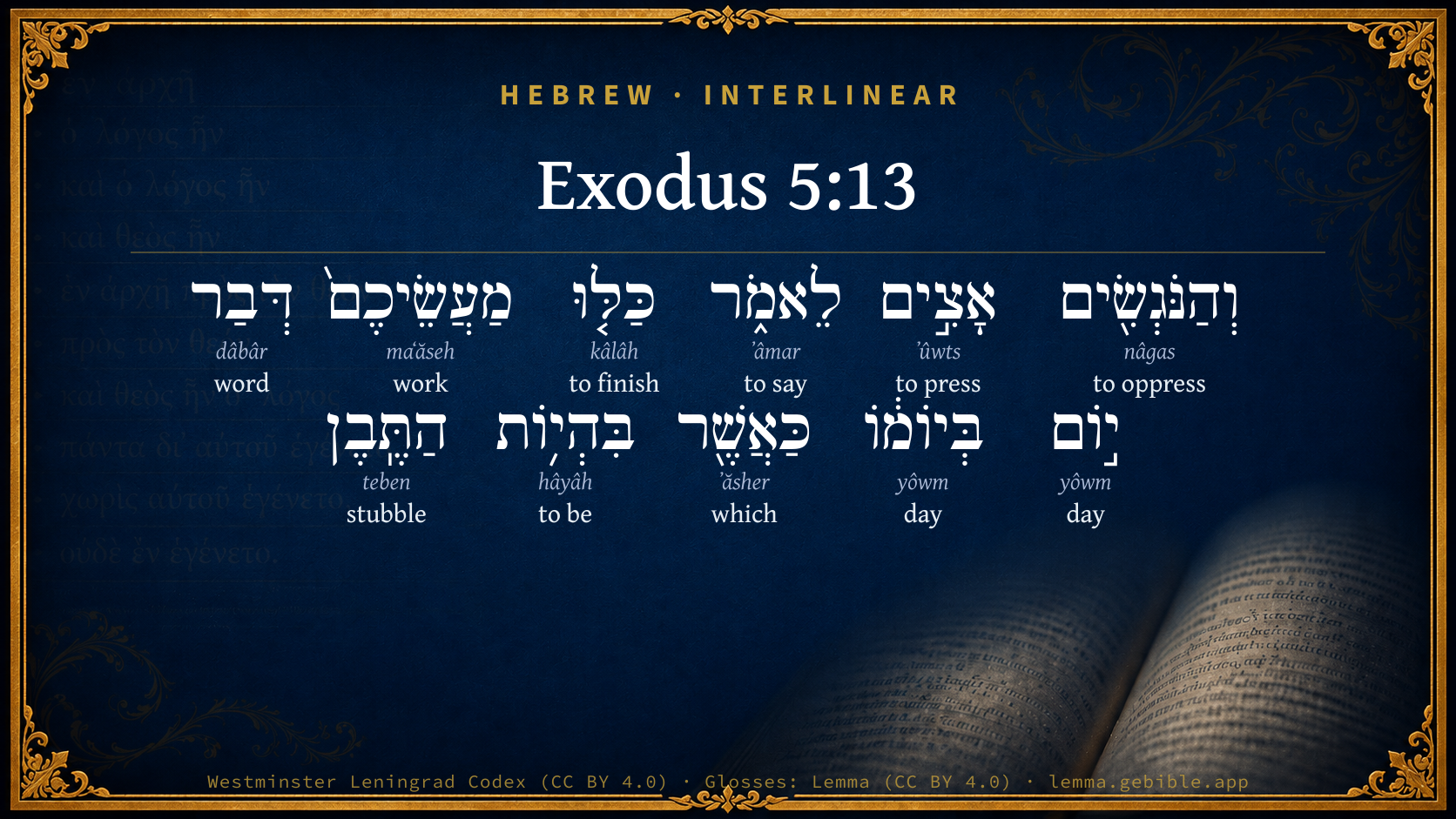
  1. וְהַנֹּגְשִׂ֖ים nâgas H5065 “and · the · oppressing” Conjunction + Particle, Definite Article + Verb, Qal, Participle Active, Masculine, Plural, Absolute
  2. לֵאמֹ֑ר ʼâmar H559 “to say” Preposition + Verb, Qal, Infinitive Construct
  3. כַּלּ֤וּ kâlâh H3615 “finish” Verb, Piel, Imperative, 2nd Person, Masculine, Plural
  4. מַעֲשֵׂיכֶם֙ maʻăseh H4639 “works · your” Noun, Common, Masculine, Plural, Construct + Suffix, Personal, 2nd Person, Masculine, Plural
  5. דְּבַר dâbâr H1697 “word of” Noun, Common, Masculine, Singular, Construct
  6. י֣וֹם yôwm H3117 “day” Noun, Common, Masculine, Singular, Absolute
  7. בְּיוֹמ֔וֹ yôwm H3117 “in/at · day · his” Preposition + Noun, Common, Masculine, Singular, Construct + Suffix, Personal, 3rd Person, Masculine, Singular
  8. כַּאֲשֶׁ֖ר ʼăsher H834 “like/as · which” Preposition + Particle, Relative
  9. בִּהְי֥וֹת hâyâh H1961 “in/at · to be” Preposition + Verb, Qal, Infinitive Construct
  10. הַתֶּֽבֶן teben H8401 “the · stubble” Particle, Definite Article + Noun, Common, Masculine, Singular, Absolute

About this verse

These counts appear in no published source. They are computed here, from the morphology-tagged text and Lemma’s own curated glosses. What Lemma adds →

11
words
10
distinct lemmas
Pentateuch
section

Notable vocabulary

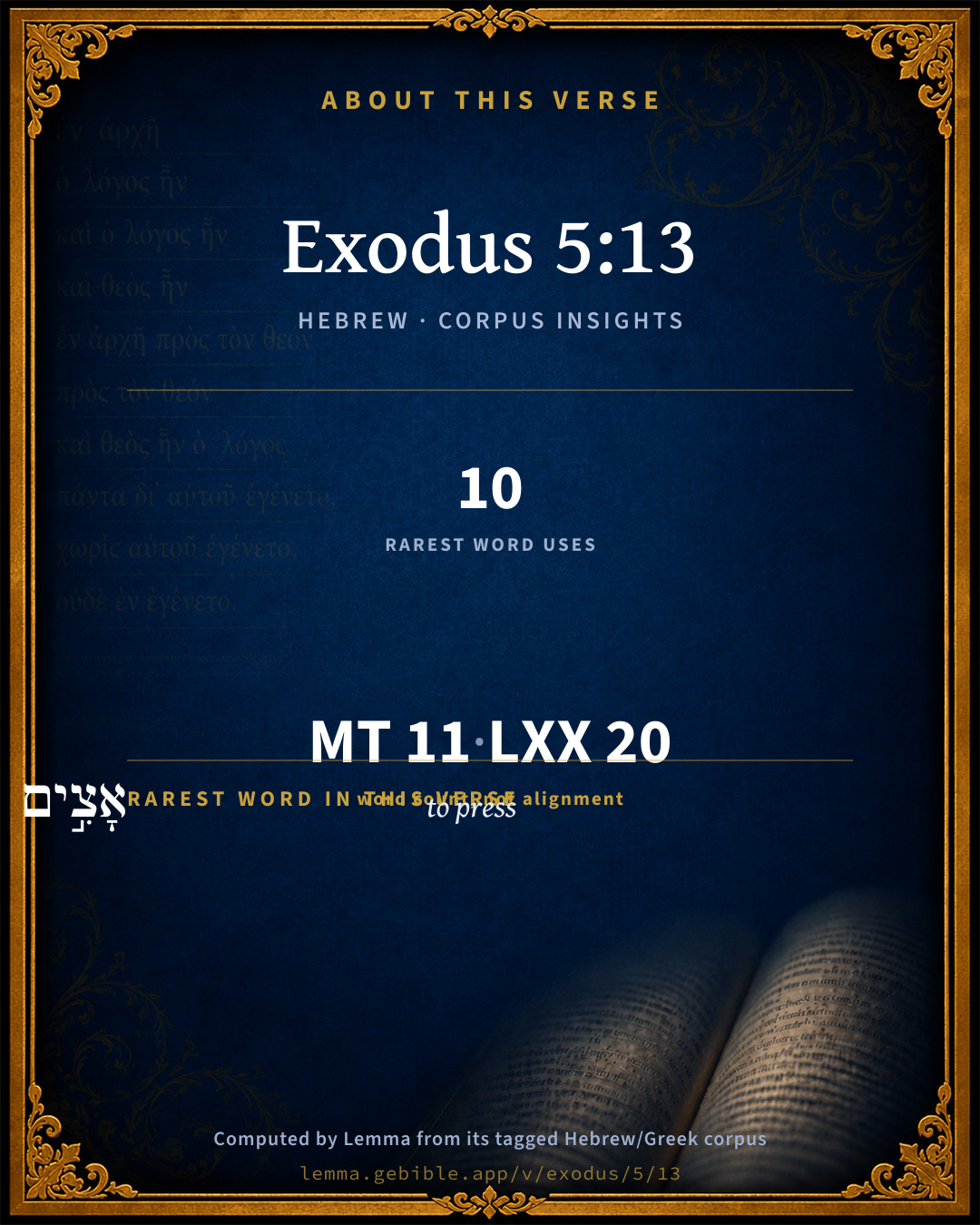
The rarest word here is אָצִ֣ים to press H213 — appearing just 10 times in the whole Hebrew Bible.

Shared distinctive vocabulary

אָצִ֣ים to press H213 occurs in 10 verses of the Hebrew Bible. Also found in:

Grammatical profile

  • 5 verbs
  • 5 nouns
  • 1 particle

Verb forms

  • וְהַנֹּגְשִׂ֖ים Qal · Participle Active
  • אָצִ֣ים Qal · Participle Active
  • לֵאמֹ֑ר Qal · Infinitive Construct
  • כַּלּ֤וּ Piel · Imperative
  • בִּהְי֥וֹת Qal · Infinitive Construct

Repetition

A word recurs within this verse — often emphatic in Hebrew:

  • י֣וֹם day H3117 ×2

Hebrew & Septuagint length

In English translation the verse runs 15 words from the Hebrew and 18 from the Septuagint (LXX English) — closely comparable.

A rough comparison of the two English renderings, which tokenize alike — not a word-level alignment.

Word counts can differ between the Hebrew and the Greek without any difference in meaning — e.g. the Hebrew direct-object marker אֵת has no separate Greek word, and Greek often adds the article ὁ.

In the original languages it is 11 Hebrew tokens and 20 Greek tokens — but the two are counted differently (Hebrew bundles its prefixes and suffixes into one token; the Greek is in lemma form), so that isn’t a like-for-like length.

Hebrew and Greek witnesses Masoretic Hebrew ↔ Greek Septuagint

The same verse in the two great witnesses to the Old Testament, shown verse-for-verse.

These are two independent witnesses, not word-aligned to each other, and the Septuagint is shown in lemma (dictionary) form.

Hebrew Exodus 5:13 Masoretic · Westminster Leningrad Codex

וְהַנֹּגְשִׂ֖ים אָצִ֣ים לֵאמֹ֑ר כַּלּ֤וּ מַעֲשֵׂיכֶם֙ דְּבַר י֣וֹם בְּיוֹמ֔וֹ כַּאֲשֶׁ֖ר בִּהְי֥וֹת הַתֶּֽבֶן

The taskmasters were urgent saying, "Fulfill your work quota daily, as when there was straw!"

World English Bible · Public Domain

Greek LXX Exodus 5:13 Septuagint · lemma form

ὁ δέ ἐργοδιωκτής κατασπεύδω αὐτός λέγω συντελέω ὁ ἔργον ὁ καταἥκω κατά ἡμέρα καθάπερ καί ὅτε ὁ ἄχυρον δίδωμι σύ

and the taskmasters hastened them, saying, Fulfil your regular daily tasks, even as when straw was given you.

LXX2012 (modern English Septuagint) · Public Domain

Hebrew: Westminster Leningrad Codex (CC BY 4.0). Greek: Septuagint (public domain); English from LXX2012 (modern English Septuagint) (Public Domain). How the Septuagint differs from the Hebrew →

Targum (Aramaic paraphrase)

2

The Targum is the ancient Jewish Aramaic paraphrase of the Hebrew Scriptures — an interpretive translation, not the Hebrew text itself. Onkelos (literal) and Pseudo-Jonathan (expansive) render the Torah, and Jonathan the Prophets. Coverage is partial: where no permissively-licensed English translation exists for a verse, only the Aramaic is shown. This is verse-level text, not a word-by-word alignment to the Hebrew.

  1. Targum Onkelos Torah (Genesis–Deuteronomy)
    וְשִׁלְטוֹנַיָא דָחֲקִין לְמֵימָר אַשְׁלִימוּ עוֹבָדֵיכוֹן פִּתְגַם יוֹם בְּיוֹמֵהּ כְּמָא דַהֲוֵיתוּן עָבְדִין כַּד אִתְיְהֵב לְכוֹן תִּבְנָא:

    (no public-domain English translation for this verse)

    Targum Onkelos — Aramaic: “Onkelos Genesis” (public domain); “Onkelos Exodus” (public domain); “Onkelos Leviticus” (public domain); “Onkelos Numbers” (public domain); “Onkelos Deuteronomy” (public domain). English: “Sefaria Community Translation” (CC0 1.0 (public-domain dedication)); “J.W. Etheridge. The Targums of Onkelos and Jonathan Ben Uzziel on the Pentateuch. London: Longmans, Green, 1862” (public domain). Text via Sefaria.

  2. Targum Pseudo-Jonathan Torah (Genesis–Deuteronomy)
    וְשׁוּלְטָנַיָא דַחֲקִין לְמֵימָר אַשְׁלִימוּ עֲבִידַתְכוֹן פִּתְגָם יוֹם בְּיוֹמֵיהּ הֵיכְמָא דַהֲוֵיתוּן עָבְדִין כַּד הֲוָה יָהֵיב לְכוֹן תִּיבְנָא

    But the officers were pressing, saying, Fulfil your work day by day, as you did when the straw was given you.

    Targum Pseudo-Jonathan — Aramaic: “Targum Jonathan on Genesis” (public domain); “Targum Jonathan on Exodus” (public domain); “Targum Jonathan on Leviticus” (public domain); “Targum Jonathan on Numbers” (public domain); “Targum Jonathan on Deuteronomy” (public domain). English: “The Targum of Jonathan ben Uzziel, trans. J. W. Etheridge, London, 1862” (public domain). Text via Sefaria.

Commentary

Notes on Exodus 5:13 from classic Christian and Jewish commentators (each source and its license shown beneath its notes). The classic Christian expositions comment on the surrounding passage and are grouped to its opening verse, so a note may address several verses; the Jewish commentaries on the Tanakh (Rashi and others) are per-verse, so they appear only where the commentator wrote on this verse.

Lemma curates 59 commentaries, every one of them public domain or Creative Commons licensed, each selected and text-cleaned for this edition rather than reprinted as found. About our sources →

Trapp's Complete Commentary

John Trapp

Exo 5:13 And the taskmasters hasted [them], saying, Fulfil your works, [your] daily tasks, as when there was straw.

Ver. 13. And the taskmasters.] Who were Egyptians, as the officers under them were Israelities, and beaten. {Exo 5:14}

John Trapp, A Commentary or Exposition upon All the Books of the Old and New Testament (1647–1656) — public domain. Text from a community e-Sword module.

Geneva Bible (1599)

Geneva Bible translators

Hebrew, the work of a day in his day.

Geneva Bible (1599) marginal notes — public domain. Text via Bolls.life.

Jamieson, Fausset & Brown

Robert Jamieson, A. R. Fausset & David Brown

And the taskmasters hasted them . . . officers . . . beaten--As the nearest fields were bared and the people had to go farther for stubble, it was impossible for them to meet the demand by the usual tale of bricks. "The beating of the officers is just what might have been expected from an Eastern tyrant, especially in the valley of the Nile, as it appears from the monuments, that ancient Egypt, like modern China, was principally governed by the stick" [TAYLOR]. "The mode of beating was by the offender being laid flat on the ground and generally held by the hands and feet while the chastisement was administered" [WILKINSON]. (Deu 25:2). A picture representing the Hebrews on a brick field, exactly as described in this chapter, was found in an Egyptian tomb at Thebes.

Jamieson, Fausset & Brown — Commentary Critical and Explanatory on the Whole Bible (1871) — public domain (CC PDM 1.0). Text via the HelloAO Bible API.

Ellicott's Commentary for English Readers

(13) The taskmasters hasted them.—The Egyptian monuments show us foreign labourers engaged in brick-making under Egyptian overseers, or “taskmasters,” who are armed with sticks, and “haste” the labourers whenever they cease work for the purpose of resting themselves. The overseers are represented as continually saying to the workpeople, “Work without faintness.” (See Wilkinson, in Rawlinson’s Herodotus, vol. ii. p. 214.)

As when there was straw.—Heb., as when there, was the straw—i.e., as. when the straw was furnished to you.

A Bible Commentary for English Readers, edited by Charles John Ellicott (1878–1897) — public domain. Text from a community e-Sword module.

The Cambridge Bible for Schools and Colleges

gen. ed. J. J. S. Perowne

13. your daily tasks] Heb. the matter of a day in its day, a Heb. idiom implying a daily portion, amount, or duty. See Exo_16:4, Lev_23:37 (RV. ‘each on its own day’), 1Ki_8:59, 2Ki_25:30 al.

demanded] i.e. asked. ‘Demand’ in Old English meant simply to ‘ask’ (Fr. demander), not, as now, to ask with authority. See Aldis Wright’s Bible Word-Book, or DB. s.v. So Job_38:3, 2Sa_11:7, Mat_2:4, &c. Here ‘and demanded’ is a paraphrase, the Heb. being simply saying.

13–14. Although however the number of workers was thus materially diminished, the ‘taskmasters,’ carrying out the Pharaoh’s injunctions, still demand the same tale of bricks; and as it is not forthcoming, the ‘officers’ (v. 6) of the Israelites are held responsible for the deficit, and beaten.

The Cambridge Bible for Schools and Colleges (gen. ed. J. J. S. Perowne; Cambridge University Press, 1878–1918) — public domain. Text from a community e-Sword module.

John Gill's Exposition

And the taskmasters hasted them, Kept them tight and close to their work, and were urgent on them to make quick dispatch of it:

saying, fulfil your works, your daily tasks, as when there was straw; they insisted upon it, that they did the same business at the brickkilns, made the same number of bricks every day, as they used to do when they had straw at hand. See Exo 5:11.

John Gill's Exposition of the Whole Bible (1746–1763) — public domain (CC PDM 1.0). Text via the HelloAO Bible API.

The Pulpit Commentary

Vers. 13, 14. The taskmasters hasted them. The Egyptian overseers, armed with rods, went about among the toiling Israelites continually, and "hasted them" by dealing out blows freely on all who made any pause in their work. The unceasing toil lasted from morning to night; yet still the required" tale" could not be produced; and consequently the native officers, whose business it was to produce the "tale," were punished by the bastinado at the close of the day not giving in the proper amount. Kalisch observes now the Arabic fellahs, whose position is very analogous to that of the Israelites described in our text, are treated by the Turks in the same manner. Arabic overseers have to give an account of the labours of their countrymen to the Turkish taskmasters, who often chastise them mercilessly for the real or imputed of. fences of the Arabic workmen."

The Pulpit Commentary (1880–1919), ed. H.D.M. Spence-Jones & Joseph S. Exell — public domain. Text from a community e-Sword module.

Keil & Delitzsch

C. F. Keil & F. Delitzsch

בּיומו יום דּבר, the quantity fixed for every day, "just as when the straw was (there)," i.e., was given out for the work.

Keil & Delitzsch — Biblical Commentary on the Old Testament (1861–1891) — public domain (CC PDM 1.0). Text via the HelloAO Bible API. (Old Testament only.)

Rashi

Rabbi Shlomo Yitzchaki (Rashi)

אצים means PRESSING.

דבר יום ביומו means the full quantity due each day complete it on that day, as ye used to do when straw was ready at hand.

Rashi on the Tanakh — English translations: “The Judaica Press complete Tanach with Rashi, translated by A. J. Rosenberg” (CC BY 4.0); “Pentateuch with Rashi's commentary by M. Rosenbaum and A.M. Silbermann, 1929-1934” (public domain); “The Metsudah Tanach series, Lakewood, N.J” (CC BY 4.0); and “The Book of Joshua, Metsudah Publications, 1997” (CC BY 4.0). Text via Sefaria.

Lesson kit

Teaching starters — assembled from the data on this page, not authored interpretation. Every prompt links to the verse data it draws on. Edit before teaching.

Exodus, in the Pentateuch, opens this verse with 11 words (10 distinct Hebrew lemmas). Its most distinctive word is ʼûwts (“to press”). A historical commentator’s framing appears above. Read the whole chapter for the surrounding context.

Discussion questions

  1. The word ʼûwts carries the sense “to press.” How does it shape the verse?
  2. How does Genesis 19:15, which shares the word «to press», read alongside this verse?
  3. What does the repetition of “day” (2× in this one verse) do in this verse?
  4. These translations render this verse differently. What is at stake in choosing one wording over another?
  5. «וְהַנֹּגְשִׂ֖ים» is a Qal Participle Active verb. How does that grammatical form shape the action described?
  6. Compare how Trapp's Complete Commentary and Geneva Bible (1599) read this verse. Where do they agree or differ?

Things to notice

Reading settings

Reading text

Shown beneath each verse's original-language words.

Old Testament
Old Testament edition

Read the OT as the Masoretic Hebrew (MT) or the Greek Septuagint (LXX).

English shown for the Greek Septuagint (in the Hebrew ↔ Greek comparison).

Comparing translations? Open the Compare panel on any verse page to stack up to four side by side.