Psalms 84:2

Hebrew (Westminster Leningrad Codex) Psalms 84:2 appears in the Hebrew Old Testament. The text above is from the Westminster Leningrad Codex. Each word links to its Strong’s number, a concise gloss, and parsing drawn from the Open Scriptures Hebrew Bible morphology. Click any word for its full Brown-Driver-Briggs (BDB) entry.
Download image
Cite this verse

Psalms 84:2 (World English Bible). Public Domain. Lemma interlinear Bible study tool, https://lemma.gebible.app/v/psalms/84/2.

Show BibTeX & RIS
BibTeX
RIS
English Translation
My soul longs, and even faints for the courts of Yahweh. My heart and my flesh cry out for the living God.
World English Bible · Public Domain
Download a study sheet

One document with this verse’s original text, its word-by-word gloss line, the meaning frame, cross-references with their text, attributed commentary, and full source and license credits — printable, and it pastes into notes with its structure intact.

This verse Autodidact and up

Study sheet (.html) Plain text (.txt)

A passage Seminary Student

Up to 50 verses in one chapter. A passage sheet keeps up to 6 commentary sources and 12 cross-references per verse, in the order this page ranks them, and says so on the sheet whenever that leaves anything out. Ask for a single verse and you get the Autodidact verse sheet above.

Everything on this page stays free to read, with no account — the sheet is a download of what is already on screen, not access to it.

Want to remove ads? Support Godless Engineer
Compare translations 3

The same verse in 3 English versions, stacked beneath the original-language interlinear above. Click any original word for its lexicon entry.

Each is an independent rendering of the whole verse — the interlinear is not word-aligned to these translations.

Highlighted words mark where these versions differ — a whole-verse word diff, not a word-by-word alignment.

  • World English Bible Public Domain
    My soul longs, and even faints for the courts of Yahweh. My heart and my flesh cry out for the living God.
  • King James Version Public Domain
    My soul longeth, yea, even fainteth for the courts of the LORD: my heart and my flesh crieth out for the living God.
  • unfoldingWord Literal Text CC BY-SA 4.0
    My soul longs and even faints for the courts of Yahweh; my heart and my flesh cry out to the living God.

unfoldingWord Literal Text — © unfoldingWord, licensed CC BY-SA 4.0. Word-aligned USFM3 via Door43 (git.door43.org/unfoldingWord/en_ult).

Versions to compare (up to 4)

3 of 4 selected

Show all 18 translations

Every available English version of this verse, each an independent rendering of the whole verse.

  • World English Bible Public Domain
    My soul longs, and even faints for the courts of Yahweh. My heart and my flesh cry out for the living God.
  • Berean Standard Bible Public Domain
    My soul longs, even faints, for the courts of the LORD; my heart and my flesh cry out for the living God.
  • Majority Standard Bible Public Domain
    My soul longs, even faints, for the courts of the LORD; my heart and my flesh cry out for the living God.
  • King James Version Public Domain
    My soul longeth, yea, even fainteth for the courts of the LORD: my heart and my flesh crieth out for the living God.
  • American Standard Version (1901) Public Domain
    My soul longeth, yea, even fainteth for the courts of Jehovah; My heart and my flesh cry out unto the living God.
  • Revised Version (1885) Public Domain
    My soul longeth, yea, even fainteth for the courts of the LORD; my heart and my flesh cry out unto the living God.
  • Geneva Bible (1599) Public Domain
    My soule longeth, yea, and fainteth for the courtes of the Lord: for mine heart and my flesh reioyce in the liuing God.
  • Douay-Rheims (1899) Public Domain
    How lovely are thy tabernacles, O Lord of host!
  • Young's Literal Translation Public Domain
    My soul desired, yea, it hath also been consumed, For the courts of Jehovah, My heart and my flesh cry aloud unto the living God,
  • Literal Standard Version CC BY-SA 4.0
    My soul desired, indeed, it has also been consumed, || For the courts of YHWH, || My heart and my flesh cry aloud to the living God,
  • Unlocked Literal Bible CC BY-SA 4.0
    I long for the courts of Yahweh, my desire for it has made me exhausted. My heart and all of my being call out to the living God.
  • unfoldingWord Literal Text CC BY-SA 4.0
    My soul longs and even faints for the courts of Yahweh; my heart and my flesh cry out to the living God.
  • Darby Bible Public Domain
    My soul longeth, yea, even fainteth for the courts of Jehovah; my heart and my flesh cry out for the living ùGod.
  • World Messianic Bible Public Domain
    My soul longs, and even faints for the courts of the LORD. My heart and my flesh cry out for the living God.
  • Webster's Bible Public Domain
    \\84:1\\To the chief Musician upon Gittith, A Psalm for the sons of Korah. How amiable are thy tabernacles, O LORD of hosts!
  • Free Bible Version CC BY-SA 4.0
    I long, I ache, to be in the courts of the Lord. My mind and my body sing for joy to the living God.
  • Bible in Basic English Public Domain
    The passion of my soul's desire is for the house of the Lord; my heart and my flesh are crying out for the living God.
  • JPS Tanakh (1917) Public Domain
    (84-3) My soul yearneth, yea, even pineth for the courts of the LORD; my heart and my flesh sing for joy unto the living God.

Literal Standard Version (2020), Covenant Press — licensed CC BY-SA 4.0. Text via the HelloAO Bible API (eBible.org). Unlocked Literal Bible (unfoldingWord) — licensed CC BY-SA 4.0. Text via the HelloAO Bible API (eBible.org). unfoldingWord Literal Text — © unfoldingWord, licensed CC BY-SA 4.0. Word-aligned USFM3 via Door43 (git.door43.org/unfoldingWord/en_ult). Free Bible Version, Dr. Jonathan Gallagher — licensed CC BY-SA 4.0. Text via the HelloAO Bible API (eBible.org).

Word by word

More ways to search: Search by grammar → Find every occurrence → Compare this word →

Practice this passage: Drill this verse → Learn its vocabulary →

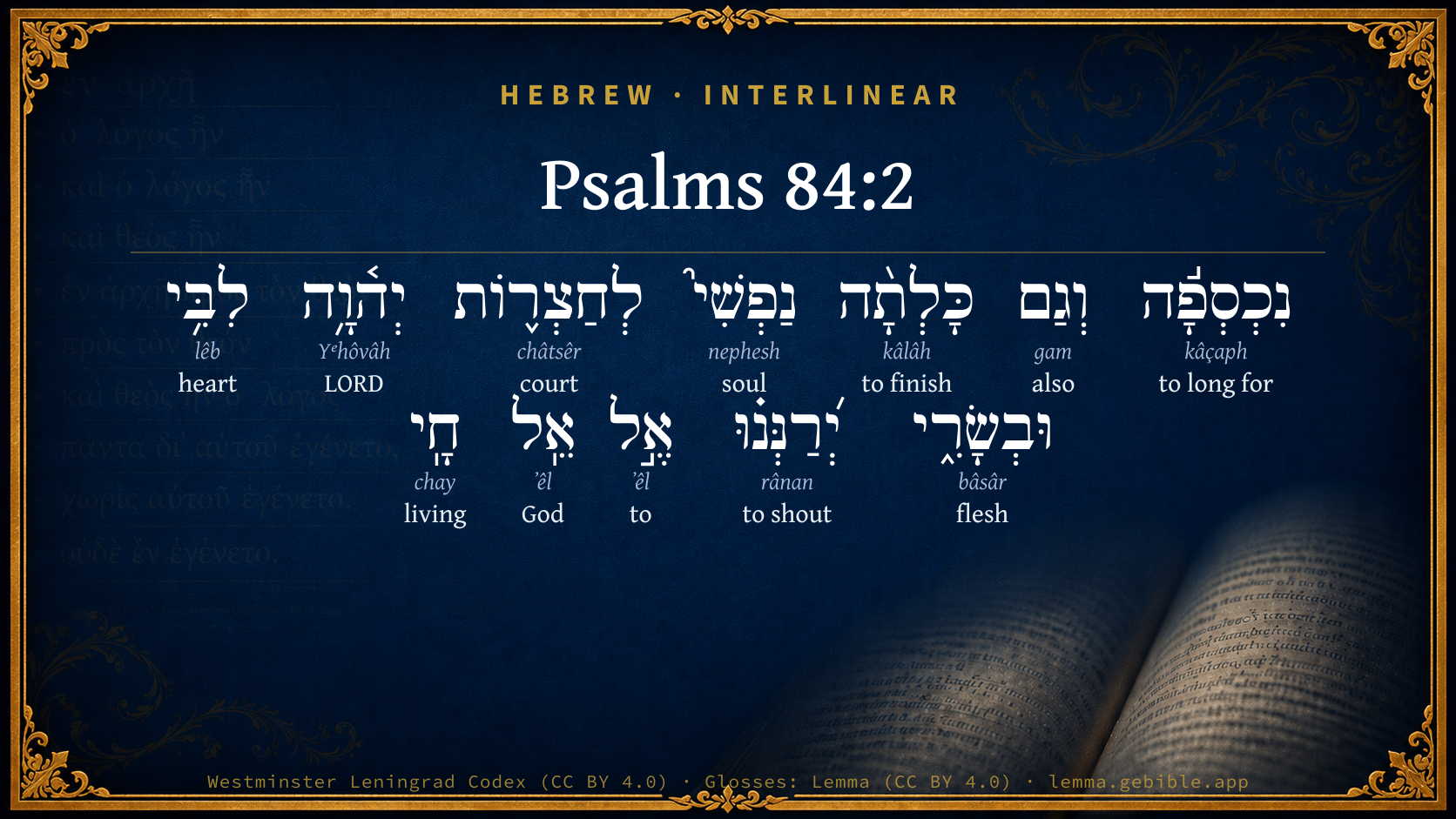
נִכְסְפָ֬ה
kâçaph
H3700
“to long for”
Verb, Niphal, Perfect, 3rd Person, Feminine, Singular
Part of Speech
Verb
Stem
Niphal
Form
Perfect
Person
3rd Person
Gender
Feminine
Number
Singular
Full BDB Definition

Origin: a primitive root

TWOT: 1015

to long for, yearn for, long after - (Qal) to long for - (Niphal) - to long for (deeply) - being longed for (participle)
  1. וְגַם gam H1571 “and · also” Conjunction + Particle, Accusative
  2. כָּלְתָ֨ה kâlâh H3615 “to finish” Verb, Qal, Perfect, 3rd Person, Feminine, Singular
  3. נַפְשִׁי֮ nephesh H5315 “soul · my” Noun, Common, Both, Singular, Construct + Suffix, Personal, 1st Person, Common, Singular
  4. לְחַצְר֪וֹת châtsêr H2691 “to/for · courts of” Preposition + Noun, Common, Both, Plural, Construct
  5. יְה֫וָ֥ה Yᵉhôvâh H3068 “LORD” Noun, Proper
  6. לִבִּ֥י lêb H3820 “heart · my” Noun, Common, Masculine, Singular, Construct + Suffix, Personal, 1st Person, Common, Singular
  7. וּבְשָׂרִ֑י bâsâr H1320 “and · flesh · my” Conjunction + Noun, Common, Masculine, Singular, Construct + Suffix, Personal, 1st Person, Common, Singular
  8. יְ֝רַנְּנ֗וּ rânan H7442 “to shout” Verb, Piel, Imperfect, 3rd Person, Masculine, Plural
  9. אֶ֣ל ʼêl H413 “to” Preposition
  10. אֵֽל ʼêl H410 “God” Noun, Common, Masculine, Singular, Absolute
  11. חָֽי chay H2416 “living” Adjective, Adjective, Masculine, Singular, Absolute

About this verse

These counts appear in no published source. They are computed here, from the morphology-tagged text and Lemma’s own curated glosses. What Lemma adds →

12
words
12
distinct lemmas
Wisdom
section

Notable vocabulary

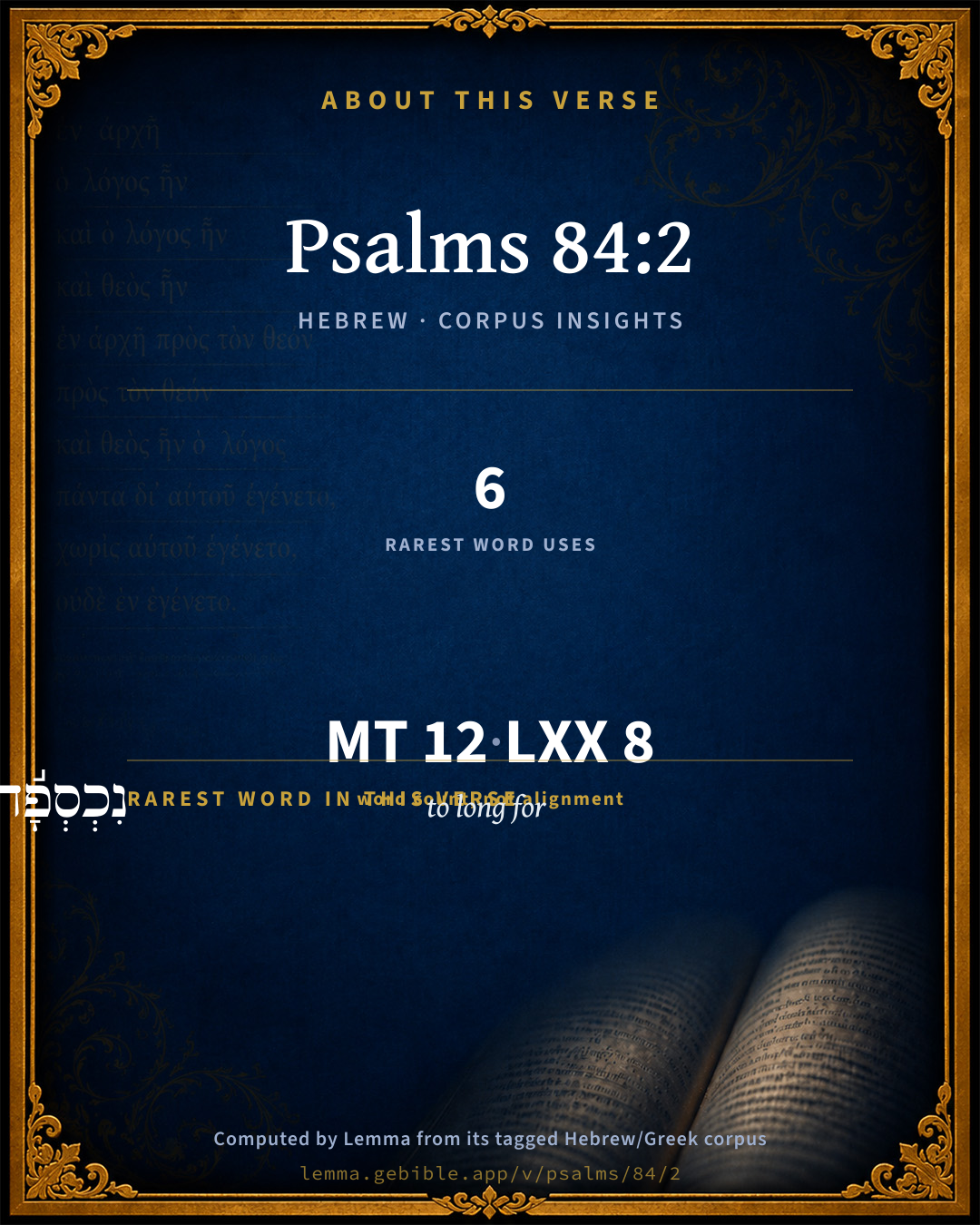
The rarest word here is נִכְסְפָ֬ה to long for H3700 — appearing just 6 times in the whole Hebrew Bible.

Shared distinctive vocabulary

נִכְסְפָ֬ה to long for H3700 occurs in 5 verses of the Hebrew Bible. Also found in:

Grammatical profile

  • 3 verbs
  • 6 nouns
  • 1 adjective
  • 1 preposition
  • 1 particle

Verb forms

  • נִכְסְפָ֬ה Niphal · Perfect
  • כָּלְתָ֨ה Qal · Perfect
  • יְ֝רַנְּנ֗וּ Piel · Imperfect

Hebrew & Septuagint length

In English translation the verse runs 22 words from the Hebrew and 22 from the Septuagint (LXX English) — the same length.

A rough comparison of the two English renderings, which tokenize alike — not a word-level alignment.

Word counts can differ between the Hebrew and the Greek without any difference in meaning — e.g. the Hebrew direct-object marker אֵת has no separate Greek word, and Greek often adds the article ὁ.

In the original languages it is 12 Hebrew tokens and 8 Greek tokens — but the two are counted differently (Hebrew bundles its prefixes and suffixes into one token; the Greek is in lemma form), so that isn’t a like-for-like length.

Cross-references

11

Topical passages linked to Psalms 84:2 in the Treasury of Scripture Knowledge — connected by theme and wording, ordered by reader-vote popularity; previews shown in the World English Bible.

  • Isaiah 26:9 With my soul have I desired you in the night; yes, with my spirit within me will I seek you earnestly: for when your judgments are in the earth, the inhabitants of the world learn righteousness.
  • Psalms 42:1–2 As the deer pants for the water brooks, So my soul pants after you, God.
  • Psalms 63:1–2 God, you are my God. I will earnestly seek you. My soul thirsts for you, My flesh longs for you, In a dry and weary land, where there is no water.
  • Psalms 119:81 My soul faints for your salvation. I hope in your word.
  • Psalms 73:26 My flesh and my heart fails, But God is the strength of my heart and my portion forever.
  • Psalms 143:6 I spread forth my hands to you. My soul thirsts for you, like a parched land. Selah.
  • Psalms 119:20 My soul is consumed with longing for your ordinances at all times.
  • Job 23:3 Oh that I knew where I might find him! That I might come even to his seat!
  • Song of Solomon 5:8 I adjure you, daughters of Jerusalem, If you find my beloved, That you tell him that I am faint with love. Friends
  • Song of Solomon 2:4–5 He brought me to the banquet hall. His banner over me is love.
  • Isaiah 64:1 Oh that you would tear the heavens, that you would come down, that the mountains might quake at your presence,

Cross-references courtesy of OpenBible.info (CC BY 4.0).

Hebrew and Greek witnesses Masoretic Hebrew ↔ Greek Septuagint

The same verse in the two great witnesses to the Old Testament, shown verse-for-verse.

You’re reading Greek Psalm 83 (Hebrew Psalm 84). The Septuagint counts the superscription, so verse numbers can differ from the Hebrew — chapter-level alignment, not verse-by-verse. Numbering follows Rahlfs.

These are two independent witnesses, not word-aligned to each other, and the Septuagint is shown in lemma (dictionary) form.

Hebrew Psalms 84:2 Masoretic · Westminster Leningrad Codex

נִכְסְפָ֬ה וְגַם כָּלְתָ֨ה נַפְשִׁי֮ לְחַצְר֪וֹת יְה֫וָ֥ה לִבִּ֥י וּבְשָׂרִ֑י יְ֝רַנְּנ֗וּ אֶ֣ל אֵֽל חָֽי

My soul longs, and even faints for the courts of Yahweh. My heart and my flesh cry out for the living God.

World English Bible · Public Domain

Greek LXX Greek Psalm 83:2 Septuagint · lemma form

ὡς ἀγαπητός ὁ σκήνωμα σύ κύριος ὁ δύναμις

My soul longs, and faints for the courts of the Lord: my heart and my flesh have exulted in the living god.

LXX2012 (modern English Septuagint) · Public Domain

On this verse, Ellicott's Commentary for English Readers discusses the Septuagint’s reading. Read the note in Commentary ↓

Hebrew: Westminster Leningrad Codex (CC BY 4.0). Greek: Septuagint (public domain); English from LXX2012 (modern English Septuagint) (Public Domain). How the Septuagint differs from the Hebrew →

Commentary

Notes on Psalms 84:2 from classic Christian and Jewish commentators (each source and its license shown beneath its notes). The classic Christian expositions comment on the surrounding passage and are grouped to its opening verse, so a note may address several verses; the Jewish commentaries on the Tanakh (Rashi and others) are per-verse, so they appear only where the commentator wrote on this verse.

Lemma curates 59 commentaries, every one of them public domain or Creative Commons licensed, each selected and text-cleaned for this edition rather than reprinted as found. About our sources →

Trapp's Complete Commentary

John Trapp

Psa 84:2 My soul longeth, yea, even fainteth for the courts of the LORD: my heart and my flesh crieth out for the living God.

Ver. 2. My soul longeth] As she did who said, Give me children or else I die. His soul once longed for the waters of the well of Bethlehem, but not so earnestly as now to draw waters with joy out of those wells of salvation.

My heart and my flesh] Ut sit sanctitas in corde, et sanitas in corpore. And for obtaining of this, whole David crieth aloud, as a child when hungry crieth every whit of him, hands feet, face, all cry; and then the mother flings by all, then she flies and outruns herself; so here: The desires of the righteous shall be satisfied, Pro 10:24.

John Trapp, A Commentary or Exposition upon All the Books of the Old and New Testament (1647–1656) — public domain. Text from a community e-Sword module.

The Biblical Illustrator

Joseph S. Exell

Psa_84:2

My soul longeth, yea, even fainteth for the courts of the Lord: my heart and my flesh crieth out for the living God.

The profoundest hunger of human nature

The words soul, heart, flesh, are here used to represent the whole man, human nature in its entirety; and this human nature is here longing, craving, hungering, crying out for the living God, nothing less. This means--

I. That nothing less will satisfy humanity. Not a whole universe, not a million pantheons of dead gods; it is the living God.

II. That humanity requires no logic to prove that there is a God. So inwrought into man is the belief of His existence, that the whole being cries out for Him.

III. That anti-theism is anti-humanity. Anti-theism is a lie to our common nature. (Homilist.)

The hearts cry after God

I. The desire of heart and flesh--the living God. Sibbes well observes that the desires of the heart are the best proofs of saintship; and if a man wishes to know whether he is really a saint or no, he can very soon find out by putting his finger upon the pulse of his desires, for those are things that never can be counterfeit. You may counterfeit words; you may counterfeit actions; but you cannot counterfeit desires.

1. Every saint has within his breast that which is actually born of God, and therefore it cries out after its own Father.

2. Every believer has the Spirit of God dwelling within him, and if he has the Spirit of God dwelling within him, it is only natural that he should desire God.

3. The experience of earth often makes you long more for God. After you have discovered the hollowness, the disappointing nature of the world.

II. The intensity of this desire.

1. It is an intensity that drowns all other desires Crieth out for God. I passed a little child the other day being led by the hand by a kind-faced policeman; and as the little thing walked by his side, I could hear it amidst its sobs, continually crying, Father! father! father! father! Yes, in this great city-full of people, the only face the child waned to see was the face of its father. He knew he had lost a fathers hand, for he had wandered from a fathers side, and he wanted father back again. My heart and my flesh crieth out for God. Just as a lost child cares not for a million faces it may meet along the road--it wants to look at its fathers face--so the true born child of God can rest satisfied with nothing short of a sight of his God. My heart and my flesh crieth out for God.

2. It is an intensity of desire that creates pain. The language of our text is the language of a soul which can bear its anguish no longer in silence. It is a cry extorted by inward pangs. (A. G. Brown.)

The souls want of God

The chief want of man is God. The soul is for God, and God for the soul. What God hath joined together, let not man put asunder.

1. The first step in this answer to the deepest want of human nature is the conviction that God is--that God lives. Heart and flesh cry; where is the response? Joyful is the moment in the souls experience when the reality of Gods being comes over us with its full power. The first need of the soul is to feel that God is real--the great reality and essence of all things. And if sin had not shut up and darkened the windows of our being, this gracious light would flow in on every side.

2. Then we are to feel that He is Present and Living. The belief of not a few seems to be in a past God, a deceased, departed Deity, and the world as a huge skeleton out of which all the soul has gone, not an abode for the indwelling Power, but the ruins of His former stately palace. But He has not made the world and then retired from it. He is not an absentee proprietor. He is the present Creator, the living God, as on the worlds first morning. He dyes the flower, and ripens the corn. Laws are but His uniform modes of working. Forces are but the heavings of the indwelling Almightiness. He is, and He is present. He overflows creation. He is all in all.

3. But the heart and flesh have another note in their cry, and it is for a Good Being, or, as our Saxon has it, God, that is, the Good, whom we may love. God, the Good, is in all systems, all beings, and in all working according to His own being, that is, for good. Father is His proper name. Nature, Providence, Jesus, all teach this comforting lesson. And When the heart in its hopes and affections, and the flesh in its griefs and pangs, cry, the response comes from every side, and is echoed and re-echoed in endless and harmonious sounds--God is good.

4. The want of the soul is not only for a good, but for a great God, whom we may adore. It admires greatness with an even earlier and intenser admiration than goodness. Our tastes change very much from youth onward. Things we once passionately admired cease to move us. The soul has got beyond them. It exhausts one thing after another. But there is one youthful sentiment that is never outgrown--that rises with our intellectual stature, and spreads with our moral expansion, and soars with our spiritual aspirations--and that is our faith in the Great God--

And, as it hastens, every age

But makes its brightness more divine.

5. The nature of man has been so created as to seek after a Wise and Infinite Intelligence. We admire with huge respect the men even who have been able to pocket a little science, who can read a dozen languages, who are largely conversant with affairs, and know things as they are. A skilful invention is heralded from hemisphere to hemisphere. He who has read one of the characters in Natures alphabet, or spelled out a few syllables or words in her mighty lore, is hailed with all the titles of glory. But no libraries, geniuses, scientific or literary associations, no fragments and crumbs that fall from the table of knowledge, can meet the unextinguishable thirst of man for the spiritual and the immortal. Let him not think to fill an infinite craving with anything less than the Infinite. But if I have at all rightly interpreted the significance of this cry, which is for ever ascending from the breast, and seeking after God, you may ask, How shall it be satisfied? I would not dogmatize, and say by any one way, but rather by all ways. It is more in the waiting, receiving, and teachable state of the soul, than it is by methods, cultures, churches, and dispensations. Seek, then, for the truth, and in the truth God will ever be coming, and entering in and taking possession of the soul, and driving out every darkness and weakness. Rest not short of God. (A. A. Livermore.)

The religious sense

What is the secret of the enduring charm, the comforting and ennobling influence of the psalms? Is it not to be found, in part at least, in the frank revelation made by the psalmist of his own personal experience and aspiration? His prayers are not addressed to the congregation I In rapturous praise and in fervent prayer he pours out his soul unto God. So wide and varied is the range of his experience that alike in joy and sadness, in exultation or contrition, in victory or defeat, we find in his confession of sin, his jubilant gratitude, his martial ardour, his triumphant faith, the best statement of our own sin and failure, expectation and yearning. Thus to the very depths of our nature does he go down when, as in the text, he exclaims, My heart and my flesh crieth out for the living God.

I. Man has a religious sense. It is customary to speak of the five senses; but modern physiologists affirm the popular enumeration to be defective. It does not take into account, we are told, the sensations of heat and cold, hunger and thirst, or the sensations of organic life. Neither does it recognize the muscular sense, whereby we measure and regulate our bodily activities. We hear also of an internal sense, or the minds knowledge of its own operations. Then, again, we occasionally hear of the aesthetic sense, whereby we have the perception or feeling of beauty. Philosophers, as Shaftesbury, have affirmed the existence also in man of a moral sense, meaning that moral distinctions are not due to reasoning processes, but are recognized by a kind of feeling, or an immediate and undefinable intuition. In like manner may it be affirmed that man has a religious sense. Just as we are constituted to taste and touch, to have a sense of the beautiful, and to have a sense of right and wrong, so are we constituted to feel after God. Wherever man is there religion is, said Max Muller, who also affirms, I maintain that religion, so far from being impossible, is inevitable if only we are left in possession of our senses. Just because you are a man, made by and for God, the religious element within you constrains you, in spite of yourself, to exclaim of all earthly pursuits and pleasures promising satisfaction and peace, Vanity of vanities, all is vanity.

II. The religious sense needs training. Whatever be the stage of moral and spiritual experience, the limits of development have not been reached. The religious sense can always be touched to finer issues. By neglect it pines and withers. Through disuse the facility of speech in a foreign tongue lessens and disappears, and how completely the mastery has been lost may not be known till on some sudden emergency, to our utter humiliation, we find the words will not come when we do call for them; and we who once could swiftly weave our thought into speech, now stand in dumb imbecility. It is too often forgotten that a similar retribution, but infinitely graver in its issues, awaits the man who neglects to maintain his religious nature in healthful efficiency. When we call to mind the sure operation of this law, need we wonder that, spiritually, men differ so greatly, and that while some are keenly sensitive to the softer whispers of Divine love, others need the loud thunders of Heavens artillery to rouse them to a consciousness of God? If the man of business give only the fragments of his time to the culture of his soul, what marvel that, whilst sagacious and successful in commerce, he should be weak, ignorant, and wayward in spiritual insight and service. If the student of Nature devote all his thought and energy to the investigation of her laws, what wonder that the penalty of excessive and exclusive study of physical science should be, as Darwin had to acknowledge with sorrow, the loss of relish for music, poetry, and the higher pursuits that refine and elevate life. If the intellect be trained and the affections neglected, what wonder that a Francis Bacon should show himself wisest, meanest of mankind, ready and eager to sell his glorious birthright for a mess of pottage. O the pity of it, that men should so zealously train the understanding and so persistently neglect the heart, should suffer the cobwebs to darken the window of the soul, and allow the holy fire to go out! Yet is there no part of our nature we can so ill afford to leave undisciplined. If religion meant pardon only, even then delay would be dangerous, but if it mean the training of the soul, the development of character after the pattern of Christ Jesus, the discipline of the religious sense to swift, accurate, and joyous activity, is it not of all follies the greatest to neglect or postpone the culture of the soul?

III. What is the method of training? The answer is not difficult. It is one advantage of the line of thought pursued that the reply can be so easy and natural. How do men proceed to train their other senses? How is it that the dyer discerns varieties of hue unapparent to the untrained eye? How does the artist appreciate distinctions of shade invisible to the ordinary vision? Though there may sometimes be original and native superiority, it still holds true that practice makes perfect. How shall the ear be trained to appreciate the subtle harmonies of music? Will it suffice to read treatises that describe the auditory and vocal organs? Will it be enough to study theories of musical composition? Will it not be needful to listen to music, to note the separate and combined effects, and ourselves to play and to sing if we are to possess executive skill and correct musical judgment? No one ever yet became a musical expert who did not use his ears! In like manner, it may be said, no man ever became an efficient public speaker by reading manuals of elocution, or treatises of rhetoric alone. There is needed intelligent and persevering practice for the attainment of the art to conceal art, and to speak with ease, clearness, and force. A man learns to swim not by perusing written instructions on natation, but by swimming. He learns to paint by painting. However useful theories of the various arts may be, in every sphere it is recognized that it is only by practice, wise and sedulous, the highest efficiency can be gained. It is that the simplicity of this has caused it to be overlooked when religious training is considered? How many appear to think that the mere reading of the Bible will discipline the nature! To study a chart is one thing, to navigate the vessel by its information quite another thing. To read the Bible is good, to act according to its directions is better. Exercise thyself unto godliness, was Pauls counsel to Timothy.

IV. Can we by innate strength of will accomplish this high work? For physical and mental training are not schools, colleges, teachers, and professors required? Can the irreligious man, by his own resolve alone, develop high religious sensibility? The uniform declarations of the Book of God concur with the humiliating testimony of personal consciousness, that it is not in man to direct his steps, to subdue his turbulent passions, to bring his motives and plans into harmony with the Divine will, to educate to unerring precision and robust energy his religious sense. Nor is there any need that he should attempt the impossible task. The heart cries out for the living God, and He delights to answer its cry. (A. Cowe, M. A.)

The Biblical Illustrator, edited by Joseph S. Exell (c. 1880s–1900s) — public domain. Text from a community e-Sword module.

J. A. Alexander on Psalms

Joseph Addison Alexander

3. (Psa 84:2) Longs and also faints my soul for the courts of Jehovah, my heart and my flesh; they sing (with joy) unto the living God. The first verb is expressive of intense desire, as in Psa 17:12. Compare Gen 31:30. Instead of and also the English Bible has yea even, which is perhaps too strong, and indicates a climax not intended by the writer. Faints, fails, or is consumed with strong desire. The plural courts, i.e. enclosures, is to be explained like dwellings in Psa 84:1. Solomon's temple had two courts; but one was appropriated to the priests, 2Ch 4:9. The courts of the tabernacle are mentioned as the place where God statedly communed with Israel. See above, on Psa 65:4, and below, on Psa 92:13. They are here mentioned merely as a sign of the communion itself, which might be enjoyed in any place whatever. See above, on Psa 27:4; Psa 36:9. Soul, heart, and flesh, denote the whole man. See above, on Psa 63:1. The Hebrew accents connect heart and flesh with the preceding words. A much more natural division is the common one, which construes them directly with the verb of the last clause. That verb elsewhere always denotes a joyful shout or song; but the derivative noun is used to signify a cry for help or earnest prayer, which meaning some attach to the verb itself in this place, so as to make the clauses strictly parallel. If the usual meaning of the verb be here retained, the clause shews that the speaker had already experienced that for which he prays. The living God, really existing, and the giver of life to others. See above, on Psa 42:2.

2. The teacher is clothed in blessings.

Joseph Addison Alexander, The Psalms Translated and Explained (1850) — public domain. Text from a community e-Sword module.

Geneva Bible (1599)

Geneva Bible translators

For none but the Priests could enter into the Sanctuary, and the rest of the people into the courts.

Geneva Bible (1599) marginal notes — public domain. Text via Bolls.life.

Adam Clarke's Commentary

Verse 2. My soul longeth] It is a Levite that speaks, who ardently longs to regain his place in the temple, and his part in the sacred services.

My heart and my flesh] All the desires of my soul and body; every appetite and wish, both animal and spiritual, long for thy service.

Adam Clarke's Commentary on the Bible (1810–1826) — public domain. Text from a community e-Sword/MySword module.

John Calvin's Commentaries

I have observed, that in the second verse a more than ordinary ardor of desire is expressed. The first verb, כספ, casaph, signifies vehemently to desire; but not contented with this word, David adds, that his soul fainteth after the courts of the Lord, which is equivalent to our pining away, when, under the influence of extreme mental emotion, we are in a manner transported out of ourselves. He speaks only of the courts of the tabernacle, because, not being a priest, it was not lawful for him to go beyond the outer court. None but the priests, as is well known, were permitted to enter into the inner sanctuary. In the close of the verse, he declares, that this longing extended itself even to his body, that is, it manifested itself in the utterance of the mouth, the languor of the eyes, and the action of the hands. The reason why he longed so intensely to have access to the tabernacle was, to enjoy the living God; not that he conceived of God as shut up in so narrow a place as was the tent of the ark, but he was convinced of the need he had of steps, by which to rise up to heaven, and knew that the visible sanctuary served the purpose of a ladder, because, by it the minds of the godly were directed and conducted to the heavenly model. And assuredly, when we consider that the sluggishness of our flesh hinders us from elevating our minds to the height of the divine majesty, in vain would God call us to himself, did he not at the same time, on his part, come down to us; or, did he not at least, by the interposition of means, stretch out his hand to us, so to speak, in order to lift us up to himself.

John Calvin's Commentaries (1540-1563) — public domain. Text from the Calvin Translation Society English edition (1840s-50s) via the Christian Classics Ethereal Library (ccel.org). Calvin's coverage is partial (roughly two-thirds of the Bible); uncommented books and verses are honest gaps, never fabricated. The 19th-century editor's footnotes and remarks are omitted so the notes are faithfully Calvin's own voice.

Ellicott's Commentary for English Readers

(2) Longeth.—From root meaning to grow pale, expressing one effect of strong emotion—grows pale with longing. So the Latin poets used pallidus to express the effects of passionate love, and generally of any strong emotion:

“Ambitione mala aut argenti pallet amore.”

HOR., Sat. ii. 3, 78.

Or we may perhaps compare Shakespeare’s

“Sicklied o’er with the pale cast of thought.”

For a similar fervid expression of desire for communion with God, comp. Psa_63:1.

Fainteth.—Or more properly, as LXX., faileth.

Courts.—This, too, seems, like tabernacles above, to be used in a general poetical way, so that there is no need to think of the court of the priests as distinguished from that of the people.

The living God.—Comp. Psa_42:2, the only other place in the Psalms where God is so named.

A Bible Commentary for English Readers, edited by Charles John Ellicott (1878–1897) — public domain. Text from a community e-Sword module.

The Cambridge Bible for Schools and Colleges

gen. ed. J. J. S. Perowne

2. My soul hath pined, yea, even fainted. The verbs are perfects, and it seems best to suppose that he is recalling the earnest longings which are even now finding satisfaction, as his feet stand in the Temple courts, and his heart and flesh sing for joy unto the living God. The latter verb denotes joyous singing, such as that with which pilgrims enlivened their journey. Cp. Jer_31:12; and the cognate substantive in Psa_42:4. Soul, heart, and flesh, the emotions, the reason and the will, with the living organism of the body through which they act, make up the whole man. See Psa_16:9; Psa_73:26; and cp. 1Th_5:23.

the living God] The same phrase (El chay) as in Psa_42:2. God Himself is the final object of desire: the Temple is only the means of realising His Presence.

The Cambridge Bible for Schools and Colleges (gen. ed. J. J. S. Perowne; Cambridge University Press, 1878–1918) — public domain. Text from a community e-Sword module.

John Gill's Exposition

Yea, the sparrow hath found an house,.... One or other of the houses of men, where to build its nest; or its nest itself is called an house, as it seems to be explained in the next clause: the word here used signifies any bird; we translate it a "sparrow", and so Kimchi; the Targum renders it the "dove"; but the Midrash is,

"it is not said as a dove, but as a sparrow: the dove takes its young, and returns to its place; not so the sparrow:''

and the swallow a nest for herself, where she may lay her young; the Septuagint, Vulgate Latin, Syriac, and Arabic versions, have it the "turtle", the stock, or ring dove: and so the Targum, which paraphrases this clause, in connection with the following, thus:

"and the turtle a nest for herself, whose young are fit to be offered up upon thine altars:''

it is translated a swallow in Pro 26:2 and has its name in Hebrew from liberty, it not loving confinement, or because it freely visits the houses of men without fear:

even thine altars, O Lord of hosts; that is, as some understand it, there the swallow builds a nest, and lays her young; but it can hardly be thought that this could be done in them, since the priests were so often officiating at them, and there were so much noise, fire, and smoke there; it must be "at the sides of them", as the Syriac and Arabic versions render it, or near unto them; or rather in the rafters of the house where they were; and the rafters and beams of the temple were of cedar, and in such turtles have their nests (s); or in the houses adjoining to the tabernacle; or in the trees that might be near it; see Jos 24:26, and so the psalmist seems to envy and begrudge the place these birds had, and wishes he had the same nearness as they. Kimchi observes, that if this is to be understood of David, when in the land of the Philistines, at that time high places and altars were lawful everywhere, and there birds might build their nests; but if of the captivity, the birds found a place and built their nests in the ruins of the temple and altars; and so Jarchi; for as for the temple, it was not built in the times of David; besides, when built, had a scarecrow on it (t): though the words may be considered as in connection with Psa 84:3 and what goes before be read in a parenthesis, as they are by R. Judah Ben Balsam, cited by R. Aben Ezra;

"my soul longeth for the courts of the Lord, crieth out for the living God: even thine altars, O Lord of hosts'';

that is, for them; or may be supplied thus,

"I desire thine altars, O Lord of hosts'' (u):

as the birds above mentioned seek for a nest, and desire to find one, and have what they want, and nature prompts them to; so I desire a place in thine house and courts, and near thine altars; see Mat 8:20, or thus; as these birds rejoice, when they have found an house or nest for themselves and young; so should I rejoice, might I be favoured once more with attendance on thine altars, O Lord of hosts: mention is made of "altars", referring both to the altar of burnt sacrifice, and the altar of incense, both typical of Christ, Heb 13:10 and of his sacrifice and intercession; both which believers have to do with: it is added,

my King, and my God; when, by attending at his tabernacle, courts, and altars, he would testify his subjection to him as his King, and his faith in him, and thankfulness to him, as his God; see Joh 20:28.

(s) Vide Theocrit. Idyl. 5. (t) "To drive away birds", or "to destroy them", Misn. Middot, c. 4. s. 6. Maimon. & Bartenora, in ib. (u) So Noldius, p. 23.

John Gill's Exposition of the Whole Bible (1746–1763) — public domain (CC PDM 1.0). Text via the HelloAO Bible API.

Albert Barnes' Notes on the Bible

My soul longeth - The word used here means properly to be pale; then, to be faint or weak; and then, to pine after, to long for, to desire earnestly. It would properly denote such a longing or desire as to make one faint or exhausted; that is, it indicates intense desire. In Psa 17:12, it is applied to a hungry lion; “Like a lion that is greedy of its prey.” In Gen 31:30, it conveys the idea of intense desire: “Because thou sore longedst after thy father’s house.” For an illustration of the sentiment here expressed, see the notes at Psa 42:1-2.

Yea, even fainteth - Is exhausted; fails of its strength. The word means properly to be completed, finished; then to be consumed, to be spent, to waste or pine away. Gen 21:15; Jer 16:4; Lam 2:11; Job 19:27.

For the courts of the Lord - The word used here refers to the different areas around the tabernacle or temple, within which many of the services of public worship were conducted, and which were frequented by different classes of persons. See the notes at Mat 21:12.

My heart and my flesh - My whole nature; my body and my soul; all my desires and aspirations - all the longings of my heart are there. The body - the flesh - cries out for rest; the heart - the soul - for communion with God. Our whole nature demands the benefits which spring from the worship of God. Body and soul were made for his service, and the necessities of neither can be satisfied without religion.

Crieth out - The word used here - רנן rânan - means properly to give forth a tremulous sound; then, to give forth the voice in vibrations, or in a tremulous manner; and thence it may mean either to utter cries of joy, Lev 9:24; Job 38:7; Isa 12:6, or to utter a loud wail Lam 2:19. Its common application is to joy Psa 98:4; Psa 132:16; Psa 65:8; and it might be rendered here, “Sing unto the Lord,” or “Rejoice unto the Lord.” The connection, however, seems to demand that it be understood as the cry of earnest longing or desire.

For the living God - God, the true God, considered as living, in contradistinction from idols, always spoken of as dead. Compare Psa 63:1.

Albert Barnes' Notes on the Bible (1834–1885) — public domain. Text from a community e-Sword/MySword module.

Matthew Poole's English Annotations

Fainteth, or, is consumed, with grief for want of them, and with vehement desire to enjoy them, and with the deferring and disappointment of his hopes. See Pro 13:12.

For the courts; to enter into the outward court with the people, and to see what is done by the priests in the inner court, and to join with them in their religious exercises.

My heart and my flesh crieth out with a doleful cry, of which this word is used also Lam 2:19, which elsewhere and commonly signifies a joyful shout. The sense is, my soul and body are pained; or the passion of my heart maketh my tongue cry out.

Matthew Poole's English Annotations on the Holy Bible (1683–1685) — public domain. Text from a community e-Sword/MySword module.

The Treasury of David

Charles H. Spurgeon

Ver. 2. My soul longeth, it pines, and faints to meet with the saints in the Lord's house. The desire was deep and insatiable the very soul of the man was yearning for his God.

Yea, even fainteth; as though it could not long hold out, but was exhausted with delay. He had a holy lovesickness upon him, and was wasted with an inward consumption because he was debarred the worship of the Lord in the appointed place.

For the courts of the Lord. To stand once again in those areas which were dedicated to holy adoration was the soul longing of the psalmist. True subjects love the courts of their king.

My heart and my flesh crieth out for the living God. It was God himself that he pined for, the only living and true God. His whole nature entered into his longing. Even the clay cold flesh grew warm through the intense action of his fervent spirit. Seldom, indeed, does the flesh incline in the right direction, but in the matter of Sabbath services our weary body sometimes comes to the assistance of our longing heart, for it desires the physical rest as much as the soul desires the spiritual repose. The psalmist declared that he could not remain silent in his desires, but began to cry out for God and his house; he wept, he sighed, he pleaded for the privilege. Some need to be whipped to church, while here is David crying for it. He needed no clatter of bells from the belfry to ring him in, he carried his bell in his own bosom: holy appetite is a better call to worship than a full chime.

Ver. 2. My soul longeth, yea, even fainteth, etc. Every amiableness is not so great to make a longing, nor every longing so great to make a fainting; nor every fainting so great to make the soul to faint; Oh, then, consider how great this amiableness is, which makes my soul not only to long, but to faint with longing! And blame me not for fainting, as though it were my own fault for not restraining my longing; for seeing his Tabernacles are of infinite amiableness, they must need work in me an infinite delighting, and that delighting an infinite longing; and what restraint can there be of that which is infinite? No, alas, my fainting is but answerable to my longing, and my longing but answerable to the amiableness. If I had the offer made me, which was made to Christ, to enjoy all the kingdoms of the earth, but with condition to want the Courts of the Lord; this want would bring to my soul a greater grief than that enjoying would give it contentment: for seeing his Tabernacles are so amiable, where He is Lord of Hosts, how amiable must they needs be, where he is Prince of Peace? and Prince of Peace he is in his Courts, though in his camp he be Lord of Hosts. Sir Richard Baker.

Ver. 2. My soul longeth, yea, even fainteth. The word hlk (fainteth) signifies to be consumed with longing, as the Latins say, deperire aliquem amore (he is dying of love), that is, he so vehemently loves, and is enflamed with so great a desire to obtain the loved object, that he wastes and pines away unless his wish is gratified. Therefore, an ardent longing is meant, which so torments and burns the mind, that flesh and marrow waste away, so long as it is not permitted to enjoy the thing desired. Mollerus.

Ver. 2. soul...heart...flesh. Marking the whole man, with every faculty and affection. The verbs are also very expressive. The first longeth, means literally, "hath grown pale, "as with the intensity of the feeling; the second, fainteth, is more exactly "faileth, "or "is consumed." Job 19:27. J. J. Stewart Perowne.

Ver. 2. Crieth. The word that is here rendered crieth, is from (Heb.), that signifies to shout, shrill, or cry out, as soldiers do at the beginning of a battle, when they cry out, Fall on, fall on, fall on, or when they cry out after a victory, Victory, victory, victory! The Hebrew word notes a strong cry, or to cry as a child cries when it is sadly hungry, for now very whit of the child cries, hands cry, and face cries, and feet cry. Thomas Brooks.

Ver. 2. Living God. Ps 42:2, My soul thirsteth for God, for the living God, is the only other place in the Psalms where God is so named. This particular form of expression, El Chay, occurs but twice beside in the Bible, Jos 3:10 Ho 1:10. J. J. Stewart Perowne.

Ver. 2.

I. The object of desire:

(1) The house of the Lord;

(2) The Lord of the house; the life of God in us

and our life in him.

II. The Occasion of the Desire. Exclusion from the

Sanctuary. David says not, Oh how I long for my

palace, my crown, my sceptre, my kingdom; but, Oh how

I long to return to the house of God!

III. The Strength of the Desire.

(1) It was an inward longing, "my soul longeth, "

etc.;

(2) A painful longing, "yea, fainteth; "

(3) A prayerful longing, "my heart crieth out; "

(4) An entire longing, "my heart, my flesh, "etc.;

Or,

I. The value of God's house is known by

attending it.

II. It is better known by being afterwards

banished from it.

III. It is best know by being restored to it. G. R.

Psalms 84:3*

Charles H. Spurgeon's The Treasury of David (1869–1885) — public domain. Psalms only. Text from a community e-Sword/MySword module.

Whedon's Commentary on the Bible

Daniel D. Whedon

2. My soul longeth… fainteth—My desires for the courts of Jehovah are such, that my strength wastes away.

My heart and my flesh crieth out for… God—The psalmist’s desire for the “courts of the Lord” was a longing after God himself. The spiritual sense predominates.

Daniel D. Whedon (gen. ed.), Commentary on the Old and New Testaments (1874–1909) — public domain. Text from a community e-Sword module.

The Pulpit Commentary

My soul longeth, yea, even fainteth for the courts of the Lord. These expressions do not imply that the writer is absent from the temple, but only that his delight in it is never satiated. My heart and my flesh; i.e. my whole nature. Crieth out for the living God; rather, rejoiceth; or "sings out a note of joy" unto the living God. So Hengstenberg, who says, "The verb Neri is of frequent occurrence in the Psalms, and always signifies to rejoice." Compare the comment of Professor Cheyne.

God the Living One.

The precise expression here used is only found besides in Psa_42:2. "In the New Testament the name "living God" is found in St. Matthew"s and St. John"s Gospels, in the speech of Paul and Barnabas in the Acts, (Act_14:14) in several of St. Paul"s Epistles, four times in the Epistle to the Hebrews, and once in the Revelation." It is difficult to treat this subject as a universal experience, because our hearts are so full of the risen and living Christ, God manifest in the flesh, God manifest in the spirit. He is God, the living God, ever with us, as Helper, Inspirer, Comforter, and Sanctifier; but we may helpfully try to take the position of a "son of Korah," and begin by considering what the "living God" was to him.

I GOD THOUGHT OF IN MAN"S MEDITATIONS. Why did it not suffice this writer to read his Bible, study and think about God, in the land beyond the Jordan? A man can have feast times, times of spiritual refreshing, in the privacy of his home, and in the midst of God"s handiwork in nature. And every man ought to have such thoughts of God; nourish and cherish them. But here is the fact of human experienceGod thought has never wholly sufficed and satisfied any human being yet, because man is a composite being. He is not all thought. He has a body. And this very thinking is dependent on the help that symbols relative to the body can bring. Devotees may strive to become all thought. They do not thus transcend human nature, they degrade it. We must have more concerning our God than mere thinking about him; and therefore this Korahite longs for his revealed Presence in the temple.

II GOD REALIZED THROUGH APPOINTED SYMBOLS. Pious souls have always recognized a sense in which God is specially present in his sanctuaries, and in his sacraments. God taught this to all the ages by the manifestation of his Presence in Jewish tabernacle and temple, by the brooding cloud and the Shechinah light. What the psalmist dwells on is, that he used to realize God"s nearness when he looked on his dwelling place, shared in his worship, and heard his priests. Urge that only at spiritual peril can men neglect the symbols of the presence and working of the living God.

III GOD FELT IN MAN"S HEART AND LIFE. This is the full realization of God as the Living One, living and working in us. Show this is an advance on sentiment, or mere thought of God, and on formalism, or mere outward worship of God. It is God in us, the inspiration of all good. It is "Christ our Life. R.T.

The Pulpit Commentary (1880–1919), ed. H.D.M. Spence-Jones & Joseph S. Exell — public domain. Text from a community e-Sword module.

Rashi

Rabbi Shlomo Yitzchaki (Rashi)

How beloved are Your dwelling places How beloved and dear are Your dwelling places!

Rashi on the Tanakh — English translations: “The Judaica Press complete Tanach with Rashi, translated by A. J. Rosenberg” (CC BY 4.0); “Pentateuch with Rashi's commentary by M. Rosenbaum and A.M. Silbermann, 1929-1934” (public domain); “The Metsudah Tanach series, Lakewood, N.J” (CC BY 4.0); and “The Book of Joshua, Metsudah Publications, 1997” (CC BY 4.0). Text via Sefaria.

Lesson kit

Teaching starters — assembled from the data on this page, not authored interpretation. Every prompt links to the verse data it draws on. Edit before teaching.

Psalms, in the Wisdom, opens this verse with 12 words (12 distinct Hebrew lemmas). Its most distinctive word is kâçaph (“to long for”). A historical commentator’s framing appears above. Read the whole chapter for the surrounding context.

Discussion questions

  1. What does “to long for” (kâçaph) contribute to the verse as a whole?
  2. Genesis 31:30 shares the word «to long for» with this verse. How do the two illuminate each other?
  3. These translations render this verse differently; the difference is in the English rendering, not the original. What questions does that raise?
  4. The verb «נִכְסְפָ֬ה» is Niphal Perfect. How does its form color the action?
  5. Reading how Trapp's Complete Commentary and The Biblical Illustrator read this verse, where do the two commentators agree and where do they part?

Things to notice

Reading settings

Reading text

Shown beneath each verse's original-language words.

Old Testament
Old Testament edition

Read the OT as the Masoretic Hebrew (MT) or the Greek Septuagint (LXX).

English shown for the Greek Septuagint (in the Hebrew ↔ Greek comparison).

Comparing translations? Open the Compare panel on any verse page to stack up to four side by side.