1 Samuel 15:18

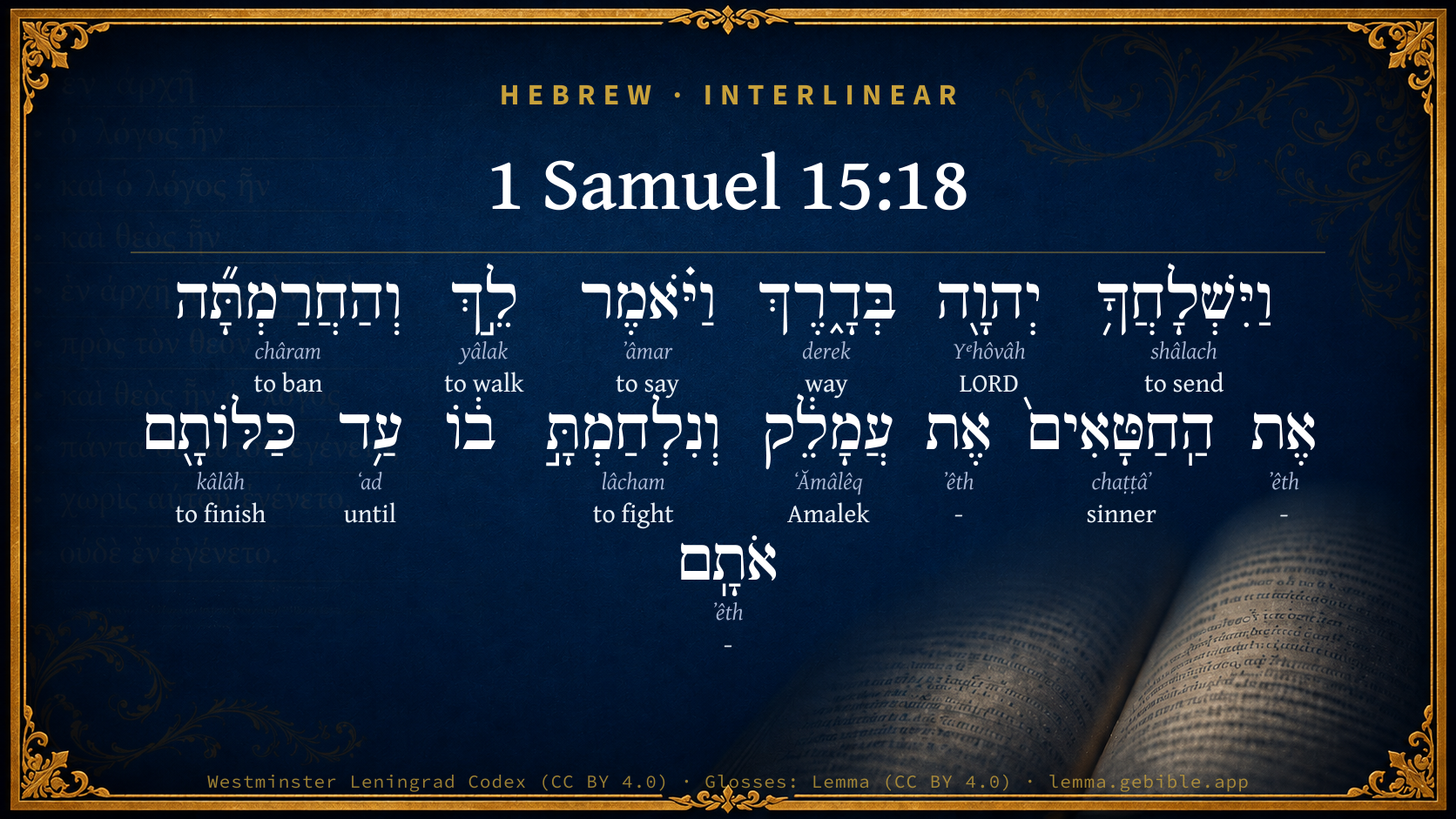
Hebrew (Westminster Leningrad Codex) 1 Samuel 15:18 appears in the Hebrew Old Testament. The text above is from the Westminster Leningrad Codex. Each word links to its Strong’s number, a concise gloss, and parsing drawn from the Open Scriptures Hebrew Bible morphology. Click any word for its full Brown-Driver-Briggs (BDB) entry.
Download image
Cite this verse

1 Samuel 15:18 (World English Bible). Public Domain. Lemma interlinear Bible study tool, https://lemma.gebible.app/v/1-samuel/15/18.

Show BibTeX & RIS
BibTeX
RIS
English Translation
and Yahweh sent you on a journey, and said, 'Go, and utterly destroy the sinners the Amalekites, and fight against them until they are consumed.'
World English Bible · Public Domain
Download a study sheet

One document with this verse’s original text, its word-by-word gloss line, the meaning frame, cross-references with their text, attributed commentary, and full source and license credits — printable, and it pastes into notes with its structure intact.

This verse Autodidact and up

Study sheet (.html) Plain text (.txt)

A passage Seminary Student

Up to 50 verses in one chapter. A passage sheet keeps up to 6 commentary sources and 12 cross-references per verse, in the order this page ranks them, and says so on the sheet whenever that leaves anything out. Ask for a single verse and you get the Autodidact verse sheet above.

Everything on this page stays free to read, with no account — the sheet is a download of what is already on screen, not access to it.

Want to remove ads? Support Godless Engineer
Compare translations 3

The same verse in 3 English versions, stacked beneath the original-language interlinear above. Click any original word for its lexicon entry.

Each is an independent rendering of the whole verse — the interlinear is not word-aligned to these translations.

Highlighted words mark where these versions differ — a whole-verse word diff, not a word-by-word alignment.

  • World English Bible Public Domain
    and Yahweh sent you on a journey, and said, 'Go, and utterly destroy the sinners the Amalekites, and fight against them until they are consumed.'
  • King James Version Public Domain
    And the LORD sent thee on a journey, and said, Go and utterly destroy the sinners the Amalekites, and fight against them until they be consumed.
  • unfoldingWord Literal Text CC BY-SA 4.0
    And Yahweh sent you on your way, and he said, ‘Go, and you shall devote the sinners, Amalek. And you shall fight with him until the finishing of them.’

unfoldingWord Literal Text — © unfoldingWord, licensed CC BY-SA 4.0. Word-aligned USFM3 via Door43 (git.door43.org/unfoldingWord/en_ult).

Versions to compare (up to 4)

3 of 4 selected

Show all 18 translations

Every available English version of this verse, each an independent rendering of the whole verse.

  • World English Bible Public Domain
    and Yahweh sent you on a journey, and said, 'Go, and utterly destroy the sinners the Amalekites, and fight against them until they are consumed.'
  • Berean Standard Bible Public Domain
    and sent you on a mission, saying, ‘Go and devote to destruction the sinful Amalekites. Fight against them until you have wiped them out.’
  • Majority Standard Bible Public Domain
    and sent you on a mission, saying, ‘Go and devote to destruction the sinful Amalekites. Fight against them until you have wiped them out.’
  • King James Version Public Domain
    And the LORD sent thee on a journey, and said, Go and utterly destroy the sinners the Amalekites, and fight against them until they be consumed.
  • American Standard Version (1901) Public Domain
    and Jehovah sent thee on a journey, and said, Go, and utterly destroy the sinners the Amalekites, and fight against them until they be consumed.
  • Revised Version (1885) Public Domain
    and the LORD sent thee on a journey, and said, Go and utterly destroy the sinners the Amalekites, and fight against them until they be consumed.
  • Geneva Bible (1599) Public Domain
    And the Lord sent thee on a iourney, and saide, Goe, and destroy those sinners the Amalekites, and fight against them, vntill thou destroy them.
  • Douay-Rheims (1899) Public Domain
    And the Lord sent thee on the way, and said: Go, and kill the sinners of Amalec, and thou shalt fight against them until thou hast utterly destroyed them.
  • Young's Literal Translation Public Domain
    and Jehovah sendeth thee in the way, and saith, Go, and thou hast devoted the sinners, the Amalekite, and fought against them till they are consumed;
  • Literal Standard Version CC BY-SA 4.0
    and YHWH sends you in the way, and says, Go, and you have devoted the sinners, the Amalekite, and fought against them until they are consumed;
  • Unlocked Literal Bible CC BY-SA 4.0
    and Yahweh sent you on your way and said, 'Go and completely destroy the sinners, the Amalekites, and fight against them until they are destroyed.'
  • unfoldingWord Literal Text CC BY-SA 4.0
    And Yahweh sent you on your way, and he said, ‘Go, and you shall devote the sinners, Amalek. And you shall fight with him until the finishing of them.’
  • Darby Bible Public Domain
    And Jehovah sent thee on a way and said, Go and utterly destroy the sinners the Amalekites, and fight against them until they be consumed.
  • World Messianic Bible Public Domain
    and the LORD sent you on a journey, and said, ‘Go, and utterly destroy the sinners the Amalekites, and fight against them until they are consumed.’
  • Webster's Bible Public Domain
    And the LORD sent thee on a journey, and said, Go, and utterly destroy the sinners the Amalekites, and fight against them until they are consumed.
  • Free Bible Version CC BY-SA 4.0
    Then he sent you out to do something, telling you, ‘Go and exterminate those sinners, the Amalekites. Attack them until they're all destroyed.’
  • Bible in Basic English Public Domain
    And the Lord sent you on a journey and said, Go and put to the curse those sinners, the Amalekites, fighting against them till every one is dead.
  • JPS Tanakh (1917) Public Domain
    and the LORD sent thee on a journey, and said: Go and utterly destroy the sinners the Amalekites, and fight against them until they be consumed.

Literal Standard Version (2020), Covenant Press — licensed CC BY-SA 4.0. Text via the HelloAO Bible API (eBible.org). Unlocked Literal Bible (unfoldingWord) — licensed CC BY-SA 4.0. Text via the HelloAO Bible API (eBible.org). unfoldingWord Literal Text — © unfoldingWord, licensed CC BY-SA 4.0. Word-aligned USFM3 via Door43 (git.door43.org/unfoldingWord/en_ult). Free Bible Version, Dr. Jonathan Gallagher — licensed CC BY-SA 4.0. Text via the HelloAO Bible API (eBible.org).

Word by word

More ways to search: Search by grammar → Find every occurrence → Compare this word →

Practice this passage: Drill this verse → Learn its vocabulary →

הַֽחַטָּאִים֙
chaṭṭâʼ
H2400
“the · sinner”
Particle, Definite Article + Adjective, Adjective, Masculine, Plural, Absolute
Part of Speech
Particle + Adjective
Type
Adjective
Gender
Masculine
Number
Plural
State
Absolute
Full BDB Definition

Origin: intensively from H2398

TWOT: 638b

sinners (noun masculine) - sinful (adjective) - exposed to condemnation, reckoned as offenders (adjective)
  1. וַיִּשְׁלָחֲךָ֥ shâlach H7971 “and · to send · you” Conjunction + Verb, Qal, Sequential Imperfect, 3rd Person, Masculine, Singular + Suffix, Personal, 2nd Person, Masculine, Singular
  2. יְהוָ֖ה Yᵉhôvâh H3068 “LORD” Noun, Proper
  3. בְּדָ֑רֶךְ derek H1870 “in/at · way” Preposition + Noun, Common, Both, Singular, Absolute
  4. וַיֹּ֗אמֶר ʼâmar H559 “and · to say” Conjunction + Verb, Qal, Sequential Imperfect, 3rd Person, Masculine, Singular
  5. לֵ֣ךְ yâlak H3212 “walk” Verb, Qal, Imperative, 2nd Person, Masculine, Singular
  6. וְהַחֲרַמְתָּ֞ה châram H2763 “and · to ban” Conjunction + Verb, Hiphil, Sequential Perfect, 2nd Person, Masculine, Singular
  7. אֶת ʼêth H853 “-” Particle, Direct Object
  8. אֶת ʼêth H853 “-” Particle, Direct Object
  9. עֲמָלֵ֔ק ʻĂmâlêq H6002 “Amalek” Noun, Proper
  10. וְנִלְחַמְתָּ֣ lâcham H3898 “and · to fight” Conjunction + Verb, Niphal, Sequential Perfect, 2nd Person, Masculine, Singular
  11. עַ֥ד ʻad H5704 “until” Preposition
  12. כַּלּוֹתָ֖ם kâlâh H3615 “to finish · them” Verb, Piel, Infinitive Construct + Suffix, Personal, 3rd Person, Masculine, Plural
  13. אֹתָֽם ʼêth H853 “- · them” Particle, Direct Object + Suffix, Personal, 3rd Person, Masculine, Plural

About this verse

These counts appear in no published source. They are computed here, from the morphology-tagged text and Lemma’s own curated glosses. What Lemma adds →

15
words
12
distinct lemmas
Historical
section

Notable vocabulary

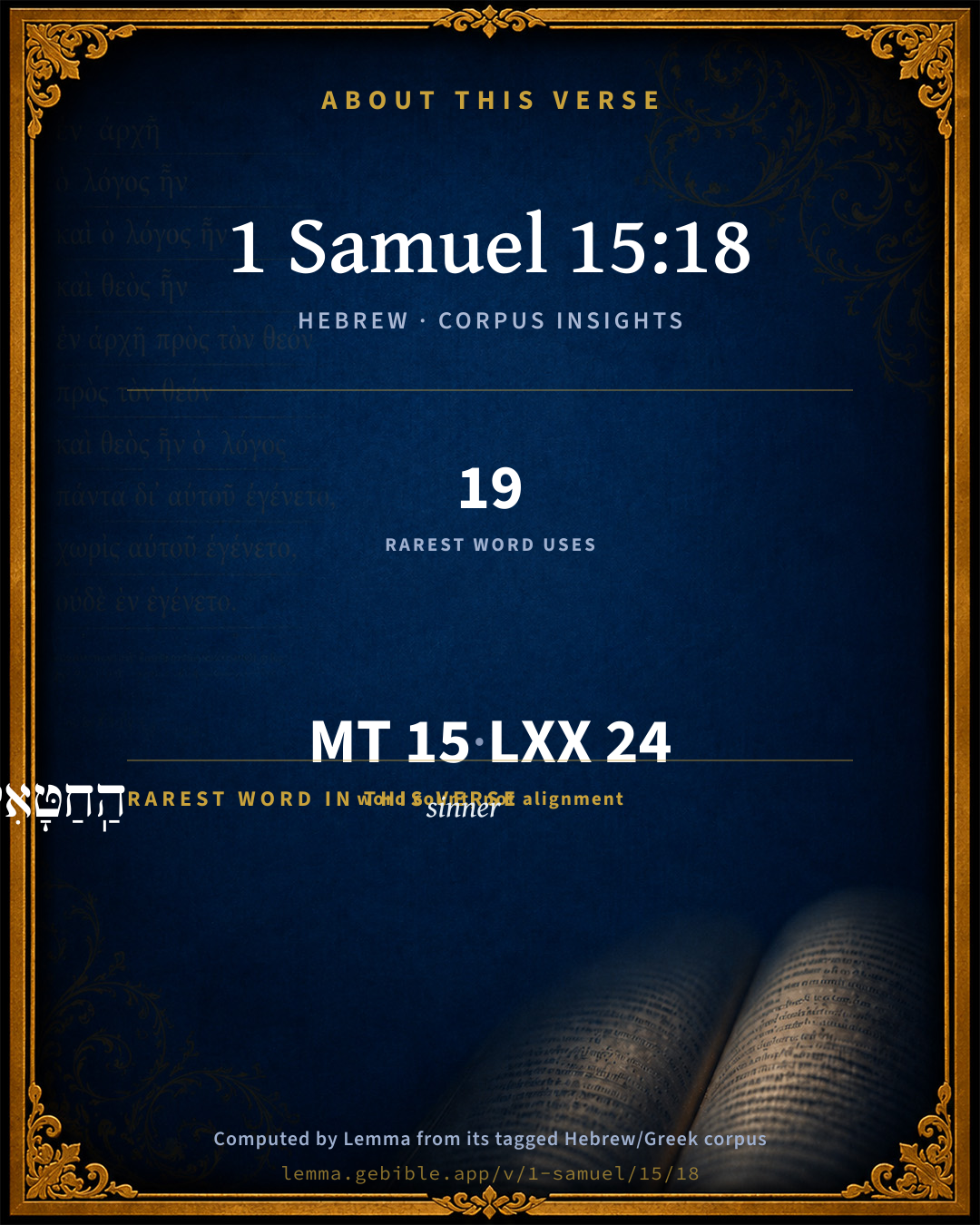
The rarest word here is הַֽחַטָּאִים֙ sinner H2400 — appearing just 19 times in the whole Hebrew Bible.

Shared distinctive vocabulary

הַֽחַטָּאִים֙ sinner H2400 occurs in 19 verses of the Hebrew Bible. Also found in:

Grammatical profile

  • 6 verbs
  • 3 nouns
  • 1 adjective
  • 2 prepositions
  • 3 particles

Verb forms

  • וַיִּשְׁלָחֲךָ֥ Qal · Sequential Imperfect
  • וַיֹּ֗אמֶר Qal · Sequential Imperfect
  • לֵ֣ךְ Qal · Imperative
  • וְהַחֲרַמְתָּ֞ה Hiphil · Sequential Perfect
  • וְנִלְחַמְתָּ֣ Niphal · Sequential Perfect
  • כַּלּוֹתָ֖ם Piel · Infinitive Construct

Hebrew & Septuagint length

In English translation the verse runs 25 words from the Hebrew and 37 from the Septuagint (LXX English) — the Septuagint runs noticeably longer here. See the side-by-side →

A rough comparison of the two English renderings, which tokenize alike — not a word-level alignment.

Word counts can differ between the Hebrew and the Greek without any difference in meaning — e.g. the Hebrew direct-object marker אֵת has no separate Greek word, and Greek often adds the article ὁ.

In the original languages it is 15 Hebrew tokens and 24 Greek tokens — but the two are counted differently (Hebrew bundles its prefixes and suffixes into one token; the Greek is in lemma form), so that isn’t a like-for-like length.

Cross-references

6

Topical passages linked to 1 Samuel 15:18 in the Treasury of Scripture Knowledge — connected by theme and wording, ordered by reader-vote popularity; previews shown in the World English Bible.

  • Genesis 13:13 Now the men of Sodom were exceedingly wicked and sinners against Yahweh.
  • Genesis 15:16 In the fourth generation they will come here again, for the iniquity of the Amorite is not yet full."
  • Numbers 16:38 even the censers of these sinners against their own lives; and let them be made beaten plates for a covering of the altar: for they offered them before Yahweh; therefore they are holy; and they shall be a sign to the children of Israel.
  • Job 31:3 Is it not calamity to the unrighteous, And disaster to the workers of iniquity?
  • Proverbs 10:29 The way of Yahweh is a stronghold to the upright, But it is a destruction to the workers of iniquity.
  • Proverbs 13:21 Misfortune pursues sinners, But prosperity rewards the righteous.

Cross-references courtesy of OpenBible.info (CC BY 4.0).

Hebrew and Greek witnesses Masoretic Hebrew ↔ Greek Septuagint

The same verse in the two great witnesses to the Old Testament, shown verse-for-verse.

Here the Septuagint runs noticeably longer than the Hebrew — LXX2012 (modern English Septuagint) 37 words vs World English Bible 25. A rough length comparison of the two English translations, not a word-level alignment — read both below.

These are two independent witnesses, not word-aligned to each other, and the Septuagint is shown in lemma (dictionary) form.

Hebrew 1 Samuel 15:18 Masoretic · Westminster Leningrad Codex

וַיִּשְׁלָחֲךָ֥ יְהוָ֖ה בְּדָ֑רֶךְ וַיֹּ֗אמֶר לֵ֣ךְ וְהַחֲרַמְתָּ֞ה אֶת הַֽחַטָּאִים֙ אֶת עֲמָלֵ֔ק וְנִלְחַמְתָּ֣ ב֔וֹ עַ֥ד כַּלּוֹתָ֖ם אֹתָֽם

and Yahweh sent you on a journey, and said, 'Go, and utterly destroy the sinners the Amalekites, and fight against them until they are consumed.'

World English Bible · Public Domain

Greek LXX 1 Samuel 15:18 Septuagint · lemma form

καί ἀποστέλλω σύ κύριος ἐν ὁδός καί εἶπον σύ πορεύομαι καί ἐκὀλεθρεύω ὁ ἁμαρτάνω εἰς ἐγώ ὁ αμαληκ καί πολεμέω αὐτός ἕως συντελέω αὐτός

And the Lord sent you on a journey, and said to you, Go, and utterly destroy: you shall kill the sinners against me, even the Amalekites; and you shall war against them until you have consumed them.

LXX2012 (modern English Septuagint) · Public Domain

Hebrew: Westminster Leningrad Codex (CC BY 4.0). Greek: Septuagint (public domain); English from LXX2012 (modern English Septuagint) (Public Domain). How the Septuagint differs from the Hebrew →

Targum (Aramaic paraphrase)

1

The Targum is the ancient Jewish Aramaic paraphrase of the Hebrew Scriptures — an interpretive translation, not the Hebrew text itself. Onkelos (literal) and Pseudo-Jonathan (expansive) render the Torah, and Jonathan the Prophets. Coverage is partial: where no permissively-licensed English translation exists for a verse, only the Aramaic is shown. This is verse-level text, not a word-by-word alignment to the Hebrew.

  1. Targum Jonathan Prophets (Joshua–Malachi)
    וְשַׁלְחָךְ יְיָ בְּאוֹרְחָא וַאֲמַר אֱזֵיל וּתְגַמַר יַת חַיָבַיָא יַת דְבֵית עֲמָלֵק וְתַגִיחַ קְרָבָא בְהוֹן עַד דִתְשֵׁיצֵי יַתְהוֹן:

    (no public-domain English translation for this verse)

    Targum Jonathan — Aramaic: “Mikraot Gedolot” (public domain). English: “Sefaria Community Translation” (CC0 1.0 (public-domain dedication)); “London "Chaldee Paraphrase," 1871” (public domain). Text via Sefaria.

Commentary

Notes on 1 Samuel 15:18 from classic Christian and Jewish commentators (each source and its license shown beneath its notes). The classic Christian expositions comment on the surrounding passage and are grouped to its opening verse, so a note may address several verses; the Jewish commentaries on the Tanakh (Rashi and others) are per-verse, so they appear only where the commentator wrote on this verse.

Lemma curates 59 commentaries, every one of them public domain or Creative Commons licensed, each selected and text-cleaned for this edition rather than reprinted as found. About our sources →

Trapp's Complete Commentary

John Trapp

1Sa 15:18 And the LORD sent thee on a journey, and said, Go and utterly destroy the sinners the Amalekites, and fight against them until they be consumed.

Ver. 18. Go and utterly destroy the sinners the Amalekites.] Those sinners with an accent, those wicked with a witness; qui noluerant solita peccare, - as Seneca said of some in his time, - who strove to out sin others.

John Trapp, A Commentary or Exposition upon All the Books of the Old and New Testament (1647–1656) — public domain. Text from a community e-Sword module.

Joseph Benson's Commentary

1Sa 15:18-19. The Lord sent thee on a journey — So easy was the service, and so certain the success, that it was rather to be called a journey than a war. Wherefore didst thou not obey the voice of the Lord? — The command was as plain as words could make it; and there was no reason but his own base covetousness why it was not obeyed.

Joseph Benson's Commentary on the Old and New Testaments (1811–1818) — public domain. Text from a community e-Sword module.

Ellicott's Commentary for English Readers

(18) The sinners the Amalekites.—This briefly rehearses the charge of the Most High, which Saul had deliberately disobeyed. It is noticeable that the Amalekites are expressly called “sinners,” thus indicating the reason of the Divine wrath against them. The men of Sodom (Gen_13:13) were styled “sinners before the Lord.”

A Bible Commentary for English Readers, edited by Charles John Ellicott (1878–1897) — public domain. Text from a community e-Sword module.

The Cambridge Bible for Schools and Colleges

gen. ed. J. J. S. Perowne

18. the sinners the Amalekites] Sin was the ground of their doom. The special sin which singled them out for punishment was their opposition to the will of God as regards the destiny of his people Israel.

The Cambridge Bible for Schools and Colleges (gen. ed. J. J. S. Perowne; Cambridge University Press, 1878–1918) — public domain. Text from a community e-Sword module.

John Gill's Exposition

And the Lord sent thee on a journey,.... And therefore he ought to have attended to the errand sent upon, and executed the orders given; in vain, therefore, was it to lay the blame on the people:

and said, go, and utterly destroy the sinners, the Amalekites; those notorious sinners, who deserve no mercy at the hands of God or men; who had so highly offended the Lord, and had been so injurious to his people at their first coming out of Egypt. The orders were plain, not to be mistaken, and full and strong for the utter destruction of them without any exception, and therefore nothing could be pleaded in excuse for the violation of them:

and fight against them until they be consumed; entirely; they were not to be left until an end was made of them; or "until they had consumed them" (d), the people of Israel, or the soldiers with Saul.

(d) "donec consumant ipsi eos", Pagninus; so Vatablus.

John Gill's Exposition of the Whole Bible (1746–1763) — public domain (CC PDM 1.0). Text via the HelloAO Bible API.

Albert Barnes' Notes on the Bible

The sinners - As though God would justify His commission to destroy them. (Compare Gen 13:13.)

Albert Barnes' Notes on the Bible (1834–1885) — public domain. Text from a community e-Sword/MySword module.

Matthew Poole's English Annotations

The sinners; so called by way of eminency, as that word is used, Gen 13:13; Mat 9:10; Joh 9:24,31.

Matthew Poole's English Annotations on the Holy Bible (1683–1685) — public domain. Text from a community e-Sword/MySword module.

The Pulpit Commentary

The sinners. The Amalekites were a race of robbers, and the command "to devote them" was the consequence of the robbery and murder practised by them on the Israelite borders.

The Pulpit Commentary (1880–1919), ed. H.D.M. Spence-Jones & Joseph S. Exell — public domain. Text from a community e-Sword module.

John Wesley's Explanatory Notes

A journey - So easy was the service, and so certain the success, that it was rather to be called a journey than a war.

John Wesley, Explanatory Notes Upon the Whole Bible (1754–1765) — public domain. Text via the GEBible commentary corpus.

Rashi

Rabbi Shlomo Yitzchaki (Rashi)

Until they destroy them. The people who are with you will destroy them.

Rashi on the Tanakh — English translations: “The Judaica Press complete Tanach with Rashi, translated by A. J. Rosenberg” (CC BY 4.0); “Pentateuch with Rashi's commentary by M. Rosenbaum and A.M. Silbermann, 1929-1934” (public domain); “The Metsudah Tanach series, Lakewood, N.J” (CC BY 4.0); and “The Book of Joshua, Metsudah Publications, 1997” (CC BY 4.0). Text via Sefaria.

Lesson kit

Teaching starters — assembled from the data on this page, not authored interpretation. Every prompt links to the verse data it draws on. Edit before teaching.

1 Samuel, in the Historical, opens this verse with 15 words (12 distinct Hebrew lemmas). Its most distinctive word is chaṭṭâʼ (“sinner”). The Greek Septuagint runs longer here. A historical commentator’s framing appears above. Read the whole chapter for the surrounding context.

Discussion questions

  1. How does “sinner” (chaṭṭâʼ) shape what this verse is saying?
  2. How does Genesis 13:13, which shares the word «sinner», read alongside this verse?
  3. The Septuagint runs longer here than the Hebrew. What might account for the difference?
  4. These translations render this verse differently; the difference is in the English rendering, not the original. What questions does that raise?
  5. «וַיִּשְׁלָחֲךָ֥» is a Qal Sequential Imperfect verb. How does that grammatical form shape the action described?
  6. Compare how Trapp's Complete Commentary and Joseph Benson's Commentary read this verse. Where do they agree or differ?

Things to notice

Reading settings

Reading text

Shown beneath each verse's original-language words.

Old Testament
Old Testament edition

Read the OT as the Masoretic Hebrew (MT) or the Greek Septuagint (LXX).

English shown for the Greek Septuagint (in the Hebrew ↔ Greek comparison).

Comparing translations? Open the Compare panel on any verse page to stack up to four side by side.