Judges 15:17

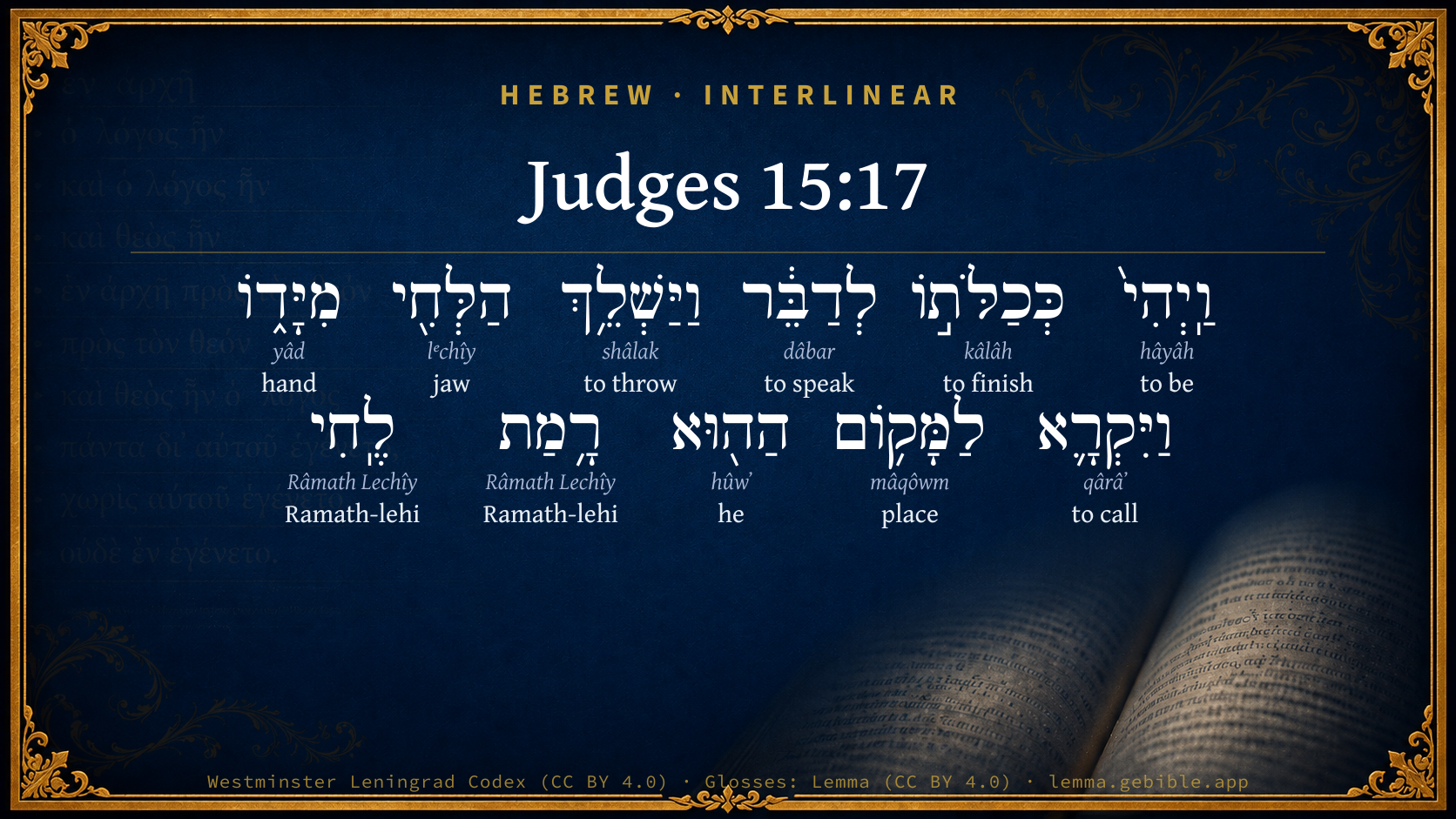
Hebrew (Westminster Leningrad Codex) Judges 15:17 appears in the Hebrew Old Testament. The text above is from the Westminster Leningrad Codex. Each word links to its Strong’s number, a concise gloss, and parsing drawn from the Open Scriptures Hebrew Bible morphology. Click any word for its full Brown-Driver-Briggs (BDB) entry.
Download image
Cite this verse

Judges 15:17 (World English Bible). Public Domain. Lemma interlinear Bible study tool, https://lemma.gebible.app/v/judges/15/17.

Show BibTeX & RIS
BibTeX
RIS
English Translation
It happened, when he had made an end of speaking, that he cast away the jawbone out of his hand; and that place was called Ramath Lehi.
World English Bible · Public Domain
Highlights
  • 1 first appearance in the Hebrew Bible
Full analysis ↓
Download a study sheet

One document with this verse’s original text, its word-by-word gloss line, the meaning frame, cross-references with their text, attributed commentary, and full source and license credits — printable, and it pastes into notes with its structure intact.

This verse Autodidact and up

Study sheet (.html) Plain text (.txt)

A passage Seminary Student

Up to 50 verses in one chapter. A passage sheet keeps up to 6 commentary sources and 12 cross-references per verse, in the order this page ranks them, and says so on the sheet whenever that leaves anything out. Ask for a single verse and you get the Autodidact verse sheet above.

Everything on this page stays free to read, with no account — the sheet is a download of what is already on screen, not access to it.

Want to remove ads? Support Godless Engineer
Compare translations 3

The same verse in 3 English versions, stacked beneath the original-language interlinear above. Click any original word for its lexicon entry.

Each is an independent rendering of the whole verse — the interlinear is not word-aligned to these translations.

Highlighted words mark where these versions differ — a whole-verse word diff, not a word-by-word alignment.

  • World English Bible Public Domain
    It happened, when he had made an end of speaking, that he cast away the jawbone out of his hand; and that place was called Ramath Lehi.
  • King James Version Public Domain
    And it came to pass, when he had made an end of speaking, that he cast away the jawbone out of his hand, and called that place Ramathlehi.
  • unfoldingWord Literal Text CC BY-SA 4.0
    And it happened in his finishing to speak, that he threw the jawbone from his hand, so he called that place Ramath Lehi.

unfoldingWord Literal Text — © unfoldingWord, licensed CC BY-SA 4.0. Word-aligned USFM3 via Door43 (git.door43.org/unfoldingWord/en_ult).

Versions to compare (up to 4)

3 of 4 selected

Show all 18 translations

Every available English version of this verse, each an independent rendering of the whole verse.

  • World English Bible Public Domain
    It happened, when he had made an end of speaking, that he cast away the jawbone out of his hand; and that place was called Ramath Lehi.
  • Berean Standard Bible Public Domain
    And when Samson had finished speaking, he cast the jawbone from his hand; and he named that place Ramath-lehi.
  • Majority Standard Bible Public Domain
    And when Samson had finished speaking, he cast the jawbone from his hand; and he named that place Ramath-lehi.
  • King James Version Public Domain
    And it came to pass, when he had made an end of speaking, that he cast away the jawbone out of his hand, and called that place Ramathlehi.
  • American Standard Version (1901) Public Domain
    And it came to pass, when he had made an end of speaking, that he cast away the jawbone out of his hand; and that place was called Ramath-lehi.
  • Revised Version (1885) Public Domain
    And it came to pass, when he had made an end of speaking, that he cast away the jawbone out of his hand; and that place was called Ramath-lehi.
  • Geneva Bible (1599) Public Domain
    And when he had left speaking, hee cast away the iawebone out of his hande, and called that place, Ramath-Lehi.
  • Douay-Rheims (1899) Public Domain
    And when he had ended these words singing, he threw the jawbone out of his hand, and called the name of that place Ramathlechi, which is interpreted the lifting up of the jawbone.
  • Young's Literal Translation Public Domain
    And it cometh to pass when he finisheth speaking, that he casteth away the jaw-bone out of his hand, and calleth that place Ramath-Lehi;
  • Literal Standard Version CC BY-SA 4.0
    And it comes to pass, when he finishes speaking, that he casts away the jawbone out of his hand, and calls that place Ramath-Lehi;
  • Unlocked Literal Bible CC BY-SA 4.0
    When Samson finished speaking, he threw away the jawbone, and he called the place Ramath Lehi.
  • unfoldingWord Literal Text CC BY-SA 4.0
    And it happened in his finishing to speak, that he threw the jawbone from his hand, so he called that place Ramath Lehi.
  • Darby Bible Public Domain
    When he had finished speaking, he threw away the jawbone out of his hand; and that place was called Ra'math-le'hi.
  • World Messianic Bible Public Domain
    When he had finished speaking, he threw the jawbone out of his hand; and that place was called Ramath Lehi.
  • Webster's Bible Public Domain
    And it came to pass when he had made an end of speaking, that he cast away the jaw-bone out of his hand, and called that place Ramath-lehi.
  • Free Bible Version CC BY-SA 4.0
    After Samson had finished his speech, he threw away the jawbone, and he named the place Hill of the Jawbone.
  • Bible in Basic English Public Domain
    And having said these words, he let the mouth-bone go out of his hand; so that place was named Ramath-lehi.
  • JPS Tanakh (1917) Public Domain
    And it came to pass, when he had made an end of speaking, that he cast away the jawbone out of his hand; and that place was called Ramath-lehi.

Literal Standard Version (2020), Covenant Press — licensed CC BY-SA 4.0. Text via the HelloAO Bible API (eBible.org). Unlocked Literal Bible (unfoldingWord) — licensed CC BY-SA 4.0. Text via the HelloAO Bible API (eBible.org). unfoldingWord Literal Text — © unfoldingWord, licensed CC BY-SA 4.0. Word-aligned USFM3 via Door43 (git.door43.org/unfoldingWord/en_ult). Free Bible Version, Dr. Jonathan Gallagher — licensed CC BY-SA 4.0. Text via the HelloAO Bible API (eBible.org).

Word by word

More ways to search: Search by grammar → Find every occurrence → Compare this word →

Practice this passage: Drill this verse → Learn its vocabulary →

רָ֥מַת
Râmath Lechîy
H7437
“Ramath-lehi”
Noun, Proper
Part of Speech
Noun
Type
Proper
Full BDB Definition

Origin: from H7413 and H3895

TWOT: None

Ramath-lehi = "height of a jawbone" - a place by the rock Elam in northern Judah near the border of the Philistines; named by Samson after his slaughter of the 1000 Philistines with the jawbone of an ass
  1. וַֽיְהִי֙ hâyâh H1961 “and · to be” Conjunction + Verb, Qal, Sequential Imperfect, 3rd Person, Masculine, Singular
  2. כְּכַלֹּת֣וֹ kâlâh H3615 “like/as · to finish · him” Preposition + Verb, Piel, Infinitive Construct + Suffix, Personal, 3rd Person, Masculine, Singular
  3. לְדַבֵּ֔ר dâbar H1696 “to speak” Preposition + Verb, Piel, Infinitive Construct
  4. וַיַּשְׁלֵ֥ךְ shâlak H7993 “and · to throw” Conjunction + Verb, Hiphil, Sequential Imperfect, 3rd Person, Masculine, Singular
  5. הַלְּחִ֖י lᵉchîy H3895 “the · jaw” Particle, Definite Article + Noun, Common, Both, Singular, Absolute
  6. מִיָּד֑וֹ yâd H3027 “from · hand · his” Preposition + Noun, Common, Both, Singular, Construct + Suffix, Personal, 3rd Person, Masculine, Singular
  7. וַיִּקְרָ֛א qârâʼ H7121 “and · to call” Conjunction + Verb, Qal, Sequential Imperfect, 3rd Person, Masculine, Singular
  8. לַמָּק֥וֹם mâqôwm H4725 “to/for the · place” Preposition, Determined + Noun, Common, Masculine, Singular, Absolute
  9. הַה֖וּא hûwʼ H1931 “the · he” Particle, Definite Article + Pronoun, Personal, 3rd Person, Masculine, Singular
  10. לֶֽחִי Râmath Lechîy H7437 “Ramath-lehi” Noun, Proper

About this verse

These counts appear in no published source. They are computed here, from the morphology-tagged text and Lemma’s own curated glosses. What Lemma adds →

11
words
10
distinct lemmas
Historical
section

Notable vocabulary

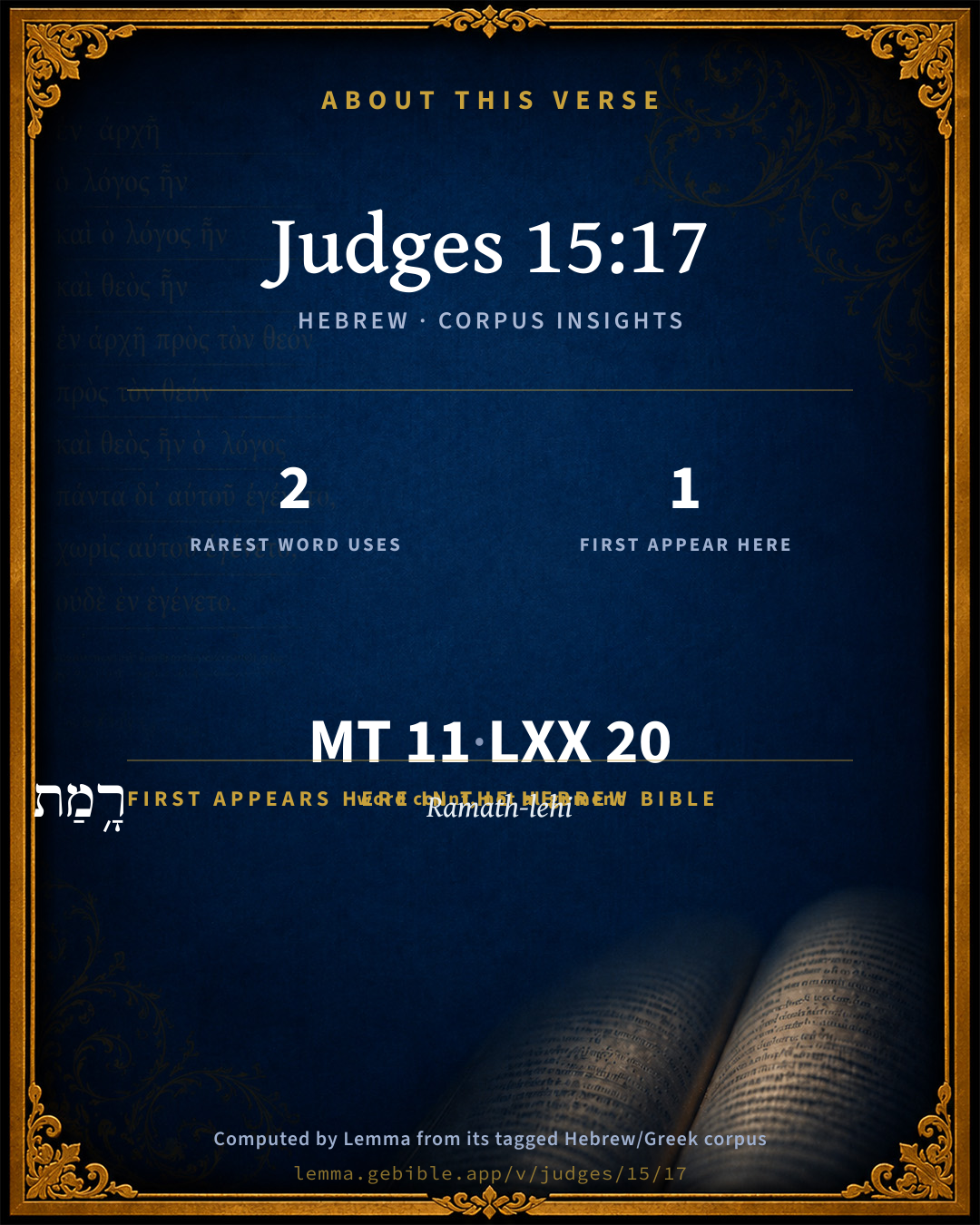
The rarest word here is רָ֥מַת Ramath-lehi H7437 — appearing just 2 times in the whole Hebrew Bible.

First appearance in Scripture

This word makes its first canonical appearance in the Hebrew Bible here:

  • רָ֥מַת Ramath-lehi H7437

Grammatical profile

  • 5 verbs
  • 5 nouns
  • 1 pronoun

Verb forms

  • וַֽיְהִי֙ Qal · Sequential Imperfect
  • כְּכַלֹּת֣וֹ Piel · Infinitive Construct
  • לְדַבֵּ֔ר Piel · Infinitive Construct
  • וַיַּשְׁלֵ֥ךְ Hiphil · Sequential Imperfect
  • וַיִּקְרָ֛א Qal · Sequential Imperfect

Repetition

A word recurs within this verse — often emphatic in Hebrew:

  • רָ֥מַת Ramath-lehi H7437 ×2

Hebrew & Septuagint length

In English translation the verse runs 27 words from the Hebrew and 28 from the Septuagint (LXX English) — closely comparable.

A rough comparison of the two English renderings, which tokenize alike — not a word-level alignment.

Word counts can differ between the Hebrew and the Greek without any difference in meaning — e.g. the Hebrew direct-object marker אֵת has no separate Greek word, and Greek often adds the article ὁ.

In the original languages it is 11 Hebrew tokens and 20 Greek tokens — but the two are counted differently (Hebrew bundles its prefixes and suffixes into one token; the Greek is in lemma form), so that isn’t a like-for-like length.

Hebrew and Greek witnesses Masoretic Hebrew ↔ Greek Septuagint

The same verse in the two great witnesses to the Old Testament, shown verse-for-verse.

These are two independent witnesses, not word-aligned to each other, and the Septuagint is shown in lemma (dictionary) form.

Hebrew Judges 15:17 Masoretic · Westminster Leningrad Codex

וַֽיְהִי֙ כְּכַלֹּת֣וֹ לְדַבֵּ֔ר וַיַּשְׁלֵ֥ךְ הַלְּחִ֖י מִיָּד֑וֹ וַיִּקְרָ֛א לַמָּק֥וֹם הַה֖וּא רָ֥מַת לֶֽחִי

It happened, when he had made an end of speaking, that he cast away the jawbone out of his hand; and that place was called Ramath Lehi.

World English Bible · Public Domain

Greek LXX Judges 15:17 Septuagint · lemma form

καί γίγνομαι ὡς παύω λαλέω καί ῥίπτω ὁ σιαγών ἐκ ὁ χείρ αὐτός καί καλέω ὁ τόπος ἐκεῖνος ἀναίρεσις σιαγών

And it came to pass when he ceased speaking, that he cast the jaw-bone out of his hand; and he called that place the Lifting of the jaw-bone.

LXX2012 (modern English Septuagint) · Public Domain

On this verse, Ellicott's Commentary for English Readers discusses the Septuagint’s reading. Read the note in Commentary ↓

Hebrew: Westminster Leningrad Codex (CC BY 4.0). Greek: Septuagint (public domain); English from LXX2012 (modern English Septuagint) (Public Domain). How the Septuagint differs from the Hebrew →

Targum (Aramaic paraphrase)

1

The Targum is the ancient Jewish Aramaic paraphrase of the Hebrew Scriptures — an interpretive translation, not the Hebrew text itself. Onkelos (literal) and Pseudo-Jonathan (expansive) render the Torah, and Jonathan the Prophets. Coverage is partial: where no permissively-licensed English translation exists for a verse, only the Aramaic is shown. This is verse-level text, not a word-by-word alignment to the Hebrew.

  1. Targum Jonathan Prophets (Joshua–Malachi)
    וַהֲוָה כְּשֵׁיצָיוּתֵיהּ לְמַלָלָא וּרְמָא לוֹעָא מִן יְדֵיהּ וּקְרָא לְאַתְרָא הַהוּא רָמַת לְחִי:

    (no public-domain English translation for this verse)

    Targum Jonathan — Aramaic: “Mikraot Gedolot” (public domain). English: “Sefaria Community Translation” (CC0 1.0 (public-domain dedication)); “London "Chaldee Paraphrase," 1871” (public domain). Text via Sefaria.

Commentary

Notes on Judges 15:17 from classic Christian and Jewish commentators (each source and its license shown beneath its notes). The classic Christian expositions comment on the surrounding passage and are grouped to its opening verse, so a note may address several verses; the Jewish commentaries on the Tanakh (Rashi and others) are per-verse, so they appear only where the commentator wrote on this verse.

Lemma curates 59 commentaries, every one of them public domain or Creative Commons licensed, each selected and text-cleaned for this edition rather than reprinted as found. About our sources →

Trapp's Complete Commentary

John Trapp

Jdg 15:17 And it came to pass, when he had made an end of speaking, that he cast away the jawbone out of his hand, and called that place Ramathlehi.

Ver. 17. And called that place Ramathlehi.] We must likewise set up marks and monuments of God’s signal mercies, to preserve the memory of them, which else will soon be moth eaten. Abraham did so by his Jehovahjireh, Moses by his Jehovahnissi, Samuel by his Ebenezer, Jehoshaphat by his Berachah, the Jews in Esther by their Purim, &c.

John Trapp, A Commentary or Exposition upon All the Books of the Old and New Testament (1647–1656) — public domain. Text from a community e-Sword module.

Joseph Benson's Commentary

Jdg 15:17-18. He called that place Ramath-lehi — That is, The lifting up, or, casting away of the jaw-bone. He gave it this name in order to perpetuate the memory of this action. And he was sore athirst — A natural effect of the great labour he had used. And perhaps there was the hand of God therein, to chastise him for not making mention of God in his song, and to keep him from being proud of his strength. One would have thought that the men of Judah would have met him with bread and wine; but they so little regarded him that he is fainting for want of a draught of water! Thus are the greatest slights often put upon those that do the greatest services! Shall I die — Wilt thou not finish what thou hast begun? Wilt thou undo what thou hast done?

Joseph Benson's Commentary on the Old and New Testaments (1811–1818) — public domain. Text from a community e-Sword module.

Geneva Bible (1599)

Geneva Bible translators

Or, the lifting up of the jaw.

Geneva Bible (1599) marginal notes — public domain. Text via Bolls.life.

Adam Clarke's Commentary

Verse 17. Ramath-lehi.] The lifting up or casting away of the jaw-bone. Lehi was the name of the place before, Ramath was now added to it here; he lifted up the jaw-bone against his enemies, and slew them.

Adam Clarke's Commentary on the Bible (1810–1826) — public domain. Text from a community e-Sword/MySword module.

Ellicott's Commentary for English Readers

(17) Ramath-lehi.—The marginal rendering, “the lifting up of the jawbone” is found in the LXX. and Vulg., and derives Ramath from the verb rûm,” to be high.” The more natural explanation is, “the hill of Lehi.” The other marginal rendering, “the casting away of the jawbone,” derives Ramath from the verb ramah, “he cast.” This would require the form Remath.

A Bible Commentary for English Readers, edited by Charles John Ellicott (1878–1897) — public domain. Text from a community e-Sword module.

The Cambridge Bible for Schools and Colleges

gen. ed. J. J. S. Perowne

17. was called] The text here and in Jdg_15:19 is to be preferred to the marg.

Ramath-lehi] i.e. the height of Lehi, cf. Ramath-mizpeh Jos_13:26, Ramoth-gilead etc. Popular etymology, however, gave it the sense, casting away of the jawbone.

The Cambridge Bible for Schools and Colleges (gen. ed. J. J. S. Perowne; Cambridge University Press, 1878–1918) — public domain. Text from a community e-Sword module.

John Gill's Exposition

And it came to pass, when he had made an end of speaking,.... Of delivering out the above song, which very probably consisted of much more than what is here expressed:

that he cast away the jawbone out of his hand; which he held in his hand had wrought by him through the means of it, and so served to animate him to praise and thankfulness; but having no further use for it, he threw it away:

and called the place Ramathlehi; that is, the casting away the jawbone, so Kimchi; but Ben Gersom thinks it was an high place where it was thrown, and so signifies the elevation or lifting up of the "jawbone", as the Septuagint version renders it.

John Gill's Exposition of the Whole Bible (1746–1763) — public domain (CC PDM 1.0). Text via the HelloAO Bible API.

Albert Barnes' Notes on the Bible

Ramath-lehi - Either the “height or hill of Lehi,” or, “of the jaw-bone;” or, as in the margin, “the crestlag away of the jaw-bone,” with allusion to Samson casting it out of his hand, when he had finished his war-song.

Albert Barnes' Notes on the Bible (1834–1885) — public domain. Text from a community e-Sword/MySword module.

Haydock's Catholic Bible Commentary

Which is, &c. This is added by the Vulgate being the interpretation of the Septuagint Anairesis; (Calmet) though it also signify, "the slaughter." (St. Ambrose, ep. 19.) (Haydock) --- The Syriac and Arabic have read domoth, "the blood," instead of ramath Lechi, "the lifting up;" or as others would have it, "the throwing down of the jaw-bone." (Calmet) --- Samson had snatched it form the ground, slew the thousand Philistines, and left it a a monument of his victory. (Haydock)

George Leo Haydock (1774–1849), Haydock's Catholic Family Bible and Commentary, 1859 edition — public domain. Excludes Psalms (Douay-Rheims chapter numbering differs from Protestant) and Deuterocanonical books (Catholic canon only).

Matthew Poole's English Annotations

And by contraction, Lehi, Jdg 15:14, it being usual so to contract proper names; as Salem is put for Jerusalem, Psa 76:2; Sheba for Beer-sheba, Jos 19:2; and many other.

Matthew Poole's English Annotations on the Holy Bible (1683–1685) — public domain. Text from a community e-Sword/MySword module.

Whedon's Commentary on the Bible

Daniel D. Whedon

17. Called that place Ramath-lehi — The name means hill or height of the jawbone, and seems to have originated with this triumph of Samson. In this case the name Lehi is used proleptically in Jdg_15:9.

Daniel D. Whedon (gen. ed.), Commentary on the Old and New Testaments (1874–1909) — public domain. Text from a community e-Sword module.

The Pulpit Commentary

Made an end of speaking, i.e. of reciting the song about the heaps of slain. It is singular that the word rendered speaking might also be rendered destroying, as in 2Ch_22:10. Called that place Ramath-lechi, i.e. the height of Lechi, or of the jaw bone, or, rather, the throwing away of the jawbone. He commemorated the exact spot where the slaughter ceased and the weapon Was thrown away by giving it the name of Ramath-Lechi, or, as it was called for shortness, Lechi (or hal-Lechi).

Vers. 17-19. The self-refreshment of Divine service.

After his great exploit Samson was exhausted and athirst. The zeal for the glory of Jehovah is upon him, and he cannot brook the tarnishing of his glorious victory by a base surrender to the Philistines. He immediately calls upon God, and is answered in the very scene of his warfare.

I IN MOMENTS OF GREATEST EXALTATION AND POWER THE SAINT IS REMINDED OF HIS WEAKNESS AND DEPENDENCE UPON GOD. Paul and the "thorn in the flesh." The great deed and heroic uplifting of soul accompanying it are a Divine gift a treasure in an earthen vessel. "By the grace of God I am what I am.

II THE TRUE SAINT WILL FRANKLY ACKNOWLEDGE THIS, AND BETAKE HIMSELF TO PRAYER FOR DIVINE HELP. The faith that made Samson irresistible in battle now makes him prevail with God. A sense of spiritual fitness forbids the notion that God will suffer such an anti-climax. The victories that spring from acknowledged weakness are more glorious than those which proceed upon our fancied independence and self-sufficiency. "When I am weak, then am I strong.

III THE CONDITIONS OF AN EFFECTUAL PRAYER.

1. Sincerity and faith. God had helped him already; be is convinced, therefore, that he will still help.

2. Because of wants and hardships necessitated by Divine service. He is immediately answered, and in the very scene of it. No earthly hand is suffered to help.

3. Zeal for the glory of God. The idea of neutralising his triumph by yielding through physical distress is obnoxious to him. He asks God to preserve the splendour of the exploit which brought such glory to his name. M.

The Pulpit Commentary (1880–1919), ed. H.D.M. Spence-Jones & Joseph S. Exell — public domain. Text from a community e-Sword module.

John Wesley's Explanatory Notes

Ramath-Lehi - That is, the lifting up of the jaw-bone; by contraction Lehi, ver. 14, as Salem is put for Jerusalem.

John Wesley, Explanatory Notes Upon the Whole Bible (1754–1765) — public domain. Text via the GEBible commentary corpus.

Scofield Reference Notes

C. I. Scofield

Ramathlehi

The hill of the jawbone.

The Scofield Reference Bible (1917 edition), notes by C. I. Scofield — public domain. Text from a community e-Sword module.

unfoldingWord translationNotes

Door43 World Missions Community

Ramath Lehi

This is the name of a place. It's name means "Jawbone Hill" (See: How to Translate Names)

was very thirsty

"needed water to drink"

But now will I die of thirst and fall into ... uncircumcised?

Possible meanings are 1) Samson is so thirsty he could literally die. AT: "But now I will die of thirst and my body will fall into ... uncircumcised." or 2) Samson exaggerates how thirsty he is by asking if he will die of thirst. AT: "But now will you allow me to become so weak from my thirst that I fall into ... uncircumcised?" (See: Hyperbole and Generalization)

die of thirst

This means to die because you have not drank enough and therefore, you do not have enough water in your body. (See: Idiom)

fall into the hands of those who are uncircumcised

The phrase "fall into the hands" means to be captured. "Those who are uncircumcised" refers to the Philistines and with the word "uncircumcised" emphasizing that they do not worship Yahweh. AT: "be captured by those godless Philistines" (See: Idiom)

translationWords

Samson

call

servant

die

circumcise

unfoldingWord translationNotes — © Distant Shores Media and the Door43 World Missions Community, licensed CC BY-SA 4.0. Source: git.door43.org/Door43/en_tn.

Lesson kit

Teaching starters — assembled from the data on this page, not authored interpretation. Every prompt links to the verse data it draws on. Edit before teaching.

Judges, in the Historical, opens this verse with 11 words (10 distinct Hebrew lemmas). Its most distinctive word is Râmath Lechîy (“Ramath-lehi”). A historical commentator’s framing appears above. Read the whole chapter for the surrounding context.

Discussion questions

  1. The word Râmath Lechîy carries the sense “Ramath-lehi.” How does it shape the verse?
  2. The word “Ramath-lehi” first appears here in Scripture. What is being introduced at this debut?
  3. “Ramath-lehi” occurs 2× in this one verse. What is the effect of the repetition?
  4. The translations on this page render this verse differently — a whole-verse word diff, not a word-by-word alignment. What might account for the different wordings?
  5. The verb «וַֽיְהִי֙» is Qal Sequential Imperfect. How does its form color the action?
  6. Reading how Trapp's Complete Commentary and Joseph Benson's Commentary read this verse, where do the two commentators agree and where do they part?

Things to notice

Reading settings

Reading text

Shown beneath each verse's original-language words.

Old Testament
Old Testament edition

Read the OT as the Masoretic Hebrew (MT) or the Greek Septuagint (LXX).

English shown for the Greek Septuagint (in the Hebrew ↔ Greek comparison).

Comparing translations? Open the Compare panel on any verse page to stack up to four side by side.