Ezekiel 43:23

Hebrew (Westminster Leningrad Codex) Ezekiel 43:23 appears in the Hebrew Old Testament. The text above is from the Westminster Leningrad Codex. Each word links to its Strong’s number, a concise gloss, and parsing drawn from the Open Scriptures Hebrew Bible morphology. Click any word for its full Brown-Driver-Briggs (BDB) entry.
Download image
Cite this verse

Ezekiel 43:23 (World English Bible). Public Domain. Lemma interlinear Bible study tool, https://lemma.gebible.app/v/ezekiel/43/23.

Show BibTeX & RIS
BibTeX
RIS
English Translation
When you have made an end of cleansing it, you shall offer a young bull without blemish, and a ram out of the flock without blemish.
World English Bible · Public Domain
Download a study sheet

One document with this verse’s original text, its word-by-word gloss line, the meaning frame, cross-references with their text, attributed commentary, and full source and license credits — printable, and it pastes into notes with its structure intact.

This verse Autodidact and up

Study sheet (.html) Plain text (.txt)

A passage Seminary Student

Up to 50 verses in one chapter. A passage sheet keeps up to 6 commentary sources and 12 cross-references per verse, in the order this page ranks them, and says so on the sheet whenever that leaves anything out. Ask for a single verse and you get the Autodidact verse sheet above.

Everything on this page stays free to read, with no account — the sheet is a download of what is already on screen, not access to it.

Want to remove ads? Support Godless Engineer
Compare translations 3

The same verse in 3 English versions, stacked beneath the original-language interlinear above. Click any original word for its lexicon entry.

Each is an independent rendering of the whole verse — the interlinear is not word-aligned to these translations.

Highlighted words mark where these versions differ — a whole-verse word diff, not a word-by-word alignment.

  • World English Bible Public Domain
    When you have made an end of cleansing it, you shall offer a young bull without blemish, and a ram out of the flock without blemish.
  • King James Version Public Domain
    When thou hast made an end of cleansing it, thou shalt offer a young bullock without blemish, and a ram out of the flock without blemish.
  • unfoldingWord Literal Text CC BY-SA 4.0
    When you finish its cleansing, offer an unblemished bull from the cattle and an unblemished ram from the flock.

unfoldingWord Literal Text — © unfoldingWord, licensed CC BY-SA 4.0. Word-aligned USFM3 via Door43 (git.door43.org/unfoldingWord/en_ult).

Versions to compare (up to 4)

3 of 4 selected

Show all 18 translations

Every available English version of this verse, each an independent rendering of the whole verse.

  • World English Bible Public Domain
    When you have made an end of cleansing it, you shall offer a young bull without blemish, and a ram out of the flock without blemish.
  • Berean Standard Bible Public Domain
    When you have finished the purification, you are to present a young, unblemished bull and an unblemished ram from the flock.
  • Majority Standard Bible Public Domain
    When you have finished the purification, you are to present a young, unblemished bull and an unblemished ram from the flock.
  • King James Version Public Domain
    When thou hast made an end of cleansing it, thou shalt offer a young bullock without blemish, and a ram out of the flock without blemish.
  • American Standard Version (1901) Public Domain
    When thou hast made an end of cleansing it, thou shalt offer a young bullock without blemish, and a ram out of the flock without blemish.
  • Revised Version (1885) Public Domain
    When thou hast made an end of cleansing it, thou shalt offer a young bullock without blemish, and a ram out of the flock without blemish.
  • Geneva Bible (1599) Public Domain
    When thou hast made an ende of clensing it, thou shalt offer a yong bullocke without blemish, and a ram out of the flocke without blemish.
  • Douay-Rheims (1899) Public Domain
    And in the second day thou shalt offer a he goat without blemish for sin: and they shall expiate the altar, as they expiated it with the calf.
  • Young's Literal Translation Public Domain
    In thy finishing cleansing, thou dost bring near a calf, a son of the herd, a perfect one, and a ram out of the flock, a perfect one.
  • Literal Standard Version CC BY-SA 4.0
    In your finishing cleansing, you bring a calf near, a son of the herd, a perfect one, and a ram out of the flock, a perfect one.
  • Unlocked Literal Bible CC BY-SA 4.0
    When you finish its cleansing, offer an unblemished bull from the cattle and an unblemished ram from the flock.
  • unfoldingWord Literal Text CC BY-SA 4.0
    When you finish its cleansing, offer an unblemished bull from the cattle and an unblemished ram from the flock.
  • Darby Bible Public Domain
    When thou hast ended purging it, thou shalt present a young bullock without blemish, and a ram out of the flock without blemish;
  • World Messianic Bible Public Domain
    When you have finished cleansing it, you shall offer a young bull without defect and a ram out of the flock without defect.
  • Webster's Bible Public Domain
    When thou hast made an end of cleansing it, thou shalt offer a young bullock without blemish, and a ram out of the flock without blemish.
  • Free Bible Version CC BY-SA 4.0
    After you've finished the purifying process, you are to present a young bull and a ram, both free from defects.
  • Bible in Basic English Public Domain
    And after you have made it clean, let a young ox without a mark be offered, and a male sheep from the flock without a mark.
  • JPS Tanakh (1917) Public Domain
    When thou hast made an end of purifying it, thou shalt offer a young bullock without blemish, and a ram out of the flock without blemish.

Literal Standard Version (2020), Covenant Press — licensed CC BY-SA 4.0. Text via the HelloAO Bible API (eBible.org). Unlocked Literal Bible (unfoldingWord) — licensed CC BY-SA 4.0. Text via the HelloAO Bible API (eBible.org). unfoldingWord Literal Text — © unfoldingWord, licensed CC BY-SA 4.0. Word-aligned USFM3 via Door43 (git.door43.org/unfoldingWord/en_ult). Free Bible Version, Dr. Jonathan Gallagher — licensed CC BY-SA 4.0. Text via the HelloAO Bible API (eBible.org).

Word by word

More ways to search: Search by grammar → Find every occurrence → Compare this word →

Practice this passage: Drill this verse → Learn its vocabulary →

תָּמִ֔ים
tâmîym
H8549
“complete”
Adjective, Adjective, Masculine, Singular, Absolute
Part of Speech
Adjective
Type
Adjective
Gender
Masculine
Number
Singular
State
Absolute
Full BDB Definition

Origin: from H8552

TWOT: 2522d

complete, whole, entire, sound - complete, whole, entire - whole, sound, healthful - complete, entire (of time) - sound, wholesome, unimpaired, innocent, having integrity - what is complete or entirely in accord with truth and fact (neuter adjective/substantive)
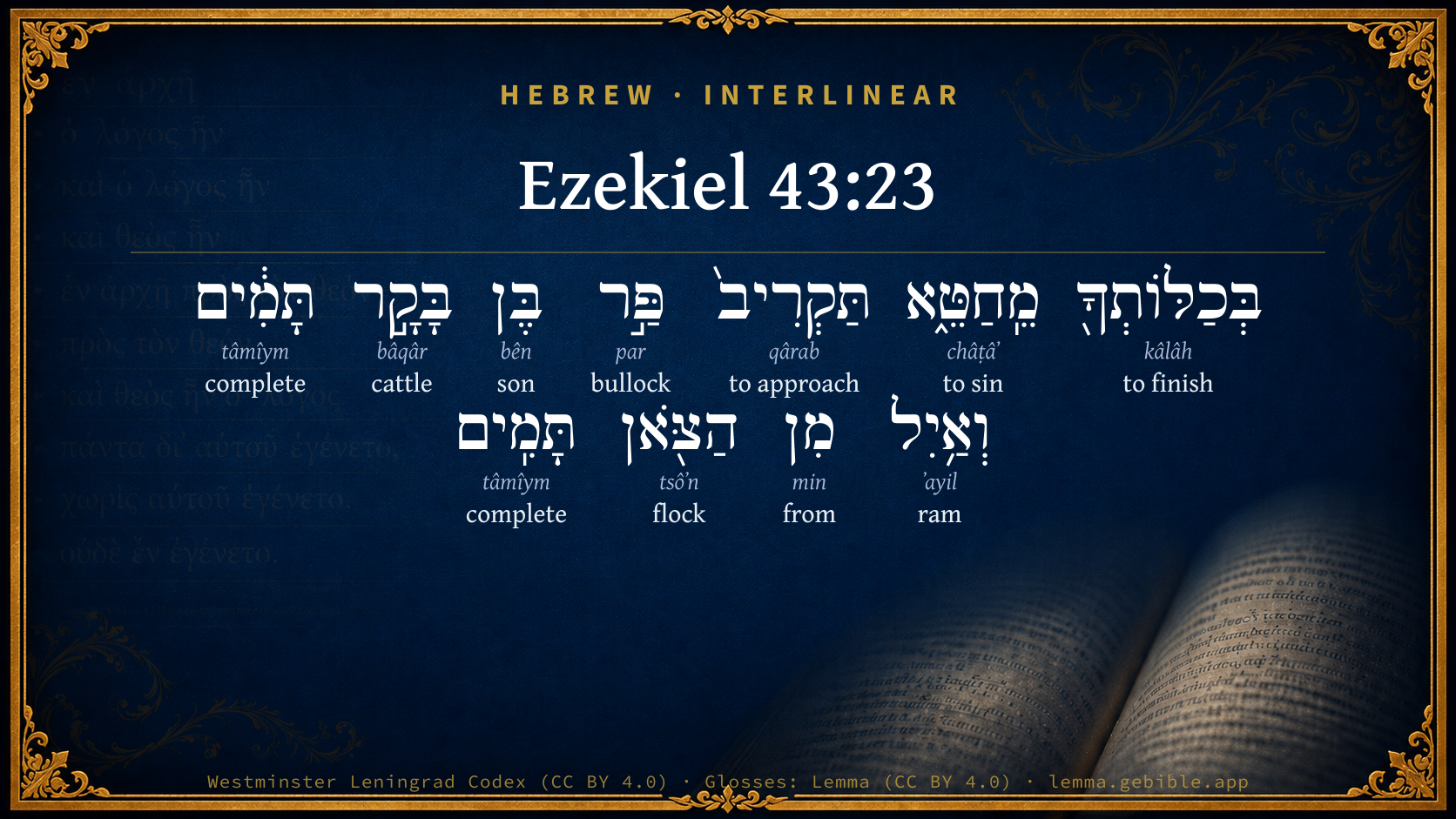
  1. בְּכַלּוֹתְךָ֖ kâlâh H3615 “in/at · to finish · you” Preposition + Verb, Piel, Infinitive Construct + Suffix, Personal, 2nd Person, Masculine, Singular
  2. מֵֽחַטֵּ֑א châṭâʼ H2398 “from · to sin” Preposition + Verb, Piel, Infinitive Construct
  3. תַּקְרִיב֙ qârab H7126 “to approach” Verb, Hiphil, Imperfect, 2nd Person, Masculine, Singular
  4. פַּ֣ר par H6499 “bullock” Noun, Common, Masculine, Singular, Absolute
  5. בֶּן bên H1121 “son of” Noun, Common, Masculine, Singular, Construct
  6. בָּקָ֣ר bâqâr H1241 “cattle” Noun, Common, Both, Singular, Absolute
  7. וְאַ֥יִל ʼayil H352 “and · ram” Conjunction + Noun, Common, Masculine, Singular, Absolute
  8. מִן min H4480 “from” Preposition
  9. הַצֹּ֖אן tsôʼn H6629 “the · flock” Particle, Definite Article + Noun, Common, Both, Singular, Absolute
  10. תָּמִֽים tâmîym H8549 “complete” Adjective, Adjective, Masculine, Singular, Absolute

About this verse

These counts appear in no published source. They are computed here, from the morphology-tagged text and Lemma’s own curated glosses. What Lemma adds →

11
words
10
distinct lemmas
Prophets
section

Grammatical profile

  • 3 verbs
  • 5 nouns
  • 2 adjectives
  • 1 preposition

Verb forms

  • בְּכַלּוֹתְךָ֖ Piel · Infinitive Construct
  • מֵֽחַטֵּ֑א Piel · Infinitive Construct
  • תַּקְרִיב֙ Hiphil · Imperfect

Repetition

A word recurs within this verse — often emphatic in Hebrew:

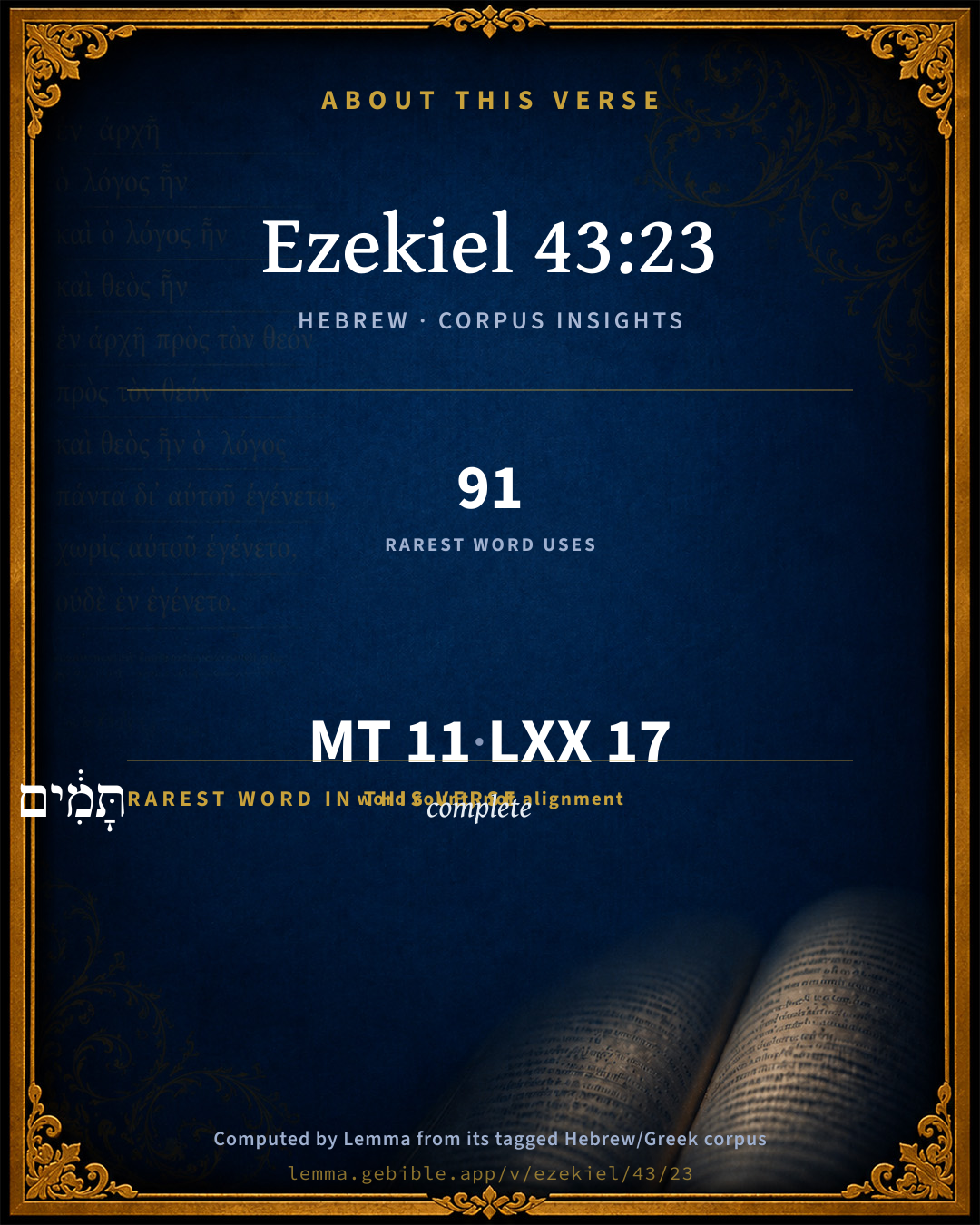
  • תָּמִ֔ים complete H8549 ×2

Hebrew & Septuagint length

In English translation the verse runs 26 words from the Hebrew and 23 from the Septuagint (LXX English) — closely comparable.

A rough comparison of the two English renderings, which tokenize alike — not a word-level alignment.

Word counts can differ between the Hebrew and the Greek without any difference in meaning — e.g. the Hebrew direct-object marker אֵת has no separate Greek word, and Greek often adds the article ὁ.

In the original languages it is 11 Hebrew tokens and 17 Greek tokens — but the two are counted differently (Hebrew bundles its prefixes and suffixes into one token; the Greek is in lemma form), so that isn’t a like-for-like length.

Cross-references

1

Topical passages linked to Ezekiel 43:23 in the Treasury of Scripture Knowledge — connected by theme and wording, ordered by reader-vote popularity; previews shown in the World English Bible.

  • Exodus 29:1 "This is the thing that you shall do to them to make them holy, to minister to me in the priest's office: take one young bull and two rams without blemish,

Cross-references courtesy of OpenBible.info (CC BY 4.0).

Hebrew and Greek witnesses Masoretic Hebrew ↔ Greek Septuagint

The same verse in the two great witnesses to the Old Testament, shown verse-for-verse.

These are two independent witnesses, not word-aligned to each other, and the Septuagint is shown in lemma (dictionary) form.

Hebrew Ezekiel 43:23 Masoretic · Westminster Leningrad Codex

בְּכַלּוֹתְךָ֖ מֵֽחַטֵּ֑א תַּקְרִיב֙ פַּ֣ר בֶּן בָּקָ֣ר תָּמִ֔ים וְאַ֥יִל מִן הַצֹּ֖אן תָּמִֽים

When you have made an end of cleansing it, you shall offer a young bull without blemish, and a ram out of the flock without blemish.

World English Bible · Public Domain

Greek LXX Ezekiel 43:23 Septuagint · lemma form

καί μετά ὁ συντελέω σύ ὁ ἐξιλασμός προςφέρω μόσχος ἐκ βοῦς ἄμωμος καί κριός ἐκ πρόβατον ἄμωμος

And after they have finished the atonement, they shall bring an unblemished calf of the herd, and an unblemished ram of the flock.

LXX2012 (modern English Septuagint) · Public Domain

Hebrew: Westminster Leningrad Codex (CC BY 4.0). Greek: Septuagint (public domain); English from LXX2012 (modern English Septuagint) (Public Domain). How the Septuagint differs from the Hebrew →

Targum (Aramaic paraphrase)

1

The Targum is the ancient Jewish Aramaic paraphrase of the Hebrew Scriptures — an interpretive translation, not the Hebrew text itself. Onkelos (literal) and Pseudo-Jonathan (expansive) render the Torah, and Jonathan the Prophets. Coverage is partial: where no permissively-licensed English translation exists for a verse, only the Aramaic is shown. This is verse-level text, not a word-by-word alignment to the Hebrew.

  1. Targum Jonathan Prophets (Joshua–Malachi)
    בְּשֵׁיצָיוּתָךְ מִלְדַכָּאָה תַּקְרִיב תּוֹר בַּר תּוֹרֵי שְׁלִים וּדְכַר מִן עָנָא שְׁלִים:

    (no public-domain English translation for this verse)

    Targum Jonathan — Aramaic: “Mikraot Gedolot” (public domain). English: “Sefaria Community Translation” (CC0 1.0 (public-domain dedication)); “London "Chaldee Paraphrase," 1871” (public domain). Text via Sefaria.

Commentary

Notes on Ezekiel 43:23 from classic Christian and Jewish commentators (each source and its license shown beneath its notes). The classic Christian expositions comment on the surrounding passage and are grouped to its opening verse, so a note may address several verses; the Jewish commentaries on the Tanakh (Rashi and others) are per-verse, so they appear only where the commentator wrote on this verse.

Lemma curates 59 commentaries, every one of them public domain or Creative Commons licensed, each selected and text-cleaned for this edition rather than reprinted as found. About our sources →

Trapp's Complete Commentary

John Trapp

Eze 43:23 When thou hast made an end of cleansing [it], thou shalt offer a young bullock without blemish, and a ram out of the flock without blemish.

Ver. 23. Thou shalt offer.] See on Eze 43:19.

John Trapp, A Commentary or Exposition upon All the Books of the Old and New Testament (1647–1656) — public domain. Text from a community e-Sword module.

Ellicott's Commentary for English Readers

(23) Hast made an end of cleansing it.—Not an end of the entire service of consecration, but of the sin offering for the day, for Eze_43:25 says distinctly that both a sin offering and a burnt offering were to be offered on each day of the seven. The reason that the burnt offering is not mentioned on the first day is, that the sin offering being changed on the second day, the prophet first describes that for both days, and then goes to the other, which remained the same throughout. Here the burnt offering is a bullock and a ram; in Exodus 29 two rams.

A Bible Commentary for English Readers, edited by Charles John Ellicott (1878–1897) — public domain. Text from a community e-Sword module.

The Cambridge Bible for Schools and Colleges

gen. ed. J. J. S. Perowne

23. The burnt-offering, following the sin-offering, was a young bullock and a ram.

The Cambridge Bible for Schools and Colleges (gen. ed. J. J. S. Perowne; Cambridge University Press, 1878–1918) — public domain. Text from a community e-Sword module.

John Gill's Exposition

When thou hast made an end of cleansing it,.... The altar, by the sacrifices of the bullock and the kid, on the first and second days; then, on the third day,

thou shalt offer a young bullock without blemish, and a ram out of the flock without blemish; all these sacrifices point at the one sacrifice of Christ; which was pure and perfect, and once offered up for the sins of many, and needs no reiteration; only the doctrine of it is to be frequently inculcated in the ministry of the word and ordinances.

John Gill's Exposition of the Whole Bible (1746–1763) — public domain (CC PDM 1.0). Text via the HelloAO Bible API.

Albert Barnes' Notes on the Bible

There was, on each of the seven days, a burnt-offering of a bullock and a ram, preceded by a “sin-offereng of a bullock” on the first day, and of a “kid of the goats” on the other days.

Eze 43:24

Salt is here added to the “burnt-offering” to express still more the idea of purification. In the second temple no sacrifice was complete without the use of salt, and the rabbis assert that there was a great heap of salt close to the altar, always ready for use, and that the inclined plane to the altar was kept covered with salt. Compare Mar 9:49.

Eze 43:26

Consecrate themselves - literally, as in the margin. Lev 8:27. The priests are already consecrated, but the memory of their consecration was thus kept up at the dedication of the altar.

Albert Barnes' Notes on the Bible (1834–1885) — public domain. Text from a community e-Sword/MySword module.

Matthew Poole's English Annotations

Made an end of the first and second days’ sacrifices, and cleansing the altar.

Thou shalt offer on the third day, and so on, through seven days.

A ram: a kid, Eze 43:22, now a ram; both, or either, as God appoints; there was no inherent excellency in either one or other to commend them to God, but a male and without blemish it must be.

Matthew Poole's English Annotations on the Holy Bible (1683–1685) — public domain. Text from a community e-Sword/MySword module.

The Pulpit Commentary

Vers. 23, 24 The presentation of a burnt offering unto the Lord was the next item in the ritual that should be observed. The material composing it should consist of a young bullock without blemish, as in the ordinary sacrificial cede, (Lev_1:3, Lev_1:4, Lev_1:5) and a ram out of the flock without blemish, as in the consecration of the priests (Exo_29:18) and of the altar. (Lev_8:18) The persons presenting it should be the prophet, thou, and the priests, they, as his representatives. The mode of offering should be by burning, the distinctive act in a burnt offering, as that of a sin offering was sprinkling, and that of a peace offering the sacrificial meal, and by casting salt upon the carcass, a feature in every meat offering, (Lev_2:13) and here added probably to intensify the idea of purification. "In the corrosive and antiseptic property of salt there is hidden something of the purifying and consuming nature of fire; hence the Redeemer, in Mar_9:49, combines the salting of the sacrifice with the purifying fire of self- denial" (Kurtz, "Sacrificial Worship of the Old Testament," The significance of it should be an expression of complete self-surrender unto Jehovah, as the necessary outcome of the antecedent act of expiation. The time of its presentation should be immediately after the cleansing of the altar on the second day, and presumably also on the succeeding days. Whether the burnt offering was, as Keil maintains, or was not, as Kliefoth contends, offered also on the first day is difficult to decide, though the former opinion has, perhaps, most in its favor. The Mosaic ritual always enjoined a burnt offering to be offered as a sequel to the sin offering; (comp. Exo_29:14, Exo_29:18, with Lev_8:14, Lev_8:18; and see Kurtz, "Sacrificial Worship of the Old Testament," and, in accordance with this, vers. 23 and 24 naturally follow on vers. 19-21, ver. 22 being interposed because of the variation in the sin offering for the second day.

The Pulpit Commentary (1880–1919), ed. H.D.M. Spence-Jones & Joseph S. Exell — public domain. Text from a community e-Sword module.

John Wesley's Explanatory Notes

Shalt offer - On the third day, and so on, through seven days.

John Wesley, Explanatory Notes Upon the Whole Bible (1754–1765) — public domain. Text via the GEBible commentary corpus.

Rashi

Rabbi Shlomo Yitzchaki (Rashi)

the purification [Heb. מֵחַטֵא,] from purifying.

Rashi on the Tanakh — English translations: “The Judaica Press complete Tanach with Rashi, translated by A. J. Rosenberg” (CC BY 4.0); “Pentateuch with Rashi's commentary by M. Rosenbaum and A.M. Silbermann, 1929-1934” (public domain); “The Metsudah Tanach series, Lakewood, N.J” (CC BY 4.0); and “The Book of Joshua, Metsudah Publications, 1997” (CC BY 4.0). Text via Sefaria.

Lesson kit

Teaching starters — assembled from the data on this page, not authored interpretation. Every prompt links to the verse data it draws on. Edit before teaching.

Ezekiel, in the Prophets, opens this verse with 11 words (10 distinct Hebrew lemmas). Its most distinctive word is tâmîym (“complete”). A historical commentator’s framing appears above. Read the whole chapter for the surrounding context.

Discussion questions

  1. How does “complete” (tâmîym) shape what this verse is saying?
  2. How does Exodus 29:1, which shares this passage’s theme, read alongside this verse?
  3. What does the repetition of “complete” (2× in this one verse) do in this verse?
  4. These translations render this verse differently. What is at stake in choosing one wording over another?
  5. «בְּכַלּוֹתְךָ֖» is a Piel Infinitive Construct verb. How does that grammatical form shape the action described?
  6. Compare how Trapp's Complete Commentary and Ellicott's Commentary for English Readers read this verse. Where do they agree or differ?

Things to notice

Reading settings

Reading text

Shown beneath each verse's original-language words.

Old Testament
Old Testament edition

Read the OT as the Masoretic Hebrew (MT) or the Greek Septuagint (LXX).

English shown for the Greek Septuagint (in the Hebrew ↔ Greek comparison).

Comparing translations? Open the Compare panel on any verse page to stack up to four side by side.