Genesis 44:12

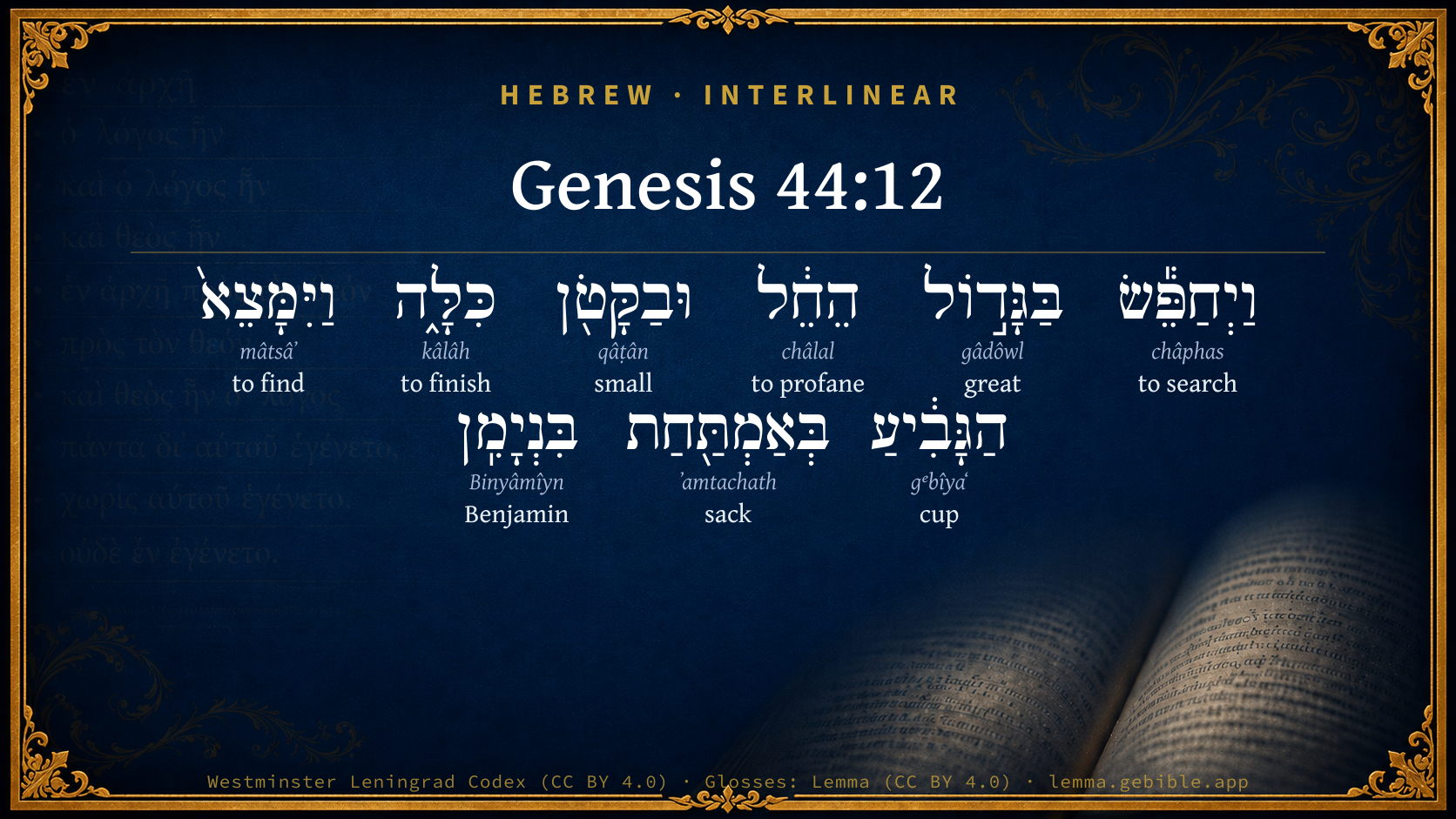
Hebrew (Westminster Leningrad Codex) Genesis 44:12 appears in the Hebrew Old Testament. The text above is from the Westminster Leningrad Codex. Each word links to its Strong’s number, a concise gloss, and parsing drawn from the Open Scriptures Hebrew Bible morphology. Click any word for its full Brown-Driver-Briggs (BDB) entry.
Download image
Cite this verse

Genesis 44:12 (World English Bible). Public Domain. Lemma interlinear Bible study tool, https://lemma.gebible.app/v/genesis/44/12.

Show BibTeX & RIS
BibTeX
RIS
English Translation
He searched, beginning with the eldest, and ending at the youngest. The cup was found in Benjamin's sack.
World English Bible · Public Domain
Download a study sheet

One document with this verse’s original text, its word-by-word gloss line, the meaning frame, cross-references with their text, attributed commentary, and full source and license credits — printable, and it pastes into notes with its structure intact.

This verse Autodidact and up

Study sheet (.html) Plain text (.txt)

A passage Seminary Student

Up to 50 verses in one chapter. A passage sheet keeps up to 6 commentary sources and 12 cross-references per verse, in the order this page ranks them, and says so on the sheet whenever that leaves anything out. Ask for a single verse and you get the Autodidact verse sheet above.

Everything on this page stays free to read, with no account — the sheet is a download of what is already on screen, not access to it.

Want to remove ads? Support Godless Engineer
Compare translations 3

The same verse in 3 English versions, stacked beneath the original-language interlinear above. Click any original word for its lexicon entry.

Each is an independent rendering of the whole verse — the interlinear is not word-aligned to these translations.

Highlighted words mark where these versions differ — a whole-verse word diff, not a word-by-word alignment.

  • World English Bible Public Domain
    He searched, beginning with the eldest, and ending at the youngest. The cup was found in Benjamin's sack.
  • King James Version Public Domain
    And he searched, and began at the eldest, and left at the youngest: and the cup was found in Benjamin's sack.
  • unfoldingWord Literal Text CC BY-SA 4.0
    Then he searched, beginning with the oldest and ending with the youngest, and the cup was found in Benjamin’s sack!

unfoldingWord Literal Text — © unfoldingWord, licensed CC BY-SA 4.0. Word-aligned USFM3 via Door43 (git.door43.org/unfoldingWord/en_ult).

Versions to compare (up to 4)

3 of 4 selected

Show all 18 translations

Every available English version of this verse, each an independent rendering of the whole verse.

  • World English Bible Public Domain
    He searched, beginning with the eldest, and ending at the youngest. The cup was found in Benjamin's sack.
  • Berean Standard Bible Public Domain
    The steward searched, beginning with the oldest and ending with the youngest—and the cup was found in Benjamin’s sack.
  • Majority Standard Bible Public Domain
    The steward searched, beginning with the oldest and ending with the youngest—and the cup was found in Benjamin’s sack.
  • King James Version Public Domain
    And he searched, and began at the eldest, and left at the youngest: and the cup was found in Benjamin's sack.
  • American Standard Version (1901) Public Domain
    And he searched, `and' began at the eldest, and left off at the youngest: and the cup was found in Benjamin's sack.
  • Revised Version (1885) Public Domain
    And he searched, and began at the eldest, and left at the youngest: and the cup was found in Benjamin’s sack.
  • Geneva Bible (1599) Public Domain
    And he searched, and began at the eldest and left at the yongest: and the cuppe was found in Beniamins sacke.
  • Douay-Rheims (1899) Public Domain
    Which when he had searched, beginning at the eldest and ending at the youngest, he found the cup in Benjamin's sack.
  • Young's Literal Translation Public Domain
    and he searcheth -- at the eldest he hath begun, and at the youngest he hath completed -- and the cup is found in the bag of Benjamin;
  • Literal Standard Version CC BY-SA 4.0
    and he searches—at the eldest he has begun, and at the youngest he has completed—and the cup is found in the bag of Benjamin;
  • Unlocked Literal Bible CC BY-SA 4.0
    The steward searched. He began with the oldest and finished with the youngest, and the cup was found in Benjamin's sack.
  • unfoldingWord Literal Text CC BY-SA 4.0
    Then he searched, beginning with the oldest and ending with the youngest, and the cup was found in Benjamin’s sack!
  • Darby Bible Public Domain
    And he searched carefully: he began at the eldest, and ended at the youngest; and the cup was found in Benjamin's sack.
  • World Messianic Bible Public Domain
    He searched, beginning with the oldest, and ending at the youngest. The cup was found in Benjamin’s sack.
  • Webster's Bible Public Domain
    And he searched, and began at the eldest, and left at the youngest: and the cup was found in Benjamin's sack.
  • Free Bible Version CC BY-SA 4.0
    The household supervisor searched the sacks, beginning with the oldest and working his way down to the youngest. The cup was found in Benjamin's sack.
  • Bible in Basic English Public Domain
    And he made a search, starting with the oldest and ending with the youngest; and the cup was in Benjamin's bag.
  • JPS Tanakh (1917) Public Domain
    And he searched, beginning at the eldest, and leaving off at the youngest; and the goblet was found in Benjamin's sack.

Literal Standard Version (2020), Covenant Press — licensed CC BY-SA 4.0. Text via the HelloAO Bible API (eBible.org). Unlocked Literal Bible (unfoldingWord) — licensed CC BY-SA 4.0. Text via the HelloAO Bible API (eBible.org). unfoldingWord Literal Text — © unfoldingWord, licensed CC BY-SA 4.0. Word-aligned USFM3 via Door43 (git.door43.org/unfoldingWord/en_ult). Free Bible Version, Dr. Jonathan Gallagher — licensed CC BY-SA 4.0. Text via the HelloAO Bible API (eBible.org).

Word by word

More ways to search: Search by grammar → Find every occurrence → Compare this word →

Practice this passage: Drill this verse → Learn its vocabulary →

הַגָּבִ֔יעַ
gᵉbîyaʻ
H1375
“the · cup”
Particle, Definite Article + Noun, Common, Masculine, Singular, Absolute
Part of Speech
Particle + Noun
Type
Common
Gender
Masculine
Number
Singular
State
Absolute
Full BDB Definition

Origin: from an unused root

TWOT: 309b

cup, bowl
  1. וַיְחַפֵּ֕שׂ châphas H2664 “and · to search” Conjunction + Verb, Piel, Sequential Imperfect, 3rd Person, Masculine, Singular
  2. בַּגָּד֣וֹל gâdôwl H1419 “in/at the · great” Preposition, Determined + Adjective, Adjective, Masculine, Singular, Absolute
  3. הֵחֵ֔ל châlal H2490 “to profane” Verb, Hiphil, Perfect, 3rd Person, Masculine, Singular
  4. וּבַקָּטֹ֖ן qâṭân H6996 “and · in/at the · small” Conjunction + Preposition, Determined + Adjective, Adjective, Masculine, Singular, Absolute
  5. כִּלָּ֑ה kâlâh H3615 “to finish” Verb, Piel, Perfect, 3rd Person, Masculine, Singular
  6. וַיִּמָּצֵא֙ mâtsâʼ H4672 “and · to find” Conjunction + Verb, Niphal, Sequential Imperfect, 3rd Person, Masculine, Singular
  7. בְּאַמְתַּ֖חַת ʼamtachath H572 “in/at · sack of” Preposition + Noun, Common, Feminine, Singular, Construct
  8. בִּנְיָמִֽן Binyâmîyn H1144 “Benjamin” Noun, Proper

About this verse

These counts appear in no published source. They are computed here, from the morphology-tagged text and Lemma’s own curated glosses. What Lemma adds →

9
words
9
distinct lemmas
Pentateuch
section

Notable vocabulary

The rarest word here is הַגָּבִ֔יעַ cup H1375 — appearing just 14 times in the whole Hebrew Bible.

Shared distinctive vocabulary

הַגָּבִ֔יעַ cup H1375 occurs in 11 verses of the Hebrew Bible. Also found in:

Grammatical profile

  • 4 verbs
  • 3 nouns
  • 2 adjectives

Verb forms

  • וַיְחַפֵּ֕שׂ Piel · Sequential Imperfect
  • הֵחֵ֔ל Hiphil · Perfect
  • כִּלָּ֑ה Piel · Perfect
  • וַיִּמָּצֵא֙ Niphal · Sequential Imperfect

Hebrew & Septuagint length

In English translation the verse runs 18 words from the Hebrew and 21 from the Septuagint (LXX English) — closely comparable.

A rough comparison of the two English renderings, which tokenize alike — not a word-level alignment.

Word counts can differ between the Hebrew and the Greek without any difference in meaning — e.g. the Hebrew direct-object marker אֵת has no separate Greek word, and Greek often adds the article ὁ.

Cross-references

5

Topical passages linked to Genesis 44:12 in the Treasury of Scripture Knowledge — connected by theme and wording, ordered by reader-vote popularity; previews shown in the World English Bible.

  • Genesis 42:36–38 Jacob, their father, said to them, "You have bereaved me of my children! Joseph is no more, Simeon is no more, and you want to take Benjamin away. All these things are against me."
  • Genesis 43:14 May God Almighty give you mercy before the man, that he may release to you your other brother and Benjamin. If I am bereaved of my children, I am bereaved."
  • Genesis 43:33 They sat before him, the firstborn according to his birthright, and the youngest according to his youth, and the men marveled one with another.
  • Genesis 44:2 Put my cup, the silver cup, in the sack's mouth of the youngest, with his grain money." He did according to the word that Joseph had spoken.
  • Genesis 44:26–32 We said, 'We can't go down. If our youngest brother is with us, then will we go down: for we may not see the man's face, unless our youngest brother is with us.'

Cross-references courtesy of OpenBible.info (CC BY 4.0).

Hebrew and Greek witnesses Masoretic Hebrew ↔ Greek Septuagint

The same verse in the two great witnesses to the Old Testament, shown verse-for-verse.

These are two independent witnesses, not word-aligned to each other, and the Septuagint is shown in lemma (dictionary) form.

Hebrew Genesis 44:12 Masoretic · Westminster Leningrad Codex

וַיְחַפֵּ֕שׂ בַּגָּד֣וֹל הֵחֵ֔ל וּבַקָּטֹ֖ן כִּלָּ֑ה וַיִּמָּצֵא֙ הַגָּבִ֔יעַ בְּאַמְתַּ֖חַת בִּנְיָמִֽן

He searched, beginning with the eldest, and ending at the youngest. The cup was found in Benjamin's sack.

World English Bible · Public Domain

Greek LXX Genesis 44:12 Septuagint · lemma form

ἐρευνάω δέ ἀπό ὁ πρεσβύτερος ἄρχω ἕως ἔρχομαι ἐπί ὁ νέος καί εὑρίσκω ὁ κόνδυ ἐν ὁ μάρσιππος ὁ βενιαμίν

And he searched, beginning from the oldest, until he came to the youngest; and he found the cup in Benjamin's sack.

LXX2012 (modern English Septuagint) · Public Domain

Hebrew: Westminster Leningrad Codex (CC BY 4.0). Greek: Septuagint (public domain); English from LXX2012 (modern English Septuagint) (Public Domain). How the Septuagint differs from the Hebrew →

Targum (Aramaic paraphrase)

2

The Targum is the ancient Jewish Aramaic paraphrase of the Hebrew Scriptures — an interpretive translation, not the Hebrew text itself. Onkelos (literal) and Pseudo-Jonathan (expansive) render the Torah, and Jonathan the Prophets. Coverage is partial: where no permissively-licensed English translation exists for a verse, only the Aramaic is shown. This is verse-level text, not a word-by-word alignment to the Hebrew.

  1. Targum Onkelos Torah (Genesis–Deuteronomy)
    וּבְלַשׁ בְּרַבָּא שָׁרֵי וּבִזְעֵירָא שֵׁצִי וְאִשְׁתְּכַח כַּלִּידָא בְּטוֹעֲנָא דְבִנְיָמִן

    (no public-domain English translation for this verse)

    Targum Onkelos — Aramaic: “Onkelos Genesis” (public domain); “Onkelos Exodus” (public domain); “Onkelos Leviticus” (public domain); “Onkelos Numbers” (public domain); “Onkelos Deuteronomy” (public domain). English: “Sefaria Community Translation” (CC0 1.0 (public-domain dedication)); “J.W. Etheridge. The Targums of Onkelos and Jonathan Ben Uzziel on the Pentateuch. London: Longmans, Green, 1862” (public domain). Text via Sefaria.

  2. Targum Pseudo-Jonathan Torah (Genesis–Deuteronomy)
    וּפִשְׁפֵּשׁ בִּרְאוּבֵן שָׁרֵי וּבְבִנְיָמִין פָּסַק וְאִשְׁתַּכַּח אוֹגְבִין בְּטוֹנָא דְבִנְיָמִין

    And he searched beginning with Reuben, and ending with Benjamin. And the cup was found in Benjamin's sack.

    Targum Pseudo-Jonathan — Aramaic: “Targum Jonathan on Genesis” (public domain); “Targum Jonathan on Exodus” (public domain); “Targum Jonathan on Leviticus” (public domain); “Targum Jonathan on Numbers” (public domain); “Targum Jonathan on Deuteronomy” (public domain). English: “The Targum of Jonathan ben Uzziel, trans. J. W. Etheridge, London, 1862” (public domain). Text via Sefaria.

Commentary

Notes on Genesis 44:12 from classic Christian and Jewish commentators (each source and its license shown beneath its notes). The classic Christian expositions comment on the surrounding passage and are grouped to its opening verse, so a note may address several verses; the Jewish commentaries on the Tanakh (Rashi and others) are per-verse, so they appear only where the commentator wrote on this verse.

Lemma curates 59 commentaries, every one of them public domain or Creative Commons licensed, each selected and text-cleaned for this edition rather than reprinted as found. About our sources →

Trapp's Complete Commentary

John Trapp

Gen 44:12 And he searched, [and] began at the eldest, and left at the youngest: and the cup was found in Benjamin’s sack.

Ver. 12. And he searched, and began at the eldest.] The better to avoid suspicion, for he knew well enough where to find the cup. So Jonadab, Amnon’s carnal friend but spiritual enemy, could tell David that not all the king’s sons, as the report ran, but Amnon only was slain by Absalom. The devil also when he hath conveyed his cups into our sacks, his goods into our houses, - as the Russians use to deal by their enemies, and then accuse them of theft, - his {a} injections into our hearts, if we fancy them never so little, will accuse us to God, and claim both them and us too for his own.

And the cup was found in Benjamin’s sack.] Sacco soluto apparuit argentum, saith Ambrose. When God comes to turn the bottom of the bag upward, all will out. Sin not, therefore, in hope of secrecy; on the fair day, at the last day, all packs shall be opened.

{a} Heyl., Geog., p. 243.

John Trapp, A Commentary or Exposition upon All the Books of the Old and New Testament (1647–1656) — public domain. Text from a community e-Sword module.

The Cambridge Bible for Schools and Colleges

gen. ed. J. J. S. Perowne

12. searched] There is no mention of the money in the sacks’ mouths (Gen_44:1). The interest centres on the cup. That the search is made in order of age is a dramatic touch adding to the excitement of the scene described, and probably carried out by the directions of Joseph himself, as if it might be assumed that the youngest was the least likely to be the thief. Cf. Gen_43:33.

The Cambridge Bible for Schools and Colleges (gen. ed. J. J. S. Perowne; Cambridge University Press, 1878–1918) — public domain. Text from a community e-Sword module.

John Gill's Exposition

And he searched,.... To the bottom of them, not content to look into the mouth of them being opened, but rummaged them, and searched deeply into them to find the cup, which was the thing charged upon them he was solicitous to find; as for the money in the sack's mouth he took no notice of that, nor is there any mention of it:

and began at the oldest; at Reuben, as the Targum of Jonathan expresses it: the steward might know their different ages in course, by the order in which they were placed at Joseph's table when they dined with him:

and left off at the youngest; at Benjamin, he ended his scrutiny with him; this method he took partly to hold them in fear as long as he could, and partly to prevent any suspicion of design, which might have been entertained had he went directly to Benjamin's sack:

and the cup was found in Benjamin's sack; where the steward himself had put it, and as it is usually said, they that hide can find.

John Gill's Exposition of the Whole Bible (1746–1763) — public domain (CC PDM 1.0). Text via the HelloAO Bible API.

Matthew Poole's English Annotations

Began at the eldest, to take off all their suspicion of his fraud.

The cup was found in Benjamin’s sack. He found doubtless the money there, but he accused them not about that matter, both because they had an answer ready to that charge from his own mouth, Gen 43:23, and because the greater crime, the stealing of the cup which Joseph so much prized and used, might seem to extinguish the less, or at least cause him to neglect it.

Matthew Poole's English Annotations on the Holy Bible (1683–1685) — public domain. Text from a community e-Sword/MySword module.

Rashi

Rabbi Shlomo Yitzchaki (Rashi)

בגדול החל AT THE ELDEST HE BEGAN — so that they should not perceive that he knew where it was (Genesis Rabbah 92.8).

Rashi on the Tanakh — English translations: “The Judaica Press complete Tanach with Rashi, translated by A. J. Rosenberg” (CC BY 4.0); “Pentateuch with Rashi's commentary by M. Rosenbaum and A.M. Silbermann, 1929-1934” (public domain); “The Metsudah Tanach series, Lakewood, N.J” (CC BY 4.0); and “The Book of Joshua, Metsudah Publications, 1997” (CC BY 4.0). Text via Sefaria.

Radak

Rabbi David Kimhi (Radak)

ויחפש, בגדול החל, in order that they should not suspect him of having planted the goblet in Binyamin’s sack, he made a show of starting to search the oldest, etc. He knew their respective rank in seniority from the way Joseph had seated them at the meal.

Radak on the Tanakh — English translations: “Sefaria Community Translation” (CC0 1.0 (public-domain dedication)); “Eliyahu Munk, HaChut Hameshulash” (CC BY 4.0); “Rabbi Mike Feuer, Jerusalem Anthology” (CC BY 4.0); and “R. David Kimhi on the first book of Psalms, Translated by R.G. Finch, London, 1919” (public domain). Text via Sefaria.

Lesson kit

Teaching starters — assembled from the data on this page, not authored interpretation. Every prompt links to the verse data it draws on. Edit before teaching.

Genesis, in the Pentateuch, opens this verse with 9 words (9 distinct Hebrew lemmas). Its most distinctive word is gᵉbîyaʻ (“cup”). A historical commentator’s framing appears above. Read the whole chapter for the surrounding context.

Discussion questions

  1. What does “cup” (gᵉbîyaʻ) contribute to the verse as a whole?
  2. How does Genesis 44:2, which shares the word «cup», read alongside this verse?
  3. These translations render this verse differently. What is at stake in choosing one wording over another?
  4. «וַיְחַפֵּ֕שׂ» is a Piel Sequential Imperfect verb. How does that grammatical form shape the action described?
  5. Compare how Trapp's Complete Commentary and The Cambridge Bible for Schools and Colleges read this verse. Where do they agree or differ?

Things to notice

Reading settings

Reading text

Shown beneath each verse's original-language words.

Old Testament
Old Testament edition

Read the OT as the Masoretic Hebrew (MT) or the Greek Septuagint (LXX).

English shown for the Greek Septuagint (in the Hebrew ↔ Greek comparison).

Comparing translations? Open the Compare panel on any verse page to stack up to four side by side.