
1 Samuel 25:17

Hebrew (Westminster Leningrad Codex) 1 Samuel 25:17 appears in the Hebrew Old Testament. The text above is from the Westminster Leningrad Codex. Each word links to its Strong’s number, a concise gloss, and parsing drawn from the Open Scriptures Hebrew Bible morphology. Click any word for its full Brown-Driver-Briggs (BDB) entry.
Download image
Cite this verse

1 Samuel 25:17 (World English Bible). Public Domain. Lemma interlinear Bible study tool, https://lemma.gebible.app/v/1-samuel/25/17.

Show BibTeX & RIS
BibTeX
RIS
English Translation
Now therefore know and consider what you will do; for evil is determined against our master, and against all his house: for he is such a worthless fellow that one can't speak to him.
World English Bible · Public Domain
Download a study sheet

One document with this verse’s original text, its word-by-word gloss line, the meaning frame, cross-references with their text, attributed commentary, and full source and license credits — printable, and it pastes into notes with its structure intact.

This verse Autodidact and up

Study sheet (.html) Plain text (.txt)

A passage Seminary Student

Up to 50 verses in one chapter. A passage sheet keeps up to 6 commentary sources and 12 cross-references per verse, in the order this page ranks them, and says so on the sheet whenever that leaves anything out. Ask for a single verse and you get the Autodidact verse sheet above.

Everything on this page stays free to read, with no account — the sheet is a download of what is already on screen, not access to it.

Want to remove ads? Support Godless Engineer
Compare translations 3

The same verse in 3 English versions, stacked beneath the original-language interlinear above. Click any original word for its lexicon entry.

Each is an independent rendering of the whole verse — the interlinear is not word-aligned to these translations.

Highlighted words mark where these versions differ — a whole-verse word diff, not a word-by-word alignment.

  • World English Bible Public Domain
    Now therefore know and consider what you will do; for evil is determined against our master, and against all his house: for he is such a worthless fellow that one can't speak to him.
  • King James Version Public Domain
    Now therefore know and consider what thou wilt do; for evil is determined against our master, and against all his household: for he is such a son of Belial, that a man cannot speak to him.
  • unfoldingWord Literal Text CC BY-SA 4.0
    And now, know and see what you shall do, for harm has completed against our master and against all of his house. And he a son of wickedness from speaking to him.”

unfoldingWord Literal Text — © unfoldingWord, licensed CC BY-SA 4.0. Word-aligned USFM3 via Door43 (git.door43.org/unfoldingWord/en_ult).

Versions to compare (up to 4)

3 of 4 selected

Show all 18 translations

Every available English version of this verse, each an independent rendering of the whole verse.

  • World English Bible Public Domain
    Now therefore know and consider what you will do; for evil is determined against our master, and against all his house: for he is such a worthless fellow that one can't speak to him.
  • Berean Standard Bible Public Domain
    Now consider carefully what you must do, because disaster looms over our master and all his household. For he is such a scoundrel that nobody can speak to him!”
  • Majority Standard Bible Public Domain
    Now consider carefully what you must do, because disaster looms over our master and all his household. For he is such a scoundrel that nobody can speak to him!”
  • King James Version Public Domain
    Now therefore know and consider what thou wilt do; for evil is determined against our master, and against all his household: for he is such a son of Belial, that a man cannot speak to him.
  • American Standard Version (1901) Public Domain
    Now therefore know and consider what thou wilt do; for evil is determined against our master, and against all his house: for he is such a worthless fellow, that one cannot speak to him.
  • Revised Version (1885) Public Domain
    Now therefore know and consider what thou wilt do; for evil is determined against our master, and against all his house: for he is such a son of Belial, that one cannot speak to him.
  • Geneva Bible (1599) Public Domain
    Nowe therefore take heede, and see what thou shalt doe: for euill will surely come vpon our master, and vpon all his familie: for he is so wicked that a man can not speake to him.
  • Douay-Rheims (1899) Public Domain
    Wherefore consider, and think what thou hast to do: for evil is determined against thy husband, and against thy house, and he is a son of Belial, so that no man can speak to him.
  • Young's Literal Translation Public Domain
    `And, now, know and consider what thou dost; for evil hath been determined against our lord, and against all his house, and he `is' too much a son of worthlessness to be spoken to.'
  • Literal Standard Version CC BY-SA 4.0
    And now, know and consider what you do; for evil has been determined against our lord, and against all his house, and he [is] too much a son of worthlessness to be spoken to.”
  • Unlocked Literal Bible CC BY-SA 4.0
    Therefore know this and consider what you will do, for evil is plotted against our master, and against his whole house. He is such a worthless fellow that one cannot reason with him.”
  • unfoldingWord Literal Text CC BY-SA 4.0
    And now, know and see what you shall do, for harm has completed against our master and against all of his house. And he a son of wickedness from speaking to him.”
  • Darby Bible Public Domain
    And now know and consider what thou wilt do, for evil is determined against our master, and against all his household; and he is such a son of Belial, that one cannot speak to him.
  • World Messianic Bible Public Domain
    Now therefore know and consider what you will do; for evil is determined against our master and against all his house, for he is such a worthless fellow that one can’t speak to him.”
  • Webster's Bible Public Domain
    Now therefore know and consider what thou wilt do: for evil is determined against our master, and against all his household: for he is such a son of Belial, that a man cannot speak to him.
  • Free Bible Version CC BY-SA 4.0
    You should know what happened and consider what you should do about it. Disaster is about to strike our master and his whole family, but he's so obnoxious no one can talk sense into him!”
  • Bible in Basic English Public Domain
    So now, give thought to what you are going to do; for evil is in store for our master and all his house: for he is such a good-for-nothing person that it is not possible to say anything to him.
  • JPS Tanakh (1917) Public Domain
    Now therefore know and consider what thou wilt do; for evil is determined against our master, and against all his house; for he is such a base fellow, that one cannot speak to him.'

Literal Standard Version (2020), Covenant Press — licensed CC BY-SA 4.0. Text via the HelloAO Bible API (eBible.org). Unlocked Literal Bible (unfoldingWord) — licensed CC BY-SA 4.0. Text via the HelloAO Bible API (eBible.org). unfoldingWord Literal Text — © unfoldingWord, licensed CC BY-SA 4.0. Word-aligned USFM3 via Door43 (git.door43.org/unfoldingWord/en_ult). Free Bible Version, Dr. Jonathan Gallagher — licensed CC BY-SA 4.0. Text via the HelloAO Bible API (eBible.org).

Word by word

More ways to search: Search by grammar → Find every occurrence → Compare this word →

Practice this passage: Drill this verse → Learn its vocabulary →

בְּלִיַּ֔עַל
bᵉlîyaʻal
H1100
“worthlessness”
Noun, Common, Masculine, Singular, Absolute
Part of Speech
Noun
Type
Common
Gender
Masculine
Number
Singular
State
Absolute
Full BDB Definition

Origin: from H1097 and H3276

TWOT: 246g

worthlessness - worthless, good for nothing, unprofitable, base fellow - wicked - ruin, destruction (construct)
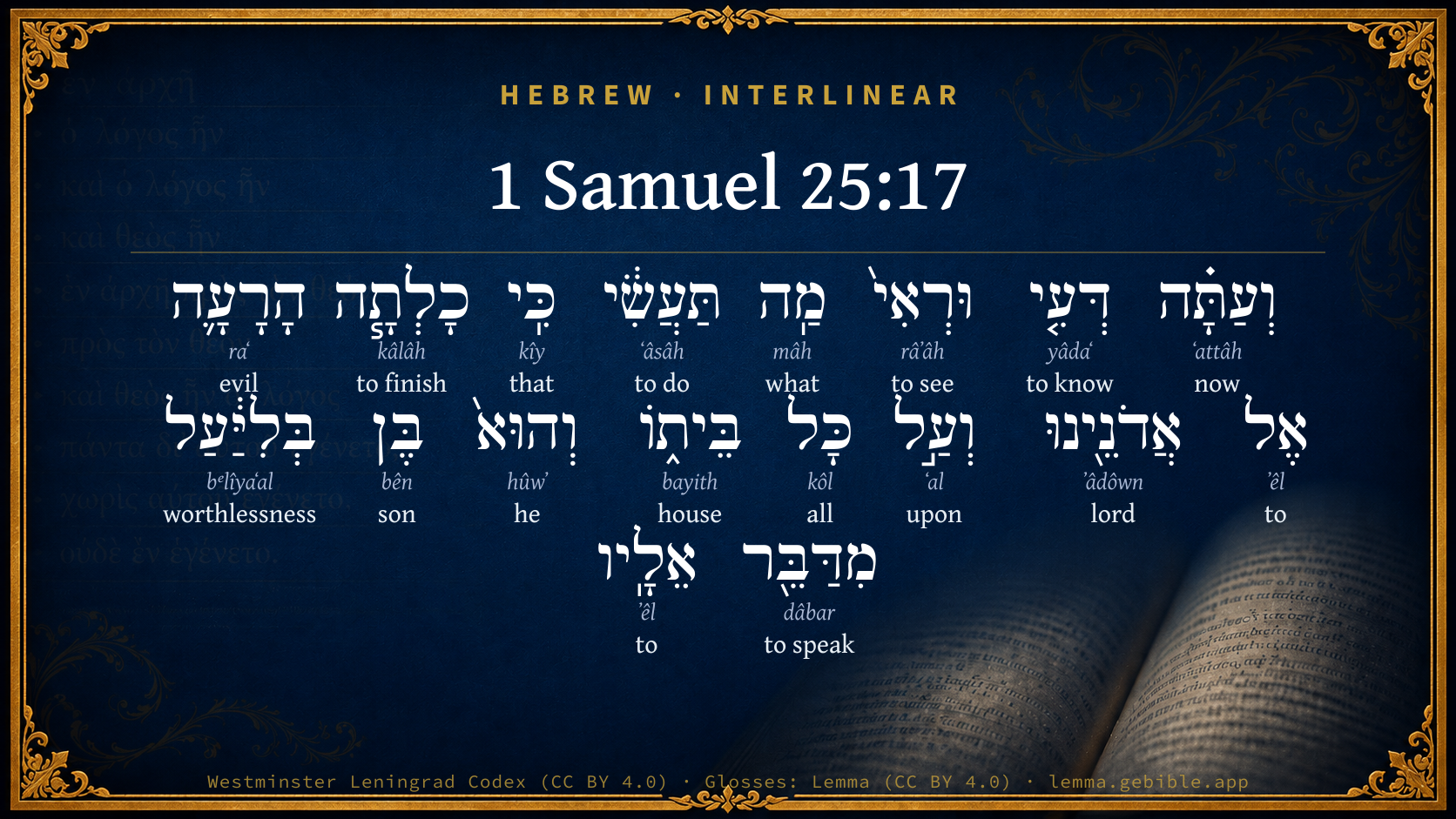
  1. וְעַתָּ֗ה ʻattâh H6258 “and · now” Conjunction + Adverb
  2. דְּעִ֤י yâdaʻ H3045 “know” Verb, Qal, Imperative, 2nd Person, Feminine, Singular
  3. וּרְאִי֙ râʼâh H7200 “and · see” Conjunction + Verb, Qal, Imperative, 2nd Person, Feminine, Singular
  4. מַֽה mâh H4100 “what” Particle, Interrogative
  5. תַּעֲשִׂ֔י ʻâsâh H6213 “to do” Verb, Qal, Imperfect, 2nd Person, Feminine, Singular
  6. כִּֽי kîy H3588 “that” Conjunction
  7. כָלְתָ֧ה kâlâh H3615 “to finish” Verb, Qal, Perfect, 3rd Person, Feminine, Singular
  8. הָרָעָ֛ה raʻ H7451 “the · evil” Particle, Definite Article + Noun, Common, Feminine, Singular, Absolute
  9. אֶל ʼêl H413 “to” Preposition
  10. אֲדֹנֵ֖ינוּ ʼâdôwn H113 “lords · our” Noun, Common, Masculine, Plural, Construct + Suffix, Personal, 1st Person, Common, Plural
  11. וְעַ֣ל ʻal H5921 “and · upon” Conjunction + Preposition
  12. כָּל kôl H3605 “all of” Noun, Common, Masculine, Singular, Construct
  13. בֵּית֑וֹ bayith H1004 “house · his” Noun, Common, Masculine, Singular, Construct + Suffix, Personal, 3rd Person, Masculine, Singular
  14. וְהוּא֙ hûwʼ H1931 “and · he” Conjunction + Pronoun, Personal, 3rd Person, Masculine, Singular
  15. בֶּן bên H1121 “son of” Noun, Common, Masculine, Singular, Construct
  16. מִדַּבֵּ֖ר dâbar H1696 “from · to speak” Preposition + Verb, Piel, Infinitive Construct
  17. אֵלָֽיו ʼêl H413 “to · him” Preposition + Suffix, Personal, 3rd Person, Masculine, Singular

About this verse

These counts appear in no published source. They are computed here, from the morphology-tagged text and Lemma’s own curated glosses. What Lemma adds →

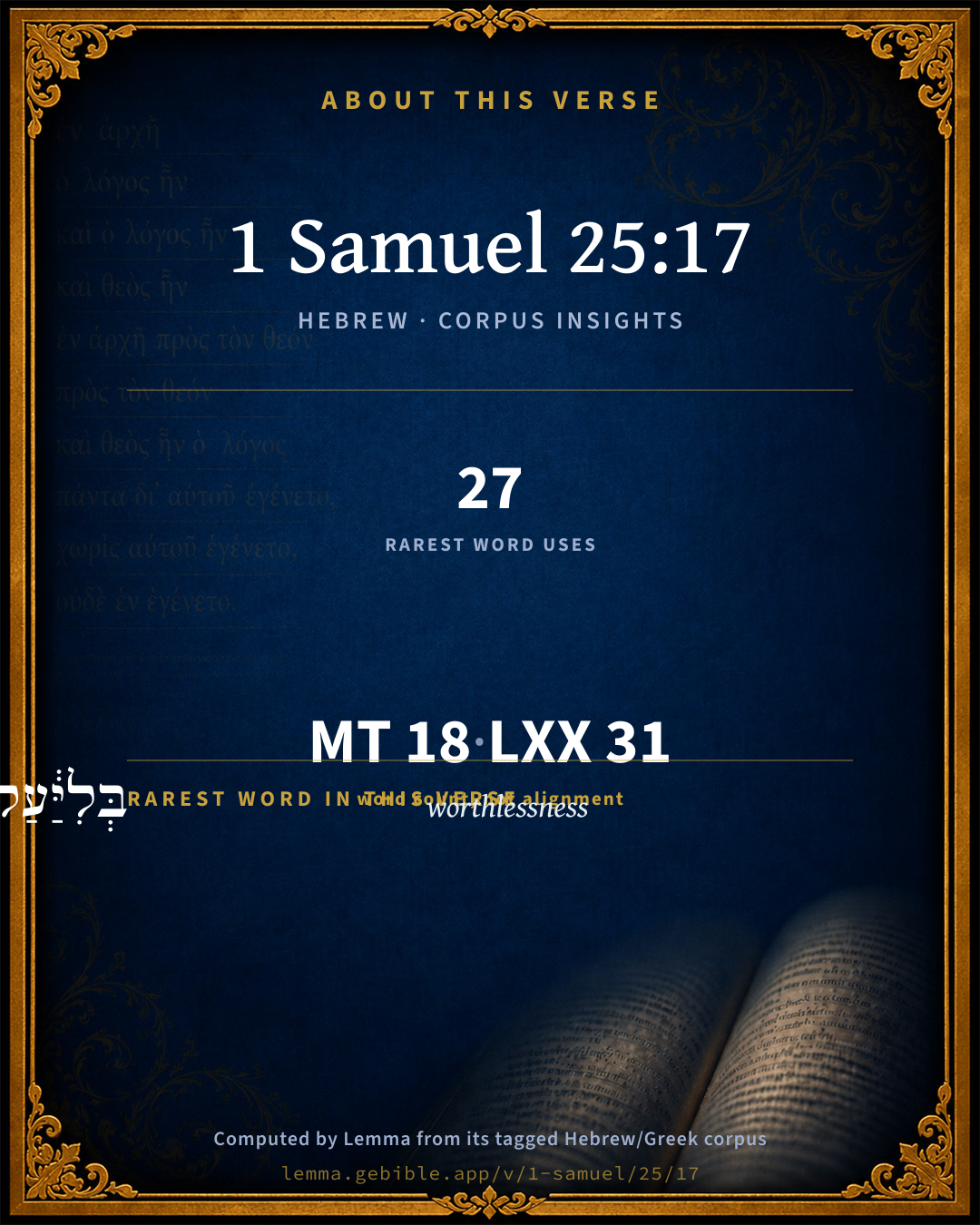
18
words
17
distinct lemmas
Historical
section

Shared distinctive vocabulary

בְּלִיַּ֔עַל worthlessness H1100 occurs in 26 verses of the Hebrew Bible. Also found in:

Grammatical profile

  • 5 verbs
  • 6 nouns
  • 1 pronoun
  • 3 prepositions
  • 1 conjunction
  • 1 adverb
  • 1 particle

Verb forms

  • דְּעִ֤י Qal · Imperative
  • וּרְאִי֙ Qal · Imperative
  • תַּעֲשִׂ֔י Qal · Imperfect
  • כָלְתָ֧ה Qal · Perfect
  • מִדַּבֵּ֖ר Piel · Infinitive Construct

Repetition

A word recurs within this verse — often emphatic in Hebrew:

  • אֶל to H413 ×2

Hebrew & Septuagint length

In English translation the verse runs 34 words from the Hebrew and 34 from the Septuagint (LXX English) — the same length.

A rough comparison of the two English renderings, which tokenize alike — not a word-level alignment.

Word counts can differ between the Hebrew and the Greek without any difference in meaning — e.g. the Hebrew direct-object marker אֵת has no separate Greek word, and Greek often adds the article ὁ.

In the original languages it is 18 Hebrew tokens and 31 Greek tokens — but the two are counted differently (Hebrew bundles its prefixes and suffixes into one token; the Greek is in lemma form), so that isn’t a like-for-like length.

Cross-references

14

Topical passages linked to 1 Samuel 25:17 in the Treasury of Scripture Knowledge — connected by theme and wording, ordered by reader-vote popularity; previews shown in the World English Bible.

  • Deuteronomy 13:13 Certain base fellows are gone out from the midst of you, and have drawn away the inhabitants of their city, saying, Let us go and serve other gods, which you have not known;
  • 1 Samuel 20:7 If he says, 'It is well;' your servant shall have peace: but if he be angry, then know that evil is determined by him.
  • Judges 19:22 As they were making their hearts merry, behold, the men of the city, certain base fellows, beset the house round about, beating at the door; and they spoke to the master of the house, the old man, saying, Bring forth the man who came into your house, that we may know him.
  • 1 Samuel 2:12 Now the sons of Eli were base men; they didn't know Yahweh.
  • 1 Samuel 20:9 Jonathan said, Far be it from you; for if I should at all know that evil were determined by my father to come on you, then wouldn't I tell you that?
  • 1 Samuel 20:32–33 Jonathan answered Saul his father, and said to him, "Why should he be put to death? What has he done?"
  • 1 Samuel 25:25 Please don't let my lord regard this worthless fellow, even Nabal; for as his name is, so is he; Nabal is his name, and folly is with him: but I your handmaid didn't see the young men of my lord, whom you did send.
  • 2 Samuel 23:6–7 But the ungodly shall be all of them as thorns to be thrust away, Because they can't be taken with the hand
  • 1 Kings 21:10 and set two men, base fellows, before him, and let them testify against him, saying, You did curse God and the king. Then carry him out, and stone him to death.
  • 1 Kings 21:13 The two men, the base fellows, came in and sat before him: and the base fellows bore witness against him, even against Naboth, in the presence of the people, saying, Naboth did curse God and the king. Then they carried him forth out of the city, and stoned him to death with stones.
  • 2 Kings 5:13–14 His servants came near, and spoke to him, and said, My father, if the prophet had bid you do some great thing, wouldn't you have done it? how much rather then, when he says to you, Wash, and be clean?
  • 2 Chronicles 13:7 There were gathered to him worthless men, base fellows, who strengthened themselves against Rehoboam the son of Solomon, when Rehoboam was young and tender-hearted, and could not withstand them.
  • 2 Chronicles 25:16 It happened, as he talked with him, that [the king] said to him, Have we made you of the king's counsel? Stop! Why should you be struck down? Then the prophet stopped, and said, I know that God has determined to destroy you, because you have done this, and have not listened to my counsel.
  • Esther 7:7 The king arose in his wrath from the banquet of wine [and went] into the palace garden: and Haman stood up to make request for his life to Esther the queen; for he saw that there was evil determined against him by the king.

Cross-references courtesy of OpenBible.info (CC BY 4.0).

Hebrew and Greek witnesses Masoretic Hebrew ↔ Greek Septuagint

The same verse in the two great witnesses to the Old Testament, shown verse-for-verse.

These are two independent witnesses, not word-aligned to each other, and the Septuagint is shown in lemma (dictionary) form.

Hebrew 1 Samuel 25:17 Masoretic · Westminster Leningrad Codex

וְעַתָּ֗ה דְּעִ֤י וּרְאִי֙ מַֽה תַּעֲשִׂ֔י כִּֽי כָלְתָ֧ה הָרָעָ֛ה אֶל אֲדֹנֵ֖ינוּ וְעַ֣ל כָּל בֵּית֑וֹ וְהוּא֙ בֶּן בְּלִיַּ֔עַל מִדַּבֵּ֖ר אֵלָֽיו

Now therefore know and consider what you will do; for evil is determined against our master, and against all his house: for he is such a worthless fellow that one can't speak to him.

World English Bible · Public Domain

Greek LXX 1 Samuel 25:17 Septuagint · lemma form

καί νῦν γιγνώσκω καί ὁράω τίς σύ ποιέω ὅτι συντελέω ὁ κακία εἰς ὁ κύριος ἐγώ καί εἰς ὁ οἶκος αὐτός καί οὗτος υἱός λοιμός καί οὐ εἰμί λαλέω πρός αὐτός

And now do you consider, and see what you will do; for mischief is determined against our lord and against his house; and he is a vile character, and one can’t speak to him.

LXX2012 (modern English Septuagint) · Public Domain

Hebrew: Westminster Leningrad Codex (CC BY 4.0). Greek: Septuagint (public domain); English from LXX2012 (modern English Septuagint) (Public Domain). How the Septuagint differs from the Hebrew →

Targum (Aramaic paraphrase)

1

The Targum is the ancient Jewish Aramaic paraphrase of the Hebrew Scriptures — an interpretive translation, not the Hebrew text itself. Onkelos (literal) and Pseudo-Jonathan (expansive) render the Torah, and Jonathan the Prophets. Coverage is partial: where no permissively-licensed English translation exists for a verse, only the Aramaic is shown. This is verse-level text, not a word-by-word alignment to the Hebrew.

  1. Targum Jonathan Prophets (Joshua–Malachi)
    וּכְעַן דְעִי וַחֲזֵי מַה תַעְבְּדִין אֲרֵי גְמִירָא בִּישְׁתָא לְמֵיתֵי עַל רִבּוֹנָנָא וְעַל כָּל בֵּיתֵיהּ וְהוּא גְבַר רַשִׁיעָא מִלְמַלָלָא עִמֵיהּ:

    (no public-domain English translation for this verse)

    Targum Jonathan — Aramaic: “Mikraot Gedolot” (public domain). English: “Sefaria Community Translation” (CC0 1.0 (public-domain dedication)); “London "Chaldee Paraphrase," 1871” (public domain). Text via Sefaria.

Commentary

Notes on 1 Samuel 25:17 from classic Christian and Jewish commentators (each source and its license shown beneath its notes). The classic Christian expositions comment on the surrounding passage and are grouped to its opening verse, so a note may address several verses; the Jewish commentaries on the Tanakh (Rashi and others) are per-verse, so they appear only where the commentator wrote on this verse.

Lemma curates 59 commentaries, every one of them public domain or Creative Commons licensed, each selected and text-cleaned for this edition rather than reprinted as found. About our sources →

Trapp's Complete Commentary

John Trapp

1Sa 25:17 Now therefore know and consider what thou wilt do; for evil is determined against our master, and against all his household: for he [is such] a son of Belial, that [a man] cannot speak to him.

Ver. 17. For evil is determined.] As may well be gathered from the strength and animosity of David and his men thus incensed.

For he is such a son of Belial.] Cervicosus et indomitus, biliosus et bellicosus, so extremely froward and foul tempered, that there is no talking to him: Proh durum et dirum caput! Caelius, the Roman orator, mortalium ille iracundissimus, was such another fool. {a}

{a} Sen., De Ira, lib. iii. cap. 8.

John Trapp, A Commentary or Exposition upon All the Books of the Old and New Testament (1647–1656) — public domain. Text from a community e-Sword module.

The Biblical Illustrator

Joseph S. Exell

1Sa_25:17

For he is such a son of Belial, that a man cannot speak to him.

The bad-tempered man

In this chapter you find a perfect picture of a choleric, bad-tempered man. There is a saying that the worst temper in the house always rules, and often it is so. I have seen father and mother weakly yielding to some boorish, ill-tempered child. You have met the workman who was feared by all his fellows because he was a churl, a sullen, violent-tempered man, a modern Nabal, which means a fool. What a picture of home life is drawn for us here in this chapter. In the foreground is Nabal, the grumpy, sullen, beetle-browed, coarse-tongued, drunken husband--the prototype of hundreds of husbands of today, Who rule in their own little world with all the despotism of a Nero, and who only need a larger platform and greater power to show us how inhuman, how cruel, and how like the devil men can become. That is Nabal in low life, but you find Nabal in high life, in political life, ay! and in church life too. And then there is Abigail, Nabals wife, in the picture, and she is its redeeming feature. She is as tactful as she is beautiful, and she knew her husbands moods well, and she is always particularly gracious when the wind is in the east, and Nabal is most out of temper. Hes gey bad to live with, was the testimony of Carlyles mother, and the reading of some of the letters his wife wrote are nothing less than heart breaking. If he would only be satisfied, she said, but I have learned that when he does not find fault he is pleased, and that has to content me. Such a wife as Abigail is a crown to her husband; a daily blessing from God; but Nabal had the dark spirit within him, and never saw her worth. There are men who will go through a rose garden and never smell its sweet fragrance. Graciousness, and sweetness, and gentleness are wasted on such natures as Nabals, but let those who have to deal with these churls remember that it is always worth while to practise these virtues, if only for their own sake. Abigail did not let Nabal destroy her good temper, although her married life was little better than a martyrdom. The mind, Milton tells us, is its own place, and it can make a heaven of hell, and a hell of heaven, and Abigail, denied the love of her husband, won the love and respect of the servants, and was a shelter in the time of storm to them. Nabal, says Dr. Whyte, died of a strange disease, indebtedness to his wife. He could not brook the thought that he owed his life to the good sense of his wife and to the forbearance of David; it was wormwood and gall, and it poisoned him, and he died of a heart frozen by his own wickedness. Have there not been times when our bad temper has ruled, and we have forgotten to be either just or generous? Nabal died of a frozen heart, but he has had a resurrection in many a life. Boorishness and churlishness were not buried in Nabals grave. Temper, says Bishop Watson, is nine-tenths of religion. Let this mind be in you, which was also in Christ Jesus, pleads the Apostle. It is the Christ mind that is the great thing, not simply doing the right thing, but doing it in the right spirit. Nabal was a rich man, but he never was a gentleman; you could not make a gentleman out of such stuff as constituted Nabals nature. Have you met him--this loud-voiced, blatant, well-dressed, overfed churl. A quaint old Methodist used to say, Never judge a man by the size of his house. A very small rabbit may live in a very big hole. Behaviour, says Emerson, is the finest of the fine arts. Manners are the garments of the spirit, the eternal clothing of the being. Even religion turns sour with some men, and that which should spell light, brightness, and cheerfulness spells instead sourness, unrighteousness, and exclusiveness. You remember how Robert Falconers grandmother hid away his fiddle, fearful lest the lad should be tempted by it into worldly things, never dreaming that God melts the heart of some by touching the bow of a fiddle with His own figures, as He speaks to others by the voice of some great preacher. He has many ways of fulfilling Himself. How this churlishness destroys the best in life, and robs it of sweetness. The prodigal came home, and his reception would have been perfect but for the one thing, and that was his brothers churlishness. Sir, said Dr. Johnson, a man has no more right to say an uncivil thing than to act one; no more right to say a rude thing to another than to knock him down. Epictetus has left us a great lesson in his famous saying, If a man is unhappy, remember that his unhappiness is his own fault; for God hath made all men to be happy. (Samuel Herren.)

The Biblical Illustrator, edited by Joseph S. Exell (c. 1880s–1900s) — public domain. Text from a community e-Sword module.

Geneva Bible (1599)

Geneva Bible translators

Hebrew, is accomplished.

Geneva Bible (1599) marginal notes — public domain. Text via Bolls.life.

Ellicott's Commentary for English Readers

(17) A son of Belial.—Belial was not a proper name, though it subsequently came to be considered one. It signifies simply worthlessness; here a “son of Belial” is an expression for a bad, worthless fellow.

A Bible Commentary for English Readers, edited by Charles John Ellicott (1878–1897) — public domain. Text from a community e-Sword module.

The Cambridge Bible for Schools and Colleges

gen. ed. J. J. S. Perowne

17. such a son of Belial] Such an evil man. See on 1Sa_1:16. So wilful and obstinate that his servants dared not try to reason with him, but appealed to Abigail instead.

The Cambridge Bible for Schools and Colleges (gen. ed. J. J. S. Perowne; Cambridge University Press, 1878–1918) — public domain. Text from a community e-Sword module.

John Gill's Exposition

Now therefore know and consider what thou wilt do,.... For the preservation of her family:

for evil is determined against our master, and against all his household; which he concluded, either from something that dropped from David's messengers, as they turned away from Nabal; or from the martial spirit of David himself, who would never put up such an affront and indignity cast upon him; or from some intelligence he had of David's arming his men, and marching to take vengeance:

for he is such a son of Belial, that a man cannot speak to him; meaning Nabal, who was such a worthless, passionate, and ill natured man, such a lawless and imperious one, that he would not suffer a man to speak to him about anything; and it was to no purpose to attempt it, which was a reason this servant did not choose to speak to him about this affair, but to Abigail; and suggests, that it would signify nothing for her to speak to him about it, but it would be most advisable for her to consider with herself what was to be done immediately, without consulting him: the words may be rendered, "for he is a son of Belial that speaks unto him" (a); or when "he speaks unto him", or it is told him; meaning not the servant that reported to David what Nabal said; for Abarbinel observes there were ten of them, and therefore it could not be said of them, he is a son of Belial; but rather David himself, as he and Kimchi observe it may be interpreted of; that though he was so good and upright a man, yet when it should be told him how Nabal had treated him, he would be so provoked at it, that he would become and act like a son of Belial; storm and rage, and vow destruction to Nabal and his family, and come out with his whole army to destroy them; but the first sense is best.

(a) "loquens ad cum".

John Gill's Exposition of the Whole Bible (1746–1763) — public domain (CC PDM 1.0). Text via the HelloAO Bible API.

Haydock's Catholic Bible Commentary

Determined, and as if it had already taken place, chap. xx. 7.

George Leo Haydock (1774–1849), Haydock's Catholic Family Bible and Commentary, 1859 edition — public domain. Excludes Psalms (Douay-Rheims chapter numbering differs from Protestant) and Deuterocanonical books (Catholic canon only).

Matthew Poole's English Annotations

Evil is determined against our master; which it was easy to guess; either from some threatening expressions which David’s men used; or from the consideration of David’s great power, and that rage which so high a provocation was likely to produce in military persons.

A man cannot speak to him, to wit, without hazard to himself, and therefore I acquaint thee rather than him with this matter.

Matthew Poole's English Annotations on the Holy Bible (1683–1685) — public domain. Text from a community e-Sword/MySword module.

Whedon's Commentary on the Bible

Daniel D. Whedon

17. Son of Belial — See note on 1Sa_1:16.

Daniel D. Whedon (gen. ed.), Commentary on the Old and New Testaments (1874–1909) — public domain. Text from a community e-Sword module.

John Wesley's Explanatory Notes

Can not speak - But he flies into a passion.

John Wesley, Explanatory Notes Upon the Whole Bible (1754–1765) — public domain. Text via the GEBible commentary corpus.

Rashi

Rabbi Shlomo Yitzchaki (Rashi)

For the evil has been decided. By Dovid against him.

He is too wicked a person to speak to. Our master is such a base person so that I cannot tell him that which I am telling you, because he will become angry with us.

Rashi on the Tanakh — English translations: “The Judaica Press complete Tanach with Rashi, translated by A. J. Rosenberg” (CC BY 4.0); “Pentateuch with Rashi's commentary by M. Rosenbaum and A.M. Silbermann, 1929-1934” (public domain); “The Metsudah Tanach series, Lakewood, N.J” (CC BY 4.0); and “The Book of Joshua, Metsudah Publications, 1997” (CC BY 4.0). Text via Sefaria.

Lesson kit

Teaching starters — assembled from the data on this page, not authored interpretation. Every prompt links to the verse data it draws on. Edit before teaching.

1 Samuel, in the Historical, opens this verse with 18 words (17 distinct Hebrew lemmas). Its most distinctive word is bᵉlîyaʻal (“worthlessness”). A historical commentator’s framing appears above. Read the whole chapter for the surrounding context.

Discussion questions

  1. How does “worthlessness” (bᵉlîyaʻal) shape what this verse is saying?
  2. How does Deuteronomy 13:13, which shares the word «worthlessness», read alongside this verse?
  3. What does the repetition of “to” (2× in this one verse) do in this verse?
  4. These translations render this verse differently. What is at stake in choosing one wording over another?
  5. «דְּעִ֤י» is a Qal Imperative verb. How does that grammatical form shape the action described?
  6. Compare how Trapp's Complete Commentary and The Biblical Illustrator read this verse. Where do they agree or differ?

Things to notice

Reading settings

Reading text

Shown beneath each verse's original-language words.

Old Testament
Old Testament edition

Read the OT as the Masoretic Hebrew (MT) or the Greek Septuagint (LXX).

English shown for the Greek Septuagint (in the Hebrew ↔ Greek comparison).

Comparing translations? Open the Compare panel on any verse page to stack up to four side by side.