
1 Samuel 20:9

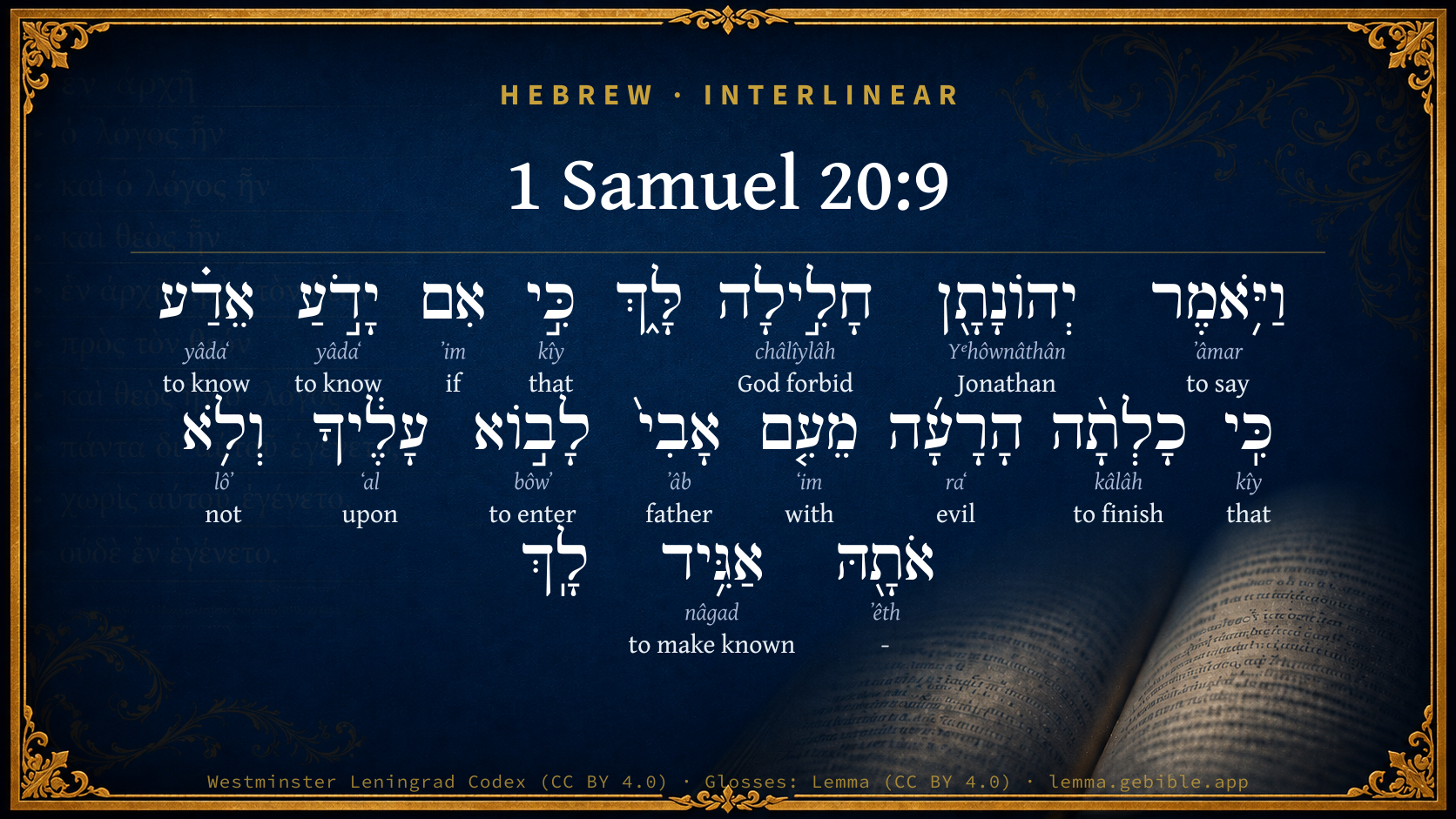
Hebrew (Westminster Leningrad Codex) 1 Samuel 20:9 appears in the Hebrew Old Testament. The text above is from the Westminster Leningrad Codex. Each word links to its Strong’s number, a concise gloss, and parsing drawn from the Open Scriptures Hebrew Bible morphology. Click any word for its full Brown-Driver-Briggs (BDB) entry.
Download image
Cite this verse

1 Samuel 20:9 (World English Bible). Public Domain. Lemma interlinear Bible study tool, https://lemma.gebible.app/v/1-samuel/20/9.

Show BibTeX & RIS
BibTeX
RIS
English Translation
Jonathan said, Far be it from you; for if I should at all know that evil were determined by my father to come on you, then wouldn't I tell you that?
World English Bible · Public Domain
Download a study sheet

One document with this verse’s original text, its word-by-word gloss line, the meaning frame, cross-references with their text, attributed commentary, and full source and license credits — printable, and it pastes into notes with its structure intact.

This verse Autodidact and up

Study sheet (.html) Plain text (.txt)

A passage Seminary Student

Up to 50 verses in one chapter. A passage sheet keeps up to 6 commentary sources and 12 cross-references per verse, in the order this page ranks them, and says so on the sheet whenever that leaves anything out. Ask for a single verse and you get the Autodidact verse sheet above.

Everything on this page stays free to read, with no account — the sheet is a download of what is already on screen, not access to it.

Want to remove ads? Support Godless Engineer
Compare translations 3

The same verse in 3 English versions, stacked beneath the original-language interlinear above. Click any original word for its lexicon entry.

Each is an independent rendering of the whole verse — the interlinear is not word-aligned to these translations.

Highlighted words mark where these versions differ — a whole-verse word diff, not a word-by-word alignment.

  • World English Bible Public Domain
    Jonathan said, Far be it from you; for if I should at all know that evil were determined by my father to come on you, then wouldn't I tell you that?
  • King James Version Public Domain
    And Jonathan said, Far be it from thee: for if I knew certainly that evil were determined by my father to come upon thee, then would not I tell it thee?
  • unfoldingWord Literal Text CC BY-SA 4.0
    And Jonathan said, “Profane to you! For if knowing, I know that harm has completed from with my father to come upon you, then will I not declare it to you?”

unfoldingWord Literal Text — © unfoldingWord, licensed CC BY-SA 4.0. Word-aligned USFM3 via Door43 (git.door43.org/unfoldingWord/en_ult).

Versions to compare (up to 4)

3 of 4 selected

Show all 18 translations

Every available English version of this verse, each an independent rendering of the whole verse.

  • World English Bible Public Domain
    Jonathan said, Far be it from you; for if I should at all know that evil were determined by my father to come on you, then wouldn't I tell you that?
  • Berean Standard Bible Public Domain
    “Never!” Jonathan replied. “If I ever found out that my father had evil intentions against you, would I not tell you?”
  • Majority Standard Bible Public Domain
    “Never!” Jonathan replied. “If I ever found out that my father had evil intentions against you, would I not tell you?”
  • King James Version Public Domain
    And Jonathan said, Far be it from thee: for if I knew certainly that evil were determined by my father to come upon thee, then would not I tell it thee?
  • American Standard Version (1901) Public Domain
    And Jonathan said, Far be it from thee; for if I should at all know that evil were determined by my father to come upon thee, then would not I tell it thee?
  • Revised Version (1885) Public Domain
    And Jonathan said, Far be it from thee: for if I should at all know that evil were determined by my father to come upon thee, then would not I tell it thee?
  • Geneva Bible (1599) Public Domain
    And Ionathan answered, God keepe that from thee: for if I knewe that wickednesse were concluded of my father to come vpon thee, would not I tell it thee?
  • Douay-Rheims (1899) Public Domain
    And Jonathan said: Far be this from thee: for if I should certainly know that evil is determined by my father against thee, I could do no otherwise than tell thee.
  • Young's Literal Translation Public Domain
    And Jonathan saith, `Far be it from thee! for I certainly do not know that the evil hath been determined by my father to come upon thee, and I do not declare it to thee.'
  • Literal Standard Version CC BY-SA 4.0
    And Jonathan says, “Far be it from you! For I certainly do not know that the evil has been determined by my father to come on you, and I do not declare it to you.”
  • Unlocked Literal Bible CC BY-SA 4.0
    Jonathan said, “Far be it from you! If I learned my father decided harm to come upon you, would I not tell you?”
  • unfoldingWord Literal Text CC BY-SA 4.0
    And Jonathan said, “Profane to you! For if knowing, I know that harm has completed from with my father to come upon you, then will I not declare it to you?”
  • Darby Bible Public Domain
    And Jonathan said, Far be it from thee; for, if I knew with certainty that evil were determined by my father to come upon thee, would I not tell it thee?
  • World Messianic Bible Public Domain
    Jonathan said, “Far be it from you; for if I should at all know that evil were determined by my father to come on you, then wouldn’t I tell you that?”
  • Webster's Bible Public Domain
    And Jonathan said, Far be it from thee: for if I knew certainly that evil is determined by my father to come upon thee, then would not I tell it thee?
  • Free Bible Version CC BY-SA 4.0
    “Absolutely not!” Jonathan replied. “If I knew for certain that my father had plans to harm you, don't you think I'd tell you?”
  • Bible in Basic English Public Domain
    And Jonathan said, Do not have such a thought: for if I saw that my father was designing evil against you, would I not give you word of it?
  • JPS Tanakh (1917) Public Domain
    And Jonathan said: 'Far be it from thee; for if I should at all know that evil were determined by my father to come upon thee, then would not I tell it thee?

Literal Standard Version (2020), Covenant Press — licensed CC BY-SA 4.0. Text via the HelloAO Bible API (eBible.org). Unlocked Literal Bible (unfoldingWord) — licensed CC BY-SA 4.0. Text via the HelloAO Bible API (eBible.org). unfoldingWord Literal Text — © unfoldingWord, licensed CC BY-SA 4.0. Word-aligned USFM3 via Door43 (git.door43.org/unfoldingWord/en_ult). Free Bible Version, Dr. Jonathan Gallagher — licensed CC BY-SA 4.0. Text via the HelloAO Bible API (eBible.org).

Word by word

More ways to search: Search by grammar → Find every occurrence → Compare this word →

Practice this passage: Drill this verse → Learn its vocabulary →

חָלִ֣ילָה
châlîylâh
H2486
“God forbid”
Particle, Interjection + Suffix, h
Part of Speech
Particle
Type
Interjection
Full BDB Definition

Origin: a directive from H2490

TWOT: 661c

far be it (from me), God forbid that, let it not be
  1. וַיֹּ֥אמֶר ʼâmar H559 “and · to say” Conjunction + Verb, Qal, Sequential Imperfect, 3rd Person, Masculine, Singular
  2. יְהוֹנָתָ֖ן Yᵉhôwnâthân H3083 “Jonathan” Noun, Proper
  3. כִּ֣י kîy H3588 “that” Conjunction
  4. אִם ʼim H518 “if” Conjunction
  5. יָדֹ֣עַ yâdaʻ H3045 “to know” Verb, Qal, Infinitive Absolute
  6. אֵדַ֗ע yâdaʻ H3045 “to know” Verb, Qal, Imperfect, 1st Person, Common, Singular
  7. כִּֽי kîy H3588 “that” Conjunction
  8. כָלְתָ֨ה kâlâh H3615 “to finish” Verb, Qal, Perfect, 3rd Person, Feminine, Singular
  9. הָרָעָ֜ה raʻ H7451 “the · evil” Particle, Definite Article + Noun, Common, Feminine, Singular, Absolute
  10. מֵעִ֤ם ʻim H5973 “from · with” Preposition + Preposition
  11. אָבִי֙ ʼâb H1 “father · my” Noun, Common, Masculine, Singular, Construct + Suffix, Personal, 1st Person, Common, Singular
  12. לָב֣וֹא bôwʼ H935 “to enter” Preposition + Verb, Qal, Infinitive Construct
  13. עָלֶ֔יךָ ʻal H5921 “upon · you” Preposition + Suffix, Personal, 2nd Person, Masculine, Singular
  14. וְלֹ֥א lôʼ H3808 “and · not” Conjunction + Particle, Negative
  15. אֹתָ֖הּ ʼêth H853 “- · her” Particle, Direct Object + Suffix, Personal, 3rd Person, Feminine, Singular
  16. אַגִּ֥יד nâgad H5046 “to make known” Verb, Hiphil, Imperfect, 1st Person, Common, Singular

About this verse

These counts appear in no published source. They are computed here, from the morphology-tagged text and Lemma’s own curated glosses. What Lemma adds →

19
words
15
distinct lemmas
Historical
section

Notable vocabulary

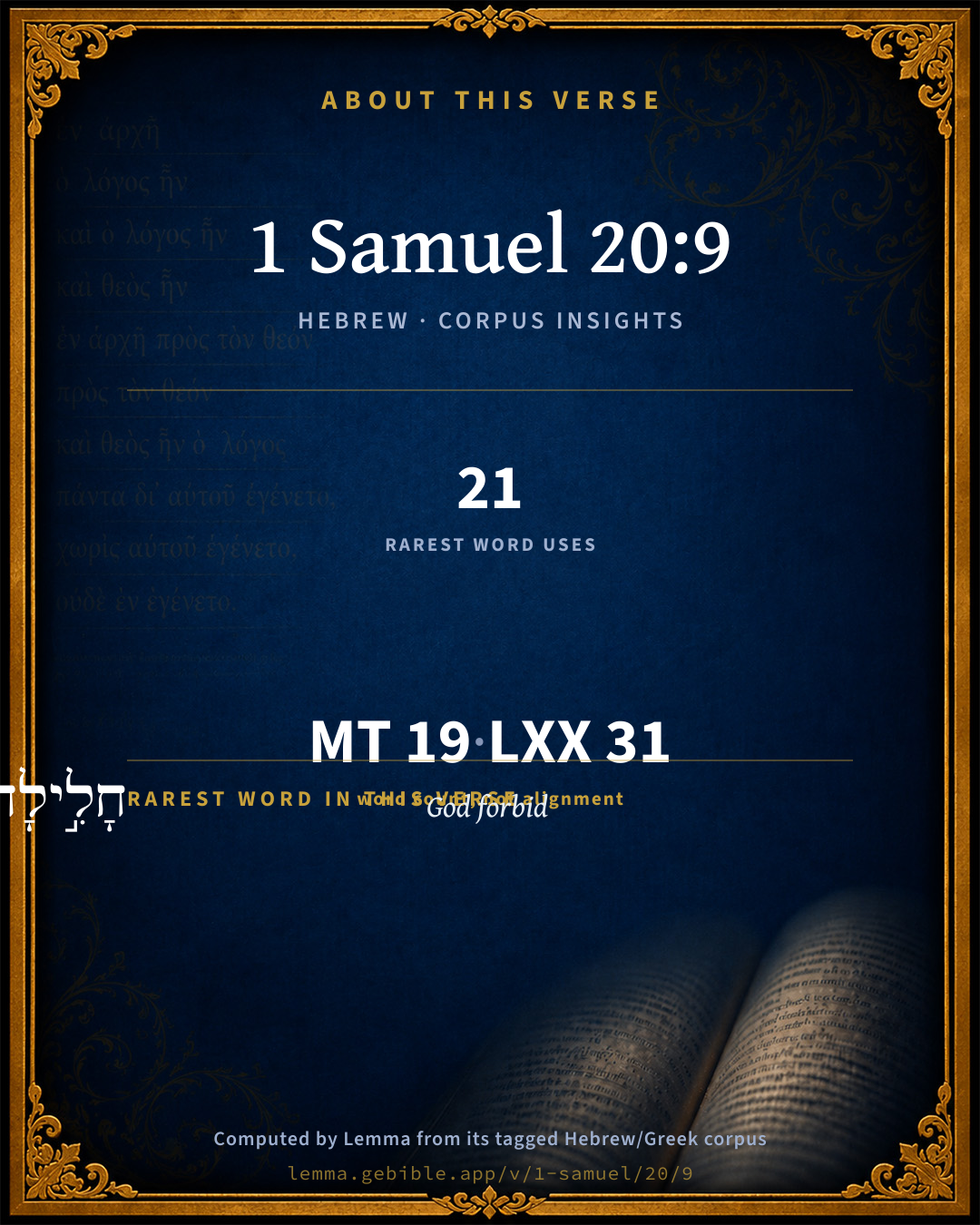
The rarest word here is חָלִ֣ילָה God forbid H2486 — appearing just 21 times in the whole Hebrew Bible.

Shared distinctive vocabulary

חָלִ֣ילָה God forbid H2486 occurs in 19 verses of the Hebrew Bible. Also found in:

Grammatical profile

  • 6 verbs
  • 3 nouns
  • 4 prepositions
  • 3 conjunctions
  • 3 particles

Verb forms

  • וַיֹּ֥אמֶר Qal · Sequential Imperfect
  • יָדֹ֣עַ Qal · Infinitive Absolute
  • אֵדַ֗ע Qal · Imperfect
  • כָלְתָ֨ה Qal · Perfect
  • לָב֣וֹא Qal · Infinitive Construct
  • אַגִּ֥יד Hiphil · Imperfect

Repetition

Words recur within this verse — often emphatic in Hebrew:

  • יָדֹ֣עַ to know H3045 ×2
  • כִּ֣י that H3588 ×2

Hebrew & Septuagint length

In English translation the verse runs 31 words from the Hebrew and 36 from the Septuagint (LXX English) — closely comparable.

A rough comparison of the two English renderings, which tokenize alike — not a word-level alignment.

Word counts can differ between the Hebrew and the Greek without any difference in meaning — e.g. the Hebrew direct-object marker אֵת has no separate Greek word, and Greek often adds the article ὁ.

In the original languages it is 19 Hebrew tokens and 31 Greek tokens — but the two are counted differently (Hebrew bundles its prefixes and suffixes into one token; the Greek is in lemma form), so that isn’t a like-for-like length.

Cross-references

3

Topical passages linked to 1 Samuel 20:9 in the Treasury of Scripture Knowledge — connected by theme and wording, ordered by reader-vote popularity; previews shown in the World English Bible.

  • 1 Samuel 19:2 Jonathan told David, saying, Saul my father seeks to kill you: now therefore, please take care of yourself in the morning, and live in a secret place, and hide yourself:
  • 1 Samuel 20:38 Jonathan cried after the boy, Go fast! Hurry! Don't delay! Jonathan's boy gathered up the arrows, and came to his master.
  • 1 Samuel 20:42 Jonathan said to David, Go in peace, because we have sworn both of us in the name of Yahweh, saying, Yahweh shall be between me and you, and between my seed and your seed, forever. He arose and departed: and Jonathan went into the city.

Cross-references courtesy of OpenBible.info (CC BY 4.0).

Hebrew and Greek witnesses Masoretic Hebrew ↔ Greek Septuagint

The same verse in the two great witnesses to the Old Testament, shown verse-for-verse.

These are two independent witnesses, not word-aligned to each other, and the Septuagint is shown in lemma (dictionary) form.

Hebrew 1 Samuel 20:9 Masoretic · Westminster Leningrad Codex

וַיֹּ֥אמֶר יְהוֹנָתָ֖ן חָלִ֣ילָה לָּ֑ךְ כִּ֣י אִם יָדֹ֣עַ אֵדַ֗ע כִּֽי כָלְתָ֨ה הָרָעָ֜ה מֵעִ֤ם אָבִי֙ לָב֣וֹא עָלֶ֔יךָ וְלֹ֥א אֹתָ֖הּ אַגִּ֥יד לָֽךְ

Jonathan said, Far be it from you; for if I should at all know that evil were determined by my father to come on you, then wouldn't I tell you that?

World English Bible · Public Domain

Greek LXX 1 Samuel 20:9 Septuagint · lemma form

καί εἶπον ιωναθαν μηδαμῶς σύ ὅτι ἐάν γιγνώσκω γιγνώσκω ὅτι συντελέω ὁ κακία παρά ὁ πατήρ ἐγώ ὁ ἔρχομαι ἐπί σύ καί ἐάν μή εἰς ὁ πόλις σύ ἐγώ ἀποἀγγέλλω σύ

And Jonathan said, That be far from you: for if I surely know that evil is determined by my father to come upon you, although it should not be against your cities, I will tell you.

LXX2012 (modern English Septuagint) · Public Domain

On this verse, Haydock's Catholic Bible Commentary discusses the Septuagint’s reading. Read the note in Commentary ↓

Hebrew: Westminster Leningrad Codex (CC BY 4.0). Greek: Septuagint (public domain); English from LXX2012 (modern English Septuagint) (Public Domain). How the Septuagint differs from the Hebrew →

Targum (Aramaic paraphrase)

1

The Targum is the ancient Jewish Aramaic paraphrase of the Hebrew Scriptures — an interpretive translation, not the Hebrew text itself. Onkelos (literal) and Pseudo-Jonathan (expansive) render the Torah, and Jonathan the Prophets. Coverage is partial: where no permissively-licensed English translation exists for a verse, only the Aramaic is shown. This is verse-level text, not a word-by-word alignment to the Hebrew.

  1. Targum Jonathan Prophets (Joshua–Malachi)
    וַאֲמַר יְהוֹנָתָן חַס לָךְ אֲרֵי אִם מִדַע אֵדַע אֲרֵי גְמִירָא בִּישְׁתָּא מִן אַבָּא לְמֵיתֵי עֲלָךְ וְלָא יָתָהּ אֲחַוֵי לָךְ:

    (no public-domain English translation for this verse)

    Targum Jonathan — Aramaic: “Mikraot Gedolot” (public domain). English: “Sefaria Community Translation” (CC0 1.0 (public-domain dedication)); “London "Chaldee Paraphrase," 1871” (public domain). Text via Sefaria.

Commentary

Notes on 1 Samuel 20:9 from classic Christian and Jewish commentators (each source and its license shown beneath its notes). The classic Christian expositions comment on the surrounding passage and are grouped to its opening verse, so a note may address several verses; the Jewish commentaries on the Tanakh (Rashi and others) are per-verse, so they appear only where the commentator wrote on this verse.

Lemma curates 59 commentaries, every one of them public domain or Creative Commons licensed, each selected and text-cleaned for this edition rather than reprinted as found. About our sources →

Matthew Henry's Commentary

Here, I. Jonathan protests his fidelity to David in his distress. Notwithstanding the strong confidence David had in Jonathan, yet, because he might have some reason to fear that his father's influence, and his own interest, should make him warp, or grow cool towards him, Jonathan thought it requisite solemnly to renew the professions of his friendship to him (Sa1 20:9): "Far be it from thee to think that I suspect thee of any crime for which I should either slay thee myself or deliver thee to my father; no, if thou hast any jealousy of that, Come let us go into the field (Sa1 20:11), and talk it over more fully." He did not challenge him to the field to fight him for an affront, but to fix him in his friendship. He faithfully promised him that he would let him know how, upon trial, he found his father affected towards him, and would make the matter neither better nor worse than it was. "If there be good towards thee, I will show it thee, that thou mayest be easy (Sa1 20:12), if evil, I will send thee away, that thou mayest be safe" (Sa1 20:13); and thus he would help to deliver him from the evil if it were real and from the fear of evil if it were but imaginary. For the confirmation of his promise he appeals to God, 1. As a witness (Sa1 20:12): "O Lord God of Israel, thou knowest I mean sincerely, and think as I speak." The strength of his passion made the manner of his speaking concise and abrupt. 2. As a judge: "The Lord do so and much more to Jonathan (Sa1 20:13), if I speak deceitfully, or break my word with my friend." He expressed himself thus solemnly that David might be abundantly assured of his sincerity. And thus God has confirmed his promises to us, that we might have strong consolation, Heb 6:17, Heb 6:18. Jonathan adds to his protestations his hearty prayers: "The Lord be with thee, to protect and prosper thee, as he has been formerly with my father, though now he has withdrawn." Thus he imitates his belief that David would be in his father's place, and his good wishes that he might prosper in it better than his father now did.

II. He provides for the entail of the covenant of friendship with David upon his posterity, Sa1 20:14-16. He engages David to be a friend to his family when he was gone (Sa1 20:15): Thou shalt promise that thou wilt not cut off thy kindness from my house for ever. This he spoke from a natural affection he had to his children, whom he desired it might go well with after his decease, and for whose future welfare he desired to improve his present interest. It also intimates his firm belief of David's advancement, and that it would be in the power of his hand to do a kindness or unkindness to his seed; for, in process of time, the Lord would cut off his enemies, Saul himself was not expected; then "Do not thou cut off thy kindness from my house, nor revenge my father's wrongs upon my children." The house of David must likewise be bound to the house of Jonathan from generation to generation; he made a covenant (Sa1 20:16) with the house of David. Note, True friends cannot but covet to transmit to theirs after them their mutual affections. Thy own friend, and thy father's friend, forsake not. This kindness, 1. He calls the kindness of the Lord, because it is such kindness as God shows to those he takes into covenant with himself; for he is a God to them and to their seed; they are beloved for the fathers' sakes. 2. He secures it by an imprecation (Sa1 20:16): The Lord require it at the hand of David's seed (for of David himself he had no suspicion) if they prove so far David's enemies as to deal wrongfully with the posterity of Jonathan, David's friend. He feared lest David, or some of his, should hereafter be tempted, for the clearing and confirming of their title to the throne, to do by his seed as Abimelech had done by the sons of Gideon (Jdg 9:5), and this he would effectually prevent; but the reason given (Sa1 20:17) why Jonathan was so earnest to have the friendship entailed is purely generous, and has nothing of self in it; it was because he loved him as he loved his own soul, and therefore desired that he and his might be beloved by him. David, though now in disgrace at court and in distress, was as amiable in the eyes of Jonathan as ever he had been, and he loved him never the less for his father's hating him, so pure were the principles on which his friendship was built. Having himself sworn to David, he caused David to swear to him, and (as we read it) to swear again, which David consented to (for he that bears an honest mind does not startle at assurances), to swear by his love to him, which he looked upon as a sacred thing. Jonathan's heart was so much upon it that, when they parted this time, he concluded with a solemn appeal to God: The Lord be between me and thee for ever (Sa1 20:23), that is, "God himself be judge between us and our families for ever, if on either side this league of friendship be violated." It was in remembrance of this covenant that David was kind to Mephibosheth, Sa2 9:7; Sa2 21:7. It will be a kindness to ourselves and ours to secure an interest in those whom God favours and to make his friends ours.

III. He settles the method of intelligence, and by what signs and tokens he would give him notice how his father stood affected towards him. David would be missed the first day, or at least the second day, of the new moon, and would be enquired after, Sa1 20:18. On the third day, by which time he would have returned from Bethlehem, he must be at such a place (Sa1 20:19), and Jonathan would come towards that place with his bow and arrows to shoot for diversion (Sa1 20:20), would send his lad to fetch his arrows, and, if they were shot short of the lad, David must take it for a signal of safety, and not be afraid to show his head (Sa1 20:21); but, if he shot beyond the lad, it was a signal of danger, and he must shift for his safety, Sa1 20:22. This expedient he fixed lest he should not have the opportunity, which yet it proved he had, of talking with David, and making the report by word of mouth.

Matthew Henry's Commentary on the Whole Bible (1708–1710) — public domain (CC PDM 1.0). Text via the HelloAO Bible API.

Trapp's Complete Commentary

John Trapp

1Sa 20:9 And Jonathan said, Far be it from thee: for if I knew certainly that evil were determined by my father to come upon thee, then would not I tell it thee?

Ver. 9. That evil were determined by my father.] The Vulgate rendereth it, completam esse malitiam patris mei contra re, that my father were so malicious as to murder thee.

John Trapp, A Commentary or Exposition upon All the Books of the Old and New Testament (1647–1656) — public domain. Text from a community e-Sword module.

Joseph Benson's Commentary

1Sa 20:9-13. Jonathan said, Far be it from thee — Or, rather, Far be this away; for Jonathan is speaking of himself in this thing. Then said David, Who shall tell me? — Who shall bring me advice how matters stand? They went out both into the field — To take their measures about this matter. Jonathan said, O Lord God of Israel — Do thou hear and judge between us. These first words of the sentence seem to be an exclamation, or an abrupt speech, not usual in great passions, and the rest are as if he had said, Shall I, who love thee so much, be thought capable of breaking my word with thee? In all these verses the words are broken, concise, and interrupted: as the words of lovers are wont to be, especially when they are disturbed. But there are a tenderness and sincerity in this exclamation of Jonathan which are scarcely to be equalled. If there be good toward thee — I will show it thee, that thou mayest be easy. If it please my father to do thee evil — I will send thee away, that thou mayest be safe. Thus he would help to deliver him from evil if it were real, and from the fear of evil if it were but imaginary. The Lord do so and much more to Jonathan — If I speak deceitfully, or break my word with my friend: he expresseth himself thus solemnly that David might be fully assured of his sincerity. And thus God has confirmed his promises to us, that we might have strong consolation, Heb 6:17-18. The Lord be with thee — And protect and prosper thee. Thus, to his protestations, Jonathan adds his hearty prayers for David. As he hath been with my father — Formerly, though now he be withdrawn. This intimates his belief that David would be in his father’s place, and his desire that he might prosper in it better than his father now did.

Joseph Benson's Commentary on the Old and New Testaments (1811–1818) — public domain. Text from a community e-Sword module.

Geneva Bible (1599)

Geneva Bible translators

That he were fully determined.

Geneva Bible (1599) marginal notes — public domain. Text via Bolls.life.

Ellicott's Commentary for English Readers

(9) Far be it from thee.—Vulg., absit hoc a te. This strong expression bears emphatic testimony to Jonathan’s implicit belief in his loved friend’s stainless loyalty. He indignantly refuses to take his life, or even to allow that life to be touched by his father. The sentences here are broken ones; the next one following is left, in the Hebrew, incomplete. They betoken the agitation and deep feeling of the chivalrous, indignant speaker.

A Bible Commentary for English Readers, edited by Charles John Ellicott (1878–1897) — public domain. Text from a community e-Sword module.

The Cambridge Bible for Schools and Colleges

gen. ed. J. J. S. Perowne

9. Far be it from thee] i.e. Do not suppose that I could either slay thee myself or give thee up to my father. The same phrase is rendered “God forbid” in 1Sa_20:2.

The Cambridge Bible for Schools and Colleges (gen. ed. J. J. S. Perowne; Cambridge University Press, 1878–1918) — public domain. Text from a community e-Sword module.

John Gill's Exposition

And Jonathan said, far be it from thee,.... To entertain such a thought of me, or to have the least suspicion of me, that I should conceal my father's ill intentions against thee, if known to me:

for if I knew certainly that evil were determined by my father to come upon thee, then would I not tell it thee? certainly I would; canst thou doubt of my kindness and fidelity? surely thou hast no reason, when such a covenant of friendship subsists between us, and there has not been the least breach of it on either side.

John Gill's Exposition of the Whole Bible (1746–1763) — public domain (CC PDM 1.0). Text via the HelloAO Bible API.

Haydock's Catholic Bible Commentary

Thee. Hebrew, "then, should I not tell thee?" (Calmet) --- Septuagint, "and if it reach not thy cities, I will inform thee."

George Leo Haydock (1774–1849), Haydock's Catholic Family Bible and Commentary, 1859 edition — public domain. Excludes Psalms (Douay-Rheims chapter numbering differs from Protestant) and Deuterocanonical books (Catholic canon only).

Matthew Poole's English Annotations

Far be it from thee; I abhor the thoughts of either killing thee myself, or giving thee up to my father to slay thee.

Matthew Poole's English Annotations on the Holy Bible (1683–1685) — public domain. Text from a community e-Sword/MySword module.

The Pulpit Commentary

Far be it, the word rendered God forbid in ver. 2. It indignantly rejects the idea of David having committed any crime. The rest of the verse is an incomplete sentence: "If I knew certainly that evil were determined by my father to come upon thee, and did not tell thee-" These broken sentences have great force in the original, as signs of intense feeling. (comp. Luk_19:42) We must complete the sentence mentally in some such way as the Syriac: "then Jehovah do so to me, and more also."

The Pulpit Commentary (1880–1919), ed. H.D.M. Spence-Jones & Joseph S. Exell — public domain. Text from a community e-Sword module.

Rashi

Rabbi Shlomo Yitzchaki (Rashi)

Far be it from you. To suspect me thus, that I know he has decided upon evil, and not to tell you.

Rashi on the Tanakh — English translations: “The Judaica Press complete Tanach with Rashi, translated by A. J. Rosenberg” (CC BY 4.0); “Pentateuch with Rashi's commentary by M. Rosenbaum and A.M. Silbermann, 1929-1934” (public domain); “The Metsudah Tanach series, Lakewood, N.J” (CC BY 4.0); and “The Book of Joshua, Metsudah Publications, 1997” (CC BY 4.0). Text via Sefaria.

Lesson kit

Teaching starters — assembled from the data on this page, not authored interpretation. Every prompt links to the verse data it draws on. Edit before teaching.

1 Samuel, in the Historical, opens this verse with 19 words (15 distinct Hebrew lemmas). Its most distinctive word is châlîylâh (“God forbid”). A historical commentator’s framing appears above. Read the whole chapter for the surrounding context.

Discussion questions

  1. What does “God forbid” (châlîylâh) contribute to the verse as a whole?
  2. How does Genesis 18:25, which shares the word «God forbid», read alongside this verse?
  3. What does the repetition of “to know” (2× in this one verse) do in this verse?
  4. These translations render this verse differently; the difference is in the English rendering, not the original. What questions does that raise?
  5. «וַיֹּ֥אמֶר» is a Qal Sequential Imperfect verb. How does that grammatical form shape the action described?
  6. Compare how Matthew Henry's Commentary and Trapp's Complete Commentary read this verse. Where do they agree or differ?

Things to notice

Reading settings

Reading text

Shown beneath each verse's original-language words.

Old Testament
Old Testament edition

Read the OT as the Masoretic Hebrew (MT) or the Greek Septuagint (LXX).

English shown for the Greek Septuagint (in the Hebrew ↔ Greek comparison).

Comparing translations? Open the Compare panel on any verse page to stack up to four side by side.