1 Kings 22:11

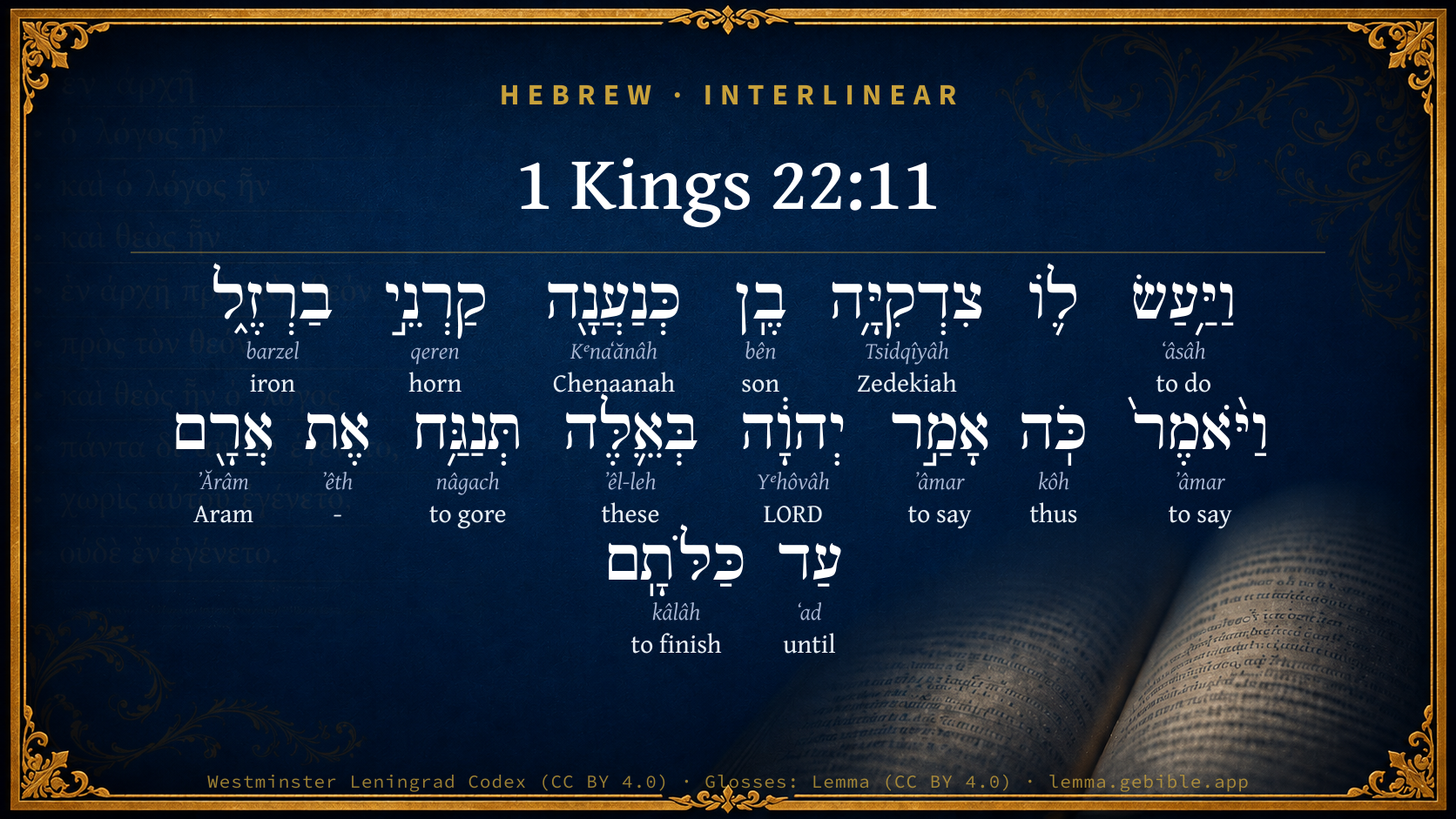
Hebrew (Westminster Leningrad Codex) 1 Kings 22:11 appears in the Hebrew Old Testament. The text above is from the Westminster Leningrad Codex. Each word links to its Strong’s number, a concise gloss, and parsing drawn from the Open Scriptures Hebrew Bible morphology. Click any word for its full Brown-Driver-Briggs (BDB) entry.
Download image
Cite this verse

1 Kings 22:11 (World English Bible). Public Domain. Lemma interlinear Bible study tool, https://lemma.gebible.app/v/1-kings/22/11.

Show BibTeX & RIS
BibTeX
RIS
English Translation
Zedekiah the son of Chenaanah made him horns of iron, and said, Thus says Yahweh, With these shall you push the Syrians, until they be consumed.
World English Bible · Public Domain
Highlights
  • 2 first appearances in the Hebrew Bible
Full analysis ↓
Download a study sheet

One document with this verse’s original text, its word-by-word gloss line, the meaning frame, cross-references with their text, attributed commentary, and full source and license credits — printable, and it pastes into notes with its structure intact.

This verse Autodidact and up

Study sheet (.html) Plain text (.txt)

A passage Seminary Student

Up to 50 verses in one chapter. A passage sheet keeps up to 6 commentary sources and 12 cross-references per verse, in the order this page ranks them, and says so on the sheet whenever that leaves anything out. Ask for a single verse and you get the Autodidact verse sheet above.

Everything on this page stays free to read, with no account — the sheet is a download of what is already on screen, not access to it.

Want to remove ads? Support Godless Engineer
Compare translations 3

The same verse in 3 English versions, stacked beneath the original-language interlinear above. Click any original word for its lexicon entry.

Each is an independent rendering of the whole verse — the interlinear is not word-aligned to these translations.

Highlighted words mark where these versions differ — a whole-verse word diff, not a word-by-word alignment.

  • World English Bible Public Domain
    Zedekiah the son of Chenaanah made him horns of iron, and said, Thus says Yahweh, With these shall you push the Syrians, until they be consumed.
  • King James Version Public Domain
    And Zedekiah the son of Chenaanah made him horns of iron: and he said, Thus saith the LORD, With these shalt thou push the Syrians, until thou have consumed them.
  • unfoldingWord Literal Text CC BY-SA 4.0
    And Zedekiah, the son of Kenaanah, made horns of iron for himself, and he said, “Thus says Yahweh: ‘With these you will gore Aram until their finishing.’”

unfoldingWord Literal Text — © unfoldingWord, licensed CC BY-SA 4.0. Word-aligned USFM3 via Door43 (git.door43.org/unfoldingWord/en_ult).

Versions to compare (up to 4)

3 of 4 selected

Show all 18 translations

Every available English version of this verse, each an independent rendering of the whole verse.

  • World English Bible Public Domain
    Zedekiah the son of Chenaanah made him horns of iron, and said, Thus says Yahweh, With these shall you push the Syrians, until they be consumed.
  • Berean Standard Bible Public Domain
    Now Zedekiah son of Chenaanah had made for himself iron horns and declared, “This is what the LORD says: ‘With these you shall gore the Arameans until they are finished off.’”
  • Majority Standard Bible Public Domain
    Now Zedekiah son of Chenaanah had made for himself iron horns and declared, “This is what the LORD says: ‘With these you shall gore the Arameans until they are finished off.’”
  • King James Version Public Domain
    And Zedekiah the son of Chenaanah made him horns of iron: and he said, Thus saith the LORD, With these shalt thou push the Syrians, until thou have consumed them.
  • American Standard Version (1901) Public Domain
    And Zedekiah the son of Chenaanah made him horns of iron, and said, Thus saith Jehovah, With these shalt thou push the Syrians, until they be consumed.
  • Revised Version (1885) Public Domain
    And Zedekiah the son of Chenaanah made him horns of iron, and said, Thus saith the LORD, With these shalt thou push the Syrians, until they be consumed.
  • Geneva Bible (1599) Public Domain
    And Zidkiiah the sonne of Chenaanah made him hornes of yron, and sayd, Thus sayth the Lord, With these shalt thou push the Aramites, vntill thou hast consumed them.
  • Douay-Rheims (1899) Public Domain
    And Sedecias the son of Chanaana made himself horns of iron, and said: Thus saith the Lord: With these shalt thou push Syria, till thou destroy it.
  • Young's Literal Translation Public Domain
    And Zedekiah son of Chenaanah maketh for himself horns of iron, and saith, `Thus said Jehovah, By these thou dost push the Aramaeans till they are consumed;'
  • Literal Standard Version CC BY-SA 4.0
    And Zedekiah son of Chenaanah makes horns of iron for himself and says, “Thus said YHWH: By these you push the Arameans until they are consumed”;
  • Unlocked Literal Bible CC BY-SA 4.0
    Zedekiah son of Kenaanah made himself horns of iron and said, “Yahweh says this: 'With these you will push the Arameans until they are consumed.'”
  • unfoldingWord Literal Text CC BY-SA 4.0
    And Zedekiah, the son of Kenaanah, made horns of iron for himself, and he said, “Thus says Yahweh: ‘With these you will gore Aram until their finishing.’”
  • Darby Bible Public Domain
    And Zedekiah the son of Chenaanah made for himself horns of iron, and he said, Thus saith Jehovah: With these shalt thou push the Syrians, until thou have exterminated them.
  • World Messianic Bible Public Domain
    Zedekiah the son of Chenaanah made himself horns of iron, and said, “The LORD says, ‘With these you will push the Syrians, until they are consumed.’”
  • Webster's Bible Public Domain
    And Zedekiah the son of Chenaanah made him horns of iron: and he said, Thus saith the LORD, With these shalt thou push the Syrians, until thou hast consumed them.
  • Free Bible Version CC BY-SA 4.0
    One of them, Zedekiah, son of Chenaanah, had made himself iron horns. He announced, “This is what the Lord says: ‘With these horns you will gore the Arameans until they're dead!’”
  • Bible in Basic English Public Domain
    And Zedekiah, the son of Chenaanah, made himself horns of iron and said, The Lord says, Pushing back the Aramaeans with these, you will put an end to them completely.
  • JPS Tanakh (1917) Public Domain
    And Zedekiah the son of Chenaanah made him horns of iron, and said: 'Thus saith the LORD: With these shalt thou gore the Arameans, until they be consumed.'

Literal Standard Version (2020), Covenant Press — licensed CC BY-SA 4.0. Text via the HelloAO Bible API (eBible.org). Unlocked Literal Bible (unfoldingWord) — licensed CC BY-SA 4.0. Text via the HelloAO Bible API (eBible.org). unfoldingWord Literal Text — © unfoldingWord, licensed CC BY-SA 4.0. Word-aligned USFM3 via Door43 (git.door43.org/unfoldingWord/en_ult). Free Bible Version, Dr. Jonathan Gallagher — licensed CC BY-SA 4.0. Text via the HelloAO Bible API (eBible.org).

Word by word

More ways to search: Search by grammar → Find every occurrence → Compare this word →

Practice this passage: Drill this verse → Learn its vocabulary →

כְּנַעֲנָ֖ה
Kᵉnaʻănâh
H3668
“Chenaanah”
Noun, Proper
Part of Speech
Noun
Type
Proper
Full BDB Definition

Origin: from H3667

TWOT: None

Chenaanah = "trader" - father of Zedekiah the false prophet of Ahab - son of Bilhan, grandson of Jediael, and great grandson of Benjamin and the founder of a house of Benjamin
  1. וַיַּ֥עַשׂ ʻâsâh H6213 “and · to do” Conjunction + Verb, Qal, Sequential Imperfect, 3rd Person, Masculine, Singular
  2. צִדְקִיָּ֥ה Tsidqîyâh H6667 “Zedekiah” Noun, Proper
  3. בֶֽן bên H1121 “son of” Noun, Common, Masculine, Singular, Construct
  4. קַרְנֵ֣י qeren H7161 “horns of” Noun, Common, Both, Dual, Construct
  5. בַרְזֶ֑ל barzel H1270 “iron” Noun, Common, Masculine, Singular, Absolute
  6. וַיֹּ֨אמֶר֙ ʼâmar H559 “and · to say” Conjunction + Verb, Qal, Sequential Imperfect, 3rd Person, Masculine, Singular
  7. כֹּֽה kôh H3541 “thus” Adverb
  8. אָמַ֣ר ʼâmar H559 “to say” Verb, Qal, Perfect, 3rd Person, Masculine, Singular
  9. יְהוָ֔ה Yᵉhôvâh H3068 “LORD” Noun, Proper
  10. בְּאֵ֛לֶּה ʼêl-leh H428 “in/at · these” Preposition + Pronoun, Demonstrative, Common, Plural
  11. תְּנַגַּ֥ח nâgach H5055 “to gore” Verb, Piel, Imperfect, 2nd Person, Masculine, Singular
  12. אֶת ʼêth H853 “-” Particle, Direct Object
  13. אֲרָ֖ם ʼĂrâm H758 “Aram” Noun, Proper
  14. עַד ʻad H5704 “until” Preposition
  15. כַּלֹּתָֽם kâlâh H3615 “to finish · them” Verb, Piel, Infinitive Construct + Suffix, Personal, 3rd Person, Masculine, Plural

About this verse

These counts appear in no published source. They are computed here, from the morphology-tagged text and Lemma’s own curated glosses. What Lemma adds →

17
words
15
distinct lemmas
Historical
section

Notable vocabulary

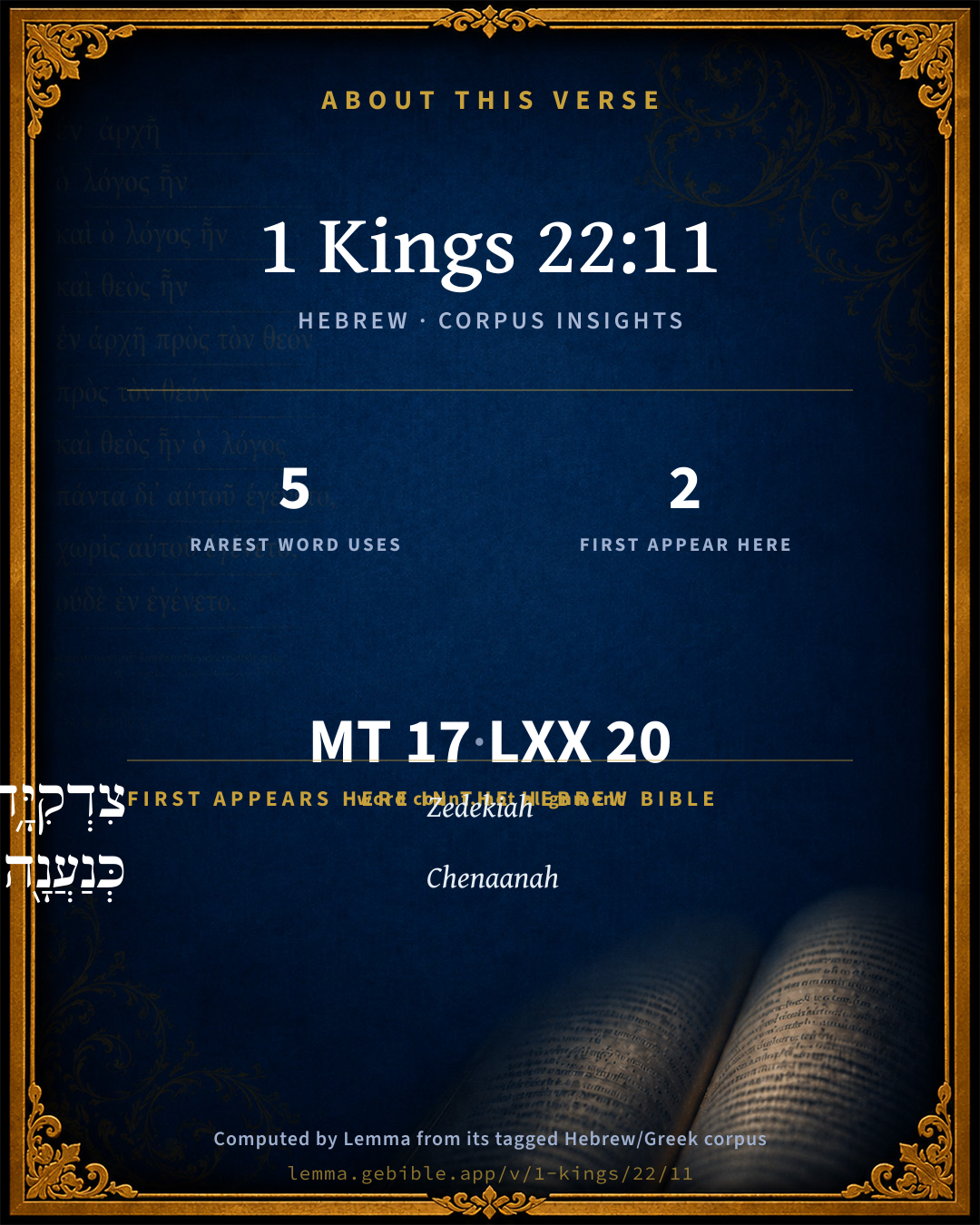
The rarest word here is כְּנַעֲנָ֖ה Chenaanah H3668 — appearing just 5 times in the whole Hebrew Bible.

First appearance in Scripture

These words make their first canonical appearance in the Hebrew Bible here:

  • צִדְקִיָּ֥ה Zedekiah H6667
  • כְּנַעֲנָ֖ה Chenaanah H3668

Shared distinctive vocabulary

כְּנַעֲנָ֖ה Chenaanah H3668 occurs in 5 verses of the Hebrew Bible. Also found in:

Grammatical profile

  • 5 verbs
  • 7 nouns
  • 1 pronoun
  • 2 prepositions
  • 1 adverb
  • 1 particle

Verb forms

  • וַיַּ֥עַשׂ Qal · Sequential Imperfect
  • וַיֹּ֨אמֶר֙ Qal · Sequential Imperfect
  • אָמַ֣ר Qal · Perfect
  • תְּנַגַּ֥ח Piel · Imperfect
  • כַּלֹּתָֽם Piel · Infinitive Construct

Repetition

A word recurs within this verse — often emphatic in Hebrew:

  • וַיֹּ֨אמֶר֙ to say H559 ×2

Hebrew & Septuagint length

In English translation the verse runs 26 words from the Hebrew and 26 from the Septuagint (LXX English) — the same length.

A rough comparison of the two English renderings, which tokenize alike — not a word-level alignment.

Word counts can differ between the Hebrew and the Greek without any difference in meaning — e.g. the Hebrew direct-object marker אֵת has no separate Greek word, and Greek often adds the article ὁ.

In the original languages it is 17 Hebrew tokens and 20 Greek tokens — but the two are counted differently (Hebrew bundles its prefixes and suffixes into one token; the Greek is in lemma form), so that isn’t a like-for-like length.

Cross-references

15

Topical passages linked to 1 Kings 22:11 in the Treasury of Scripture Knowledge — connected by theme and wording, ordered by reader-vote popularity; previews shown in the World English Bible.

  • Zechariah 1:18–21 I lifted up my eyes, and saw, and, behold, four horns.
  • Deuteronomy 33:17 The firstborn of his herd, majesty is his; His horns are the horns of the wild-ox: With them he shall push the peoples all of them, [even] the ends of the earth: They are the ten thousands of Ephraim, They are the thousands of Manasseh.
  • Jeremiah 23:17 They say continually to those who despise me, Yahweh has said, You shall have peace; and to everyone who walks in the stubbornness of his own heart they say, No evil shall come on you.
  • Jeremiah 23:25 I have heard what the prophets have said, who prophesy lies in my name, saying, I have dreamed, I have dreamed.
  • Jeremiah 23:31 Behold, I am against the prophets, says Yahweh, who use their tongues, and say, He says.
  • Jeremiah 27:2 Thus says Yahweh to me: Make you bonds and bars, and put them on your neck;
  • Jeremiah 28:2–3 Thus speaks Yahweh of Hosts, the God of Israel, saying, I have broken the yoke of the king of Babylon.
  • Jeremiah 28:10–14 Then Hananiah the prophet took the bar from off the prophet Jeremiah's neck, and broke it.
  • Jeremiah 29:21 Thus says Yahweh of Hosts, the God of Israel, concerning Ahab the son of Kolaiah, and concerning Zedekiah the son of Maaseiah, who prophesy a lie to you in my name: Behold, I will deliver them into the hand of Nebuchadrezzar king of Babylon; and he shall kill them before your eyes;
  • Ezekiel 13:6–9 They have seen falsehood and lying divination, who say, Yahweh says; but Yahweh has not sent them: and they have made men to hope that the word would be confirmed.
  • Ezekiel 22:27–28 Her princes in the midst of it are like wolves ravening the prey, to shed blood, [and] to destroy souls, that they may get dishonest gain.
  • Acts 19:13–16 But some of the itinerant Jews, exorcists, took on themselves to name over those who had the evil spirits the name of the Lord Jesus, saying, "We adjure you by Jesus whom Paul preaches."
  • 2 Corinthians 11:13–15 For such men are false apostles, deceitful workers, masquerading as Christ's apostles.
  • 2 Timothy 3:8 Even as Jannes and Jambres opposed Moses, so do these also oppose the truth; men corrupted in mind, reprobate concerning the faith.
  • Micah 3:11 Her leaders judge for bribes, And her priests teach for a price, And her prophets of it tell forturnes for money: Yet they lean on Yahweh, and say, Isn't Yahweh in the midst of us? No disaster will come on us.

Cross-references courtesy of OpenBible.info (CC BY 4.0).

Hebrew and Greek witnesses Masoretic Hebrew ↔ Greek Septuagint

The same verse in the two great witnesses to the Old Testament, shown verse-for-verse.

These are two independent witnesses, not word-aligned to each other, and the Septuagint is shown in lemma (dictionary) form.

Hebrew 1 Kings 22:11 Masoretic · Westminster Leningrad Codex

וַיַּ֥עַשׂ ל֛וֹ צִדְקִיָּ֥ה בֶֽן כְּנַעֲנָ֖ה קַרְנֵ֣י בַרְזֶ֑ל וַיֹּ֨אמֶר֙ כֹּֽה אָמַ֣ר יְהוָ֔ה בְּאֵ֛לֶּה תְּנַגַּ֥ח אֶת אֲרָ֖ם עַד כַּלֹּתָֽם

Zedekiah the son of Chenaanah made him horns of iron, and said, Thus says Yahweh, With these shall you push the Syrians, until they be consumed.

World English Bible · Public Domain

Greek LXX 1 Kings 22:11 Septuagint · lemma form

καί ποιέω ἑαυτοῦ σεδεκιας υἱός χανανα κέρας σιδηροῦς καί εἶπον ὅδε λέγω κύριος ἐν οὗτος κερατίζω ὁ συρία ἕως συντελέω

And Sedekias son of Chanaan made for himself iron horns, and said, Thus says the Lord, With these you shall push Syria, until it be consumed.

LXX2012 (modern English Septuagint) · Public Domain

On this verse, Haydock's Catholic Bible Commentary discusses the Septuagint’s reading. Read the note in Commentary ↓

Hebrew: Westminster Leningrad Codex (CC BY 4.0). Greek: Septuagint (public domain); English from LXX2012 (modern English Septuagint) (Public Domain). How the Septuagint differs from the Hebrew →

Targum (Aramaic paraphrase)

1

The Targum is the ancient Jewish Aramaic paraphrase of the Hebrew Scriptures — an interpretive translation, not the Hebrew text itself. Onkelos (literal) and Pseudo-Jonathan (expansive) render the Torah, and Jonathan the Prophets. Coverage is partial: where no permissively-licensed English translation exists for a verse, only the Aramaic is shown. This is verse-level text, not a word-by-word alignment to the Hebrew.

  1. Targum Jonathan Prophets (Joshua–Malachi)
    וַעֲבַד לֵיהּ צִדְקִיָה בַר כְּנַעֲנָה קַרְנִין דְבַרְזֶל וַאֲמַר כִּדְנַן אֲמַר יְיָ בְּאִילֵין תְּקַטֵל יַת אֱנַשׁ אֲרָם עַד דִי תְשֵׁיצִינוּן:

    (no public-domain English translation for this verse)

    Targum Jonathan — Aramaic: “Mikraot Gedolot” (public domain). English: “Sefaria Community Translation” (CC0 1.0 (public-domain dedication)); “London "Chaldee Paraphrase," 1871” (public domain). Text via Sefaria.

Commentary

Notes on 1 Kings 22:11 from classic Christian and Jewish commentators (each source and its license shown beneath its notes). The classic Christian expositions comment on the surrounding passage and are grouped to its opening verse, so a note may address several verses; the Jewish commentaries on the Tanakh (Rashi and others) are per-verse, so they appear only where the commentator wrote on this verse.

Lemma curates 59 commentaries, every one of them public domain or Creative Commons licensed, each selected and text-cleaned for this edition rather than reprinted as found. About our sources →

Trapp's Complete Commentary

John Trapp

1Ki 22:11 And Zedekiah the son of Chenaanah made him horns of iron: and he said, Thus saith the LORD, With these shalt thou push the Syrians, until thou have consumed them.

Ver. 11. Made him horns of iron.] After the manner of the true prophets of God, who usually, to the word they spake, added such outward sensible signs.

With these shalt thou push the Syrians.] Thus this horned beast vapoured and vaunted. Augustine observed of Primianus and Maximianus, that they were jolly fellows in a faction. Else, said he, Primianus might have been Postremianus, and Maximianus Minimianus.

John Trapp, A Commentary or Exposition upon All the Books of the Old and New Testament (1647–1656) — public domain. Text from a community e-Sword module.

Joseph Benson's Commentary

1Ki 22:11. Zedekiah made him horns of iron — Fit emblems of the power and victory of these two kings. The devil is God’s ape, and the false prophets imitated the true, who, when they declared God’s mind by words, did also sometimes confirm it by sensible signs, Isa 20:2; Jer 27:2. Thus saith the Lord — Hebrew, Jehovah, in whose name he pretends to speak, to gain the more credit and countenance to his words.

Joseph Benson's Commentary on the Old and New Testaments (1811–1818) — public domain. Text from a community e-Sword module.

Geneva Bible (1599)

Geneva Bible translators

The true Prophets of God were accustomed to use signs for the confirmation of their doctrine, Isa. 20:2; Jer. 7:2. Wherein the false Prophets did imitate them, thinking thereby to make their doctrine more commendable.

Geneva Bible (1599) marginal notes — public domain. Text via Bolls.life.

Jamieson, Fausset & Brown

Robert Jamieson, A. R. Fausset & David Brown

Zedekiah the son of Chenaanah made him horns of iron--Small projections, of the size and form of our candle extinguishers (worn in many parts of the East as military ornaments), were worn by the Syrians of that time, and probably by the Israelite warriors also. Zedekiah, by assuming two horns, personated two heroes, and, pretending to be a prophet, wished in this manner to represent the kings of Israel and Judah in a military triumph. It was a symbolic action, to impart greater force to his language (see Deu 33:17); but it was little more than a flourish with a spontoon [CALMET, Fragments].

Jamieson, Fausset & Brown — Commentary Critical and Explanatory on the Whole Bible (1871) — public domain (CC PDM 1.0). Text via the HelloAO Bible API.

Adam Clarke's Commentary

Verse 11. Zedekiah - made him horns of iron] This was in imitation of that sort of prophecy which instructed by significative actions. This was frequent among the prophets of the Lord.

Adam Clarke's Commentary on the Bible (1810–1826) — public domain. Text from a community e-Sword/MySword module.

Ellicott's Commentary for English Readers

(11) Zedekiah.—The name itself (“righteousness of Jehovah”) must certainly imply professed devotion to the true God, whose Name here is first uttered by him. Symbolic action was not unfrequent in the prophets. (See Note on 1Ki_11:30.) The use of the horns, as emblems of victorious strength, is also familiar, as in the utterance of Balaam (Num_23:22), in the blessing of Moses (Deu_33:17), in the song of Hannah (1Sa_3:1), in the visions of Daniel and Zechariah (Dan_8:3-10; Zec_1:18-19).

A Bible Commentary for English Readers, edited by Charles John Ellicott (1878–1897) — public domain. Text from a community e-Sword module.

The Cambridge Bible for Schools and Colleges

gen. ed. J. J. S. Perowne

11. Zedekiah] In 1Ki_22:24 we see that Zedekiah was the leader of Ahab’s prophets. His action here is one of those symbolical proceedings not uncommon with the prophets. Thus Ahijah significantly rent his garment into twelve pieces (1Ki_11:30) and gave Jeroboam ten. Zedekiah’s language, addressed to Ahab, is probably an allusion to the blessing of Ephraim in Deu_33:17. By this time Ephraim had become the representative tribe of the Northern Kingdom, and of him Moses had said ‘his horns are like the horns of unicorns: with them he shall push the people together to the ends of the earth.’ By such language not only Ahab, but Jehoshaphat might be encouraged to trust more to the prophecies of success.

until thou have consumed them] R.V. until they be consumed. There is nothing in the original to warrant ‘thou.’

The Cambridge Bible for Schools and Colleges (gen. ed. J. J. S. Perowne; Cambridge University Press, 1878–1918) — public domain. Text from a community e-Sword module.

John Gill's Exposition

And Micaiah said, as the Lord liveth,.... He swore by the living God, for the confirmation of what he was about to say:

what the Lord saith unto me, that will I speak; truly and faithfully, keeping nothing back, nor adding anything, whether it be good or evil, pleasing or displeasing; it looks as if as yet he had no instruction from the Lord what to say, and yet the vision he later declares seems to have been had by him before, Kg1 22:17.

John Gill's Exposition of the Whole Bible (1746–1763) — public domain (CC PDM 1.0). Text via the HelloAO Bible API.

Albert Barnes' Notes on the Bible

Horns of iron - The horn in Scripture is the favorite symbol of power; and pushing with the horn is a common metaphor for attacking and conquering enemies (see Deu 33:17; Compare Psa 44:5; Dan 8:4). Zedekiah, in employing a symbolic action, was following the example of a former Israelite prophet 1Ki 11:30.

Thus saith the Lord - Or, יהוה yehovâh. Zedekiah lays aside the unmeaningful “Lord” אדני 'ǎdonāy of the general company of Israelite prophets 1Ki 22:6, and professes to have a direct message from Yahweh to Ahab. He may have believed his own words, for the “lying spirit” 1Ki 22:22 may have seemed to him a messenger from Yahweh. All the rest followed his example 1Ki 22:12.

Albert Barnes' Notes on the Bible (1834–1885) — public domain. Text from a community e-Sword/MySword module.

Haydock's Catholic Bible Commentary

Push, "with the horn," (Greek: keratiseis; Septuagint) and throw into the air, (Menochius) like a bull. (Calmet) --- Nothing shall withstand thy power. The actions of Sedecias were of the same import as his words. (Haydock) --- See Jeremias xxvii. 2., and xxviii. 10. --- Such horns were shewn to Zacharias; (i. 18.) as false prophets often do, like the true ones. (Worthington)

George Leo Haydock (1774–1849), Haydock's Catholic Family Bible and Commentary, 1859 edition — public domain. Excludes Psalms (Douay-Rheims chapter numbering differs from Protestant) and Deuterocanonical books (Catholic canon only).

Matthew Poole's English Annotations

Horns of iron; fit emblems of the power and victory of these two kings. The devil is God’s ape, and the false prophets sometimes imitating the true, who when they declared God’s mind by words, did also oftentimes confirm it by sensible signs. See Isa 20:2; Jer 27:2.

Thus saith the Lord, Heb. Jehovah; whose name he pretends, to gain the more credit and countenance to his words. See Poole "1Ki 21:7".

Matthew Poole's English Annotations on the Holy Bible (1683–1685) — public domain. Text from a community e-Sword/MySword module.

Whedon's Commentary on the Bible

Daniel D. Whedon

11. Zedekiah — One of the four hundred false prophets.

Made him horns of iron — In order to prophesy by symbol as well as by word.

With these shalt thou push the Syrians — Here was an embodying of the imagery of Deu_33:17, where of the triumph of Joseph it is said: “His glory is like the firstling of his bullock, and his horns are like the horns of unicorns; with them he shall push the people together to the ends of the earth.” Not only do Zedekiah’s words and action bear witness to the existence of the Pentateuch at that time, but also show his desire to strengthen his prophecy by embodying in it an old promise to the most prominent tribe in Israel.

Daniel D. Whedon (gen. ed.), Commentary on the Old and New Testaments (1874–1909) — public domain. Text from a community e-Sword module.

The Pulpit Commentary

And Zedekiah This name =" Justice of Jehovah," is one of the proofs that these cannot have been prophets of Baal, as Stanley and others suppose the son of Chenaanah =" Canaanitess." But we gather 1Ch_7:10 that this, like Shelomith, was a man"s name. The Benjamite there mentioned may be identical with the father (or ancestor) of Zedekiah made him Rawlinson would translate, had made him," He says that the horns must have "been made previously, in expectation of some such occasion as that now afforded him." But it is quite conceivable that during the prophesyings, which clearly lasted some time, the idea occurred to Zedekiah, and it would not take long to put it into execution horns of Iron Thenius understands that these were iron spikes held on the forehead. But the reference is clearly to the horns of a bullock, and the appropriateness of the prophetic act is only manifest when we remember that Ephraim is compared to a bullock, (Deu_33:17) and more, that Moses spake beforehand of the strength of his horns, and predicted that with them he should push the people together to the ends of the earth." Not only, that is to say, was the horn a familiar Oriental symbol of power (1Sa_2:1, 1Sa_2:10; 2Sa_22:3; Psa_89:24 Psa_92:10; Dan_7:21 Dan_8:8, etc.) but it was identified in a peculiar manner with the powerful tribe of Ephraim; in ether words, with the kingdom of Israel This symbolical act was not necessarily an imitation of the action of Ahijah. (1Ki_11:30) Such acted parables were not uncommon among the prophets (2Ki_13:15; Isa_20:2; Jer_13:1 Jer_19:10 Jer_32:9 sqq.; Eze_4:5; Act_21:11) and he said, Thus saith the Lord Heb. Jehovah. He now uses the sacred name; no doubt because of Jehoshaphat"s demand, ver. 7, With these shalt thou push the word of (Deu_33:17) the Syrians, until thou have consumed then.

The Pulpit Commentary (1880–1919), ed. H.D.M. Spence-Jones & Joseph S. Exell — public domain. Text from a community e-Sword module.

Lesson kit

Teaching starters — assembled from the data on this page, not authored interpretation. Every prompt links to the verse data it draws on. Edit before teaching.

1 Kings, in the Historical, opens this verse with 17 words (15 distinct Hebrew lemmas). Its most distinctive word is Kᵉnaʻănâh (“Chenaanah”). A historical commentator’s framing appears above. Read the whole chapter for the surrounding context.

Discussion questions

  1. What does “Chenaanah” (Kᵉnaʻănâh) contribute to the verse as a whole?
  2. 2 words make their first appearance in Scripture here. What does this debut establish?
  3. How does 1 Kings 22:24, which shares the word «Chenaanah», read alongside this verse?
  4. What does the repetition of “to say” (2× in this one verse) do in this verse?
  5. These translations render this verse differently. What is at stake in choosing one wording over another?
  6. «וַיַּ֥עַשׂ» is a Qal Sequential Imperfect verb. How does that grammatical form shape the action described?
  7. Compare how Trapp's Complete Commentary and Joseph Benson's Commentary read this verse. Where do they agree or differ?

Things to notice

Reading settings

Reading text

Shown beneath each verse's original-language words.

Old Testament
Old Testament edition

Read the OT as the Masoretic Hebrew (MT) or the Greek Septuagint (LXX).

English shown for the Greek Septuagint (in the Hebrew ↔ Greek comparison).

Comparing translations? Open the Compare panel on any verse page to stack up to four side by side.