

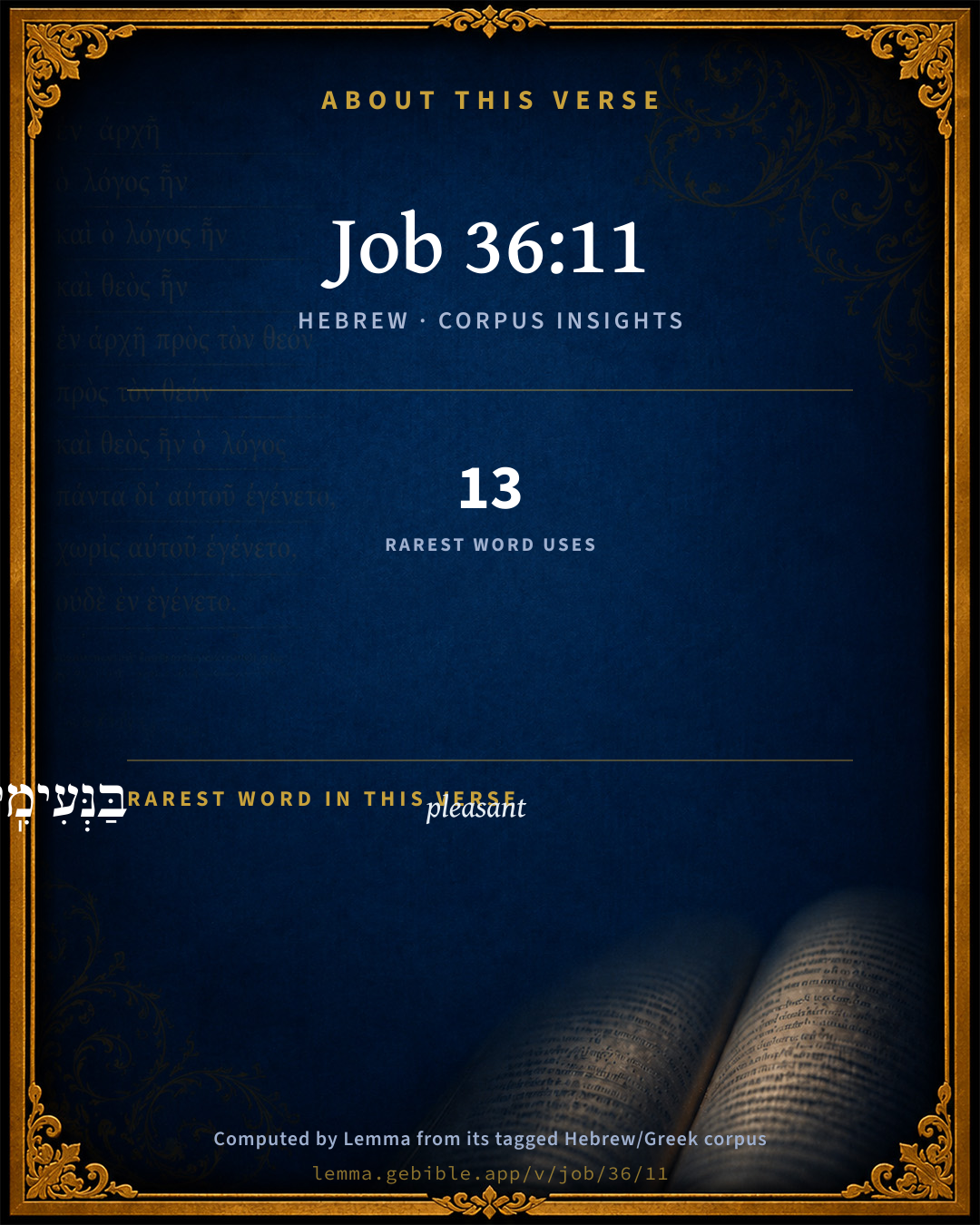
Job 36:11

Hebrew (Westminster Leningrad Codex) Job 36:11 appears in the Hebrew Old Testament. The text above is from the Westminster Leningrad Codex. Each word links to its Strong’s number, a concise gloss, and parsing drawn from the Open Scriptures Hebrew Bible morphology. Click any word for its full Brown-Driver-Briggs (BDB) entry.
Download image
Cite this verse

Job 36:11 (World English Bible). Public Domain. Lemma interlinear Bible study tool, https://lemma.gebible.app/v/job/36/11.

Show BibTeX & RIS
BibTeX
RIS
English Translation
If they listen and serve him, They shall spend their days in prosperity, And their years in pleasures.
World English Bible · Public Domain
Download a study sheet

One document with this verse’s original text, its word-by-word gloss line, the meaning frame, cross-references with their text, attributed commentary, and full source and license credits — printable, and it pastes into notes with its structure intact.

This verse Autodidact and up

Study sheet (.html) Plain text (.txt)

A passage Seminary Student

Up to 50 verses in one chapter. A passage sheet keeps up to 6 commentary sources and 12 cross-references per verse, in the order this page ranks them, and says so on the sheet whenever that leaves anything out. Ask for a single verse and you get the Autodidact verse sheet above.

Everything on this page stays free to read, with no account — the sheet is a download of what is already on screen, not access to it.

Want to remove ads? Support Godless Engineer
Compare translations 3

The same verse in 3 English versions, stacked beneath the original-language interlinear above. Click any original word for its lexicon entry.

Each is an independent rendering of the whole verse — the interlinear is not word-aligned to these translations.

Highlighted words mark where these versions differ — a whole-verse word diff, not a word-by-word alignment.

  • World English Bible Public Domain
    If they listen and serve him, They shall spend their days in prosperity, And their years in pleasures.
  • King James Version Public Domain
    If they obey and serve him, they shall spend their days in prosperity, and their years in pleasures.
  • unfoldingWord Literal Text CC BY-SA 4.0
    If they hear and serve, they will complete their days in good and their years in pleasantness.

unfoldingWord Literal Text — © unfoldingWord, licensed CC BY-SA 4.0. Word-aligned USFM3 via Door43 (git.door43.org/unfoldingWord/en_ult).

Versions to compare (up to 4)

3 of 4 selected

Show all 18 translations

Every available English version of this verse, each an independent rendering of the whole verse.

  • World English Bible Public Domain
    If they listen and serve him, They shall spend their days in prosperity, And their years in pleasures.
  • Berean Standard Bible Public Domain
    If they obey and serve Him, then they end their days in prosperity and their years in happiness.
  • Majority Standard Bible Public Domain
    If they obey and serve Him, then they end their days in prosperity and their years in happiness.
  • King James Version Public Domain
    If they obey and serve him, they shall spend their days in prosperity, and their years in pleasures.
  • American Standard Version (1901) Public Domain
    If they hearken and serve `him', They shall spend their days in prosperity, And their years in pleasures.
  • Revised Version (1885) Public Domain
    If they hearken and serve him, they shall spend their days in prosperity, and their years in pleasures.
  • Geneva Bible (1599) Public Domain
    If they obey and serue him, they shall end their dayes in prosperity, and their yeres in pleasures.
  • Douay-Rheims (1899) Public Domain
    If they shall hear and observe, they shall accomplish their days in good, and their years in glory.
  • Young's Literal Translation Public Domain
    If they do hear and serve, They complete their days in good, And their years in pleasantness.
  • Literal Standard Version CC BY-SA 4.0
    If they hear and serve, || They complete their days in good, || And their years in pleasantness.
  • Unlocked Literal Bible CC BY-SA 4.0
    If they listen to him and worship him, they will spend their days in prosperity, their years in contentment.
  • unfoldingWord Literal Text CC BY-SA 4.0
    If they hear and serve, they will complete their days in good and their years in pleasantness.
  • Darby Bible Public Domain
    If they hearken and serve [him], they shall accomplish their days in prosperity, and their years in pleasures.
  • World Messianic Bible Public Domain
    If they listen and serve him, they will spend their days in prosperity, and their years in pleasures.
  • Webster's Bible Public Domain
    If they obey and serve him, they shall spend their days in prosperity, and their years in pleasures.
  • Free Bible Version CC BY-SA 4.0
    If they listen and do what God says they will live out their lives in happiness.
  • Bible in Basic English Public Domain
    If they give ear to his voice, and do his word, then he gives them long life, and years full of pleasure.
  • JPS Tanakh (1917) Public Domain
    If they hearken and serve Him, they shall spend their days in prosperity, and their years in pleasures.

Literal Standard Version (2020), Covenant Press — licensed CC BY-SA 4.0. Text via the HelloAO Bible API (eBible.org). Unlocked Literal Bible (unfoldingWord) — licensed CC BY-SA 4.0. Text via the HelloAO Bible API (eBible.org). unfoldingWord Literal Text — © unfoldingWord, licensed CC BY-SA 4.0. Word-aligned USFM3 via Door43 (git.door43.org/unfoldingWord/en_ult). Free Bible Version, Dr. Jonathan Gallagher — licensed CC BY-SA 4.0. Text via the HelloAO Bible API (eBible.org).

Word by word

More ways to search: Search by grammar → Find every occurrence → Compare this word →

Practice this passage: Drill this verse → Learn its vocabulary →

בַּנְּעִימִֽים
nâʻîym
H5273
“in/at the · pleasant”
Preposition, Determined + Adjective, Adjective, Masculine, Plural, Absolute
Part of Speech
Preposition + Adjective
Type
Adjective
Gender
Masculine
Number
Plural
State
Absolute
Full BDB Definition

Origin: from H5276

TWOT: 1384b , 1385a

pleasant, delightful, sweet, lovely, agreeable - delightful - lovely, beautiful (physical) - singing, sweetly sounding, musical
  1. אִֽם ʼim H518 “if” Conjunction
  2. יִשְׁמְע֗וּ shâmaʻ H8085 “to hear” Verb, Qal, Imperfect, 3rd Person, Masculine, Plural
  3. וְֽיַ֫עֲבֹ֥דוּ ʻâbad H5647 “and · to serve” Conjunction + Verb, Qal, Imperfect, 3rd Person, Masculine, Plural
  4. יְכַלּ֣וּ kâlâh H3615 “to finish” Verb, Piel, Imperfect, 3rd Person, Masculine, Plural
  5. יְמֵיהֶ֣ם yôwm H3117 “days · their” Noun, Common, Masculine, Plural, Construct + Suffix, Personal, 3rd Person, Masculine, Plural
  6. בַּטּ֑וֹב ṭôwb H2896 “in/at the · good” Preposition, Determined + Adjective, Adjective, Masculine, Singular, Absolute
  7. וּ֝שְׁנֵיהֶ֗ם shâneh H8141 “and · year · their” Conjunction + Adjective, Cardinal number, Masculine, Dual, Construct + Suffix, Personal, 3rd Person, Masculine, Plural

About this verse

These counts appear in no published source. They are computed here, from the morphology-tagged text and Lemma’s own curated glosses. What Lemma adds →

8
words
8
distinct lemmas
Wisdom
section

Notable vocabulary

The rarest word here is בַּנְּעִימִֽים pleasant H5273 — appearing just 13 times in the whole Hebrew Bible.

Shared distinctive vocabulary

בַּנְּעִימִֽים pleasant H5273 occurs in 13 verses of the Hebrew Bible. Also found in:

Grammatical profile

  • 3 verbs
  • 1 noun
  • 3 adjectives
  • 1 conjunction

Verb forms

  • יִשְׁמְע֗וּ Qal · Imperfect
  • וְֽיַ֫עֲבֹ֥דוּ Qal · Imperfect
  • יְכַלּ֣וּ Piel · Imperfect

Hebrew & Septuagint length

In English translation the verse runs 18 words from the Hebrew and 19 from the Septuagint (LXX English) — closely comparable.

A rough comparison of the two English renderings, which tokenize alike — not a word-level alignment.

Word counts can differ between the Hebrew and the Greek without any difference in meaning — e.g. the Hebrew direct-object marker אֵת has no separate Greek word, and Greek often adds the article ὁ.

Cross-references

14

Topical passages linked to Job 36:11 in the Treasury of Scripture Knowledge — connected by theme and wording, ordered by reader-vote popularity; previews shown in the World English Bible.

  • Jeremiah 7:23 but this thing I commanded them, saying, Listen to my voice, and I will be your God, and you shall be my people; and walk you in all the way that I command you, that it may be well with you.
  • Isaiah 1:19 If you are willing and obedient, You shall eat the good of the land;
  • Jeremiah 26:13 Now therefore amend your ways and your doings, and obey the voice of Yahweh your God; and Yahweh will repent him of the evil that he has pronounced against you.
  • Deuteronomy 4:30 When you are in oppression, and all these things are come on you, in the latter days you shall return to Yahweh your God, and listen to his voice:
  • Hebrews 11:8 By faith, Abraham, when he was called, obeyed to go out to the place which he was to receive for an inheritance. He went out, not knowing where he went.
  • Job 22:23 If you return to the Almighty, you shall be built up, If you put away unrighteousness far from your tents.
  • James 5:5 You have lived delicately on the earth, and taken your pleasure. You have nourished your hearts as in a day of slaughter.
  • Job 22:21 "Acquaint yourself with him, now, and be at peace. Thereby good shall come to you.
  • Revelation 18:7 However much she glorified herself, and grew wanton, so much give her of torment and mourning. For she says in her heart, 'I sit a queen, and am no widow, and will in no way see mourning.'
  • Job 11:13–19 "If you set your heart aright, Stretch out your hands toward him.
  • Job 42:12 So Yahweh blessed the latter end of Job more than his beginning. He had fourteen thousand sheep, six thousand camels, one thousand yoke of oxen, and a thousand female donkeys.
  • Ecclesiastes 9:2–3 All things come alike to all. There is one event to the righteous and to the wicked; to the good, to the clean, to the unclean, to him who sacrifices, and to him who doesn't sacrifice. As is the good, so is the sinner; he who takes an oath, as he who fears an oath.
  • Romans 6:17 But thanks be to God, that, whereas you were bondservants of sin, you became obedient from the heart to that form of teaching whereunto you were delivered.
  • Job 21:11 They send forth their little ones like a flock. Their children dance.

Cross-references courtesy of OpenBible.info (CC BY 4.0).

Hebrew and Greek witnesses Masoretic Hebrew ↔ Greek Septuagint

The same verse in the two great witnesses to the Old Testament, shown verse-for-verse.

These are two independent witnesses, not word-aligned to each other, and the Septuagint is shown in lemma (dictionary) form.

Hebrew Job 36:11 Masoretic · Westminster Leningrad Codex

אִֽם יִשְׁמְע֗וּ וְֽיַ֫עֲבֹ֥דוּ יְכַלּ֣וּ יְמֵיהֶ֣ם בַּטּ֑וֹב וּ֝שְׁנֵיהֶ֗ם בַּנְּעִימִֽים

If they listen and serve him, They shall spend their days in prosperity, And their years in pleasures.

World English Bible · Public Domain

Greek LXX Job 36:11 Septuagint · lemma form

ἐάν ἀκούω καί δουλεύω συντελέω ὁ ἡμέρα αὐτός ἐν ἀγαθός καί ὁ ἔτος αὐτός ἐν εὐπρέπεια

If they should hear and serve him, they shall spend their days in prosperity, and their years in honor.

LXX2012 (modern English Septuagint) · Public Domain

Hebrew: Westminster Leningrad Codex (CC BY 4.0). Greek: Septuagint (public domain); English from LXX2012 (modern English Septuagint) (Public Domain). How the Septuagint differs from the Hebrew →

Commentary

Notes on Job 36:11 from classic Christian and Jewish commentators (each source and its license shown beneath its notes). The classic Christian expositions comment on the surrounding passage and are grouped to its opening verse, so a note may address several verses; the Jewish commentaries on the Tanakh (Rashi and others) are per-verse, so they appear only where the commentator wrote on this verse.

Lemma curates 59 commentaries, every one of them public domain or Creative Commons licensed, each selected and text-cleaned for this edition rather than reprinted as found. About our sources →

Trapp's Complete Commentary

John Trapp

Job 36:11 If they obey and serve [him], they shall spend their days in prosperity, and their years in pleasures.

Ver. 11. If they obey and serve him, they shall, &c.] Heb. they shall finish, they shall spend and end their days in prosperity, and their years in pleasure, as Joseph, Job, and some others have done, who lived and died with glory. Howbeit this promise is to be understood with exception of the cross, which yet God both can, and to his will, make profitable and pleasant; as he did to that godly prince who, being asked, How he could so well endure so long and hard imprisonment? answered, That he had therein felt the divine consolations of the martyrs. But,

Haud facile invenies multis e millibus unum,

Virtutem pretium qui putet esse sui.

John Trapp, A Commentary or Exposition upon All the Books of the Old and New Testament (1647–1656) — public domain. Text from a community e-Sword module.

Joseph Benson's Commentary

Job 36:11-12. If they obey — God’s admonition and command; they shall spend their days in prosperity — They shall be restored to their former prosperity, and shall live and die in it. This he says according to the tenor of God’s promises, especially in the Old Testament state of the church, and according to the common course of God’s providence in those days, which Elihu and other good men had observed; and their years in pleasures — Abounding in worldly comforts, and delighting themselves in the love and favour of God thereby manifested to them. But if they obey not — If the righteous, spoken of Job 36:7, opposed to the hypocrites, mentioned in the next verse, be disobedient to the divine admonitions; they shall perish by the sword — They shall be cut off by some extraordinary or remarkable judgment; and they shall die without knowledge — Shall die in or for their inadvertency or folly, or, because they are without knowledge, as בבלי דעת, bibli dagnath, may be rendered, because they are ignorant, or brutish, and will not learn the lessons which God so plainly teaches them.

Joseph Benson's Commentary on the Old and New Testaments (1811–1818) — public domain. Text from a community e-Sword module.

Tyndale Open Study Notes

Tyndale Open Resources

36:11 If they listen and obey God, they will be blessed: This is a valid biblical principle of repentance (see 11:13-19; 22:21-25; Deut 4:30; Jer 7:23; 26:13).

Tyndale Open Study Notes — © Tyndale Open Resources, licensed CC BY-SA 4.0. Text via the HelloAO Bible API.

Jamieson, Fausset & Brown

Robert Jamieson, A. R. Fausset & David Brown

serve--that is, worship; as in Isa 19:23. God is to be supplied (compare Isa 1:19-20).

Jamieson, Fausset & Brown — Commentary Critical and Explanatory on the Whole Bible (1871) — public domain (CC PDM 1.0). Text via the HelloAO Bible API.

Adam Clarke's Commentary

Verse 11. If they obey and serve him] There may appear in the course of Providence to be some exceptions to this general rule; but it is most true, that this is literally or spiritually fulfilled to all the genuine followers of God. Every man is happy, in whatsoever circumstances, whose heart is unreservedly dedicated to his Maker.

Adam Clarke's Commentary on the Bible (1810–1826) — public domain. Text from a community e-Sword/MySword module.

Ellicott's Commentary for English Readers

(11) They shall spend their days in prosperity.—It is, perhaps, not more easy to reconcile this teaching of Elihu’s with the realities of actual fact than it is the notions of Job’s friends as to direct retribution in life.

A Bible Commentary for English Readers, edited by Charles John Ellicott (1878–1897) — public domain. Text from a community e-Sword module.

The Cambridge Bible for Schools and Colleges

gen. ed. J. J. S. Perowne

11, 12. Such afflictions, though graciously meant, may have different issues according as men receive them. On the expression “the sword” in Job_36:12 see ch. Job_33:18.

The Cambridge Bible for Schools and Colleges (gen. ed. J. J. S. Perowne; Cambridge University Press, 1878–1918) — public domain. Text from a community e-Sword module.

John Gill's Exposition

If they obey and serve him,.... That is, God, to whom so many things are ascribed in the preceding verses; and who only is to be obeyed and served in a religious way, with the obedience of faith and love, in all his commands and ordinances. But here not so much obedience to his word, his law or Gospel, as to his rod is intended: "if they hear", &c. (q); hear the rod and him that has appointed it; hearken to his reproving, instructing, and commanding voice, in affliction; to his calls, cautions, and admonitions thereby given; and act according to them; humble themselves under the mighty hand of God, and return from iniquity:

they shall spend their days in prosperity, and their years in pleasures; which intimates, that those to whom afflictions are sanctified, and they obedient under them, when recovered out of them shall enjoy long life; not only live many days, but years, and those in great prosperity and pleasure; be blessed with much temporal prosperity, which lies in riches and wealth, as this word is rendered in Job 21:13; and in bodily health, which is a considerable part of outward prosperity; but more especially prosperity of soul may be intended, see Jo3 1:2; which is enjoyed when a man is favoured with the discoveries of the love of God to him; with applications of pardoning grace and mercy; when grace is in lively exercise in him, and he has a spiritual appetite for the good word of God, and is fruitful in every good work: and so pleasures do not so much design corporeal pleasures, though ever so innocent and lawful; for though they may at proper times be indulged unto, yet a man's days and years are not to be spent in them; but rather spiritual pleasures, which are had in views of the wonderful love of God in Christ; in the enjoyment of the gracious presence of God, and communion with him; and which the people of God are favoured with, in his house and ordinances, ways and worship: and when those years are gone, endless pleasures at God's right hand, and in his presence, will follow.

(q) "si audierint et fecerint", Codurcus.

John Gill's Exposition of the Whole Bible (1746–1763) — public domain (CC PDM 1.0). Text via the HelloAO Bible API.

Albert Barnes' Notes on the Bible

If they obey and serve him - That is, if, as the result of their afflictions, they repent of their sins, seek his mercy, and serve him in time to come, they shall be prospered still. The design of affliction, Elihu says, is, not to cut them off, but to bring them to repentance. This sentiment he had advanced and illustrated before at greater length; see the notes at Job 33:23-28. The object of all this is, doubtless, to assure Job that he should not regard his calamities either as proof that he had never understood religion - as his friends maintained; or that God was severe, and did not regard those that loved and obeyed him - as Job had seemed to suppose; but that there was something in his life and conduct which made discipline necessary, and that if he would repcnt of that, he would find returning prosperity, and end his days in happiness and peace.

Albert Barnes' Notes on the Bible (1834–1885) — public domain. Text from a community e-Sword/MySword module.

Matthew Poole's English Annotations

If they obey God’s admonition and command.

They shall spend their days in prosperity; they shall be restored to their farmer prosperity, and shall live and die in it. This he speaks according to the tenor of God’s promises, especially in the Old Testament state of the church, and according to the common course and method of God’s providence, which Elihu and other good men had observed.

Their years in pleasures; abounding in worldly comforts, and being enabled by God to rejoice in them, which is God’s gift, Ecc 3:13, and delighting themselves in God’s love and favour to them.

Matthew Poole's English Annotations on the Holy Bible (1683–1685) — public domain. Text from a community e-Sword/MySword module.

Whedon's Commentary on the Bible

Daniel D. Whedon

11. Prosperity — Literally, good, which is a more comprehensive term. Job, in describing the pious man’s destiny, (Job_21:25,) declared that such an one had not enjoyed the good, literally, “had not eaten in the good.” Elihu now replies that the servants of God spend their days in the good, since such service is necessarily a well-spring of the true good.

Pleasures — The original of this word, as also in Psa_16:6, literally signifies “pleasantnesses,” (plural form,) and, like the Latin amoena, points to joyous surroundings. Light “within one’s own clear breast” shines beyond and makes “bright day.” (For illustration, see Milton’s “Comus,” lines 360-390.)

Daniel D. Whedon (gen. ed.), Commentary on the Old and New Testaments (1874–1909) — public domain. Text from a community e-Sword module.

The Pulpit Commentary

If they obey and serve him, they shall spend their days in prosperity, and their years in pleasures. (comp. Job_12:13-19 Jer_7:23 Jer_26:13) Under the old covenant, prosperity was promised to the righteous, and even to the repentant, frequently, and in the most definite terms. Under the new, when any such promise is made, it is carefully guarded; (Mar_10:30) while in many passages the promise is of an opposite character the righteous are told to expect tribulations and persecutions. (Joh_16:33 Act_14:22 2Ti_3:12 Heb_12:1-11 1Pe_4:12, 1Pe_4:13, etc.)

The Pulpit Commentary (1880–1919), ed. H.D.M. Spence-Jones & Joseph S. Exell — public domain. Text from a community e-Sword module.

Keil & Delitzsch

C. F. Keil & F. Delitzsch

11 If they hear and yield,

They pass their days in prosperity

And their years in pleasure.

12 And if they hear not,

They pass away by the bow

And expire in lack of knowledge.

Since a declaration of the divine will has preceded in Job 36:10, it is more natural to take ויעבדוּ in the sense of obsequi, to do the will of another (as Kg1 12:7, comp. מעבּד from עבד in the generalized sense of facere), than, with Umbr., in the sense of colere scil. Deum (as Isa 19:23, Arab. ‛âbid, one who reveres God, a godly person). Instead of יבלּוּ, Isa 65:22 (on which the Masora observes לית, i.e., "nowhere else") and Job 21:13 Chethb, 'it is here without dispute יכלּוּ (Targ. ישׁלּמוּן, peragent, as Eze 43:27). נעימים is, as Psa 16:6, a neutral masc.: amoena. On עבר בשׁלח, to precipitate one's self into the weapon, i.e., to incur peremptory punishment, comp. Job 33:18. On בבלי דעת comp. Job 35:16; Job 4:21. Impenitence changes affliction, which is intended to be a means of rescue, into total destruction; yet there are some who will not be warned and affrighted by it.

Keil & Delitzsch — Biblical Commentary on the Old Testament (1861–1891) — public domain (CC PDM 1.0). Text via the HelloAO Bible API. (Old Testament only.)

Rashi

Rabbi Shlomo Yitzchaki (Rashi)

If they understand and worship Him.

Rashi on the Tanakh — English translations: “The Judaica Press complete Tanach with Rashi, translated by A. J. Rosenberg” (CC BY 4.0); “Pentateuch with Rashi's commentary by M. Rosenbaum and A.M. Silbermann, 1929-1934” (public domain); “The Metsudah Tanach series, Lakewood, N.J” (CC BY 4.0); and “The Book of Joshua, Metsudah Publications, 1997” (CC BY 4.0). Text via Sefaria.

Lesson kit

Teaching starters — assembled from the data on this page, not authored interpretation. Every prompt links to the verse data it draws on. Edit before teaching.

Job, in the Wisdom, opens this verse with 8 words (8 distinct Hebrew lemmas). Its most distinctive word is nâʻîym (“pleasant”). A historical commentator’s framing appears above. Read the whole chapter for the surrounding context.

Discussion questions

  1. How does “pleasant” (nâʻîym) shape what this verse is saying?
  2. 2 Samuel 1:23 shares the word «pleasant» with this verse. How do the two illuminate each other?
  3. The translations on this page render this verse differently — a whole-verse word diff, not a word-by-word alignment. What might account for the different wordings?
  4. The verb «יִשְׁמְע֗וּ» is Qal Imperfect. How does its form color the action?
  5. Reading how Trapp's Complete Commentary and Joseph Benson's Commentary read this verse, where do the two commentators agree and where do they part?

Things to notice

Reading settings

Reading text

Shown beneath each verse's original-language words.

Old Testament
Old Testament edition

Read the OT as the Masoretic Hebrew (MT) or the Greek Septuagint (LXX).

English shown for the Greek Septuagint (in the Hebrew ↔ Greek comparison).

Comparing translations? Open the Compare panel on any verse page to stack up to four side by side.