
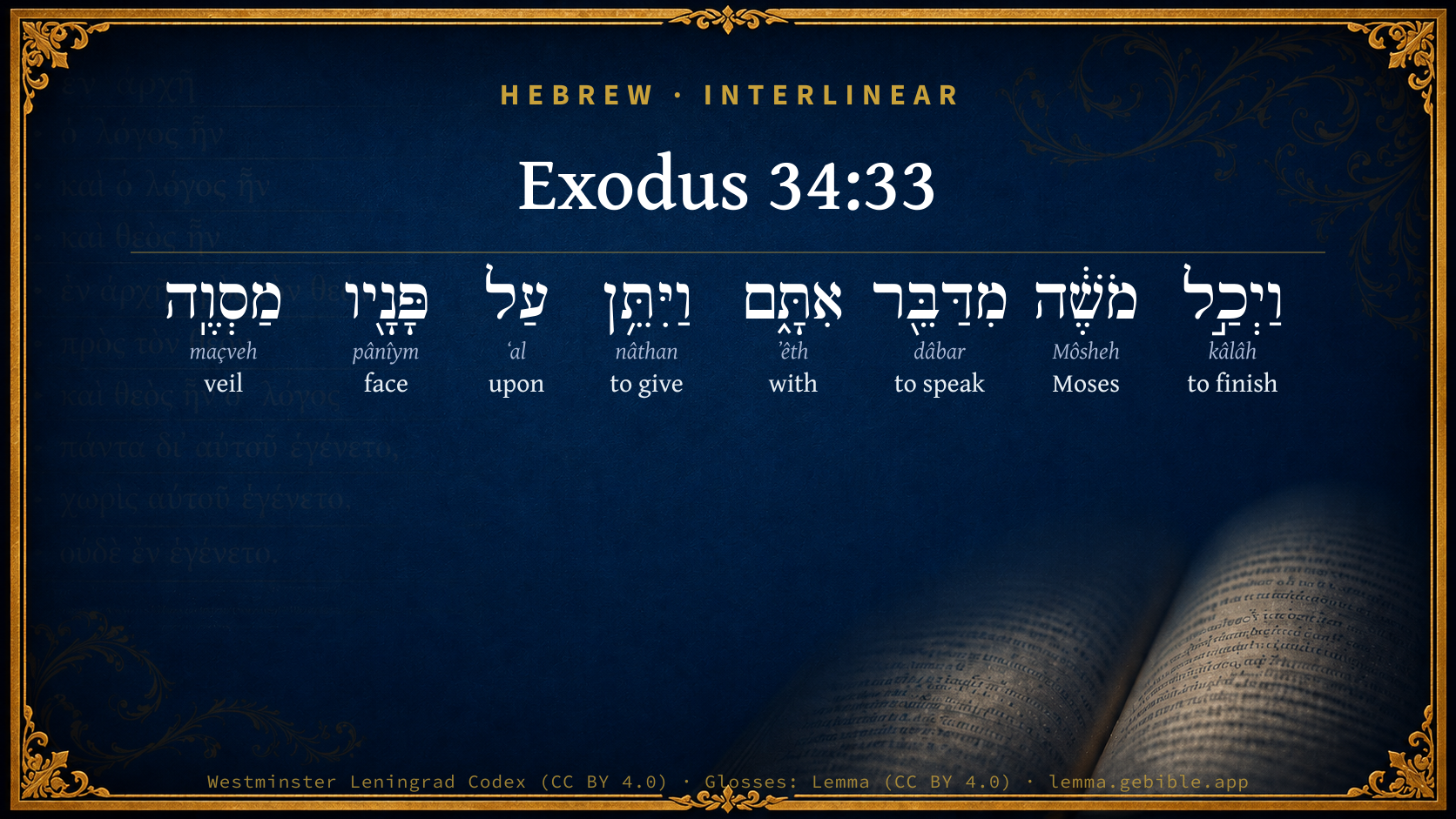
Exodus 34:33

Hebrew (Westminster Leningrad Codex) Exodus 34:33 appears in the Hebrew Old Testament. The text above is from the Westminster Leningrad Codex. Each word links to its Strong’s number, a concise gloss, and parsing drawn from the Open Scriptures Hebrew Bible morphology. Click any word for its full Brown-Driver-Briggs (BDB) entry.
Download image
Cite this verse

Exodus 34:33 (World English Bible). Public Domain. Lemma interlinear Bible study tool, https://lemma.gebible.app/v/exodus/34/33.

Show BibTeX & RIS
BibTeX
RIS
English Translation
When Moses was done speaking with them, he put a veil on his face.
World English Bible · Public Domain
Highlights
  • 1 first appearance in the Hebrew Bible
Full analysis ↓
Download a study sheet

One document with this verse’s original text, its word-by-word gloss line, the meaning frame, cross-references with their text, attributed commentary, and full source and license credits — printable, and it pastes into notes with its structure intact.

This verse Autodidact and up

Study sheet (.html) Plain text (.txt)

A passage Seminary Student

Up to 50 verses in one chapter. A passage sheet keeps up to 6 commentary sources and 12 cross-references per verse, in the order this page ranks them, and says so on the sheet whenever that leaves anything out. Ask for a single verse and you get the Autodidact verse sheet above.

Everything on this page stays free to read, with no account — the sheet is a download of what is already on screen, not access to it.

Want to remove ads? Support Godless Engineer
Compare translations 3

The same verse in 3 English versions, stacked beneath the original-language interlinear above. Click any original word for its lexicon entry.

Each is an independent rendering of the whole verse — the interlinear is not word-aligned to these translations.

Highlighted words mark where these versions differ — a whole-verse word diff, not a word-by-word alignment.

  • World English Bible Public Domain
    When Moses was done speaking with them, he put a veil on his face.
  • King James Version Public Domain
    And till Moses had done speaking with them, he put a vail on his face.
  • unfoldingWord Literal Text CC BY-SA 4.0
    And Moses finished from speaking with them, and he put a veil over his face.

unfoldingWord Literal Text — © unfoldingWord, licensed CC BY-SA 4.0. Word-aligned USFM3 via Door43 (git.door43.org/unfoldingWord/en_ult).

Versions to compare (up to 4)

3 of 4 selected

Show all 18 translations

Every available English version of this verse, each an independent rendering of the whole verse.

  • World English Bible Public Domain
    When Moses was done speaking with them, he put a veil on his face.
  • Berean Standard Bible Public Domain
    When Moses had finished speaking with them, he put a veil over his face.
  • Majority Standard Bible Public Domain
    When Moses had finished speaking with them, he put a veil over his face.
  • King James Version Public Domain
    And till Moses had done speaking with them, he put a vail on his face.
  • American Standard Version (1901) Public Domain
    And when Moses had done speaking with them, he put a veil on his face.
  • Revised Version (1885) Public Domain
    And when Moses had done speaking with them, he put a veil on his face.
  • Geneva Bible (1599) Public Domain
    So Moses made an end of comuning with them, and had put a couering vpon his face.
  • Douay-Rheims (1899) Public Domain
    And having done speaking, he put a veil upon his face.
  • Young's Literal Translation Public Domain
    And Moses finisheth speaking with them, and putteth on his face a vail;
  • Literal Standard Version CC BY-SA 4.0
    And Moses finishes speaking with them, and puts a veil on his face;
  • Unlocked Literal Bible CC BY-SA 4.0
    When Moses had finished speaking with them, he put a veil over his face.
  • unfoldingWord Literal Text CC BY-SA 4.0
    And Moses finished from speaking with them, and he put a veil over his face.
  • Darby Bible Public Domain
    And Moses ended speaking with them; and he had put on his face a veil.
  • World Messianic Bible Public Domain
    When Moses was done speaking with them, he put a veil on his face.
  • Webster's Bible Public Domain
    And till Moses had done speaking with them, he put a vail on his face.
  • Free Bible Version CC BY-SA 4.0
    After Moses finished talking with them, he put a veil over his face.
  • Bible in Basic English Public Domain
    And at the end of his talk with them, Moses put a veil over his face.
  • JPS Tanakh (1917) Public Domain
    And when Moses had done speaking with them, he put a veil on his face.

Literal Standard Version (2020), Covenant Press — licensed CC BY-SA 4.0. Text via the HelloAO Bible API (eBible.org). Unlocked Literal Bible (unfoldingWord) — licensed CC BY-SA 4.0. Text via the HelloAO Bible API (eBible.org). unfoldingWord Literal Text — © unfoldingWord, licensed CC BY-SA 4.0. Word-aligned USFM3 via Door43 (git.door43.org/unfoldingWord/en_ult). Free Bible Version, Dr. Jonathan Gallagher — licensed CC BY-SA 4.0. Text via the HelloAO Bible API (eBible.org).

Word by word

More ways to search: Search by grammar → Find every occurrence → Compare this word →

Practice this passage: Drill this verse → Learn its vocabulary →

About this verse

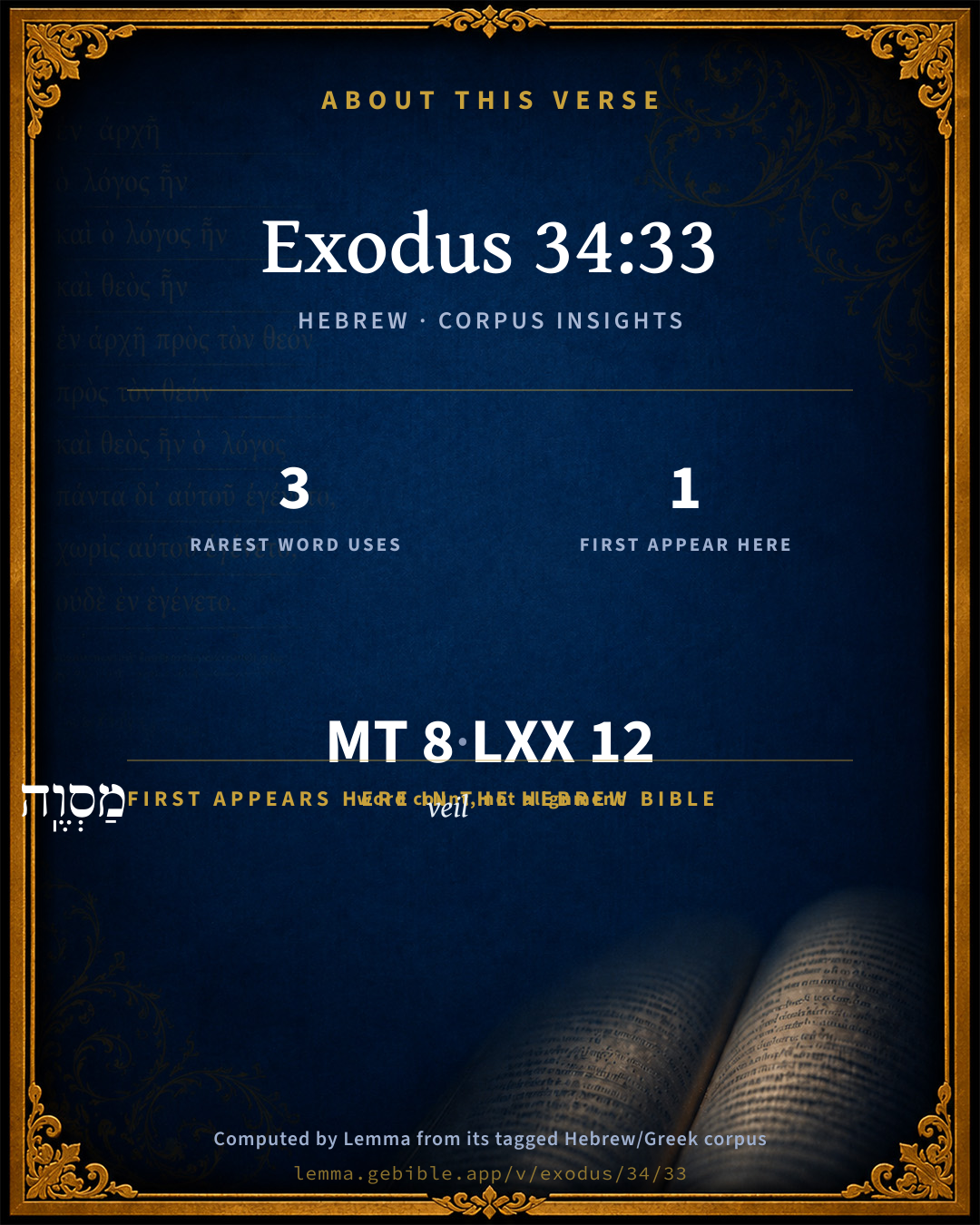
These counts appear in no published source. They are computed here, from the morphology-tagged text and Lemma’s own curated glosses. What Lemma adds →

8
words
8
distinct lemmas
Pentateuch
section

Notable vocabulary

The rarest word here is מַסְוֶֽה veil H4533 — appearing just 3 times in the whole Hebrew Bible.

First appearance in Scripture

This word makes its first canonical appearance in the Hebrew Bible here:

  • מַסְוֶֽה veil H4533

Shared distinctive vocabulary

מַסְוֶֽה veil H4533 occurs in 3 verses of the Hebrew Bible. Also found in:

Grammatical profile

  • 3 verbs
  • 3 nouns
  • 2 prepositions

Verb forms

  • וַיְכַ֣ל Piel · Sequential Imperfect
  • מִדַּבֵּ֖ר Piel · Infinitive Construct
  • וַיִּתֵּ֥ן Qal · Sequential Imperfect

Hebrew & Septuagint length

In English translation the verse runs 14 words from the Hebrew and 14 from the Septuagint (LXX English) — the same length.

A rough comparison of the two English renderings, which tokenize alike — not a word-level alignment.

Word counts can differ between the Hebrew and the Greek without any difference in meaning — e.g. the Hebrew direct-object marker אֵת has no separate Greek word, and Greek often adds the article ὁ.

In the original languages it is 8 Hebrew tokens and 12 Greek tokens — but the two are counted differently (Hebrew bundles its prefixes and suffixes into one token; the Greek is in lemma form), so that isn’t a like-for-like length.

Cross-references

3

Topical passages linked to Exodus 34:33 in the Treasury of Scripture Knowledge — connected by theme and wording, ordered by reader-vote popularity; previews shown in the World English Bible.

  • 2 Corinthians 4:4–6 in whom the god of this world has blinded the minds of the unbelieving, that the light of the Gospel of the glory of Christ, who is the image of God, should not dawn on them.
  • 2 Corinthians 3:13–18 and not as Moses, who put a veil on his face, that the children of Israel wouldn't look steadfastly on the end of that which was passing away.
  • Romans 10:4 For Christ is the fulfillment of the law for righteousness to everyone who believes.

Cross-references courtesy of OpenBible.info (CC BY 4.0).

Hebrew and Greek witnesses Masoretic Hebrew ↔ Greek Septuagint

The same verse in the two great witnesses to the Old Testament, shown verse-for-verse.

These are two independent witnesses, not word-aligned to each other, and the Septuagint is shown in lemma (dictionary) form.

Hebrew Exodus 34:33 Masoretic · Westminster Leningrad Codex

וַיְכַ֣ל מֹשֶׁ֔ה מִדַּבֵּ֖ר אִתָּ֑ם וַיִּתֵּ֥ן עַל פָּנָ֖יו מַסְוֶֽה

When Moses was done speaking with them, he put a veil on his face.

World English Bible · Public Domain

Greek LXX Exodus 34:33 Septuagint · lemma form

καί ἐπειδή καταπαύω λαλέω πρός αὐτός ἐπιτίθημι ἐπί ὁ πρόσωπον αὐτός κάλυμμα

And when he ceased speaking to them, he put a veil on his face.

LXX2012 (modern English Septuagint) · Public Domain

On this verse, The Pulpit Commentary discusses the Septuagint’s reading. Read the note in Commentary ↓

Hebrew: Westminster Leningrad Codex (CC BY 4.0). Greek: Septuagint (public domain); English from LXX2012 (modern English Septuagint) (Public Domain). How the Septuagint differs from the Hebrew →

Targum (Aramaic paraphrase)

2

The Targum is the ancient Jewish Aramaic paraphrase of the Hebrew Scriptures — an interpretive translation, not the Hebrew text itself. Onkelos (literal) and Pseudo-Jonathan (expansive) render the Torah, and Jonathan the Prophets. Coverage is partial: where no permissively-licensed English translation exists for a verse, only the Aramaic is shown. This is verse-level text, not a word-by-word alignment to the Hebrew.

  1. Targum Onkelos Torah (Genesis–Deuteronomy)
    וְשֵׁיצֵי משֶׁה מִלְמַלָלָא עִמְהוֹן וִיהַב עַל אַפּוֹהִי בֵּית אַפֵּי:

    (no public-domain English translation for this verse)

    Targum Onkelos — Aramaic: “Onkelos Genesis” (public domain); “Onkelos Exodus” (public domain); “Onkelos Leviticus” (public domain); “Onkelos Numbers” (public domain); “Onkelos Deuteronomy” (public domain). English: “Sefaria Community Translation” (CC0 1.0 (public-domain dedication)); “J.W. Etheridge. The Targums of Onkelos and Jonathan Ben Uzziel on the Pentateuch. London: Longmans, Green, 1862” (public domain). Text via Sefaria.

  2. Targum Pseudo-Jonathan Torah (Genesis–Deuteronomy)
    וּפְסַק משֶׁה מִן לְמַלָלָא עִמְהוֹן וִיהַב עַל אִיקוּנִין דְּבֵית אַנְפּוֹי סוּדָרָא

    And when Mosheh had finished to speak with them, he put over the form of his face a veil.

    Targum Pseudo-Jonathan — Aramaic: “Targum Jonathan on Genesis” (public domain); “Targum Jonathan on Exodus” (public domain); “Targum Jonathan on Leviticus” (public domain); “Targum Jonathan on Numbers” (public domain); “Targum Jonathan on Deuteronomy” (public domain). English: “The Targum of Jonathan ben Uzziel, trans. J. W. Etheridge, London, 1862” (public domain). Text via Sefaria.

Commentary

Notes on Exodus 34:33 from classic Christian and Jewish commentators (each source and its license shown beneath its notes). The classic Christian expositions comment on the surrounding passage and are grouped to its opening verse, so a note may address several verses; the Jewish commentaries on the Tanakh (Rashi and others) are per-verse, so they appear only where the commentator wrote on this verse.

Lemma curates 59 commentaries, every one of them public domain or Creative Commons licensed, each selected and text-cleaned for this edition rather than reprinted as found. About our sources →

Trapp's Complete Commentary

John Trapp

Exo 34:33 And [till] Moses had done speaking with them, he put a vail on his face.

Ver. 33. He put a vail on his face.] And had more glory by his vail than by his face. How far are those spirits from this Christian modesty, which care only to be seen and wish only to dazzle others’ eyes with admiration, not caring for unknown riches! This vail signifieth the law’s obscurity and our infidelity.

John Trapp, A Commentary or Exposition upon All the Books of the Old and New Testament (1647–1656) — public domain. Text from a community e-Sword module.

Albert Barnes' Notes on the Bible

Paul refers to this passage as showing forth the glory of the law, though it was but a “ministration of condemnation,” and was to be done away, in order to enhance the glory of the gospel, “the ministration of the spirit,” which is concealed by no veil from the eyes of believers, and is to last forever 2Co 3:7-15.

Exo 34:33

When rather than until should be supplied. Moses did not wear the veil when he was speaking to the people, but when he was silent. See Exo 34:35.

Exo 34:34

Moses went in - i. e. to the tent of meeting.

Albert Barnes' Notes on the Bible (1834–1885) — public domain. Text from a community e-Sword/MySword module.

Joseph Benson's Commentary

Exo 34:33. And Moses put a veil on his face — This veil signified the darkness of that dispensation; the ceremonial institutions had in them much of Christ and the gospel, but a veil was drawn over it, so that the children of Israel could not distinctly and steadfastly see those good things to come which the law had a shadow of. It was beauty veiled, gold in the mine, a pearl in the shell; but thanks be to God, by the gospel, the veil is taken away from off the Old Testament; yet still it remains upon the hearts of those who shut their eyes against the light.

Joseph Benson's Commentary on the Old and New Testaments (1811–1818) — public domain. Text from a community e-Sword module.

Tyndale Open Study Notes

Tyndale Open Resources

34:33 covered his face with a veil: While Moses was reporting what God had said to him, he left his face unveiled. Then he covered it, perhaps because of the fright (34:30) its radiance caused during ordinary discourse (see 2 Cor 3:7-18 for Paul’s reflection on this incident).

Tyndale Open Study Notes — © Tyndale Open Resources, licensed CC BY-SA 4.0. Text via the HelloAO Bible API.

Jamieson, Fausset & Brown

Robert Jamieson, A. R. Fausset & David Brown

he put a veil on his face--That veil was with the greatest propriety removed when speaking with the Lord, for every one appears unveiled to the eye of Omniscience; but it was replaced on returning to the people--and this was emblematic of the dark and shadowy character of that dispensation (Co2 3:13-14).

Next: Exodus Chapter 35

Jamieson, Fausset & Brown — Commentary Critical and Explanatory on the Whole Bible (1871) — public domain (CC PDM 1.0). Text via the HelloAO Bible API.

Adam Clarke's Commentary

Verse 33. And till Moses had done speaking] The meaning of the verse appears to be this: As often as Moses spoke in public to the people, he put the veil on his face, because they could not bear to look on the brightness of his countenance; but when he entered into the tabernacle to converse with the Lord, he removed this veil, Ex 34:34. St. Paul, 2Co 3:7, c., makes a very important use of the transactions recorded in this place. He represents the brightness of the face of Moses as emblematical of the glory or excellence of that dispensation but he shows that however glorious or excellent that was, it had no glory when compared with the superior excellence of the Gospel. As Moses was glorious in the eyes of the Israelites, but that glory was absorbed and lost in the splendour of God when he entered into the tabernacle, or went to meet the Lord upon the mount; so the brightness and excellence of the Mosaic dispensation are eclipsed and absorbed in the transcendent brightness or excellence of the Gospel of Christ. One was the shadow, the other is the substance. One showed SIN in its exceeding sinfulness, together with the justice and immaculate purity of God; but, in and of itself, made no provision for pardon or sanctification. The other exhibits Jesus, the Lamb of God, typified by all the sacrifices under the law, putting away sin by the sacrifice of himself, reconciling God to man and man to God, diffusing his Spirit through the souls of believers, and cleansing the very thoughts of their hearts by his inspiration, and causing them to perfect holiness in the fear of God. The one seems to shut heaven against mankind, because by the law was the knowledge, not the cure, of SIN; the other opens the kingdom of heaven to all believers. The former was a ministration of death, the latter a dispensation of life. The former ministered terror, so that even the high priest was afraid to approach, the people withdrew and stood afar off, and even Moses, the mediator of it, exceedingly feared and trembled; by the latter we have boldness to enter into the holiest through the blood of Jesus, who is the end of the law for righteousness - justification, to every one that believeth. The former gives a partial view of the Divine nature; the latter shows God as he is,

"Full orbed, in his whole round of rays complete."

The apostle farther considers the veil on the face of Moses, as being emblematical of the metaphorical nature of the different rites and ceremonies of the Mosaic dispensation, each covering some spiritual meaning or a spiritual subject; and that the Jews did not lift the veil to penetrate the spiritual sense, and did not look to the end of the commandment, which was to be abolished, but rested in the letter or literal meaning, which conferred neither light nor life.

He considers the veil also as being emblematical of that state of intellectual darkness into which the Jewish people, by their rejection of the Gospel, were plunged, and from which they have never yet been recovered. When a Jew, even at the present day, reads the law in the synagogue, he puts over his head an oblong woollen veil, with four tassels at the four corners, which is called the taled or thaled. This is a very remarkable circumstance, as it appears to be an emblem of the intellectual veil referred to by the apostle, which is still upon their hearts when Moses is read, and which prevents them from looking to the end of that which God designed should be abrogated, and which has been abolished by the introduction of the Gospel. The veil is upon their hearts, and prevents the light of the glory of God from shining into them; but we all, says the apostle, speaking of believers in Christ, with open face, without any veil, beholding as in a glass the glory of God, are changed into the same image, from glory to glory, as by the Spirit of the Lord; 2Co 3:18. Reader, dost thou know this excellence of the religion of Christ? Once thou wert darkness; art thou now light in the Lord? Art thou still under the letter that killeth, or under the Spirit that giveth life? Art thou a slave to sin or a servant of Christ? Is the veil on thy heart, or hast thou found redemption in his blood, the remission of sins? Knowest thou not these things? Then may God pity, enlighten, and save thee!

Adam Clarke's Commentary on the Bible (1810–1826) — public domain. Text from a community e-Sword/MySword module.

Ellicott's Commentary for English Readers

(33) Till Moses had done speaking with them, he put a vail on his face.—This translation exactly inverts the meaning, which is that “when Moses had done speaking with them, he put a vail on his face.” The vail became part of his ordinary costume, and was worn excepting upon occasions of two kinds: (1) When Moses was alone with God, either in the temporary “tent of meeting” or in the permanent Tabernacle, he ceased to wear the vail, and spoke with God face to face; (2) when he had a message to the people from God, and spoke to them as God’s representative, he authenticated his message by uncovering himself, and allowing the glory of his face to be seen. Otherwise, in his ordinary dealings with the people he went about veiled.

A Bible Commentary for English Readers, edited by Charles John Ellicott (1878–1897) — public domain. Text from a community e-Sword module.

The Cambridge Bible for Schools and Colleges

gen. ed. J. J. S. Perowne

33. a veil] The Heb. word (masweh) occurs only here and vv. 34, 35.

33–35. The glow alarmed the Israelites: Moses, therefore, put a veil on his face, which he wore ever afterwards, except when he went in to speak with God, or while he was communicating to the people the Divine message which he had received: in ordinary life the reflexion of the Divine glory upon his face was thus hidden from the people.

The Cambridge Bible for Schools and Colleges (gen. ed. J. J. S. Perowne; Cambridge University Press, 1878–1918) — public domain. Text from a community e-Sword module.

Haydock's Catholic Bible Commentary

And having, &c. At first, he spoke uncovered. (Menochius) --- The Protestants insert the word till in Italics, to insinuate that Moses spoke with a veil on, as St. Paul mentions; (Haydock) and Calmet would translate, "for Moses had ceased to address the people, and had put a veil upon his face," as soon as he perceived that they could not bear the blaze of his countenance. This he did out of modesty, that they might not be afraid of coming to speak freely to him, (Jansenius) though it was also mysterious, as St. Paul remarks. For even until this day, when Moses is read, the veil is upon their heart, (2 Corinthians iii. 15,) as it is upon that of heretics, who cannot see the church. (St. Augustine in Psalm xxx.) (Worthington)

George Leo Haydock (1774–1849), Haydock's Catholic Family Bible and Commentary, 1859 edition — public domain. Excludes Psalms (Douay-Rheims chapter numbering differs from Protestant) and Deuterocanonical books (Catholic canon only).

Matthew Poole's English Annotations

In condescension to their weakness

Matthew Poole's English Annotations on the Holy Bible (1683–1685) — public domain. Text from a community e-Sword/MySword module.

Whedon's Commentary on the Bible

Daniel D. Whedon

33. Till Moses had done — Rather, when he had done speaking, etc. Literally, And Moses ceased from speaking with them, and put upon his face a vail. So the vail was not worn while he was speaking, but when he left off speaking, and until he went into the tabernacle. Exo_34:34-35. “The brilliant light on Moses’s face,” says Keil, “set forth the glory of the old covenant, and was intended both for Moses and the people as a foresight and a pledge of the glory to which Jehovah had called, and would eventually exalt, the people of his possession.”

Daniel D. Whedon (gen. ed.), Commentary on the Old and New Testaments (1874–1909) — public domain. Text from a community e-Sword module.

The Pulpit Commentary

Till Moses had done speaking with them. The Hebrew text will not bear this rendering. All the ancient versions (LXX Vulg. Syr. etc.) and the Targums agree that the meaning is Moses had done speaking, he put a veil on his face." And this agrees with the plain meaning of vers. 34 and 35, which are to be taken connectedly. Moses first delivered his message with face unveiled, then he veiled himself, and thenceforth he wore a veil at all times except when he sought the Divine presence in the "tent of meeting" or the tabernacle, and when he delivered to the people any message sent them from God by him. He wore the veil ordinarily to prevent them from being dazzled. He took it off when he entered the tabernacle, that the Divine presence might shine fully on him and renew his strength. He kept it off when he returned, if he had any message to the people, until he had delivered it, in order the more fully to authenticate the message and shew to the people that it was from God. Then the children of Israel saw the face of Moses, that the skin of Moses" face shone (ver. 35). Having discharged himself of the message intrusted to him, he once more covered himself, and continued veiled until he again entered the tabernacle. The only objection that can be taken to this exegesis is derived from 2Co_3:7-16, which has been thought to imply that Moses wore the veil whenever he was in the sight of the people. But the passage does not really assert any such thing. It is quite enough for the argument, that under the old covenant a veil had been worn to conceal some of its glory. This concealment St. Paul contrasts with the openness of Christianity (vers. 13, 18); while at the same time he argues that it may be viewed as typical of that blindness and darkness which was characteristic of the Jewish nation of his day.

Vers. 33-35. The symbolism of the veil.

The veil upon Moses" face shrouded the glory of his countenance from Israel, except at such times as he spake to them the commands of God. So God himself shrouds his glory from us ordinarily, and only at rare intervals, when he would impress us most deeply, lifts the veil and lets the brightness flash forth. So Christ, when he came on earth, emptied himself of the glory which he had with the Father, hid it away, and seldom let it be seen. Tenderness and compassion for man"s weakness is the cause of the concealment in such case. Human nature, while we are in the flesh, cannot bear the blinding light of Divine glory, any more than the eye can bear to gaze upon the noonday sun. The veil was thus, primarily, a token of Moses" love for Israel; but it was also a token of many other things besides; e.g.

I OF THE DARKNESS AND MYSTERY IN WHICH DIVINE TRUTH WAS SHROUDED UNDER THE MOSAICAL DISPENSATION. The Trinity, the Incarnation, the Atonement, Justification, Sanctification, even Immortality all the great doctrines which constitute the heart and kernel of true religion, though in a certain sense contained in Mosaism, were concealed, hidden away, wrapt in a veil. Men "saw through a glass darkly" fewer or more of these truths had, that is, some dim conception of them, but saw none of them clearly till they were "brought to light" by the Gospel. "Lord, now lettest thou thy servant depart in peace, according to thy word, for mine eyes have seen thy salvation," said holy Simeon, when he looked upon the Lord, then first having made plain to him what had been darkness and cloud previously. Much of the Divine scheme of mail"s salvation had been a mystery even to angels until it was revealed to them by and through the Church. (Eph_3:4-10) When Christ came, and lived, and preached, "the people which sat in darkness saw great light, and to them which sat in the region and shadow of death light sprang up". (Mat_4:16) A solemn thought to Christians that this is so; for responsibility is in proportion to the light vouchsafed. "He that despised Moses" law died without mercy under two or three witnesses. Of how much sorer punishment shall he be thought worthy who hath trodden under foot the Son of God?". (Heb_10:28, Heb_10:29)

II OF THE BLINDNESS WHICH LIES PERMANENTLY UPON THE HEARTS AND MINDS OF THE JEWS. The veil of obstinate unbelief has so shrouded, and still so shrouds, the intelligence of the race, that, though Moses is read to them every Sabbath day, and the words of the prophets are continually sounded in their ears, they cannot see or understand. Still they remain "fools and slow of heart to believe all that the prophets have spoken". (Luk_24:25) Like the Ethiopian eunuch, they "understand not what they read"; (Act_8:31) but, unlike him, they will not accept guidance. "The veil is upon their heart". (2Co_3:15) Christians should ever pray that the time may come, and come speedily, when "the veil shall be taken away" (ib, 16), and so "all Israel be saved". (Rom_11:26) Hopeless as the task seems, Christians should still labour for the conversion of the eight millions of Jews dispersed throughout the world. Christians should beware lest they themselves, by their sinful lives, intensify and prolong the blindness of Israel, pressing the veil down upon the brows that otherwise might have cast it off, and dimming the brightness of the Gospel of Christ that otherwise might have pierced through the veil"s folds, and have given sight to the shrouded eyes.

The Pulpit Commentary (1880–1919), ed. H.D.M. Spence-Jones & Joseph S. Exell — public domain. Text from a community e-Sword module.

John Wesley's Explanatory Notes

And Moses put a veil upon his face - This veil signified the darkness of that dispensation; the ceremonial institutions had in them much of Christ and the gospel, but a veil was drawn over it, so that the children of Israel could not distinctly and steadfastly see those good things to come which the law had a shadow of. It was beauty veiled, gold in the mine, a pearl in the shell; but thanks be to God, by the gospel, the veil is taken away from off the old testament; yet still it remains upon the hearts of those who shut their eyes against the light.

John Wesley, Explanatory Notes Upon the Whole Bible (1754–1765) — public domain. Text via the GEBible commentary corpus.

Rashi

Rabbi Shlomo Yitzchaki (Rashi)

ויתן על פניו מסוה AND HE PUT A VEIL ON HIS FACE — Render it (מסוה) as the Targum does: בית אפי, a cover for his face. מסוה is an Aramaic expression (from the root סוי, “to look”). It occurs in the Talmud (Ketubot 62b) “her heart perceived (סּוי), and again in Ketubot 60a “הוה קא מסוה לאפה”, where מסוה is an expression for looking: “he looked into her face”, i. e. he gazed at her. Here, too, מסוה denotes a cloth that was put in front of the face and of the region of the eyes. And out of reverence for the “rays of glory” — that not everybody should feast himself on them — Moses used to put the veil in front of them (the eyes), but took it off during the time when he spoke to Israel, and during the time when the Omnipresent conversed with him until the moment when he was going out and also when he went out he went out without the veil.

Rashi on the Tanakh — English translations: “The Judaica Press complete Tanach with Rashi, translated by A. J. Rosenberg” (CC BY 4.0); “Pentateuch with Rashi's commentary by M. Rosenbaum and A.M. Silbermann, 1929-1934” (public domain); “The Metsudah Tanach series, Lakewood, N.J” (CC BY 4.0); and “The Book of Joshua, Metsudah Publications, 1997” (CC BY 4.0). Text via Sefaria.

Sforno

Rabbi Ovadia Sforno

When Moshe finished speaking. All the while that he spoke he left his face uncovered, in keeping with the verse, “Your eyes shall behold your teacher” (Yeshayahu 30:20), and in the spirit of Rabbi Yehudah HaNasi’s dictum, “Had I beheld [Rabbi Meir] from the front I would have been even sharper”.

Sforno on the Tanakh — English translation: “Yalkut, Sifsei Chachomim Chumash, Metsudah Publications, 2009” (CC BY 4.0). Text via Sefaria.

Lesson kit

Teaching starters — assembled from the data on this page, not authored interpretation. Every prompt links to the verse data it draws on. Edit before teaching.

Exodus, in the Pentateuch, opens this verse with 8 words (8 distinct Hebrew lemmas). Its most distinctive word is maçveh (“veil”). A historical commentator’s framing appears above. Read the whole chapter for the surrounding context.

Discussion questions

  1. How does “veil” (maçveh) shape what this verse is saying?
  2. This is the first place “veil” appears in Scripture (first appears here). What does its debut here establish?
  3. How does Exodus 34:34, which shares the word «veil», read alongside this verse?
  4. The translations on this page render this verse differently — a whole-verse word diff, not a word-by-word alignment. What might account for the different wordings?
  5. «וַיְכַ֣ל» is a Piel Sequential Imperfect verb. How does that grammatical form shape the action described?
  6. Compare how Trapp's Complete Commentary and Albert Barnes' Notes on the Bible read this verse. Where do they agree or differ?

Things to notice

Reading settings

Reading text

Shown beneath each verse's original-language words.

Old Testament
Old Testament edition

Read the OT as the Masoretic Hebrew (MT) or the Greek Septuagint (LXX).

English shown for the Greek Septuagint (in the Hebrew ↔ Greek comparison).

Comparing translations? Open the Compare panel on any verse page to stack up to four side by side.