
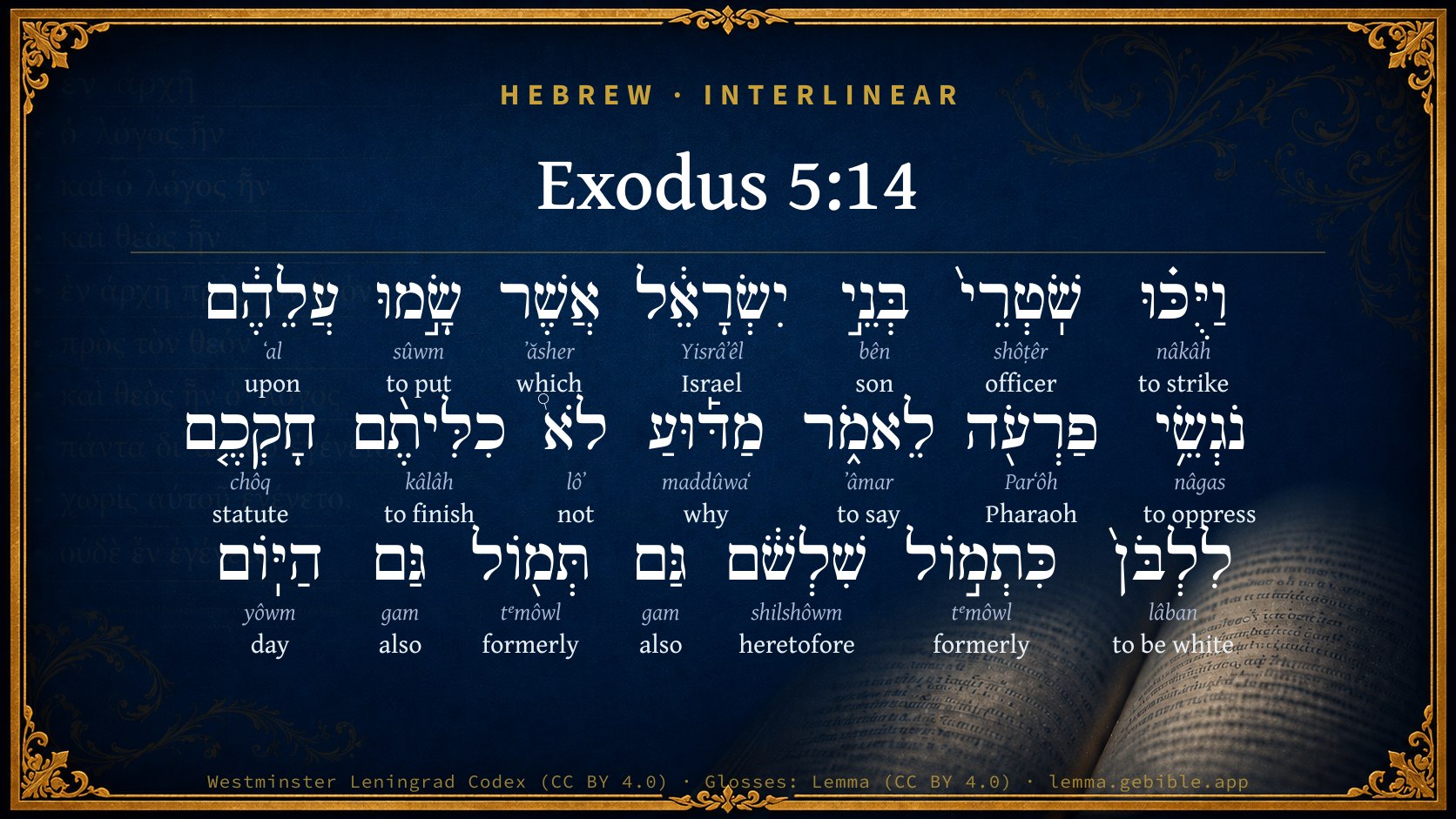
Exodus 5:14

Hebrew (Westminster Leningrad Codex) Exodus 5:14 appears in the Hebrew Old Testament. The text above is from the Westminster Leningrad Codex. Each word links to its Strong’s number, a concise gloss, and parsing drawn from the Open Scriptures Hebrew Bible morphology. Click any word for its full Brown-Driver-Briggs (BDB) entry.
Download image
Cite this verse

Exodus 5:14 (World English Bible). Public Domain. Lemma interlinear Bible study tool, https://lemma.gebible.app/v/exodus/5/14.

Show BibTeX & RIS
BibTeX
RIS
English Translation
The officers of the children of Israel, whom Pharaoh's taskmasters had set over them, were beaten, and demanded, "Why haven't you fulfilled your quota both yesterday and today, in making brick as before?"
World English Bible · Public Domain
Download a study sheet

One document with this verse’s original text, its word-by-word gloss line, the meaning frame, cross-references with their text, attributed commentary, and full source and license credits — printable, and it pastes into notes with its structure intact.

This verse Autodidact and up

Study sheet (.html) Plain text (.txt)

A passage Seminary Student

Up to 50 verses in one chapter. A passage sheet keeps up to 6 commentary sources and 12 cross-references per verse, in the order this page ranks them, and says so on the sheet whenever that leaves anything out. Ask for a single verse and you get the Autodidact verse sheet above.

Everything on this page stays free to read, with no account — the sheet is a download of what is already on screen, not access to it.

Want to remove ads? Support Godless Engineer
Compare translations 3

The same verse in 3 English versions, stacked beneath the original-language interlinear above. Click any original word for its lexicon entry.

Each is an independent rendering of the whole verse — the interlinear is not word-aligned to these translations.

Highlighted words mark where these versions differ — a whole-verse word diff, not a word-by-word alignment.

  • World English Bible Public Domain
    The officers of the children of Israel, whom Pharaoh's taskmasters had set over them, were beaten, and demanded, "Why haven't you fulfilled your quota both yesterday and today, in making brick as before?"
  • King James Version Public Domain
    And the officers of the children of Israel, which Pharaoh's taskmasters had set over them, were beaten, and demanded, Wherefore have ye not fulfilled your task in making brick both yesterday and to day, as heretofore?
  • unfoldingWord Literal Text CC BY-SA 4.0
    And the officers of the sons of Israel, whom the taskmasters of Pharaoh had put over them, were beaten, saying, “Why have you not finished your required brick making like yesterday and the day before yesterday, neither yesterday nor today?”

unfoldingWord Literal Text — © unfoldingWord, licensed CC BY-SA 4.0. Word-aligned USFM3 via Door43 (git.door43.org/unfoldingWord/en_ult).

Versions to compare (up to 4)

3 of 4 selected

Show all 18 translations

Every available English version of this verse, each an independent rendering of the whole verse.

  • World English Bible Public Domain
    The officers of the children of Israel, whom Pharaoh's taskmasters had set over them, were beaten, and demanded, "Why haven't you fulfilled your quota both yesterday and today, in making brick as before?"
  • Berean Standard Bible Public Domain
    Then the Israelite foremen, whom Pharaoh’s taskmasters had set over the people, were beaten and asked, “Why have you not fulfilled your quota of bricks yesterday or today, as you did before?”
  • Majority Standard Bible Public Domain
    Then the Israelite foremen, whom Pharaoh’s taskmasters had set over the people, were beaten and asked, “Why have you not fulfilled your quota of bricks yesterday or today, as you did before?”
  • King James Version Public Domain
    And the officers of the children of Israel, which Pharaoh's taskmasters had set over them, were beaten, and demanded, Wherefore have ye not fulfilled your task in making brick both yesterday and to day, as heretofore?
  • American Standard Version (1901) Public Domain
    And the officers of the children of Israel, whom Pharaoh's taskmasters had set over them, were beaten, and demanded, Wherefore have ye not fulfilled your task both yesterday and to-day, in making brick as heretofore?
  • Revised Version (1885) Public Domain
    And the officers of the children of Israel, which Pharaoh’s taskmasters had set over them, were beaten, and demanded, Wherefore have ye not fulfilled your task both yesterday and today, in making brick as heretofore?
  • Geneva Bible (1599) Public Domain
    And the officers of the children of Israel, which Pharaohs taskemasters had set ouer them, were beaten, and demanded, Wherefore haue ye not fulfilled your taske in making bricke yesterday and to daye, as in times past?
  • Douay-Rheims (1899) Public Domain
    And they that were over the works of the children of Israel were scourged by Pharao's taskmasters, saying: Why have you not made up the task of bricks both yesterday and to day as before?
  • Young's Literal Translation Public Domain
    And the authorities of the sons of Israel, whom the exactors of Pharaoh have placed over them, are beaten, saying, `Wherefore have ye not completed your portion in making brick as heretofore, both yesterday and to-day?'
  • Literal Standard Version CC BY-SA 4.0
    And the authorities of the sons of Israel, whom the exactors of Pharaoh have placed over them, are beaten, saying, “Why have you not completed your portion in making brick as before, both yesterday and today?”
  • Unlocked Literal Bible CC BY-SA 4.0
    Pharaoh's taskmasters beat the Israelite foremen, those same men whom they had put in charge of the workers. The taskmasters kept asking them, “Why have you not produced all the bricks required of you, either yesterday and today, as you used to do in the past?”
  • unfoldingWord Literal Text CC BY-SA 4.0
    And the officers of the sons of Israel, whom the taskmasters of Pharaoh had put over them, were beaten, saying, “Why have you not finished your required brick making like yesterday and the day before yesterday, neither yesterday nor today?”
  • Darby Bible Public Domain
    And the officers of the children of Israel, whom Pharaoh's taskmasters had set over them, were beaten, [and] it was said, Why have ye not fulfilled your task in making brick, both yesterday and to-day, as heretofore?
  • World Messianic Bible Public Domain
    The officers of the children of Israel, whom Pharaoh’s taskmasters had set over them, were beaten, and were asked, “Why haven’t you fulfilled your quota both yesterday and today, in making brick as before?”
  • Webster's Bible Public Domain
    And the officers of the children of Israel, which Pharaoh's task-masters had set over them, were beaten, and demanded, Why have ye not fulfilled your task in making brick, both yesterday and to-day, as heretofore?
  • Free Bible Version CC BY-SA 4.0
    They beat the Israelite supervisors they had put in charge, shouting at them, “Why haven't you met your quota of bricks as you did before?”
  • Bible in Basic English Public Domain
    And the responsible men of the children of Israel, whom Pharaoh's overseers had put over them, were given blows, and they said to them, Why have you not done your regular work, in making bricks as before?
  • JPS Tanakh (1917) Public Domain
    And the officers of the children of Israel, whom Pharaoh's taskmasters had set over them, were beaten, saying: 'Wherefore have ye not fulfilled your appointed task in making brick both yesterday and today as heretofore?'

Literal Standard Version (2020), Covenant Press — licensed CC BY-SA 4.0. Text via the HelloAO Bible API (eBible.org). Unlocked Literal Bible (unfoldingWord) — licensed CC BY-SA 4.0. Text via the HelloAO Bible API (eBible.org). unfoldingWord Literal Text — © unfoldingWord, licensed CC BY-SA 4.0. Word-aligned USFM3 via Door43 (git.door43.org/unfoldingWord/en_ult). Free Bible Version, Dr. Jonathan Gallagher — licensed CC BY-SA 4.0. Text via the HelloAO Bible API (eBible.org).

Word by word

More ways to search: Search by grammar → Find every occurrence → Compare this word →

Practice this passage: Drill this verse → Learn its vocabulary →

לִלְבֹּן֙
lâban
H3835
“to be white”
Preposition + Verb, Qal, Infinitive Construct
Part of Speech
Preposition + Verb
Stem
Qal
Form
Infinitive Construct
Full BDB Definition

Origin: a primitive root

TWOT: 1074b , 1074h

to be white - (Hiphil) - to make white, become white, purify - to show whiteness, grow white - (Hithpael) to become white, be purified (ethical) - (Qal) to make bricks
  1. וַיֻּכּ֗וּ nâkâh H5221 “and · to strike” Conjunction + Verb, Hophal, Sequential Imperfect, 3rd Person, Masculine, Plural
  2. שֹֽׁטְרֵי֙ shôṭêr H7860 “officer” Verb, Qal, Participle Active, Masculine, Plural, Construct
  3. בְּנֵ֣י bên H1121 “sons of” Noun, Common, Masculine, Plural, Construct
  4. יִשְׂרָאֵ֔ל Yisrâʼêl H3478 “Israel” Noun, Proper
  5. אֲשֶׁר ʼăsher H834 “which” Particle, Relative
  6. שָׂ֣מוּ sûwm H7760 “to put” Verb, Qal, Perfect, 3rd Person, Common, Plural
  7. עֲלֵהֶ֔ם ʻal H5921 “upon · them” Preposition + Suffix, Personal, 3rd Person, Masculine, Plural
  8. נֹגְשֵׂ֥י nâgas H5065 “oppressing” Verb, Qal, Participle Active, Masculine, Plural, Construct
  9. פַרְעֹ֖ה Parʻôh H6547 “Pharaoh” Noun, Proper
  10. לֵאמֹ֑ר ʼâmar H559 “to say” Preposition + Verb, Qal, Infinitive Construct
  11. מַדּ֡וּעַ maddûwaʻ H4069 “why” Particle, Interrogative
  12. לֹא֩ lôʼ H3808 “not” Particle, Negative
  13. כִלִּיתֶ֨ם kâlâh H3615 “to finish” Verb, Piel, Perfect, 2nd Person, Masculine, Plural
  14. חָקְכֶ֤ם chôq H2706 “statute · your” Noun, Common, Masculine, Singular, Construct + Suffix, Personal, 2nd Person, Masculine, Plural
  15. כִּתְמ֣וֹל tᵉmôwl H8543 “like/as · formerly” Preposition + Adverb
  16. שִׁלְשֹׁ֔ם shilshôwm H8032 “heretofore” Adverb
  17. גַּם gam H1571 “also” Particle, Accusative
  18. תְּמ֖וֹל tᵉmôwl H8543 “formerly” Adverb
  19. גַּם gam H1571 “also” Particle, Accusative
  20. הַיּֽוֹם yôwm H3117 “the · day” Particle, Definite Article + Noun, Common, Masculine, Singular, Absolute

About this verse

These counts appear in no published source. They are computed here, from the morphology-tagged text and Lemma’s own curated glosses. What Lemma adds →

21
words
19
distinct lemmas
Pentateuch
section

Notable vocabulary

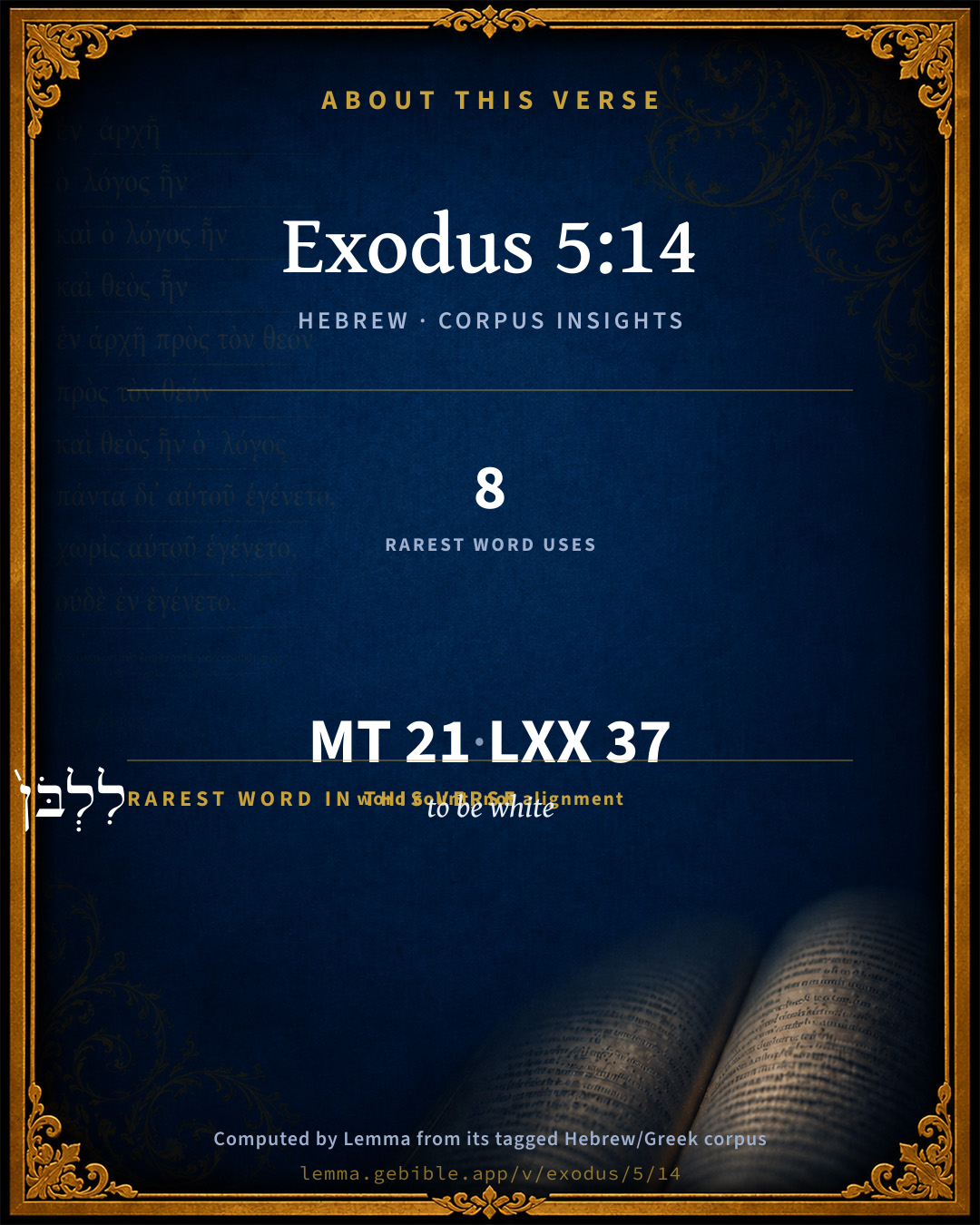
The rarest word here is לִלְבֹּן֙ to be white H3835 — appearing just 8 times in the whole Hebrew Bible.

Shared distinctive vocabulary

לִלְבֹּן֙ to be white H3835 occurs in 8 verses of the Hebrew Bible. Also found in:

Grammatical profile

  • 7 verbs
  • 5 nouns
  • 1 preposition
  • 3 adverbs
  • 5 particles

Verb forms

  • וַיֻּכּ֗וּ Hophal · Sequential Imperfect
  • שֹֽׁטְרֵי֙ Qal · Participle Active
  • שָׂ֣מוּ Qal · Perfect
  • נֹגְשֵׂ֥י Qal · Participle Active
  • לֵאמֹ֑ר Qal · Infinitive Construct
  • כִלִּיתֶ֨ם Piel · Perfect
  • לִלְבֹּן֙ Qal · Infinitive Construct

Repetition

Words recur within this verse — often emphatic in Hebrew:

  • כִּתְמ֣וֹל formerly H8543 ×2
  • גַּם also H1571 ×2

Hebrew & Septuagint length

In English translation the verse runs 33 words from the Hebrew and 45 from the Septuagint (LXX English) — closely comparable.

A rough comparison of the two English renderings, which tokenize alike — not a word-level alignment.

Word counts can differ between the Hebrew and the Greek without any difference in meaning — e.g. the Hebrew direct-object marker אֵת has no separate Greek word, and Greek often adds the article ὁ.

In the original languages it is 21 Hebrew tokens and 37 Greek tokens — but the two are counted differently (Hebrew bundles its prefixes and suffixes into one token; the Greek is in lemma form), so that isn’t a like-for-like length.

Cross-references

1

Topical passages linked to Exodus 5:14 in the Treasury of Scripture Knowledge — connected by theme and wording, ordered by reader-vote popularity; previews shown in the World English Bible.

  • Isaiah 10:24 Therefore thus says the Lord, Yahweh of Hosts, my people who dwell in Zion, don't be afraid of the Assyrian, though he strike you with the rod, and lift up his staff against you, after the manner of Egypt.

Cross-references courtesy of OpenBible.info (CC BY 4.0).

Hebrew and Greek witnesses Masoretic Hebrew ↔ Greek Septuagint

The same verse in the two great witnesses to the Old Testament, shown verse-for-verse.

These are two independent witnesses, not word-aligned to each other, and the Septuagint is shown in lemma (dictionary) form.

Hebrew Exodus 5:14 Masoretic · Westminster Leningrad Codex

וַיֻּכּ֗וּ שֹֽׁטְרֵי֙ בְּנֵ֣י יִשְׂרָאֵ֔ל אֲשֶׁר שָׂ֣מוּ עֲלֵהֶ֔ם נֹגְשֵׂ֥י פַרְעֹ֖ה לֵאמֹ֑ר מַדּ֡וּעַ לֹא֩ כִלִּיתֶ֨ם חָקְכֶ֤ם לִלְבֹּן֙ כִּתְמ֣וֹל שִׁלְשֹׁ֔ם גַּם תְּמ֖וֹל גַּם הַיּֽוֹם

The officers of the children of Israel, whom Pharaoh's taskmasters had set over them, were beaten, and demanded, "Why haven't you fulfilled your quota both yesterday and today, in making brick as before?"

World English Bible · Public Domain

Greek LXX Exodus 5:14 Septuagint · lemma form

καί μαστιγόω ὁ γραμματεύς ὁ γένος ὁ υἱός ἰσραήλ ὁ καταἵστημι ἐπί αὐτός ὑπό ὁ ἐπιστάτης ὁ φαραώ λέγω διά τίς οὐ συντελέω ὁ σύνταξις σύ ὁ πλινθεία καθάπερ χθές καί τρίτος ἡμέρα καί ὁ ὁ σήμερον

And the accountants of the race of the children of Israel, who were set over them by the masters of Pharao, were scourged, [and questioned,] men saying, Why have you⌃ not fulfilled your rates of brick work as yesterday and the third day, today also?

LXX2012 (modern English Septuagint) · Public Domain

Hebrew: Westminster Leningrad Codex (CC BY 4.0). Greek: Septuagint (public domain); English from LXX2012 (modern English Septuagint) (Public Domain). How the Septuagint differs from the Hebrew →

Targum (Aramaic paraphrase)

2

The Targum is the ancient Jewish Aramaic paraphrase of the Hebrew Scriptures — an interpretive translation, not the Hebrew text itself. Onkelos (literal) and Pseudo-Jonathan (expansive) render the Torah, and Jonathan the Prophets. Coverage is partial: where no permissively-licensed English translation exists for a verse, only the Aramaic is shown. This is verse-level text, not a word-by-word alignment to the Hebrew.

  1. Targum Onkelos Torah (Genesis–Deuteronomy)
    וּלְקוֹ סָרְכֵי בְּנֵי יִשְׂרָאֵל דִי מַנִיאוּ עֲלֵיהוֹן שִׁלְטוֹנֵי פַרְעֹה לְמֵימָר מָא דֵין לָא אַשְׁלֶמְתּוּן גְזֵרָתְכוֹן לְמִרְמֵי (לִבְנִין) כְּמֵאִתְמַלֵי וּמִדְקָמוֹהִי אַף תְּמַלֵי אַף יוֹמָא דֵין:

    (no public-domain English translation for this verse)

    Targum Onkelos — Aramaic: “Onkelos Genesis” (public domain); “Onkelos Exodus” (public domain); “Onkelos Leviticus” (public domain); “Onkelos Numbers” (public domain); “Onkelos Deuteronomy” (public domain). English: “Sefaria Community Translation” (CC0 1.0 (public-domain dedication)); “J.W. Etheridge. The Targums of Onkelos and Jonathan Ben Uzziel on the Pentateuch. London: Longmans, Green, 1862” (public domain). Text via Sefaria.

  2. Targum Pseudo-Jonathan Torah (Genesis–Deuteronomy)
    וְלָקוּ סַרְכֵי בְּנֵי יִשְרָאֵל דְמַנוּ עֲלֵיהוֹן שׁוּלְטָנֵי פַרְעה לְמֵימָר לְמָא דֵין לָא אַשְׁלַמְתּוּן גְזֵירַתְכוֹן לְמִירְמֵי לִבְנִין הֵי כְמֵאִיתְמְלֵי וְהֵי כְמִדְקָדָמוֹי אוּף אִיתְמְלֵי אוּף יוֹמָא דֵין

    And the exactors whom Pharoh set over them as officers beat the sons of Israel, saying, Why have not you fulfilled your appointment, to cast (the same number of) bricks as heretofore, today as yesterday?

    Targum Pseudo-Jonathan — Aramaic: “Targum Jonathan on Genesis” (public domain); “Targum Jonathan on Exodus” (public domain); “Targum Jonathan on Leviticus” (public domain); “Targum Jonathan on Numbers” (public domain); “Targum Jonathan on Deuteronomy” (public domain). English: “The Targum of Jonathan ben Uzziel, trans. J. W. Etheridge, London, 1862” (public domain). Text via Sefaria.

Commentary

Notes on Exodus 5:14 from classic Christian and Jewish commentators (each source and its license shown beneath its notes). The classic Christian expositions comment on the surrounding passage and are grouped to its opening verse, so a note may address several verses; the Jewish commentaries on the Tanakh (Rashi and others) are per-verse, so they appear only where the commentator wrote on this verse.

Lemma curates 59 commentaries, every one of them public domain or Creative Commons licensed, each selected and text-cleaned for this edition rather than reprinted as found. About our sources →

Trapp's Complete Commentary

John Trapp

Exo 5:14 And the officers of the children of Israel, which Pharaoh’s taskmasters had set over them, were beaten, [and] demanded, Wherefore have ye not fulfilled your task in making brick both yesterday and to day, as heretofore?

Ver. 14. Were beaten.] It is the misery of those that are trusted with authority that their inferiors’ faults are beaten upon their backs.

John Trapp, A Commentary or Exposition upon All the Books of the Old and New Testament (1647–1656) — public domain. Text from a community e-Sword module.

Adam Clarke's Commentary

Verse 14. And the officers - were beaten] Probably bastinadoed; for this is the common punishment in Egypt to the present day for minor offences. The manner of it is this: the culprit lies on his belly, his legs being turned up behind erect, and the executioner gives him so many blows on the soles of the feet with a stick. This is a very severe punishment, the sufferer not being able to walk for many weeks after, and some are lamed by it through the whole of their lives.

Adam Clarke's Commentary on the Bible (1810–1826) — public domain. Text from a community e-Sword/MySword module.

Ellicott's Commentary for English Readers

(14) The officers . . . were beaten.—This is the usual practice in the East. When any requisition is made on a town or a village, or any body of persons, the procuring of it is left to the “head men,” who are alone responsible to the Government, and are punished in case they fail to exact the full amount.

And demanded.—Rather, and asked, or (as Kalisch renders it) “with the words.”

A Bible Commentary for English Readers, edited by Charles John Ellicott (1878–1897) — public domain. Text from a community e-Sword module.

The Cambridge Bible for Schools and Colleges

gen. ed. J. J. S. Perowne

14. task] prescribed portion (or amount): cf. Pro_30:8 (RVm.), Exo_31:15. Not as in v. 13, or as in ‘taskmasters’ (v. 6).

yesterday and to-day] i.e., by Heb. idiom, recently. So heretofore is lit. ‘yesterday and the third day’; cf., in the Hebrews , vv7, 8.

The Cambridge Bible for Schools and Colleges (gen. ed. J. J. S. Perowne; Cambridge University Press, 1878–1918) — public domain. Text from a community e-Sword module.

John Gill's Exposition

And the officers of the children of Israel, which Pharaoh's taskmasters had set over them,.... This makes it clear, not only that the taskmasters and officers were different persons, but that the one were Egyptians appointed by Pharaoh, and the other were Israelites, of the better sort of them, who were set over the poorer sort by the taskmasters, to look after them, and take an account of their work, and the tale of their bricks, and give it in to the taskmasters; now these

were beaten by the taskmasters, either with a cane, stick, or cudgel, or with whips and scourges, because there was a deficiency in their accounts, and the full tale of bricks was not given in:

and demanded, wherefore have ye not fulfilled your task in making brick, both yesterday and today, as heretofore? the first day they were deficient they took no notice of it, did not call them to an account for it, but this being the case the second day, they not only expostulated with them about it, but beat them for it, which was hard usage. They had no need to ask them the reason of it, which they knew very well, and must be sensible that the men could not do the same work, and be obliged to spend part of their time in going about for straw or stubble; or the same number of men make the same tale of bricks, when some of them were employed to get straw for the rest, and to beat those officers for a deficiency through such means was cruel.

John Gill's Exposition of the Whole Bible (1746–1763) — public domain (CC PDM 1.0). Text via the HelloAO Bible API.

Haydock's Catholic Bible Commentary

And they, the officers of the children of Israel, established over their brethren, as the Hebrew more clearly insinuates, were scourged, or bastinadoed on the soles of the feet, as smaller faults are commonly punished in the East; (Calmet) or they were beaten also with rods, ver. 16. (Haydock)

George Leo Haydock (1774–1849), Haydock's Catholic Family Bible and Commentary, 1859 edition — public domain. Excludes Psalms (Douay-Rheims chapter numbering differs from Protestant) and Deuterocanonical books (Catholic canon only).

The Pulpit Commentary

Vicarious suffering.

Vicarious suffering is a blessed thing only when undergone voluntarily. In all other cases it is unjust, oppressive, cruel At the English court under the early Stuarts there was a boy who had to receive all the punishments deserved by the heir-apparent. This was a piece of detestable tyranny. The execution of children for the offences of their parents, which prevailed under the judges (Jos_7:24, Jos_7:25) and the kings of Israel (2Ki_9:26) was still worse; and bad not even the show of justice about it, since it was not accepted in lieu of the parents" suffering, but was additional to it. The Oriental system of punishing "head men" for any offence or default of. those under their jurisdiction, goes on the idea that they can and ought to prevent such sins of commission or omission. But this idea is not in accord with facts. Frequently they cannot; sometimes they neither can nor ought. In all such cases the punishment inflicted is an injustice; and the system itself must consequently be regarded as no better than an organised and licensed tyranny. Yet large tracts of Asia and Africa groan under it. "How long, O Lord, how long?"

The Pulpit Commentary (1880–1919), ed. H.D.M. Spence-Jones & Joseph S. Exell — public domain. Text from a community e-Sword module.

John Wesley's Explanatory Notes

In thy own people - For if they had given us straw, we should have fulfilled our task.

John Wesley, Explanatory Notes Upon the Whole Bible (1754–1765) — public domain. Text via the GEBible commentary corpus.

Keil & Delitzsch

C. F. Keil & F. Delitzsch

As the Israelites could not do the work appointed them, their overlookers were beaten by the Egyptian bailiffs; and when they complained to the king of this treatment, they were repulsed with harshness, and told "Ye are idle, idle; therefore ye say, Let us go and sacrifice to Jehovah." עמּך וחטאת: "and thy people sin;" i.e., not "thy people (the Israelites) must be sinners," which might be the meaning of חטא according to Gen 43:9, but "thy (Egyptian) people sin." "Thy people" must be understood as applying to the Egyptians, on account of the antithesis to "thy servants," which not only refers to the Israelitish overlookers, but includes all the Israelites, especially in the first clause. חטאת is an unusual feminine form, for חטאה (vid., Gen 33:11); and עם is construed as a feminine, as in Jdg 18:7 and Jer 8:5.

Keil & Delitzsch — Biblical Commentary on the Old Testament (1861–1891) — public domain (CC PDM 1.0). Text via the HelloAO Bible API. (Old Testament only.)

Rashi

Rabbi Shlomo Yitzchaki (Rashi)

ויכו שטרי בני ישראל AND THE BAILIFFS OF THE CHILDREN OF ISRAEL … WERE SMITTEN — These bailiffs were Israelites and they spared their fellow-Israelites, not urging them on to their work. When they handed over the bricks to the taskmasters who were Egyptians and something was deficient in the total they used to beat them because they had not urged on the Israelitish workmen. On this account these bailiffs were privileged to become members of the Sanhedrin later on, and there was taken some of the prophetical spirit that was upon Moses and it was placed upon them, as it is said, (Numbers 11:16) “Gather unto me seventy men of the elders of Israel [whom thou knowest]” — of those about whom thou knowest the kindly acts which they did in Egypt, “for they are the real elders of the people having been their bailiffs” (Exodus Rabbah 5:20).

ויכו שטרי בני ישראל אשר שמו נגשי פרעה THEN WERE SMITTEN THE BAILIFFS OF THE CHILDREN OF ISRAEL WHOM PHARAOH’S TASKMASTERS HAD PUT as bailiffs עליהם OVER THEM (i. e. over the Israelites) לאמר מדוע וגו׳ SAYING, WHEREFORE etc. — Why were they beaten? because they (the taskmasters) said to them (the bailiffs) WHEREFORE DID YE NOT FINISH (גם תמול גם היום) BOTH YESTERDAY AND TO-DAY THE TASK SET FOR YOU (חקכם) IN MAKING BRICKS as ye did yesterday-in-the-third-degree (כתמול שלשם) — which means the day before yesterday — which was the time when straw was given to them.

Heb. וַיֻכּוּ They were the object of an action. [The word is in the “hoph’al” conjugation, the recipient of the “hiph’il.”] They were beaten by others; the taskmasters beat them.

Rashi on the Tanakh — English translations: “The Judaica Press complete Tanach with Rashi, translated by A. J. Rosenberg” (CC BY 4.0); “Pentateuch with Rashi's commentary by M. Rosenbaum and A.M. Silbermann, 1929-1934” (public domain); “The Metsudah Tanach series, Lakewood, N.J” (CC BY 4.0); and “The Book of Joshua, Metsudah Publications, 1997” (CC BY 4.0). Text via Sefaria.

Lesson kit

Teaching starters — assembled from the data on this page, not authored interpretation. Every prompt links to the verse data it draws on. Edit before teaching.

Exodus, in the Pentateuch, opens this verse with 21 words (19 distinct Hebrew lemmas). Its most distinctive word is lâban (“to be white”). A historical commentator’s framing appears above. Read the whole chapter for the surrounding context.

Discussion questions

  1. What does “to be white” (lâban) contribute to the verse as a whole?
  2. Genesis 11:3 shares the word «to be white» with this verse. How do the two illuminate each other?
  3. “formerly” occurs 2× in this one verse. What is the effect of the repetition?
  4. The translations on this page render this verse differently — a whole-verse word diff, not a word-by-word alignment. What might account for the different wordings?
  5. The verb «וַיֻּכּ֗וּ» is Hophal Sequential Imperfect. How does its form color the action?
  6. Reading how Trapp's Complete Commentary and Adam Clarke's Commentary read this verse, where do the two commentators agree and where do they part?

Things to notice

Reading settings

Reading text

Shown beneath each verse's original-language words.

Old Testament
Old Testament edition

Read the OT as the Masoretic Hebrew (MT) or the Greek Septuagint (LXX).

English shown for the Greek Septuagint (in the Hebrew ↔ Greek comparison).

Comparing translations? Open the Compare panel on any verse page to stack up to four side by side.