
2 Kings 13:17

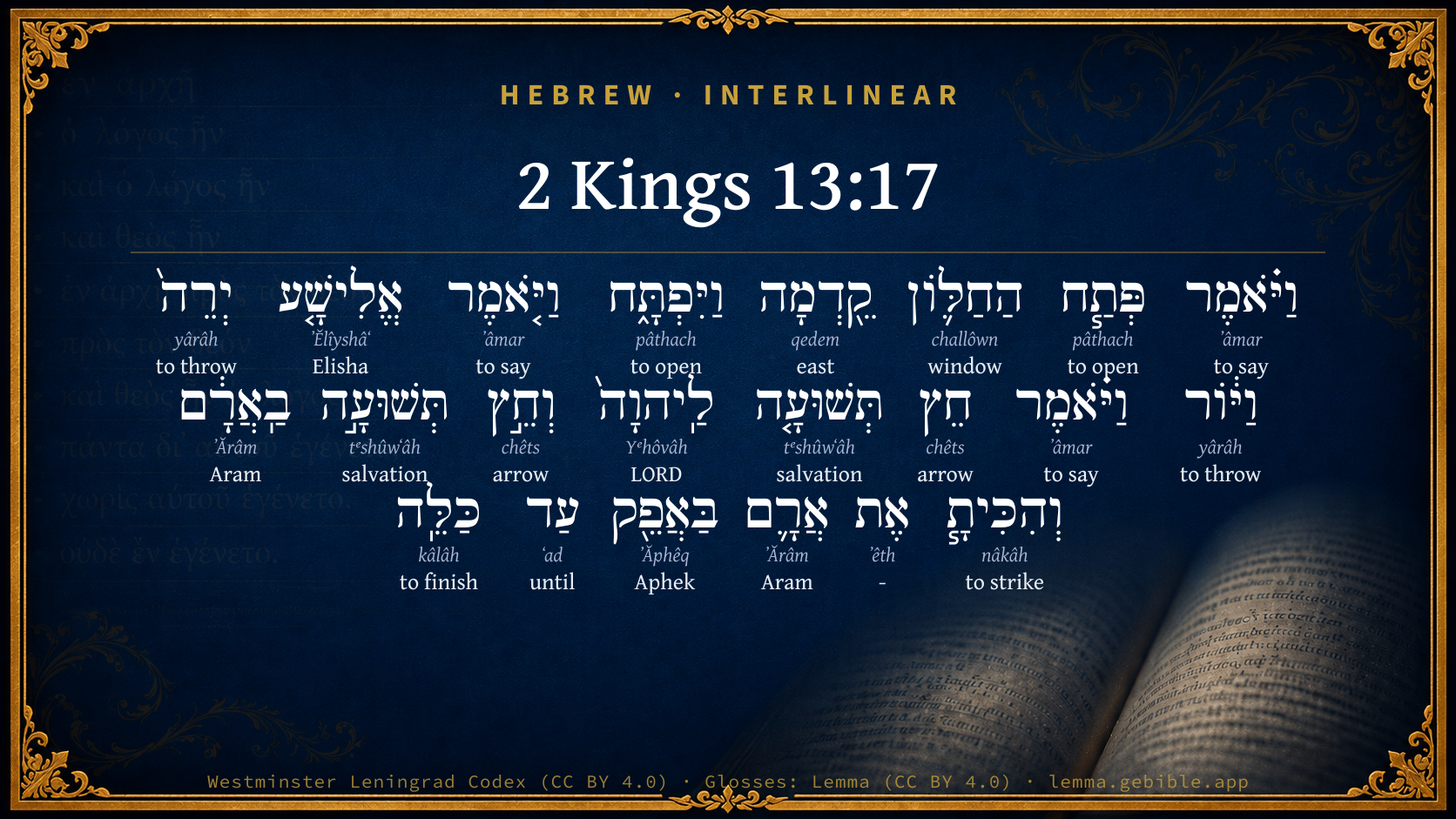
Hebrew (Westminster Leningrad Codex) 2 Kings 13:17 appears in the Hebrew Old Testament. The text above is from the Westminster Leningrad Codex. Each word links to its Strong’s number, a concise gloss, and parsing drawn from the Open Scriptures Hebrew Bible morphology. Click any word for its full Brown-Driver-Briggs (BDB) entry.
Download image
Cite this verse

2 Kings 13:17 (World English Bible). Public Domain. Lemma interlinear Bible study tool, https://lemma.gebible.app/v/2-kings/13/17.

Show BibTeX & RIS
BibTeX
RIS
English Translation
He said, Open the window eastward; and he opened it. Then Elisha said, Shoot; and he shot. He said, Yahweh's arrow of victory, even the arrow of victory over Syria; for you shall strike the Syrians in Aphek, until you have consumed them.
World English Bible · Public Domain
Download a study sheet

One document with this verse’s original text, its word-by-word gloss line, the meaning frame, cross-references with their text, attributed commentary, and full source and license credits — printable, and it pastes into notes with its structure intact.

This verse Autodidact and up

Study sheet (.html) Plain text (.txt)

A passage Seminary Student

Up to 50 verses in one chapter. A passage sheet keeps up to 6 commentary sources and 12 cross-references per verse, in the order this page ranks them, and says so on the sheet whenever that leaves anything out. Ask for a single verse and you get the Autodidact verse sheet above.

Everything on this page stays free to read, with no account — the sheet is a download of what is already on screen, not access to it.

Want to remove ads? Support Godless Engineer
Compare translations 3

The same verse in 3 English versions, stacked beneath the original-language interlinear above. Click any original word for its lexicon entry.

Each is an independent rendering of the whole verse — the interlinear is not word-aligned to these translations.

Highlighted words mark where these versions differ — a whole-verse word diff, not a word-by-word alignment.

  • World English Bible Public Domain
    He said, Open the window eastward; and he opened it. Then Elisha said, Shoot; and he shot. He said, Yahweh's arrow of victory, even the arrow of victory over Syria; for you shall strike the Syrians in Aphek, until you have consumed them.
  • King James Version Public Domain
    And he said, Open the window eastward. And he opened it. Then Elisha said, Shoot. And he shot. And he said, The arrow of the LORD's deliverance, and the arrow of deliverance from Syria: for thou shalt smite the Syrians in Aphek, till thou have consumed them.
  • unfoldingWord Literal Text CC BY-SA 4.0
    And he said, “Open the window to the east.” And one opened. And Elisha said, “Shoot.” And he shot. And he said, “The arrow of victory to Yahweh, and the arrow of victory against Aram. And you will strike Aram at Aphek to finishing.”

unfoldingWord Literal Text — © unfoldingWord, licensed CC BY-SA 4.0. Word-aligned USFM3 via Door43 (git.door43.org/unfoldingWord/en_ult).

Versions to compare (up to 4)

3 of 4 selected

Show all 18 translations

Every available English version of this verse, each an independent rendering of the whole verse.

  • World English Bible Public Domain
    He said, Open the window eastward; and he opened it. Then Elisha said, Shoot; and he shot. He said, Yahweh's arrow of victory, even the arrow of victory over Syria; for you shall strike the Syrians in Aphek, until you have consumed them.
  • Berean Standard Bible Public Domain
    “Open the east window,” said Elisha. So he opened it and Elisha said, “Shoot!” So he shot. And Elisha declared: “This is the LORD’s arrow of victory, the arrow of victory over Aram, for you shall strike the Arameans in Aphek until you have put an end to them.”
  • Majority Standard Bible Public Domain
    “Open the east window,” said Elisha. So he opened it and Elisha said, “Shoot!” So he shot. And Elisha declared: “This is the LORD’s arrow of victory, the arrow of victory over Aram, for you shall strike the Arameans in Aphek until you have put an end to them.”
  • King James Version Public Domain
    And he said, Open the window eastward. And he opened it. Then Elisha said, Shoot. And he shot. And he said, The arrow of the LORD's deliverance, and the arrow of deliverance from Syria: for thou shalt smite the Syrians in Aphek, till thou have consumed them.
  • American Standard Version (1901) Public Domain
    And he said, Open the window eastward; and he opened it. Then Elisha said, Shoot; and he shot. And he said, Jehovah's arrow of victory, even the arrow of victory over Syria; for thou shalt smite the Syrians in Aphek, till thou have consumed them.
  • Revised Version (1885) Public Domain
    And he said, Open the window eastward: and he opened it. Then Elisha said, Shoot: and he shot. And he said, The LORD’S arrow of victory, even the arrow of victory over Syria: for thou shalt smite the Syrians in Aphek, till thou have consumed them.
  • Geneva Bible (1599) Public Domain
    And saide, Open the windowe Eastward. And when he had opened it, Elisha said, Shoote. And he shot. And he sayd, Beholde the arrowe of the Lordes deliuerance and the arrowe of deliuerance against Aram: for thou shalt smite the Aramites in Aphek, till thou hast consumed them.
  • Douay-Rheims (1899) Public Domain
    And said: Open the window to the east. And when he had opened it, Eliseus said: Shoot an arrow. And he shot. And Eliseus said: The arrow of the Lord's deliverance, and the arrow of the deliverance from Syria: and thou shalt strike the Syrians in Aphec, till thou consume them.
  • Young's Literal Translation Public Domain
    and saith, `Open the window eastward;' and he openeth, and Elisha saith, `Shoot,' and he shooteth; and he saith, `An arrow of salvation to Jehovah, and an arrow of salvation against Aram, and thou hast smitten Aram, in Aphek, till consuming.'
  • Literal Standard Version CC BY-SA 4.0
    and says, “Open the window eastward”; and he opens, and Elisha says, “Shoot,” and he shoots; and he says, “An arrow of salvation from YHWH, and an arrow of salvation against Aram, and you have struck Aram, in Aphek, until consuming.”
  • Unlocked Literal Bible CC BY-SA 4.0
    Elisha said, “Open the window eastward,” so he opened it. Then Elisha said, “Shoot!”, and he shot. Elisha said, “This is Yahweh's arrow of victory, the arrow of victory over Aram, for you will attack the Arameans in Aphek until you have consumed them.”
  • unfoldingWord Literal Text CC BY-SA 4.0
    And he said, “Open the window to the east.” And one opened. And Elisha said, “Shoot.” And he shot. And he said, “The arrow of victory to Yahweh, and the arrow of victory against Aram. And you will strike Aram at Aphek to finishing.”
  • Darby Bible Public Domain
    and said, Open the window eastward. And he opened [it]. And Elisha said, Shoot. And he shot. And he said, An arrow of Jehovah's deliverance, even an arrow of deliverance from the Syrians; and thou shalt smite the Syrians in Aphek, till thou hast consumed [them].
  • World Messianic Bible Public Domain
    He said, “Open the window eastward;” and he opened it. Then Elisha said, “Shoot!” and he shot. He said, “The LORD’s arrow of victory, even the arrow of victory over Syria; for you will strike the Syrians in Aphek until you have consumed them.”
  • Webster's Bible Public Domain
    And he said, Open the window eastward. And he opened it. Then Elisha said, Shoot. And he shot. And he said, The arrow of the LORD'S deliverance, and the arrow of deliverance from Syria: for thou shalt smite the Syrians in Aphek, till thou hast consumed them.
  • Free Bible Version CC BY-SA 4.0
    “Open the east window,” he told him. So the king opened it and Elisha said, “Shoot!” So he fired an arrow. Then Elisha explained, “This is the Lord's victory arrow representing the arrow of victory over the Arameans. You will attack the Arameans in Aphek and finish them off.”
  • Bible in Basic English Public Domain
    Then he said; Let the window be open to the east: and he got it open. Then Elisha said, Let the arrow go; and he let it go. And he said, The Lord's arrow of salvation, of salvation over Aram; for you will overcome the Aramaeans in Aphek and put an end to them.
  • JPS Tanakh (1917) Public Domain
    And he said: 'Open the window eastward'; and he opened it. Then Elisha said: 'Shoot'; and he shot. And he said: 'The LORD'S arrow of victory, even the arrow of victory against Aram; for thou shalt smite the Arameans in Aphek, till thou have consumed them.'

Literal Standard Version (2020), Covenant Press — licensed CC BY-SA 4.0. Text via the HelloAO Bible API (eBible.org). Unlocked Literal Bible (unfoldingWord) — licensed CC BY-SA 4.0. Text via the HelloAO Bible API (eBible.org). unfoldingWord Literal Text — © unfoldingWord, licensed CC BY-SA 4.0. Word-aligned USFM3 via Door43 (git.door43.org/unfoldingWord/en_ult). Free Bible Version, Dr. Jonathan Gallagher — licensed CC BY-SA 4.0. Text via the HelloAO Bible API (eBible.org).

Word by word

More ways to search: Search by grammar → Find every occurrence → Compare this word →

Practice this passage: Drill this verse → Learn its vocabulary →

בַּאֲפֵ֖ק
ʼĂphêq
H663
“in/at · Aphek”
Preposition + Noun, Proper
Part of Speech
Preposition + Noun
Type
Proper
Full BDB Definition

Origin: from H662 (in the sense of strength)

TWOT: None

Aphek or Aphik = "enclosure" - a Canaanite city near Jezreel - a city in territory of Asher - a city northeast of Beirut in Transjordan
  1. וַיֹּ֗אמֶר ʼâmar H559 “and · to say” Conjunction + Verb, Qal, Sequential Imperfect, 3rd Person, Masculine, Singular
  2. פְּתַ֧ח pâthach H6605 “open” Verb, Qal, Imperative, 2nd Person, Masculine, Singular
  3. הַחַלּ֛וֹן challôwn H2474 “the · window” Particle, Definite Article + Noun, Common, Both, Singular, Absolute
  4. קֵ֖דְמָה qedem H6924 “east · toward” Noun, Common, Masculine, Singular, Absolute + Suffix, Demonstrative
  5. וַיִּפְתָּ֑ח pâthach H6605 “and · to open” Conjunction + Verb, Qal, Sequential Imperfect, 3rd Person, Masculine, Singular
  6. וַיֹּ֤אמֶר ʼâmar H559 “and · to say” Conjunction + Verb, Qal, Sequential Imperfect, 3rd Person, Masculine, Singular
  7. אֱלִישָׁ֤ע ʼĔlîyshâʻ H477 “Elisha” Noun, Proper
  8. יְרֵה֙ yârâh H3384 “throw” Verb, Qal, Imperative, 2nd Person, Masculine, Singular
  9. וַיּ֔וֹר yârâh H3384 “and · to throw” Conjunction + Verb, Hiphil, Sequential Imperfect, 3rd Person, Masculine, Singular
  10. וַיֹּ֗אמֶר ʼâmar H559 “and · to say” Conjunction + Verb, Qal, Sequential Imperfect, 3rd Person, Masculine, Singular
  11. חֵץ chêts H2671 “arrow of” Noun, Common, Masculine, Singular, Construct
  12. תְּשׁוּעָ֤ה tᵉshûwʻâh H8668 “salvation” Noun, Common, Feminine, Singular, Absolute
  13. לַֽיהוָה֙ Yᵉhôvâh H3068 “to/for · LORD” Preposition + Noun, Proper
  14. וְחֵ֣ץ chêts H2671 “and · arrow of” Conjunction + Noun, Common, Masculine, Singular, Construct
  15. תְּשׁוּעָ֣ה tᵉshûwʻâh H8668 “salvation” Noun, Common, Feminine, Singular, Absolute
  16. בַֽאֲרָ֔ם ʼĂrâm H758 “in/at · Aram” Preposition + Noun, Proper
  17. וְהִכִּיתָ֧ nâkâh H5221 “and · to strike” Conjunction + Verb, Hiphil, Sequential Perfect, 2nd Person, Masculine, Singular
  18. אֶת ʼêth H853 “-” Particle, Direct Object
  19. אֲרָ֛ם ʼĂrâm H758 “Aram” Noun, Proper
  20. עַד ʻad H5704 “until” Preposition
  21. כַּלֵּֽה kâlâh H3615 “to finish” Verb, Piel, Infinitive Absolute

About this verse

These counts appear in no published source. They are computed here, from the morphology-tagged text and Lemma’s own curated glosses. What Lemma adds →

22
words
15
distinct lemmas
Historical
section

Notable vocabulary

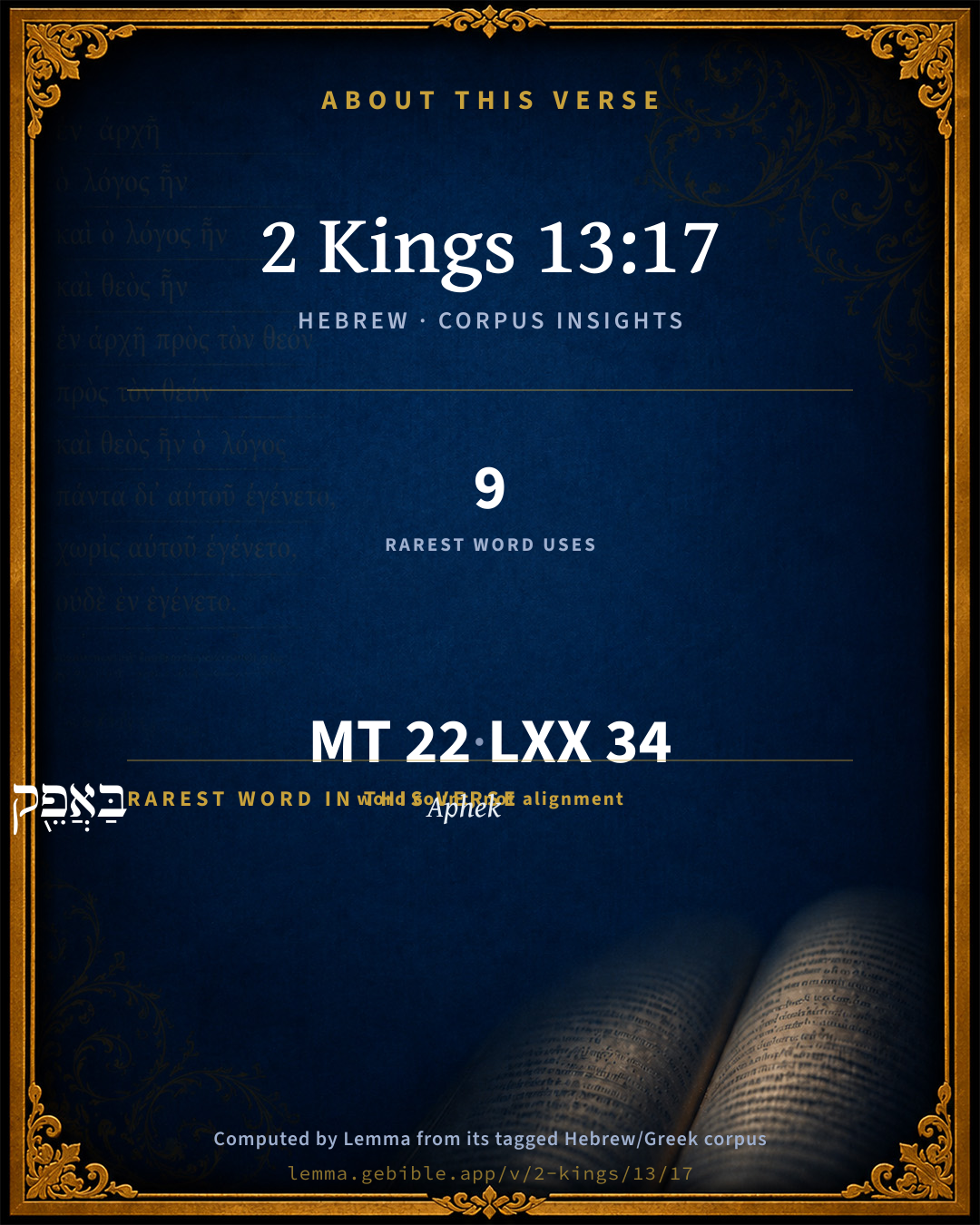
The rarest word here is בַּאֲפֵ֖ק Aphek H663 — appearing just 9 times in the whole Hebrew Bible.

Shared distinctive vocabulary

בַּאֲפֵ֖ק Aphek H663 occurs in 9 verses of the Hebrew Bible. Also found in:

Grammatical profile

  • 9 verbs
  • 11 nouns
  • 1 preposition
  • 1 particle

Verb forms

  • וַיֹּ֗אמֶר Qal · Sequential Imperfect
  • פְּתַ֧ח Qal · Imperative
  • וַיִּפְתָּ֑ח Qal · Sequential Imperfect
  • וַיֹּ֤אמֶר Qal · Sequential Imperfect
  • יְרֵה֙ Qal · Imperative
  • וַיּ֔וֹר Hiphil · Sequential Imperfect
  • וַיֹּ֗אמֶר Qal · Sequential Imperfect
  • וְהִכִּיתָ֧ Hiphil · Sequential Perfect
  • כַּלֵּֽה Piel · Infinitive Absolute

Repetition

Words recur within this verse — often emphatic in Hebrew:

  • וַיֹּ֗אמֶר to say H559 ×3
  • פְּתַ֧ח to open H6605 ×2
  • יְרֵה֙ to throw H3384 ×2
  • חֵץ arrow H2671 ×2
  • תְּשׁוּעָ֤ה salvation H8668 ×2
  • בַֽאֲרָ֔ם Aram H758 ×2

Hebrew & Septuagint length

In English translation the verse runs 43 words from the Hebrew and 47 from the Septuagint (LXX English) — closely comparable.

A rough comparison of the two English renderings, which tokenize alike — not a word-level alignment.

Word counts can differ between the Hebrew and the Greek without any difference in meaning — e.g. the Hebrew direct-object marker אֵת has no separate Greek word, and Greek often adds the article ὁ.

In the original languages it is 22 Hebrew tokens and 34 Greek tokens — but the two are counted differently (Hebrew bundles its prefixes and suffixes into one token; the Greek is in lemma form), so that isn’t a like-for-like length.

Cross-references

10

Topical passages linked to 2 Kings 13:17 in the Treasury of Scripture Knowledge — connected by theme and wording, ordered by reader-vote popularity; previews shown in the World English Bible.

  • 1 Kings 20:26 It happened at the return of the year, that Ben Hadad mustered the Syrians, and went up to Aphek, to fight against Israel.
  • 2 Kings 5:10–14 Elisha sent a messenger to him, saying, Go and wash in the Jordan seven times, and your flesh shall come again to you, and you shall be clean.
  • John 11:39–41 Jesus said, "Take away the stone." Martha, the sister of him who was dead, said to him, "Lord, by this time there is a stench, for he has been dead four days."
  • 1 Corinthians 1:18 For the word of the cross is foolishness to those who are dying, but to us who are saved it is the power of God.
  • Exodus 4:2 Yahweh said to him, "What is that in your hand?" He said, "A rod."
  • Exodus 4:17 You shall take this rod in your hand, with which you shall do the signs."
  • Judges 7:9–20 It happened the same night, that Yahweh said to him, Arise, get you down into the camp; for I have delivered it into your hand.
  • 1 Samuel 4:1 The word of Samuel came to all Israel. Now Israel went out against the Philistines to battle, and encamped beside Ebenezer: and the Philistines encamped in Aphek.
  • 2 Samuel 5:24 It shall be, when you hear the sound of marching in the tops of the mulberry trees, that then you shall bestir yourself; for then is Yahweh gone out before you to strike the host of the Philistines.
  • John 2:5–8 His mother said to the servants, "Whatever he says to you, do it."

Cross-references courtesy of OpenBible.info (CC BY 4.0).

Hebrew and Greek witnesses Masoretic Hebrew ↔ Greek Septuagint

The same verse in the two great witnesses to the Old Testament, shown verse-for-verse.

These are two independent witnesses, not word-aligned to each other, and the Septuagint is shown in lemma (dictionary) form.

Hebrew 2 Kings 13:17 Masoretic · Westminster Leningrad Codex

וַיֹּ֗אמֶר פְּתַ֧ח הַחַלּ֛וֹן קֵ֖דְמָה וַיִּפְתָּ֑ח וַיֹּ֤אמֶר אֱלִישָׁ֤ע יְרֵה֙ וַיּ֔וֹר וַיֹּ֗אמֶר חֵץ תְּשׁוּעָ֤ה לַֽיהוָה֙ וְחֵ֣ץ תְּשׁוּעָ֣ה בַֽאֲרָ֔ם וְהִכִּיתָ֧ אֶת אֲרָ֛ם בַּאֲפֵ֖ק עַד כַּלֵּֽה

He said, Open the window eastward; and he opened it. Then Elisha said, Shoot; and he shot. He said, Yahweh's arrow of victory, even the arrow of victory over Syria; for you shall strike the Syrians in Aphek, until you have consumed them.

World English Bible · Public Domain

Greek LXX 2 Kings 13:17 Septuagint · lemma form

καί εἶπον ἀναοἴγω ὁ θυρίς κατά ἀνατολή καί ἀναοἴγω καί εἶπον ελισαιε τοξεύω καί τοξεύω καί εἶπον βέλος σωτηρία ὁ κύριος καί βέλος σωτηρία ἐν συρία καί πατάσσω ὁ συρία ἐν αφεκ ἕως συντέλεια

And he said, Open the window eastward. And he opened it. And Elisaie said, Shoot. And he shot. And Elisaie said, The arrow of the Lord's deliverance, and the arrow of deliverance from Syria; and you shall strike the Syrians in Aphec until you have consumed them.

LXX2012 (modern English Septuagint) · Public Domain

Hebrew: Westminster Leningrad Codex (CC BY 4.0). Greek: Septuagint (public domain); English from LXX2012 (modern English Septuagint) (Public Domain). How the Septuagint differs from the Hebrew →

Targum (Aramaic paraphrase)

1

The Targum is the ancient Jewish Aramaic paraphrase of the Hebrew Scriptures — an interpretive translation, not the Hebrew text itself. Onkelos (literal) and Pseudo-Jonathan (expansive) render the Torah, and Jonathan the Prophets. Coverage is partial: where no permissively-licensed English translation exists for a verse, only the Aramaic is shown. This is verse-level text, not a word-by-word alignment to the Hebrew.

  1. Targum Jonathan Prophets (Joshua–Malachi)
    וַאֲמַר פְּתַח כֵּוָן לְמַדִינְחָא וּפְתַח וַאֲמַר אֱלִישָׁע שְׁדֵי וּשְׁדָא וַאֲמַר הָדֵין גִירָא יִתְעֲבֵיד לָנָא פּוּרְקָנָא מִן קֳדָם יְיָ וְהָדֵין גִירָא יִתְעֲבֵיד לָנָא נִצְחָנָא בֶּאֱנַשׁ אֲרָם וְתִמְחֵי יַת אֱנַשׁ אֲרָם בַּאֲפֵיק עַד דְיִשְׁתֵּיצוּן:

    (no public-domain English translation for this verse)

    Targum Jonathan — Aramaic: “Mikraot Gedolot” (public domain). English: “Sefaria Community Translation” (CC0 1.0 (public-domain dedication)); “London "Chaldee Paraphrase," 1871” (public domain). Text via Sefaria.

Commentary

Notes on 2 Kings 13:17 from classic Christian and Jewish commentators (each source and its license shown beneath its notes). The classic Christian expositions comment on the surrounding passage and are grouped to its opening verse, so a note may address several verses; the Jewish commentaries on the Tanakh (Rashi and others) are per-verse, so they appear only where the commentator wrote on this verse.

Lemma curates 59 commentaries, every one of them public domain or Creative Commons licensed, each selected and text-cleaned for this edition rather than reprinted as found. About our sources →

Trapp's Complete Commentary

John Trapp

2Ki 13:17 And he said, Open the window eastward. And he opened [it]. Then Elisha said, Shoot. And he shot. And he said, The arrow of the LORD’S deliverance, and the arrow of deliverance from Syria: for thou shalt smite the Syrians in Aphek, till thou have consumed [them].

Ver. 17. Then Elisha said, Shoot. And he shot.] The old Romans were wont to denounce war against their enemies by shooting an arrow or dart into their country, {a} Alexander the Great did the like when he first set foot in Persia, as Justin reporteth. {b}

Till they have consumed them.] Usque ad consumere, vel usque ad consummare.

{a} Serv. in Virg.

{b} Hist., lib. ii.

John Trapp, A Commentary or Exposition upon All the Books of the Old and New Testament (1647–1656) — public domain. Text from a community e-Sword module.

Geneva Bible (1599)

Geneva Bible translators

That is, toward Syria: so that he did not only prophesy with words, but also confirmed him by these signs that he should have the victory.

Geneva Bible (1599) marginal notes — public domain. Text via Bolls.life.

Adam Clarke's Commentary

Verse 17. Open the window eastward] This was towards the country beyond Jordan, which Hazael had taken from the Israelites.

The arrow of - deliverance from Syria] That is, As surely as that arrow is shot towards the lands conquered from Israel by the Syrians, so surely shall those lands be reconquered and restored to Israel.

It was an ancient custom to shoot an arrow or cast a spear into the country which an army intended to invade. Justin says that, as soon as Alexander the Great had arrived on the coasts of Iona, he threw a dart into the country of the Persians. "Cum delati in continentem essent, primus Alexander jaculum velut in hostilem terram jacit." - Just. lib. ii.

The dart, spear, or arrow thrown, was an emblem of the commencement of hostilities. Virgil (AEn. lib. ix., ver. 51) represents Turnus as giving the signal of attack by throwing a spear: -

Ecquis erit mecum, O Juvenes, qui primus in hostem?

En, ait: et jaculum intorquens emittit in auras,

Principium pugnae; et campo sese arduus infert.

"Who, first," he cried, "with me the foe will dare?"

Then hurled a dart, the signal of the war.

PITT.

Servius, in his note upon this place, shows that it was a custom to proclaim war in this stay: the pater patratus, or chief of the Feciales, a sort of heralds, went to the confines of the enemy's country, and, after some solemnities, said with a loud voice, I wage war with you, for such and such reasons; and then threw in a spear. It was then the business of the parties thus defied or warned to take the subject into consideration; and if they did not, within thirty days, come to some accommodation, the war was begun.

Thou shalt smite the Syrians in Aphek] This was a city of Syria, and probably the place of the first battle; and there, it appears, they had a total overthrow. They were, in the language of the text, consumed or exterminated.

Adam Clarke's Commentary on the Bible (1810–1826) — public domain. Text from a community e-Sword/MySword module.

Ellicott's Commentary for English Readers

(17) The window.—Or, lattice. Probably a lattice opening outwards.

Eastward.—In the direction of Gilead, which was occupied by the Syrians (2Ki_10:33).

Shoot.—The old illustration of declaring war by shooting an arrow into the enemy’s country (Æn. ix. 57) is not without bearing on this case, though it obviously does not exhaust the meaning of the act.

(17) And he said—i.e., Elisha said.

The arrow of the Lord’s . . . Syria.—Literally, An arrow of victory for Jehovah, and an arrow of victory over Aram!

In Aphek.—Jos_13:4; 1Ki_20:26. The scene of former defeats was to become that of triumph.

Till thou have consumed them.—Literally, unto finishing. The annihilation of the opposing army at Aphek, not of the entire forces of Syria, is predicted. (See 2Ki_13:19.)

A Bible Commentary for English Readers, edited by Charles John Ellicott (1878–1897) — public domain. Text from a community e-Sword module.

The Cambridge Bible for Schools and Colleges

gen. ed. J. J. S. Perowne

17. And he said, Open the window] That there might be a free space for the arrow to be shot through. The command must be directed to some attendant, as the king was holding the bow ready to shoot when he was bidden. The windows of this time were merely open gratings, not filled with anything transparent.

eastward] Because eastward from Samaria lay the land of Gilead, the country on which the Syrians were so constantly making their attacks, and which they now had to a great degree in their possession.

The arrow of the Lord’s deliverance] R.V. The Lord’s arrow of victory. The R.V. represents more exactly the force of the Hebrew, which describes this arrow of victory as belonging to the Lord, i.e. as being specially directed by Him, and so assured of its result.

and the arrow of deliverance from Syria] R.V. even the arrow of victory over Syria. The sentence is in apposition with the previous clause. The former looks to the prompter of the battle, the latter clause to the result.

in Aphek] This is probably the place of that name which was on the east of the sea of Galilee. See note on 1Ki_20:26. The region east of the Jordan was the constant battle-ground between Israel and Syria. See above on 2Ki_10:32-33.

till thou have consumed them] This was the prophet’s thought and the purport of his message. The lack of zeal in Joash by the giving of only three strokes when Elisha hoped for five or six, diminished the completeness of the victory which God had promised.

The Cambridge Bible for Schools and Colleges (gen. ed. J. J. S. Perowne; Cambridge University Press, 1878–1918) — public domain. Text from a community e-Sword module.

John Gill's Exposition

And the man of God was wroth with him,.... Because he ceased smiting, and smote no oftener; for it was revealed to the prophet, by an impulse upon his mind, that by the number of times he smote on the ground, it would be known how often he should get the victory over his enemies; but this was to be left to the king's own will, how often he would smite, and thereby the prophet would know also with what spirit he would pursue his victories, and the advantages he would gain:

and said, thou shouldest have smitten five or six times, then hadst thou smitten Syria until thou hadst consumed it; as a nation, as well as routed their several armies:

whereas now thou shalt smite Syria but thrice; beat them only three times in battle, according to the number of his smitings on the ground.

John Gill's Exposition of the Whole Bible (1746–1763) — public domain (CC PDM 1.0). Text via the HelloAO Bible API.

Albert Barnes' Notes on the Bible

Eastward - Syria of Damascus lay partly east, but still more north, of the holy land. The arrow was to be shot, eastward, not so much against Syria itself as against the scene of the recent Syrian successes, Gilead 2Ki 10:33, which was also to be the scene of Joash’s victories over them. Aphek is almost due east from Shunem, where it is not unlikely that Elisha now was.

The arrow ... - literally, “An arrow of deliverance from the Lord, and an arrow of deliverance against Syria; and thou shalt smite the Syrians in Aphek, even to consuming.”

Albert Barnes' Notes on the Bible (1834–1885) — public domain. Text from a community e-Sword/MySword module.

Haydock's Catholic Bible Commentary

East, looking towards Galgaad, (Hadock) which the Syrians occupied. (Menochius) --- These actions were all significative and prophetical. The throwing of a dart was formerly the mode of declaring war. (Virgil, Æneid ix.) Justin (ii.) says, "Alexander first threw a javelin, as against a hostile country." Thus also the ancients took possession. (Varro) (V. Max. iii., &c.) The people of Andros and Chalicis, sent each a deputy to seize Acanthos, when it had been abandoned by its inhabitants. The man from Andros, perceiving the other before him, threw his dart at the gate, and it was decided that he had thus lawfully obtained possession. (Plutarch, q. Græc.; Selden, Mare. Claus. iv.) --- The action of Joas may be considered in both lights. --- Them. We do not read the particulars of this battle: but it must have been very bloody. One of the three victories (ver. 25.) of Joas was probably obtained at Aphec, (Calmet) a place memorable for the victory of Achab, over the same Syrians, 3 Kings xx. 26. (Menochius)

George Leo Haydock (1774–1849), Haydock's Catholic Family Bible and Commentary, 1859 edition — public domain. Excludes Psalms (Douay-Rheims chapter numbering differs from Protestant) and Deuterocanonical books (Catholic canon only).

Matthew Poole's English Annotations

Eastward; either towards Syria, which lay north-eastward from the land of Israel; or towards the Israelites’ land beyond Jordan, which lay eastward from Canaan, and which was now possessed by the Syrians. Either way this arrow is shot against the Syrians, as a token what God intended to do against them.

In Aphek; not in the city, but in the territory of it, where it seems there was a great battle to be fought between the Israelites and Syrians. Of Aphek, see 1Sa 4:1; 29:1; 1Ki 20:30, though it is possible there might be several cities of that name. Or, as in Aphek, i.e. thou shalt smite them as they were smitten in the city and territory of Aphek, i.e. utterly destroy them; see 1Ki 20:26,29,30; the particle as being oft understood, as hath been formerly and frequently proved.

Till thou have consumed them, i.e. the Syrians; not all that people, but their armies, or at least that which was to be at Aphek, where a dreadful battle was to be fought. Or if this be meant of all the Syrian armies, this is to be understood conditionally, if he did not hinder it by his unbelief or neglect, signified in the following verses.

Matthew Poole's English Annotations on the Holy Bible (1683–1685) — public domain. Text from a community e-Sword/MySword module.

Whedon's Commentary on the Bible

Daniel D. Whedon

17. Open the window eastward — Israel’s relation to Syria was now a subject of the greatest concern to both king and prophet, and therefore uppermost in their minds.

The arrow of the Lord’s deliverance — That is, this arrow, shot towards the enemy’s country, signifies the deliverance which the Lord will soon grant Israel from the Syrian yoke. The casting of a spear or shooting of an arrow into an enemy’s country was a common signal for the beginning of hostilities. Thus Alexander the Great is said to have hurled a dart into his enemy’s land when he came to the borders of the Persian territory.

Thou shalt smite the Syrians in Aphek — To the symbol he adds a verbal prophecy. At Aphek the Syrians had previously suffered defeat. 1Ki_20:26-30.

Daniel D. Whedon (gen. ed.), Commentary on the Old and New Testaments (1874–1909) — public domain. Text from a community e-Sword module.

The Pulpit Commentary

And he said, Open the window. Though glass was unknown, or at any rate not applied to windows, yet the windows of sitting-rooms, and still more of bedrooms, had latticed shutters, which partially excluded the light and the air, and could be opened and closed at pleasure. (see the comment on 2Ki_1:2) The prophet ordered the shutter to be opened, that the king might shoot from the window. He addressed, not the king, whose hands were both engaged, but his own servant, or one of the royal attendants. Eastward. Not so much in the direction of Syria, which was north-east of the Israelite territory, as in the direction of Gilead and Bashan, which had been the scene of Hazael"s victories, (2Ki_10:33) and was now to be the scene of his reverses. Aphek lay almost duo east of Shunem, where it is probable that Elisha was. And he opened it; or, and one opened it, or they opened it. The Hebrew idiom allows of this indefinite use of the third person singular. Then Elisha said, Shoot. And he shot. And hei.e. Elishasaid, The arrow of the Lord"s deliverance, and the arrow of deliverance from Syria ; rather, an arrow. "This is," the prophet meant to say, "an arrow symbolical of deliverance about to come from Jehovah, of deliverance from the cruel oppression of the Syrians and not merely of deliverance, but of victory. For thou shalt smite the Syrians in Aphek. The Aphek intended is probably that which lay east of the Sea of Galilee, at the distance of about three miles, in lat. 32 49" nearly. This place was on the direct route between Samaria and Damascus, and had already been the scene of one great victory gained by Israel over Syria. (1Ki_20:26-30) The site is marked by the modern village of Fik. Till thou have consumed them; literally, till consuming i.e. , till the army which thou shalt defeat at that place is destroyed utterly. We have no account of the fulfillment of this prophecy, but may regard the defeat as one of those touched on in ver. 25.

The Pulpit Commentary (1880–1919), ed. H.D.M. Spence-Jones & Joseph S. Exell — public domain. Text from a community e-Sword module.

John Wesley's Explanatory Notes

Eastward - Toward Syria, which lay northeastward, from the land of Israel: this arrow is shot against the Syrians, as a token what God intended to do against them.

John Wesley, Explanatory Notes Upon the Whole Bible (1754–1765) — public domain. Text via the GEBible commentary corpus.

unfoldingWord translationNotes

Door43 World Missions Community

General Information:

Elisha continues to talk to Joash, king of Israel.

Open the window eastward

"open the window that faces east" or "open that window towards the east"

so he opened it

Since this happens after Joash takes the bow and arrows, he may have had a servant open the window. AT: "So a servant opened it" (See: Assumed Knowledge and Implicit Information)

he shot

"Joash shot the arrow"

This is Yahweh's arrow of victory, the arrow of victory over Aram

The relationship between the arrow and victory can be stated explicitly. AT: "This arrow is a sign from Yahweh that he will give you victory over Aram" or "This arrow symbolizes the victory Yahweh will give you over Aram" (See: Assumed Knowledge and Implicit Information)

Aphek

This was a city in the land of Israel. (See: How to Translate Names)

But the man of God was angry with him

"But Elisha was angry with King Joash"

until you annihilated it

"until you completely destroyed it" or "until they were completely wiped out"

translationWords

Aram

consume

God

anger

unfoldingWord translationNotes — © Distant Shores Media and the Door43 World Missions Community, licensed CC BY-SA 4.0. Source: git.door43.org/Door43/en_tn.

Rashi

Rabbi Shlomo Yitzchaki (Rashi)

“Open the window towards the east.” Opposite the land of Arom which is located in the east, as it is stated, “Arom from the east.”

“Shoot!” And he shot. [Targum Yonoson renders] “Shoot!” And he shot.

And he said, “An arrow of salvation, etc.” Elisha said, “This arrow is a symbol of salvation for Yisroel.”

In Apheik. The name of the city [is Apheik].

Rashi on the Tanakh — English translations: “The Judaica Press complete Tanach with Rashi, translated by A. J. Rosenberg” (CC BY 4.0); “Pentateuch with Rashi's commentary by M. Rosenbaum and A.M. Silbermann, 1929-1934” (public domain); “The Metsudah Tanach series, Lakewood, N.J” (CC BY 4.0); and “The Book of Joshua, Metsudah Publications, 1997” (CC BY 4.0). Text via Sefaria.

Lesson kit

Teaching starters — assembled from the data on this page, not authored interpretation. Every prompt links to the verse data it draws on. Edit before teaching.

2 Kings, in the Historical, opens this verse with 22 words (15 distinct Hebrew lemmas). Its most distinctive word is ʼĂphêq (“Aphek”). A historical commentator’s framing appears above. Read the whole chapter for the surrounding context.

Discussion questions

  1. How does “Aphek” (ʼĂphêq) shape what this verse is saying?
  2. Joshua 12:18 shares the word «Aphek» with this verse. How do the two illuminate each other?
  3. “to say” occurs 3× in this one verse. What is the effect of the repetition?
  4. The translations on this page render this verse differently — a whole-verse word diff, not a word-by-word alignment. What might account for the different wordings?
  5. The verb «וַיֹּ֗אמֶר» is Qal Sequential Imperfect. How does its form color the action?
  6. Reading how Trapp's Complete Commentary and Geneva Bible (1599) read this verse, where do the two commentators agree and where do they part?

Things to notice

Reading settings

Reading text

Shown beneath each verse's original-language words.

Old Testament
Old Testament edition

Read the OT as the Masoretic Hebrew (MT) or the Greek Septuagint (LXX).

English shown for the Greek Septuagint (in the Hebrew ↔ Greek comparison).

Comparing translations? Open the Compare panel on any verse page to stack up to four side by side.