
Job 7:9

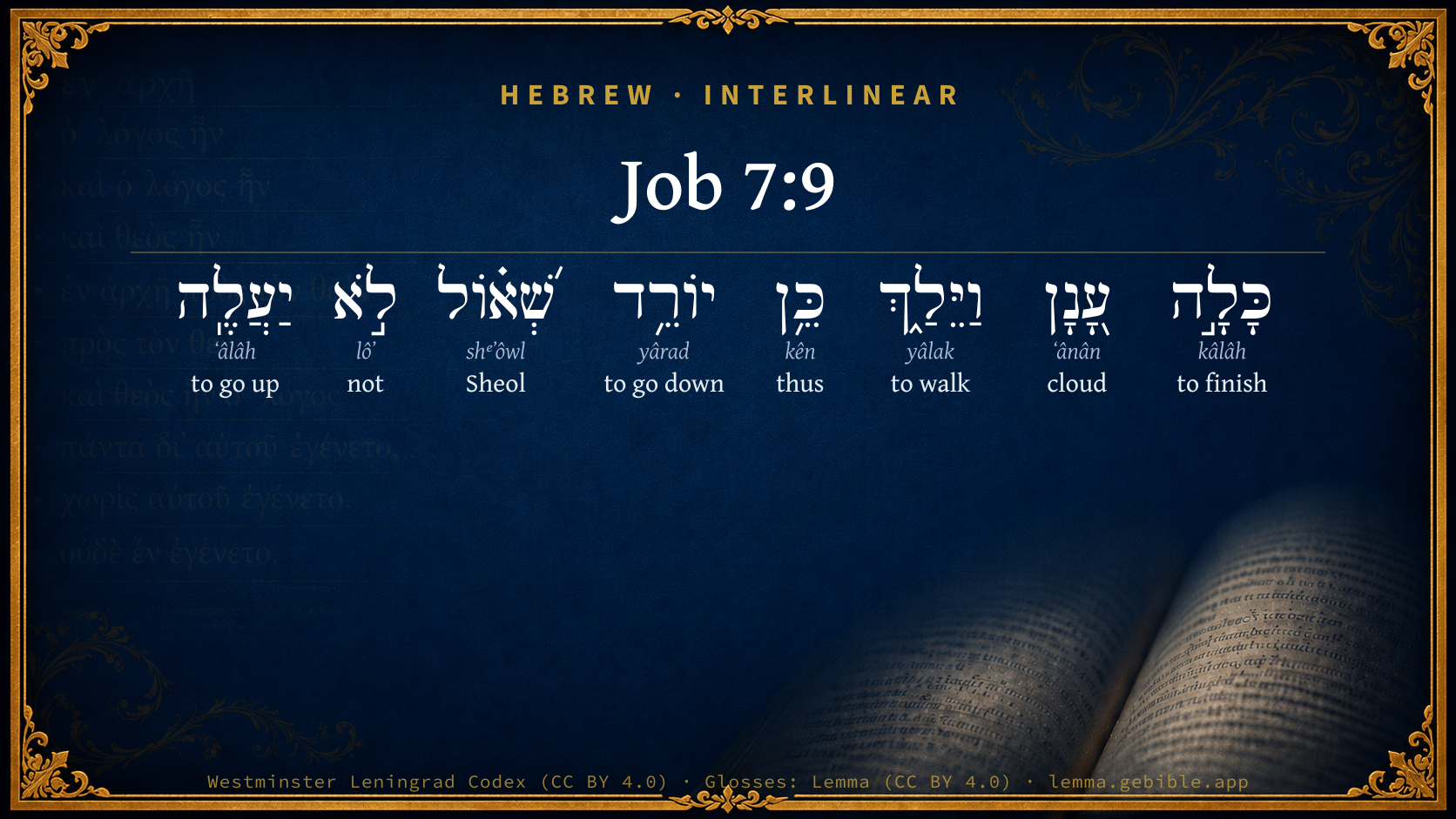
Hebrew (Westminster Leningrad Codex) Job 7:9 appears in the Hebrew Old Testament. The text above is from the Westminster Leningrad Codex. Each word links to its Strong’s number, a concise gloss, and parsing drawn from the Open Scriptures Hebrew Bible morphology. Click any word for its full Brown-Driver-Briggs (BDB) entry.
Download image
Cite this verse

Job 7:9 (World English Bible). Public Domain. Lemma interlinear Bible study tool, https://lemma.gebible.app/v/job/7/9.

Show BibTeX & RIS
BibTeX
RIS
English Translation
As the cloud is consumed and vanishes away, So he who goes down to Sheol shall come up no more.
World English Bible · Public Domain
Download a study sheet

One document with this verse’s original text, its word-by-word gloss line, the meaning frame, cross-references with their text, attributed commentary, and full source and license credits — printable, and it pastes into notes with its structure intact.

This verse Autodidact and up

Study sheet (.html) Plain text (.txt)

A passage Seminary Student

Up to 50 verses in one chapter. A passage sheet keeps up to 6 commentary sources and 12 cross-references per verse, in the order this page ranks them, and says so on the sheet whenever that leaves anything out. Ask for a single verse and you get the Autodidact verse sheet above.

Everything on this page stays free to read, with no account — the sheet is a download of what is already on screen, not access to it.

Want to remove ads? Support Godless Engineer
Compare translations 3

The same verse in 3 English versions, stacked beneath the original-language interlinear above. Click any original word for its lexicon entry.

Each is an independent rendering of the whole verse — the interlinear is not word-aligned to these translations.

Highlighted words mark where these versions differ — a whole-verse word diff, not a word-by-word alignment.

  • World English Bible Public Domain
    As the cloud is consumed and vanishes away, So he who goes down to Sheol shall come up no more.
  • King James Version Public Domain
    As the cloud is consumed and vanisheth away: so he that goeth down to the grave shall come up no more.
  • unfoldingWord Literal Text CC BY-SA 4.0
    A cloud disappears and goes away; so the one descending to Sheol does not ascend.

unfoldingWord Literal Text — © unfoldingWord, licensed CC BY-SA 4.0. Word-aligned USFM3 via Door43 (git.door43.org/unfoldingWord/en_ult).

Versions to compare (up to 4)

3 of 4 selected

Show all 18 translations

Every available English version of this verse, each an independent rendering of the whole verse.

  • World English Bible Public Domain
    As the cloud is consumed and vanishes away, So he who goes down to Sheol shall come up no more.
  • Berean Standard Bible Public Domain
    As a cloud vanishes and is gone, so he who goes down to Sheol does not come back up.
  • Majority Standard Bible Public Domain
    As a cloud vanishes and is gone, so he who goes down to Sheol does not come back up.
  • King James Version Public Domain
    As the cloud is consumed and vanisheth away: so he that goeth down to the grave shall come up no more.
  • American Standard Version (1901) Public Domain
    As the cloud is consumed and vanisheth away, So he that goeth down to Sheol shall come up no more.
  • Revised Version (1885) Public Domain
    As the cloud is consumed and vanisheth away, so he that goeth down to Sheol shall come up no more.
  • Geneva Bible (1599) Public Domain
    As the cloude vanisheth and goeth away, so he that goeth downe to the graue, shall come vp no more.
  • Douay-Rheims (1899) Public Domain
    As a cloud is consumed, and passeth away: so he that shall go down to hell shall not come up.
  • Young's Literal Translation Public Domain
    Consumed hath been a cloud, and it goeth, So he who is going down to Sheol cometh not up.
  • Literal Standard Version CC BY-SA 4.0
    A cloud has been consumed, and it goes, || So he who is going down to Sheol does not come up.
  • Unlocked Literal Bible CC BY-SA 4.0
    As a cloud is consumed and vanishes away, so he who goes down to Sheol will come up no more.
  • unfoldingWord Literal Text CC BY-SA 4.0
    A cloud disappears and goes away; so the one descending to Sheol does not ascend.
  • Darby Bible Public Domain
    The cloud consumeth and vanisheth away; so he that goeth down to Sheol shall not come up.
  • World Messianic Bible Public Domain
    As the cloud is consumed and vanishes away, so he who goes down to Sheol will come up no more.
  • Webster's Bible Public Domain
    As the cloud is consumed and vanisheth away: so he that goeth down to the grave shall come up no more.
  • Free Bible Version CC BY-SA 4.0
    When a cloud disappears, it's gone, just as anyone who goes down to Sheol does not come back up.
  • Bible in Basic English Public Domain
    A cloud comes to an end and is gone; so he who goes down into the underworld comes not up again.
  • JPS Tanakh (1917) Public Domain
    As the cloud is consumed and vanisheth away, so he that goeth down to the grave shall come up no more.

Literal Standard Version (2020), Covenant Press — licensed CC BY-SA 4.0. Text via the HelloAO Bible API (eBible.org). Unlocked Literal Bible (unfoldingWord) — licensed CC BY-SA 4.0. Text via the HelloAO Bible API (eBible.org). unfoldingWord Literal Text — © unfoldingWord, licensed CC BY-SA 4.0. Word-aligned USFM3 via Door43 (git.door43.org/unfoldingWord/en_ult). Free Bible Version, Dr. Jonathan Gallagher — licensed CC BY-SA 4.0. Text via the HelloAO Bible API (eBible.org).

Word by word

More ways to search: Search by grammar → Find every occurrence → Compare this word →

Practice this passage: Drill this verse → Learn its vocabulary →

About this verse

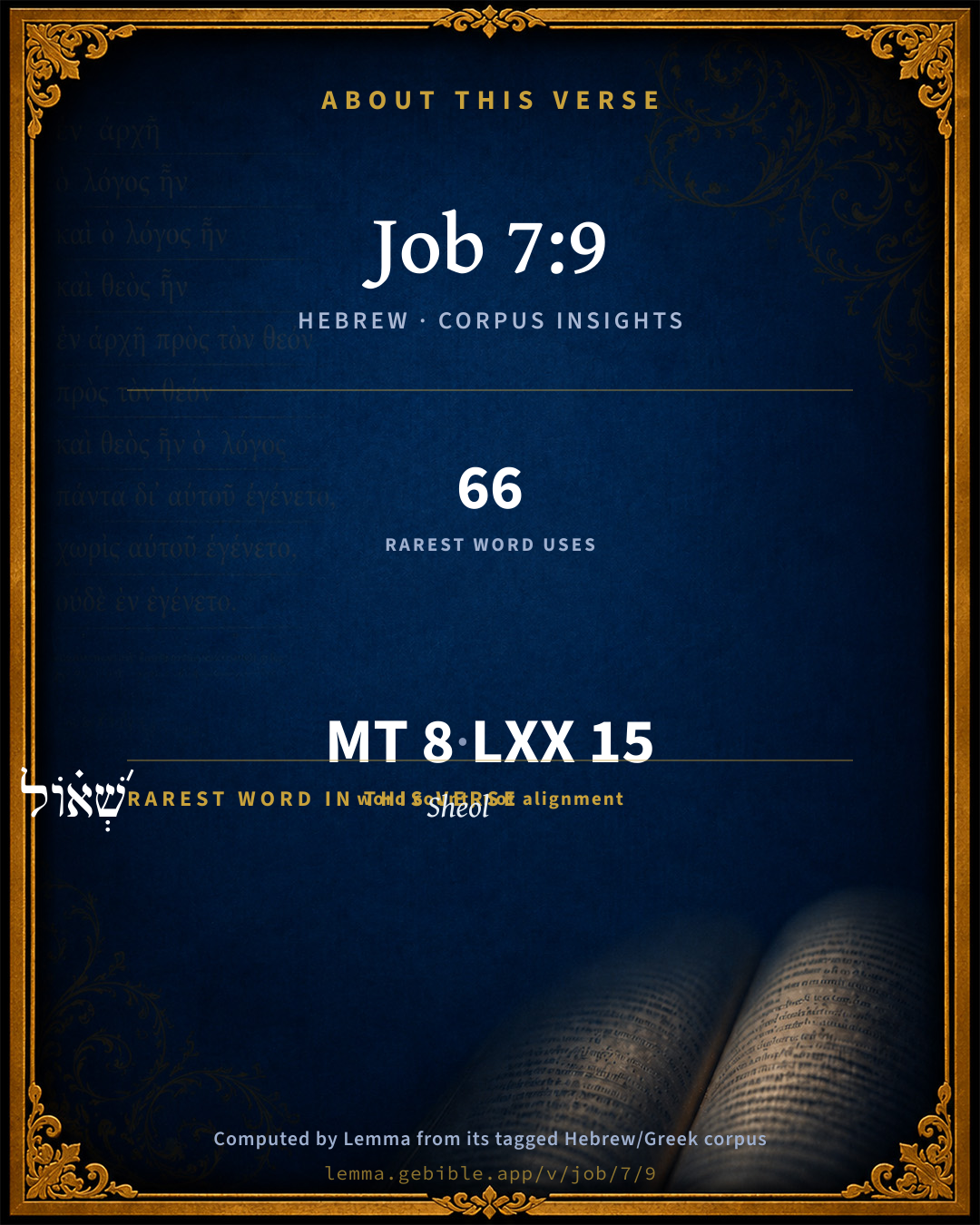
These counts appear in no published source. They are computed here, from the morphology-tagged text and Lemma’s own curated glosses. What Lemma adds →

8
words
8
distinct lemmas
Wisdom
section

Grammatical profile

  • 4 verbs
  • 2 nouns
  • 2 particles

Verb forms

  • כָּלָ֣ה Qal · Perfect
  • וַיֵּלַ֑ךְ Qal · Sequential Imperfect
  • יוֹרֵ֥ד Qal · Participle Active
  • יַעֲלֶֽה Qal · Imperfect

Hebrew & Septuagint length

In English translation the verse runs 20 words from the Hebrew and 27 from the Septuagint (LXX English) — closely comparable.

A rough comparison of the two English renderings, which tokenize alike — not a word-level alignment.

Word counts can differ between the Hebrew and the Greek without any difference in meaning — e.g. the Hebrew direct-object marker אֵת has no separate Greek word, and Greek often adds the article ὁ.

In the original languages it is 8 Hebrew tokens and 15 Greek tokens — but the two are counted differently (Hebrew bundles its prefixes and suffixes into one token; the Greek is in lemma form), so that isn’t a like-for-like length.

Cross-references

10

Topical passages linked to Job 7:9 in the Treasury of Scripture Knowledge — connected by theme and wording, ordered by reader-vote popularity; previews shown in the World English Bible.

  • 2 Samuel 14:14 For we must needs die, and are as water split on the ground, which can't be gathered up again; neither does God take away life, but devises means, that he who is banished not be an outcast from him.
  • Job 10:21 Before I go where I shall not return from, To the land of darkness and of the shadow of death;
  • Job 30:15 Terrors are turned on me. They chase my honor as the wind. My welfare has passed away as a cloud.
  • 2 Samuel 12:23 But now he is dead, why should I fast? can I bring him back again? I shall go to him, but he will not return to me.
  • Job 14:10–14 But man dies, and is laid low. Yes, man gives up the spirit, and where is he?
  • Job 16:22 For when a few years are come, I shall go the way from whence I shall not return.
  • Psalms 39:13 Oh spare me, that I may recover strength, Before I go away, and be no more."
  • Job 11:8 They are high as heaven. What can you do? Deeper than Sheol: what can you know?
  • Job 37:11 Yes, he loads the thick cloud with moisture. He spreads abroad the cloud of his lightning.
  • Isaiah 38:11 I said, I shall not see Yah, Yah in the land of the living: I shall see man no more with the inhabitants of the world.

Cross-references courtesy of OpenBible.info (CC BY 4.0).

Hebrew and Greek witnesses Masoretic Hebrew ↔ Greek Septuagint

The same verse in the two great witnesses to the Old Testament, shown verse-for-verse.

These are two independent witnesses, not word-aligned to each other, and the Septuagint is shown in lemma (dictionary) form.

Hebrew Job 7:9 Masoretic · Westminster Leningrad Codex

כָּלָ֣ה עָ֭נָן וַיֵּלַ֑ךְ כֵּ֥ן יוֹרֵ֥ד שְׁ֝א֗וֹל לֹ֣א יַעֲלֶֽה

As the cloud is consumed and vanishes away, So he who goes down to Sheol shall come up no more.

World English Bible · Public Domain

Greek LXX Job 7:9 Septuagint · lemma form

ὥσπερ νέφος ἀπο κατααἴρω ἀπό οὐρανός ἐάν γάρ ἄνθρωπος καταβαίνω εἰς ᾅδης οὐκέτι μή ἀναβαίνω

I am as a cloud that is cleared away from the sky: for if a man go down to the grave, he shall not come up again:

LXX2012 (modern English Septuagint) · Public Domain

On this verse, Albert Barnes' Notes on the Bible discusses the Septuagint’s reading. Read the note in Commentary ↓

Hebrew: Westminster Leningrad Codex (CC BY 4.0). Greek: Septuagint (public domain); English from LXX2012 (modern English Septuagint) (Public Domain). How the Septuagint differs from the Hebrew →

Commentary

Notes on Job 7:9 from classic Christian and Jewish commentators (each source and its license shown beneath its notes). The classic Christian expositions comment on the surrounding passage and are grouped to its opening verse, so a note may address several verses; the Jewish commentaries on the Tanakh (Rashi and others) are per-verse, so they appear only where the commentator wrote on this verse.

Lemma curates 59 commentaries, every one of them public domain or Creative Commons licensed, each selected and text-cleaned for this edition rather than reprinted as found. About our sources →

Trapp's Complete Commentary

John Trapp

Job 7:9 [As] the cloud is consumed and vanisheth away: so he that goeth down to the grave shall come up no [more].

Ver. 9. As the cloud is consumed and vanisheth away] A cloud is nothing else but a vapour thickened in the middle region of the air by the cold encompassing and driving it together, Psa 18:11-12, vessels they are as thin as the liquor that is in them; but some are waterless: the former are soon emptied and dissolved; the latter as soon scattered by the wind, and vanish away. {See Trapp on "Job 7:7"}

So he that goeth down to the grave shall come up no more] sc. To live and converse here with men, as Job 7:10. Or, he shall come up no more, sc. without a miracle (as Lazarus and some others long since dead rose again) he cannot return to me, said David to his deceased child, 2Sa 12:23. God could send some from the dead to warn the living; but that is not now to be expected, as Abraham told the rich man, Luk 16:27-31 Those spirits of dead men that so oft appeared in times of Popery (requiring their friends to sing masses and dirges for them; and that drew this verse from Theodorus Gaza, Sunt aliquid manes, lethum non omnia finit) were either delusions, or else devils in the shape of men. That Job doubted the resurrection, or denied it (as Rabbi Solomon, and some other, both Hebrew and Greek writers, conclude from this text) is a manifest injury done to this good man, and a force offered to the text, as appeareth by that which next followeth.

John Trapp, A Commentary or Exposition upon All the Books of the Old and New Testament (1647–1656) — public domain. Text from a community e-Sword module.

Joseph Benson's Commentary

Job 7:9-10. As the cloud is consumed — Being dissolved by the heat of the sun. And vanisheth away — Never to return again. So he that goeth down, &c., shall come up no more — Never until the general resurrection. When you see a cloud, which looked great, as if it would eclipse the sun, of a sudden dispersed and disappearing, say, Just such a thing is the life of man, a vapour that appears for a while and then vanisheth away. He shall return no more to his house — He shall no more be seen and known in his former habitation. It concerns us to secure a better place when we die: for this will own us no more.

Joseph Benson's Commentary on the Old and New Testaments (1811–1818) — public domain. Text from a community e-Sword module.

Tyndale Open Study Notes

Tyndale Open Resources

7:9 die (literally go down to Sheol): This is the first explicit mention of Sheol in Job. It is described as a place of rest from earthly pressures and distinctions (3:13-19) and as a dark dwelling place (10:21-22; 17:13) deep in the earth (11:8) that is covered in dust (17:16). It is the destiny of all the living (30:23) from which no one can return (10:21; see Gen 37:25; 2 Sam 12:12).

Tyndale Open Study Notes — © Tyndale Open Resources, licensed CC BY-SA 4.0. Text via the HelloAO Bible API.

Geneva Bible (1599)

Geneva Bible translators

Shall no more enjoy this mortal life.

If thou behold me in thine anger, I shall not be able to stand in thy presence.

Geneva Bible (1599) marginal notes — public domain. Text via Bolls.life.

Jamieson, Fausset & Brown

Robert Jamieson, A. R. Fausset & David Brown

(Sa2 12:23).

the grave--the Sheol, or place of departed spirits, not disproving Job's belief in the resurrection. It merely means, "He shall come up no more" in the present order of things.

Jamieson, Fausset & Brown — Commentary Critical and Explanatory on the Whole Bible (1871) — public domain (CC PDM 1.0). Text via the HelloAO Bible API.

Adam Clarke's Commentary

Verse 9. As the cloud is consumed] As the cloud is dissipated, so is the breath of those that go down to the grave. As that cloud shall never return, so shall it be with the dead; they return no more to sojourn with the living. See on the following verses.

Adam Clarke's Commentary on the Bible (1810–1826) — public domain. Text from a community e-Sword/MySword module.

Ellicott's Commentary for English Readers

(9) As the cloud is consumed.—It is a fine simile that man is as evanescent as a cloud; and very apt is the figure, because, whether it vanishes on the surface of the sky or is distributed in rain, nothing more completely passes away than the summer cloud. It is an appearance only, which comes to nought.

A Bible Commentary for English Readers, edited by Charles John Ellicott (1878–1897) — public domain. Text from a community e-Sword module.

The Cambridge Bible for Schools and Colleges

gen. ed. J. J. S. Perowne

9. goeth down to the grave] Heb., down to She’ôl, the place of departed persons. This is never in the Old Testament confounded with the grave, although, being an ideal place and state, the imagination often paints it in colours borrowed from the grave and the condition of the body in death; cf. ch. Job_3:13 seq., Job_10:21 seq.

The Cambridge Bible for Schools and Colleges (gen. ed. J. J. S. Perowne; Cambridge University Press, 1878–1918) — public domain. Text from a community e-Sword module.

John Gill's Exposition

As the cloud is consumed and vanisheth away,.... Which being dispersed by the wind, or broke up by the sun, is never seen, or returns more; for though the wise man speaks of clouds returning after the rain, this is not to be understood of the same clouds, but of succeeding ones, Ecc 12:2; so pardon of sin is expressed by the same metaphor, to show that sin thereby is no more, no more to be seen or remembered, Isa 43:25; the Targum renders it "as smoke", by which the shortness and consumption of men's days are expressed, Psa 102:3; but by the simile of a cloud here is not so much designed the sudden disappearance of life as the irrevocableness of it when gone, as the reddition or application following shows:

so he that goeth down to the grave shall come up no more; the grave is the house or long home that all must go to, it being the appointment of God that all should die, or be in the state of the dead; which is meant by the grave, since all are not interred in the earth; and this, as here, is frequently expressed, as if it was man's act being hither brought; and when it designs an interment in the earth, it is with great propriety called a going down; and however that be, yet the state of the dead is a state of humiliation, a coming down from all the grandeur, honour, and glory of the present state, which are all laid in the dust; and when this is man's case, he comes up no more from it, that is, of himself, by his own power; none but Christ, who is God over all, ever did this; or none naturally, or by the laws of nature, for noticing short of almighty power can effect this; it must be done in an extraordinary way, and is no less than a miraculous operation; nor will this be done until the general resurrection of the just and unjust, when all that are in their graves shall come forth, the one to the resurrection of life, and the other to the resurrection of damnation; excepting in some few instances, as the Shunammite's son, Kg2 4:32; the man that touched the bones of the prophet Elisha, Kg2 13:21; the daughter of Jairus, Mar 5:41; the widow of Nain's son, Luk 7:14; Lazarus, Joh 11:43; and those that rose at our Lord's resurrection, Mat 27:53; this is further explained in Job 7:10.

John Gill's Exposition of the Whole Bible (1746–1763) — public domain (CC PDM 1.0). Text via the HelloAO Bible API.

Albert Barnes' Notes on the Bible

As the cloud is consumed and vanisheth away - This image is taken from the light and fleecy clouds, which become smaller and smaller until they wholly vanish. For an illustration of a similar phrase, see the notes at Isa 44:22.

To the grave - - שׁאול she'ôl. Septuagint, εἰς ᾅδην eis hadēn, to Hades. The word may mean grave, or the place of departed spirits; see Isa 5:14, note; Isa 14:9, note; compare the notes at Job 10:21-22. Either signification will apply here.

Shall come up no more - Shall no more live on the earth. It would be pressing this too far to adduce it as proving that Job did not believe in the doctrine of the resurrection. The connection here requires us to understand him as meaning only that he would not appear again on the earth.

Albert Barnes' Notes on the Bible (1834–1885) — public domain. Text from a community e-Sword/MySword module.

Haydock's Catholic Bible Commentary

Hell, or the grave. (Menochius) --- He was convinced of the resurrection. But he meant that, according to the natural course, we can have no means of returning to this world after we are dead.

George Leo Haydock (1774–1849), Haydock's Catholic Family Bible and Commentary, 1859 edition — public domain. Excludes Psalms (Douay-Rheims chapter numbering differs from Protestant) and Deuterocanonical books (Catholic canon only).

Matthew Poole's English Annotations

The cloud is consumed; being dried up or dissolved by the heat of the sun.

Vanisheth away; never returneth again.

Shall come up no more, to live a natural, mortal life amongst men. For that he doth not deny a future life is manifest from Job 19:25, &c.

Matthew Poole's English Annotations on the Holy Bible (1683–1685) — public domain. Text from a community e-Sword/MySword module.

Whedon's Commentary on the Bible

Daniel D. Whedon

9. The grave — שׁאול, sheol. See Excursus III, at close of chapter.

Daniel D. Whedon (gen. ed.), Commentary on the Old and New Testaments (1874–1909) — public domain. Text from a community e-Sword module.

The Pulpit Commentary

As the aloud is consumed and vanisheth away. In mountainous countries one sees clouds clinging to a mountain-side, which do not float away, but gradually shrink, and at last wholly disappear. They are "consumed" in the strictest sense of the word the hot rays of the sun drink them up. So he that goeth down to the grave; rather, to Sheol; i.e. to the lower world, the abode of the departed. What exactly was Job"s idea of this world it is impossible to say, or whether it involved the continued separate identity of individual souls and their continued consciousness. In Isaiah"s conception both seem certainly to have been involved, (Isa_14:9-18) and perhaps in Jacob"s; (Gen_37:35) but Job s creed on the subject can only be conjectured. It is certain, however, that both the Egyptians and the early Babylonians held the continuance after death of individual souls, their separate existence, and their consciousness (see the author"s "History of Ancient Egypt," vol. 1. pp. 317-319; and "Religions of the Ancient World," pp. 62-65). Shall come up no more. The Egyptian belief was that the soul would ultimately return to the body from which death separated it, and rein-habit it. But this belief was certainly not general among the nations of antiquity.

Vers. 9, 10. The vanishing cloud.

Job conceives of life as even more transient than the weaver"s shuttle. It does not only pass swiftly away; it melts into nothingness, and ceases to be like the cloud that evaporates in the heat of the rising sun. The journey to the grave knows no return. Here we have the limited, melancholy view of death which was prevalent in Old Testament times, but which should be dispelled by the glorious doctrine of the resurrection which Christ has brought to light.

I LOST TIME IS IRRECOVERABLE. We can never overtake the days that we have let slip by us in heedless idleness. A wasted youth is an irretrievable disaster; manhood cannot possibly go back and make up for the deficiencies of youth. At best we can but do the duties of to-day; it will be foolish to neglect these in attempting to pick up those of yesterday. A misused opportunity will never return. The memories of a happy and long-lost past may dwell with us as sweetest dreams, but they can never bring back the days of old. Joy, sorrows, busy scenes, quiet scenes, all have melted away like the mountains and palaces of cloud land.

II EARTHLY LIFE WILL NEVER RETURN. The pagan doctrine of metempsychosis finds no support in Scripture. We live but once on earth. Let us, then, make the best of this one earthly life; it is the only one we have. We might think we could afford to squander it a little recklessly if we had a dozen more lives to fall back upon. But we have no reserves. All our forces are in the field. We must win the battle at once or we shall be utterly undone. The duties, joys, sorrows, of life are with us this once. Let us use them in the highest possible service, that our one life may be a good life. Our dear ones are with us for one life only. Let us be patient with them and kind to them. When we have lost them we can never have them back to atone for our ungenerous treatment of them.

III WE HAVE THIS ONE OPPORTUNITY OF PREPARING FOR THE FUTURE. We now know that death does not end all. But it ends the sowing-time, After death there is the harvest. What is sown in the present life must be reaped in the great coming age. If this life is misspent, it will go for ever, and we shall have no opportunity to come back to the world and make a better preparation for the great day of reckoning. We cannot buy oil for our vessels when the cry of the bridegroom"s coming awakes the night.

IV WE CAN LOOK FORWARD TO RISING TO A BETTER LIFE. It is foolish to take Old Testament texts as giving us a finality of truth. In their limitation they sometimes show us only the imperfection of the earlier knowledge. Job did not know the Christian revelation of redemption, though sometimes he seems to have caught glimpses of it. But we, knowing more, should have brighter hopes. Our guide is not Job in his despair, but Christ in his victory. We shall not rise on earth. But we can look forward to a resurrection-life in heaven, when we shall meet those long-lost but never. forgotten friends who have gone on before us. W.F.A.

The Pulpit Commentary (1880–1919), ed. H.D.M. Spence-Jones & Joseph S. Exell — public domain. Text from a community e-Sword module.

John Wesley's Explanatory Notes

No more - Never until the general resurrection. When we see a cloud which looked great, as if it would eclipse the sun, of a sudden dispersed and disappearing, say, Just such a thing is the life of man, a vapor that appears for a while and then vanisheth away.

John Wesley, Explanatory Notes Upon the Whole Bible (1754–1765) — public domain. Text via the GEBible commentary corpus.

Scofield Reference Notes

C. I. Scofield

grave

Heb. "Sheol." Hab 2:5. (See Scofield "Hab 2:5").

The Scofield Reference Bible (1917 edition), notes by C. I. Scofield — public domain. Text from a community e-Sword module.

Kretzmann's Popular Commentary

Paul E. Kretzmann

Job Arraigns God

v. 9. As the cloud is consumed and vanisheth away, the vapor disappearing in the dry air of the wilderness, so he that goeth down to the grave shall come up no more, if he is once in the realm of the dead, he cannot return to the former life on earth.

v. 10. He shall return no more to his house, neither shall his place, his home, know him any more, this earthly life is past forever, so far as he is concerned.

v. 11. Therefore, since God had practically abandoned him to dwell in the realm of the dead, I will not refrain my mouth, put no restraint on his speech; I will speak in the anguish of my spirit, in the bitterness and pain which possessed his soul; I will complain in the bitterness of my soul, because his soul was so disturbed and troubled; he threw aside, for once, the awe which he ordinarily showed in the presence of God.

v. 12. Am I a sea or a whale, some monster of the deep, that Thou set test a watch over me? He felt himself watched, shut in, by God, like a dangerous creature which might threaten to overwhelm the world.

v. 13. When I say, My bed shall comfort me, my couch shall ease, help bear, my complaint, a fact which is usually the case,

v. 14. then Thou scarest me with dreams, shaking him thereby to prevent his resting in comfort, and terrifiest me through visions, in consequence of them,

v. 15. so that my soul chooseth strangling, in wishing that the asthma which accompanied his illness might choke him, and death rather than my life, literally, "than these bones," that is, in preference to having his body reduced to a skeleton.

v. 16. I loathe it, he was disgusted with this life; I would not live alway, on account of the unendurable pain which he suffered. Let me alone, he asked God to withdraw His chastening hand from him; for my days are vanity, a puff of breath which vanishes away.

v. 17. What is man that Thou shouldest magnify him? and that Thou shouldest set Thine heart upon him? the bitter irony of this passage consists in Job’s asking why the great and majestic God should single out him, insignificant as he was, for the object of ever new and unceasing sufferings,

v. 18. and that Thou shouldest visit him every morning and try him every moment, putting his patience and power to a continuous test?

v. 19. How long wilt Thou not depart from me, looking away from him, turning His attention to some other object upon which He might vent His wrath, nor let me alone till I swallow down my spittle, at least for a little instant, for one moment of time?

v. 20. I have sinned; what shall I do unto Thee, O thou Preserver of men? The thought is really conditional: If I have sinned, what harm could thereby strike Thee; what detriment would be caused to Thy great glory and majesty! Why hast Thou set me as a mark against Thee, a target, or mark, for every blow, so that I am a burden to myself, which the Lord Himself would try to shake off?

v. 21. And why dost Thou not pardon my transgression and take away mine iniquity, pardon his guilt, since the end was now so near? For now shall I sleep in the dust; and Thou shalt seek me in the morning, but I shall not be. He requests God’s immediate help, fearing that else he must die. The thought in the speech of Job is that of an accusation of cruelty on the part of God, an idea which may readily become blasphemous, if not driven away by a proper regard for the righteousness of God at all times.

Paul E. Kretzmann, Popular Commentary of the Bible (1921–1924) — public domain. Text from a community e-Sword module.

Lesson kit

Teaching starters — assembled from the data on this page, not authored interpretation. Every prompt links to the verse data it draws on. Edit before teaching.

Job, in the Wisdom, opens this verse with 8 words (8 distinct Hebrew lemmas). Its most distinctive word is shᵉʼôwl (“Sheol”). A historical commentator’s framing appears above. Read the whole chapter for the surrounding context.

Discussion questions

  1. What does “Sheol” (shᵉʼôwl) contribute to the verse as a whole?
  2. How does 2 Samuel 14:14, which shares this passage’s theme, read alongside this verse?
  3. These translations render this verse differently; the difference is in the English rendering, not the original. What questions does that raise?
  4. «כָּלָ֣ה» is a Qal Perfect verb. How does that grammatical form shape the action described?
  5. Compare how Trapp's Complete Commentary and Joseph Benson's Commentary read this verse. Where do they agree or differ?

Things to notice

Reading settings

Reading text

Shown beneath each verse's original-language words.

Old Testament
Old Testament edition

Read the OT as the Masoretic Hebrew (MT) or the Greek Septuagint (LXX).

English shown for the Greek Septuagint (in the Hebrew ↔ Greek comparison).

Comparing translations? Open the Compare panel on any verse page to stack up to four side by side.