2 Chronicles 29:28

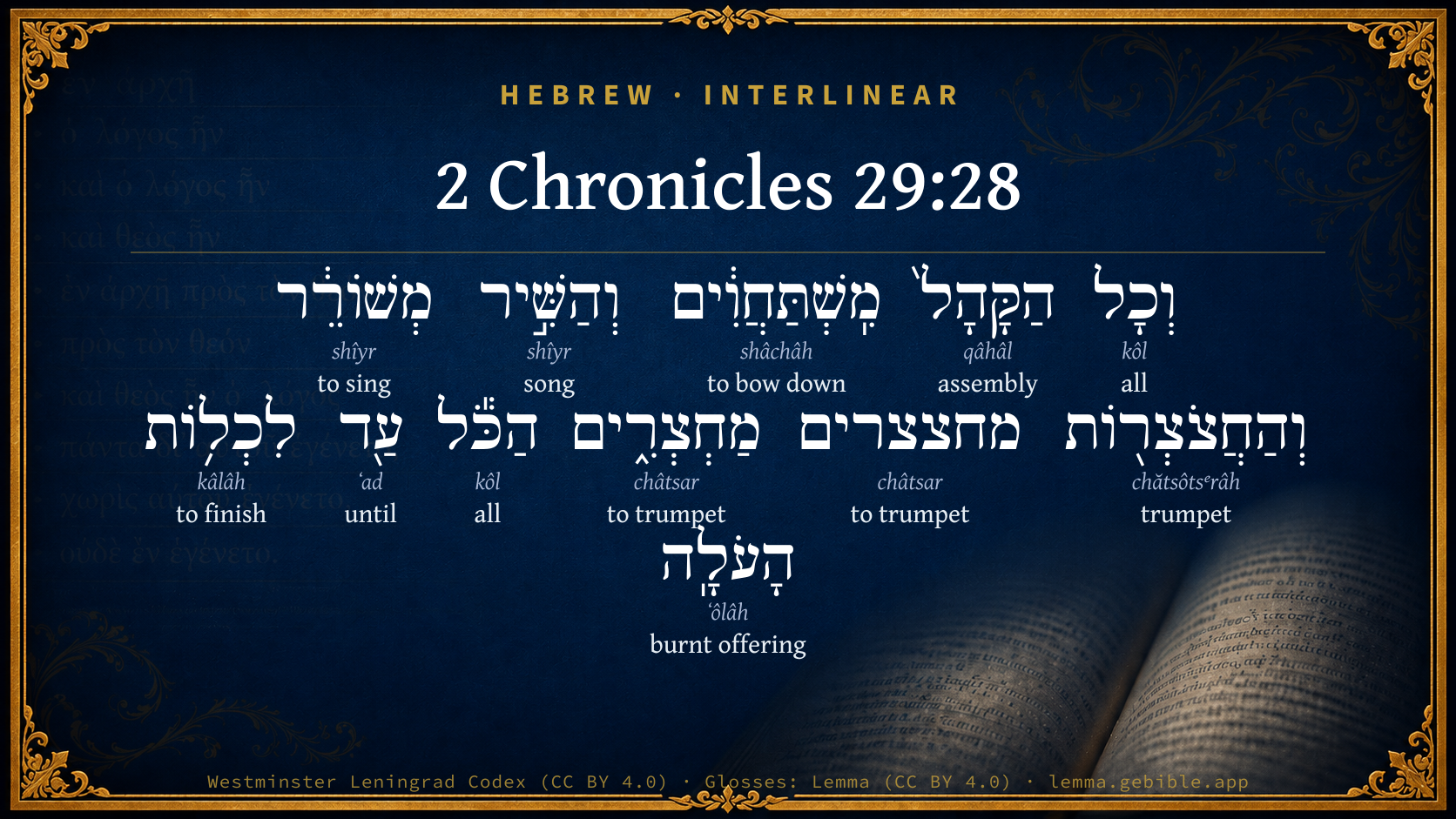
Hebrew (Westminster Leningrad Codex) 2 Chronicles 29:28 appears in the Hebrew Old Testament. The text above is from the Westminster Leningrad Codex. Each word links to its Strong’s number, a concise gloss, and parsing drawn from the Open Scriptures Hebrew Bible morphology. Click any word for its full Brown-Driver-Briggs (BDB) entry.
Download image
Cite this verse

2 Chronicles 29:28 (World English Bible). Public Domain. Lemma interlinear Bible study tool, https://lemma.gebible.app/v/2-chronicles/29/28.

Show BibTeX & RIS
BibTeX
RIS
English Translation
All the assembly worshiped, and the singers sang, and the trumpeters sounded; all this [continued] until the burnt offering was finished.
World English Bible · Public Domain
Download a study sheet

One document with this verse’s original text, its word-by-word gloss line, the meaning frame, cross-references with their text, attributed commentary, and full source and license credits — printable, and it pastes into notes with its structure intact.

This verse Autodidact and up

Study sheet (.html) Plain text (.txt)

A passage Seminary Student

Up to 50 verses in one chapter. A passage sheet keeps up to 6 commentary sources and 12 cross-references per verse, in the order this page ranks them, and says so on the sheet whenever that leaves anything out. Ask for a single verse and you get the Autodidact verse sheet above.

Everything on this page stays free to read, with no account — the sheet is a download of what is already on screen, not access to it.

Want to remove ads? Support Godless Engineer
Compare translations 3

The same verse in 3 English versions, stacked beneath the original-language interlinear above. Click any original word for its lexicon entry.

Each is an independent rendering of the whole verse — the interlinear is not word-aligned to these translations.

Highlighted words mark where these versions differ — a whole-verse word diff, not a word-by-word alignment.

  • World English Bible Public Domain
    All the assembly worshiped, and the singers sang, and the trumpeters sounded; all this [continued] until the burnt offering was finished.
  • King James Version Public Domain
    And all the congregation worshipped, and the singers sang, and the trumpeters sounded: and all this continued until the burnt offering was finished.
  • unfoldingWord Literal Text CC BY-SA 4.0
    And the whole assembly was worshipping, and the song was singing, and the trumpets were sounding, all until the burnt offering was finished.

unfoldingWord Literal Text — © unfoldingWord, licensed CC BY-SA 4.0. Word-aligned USFM3 via Door43 (git.door43.org/unfoldingWord/en_ult).

Versions to compare (up to 4)

3 of 4 selected

Show all 18 translations

Every available English version of this verse, each an independent rendering of the whole verse.

  • World English Bible Public Domain
    All the assembly worshiped, and the singers sang, and the trumpeters sounded; all this [continued] until the burnt offering was finished.
  • Berean Standard Bible Public Domain
    The whole assembly was worshiping, the singers were singing, and the trumpeters were playing. All this continued until the burnt offering was completed.
  • Majority Standard Bible Public Domain
    The whole assembly was worshiping, the singers were singing, and the trumpeters were playing. All this continued until the burnt offering was completed.
  • King James Version Public Domain
    And all the congregation worshipped, and the singers sang, and the trumpeters sounded: and all this continued until the burnt offering was finished.
  • American Standard Version (1901) Public Domain
    And all the assembly worshipped, and the singers sang, and the trumpeters sounded; all this `continued' until the burnt-offering was finished.
  • Revised Version (1885) Public Domain
    And all the congregation worshipped, and the singers sang, and the trumpeters sounded; all this continued until the burnt offering was finished.
  • Geneva Bible (1599) Public Domain
    And al the Congregation worshipped, singing a song, and they blew the trumpets: all this continued vntill the burnt offring was finished.
  • Douay-Rheims (1899) Public Domain
    And all the multitude adored, and the singers, and the trumpeters, were in their office till the holocaust was finished.
  • Young's Literal Translation Public Domain
    And all the assembly are doing obeisance, and the singers singing, and the trumpeters blowing; the whole `is' till the completion of the burnt-offering.
  • Literal Standard Version CC BY-SA 4.0
    And all the assembly are worshiping, and the singers singing, and the trumpeters blowing; the whole [is] until the completion of the burnt-offering.
  • Unlocked Literal Bible CC BY-SA 4.0
    All the assembly worshiped, the singers sang, and the trumpeters played; all this continued until the burnt offering was finished.
  • unfoldingWord Literal Text CC BY-SA 4.0
    And the whole assembly was worshipping, and the song was singing, and the trumpets were sounding, all until the burnt offering was finished.
  • Darby Bible Public Domain
    And all the congregation worshipped, and the singers sang, and the trumpeters sounded, all [the time] until the burnt-offering was finished.
  • World Messianic Bible Public Domain
    All the assembly worshiped, the singers sang, and the trumpeters sounded. All this continued until the burnt offering was finished.
  • Webster's Bible Public Domain
    And all the congregation worshiped, and the singers sang, and the trumpeters sounded: and all this continued until the burnt-offering was finished.
  • Free Bible Version CC BY-SA 4.0
    All the people in the assembly were worshiping, the singers were singing, and the trumpeters were playing. This continued until the burnt offering was finished.
  • Bible in Basic English Public Domain
    And all the people gave worship, to the sound of songs and the blowing of horns; and this went on till the burned offering was ended.
  • JPS Tanakh (1917) Public Domain
    And all the congregation prostrated themselves, and the singers sang, and the trumpeters sounded; all this continued until the burnt-offering was finished.

Literal Standard Version (2020), Covenant Press — licensed CC BY-SA 4.0. Text via the HelloAO Bible API (eBible.org). Unlocked Literal Bible (unfoldingWord) — licensed CC BY-SA 4.0. Text via the HelloAO Bible API (eBible.org). unfoldingWord Literal Text — © unfoldingWord, licensed CC BY-SA 4.0. Word-aligned USFM3 via Door43 (git.door43.org/unfoldingWord/en_ult). Free Bible Version, Dr. Jonathan Gallagher — licensed CC BY-SA 4.0. Text via the HelloAO Bible API (eBible.org).

Word by word

More ways to search: Search by grammar → Find every occurrence → Compare this word →

Practice this passage: Drill this verse → Learn its vocabulary →

מחצצרים
châtsar
H2690
“trumpeting”
Verb, Hiphil, Participle Active, Masculine, Plural, Absolute
Part of Speech
Verb
Stem
Hiphil
Form
Participle Active
Gender
Masculine
Number
Plural
State
Absolute
Full BDB Definition

Origin: a primitive root

TWOT: 726b

to sound a trumpet - (Piel) players on clarions (participle) - (Hiphil) sound with clarions (participle)
  1. וְכָל kôl H3605 “and · all of” Conjunction + Noun, Common, Masculine, Singular, Construct
  2. הַקָּהָל֙ qâhâl H6951 “the · assembly” Particle, Definite Article + Noun, Common, Masculine, Singular, Absolute
  3. מִֽשְׁתַּחֲוִ֔ים shâchâh H7812 “bowing down” Verb, Hishtaphel, Participle Active, Masculine, Plural, Absolute
  4. וְהַשִּׁ֣יר shîyr H7892 “and · the · song” Conjunction + Particle, Definite Article + Noun, Common, Both, Singular, Absolute
  5. מְשׁוֹרֵ֔ר shîyr H7891 “singing” Verb, Polel, Participle Active, Masculine, Singular, Absolute
  6. וְהַחֲצֹצְר֖וֹת chătsôtsᵉrâh H2689 “and · the · trumpets” Conjunction + Particle, Definite Article + Noun, Common, Feminine, Plural, Absolute
  7. מַחְצְרִ֑ים châtsar H2690 “trumpeting” Verb, Hiphil, Participle Active, Masculine, Plural, Absolute
  8. הַכֹּ֕ל kôl H3605 “the · all” Particle, Definite Article + Noun, Common, Masculine, Singular, Absolute
  9. עַ֖ד ʻad H5704 “until” Preposition
  10. לִכְל֥וֹת kâlâh H3615 “to finish” Preposition + Verb, Qal, Infinitive Construct
  11. הָעֹלָֽה ʻôlâh H5930 “the · burnt offering” Particle, Definite Article + Noun, Common, Feminine, Singular, Absolute

About this verse

These counts appear in no published source. They are computed here, from the morphology-tagged text and Lemma’s own curated glosses. What Lemma adds →

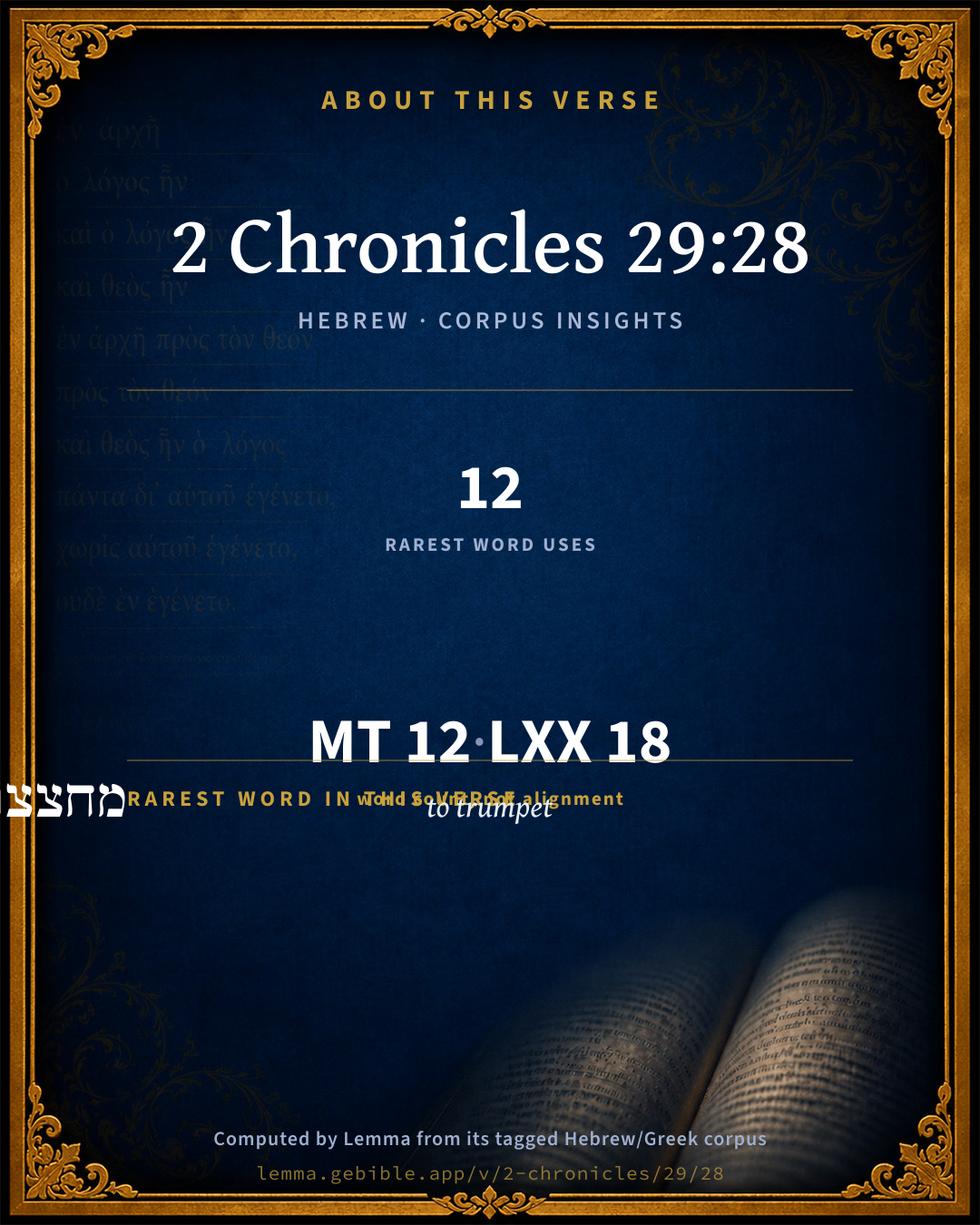
12
words
10
distinct lemmas
Historical
section

Notable vocabulary

The rarest word here is מחצצרים to trumpet H2690 — appearing just 12 times in the whole Hebrew Bible.

Shared distinctive vocabulary

מחצצרים to trumpet H2690 occurs in 6 verses of the Hebrew Bible. Also found in:

Grammatical profile

  • 5 verbs
  • 6 nouns
  • 1 preposition

Verb forms

  • מִֽשְׁתַּחֲוִ֔ים Hishtaphel · Participle Active
  • מְשׁוֹרֵ֔ר Polel · Participle Active
  • מחצצרים Hiphil · Participle Active
  • מַחְצְרִ֑ים Hiphil · Participle Active
  • לִכְל֥וֹת Qal · Infinitive Construct

Repetition

Words recur within this verse — often emphatic in Hebrew:

  • וְכָל all H3605 ×2
  • מחצצרים to trumpet H2690 ×2

Hebrew & Septuagint length

In English translation the verse runs 21 words from the Hebrew and 23 from the Septuagint (LXX English) — closely comparable.

A rough comparison of the two English renderings, which tokenize alike — not a word-level alignment.

Word counts can differ between the Hebrew and the Greek without any difference in meaning — e.g. the Hebrew direct-object marker אֵת has no separate Greek word, and Greek often adds the article ὁ.

In the original languages it is 12 Hebrew tokens and 18 Greek tokens — but the two are counted differently (Hebrew bundles its prefixes and suffixes into one token; the Greek is in lemma form), so that isn’t a like-for-like length.

Cross-references

3

Topical passages linked to 2 Chronicles 29:28 in the Treasury of Scripture Knowledge — connected by theme and wording, ordered by reader-vote popularity; previews shown in the World English Bible.

  • Psalms 68:24–26 They have seen your processions, God, Even the processions of my God, my King, into the sanctuary.
  • Psalms 89:15 Blessed are the people who learn to acclaim you. They walk in the light of your presence, Yahweh.
  • Revelation 5:8–14 Now when he had taken the book, the four living creatures and the twenty-four elders fell down before the Lamb, each one having a harp, and golden bowls full of incense, which are the prayers of the saints.

Cross-references courtesy of OpenBible.info (CC BY 4.0).

Hebrew and Greek witnesses Masoretic Hebrew ↔ Greek Septuagint

The same verse in the two great witnesses to the Old Testament, shown verse-for-verse.

These are two independent witnesses, not word-aligned to each other, and the Septuagint is shown in lemma (dictionary) form.

Hebrew 2 Chronicles 29:28 Masoretic · Westminster Leningrad Codex

וְכָל הַקָּהָל֙ מִֽשְׁתַּחֲוִ֔ים וְהַשִּׁ֣יר מְשׁוֹרֵ֔ר וְהַחֲצֹצְר֖וֹת מחצצרים מַחְצְרִ֑ים הַכֹּ֕ל עַ֖ד לִכְל֥וֹת הָעֹלָֽה

All the assembly worshiped, and the singers sang, and the trumpeters sounded; all this [continued] until the burnt offering was finished.

World English Bible · Public Domain

Greek LXX 2 Chronicles 29:28 Septuagint · lemma form

καί πᾶς ὁ ἐκκλησία προςκυνέω καί ὁ ψαλτῳδός ᾄδω καί ὁ σάλπιγξ σαλπίζω ἕως ὅς συντελέω ὁ ὁλοκαύτωσις

And all the congregation worshipped, and the psalm-singers were singing, and the trumpets sounding, until the whole burnt sacrifice had been completely offered.

LXX2012 (modern English Septuagint) · Public Domain

On this verse, Ellicott's Commentary for English Readers discusses the Septuagint’s reading. Read the note in Commentary ↓

Hebrew: Westminster Leningrad Codex (CC BY 4.0). Greek: Septuagint (public domain); English from LXX2012 (modern English Septuagint) (Public Domain). How the Septuagint differs from the Hebrew →

Commentary

Notes on 2 Chronicles 29:28 from classic Christian and Jewish commentators (each source and its license shown beneath its notes). The classic Christian expositions comment on the surrounding passage and are grouped to its opening verse, so a note may address several verses; the Jewish commentaries on the Tanakh (Rashi and others) are per-verse, so they appear only where the commentator wrote on this verse.

Lemma curates 59 commentaries, every one of them public domain or Creative Commons licensed, each selected and text-cleaned for this edition rather than reprinted as found. About our sources →

Trapp's Complete Commentary

John Trapp

2Ch 29:28 And all the congregation worshipped, and the singers sang, and the trumpeters sounded: [and] all [this continued] until the burnt offering was finished.

Ver. 28. And the singers sang.] Heb., And the song sang, i.e., the whole choir; or, as some will, the chief chanter.

John Trapp, A Commentary or Exposition upon All the Books of the Old and New Testament (1647–1656) — public domain. Text from a community e-Sword module.

Joseph Benson's Commentary

2Ch 29:28. And all the congregation worshipped — The king and all present testified their consent to, and concurrence in, all that was done by bowing their heads and worshipping, expressing an awful veneration for the divine majesty by postures of adoration. It is not enough for us to be where God is worshipped; if we do not ourselves worship him, and that not with bodily exercise only, which profits little, but with the heart.

Joseph Benson's Commentary on the Old and New Testaments (1811–1818) — public domain. Text from a community e-Sword module.

Ellicott's Commentary for English Readers

(28) Worshipped.—Were worshipping. LXX. προσεκύνει.

The singers.—Heb., the song. So we might say “the music was playing;” or even “the song was singing,” i.e., being sung.

The trumpeters sounded.—And the clarions were blowing (literally, clarioning). The participle is masculine, although the noun is properly feminine, because here the word “clarions” really stands for the clarion-players. So in modern orchestras they speak of “the violins,” or “the ‘cellos,” meaning the players on those instruments.

And all this.—Literally, the whole, until the burnt offering was finished.

This passage is highly interesting for the light it throws upon the mode in which the worship of the second Temple was conducted in the fourth century B.C., the probable age of the chronicler; and no doubt also in the times here treated of, for the Temple ritual would naturally be a matter of immemorial tradition. (Comp. 2Ch_7:5-6.)

A Bible Commentary for English Readers, edited by Charles John Ellicott (1878–1897) — public domain. Text from a community e-Sword module.

The Cambridge Bible for Schools and Colleges

gen. ed. J. J. S. Perowne

28. and all this] R.V. all this.

The Cambridge Bible for Schools and Colleges (gen. ed. J. J. S. Perowne; Cambridge University Press, 1878–1918) — public domain. Text from a community e-Sword module.

John Gill's Exposition

Moreover Hezekiah the king and the princes commanded the Levites to sing praise unto the Lord, with the words of David, and of Asaph the seer,.... Making use of psalms composed by the one and the other; Jarchi takes it to be the one hundred and fifth psalm, which begins, "O give thanks unto the Lord, call upon his name"; as in Ch1 16:7.

and they sang praises with gladness; the king and all the people:

and they bowed their heads and worshipped; made another adoration of the Divine Being, as deeply impressed with a sense of his greatness and goodness.

John Gill's Exposition of the Whole Bible (1746–1763) — public domain (CC PDM 1.0). Text via the HelloAO Bible API.

Lesson kit

Teaching starters — assembled from the data on this page, not authored interpretation. Every prompt links to the verse data it draws on. Edit before teaching.

2 Chronicles, in the Historical, opens this verse with 12 words (10 distinct Hebrew lemmas). Its most distinctive word is châtsar (“to trumpet”). A historical commentator’s framing appears above. Read the whole chapter for the surrounding context.

Discussion questions

  1. What does “to trumpet” (châtsar) contribute to the verse as a whole?
  2. How does 1 Chronicles 15:24, which shares the word «to trumpet», read alongside this verse?
  3. What does the repetition of “all” (2× in this one verse) do in this verse?
  4. These translations render this verse differently; the difference is in the English rendering, not the original. What questions does that raise?
  5. «מִֽשְׁתַּחֲוִ֔ים» is a Hishtaphel Participle Active verb. How does that grammatical form shape the action described?
  6. Compare how Trapp's Complete Commentary and Joseph Benson's Commentary read this verse. Where do they agree or differ?

Things to notice

Reading settings

Reading text

Shown beneath each verse's original-language words.

Old Testament
Old Testament edition

Read the OT as the Masoretic Hebrew (MT) or the Greek Septuagint (LXX).

English shown for the Greek Septuagint (in the Hebrew ↔ Greek comparison).

Comparing translations? Open the Compare panel on any verse page to stack up to four side by side.