
2 Kings 13:19

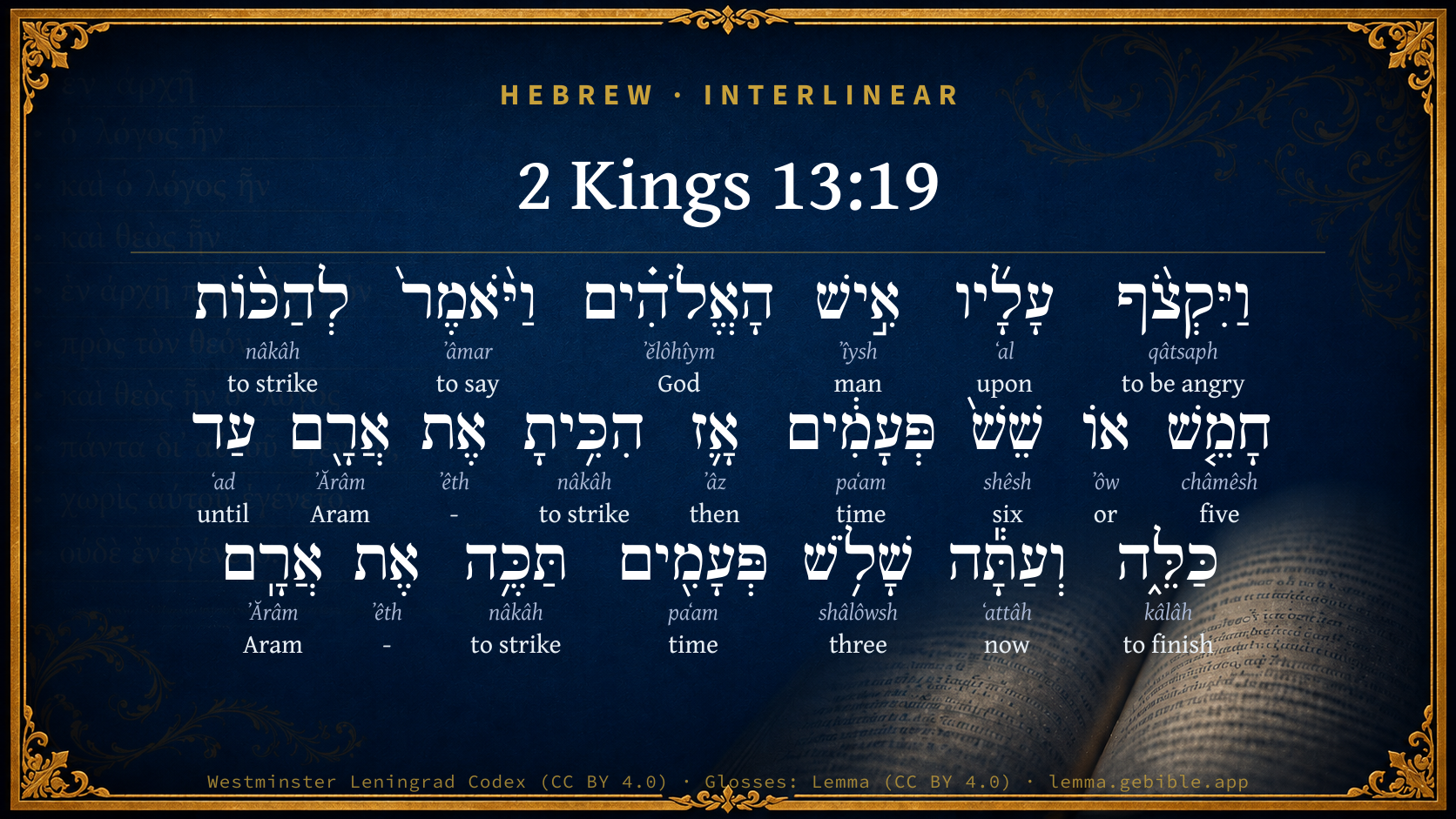
Hebrew (Westminster Leningrad Codex) 2 Kings 13:19 appears in the Hebrew Old Testament. The text above is from the Westminster Leningrad Codex. Each word links to its Strong’s number, a concise gloss, and parsing drawn from the Open Scriptures Hebrew Bible morphology. Click any word for its full Brown-Driver-Briggs (BDB) entry.
Download image
Cite this verse

2 Kings 13:19 (World English Bible). Public Domain. Lemma interlinear Bible study tool, https://lemma.gebible.app/v/2-kings/13/19.

Show BibTeX & RIS
BibTeX
RIS
English Translation
The man of God was angry with him, and said, You should have struck five or six times: then had you struck Syria until you had consumed it, whereas now you shall strike Syria but thrice.
World English Bible · Public Domain
Download a study sheet

One document with this verse’s original text, its word-by-word gloss line, the meaning frame, cross-references with their text, attributed commentary, and full source and license credits — printable, and it pastes into notes with its structure intact.

This verse Autodidact and up

Study sheet (.html) Plain text (.txt)

A passage Seminary Student

Up to 50 verses in one chapter. A passage sheet keeps up to 6 commentary sources and 12 cross-references per verse, in the order this page ranks them, and says so on the sheet whenever that leaves anything out. Ask for a single verse and you get the Autodidact verse sheet above.

Everything on this page stays free to read, with no account — the sheet is a download of what is already on screen, not access to it.

Want to remove ads? Support Godless Engineer
Compare translations 3

The same verse in 3 English versions, stacked beneath the original-language interlinear above. Click any original word for its lexicon entry.

Each is an independent rendering of the whole verse — the interlinear is not word-aligned to these translations.

Highlighted words mark where these versions differ — a whole-verse word diff, not a word-by-word alignment.

  • World English Bible Public Domain
    The man of God was angry with him, and said, You should have struck five or six times: then had you struck Syria until you had consumed it, whereas now you shall strike Syria but thrice.
  • King James Version Public Domain
    And the man of God was wroth with him, and said, Thou shouldest have smitten five or six times; then hadst thou smitten Syria till thou hadst consumed it: whereas now thou shalt smite Syria but thrice.
  • unfoldingWord Literal Text CC BY-SA 4.0
    And the man of God became angry with him, and he said, “Striking five or six times, then you would have struck Aram to finishing. But now, you will strike Aram three times.”

unfoldingWord Literal Text — © unfoldingWord, licensed CC BY-SA 4.0. Word-aligned USFM3 via Door43 (git.door43.org/unfoldingWord/en_ult).

Versions to compare (up to 4)

3 of 4 selected

Show all 18 translations

Every available English version of this verse, each an independent rendering of the whole verse.

  • World English Bible Public Domain
    The man of God was angry with him, and said, You should have struck five or six times: then had you struck Syria until you had consumed it, whereas now you shall strike Syria but thrice.
  • Berean Standard Bible Public Domain
    But the man of God was angry with him and said, “You should have struck the ground five or six times. Then you would have struck down Aram until you had put an end to it. But now you will strike down Aram only three times.”
  • Majority Standard Bible Public Domain
    But the man of God was angry with him and said, “You should have struck the ground five or six times. Then you would have struck down Aram until you had put an end to it. But now you will strike down Aram only three times.”
  • King James Version Public Domain
    And the man of God was wroth with him, and said, Thou shouldest have smitten five or six times; then hadst thou smitten Syria till thou hadst consumed it: whereas now thou shalt smite Syria but thrice.
  • American Standard Version (1901) Public Domain
    And the man of God was wroth with him, and said, Thou shouldest have smitten five or six times: then hadst thou smitten Syria till thou hadst consumed it, whereas now thou shalt smite Syria but thrice.
  • Revised Version (1885) Public Domain
    And the man of God was wroth with him, and said, Thou shouldest have smitten five or six times; then hadst thou smitten Syria till thou hadst consumed it: whereas now thou shalt smite Syria but thrice.
  • Geneva Bible (1599) Public Domain
    Then the man of God was angry with him, and sayde, Thou shouldest haue smitten fiue or sixe times, so thou shouldest haue smitten Aram, till thou haddest consumed it, where nowe thou shalt smite Aram but thrise.
  • Douay-Rheims (1899) Public Domain
    And the man of God was angry with him, and said: If thou hadst smitten five or six or seven times, thou hadst smitten Syria even to utter destruction: but now three times shalt thou smite it.
  • Young's Literal Translation Public Domain
    And the man of God is wroth against him, and saith, `By smiting five or six times then thou hadst smitten Aram till consuming; and now, three times thou dost smite Aram.'
  • Literal Standard Version CC BY-SA 4.0
    And the man of God is angry against him and says, “By striking five or six times then you had struck Aram until consuming; but now you [only] strike Aram three times.”
  • Unlocked Literal Bible CC BY-SA 4.0
    But the man of God was angry with him and said, “You should have hit the ground five or six times. Then you would have attacked Aram until you annihilated it, but now you will attack Aram only three times.”
  • unfoldingWord Literal Text CC BY-SA 4.0
    And the man of God became angry with him, and he said, “Striking five or six times, then you would have struck Aram to finishing. But now, you will strike Aram three times.”
  • Darby Bible Public Domain
    And the man of God was wroth with him, and said, Thou shouldest have smitten five or six times; then wouldest thou have smitten the Syrians till thou hadst consumed [them]; whereas now thou shalt smite Syria but thrice.
  • World Messianic Bible Public Domain
    The man of God was angry with him, and said, “You should have struck five or six times. Then you would have struck Syria until you had consumed it, but now you will strike Syria just three times.”
  • Webster's Bible Public Domain
    And the man of God was wroth with him, and said, Thou shouldst have smitten five or six times; then hadst thou smitten Syria till thou hadst consumed it: whereas now thou shalt smite Syria but thrice.
  • Free Bible Version CC BY-SA 4.0
    The man of God got angry with him, telling him, “You should have hit the ground five or six times. Then you would have attacked the Arameans until you had completely destroyed them. But now you will only attack the Arameans three times.”
  • Bible in Basic English Public Domain
    Then the man of God was angry with him and said, If you had done it five or six times, then you would have overcome Aram completely; but now you will only overcome them three times.
  • JPS Tanakh (1917) Public Domain
    And the man of God was wroth with him, and said: 'Thou shouldest have smitten five or six times; then hadst thou smitten Aram till thou hadst consumed it; whereas now thou shalt smite Aram but thrice.'

Literal Standard Version (2020), Covenant Press — licensed CC BY-SA 4.0. Text via the HelloAO Bible API (eBible.org). Unlocked Literal Bible (unfoldingWord) — licensed CC BY-SA 4.0. Text via the HelloAO Bible API (eBible.org). unfoldingWord Literal Text — © unfoldingWord, licensed CC BY-SA 4.0. Word-aligned USFM3 via Door43 (git.door43.org/unfoldingWord/en_ult). Free Bible Version, Dr. Jonathan Gallagher — licensed CC BY-SA 4.0. Text via the HelloAO Bible API (eBible.org).

Word by word

More ways to search: Search by grammar → Find every occurrence → Compare this word →

Practice this passage: Drill this verse → Learn its vocabulary →

וַיִּקְצֹ֨ף
qâtsaph
H7107
“and · to be angry”
Conjunction + Verb, Qal, Sequential Imperfect, 3rd Person, Masculine, Singular
Part of Speech
Conjunction + Verb
Stem
Qal
Form
Sequential Imperfect
Person
3rd Person
Gender
Masculine
Number
Singular
Full BDB Definition

Origin: a primitive root

TWOT: 2058

to be displeased, be angry, fret oneself, be wroth - (Qal) to be wroth, to be full of wrath, to be furious - (Hiphil) to provoke to wrath or anger - (Hithpael) to put oneself in a rage, anger oneself
  1. עָלָ֜יו ʻal H5921 “upon · him” Preposition + Suffix, Personal, 3rd Person, Masculine, Singular
  2. אִ֣ישׁ ʼîysh H376 “man of” Noun, Common, Masculine, Singular, Construct
  3. הָאֱלֹהִ֗ים ʼĕlôhîym H430 “the · God(s)” Particle, Definite Article + Noun, Common, Masculine, Plural, Absolute
  4. וַיֹּ֨אמֶר֙ ʼâmar H559 “and · to say” Conjunction + Verb, Qal, Sequential Imperfect, 3rd Person, Masculine, Singular
  5. לְהַכּ֨וֹת nâkâh H5221 “to strike” Preposition + Verb, Hiphil, Infinitive Construct
  6. חָמֵ֤שׁ châmêsh H2568 “five” Adjective, Cardinal number, Feminine, Singular, Absolute
  7. אוֹ ʼôw H176 “or” Conjunction
  8. שֵׁשׁ֙ shêsh H8337 “six” Adjective, Cardinal number, Feminine, Singular, Absolute
  9. פְּעָמִ֔ים paʻam H6471 “times” Noun, Common, Feminine, Plural, Absolute
  10. אָ֛ז ʼâz H227 “then” Adverb
  11. הִכִּ֥יתָ nâkâh H5221 “to strike” Verb, Hiphil, Perfect, 2nd Person, Masculine, Singular
  12. אֶת ʼêth H853 “-” Particle, Direct Object
  13. אֲרָ֖ם ʼĂrâm H758 “Aram” Noun, Proper
  14. עַד ʻad H5704 “until” Preposition
  15. כַּלֵּ֑ה kâlâh H3615 “to finish” Verb, Piel, Infinitive Absolute
  16. וְעַתָּ֕ה ʻattâh H6258 “and · now” Conjunction + Adverb
  17. שָׁלֹ֥שׁ shâlôwsh H7969 “three” Adjective, Cardinal number, Feminine, Singular, Absolute
  18. פְּעָמִ֖ים paʻam H6471 “times” Noun, Common, Feminine, Plural, Absolute
  19. תַּכֶּ֥ה nâkâh H5221 “to strike” Verb, Hiphil, Imperfect, 2nd Person, Masculine, Singular
  20. אֶת ʼêth H853 “-” Particle, Direct Object
  21. אֲרָֽם ʼĂrâm H758 “Aram” Noun, Proper

About this verse

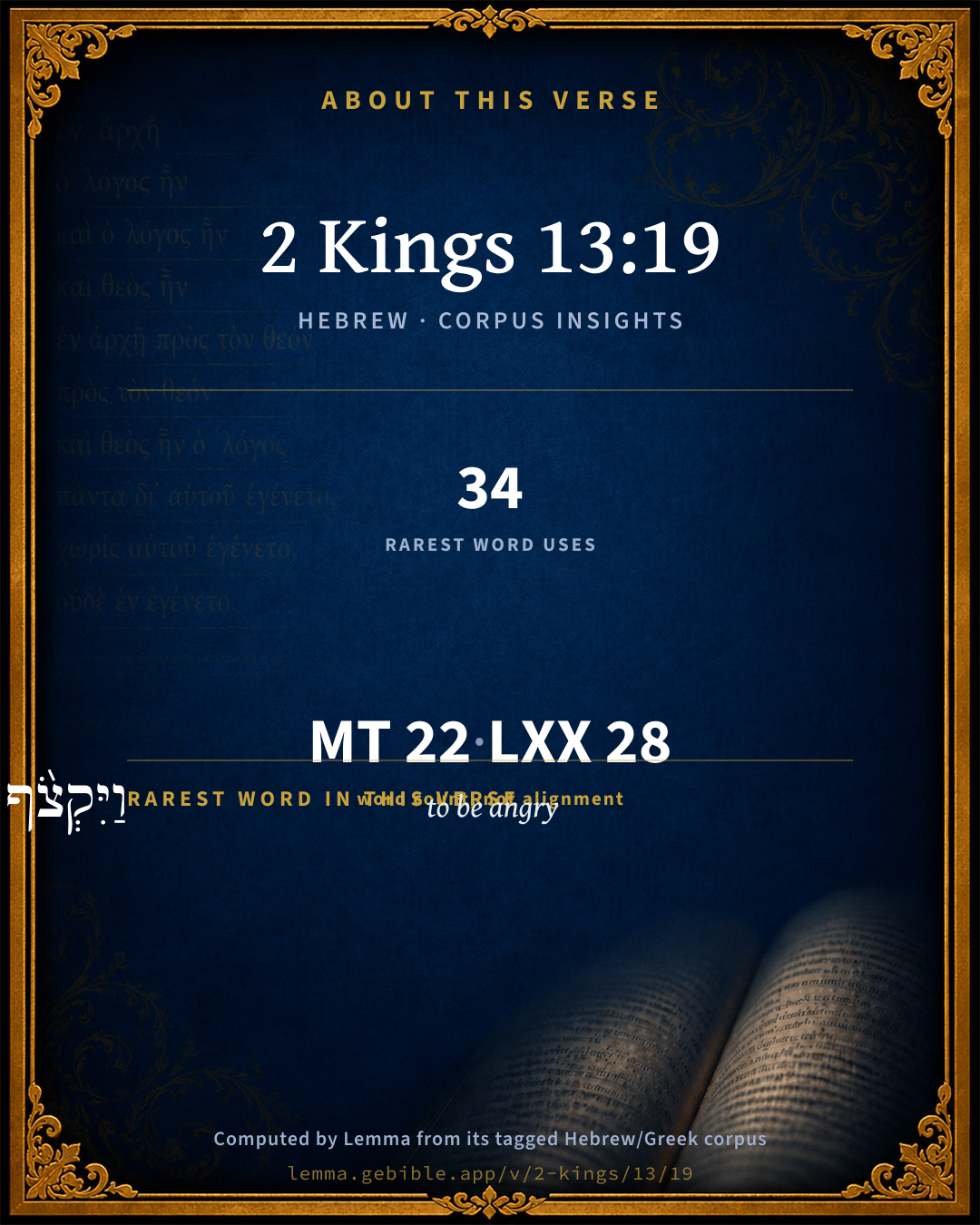
These counts appear in no published source. They are computed here, from the morphology-tagged text and Lemma’s own curated glosses. What Lemma adds →

22
words
17
distinct lemmas
Historical
section

Shared distinctive vocabulary

וַיִּקְצֹ֨ף to be angry H7107 occurs in 32 verses of the Hebrew Bible. Also found in:

Grammatical profile

  • 6 verbs
  • 6 nouns
  • 3 adjectives
  • 2 prepositions
  • 1 conjunction
  • 2 adverbs
  • 2 particles

Verb forms

  • וַיִּקְצֹ֨ף Qal · Sequential Imperfect
  • וַיֹּ֨אמֶר֙ Qal · Sequential Imperfect
  • לְהַכּ֨וֹת Hiphil · Infinitive Construct
  • הִכִּ֥יתָ Hiphil · Perfect
  • כַּלֵּ֑ה Piel · Infinitive Absolute
  • תַּכֶּ֥ה Hiphil · Imperfect

Repetition

Words recur within this verse — often emphatic in Hebrew:

  • לְהַכּ֨וֹת to strike H5221 ×3
  • פְּעָמִ֔ים time H6471 ×2
  • אֲרָ֖ם Aram H758 ×2

Hebrew & Septuagint length

In English translation the verse runs 36 words from the Hebrew and 38 from the Septuagint (LXX English) — closely comparable.

A rough comparison of the two English renderings, which tokenize alike — not a word-level alignment.

Word counts can differ between the Hebrew and the Greek without any difference in meaning — e.g. the Hebrew direct-object marker אֵת has no separate Greek word, and Greek often adds the article ὁ.

In the original languages it is 22 Hebrew tokens and 28 Greek tokens — but the two are counted differently (Hebrew bundles its prefixes and suffixes into one token; the Greek is in lemma form), so that isn’t a like-for-like length.

Cross-references

10

Topical passages linked to 2 Kings 13:19 in the Treasury of Scripture Knowledge — connected by theme and wording, ordered by reader-vote popularity; previews shown in the World English Bible.

  • 2 Kings 13:25 Jehoash the son of Jehoahaz took again out of the hand of Benhadad the son of Hazael the cities which he had taken out of the hand of Jehoahaz his father by war. Three times did Joash strike him, and recovered the cities of Israel.
  • Leviticus 10:16 Moses diligently inquired about the goat of the sin offering, and, behold, it was burned: and he was angry with Eleazar and with Ithamar, the sons of Aaron who were left, saying,
  • Numbers 16:15 Moses was very angry, and said to Yahweh, "Don't respect their offering: I have not taken one donkey from them, neither have I hurt one of them."
  • 2 Kings 1:9–15 Then [the king] sent to him a captain of fifty with his fifty. He went up to him: and, behold, he was sitting on the top of the hill. He spoke to him, man of God, the king has said, Come down.
  • 2 Kings 4:16 He said, At this season, when the time comes round, you shall embrace a son. She said, No, my lord, you man of God, do not lie to your handmaid.
  • 2 Kings 4:40 So they poured out for the men to eat. It happened, as they were eating of the stew, that they cried out, and said, man of God, there is death in the pot. They could not eat of it.
  • 2 Kings 6:9 The man of God sent to the king of Israel, saying, Beware that you not pass such a place; for there the Syrians are coming down.
  • Mark 3:5 When he had looked around at them with anger, being grieved at the hardening of their hearts, he said to the man, "Stretch out your hand." He stretched it out, and his hand was restored as healthy as the other.
  • Mark 6:5 He could do no mighty work there, except that he laid his hands on a few sick people, and healed them.
  • Mark 10:14 But when Jesus saw it, he was moved with indignation, and said to them, "Allow the little children to come to me! Don't forbid them, for the Kingdom of God belongs to such as these.

Cross-references courtesy of OpenBible.info (CC BY 4.0).

Hebrew and Greek witnesses Masoretic Hebrew ↔ Greek Septuagint

The same verse in the two great witnesses to the Old Testament, shown verse-for-verse.

These are two independent witnesses, not word-aligned to each other, and the Septuagint is shown in lemma (dictionary) form.

Hebrew 2 Kings 13:19 Masoretic · Westminster Leningrad Codex

וַיִּקְצֹ֨ף עָלָ֜יו אִ֣ישׁ הָאֱלֹהִ֗ים וַיֹּ֨אמֶר֙ לְהַכּ֨וֹת חָמֵ֤שׁ אוֹ שֵׁשׁ֙ פְּעָמִ֔ים אָ֛ז הִכִּ֥יתָ אֶת אֲרָ֖ם עַד כַּלֵּ֑ה וְעַתָּ֕ה שָׁלֹ֥שׁ פְּעָמִ֖ים תַּכֶּ֥ה אֶת אֲרָֽם

The man of God was angry with him, and said, You should have struck five or six times: then had you struck Syria until you had consumed it, whereas now you shall strike Syria but thrice.

World English Bible · Public Domain

Greek LXX 2 Kings 13:19 Septuagint · lemma form

καί λυπέω ἐπί αὐτός ὁ ἄνθρωπος ὁ θεός καί εἶπον εἰ πατάσσω πεντάκις ἤ ἑξάκις τότε ἄν πατάσσω ὁ συρία ἕως συντέλεια καί νῦν τρίς πατάσσω ὁ συρία

And the man of God was grieved at him, and said, If you had struck five or six times, then you should have struck Syria till you had consumed them; but now you shall strike Syria only thrice.

LXX2012 (modern English Septuagint) · Public Domain

On this verse, Haydock's Catholic Bible Commentary discusses the Septuagint’s reading. Read the note in Commentary ↓

Hebrew: Westminster Leningrad Codex (CC BY 4.0). Greek: Septuagint (public domain); English from LXX2012 (modern English Septuagint) (Public Domain). How the Septuagint differs from the Hebrew →

Targum (Aramaic paraphrase)

1

The Targum is the ancient Jewish Aramaic paraphrase of the Hebrew Scriptures — an interpretive translation, not the Hebrew text itself. Onkelos (literal) and Pseudo-Jonathan (expansive) render the Torah, and Jonathan the Prophets. Coverage is partial: where no permissively-licensed English translation exists for a verse, only the Aramaic is shown. This is verse-level text, not a word-by-word alignment to the Hebrew.

  1. Targum Jonathan Prophets (Joshua–Malachi)
    וּרְגֵיז עֲלוֹהִי נְבִיָא דַייָ וַאֲמַר הֲוָה חָזֵי לָךְ לְמִמְחֵי חֲמֵשׁ אוֹ שִׁית זִמְנִין בְּכֵן פּוֹן מְחֵיתָא יַת אֱנַשׁ אֲרָם עַד שֵׁיצָיוּתָא וּכְעַן תְּלַת זִמְנִין תִּמְחֵי יַת אֱנַשׁ אֲרָם:

    (no public-domain English translation for this verse)

    Targum Jonathan — Aramaic: “Mikraot Gedolot” (public domain). English: “Sefaria Community Translation” (CC0 1.0 (public-domain dedication)); “London "Chaldee Paraphrase," 1871” (public domain). Text via Sefaria.

Commentary

Notes on 2 Kings 13:19 from classic Christian and Jewish commentators (each source and its license shown beneath its notes). The classic Christian expositions comment on the surrounding passage and are grouped to its opening verse, so a note may address several verses; the Jewish commentaries on the Tanakh (Rashi and others) are per-verse, so they appear only where the commentator wrote on this verse.

Lemma curates 59 commentaries, every one of them public domain or Creative Commons licensed, each selected and text-cleaned for this edition rather than reprinted as found. About our sources →

Trapp's Complete Commentary

John Trapp

2Ki 13:19 And the man of God was wroth with him, and said, Thou shouldest have smitten five or six times; then hadst thou smitten Syria till thou hadst consumed [it]: whereas now thou shalt smite Syria [but] thrice.

Ver. 19. Thou shalt smite Israel but thrice.] And this for a punishment of the king’s slackness and slothfulness in pursuing the execution of God’s vengeance on the enemies, which the prophet might foresee.

John Trapp, A Commentary or Exposition upon All the Books of the Old and New Testament (1647–1656) — public domain. Text from a community e-Sword module.

Geneva Bible (1599)

Geneva Bible translators

Because he seemed content to have victory against the enemies of God for twice or thrice, and had not a zeal to overcome them continually, and to destroy them utterly.

Geneva Bible (1599) marginal notes — public domain. Text via Bolls.life.

Ellicott's Commentary for English Readers

(19) The man of God was wroth with him.—Because his present want of zeal augured a like deficiency in prosecuting the war hereafter. The natural irritability of the sick man may also have had something to do with it. Thenius well remarks on the manifestly historical character of the entire scene. It may be added that, to appreciate it fully, we must remember that βελομαυτεία, or soothsaying by means of arrows, was a practice of unknown antiquity in the Semitic world. Shooting an arrow, and observing where and how it fell, was one method of trying to fathom the secrets of that Power which overrules events and foreknows the future. The proceedings of David and Jonathan, recorded in 1Sa_20:35, seq., appear to have been an instance of this sort of divination, which in principle is quite analogous to casting lots, a practice so familiar to readers of the Bible. The second process—that described in 2Ki_13:18—seems equally to have depended upon chance, according to modern ideas. The prophet left it to the spontaneous impulse of the king to determine the number of strokes; because he believed that the result, whatever it was, would betoken the purpose of Jehovah. “The lot is cast into the lap, but the whole disposing thereof is of the Lord” (Pro_16:33). Elisha’s anger was the natural anger of the man and the patriot, disappointed at the result of a divination from which he had hoped greater things. In conclusion, it cannot be too often or too forcibly urged upon students of the true religion that the essential differences which isolate it from all imperfect or retrograde systems are to be found not so much in matters of outward organisation, form, and ritual, such as priesthoods and sacrifices, prophets and modes of divination, which were pretty much the same everywhere in Semitic antiquity; but in the inward spirit and substance of its teaching, in the vital truths which it handed on through successive ages, and, above all, in its steady progress from lower to higher conceptions of the Divine character and purposes, and of the right relations of man to God and his fellow-creatures.

A Bible Commentary for English Readers, edited by Charles John Ellicott (1878–1897) — public domain. Text from a community e-Sword module.

The Cambridge Bible for Schools and Colleges

gen. ed. J. J. S. Perowne

19. the man of God was wroth] We must think of sorrow as well as anger. We can see through all Elisha’s life, that the welfare of his country was very dear to him. Hence his desire that the king should accept God’s announcement of victory with eagerness, and his grief that he did not.

The Cambridge Bible for Schools and Colleges (gen. ed. J. J. S. Perowne; Cambridge University Press, 1878–1918) — public domain. Text from a community e-Sword module.

John Gill's Exposition

And it came to pass, as they were burying a man,.... That is, as they were going to bury him; for as yet they were not come to the place they designed to bury him at, as appears by what follows:

that, behold, they spied a band of men; one of the bands of the Moabites, which came to rob and plunder, and which was about the place where they intended to bury the man; or they supposed would be there by that time they got to it, or at least before they could bury him, and therefore being frightened stopped:

and they cast the man into the sepulchre of Elisha; that being nearest, they opened it, or rather rolled away the stone from it, and threw the body in great haste:

and when the man was let down, and touched the bone's of Elisha; or "went and touched" (r); that is, as Kimchi interprets it, being cast in, he rolled till he came to the body of the prophet, and touched it:

he revived, and stood upon his feet; which might serve to confirm the faith of Joash in the predictions of the prophet concerning his victories; is a proof of the resurrection of the dead, and of eternal life, and an emblem of our being quickened through the death of Christ. The Jews say (s) this man was Shallum the son of Tikvah, and husband of Huldah the prophetess, and was a good man, much given to alms, for which he was rewarded; and they further say, he went to his own house, and lived many years, and begat children, and particularly Hananeel, mentioned in Jer 32:7, which is not likely; though others say (t) he was a wicked man, Zedekiah the son of Chenaanah, Kg1 22:24 and therefore not suffered to continue in the prophet's grave; but the former is more probable; and, according to Josephus (u), it was the band of robbers that left this man, whom they had murdered, in the grave of Elisha. This grave seems to have been in the field, where the Jews of old, and in later times, buried, as in the field of Hebron, the potter's field, &c. so the Greeks, as Pausanias relates (w), and the Romans also (x), buried by the wayside.

(r) "abit et tetigit", Pagninus, Montanus. (s) Pirke Eliezer, c. 33. (t) T. Bab. Sanhedrin, fol, 47. 1. Shalshalet Hakabala, fol. 11. 2. (u) Antiqu. l. 9. c. 8. sect. 6. (w) Corinthiac. sive, l. 2. p. 97. (x) Vid. Kirchman. Funer. Roman. l. 2. c. 22.

John Gill's Exposition of the Whole Bible (1746–1763) — public domain (CC PDM 1.0). Text via the HelloAO Bible API.

Albert Barnes' Notes on the Bible

The unfaithfulness of man limits the goodness of God. Though Joash did the prophet’s bidding, it was without any zeal or fervour; and probably without any earnest belief in the efficacy of what he was doing. Compare Mar 6:5-6. God had been willing to give the Israelites complete victory over Syria 2Ki 13:17; but Joash by his non-acceptance of the divine promise in its fulness had checked the outflow of mercy; and the result was that the original promise could not be fulfilled.

Albert Barnes' Notes on the Bible (1834–1885) — public domain. Text from a community e-Sword/MySword module.

Haydock's Catholic Bible Commentary

Angry. Septuagint, "grieved." (Haydock) --- Or seven is omitted in Hebrew and Septuagint. This text proves that God knows what would take place conditionally. (Tirinus) --- If, &c. By this it appears, that God had revealed to the prophet that the king should overcome the Syrians, as many times as he should then strike on the ground; but, as he had not, at the same time, revealed to him how often the king would strike, the prophet was concerned to see that he struck but thrice. (Challoner) --- Joas was assured that he should consume the Syrians. But this was to be understood, provided he performed this part, (Menochius; Tirinus) and that destruction was not said to be entire. (Haydock)

George Leo Haydock (1774–1849), Haydock's Catholic Family Bible and Commentary, 1859 edition — public domain. Excludes Psalms (Douay-Rheims chapter numbering differs from Protestant) and Deuterocanonical books (Catholic canon only).

Matthew Poole's English Annotations

Quest. Wherein was Jehoash’s fault, or why was the prophet angry with him?

Answ. The prophet himself did not yet know how many victories Jehoash should obtain against the Syrians, but God had signified to him that he should learn that by the number of the king’s strokes. And he was angry with him, not simply because he smote only thrice, but because by his unbelief and idolatry he provoked God so to overrule his heart and hand that he should smite but thrice, which was a token that God would assist him no further; although his smiting but thrice might proceed either from his unbelief or negligence. For by the former sign, and the prophet’s comment upon it, he might clearly perceive that this also was intended as a sign of his success against the Syrians, and therefore he ought to have done it frequently and vehemently.

Matthew Poole's English Annotations on the Holy Bible (1683–1685) — public domain. Text from a community e-Sword/MySword module.

Whedon's Commentary on the Bible

Daniel D. Whedon

19. Thou shouldest have smitten five or six times — And therefore his smiting but three times symbolized that lack of determination and perseverance whereby he would fail to overthrow, effectually, the Syrian power.

Daniel D. Whedon (gen. ed.), Commentary on the Old and New Testaments (1874–1909) — public domain. Text from a community e-Sword module.

The Pulpit Commentary

And the man of God. (comp. 2Ki_4:7, 25 6:6, 9 8:4, etc.) was wroth with him. Elisha was angered at the lukewarmness of Joash, and his lack of faith and zeal. He himself, from his higher standpoint, saw the greatness of the opportunity, the abundance of favor which God was ready to grant, and the way in which God"s favor was stinted and narrowed by Joash"s want of receptiveness. Had the king been equal to the occasion, a full end might at once have been made of Syria, and Israel might have been enabled to brace herself for the still more perilous struggle with Assyria, in which she ultimately succumbed. And said, Thou shouldest have smitten five or six times; then hadst thou smitten Syria till thou hadst consumed it. It has been suggested that Joash associated the number throe with the notion of completeness, and "thought that what was done thrice was done perfectly" (Bahr); but in this case the prophet would scarcely have been angered. It is far more consonant with the entire narrative to suppose that he stopped from mere weariness, and want of strong faith and zeal. If he had been earnestly desirous of victory, and had had faith in the symbolical action as divinely directed, he would have kept on smiting till the prophet told him it was enough, or at any rate would have smitten the ground five or six times instead of three. The idea that he abstained from modesty or from prudence, "lest too extravagant demands might deprive him of all" (Von Gerlach), finds no support in the text of the narrative. He abstained (as Keil says) because "he was wanting in the proper zeal for obtaining the full promises of God." Had it been otherwise, the complete success obtained by Jeroboam II (2Ki_4:25-28) might have been anticipated by the space of fifteen or twenty years. Whereas now thou shalt smite Syria but thrice (comp. ver. 25, which declares that this prophecy was exactly accomplished).

The Pulpit Commentary (1880–1919), ed. H.D.M. Spence-Jones & Joseph S. Exell — public domain. Text from a community e-Sword module.

Rashi

Rabbi Shlomo Yitzchaki (Rashi)

And [he] said, “[If only] you had struck [the arrows at the ground] five or six times. [I.e.,] you should have.

Then. Had you done so, you would have struck Arom five or six times, for as a symbol of victory, I placed your hands on the bow.

Rashi on the Tanakh — English translations: “The Judaica Press complete Tanach with Rashi, translated by A. J. Rosenberg” (CC BY 4.0); “Pentateuch with Rashi's commentary by M. Rosenbaum and A.M. Silbermann, 1929-1934” (public domain); “The Metsudah Tanach series, Lakewood, N.J” (CC BY 4.0); and “The Book of Joshua, Metsudah Publications, 1997” (CC BY 4.0). Text via Sefaria.

Lesson kit

Teaching starters — assembled from the data on this page, not authored interpretation. Every prompt links to the verse data it draws on. Edit before teaching.

2 Kings, in the Historical, opens this verse with 22 words (17 distinct Hebrew lemmas). Its most distinctive word is qâtsaph (“to be angry”). A historical commentator’s framing appears above. Read the whole chapter for the surrounding context.

Discussion questions

  1. The word qâtsaph carries the sense “to be angry.” How does it shape the verse?
  2. Genesis 40:2 shares the word «to be angry» with this verse. How do the two illuminate each other?
  3. “to strike” occurs 3× in this one verse. What is the effect of the repetition?
  4. These translations render this verse differently; the difference is in the English rendering, not the original. What questions does that raise?
  5. The verb «וַיִּקְצֹ֨ף» is Qal Sequential Imperfect. How does its form color the action?
  6. Reading how Trapp's Complete Commentary and Geneva Bible (1599) read this verse, where do the two commentators agree and where do they part?

Things to notice

Reading settings

Reading text

Shown beneath each verse's original-language words.

Old Testament
Old Testament edition

Read the OT as the Masoretic Hebrew (MT) or the Greek Septuagint (LXX).

English shown for the Greek Septuagint (in the Hebrew ↔ Greek comparison).

Comparing translations? Open the Compare panel on any verse page to stack up to four side by side.