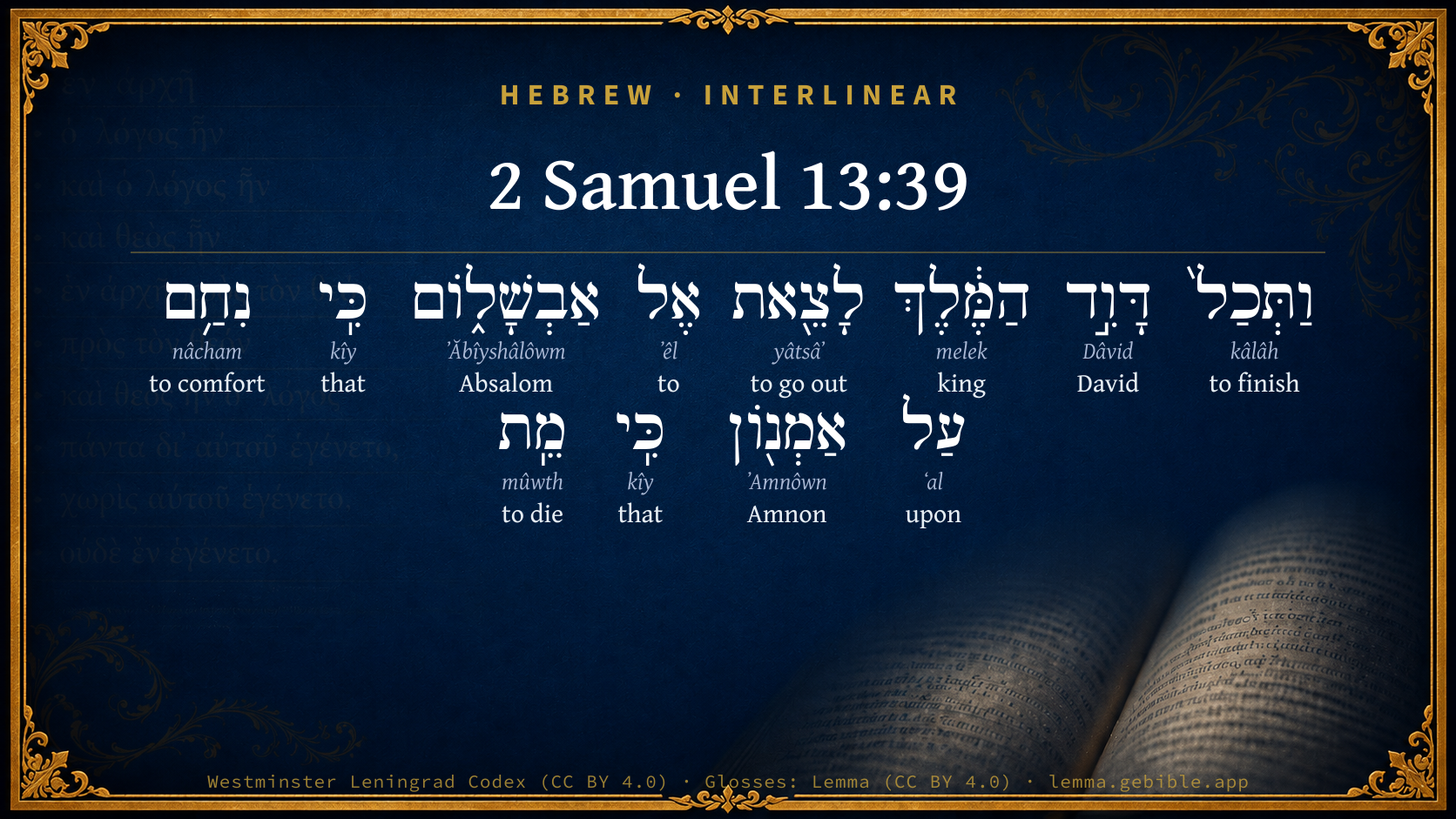
2 Samuel 13:39

Hebrew (Westminster Leningrad Codex) 2 Samuel 13:39 appears in the Hebrew Old Testament. The text above is from the Westminster Leningrad Codex. Each word links to its Strong’s number, a concise gloss, and parsing drawn from the Open Scriptures Hebrew Bible morphology. Click any word for its full Brown-Driver-Briggs (BDB) entry.
Download image
Cite this verse

2 Samuel 13:39 (World English Bible). Public Domain. Lemma interlinear Bible study tool, https://lemma.gebible.app/v/2-samuel/13/39.

Show BibTeX & RIS
BibTeX
RIS
English Translation
[the soul of] king David longed to go forth to Absalom: for he was comforted concerning Amnon, seeing he was dead.
World English Bible · Public Domain
Download a study sheet

One document with this verse’s original text, its word-by-word gloss line, the meaning frame, cross-references with their text, attributed commentary, and full source and license credits — printable, and it pastes into notes with its structure intact.

This verse Autodidact and up

Study sheet (.html) Plain text (.txt)

A passage Seminary Student

Up to 50 verses in one chapter. A passage sheet keeps up to 6 commentary sources and 12 cross-references per verse, in the order this page ranks them, and says so on the sheet whenever that leaves anything out. Ask for a single verse and you get the Autodidact verse sheet above.

Everything on this page stays free to read, with no account — the sheet is a download of what is already on screen, not access to it.

Want to remove ads? Support Godless Engineer
Compare translations 3

The same verse in 3 English versions, stacked beneath the original-language interlinear above. Click any original word for its lexicon entry.

Each is an independent rendering of the whole verse — the interlinear is not word-aligned to these translations.

Highlighted words mark where these versions differ — a whole-verse word diff, not a word-by-word alignment.

  • World English Bible Public Domain
    [the soul of] king David longed to go forth to Absalom: for he was comforted concerning Amnon, seeing he was dead.
  • King James Version Public Domain
    And the soul of king David longed to go forth unto Absalom: for he was comforted concerning Amnon, seeing he was dead.
  • unfoldingWord Literal Text CC BY-SA 4.0
    And it ceased, David the king to go out against Absalom, for he was comforted concerning Amnon, that he had died.

unfoldingWord Literal Text — © unfoldingWord, licensed CC BY-SA 4.0. Word-aligned USFM3 via Door43 (git.door43.org/unfoldingWord/en_ult).

Versions to compare (up to 4)

3 of 4 selected

Show all 17 translations

Every available English version of this verse, each an independent rendering of the whole verse.

  • World English Bible Public Domain
    [the soul of] king David longed to go forth to Absalom: for he was comforted concerning Amnon, seeing he was dead.
  • Berean Standard Bible Public Domain
    And King David longed to go to Absalom, for he had been consoled over Amnon’s death.
  • Majority Standard Bible Public Domain
    And King David longed to go to Absalom, for he had been consoled over Amnon’s death.
  • King James Version Public Domain
    And the soul of king David longed to go forth unto Absalom: for he was comforted concerning Amnon, seeing he was dead.
  • American Standard Version (1901) Public Domain
    And `the soul of' king David longed to go forth unto Absalom: for he was comforted concerning Amnon, seeing he was dead.
  • Revised Version (1885) Public Domain
    And the soul of king David longed to go forth unto Absalom: for he was comforted concerning Amnon, seeing he was dead.
  • Geneva Bible (1599) Public Domain
    And King Dauid desired to go forth vnto Absalom, because he was pacified concerning Amnon, seeing he was dead.
  • Young's Literal Translation Public Domain
    and `the soul of' king David determineth to go out unto Absalom, for he hath been comforted for Amnon, for `he is' dead.
  • Literal Standard Version CC BY-SA 4.0
    and King David determines to go out to Absalom, for he has been comforted for Amnon, for [he is] dead.
  • Unlocked Literal Bible CC BY-SA 4.0
    The mind of King David longed to go out to see Absalom, for he was comforted concerning Amnon and his death.
  • unfoldingWord Literal Text CC BY-SA 4.0
    And it ceased, David the king to go out against Absalom, for he was comforted concerning Amnon, that he had died.
  • Darby Bible Public Domain
    And king David longed to go forth to Absalom; for he was comforted concerning Amnon, seeing he was dead.
  • World Messianic Bible Public Domain
    King David longed to go out to Absalom, for he was comforted concerning Amnon, since he was dead.
  • Webster's Bible Public Domain
    And the soul of king David longed to go forth to Absalom: for he was comforted concerning Amnon, seeing he was dead.
  • Free Bible Version CC BY-SA 4.0
    King David longed to go and see Absalom, for he had finished grieving over the death of Amnon.
  • Bible in Basic English Public Domain
    And the heart of David was wasted with desire for Absalom: for he was comforted for the death of Amnon.
  • JPS Tanakh (1917) Public Domain
    And the soul of king David failed with longing for Absalom; for he was comforted concerning Amnon, seeing he was dead.

Literal Standard Version (2020), Covenant Press — licensed CC BY-SA 4.0. Text via the HelloAO Bible API (eBible.org). Unlocked Literal Bible (unfoldingWord) — licensed CC BY-SA 4.0. Text via the HelloAO Bible API (eBible.org). unfoldingWord Literal Text — © unfoldingWord, licensed CC BY-SA 4.0. Word-aligned USFM3 via Door43 (git.door43.org/unfoldingWord/en_ult). Free Bible Version, Dr. Jonathan Gallagher — licensed CC BY-SA 4.0. Text via the HelloAO Bible API (eBible.org).

Word by word

More ways to search: Search by grammar → Find every occurrence → Compare this word →

Practice this passage: Drill this verse → Learn its vocabulary →

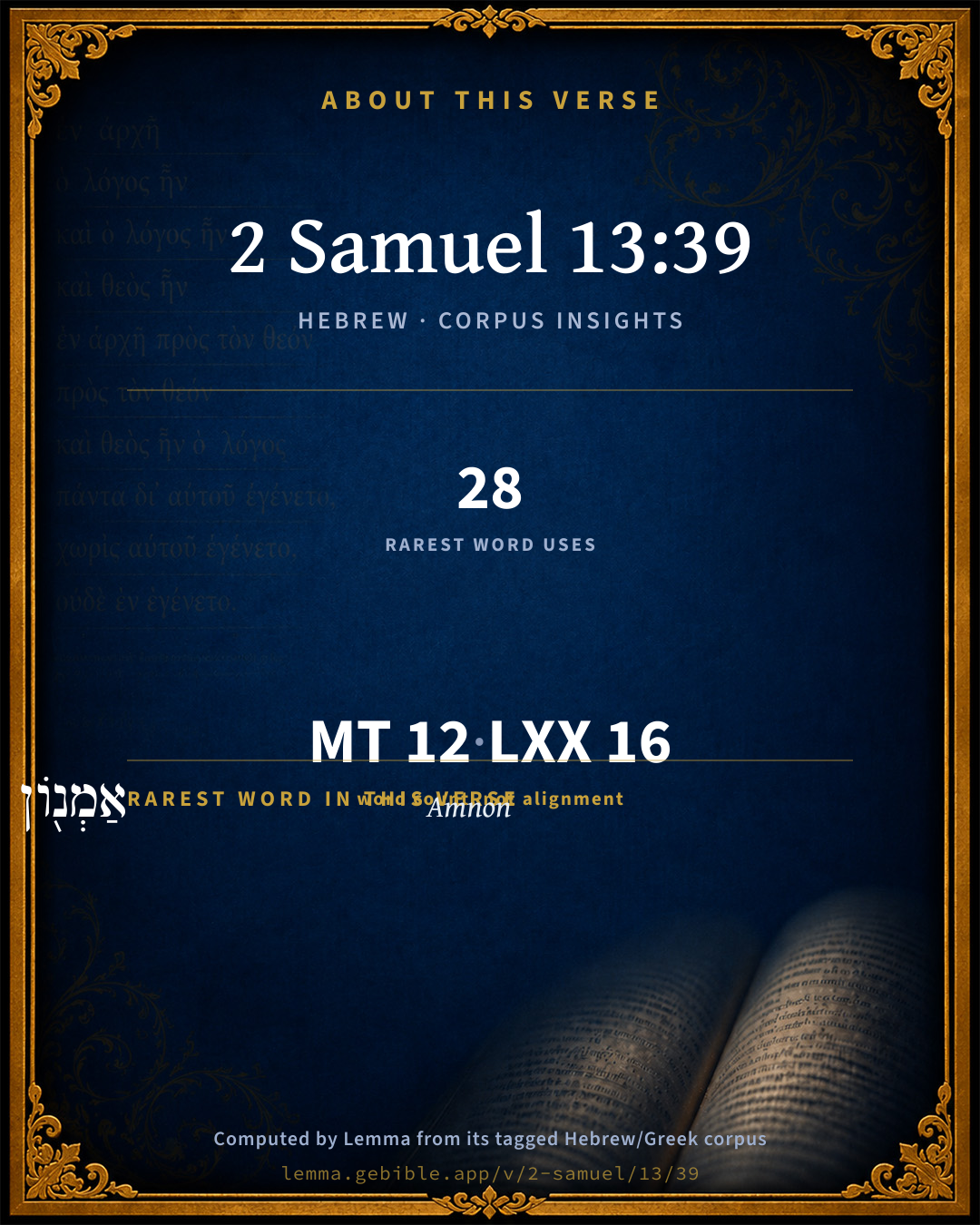
About this verse

These counts appear in no published source. They are computed here, from the morphology-tagged text and Lemma’s own curated glosses. What Lemma adds →

12
words
11
distinct lemmas
Historical
section

Shared distinctive vocabulary

אַמְנ֖וֹן Amnon H550 occurs in 22 verses of the Hebrew Bible. Also found in:

Grammatical profile

  • 4 verbs
  • 4 nouns
  • 2 prepositions
  • 2 conjunctions

Verb forms

  • וַתְּכַל֙ Piel · Sequential Imperfect
  • לָצֵ֖את Qal · Infinitive Construct
  • נִחַ֥ם Niphal · Perfect
  • מֵֽת Qal · Perfect

Repetition

A word recurs within this verse — often emphatic in Hebrew:

  • כִּֽי that H3588 ×2

Hebrew & Septuagint length

In English translation the verse runs 21 words from the Hebrew and 18 from the Septuagint (LXX English) — closely comparable.

A rough comparison of the two English renderings, which tokenize alike — not a word-level alignment.

Word counts can differ between the Hebrew and the Greek without any difference in meaning — e.g. the Hebrew direct-object marker אֵת has no separate Greek word, and Greek often adds the article ὁ.

In the original languages it is 12 Hebrew tokens and 16 Greek tokens — but the two are counted differently (Hebrew bundles its prefixes and suffixes into one token; the Greek is in lemma form), so that isn’t a like-for-like length.

Cross-references

9

Topical passages linked to 2 Samuel 13:39 in the Treasury of Scripture Knowledge — connected by theme and wording, ordered by reader-vote popularity; previews shown in the World English Bible.

  • Genesis 24:67 Isaac brought her into his mother Sarah's tent, and took Rebekah, and she became his wife. He loved her. Isaac was comforted after his mother's death.
  • Genesis 37:35 All his sons and all his daughters rose up to comfort him; but he refused to be comforted. He said, "For I will go down to Sheol to my son mourning." His father wept for him.
  • Genesis 38:12 After many days, Shua's daughter, the wife of Judah, died. Judah was comforted, and went up to his sheep-shearers to Timnah, he and his friend Hirah, the Adullamite.
  • Genesis 31:30 Now, you want to be gone, because you sore longed after your father's house, but why have you stolen my gods?"
  • Deuteronomy 28:32 Your sons and your daughters shall be given to another people; and your eyes shall look, and fail with longing for them all the day: and there shall be nothing in the power of your hand.
  • 2 Samuel 12:19–23 But when David saw that his servants were whispering together, David perceived that the child was dead; and David said to his servants, Is the child dead? They said, He is dead.
  • Psalms 84:2 My soul longs, and even faints for the courts of Yahweh. My heart and my flesh cry out for the living God.
  • Psalms 119:20 My soul is consumed with longing for your ordinances at all times.
  • Philippians 2:26 since he longed for you all, and was very troubled, because you had heard that he was sick.

Cross-references courtesy of OpenBible.info (CC BY 4.0).

Hebrew and Greek witnesses Masoretic Hebrew ↔ Greek Septuagint

The same verse in the two great witnesses to the Old Testament, shown verse-for-verse.

These are two independent witnesses, not word-aligned to each other, and the Septuagint is shown in lemma (dictionary) form.

Hebrew 2 Samuel 13:39 Masoretic · Westminster Leningrad Codex

וַתְּכַל֙ דָּוִ֣ד הַמֶּ֔לֶךְ לָצֵ֖את אֶל אַבְשָׁל֑וֹם כִּֽי נִחַ֥ם עַל אַמְנ֖וֹן כִּֽי מֵֽת

[the soul of] king David longed to go forth to Absalom: for he was comforted concerning Amnon, seeing he was dead.

World English Bible · Public Domain

Greek LXX 2 Samuel 13:39 Septuagint · lemma form

καί κοπάζω ὁ πνεῦμα ὁ βασιλεύς ὁ ἐκἔρχομαι ὀπίσω αβεσσαλωμ ὅτι παρακαλέω ἐπί αμνων ὅτι ἀποθνήσκω

And king David ceased to go out after Abessalom, for he was comforted concerning Amnon, touching his death.

LXX2012 (modern English Septuagint) · Public Domain

On this verse, John Gill's Exposition discusses the Septuagint’s reading. Read the note in Commentary ↓

Hebrew: Westminster Leningrad Codex (CC BY 4.0). Greek: Septuagint (public domain); English from LXX2012 (modern English Septuagint) (Public Domain). How the Septuagint differs from the Hebrew →

Targum (Aramaic paraphrase)

1

The Targum is the ancient Jewish Aramaic paraphrase of the Hebrew Scriptures — an interpretive translation, not the Hebrew text itself. Onkelos (literal) and Pseudo-Jonathan (expansive) render the Torah, and Jonathan the Prophets. Coverage is partial: where no permissively-licensed English translation exists for a verse, only the Aramaic is shown. This is verse-level text, not a word-by-word alignment to the Hebrew.

  1. Targum Jonathan Prophets (Joshua–Malachi)
    וְחַמֵידַת נַפְשָׁא דְדָוִד מַלְכָּא לְמִפַּק עַל אַבְשָׁלוֹם אֲרֵי אִתְנַחַם עַל אַמְנוֹן אֲרֵי מִית:

    (no public-domain English translation for this verse)

    Targum Jonathan — Aramaic: “Mikraot Gedolot” (public domain). English: “Sefaria Community Translation” (CC0 1.0 (public-domain dedication)); “London "Chaldee Paraphrase," 1871” (public domain). Text via Sefaria.

Commentary

Notes on 2 Samuel 13:39 from classic Christian and Jewish commentators (each source and its license shown beneath its notes). The classic Christian expositions comment on the surrounding passage and are grouped to its opening verse, so a note may address several verses; the Jewish commentaries on the Tanakh (Rashi and others) are per-verse, so they appear only where the commentator wrote on this verse.

Lemma curates 59 commentaries, every one of them public domain or Creative Commons licensed, each selected and text-cleaned for this edition rather than reprinted as found. About our sources →

Trapp's Complete Commentary

John Trapp

2Sa 13:39 And [the soul of] king David longed to go forth unto Absalom: for he was comforted concerning Amnon, seeing he was dead.

Ver. 39. And the soul of king David longed to go forth.] He had many sallies and egressions of affection toward him, and could, but for stark shame, have gone himself, or sent others to fetch him home. Tbere is an ocean of love in a father’s heart.

Seeing he was dead.] And could not by any tears be recovered, though he had wept himself into a stone with Niobe, or blind, as did Faustus the son of king Vortiger, for his parent’s incest.

John Trapp, A Commentary or Exposition upon All the Books of the Old and New Testament (1647–1656) — public domain. Text from a community e-Sword module.

Joseph Benson's Commentary

2Sa 13:39. The soul of King David longed to go forth to Absalom — To visit him, or to send for him. What amazing weakness was this! At first he could not find in his heart to do justice to the ravisher of his sister; and now he can almost find in his heart to receive into favour the murderer of his brother! How can we excuse David from the sin of Eli, who honoured his sons more than God.

Joseph Benson's Commentary on the Old and New Testaments (1811–1818) — public domain. Text from a community e-Sword module.

Tyndale Open Study Notes

Tyndale Open Resources

13:39 And King David: Dead Sea Scrolls and Greek version read And the spirit of the king. • longed to be reunited with his son Absalom: David’s grief over Amnon’s death was evidently alleviated; any desire David might have had to execute Absalom had dissipated.

Tyndale Open Study Notes — © Tyndale Open Resources, licensed CC BY-SA 4.0. Text via the HelloAO Bible API.

Geneva Bible (1599)

Geneva Bible translators

Or, ceased,

Geneva Bible (1599) marginal notes — public domain. Text via Bolls.life.

Adam Clarke's Commentary

Verse 39. David longed to go forth unto Absalom] We find that he had a very strong paternal affection for this young man, who appears to have had little to commend him but the beauty of his person. David wished either to go to him, or to bring him back; for the hand of time had now wiped off his tears for the death of his son Amnon. Joab had marked this disposition, and took care to work on it, in order to procure the return of Absalom. It would have been well for all parties had Absalom ended his days at Geshur. His return brought increasing wretchedness to his unfortunate father. And it may be generally observed that those undue, unreasonable paternal attachments are thus rewarded.

Adam Clarke's Commentary on the Bible (1810–1826) — public domain. Text from a community e-Sword/MySword module.

Ellicott's Commentary for English Readers

(39) The soul of King David.—The words, “the soul of,” are not in the original, and the most opposite interpretations have been given of the rest of the sentence. The sense of the English is that of the Chaldee and of the Jewish commentators—that David, after his grief for Amnon had abated, longed after Absalom and pined for his return. But it may be objected to this view, (1) that there is no ground for supplying the ellipsis in this way; (2) that the verb (which is a common one) never has elsewhere the sense given to it; and (3) that the representation thus made is contrary to fact, since David could easily have recalled Absalom had he chosen to do so, and when he actually was brought back, through Joab’s stratagem, the king refused to see him (2Sa_14:24), and only after two years more (2Sa_14:28), reluctantly admitted him to his presence. The other interpretation is better, which takes the verb impersonally, and gives the sense, David desisted from going forth against Absalom. He ought to have arrested and punished him for a murder, which was at once fratricide and high treason, as being the assassination of the heir-apparent; but the flight to Geshur made this difficult, and as time went by David “was comforted concerning Amnon,” and gradually gave up the thought of punishing Absalom.

A Bible Commentary for English Readers, edited by Charles John Ellicott (1878–1897) — public domain. Text from a community e-Sword module.

The Cambridge Bible for Schools and Colleges

gen. ed. J. J. S. Perowne

39. And the soul of king David, &c.] The Heb. of this verse is obscure, and has been made to bear almost opposite meanings. (1) The E. V., following the Jewish commentators, supplies the soul as the subject of the verb, which is feminine. It describes David as pining for the return of Absalom, after his sorrow for Amnon’s death had abated. To this interpretation it may be objected, (a) that the verb, in the voice used here, does not mean longed: (b) that if David had been anxious for Absalom’s return, he might have recalled him at once, whereas even when by Joab’s instrumentality he had been brought back to Jerusalem, he was not admitted to the royal presence. (2) By taking the verb impersonally we may obtain the sense, David desisted from going forth against Absalom (so the Vulg. “cessavitque rex David persequi Absalom;” and probably the Sept.), i.e. he gave up plans of pursuit and revenge; or by emending the text according to a very probable conjecture, the king’s wrath ceased to go forth against Absalom. Either of these renderings gives the general sense which seems to be required by the context, that David’s active hostility towards Absalom was mitigated by the lapse of time.

The Cambridge Bible for Schools and Colleges (gen. ed. J. J. S. Perowne; Cambridge University Press, 1878–1918) — public domain. Text from a community e-Sword module.

John Gill's Exposition

And the soul of King David longed to go forth unto Absalom,.... In like manner it is supplied and paraphrased in the Targum, because the word rendered "longed" is feminine; though it may be used to denote the effeminateness of David's disposition and carriage on this occasion. Aben Ezra thinks the word "wife", should be supplied, and then the sense is, that the wife of King David, the mother of Absalom, made supplication to him to send forth one of the young men to fetch Absalom, and that by her importunity to him she stirred up a longing desire in David after him. Abarbinel observes, from another writer of theirs, that all the three years David was mourning for his son, he went out continually to seek to take vengeance on Absalom; but after that time, the mother of Absalom, or Tamar his sister, or his daughter, was importunate with the king, and restrained him from going forth to seek vengeance on Absalom; and when he was comforted concerning Amnon, that woman found means to restrain him from going out, and he restrained his servants from going forth against Absalom; and so he observes the word is used for withholding or restraining in Psa 40:10; and this agrees with several ancient versions, as the Vulgate Latin,"King David ceased to persecute Absalom;''and the Septuagint,"King David ceased to go out to Absalom;''and the Syriac version,"and King David abstained from going out after Absalom:"

for he was comforted concerning Amnon, seeing he was dead; and could not be brought back from the grave, though Absalom might be from his exile, to which he had an inclination; but he knew not how to do it, consistent with justice and his own honour.

Next: 2 Samuel Chapter 14

John Gill's Exposition of the Whole Bible (1746–1763) — public domain (CC PDM 1.0). Text via the HelloAO Bible API.

Albert Barnes' Notes on the Bible

Longed to go forth - Rather, “longed after Absalom,” literally, was consumed in going forth, with a sense of disappointed hope.

Albert Barnes' Notes on the Bible (1834–1885) — public domain. Text from a community e-Sword/MySword module.

Matthew Poole's English Annotations

To go forth unto Absalom, to wit, to visit him, or to send for him. And thus this word the soul is here understood, partly from the Hebrew verb, which being of the feminine gender, agrees not with David, but with David’s soul; and partly by comparing this with other places, where the same verb is used, and the soul expressed, as Psa 84:2; 119:81. But as this supplement may seem too bold, so this version seems not so well to agree with that phrase of going out to Absalom; for David neither desired nor intended to go out to Absalom, but that Absalom should come home to him. And these words may be and are otherwise rendered, by the most ancient and remarkable interpreters, to this purpose; And king David made an end of going out (to wit, in an hostile manner, as that verb is oft used, Gen 14:18; 2Sa 11:1) against (for so the Hebrew particle el is oft used, as Jer 34:7; Eze 13 9,20; Am 7:15). Absalom; i. e. having used some, though it is probable but cold and remiss, endeavours to pursue after Absalom, and to fetch him from his grandfather’s to receive condign punishment, he now gave over thoughts of it. Thus the same verb, and that in the same conjugation, is used in the same manner, 1Ki 3:1, he made an end of building. It is to be objected, That the Hebrew verb is of the feminine gender, and therefore doth not agree with king David, which is masculine. It may be answered, That enallage of genders is a most frequent figure; and as the masculine gender is sometimes applied to women when they do some manly and gallant action, Exo 1:21, so the feminine gender is sometimes used of men when they show an effeminate tenderness in their disposition; which is the case here, as some learned Hebricians have noted.

Matthew Poole's English Annotations on the Holy Bible (1683–1685) — public domain. Text from a community e-Sword/MySword module.

The Pulpit Commentary

And (the soul of) king David longed to go forth unto Absalom. This translation has the support of the Jewish Targum, and, as the verb is feminine, the insertion of the added word is possible, though the sense seems to require "anger" instead of "the soul." But the versions (Septuagint, Syriac, and Vulgate) all give the verb its ordinary meaning of "ceasing," and, though there is something harsh in taking it impersonally, yet their authority is too great for us to say that such a mode of rendering it must be wrong. And if the grammar be difficult, the sense put upon the words by the versions is excellent. Literally they are, As to King David, there. was a ceasing to go forth after Absalom; for he was comforted, etc. At first he had demanded of Talmai the surrender of the offender, and, when Talmai refused, David tried other means; but in time, when his grief for Amnon was assuaged, he desisted from his efforts. But even so it required much subtlety on Joab"s part to obtain Absalom"s recall, which would scarcely have been the case if David"s soul was longing for his son"s return; and, even after his coming, David long maintained an unfriendly attitude. Amnon was his firstborn, and evidently dearly loved, but David"s culpable leniency had borne bitter fruit. And again he acts without thoughtful sense of justice, and though at first he would have given Absalom merited punishment, yet gradually paternal feeling resumed its sway, unhappily only to be miserably abused.

The Pulpit Commentary (1880–1919), ed. H.D.M. Spence-Jones & Joseph S. Exell — public domain. Text from a community e-Sword module.

John Wesley's Explanatory Notes

Go forth - And could not he recalled, to visit him, or to send for him. What amazing weakness was this! At first he could not find in his heart, to do justice to the ravisher of his sister! And now he can almost find in his heart to receive into favour the murderer of his brother? How can we excuse David from the sin of Eli; who honoured his sons more than God?

John Wesley, Explanatory Notes Upon the Whole Bible (1754–1765) — public domain. Text via the GEBible commentary corpus.

Keil & Delitzsch

C. F. Keil & F. Delitzsch

"And it (this) held king David back from going out to Absalom, for he comforted himself concerning Amnon, because he was dead." In adopting this translation of the difficult clause with which the verse commences, we take ותּכל in the sense of כּלא, as the verbs כלה and כלא frequently exchange their forms; we also take the third pers. fem. as the neuter impersonal, so that the subject is left indefinite, and is to be gathered from the context. Absalom's flight to Geshur, and his stay there, were what chiefly prevented David from going out to Absalom. Moreover, David's grief on account of Amnon's death gradually diminished as time rolled on. אל־אבש צאת is used in a hostile sense, as in Deu 28:7, to go out and punish him for his wickedness. The כּי before נחם might also be rendered "but," as after a negative clause, as the principal sentence implies a negation: "He did not go out against Absalom, but comforted himself." There is not only no grammatical difficulty in the way of this explanation of the verse, but it also suits the context, both before and after. All the other explanations proposed are either at variance with the rules of the language, or contain an unsuitable thought. The old Jewish interpretation (adopted in the Chaldee version, and also by the Rabbins), viz., David longed (his soul pined) to go out to Absalom (i.e., to see or visit him), is opposed, as Gusset has shown (in his Lex. pp. 731-2), to the conduct of David towards Absalom as described in 2 Samuel 14, - namely, that after Joab had succeeded by craft in bringing him back to Jerusalem, David would not allow him to come into his presence for two whole years (Sa2 14:24, Sa2 14:28). Luther's rendering, "and king David left off going out against Absalom," is not only precluded by the feminine תּכל, but also by the fact that nothing has been said about any pursuit of Absalom on the part of David. Other attempts at emendations there is no need whatever to refute.

Keil & Delitzsch — Biblical Commentary on the Old Testament (1861–1891) — public domain (CC PDM 1.0). Text via the HelloAO Bible API. (Old Testament only.)

Rashi

Rabbi Shlomo Yitzchaki (Rashi)

Dovid desired. This is a shortened verse, [it means to say:] "Dovid's soul desired." Yonoson also translates [this way:] "Dovid's soul desired," as [we find:] "[My Soul] yearns, and even pines." Language [denoting] desire.

Because he was consoled concerning Amnon. He accepted [words of] consolation.

Rashi on the Tanakh — English translations: “The Judaica Press complete Tanach with Rashi, translated by A. J. Rosenberg” (CC BY 4.0); “Pentateuch with Rashi's commentary by M. Rosenbaum and A.M. Silbermann, 1929-1934” (public domain); “The Metsudah Tanach series, Lakewood, N.J” (CC BY 4.0); and “The Book of Joshua, Metsudah Publications, 1997” (CC BY 4.0). Text via Sefaria.

Lesson kit

Teaching starters — assembled from the data on this page, not authored interpretation. Every prompt links to the verse data it draws on. Edit before teaching.

2 Samuel, in the Historical, opens this verse with 12 words (11 distinct Hebrew lemmas). Its most distinctive word is ʼAmnôwn (“Amnon”). A historical commentator’s framing appears above. Read the whole chapter for the surrounding context.

Discussion questions

  1. How does “Amnon” (ʼAmnôwn) shape what this verse is saying?
  2. How does 2 Samuel 3:2, which shares the word «Amnon», read alongside this verse?
  3. What does the repetition of “that” (2× in this one verse) do in this verse?
  4. These translations render this verse differently. What is at stake in choosing one wording over another?
  5. «וַתְּכַל֙» is a Piel Sequential Imperfect verb. How does that grammatical form shape the action described?
  6. Compare how Trapp's Complete Commentary and Joseph Benson's Commentary read this verse. Where do they agree or differ?

Things to notice

Reading settings

Reading text

Shown beneath each verse's original-language words.

Old Testament
Old Testament edition

Read the OT as the Masoretic Hebrew (MT) or the Greek Septuagint (LXX).

English shown for the Greek Septuagint (in the Hebrew ↔ Greek comparison).

Comparing translations? Open the Compare panel on any verse page to stack up to four side by side.