Jeremiah 51:63

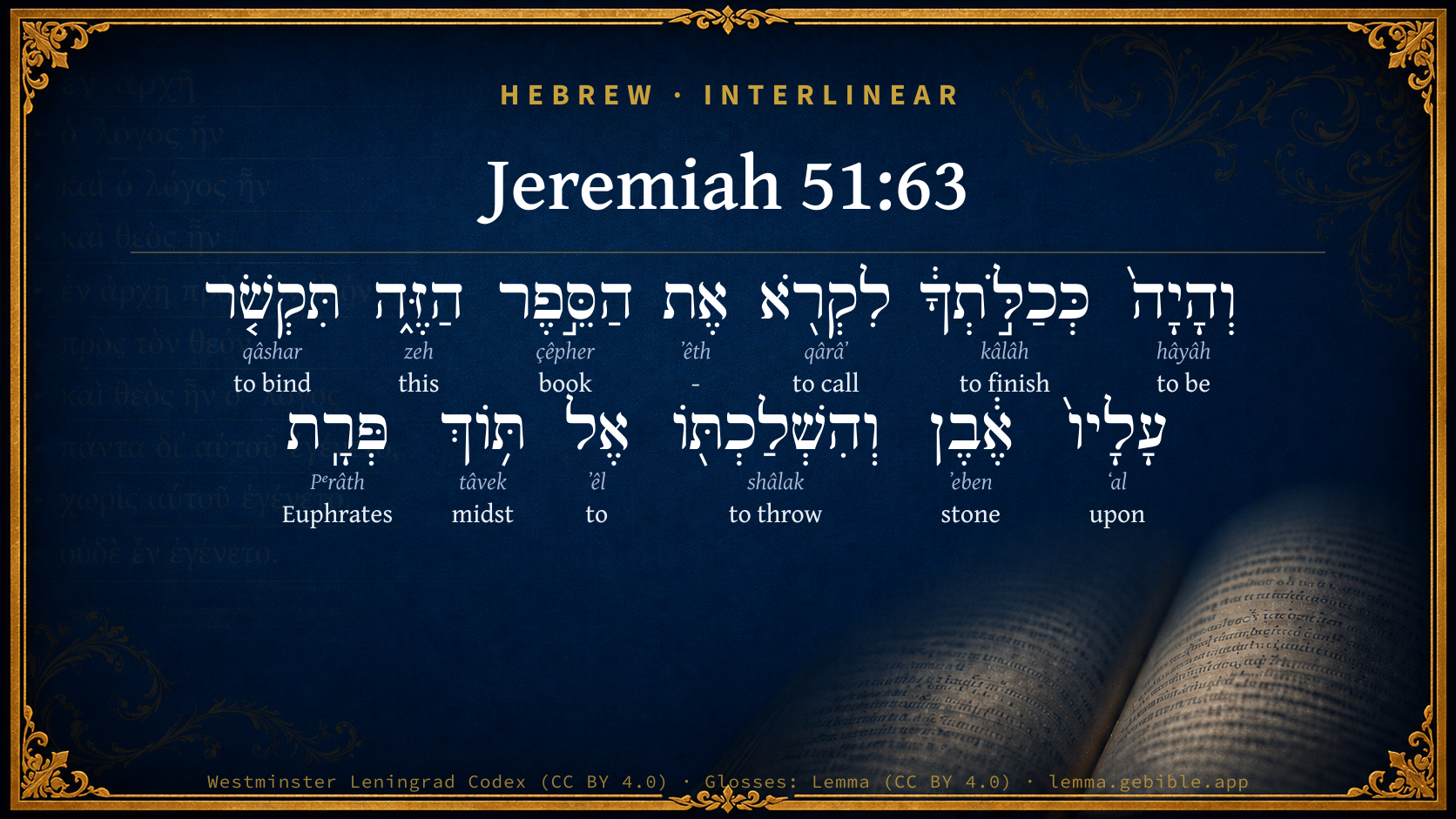
Hebrew (Westminster Leningrad Codex) Jeremiah 51:63 appears in the Hebrew Old Testament. The text above is from the Westminster Leningrad Codex. Each word links to its Strong’s number, a concise gloss, and parsing drawn from the Open Scriptures Hebrew Bible morphology. Click any word for its full Brown-Driver-Briggs (BDB) entry.
Download image
Cite this verse

Jeremiah 51:63 (World English Bible). Public Domain. Lemma interlinear Bible study tool, https://lemma.gebible.app/v/jeremiah/51/63.

Show BibTeX & RIS
BibTeX
RIS
English Translation
It shall be, when you have made an end of reading this book, that you shall bind a stone to it, and cast it into the midst of the Euphrates:
World English Bible · Public Domain
Download a study sheet

One document with this verse’s original text, its word-by-word gloss line, the meaning frame, cross-references with their text, attributed commentary, and full source and license credits — printable, and it pastes into notes with its structure intact.

This verse Autodidact and up

Study sheet (.html) Plain text (.txt)

A passage Seminary Student

Up to 50 verses in one chapter. A passage sheet keeps up to 6 commentary sources and 12 cross-references per verse, in the order this page ranks them, and says so on the sheet whenever that leaves anything out. Ask for a single verse and you get the Autodidact verse sheet above.

Everything on this page stays free to read, with no account — the sheet is a download of what is already on screen, not access to it.

Want to remove ads? Support Godless Engineer
Compare translations 3

The same verse in 3 English versions, stacked beneath the original-language interlinear above. Click any original word for its lexicon entry.

Each is an independent rendering of the whole verse — the interlinear is not word-aligned to these translations.

Highlighted words mark where these versions differ — a whole-verse word diff, not a word-by-word alignment.

  • World English Bible Public Domain
    It shall be, when you have made an end of reading this book, that you shall bind a stone to it, and cast it into the midst of the Euphrates:
  • King James Version Public Domain
    And it shall be, when thou hast made an end of reading this book, that thou shalt bind a stone to it, and cast it into the midst of Euphrates:
  • unfoldingWord Literal Text CC BY-SA 4.0
    Then when you have finished reading this scroll, tie a stone to it and throw it into the middle of the Euphrates.

unfoldingWord Literal Text — © unfoldingWord, licensed CC BY-SA 4.0. Word-aligned USFM3 via Door43 (git.door43.org/unfoldingWord/en_ult).

Versions to compare (up to 4)

3 of 4 selected

Show all 18 translations

Every available English version of this verse, each an independent rendering of the whole verse.

  • World English Bible Public Domain
    It shall be, when you have made an end of reading this book, that you shall bind a stone to it, and cast it into the midst of the Euphrates:
  • Berean Standard Bible Public Domain
    When you finish reading this scroll, tie a stone to it and cast it into the Euphrates.
  • Majority Standard Bible Public Domain
    When you finish reading this scroll, tie a stone to it and cast it into the Euphrates.
  • King James Version Public Domain
    And it shall be, when thou hast made an end of reading this book, that thou shalt bind a stone to it, and cast it into the midst of Euphrates:
  • American Standard Version (1901) Public Domain
    And it shall be, when thou hast made an end of reading this book, that thou shalt bind a stone to it, and cast it into the midst of the Euphrates:
  • Revised Version (1885) Public Domain
    And it shall be, when thou hast made an end of reading this book, that thou shalt bind a stone to it, and cast it into the midst of Euphrates:
  • Geneva Bible (1599) Public Domain
    And when thou hast made an ende of reading this booke, thou shalt binde a stone to it, and cast it in the middes of Euphrates,
  • Douay-Rheims (1899) Public Domain
    And when thou shalt have made an end of reading this book, thou shalt tie a stone to it, and shalt throw it into the midst of the Euphrates:
  • Young's Literal Translation Public Domain
    And it hath come to pass, when thou dost finish reading this book, thou dost bind to it a stone, and hast cast it into the midst of Phrat,
  • Literal Standard Version CC BY-SA 4.0
    And it has come to pass, when you finish reading this scroll, you bind a stone to it, and have cast it into the midst of the Euphrates,
  • Unlocked Literal Bible CC BY-SA 4.0
    Then when you have finished reading this scroll, tie a stone to it and throw it into the middle of the Euphrates.
  • unfoldingWord Literal Text CC BY-SA 4.0
    Then when you have finished reading this scroll, tie a stone to it and throw it into the middle of the Euphrates.
  • Darby Bible Public Domain
    And it shall be, when thou hast ended reading this book, [that] thou shalt bind a stone to it, and cast it into the midst of the Euphrates;
  • World Messianic Bible Public Domain
    It will be, when you have finished reading this book, that you shall bind a stone to it, and cast it into the middle of the Euphrates.
  • Webster's Bible Public Domain
    And it shall be, when thou hast made an end of reading this book, that thou shalt bind a stone to it, and cast it into the midst of Euphrates:
  • Free Bible Version CC BY-SA 4.0
    After you finish reading this scroll out loud, tie a stone to it and throw it into the Euphrates.
  • Bible in Basic English Public Domain
    And it will be that, when you have come to an end of reading this book, you are to have a stone fixed to it, and have it dropped into the Euphrates:
  • JPS Tanakh (1917) Public Domain
    And it shall be, when thou hast made an end of reading this book, that thou shalt bind a stone to it, and cast it into the midst of the Euphrates;

Literal Standard Version (2020), Covenant Press — licensed CC BY-SA 4.0. Text via the HelloAO Bible API (eBible.org). Unlocked Literal Bible (unfoldingWord) — licensed CC BY-SA 4.0. Text via the HelloAO Bible API (eBible.org). unfoldingWord Literal Text — © unfoldingWord, licensed CC BY-SA 4.0. Word-aligned USFM3 via Door43 (git.door43.org/unfoldingWord/en_ult). Free Bible Version, Dr. Jonathan Gallagher — licensed CC BY-SA 4.0. Text via the HelloAO Bible API (eBible.org).

Word by word

More ways to search: Search by grammar → Find every occurrence → Compare this word →

Practice this passage: Drill this verse → Learn its vocabulary →

פְּרָֽת
Pᵉrâth
H6578
“Euphrates”
Noun, Proper
Part of Speech
Noun
Type
Proper
Full BDB Definition

Origin: from an unused root meaning to break forth

TWOT: None

Euphrates = "fruitfulness" - the largest and longest river of western Asia; rises from two chief sources in the Armenian mountains and flows into the Persian Gulf
  1. וְהָיָה֙ hâyâh H1961 “and · to be” Conjunction + Verb, Qal, Sequential Perfect, 3rd Person, Masculine, Singular
  2. כְּכַלֹּ֣תְךָ֔ kâlâh H3615 “like/as · to finish · you” Preposition + Verb, Piel, Infinitive Construct + Suffix, Personal, 2nd Person, Masculine, Singular
  3. לִקְרֹ֖א qârâʼ H7121 “to call” Preposition + Verb, Qal, Infinitive Construct
  4. אֶת ʼêth H853 “-” Particle, Direct Object
  5. הַסֵּ֣פֶר çêpher H5612 “the · book” Particle, Definite Article + Noun, Common, Masculine, Singular, Absolute
  6. הַזֶּ֑ה zeh H2088 “the · this” Particle, Definite Article + Pronoun, Demonstrative, Masculine, Singular
  7. תִּקְשֹׁ֤ר qâshar H7194 “to bind” Verb, Qal, Imperfect, 2nd Person, Masculine, Singular
  8. עָלָיו֙ ʻal H5921 “upon · him” Preposition + Suffix, Personal, 3rd Person, Masculine, Singular
  9. אֶ֔בֶן ʼeben H68 “stone” Noun, Common, Feminine, Singular, Absolute
  10. וְהִשְׁלַכְתּ֖וֹ shâlak H7993 “and · to throw · him” Conjunction + Verb, Hiphil, Sequential Perfect, 2nd Person, Masculine, Singular + Suffix, Personal, 3rd Person, Masculine, Singular
  11. אֶל ʼêl H413 “to” Preposition
  12. תּ֥וֹךְ tâvek H8432 “midst of” Noun, Common, Masculine, Singular, Construct

About this verse

These counts appear in no published source. They are computed here, from the morphology-tagged text and Lemma’s own curated glosses. What Lemma adds →

13
words
13
distinct lemmas
Prophets
section

Notable vocabulary

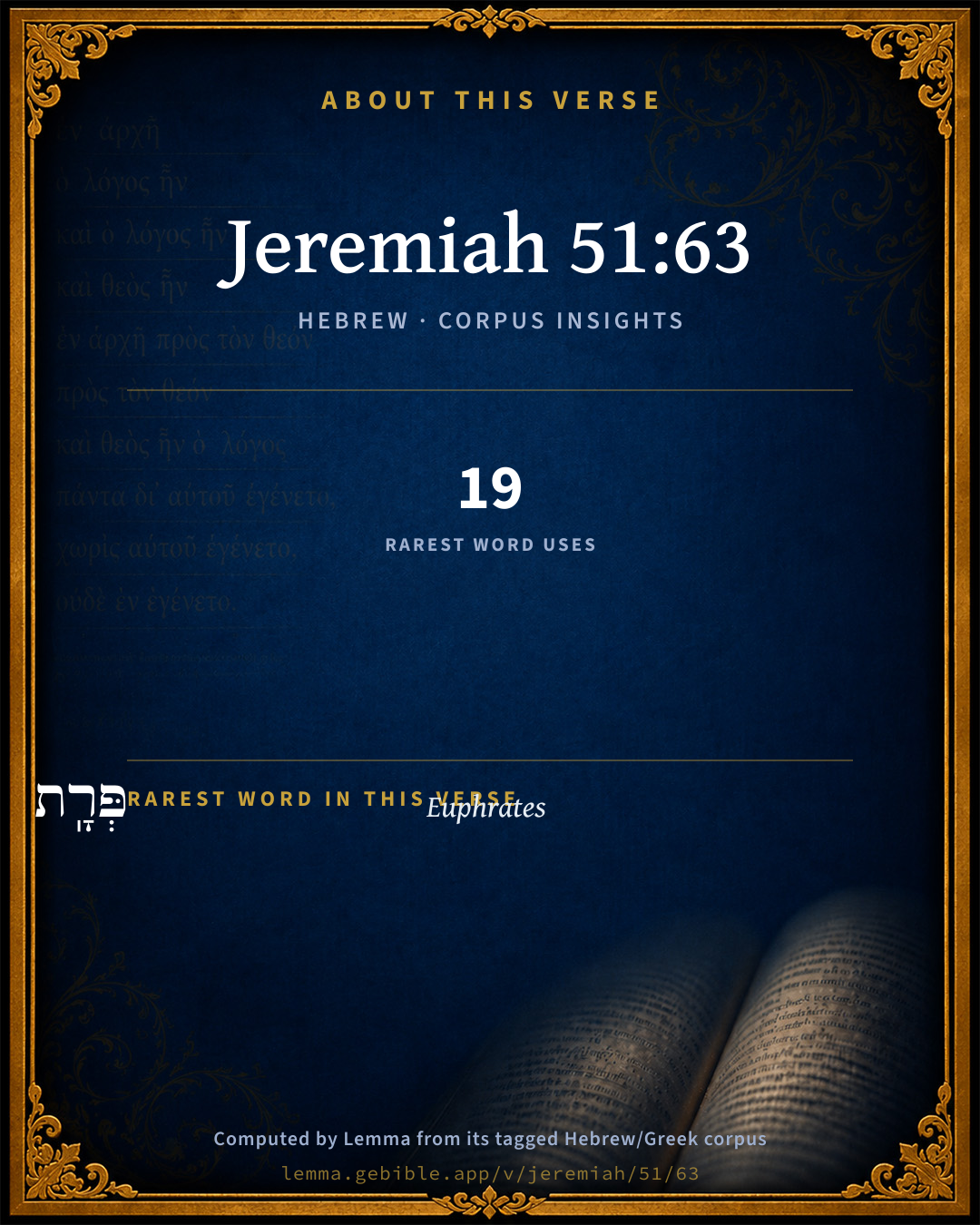
The rarest word here is פְּרָֽת Euphrates H6578 — appearing just 19 times in the whole Hebrew Bible.

Shared distinctive vocabulary

פְּרָֽת Euphrates H6578 occurs in 19 verses of the Hebrew Bible. Also found in:

Grammatical profile

  • 5 verbs
  • 4 nouns
  • 1 pronoun
  • 2 prepositions
  • 1 particle

Verb forms

  • וְהָיָה֙ Qal · Sequential Perfect
  • כְּכַלֹּ֣תְךָ֔ Piel · Infinitive Construct
  • לִקְרֹ֖א Qal · Infinitive Construct
  • תִּקְשֹׁ֤ר Qal · Imperfect
  • וְהִשְׁלַכְתּ֖וֹ Hiphil · Sequential Perfect

Cross-references

2

Topical passages linked to Jeremiah 51:63 in the Treasury of Scripture Knowledge — connected by theme and wording, ordered by reader-vote popularity; previews shown in the World English Bible.

  • Revelation 18:21 A mighty angel took up a stone like a great millstone and cast it into the sea, saying, "Thus with violence will Babylon, the great city, be thrown down, and will be found no more at all.
  • Jeremiah 19:10–11 Then shall you break the bottle in the sight of the men who go with you,

Cross-references courtesy of OpenBible.info (CC BY 4.0).

Hebrew and Greek witnesses Masoretic Hebrew ↔ Greek Septuagint

The same verse in the two great witnesses to the Old Testament, shown verse-for-verse.

These are two independent witnesses, not word-aligned to each other, and the Septuagint is shown in lemma (dictionary) form.

Hebrew Jeremiah 51:63 Masoretic · Westminster Leningrad Codex

וְהָיָה֙ כְּכַלֹּ֣תְךָ֔ לִקְרֹ֖א אֶת הַסֵּ֣פֶר הַזֶּ֑ה תִּקְשֹׁ֤ר עָלָיו֙ אֶ֔בֶן וְהִשְׁלַכְתּ֖וֹ אֶל תּ֥וֹךְ פְּרָֽת

It shall be, when you have made an end of reading this book, that you shall bind a stone to it, and cast it into the midst of the Euphrates:

World English Bible · Public Domain

Greek LXX Structure differs

In the Septuagint, Jeremiah is about an eighth shorter than the Hebrew and arranges its material differently — the Oracles Against the Nations (Hebrew chapters 46–51) appear in the middle of the Greek book, after 25:13. Because the chapter and verse boundaries do not line up, a verse-for-verse comparison with the Hebrew is not shown.

A verse-for-verse comparison isn’t shown here because the chapters and verses don’t line up. Switch to the LXX edition with the MT / LXX toggle above to read the Greek directly.

On this verse, Joseph Benson's Commentary discusses the Septuagint’s reading. Read the note in Commentary ↓

Hebrew: Westminster Leningrad Codex (CC BY 4.0). Greek: Septuagint (public domain); English from a public-domain English Septuagint. How the Septuagint differs from the Hebrew →

Targum (Aramaic paraphrase)

1

The Targum is the ancient Jewish Aramaic paraphrase of the Hebrew Scriptures — an interpretive translation, not the Hebrew text itself. Onkelos (literal) and Pseudo-Jonathan (expansive) render the Torah, and Jonathan the Prophets. Coverage is partial: where no permissively-licensed English translation exists for a verse, only the Aramaic is shown. This is verse-level text, not a word-by-word alignment to the Hebrew.

  1. Targum Jonathan Prophets (Joshua–Malachi)
    וִיהֵי כְּשֵׁצָיוּתָךְ לְמִקְרֵי יַת סִפְרָא הָדֵין תִּקְטַר בֵּיהּ אַבְנָא וְתִרְמִינֵיהּ לְגוֹ פְּרָת:

    (no public-domain English translation for this verse)

    Targum Jonathan — Aramaic: “Mikraot Gedolot” (public domain). English: “Sefaria Community Translation” (CC0 1.0 (public-domain dedication)); “London "Chaldee Paraphrase," 1871” (public domain). Text via Sefaria.

Commentary

Notes on Jeremiah 51:63 from classic Christian and Jewish commentators (each source and its license shown beneath its notes). The classic Christian expositions comment on the surrounding passage and are grouped to its opening verse, so a note may address several verses; the Jewish commentaries on the Tanakh (Rashi and others) are per-verse, so they appear only where the commentator wrote on this verse.

Lemma curates 59 commentaries, every one of them public domain or Creative Commons licensed, each selected and text-cleaned for this edition rather than reprinted as found. About our sources →

Trapp's Complete Commentary

John Trapp

Jer 51:63 And it shall be, when thou hast made an end of reading this book, [that] thou shalt bind a stone to it, and cast it into the midst of Euphrates:

Ver. 63. Thou shalt bind a stone to it.] See the like symbol or chria, Rev 18:21, where, by the mighty angel, Alcazar understandeth the prophet Jeremiah.

John Trapp, A Commentary or Exposition upon All the Books of the Old and New Testament (1647–1656) — public domain. Text from a community e-Sword module.

Joseph Benson's Commentary

Jer 51:63-64. And thou shalt bind a stone to it, and cast it into the midst of Euphrates — The prophets, as we have seen, frequently gave sensible representations of the judgments they foretold: see Jer 19:10. This now given was a significant emblem of Babylon’s sinking irrecoverably under the judgments here denounced against her: compare Rev 18:21. This threatening was in a literal sense fulfilled by Cyrus’s breaking down the head or dam of the great lake, which was on the west side of the city, in order to turn the course of the river that way; for no care being afterward taken to repair the breach, the whole country round it was overflowed. And the prophecy of Isa 14:23, foretelling that the country of Babylon should become a possession for the bittern and pools of water, was literally fulfilled. — Prideaux and Lowth. And they shall be weary — This clause, expressed by one word in the Hebrew, namely, ויעפו, is not to be met with in the translation of the LXX., “nor does it appear to me,” says Blaney, “to be authentic, notwithstanding the concurrence of the later versions and MSS. The sense is entire and complete without it; and the addition serves only to cause perplexity and confusion. The word seems to have been added by some transcriber, whose eye was caught by it at the close of the preceding paragraph, Jer 51:58,” where the same word occurs. Thus far are the words of Jeremiah — Here the prophecies of Jeremiah end: the following chapter being added by some other hand, either in the lifetime of Jeremiah, and by his consent, or after his death.

Joseph Benson's Commentary on the Old and New Testaments (1811–1818) — public domain. Text from a community e-Sword module.

Tyndale Open Study Notes

Tyndale Open Resources

51:63-64 Throwing the scroll . . . into the Euphrates River signaled the permanent destruction of Babylon.

Tyndale Open Study Notes — © Tyndale Open Resources, licensed CC BY-SA 4.0. Text via the HelloAO Bible API.

Geneva Bible (1599)

Geneva Bible translators

St. John in his Revelation alludeth to this place, when he saith that the Angel took a millstone and cast it into the sea: signifying thereby the destruction of Babylon, Rev. 18:21.

Geneva Bible (1599) marginal notes — public domain. Text via Bolls.life.

Jamieson, Fausset & Brown

Robert Jamieson, A. R. Fausset & David Brown

bind a stone, &c.-- (Rev 18:21). So the Phoceans in leaving their country, when about to found Marseilles, threw lead into the sea, binding themselves not to return till the lead should swim.

Jamieson, Fausset & Brown — Commentary Critical and Explanatory on the Whole Bible (1871) — public domain (CC PDM 1.0). Text via the HelloAO Bible API.

John Calvin's Commentaries

He afterwards adds, And when thou hast made an end of reading, thou shalt tie a stone to it and cast it into the Euphrates, and shalt say, Thus sink shall Babylon Here is added an external symbol to confirm the faith of Seraiah. We must yet bear in mind, that this was not said to Seraiah for his own sake alone, but that the people might also know, that the king’s messenger, who had been sent for the sake of conciliating, was also the messenger of God and of the Prophet, who might have otherwise been despised by the people. When, therefore, the faithful knew this, they were in no ordinary way confirmed in the truth of the prophecy. Jeremiah, then, not only consulted the benefit of Seraiah alone, but that of all the godly; for though this was unknown for a long time, yet the messenger afterwards acknowledged that this command had been given him by Jeremiah, and that he took the book and cast it into the Euphrates. This, then, was given as a confirmation to all the godly.

As to the symbols by which God sealed the prophecies in former times, we have spoken elsewhere; I therefore pass them by slightly now: only we ought to bear in mind this one thing, that these signs were only temporary sacraments; for ordinary sacraments are permanent, as the holy supper and baptism. But the sign mentioned here was temporary, and referred, as they say, to a special action: it yet had the force and character of a sacrament, as to its use, the confirmation of this prophecy. Seraiah was then bidden to tie a stone to the book, and then to cast it into the Euphrates: why so? that the volume might not swim on the surface of the water, but be sunk down to the bottom; and the application follows, Thou shalt say, etc. We see that words ought ever to be connected with signs. We hence conclude how fatuous the Papists are, who practice many ceremonies, but without knowledge. They are, indeed, dead and empty things, whatever signs men may devise for themselves, except God’s word be added. Thou shalt then say, Thus sink shall Babylon, and shall not rise from the evil which I shall bring upon her In short, Seraiah was commanded, as the Prophet’s messenger, to predict by himself concerning the fall of Babylon; but it was for the sake of all the godly, who were afterwards taught what had been done.

John Calvin's Commentaries (1540-1563) — public domain. Text from the Calvin Translation Society English edition (1840s-50s) via the Christian Classics Ethereal Library (ccel.org). Calvin's coverage is partial (roughly two-thirds of the Bible); uncommented books and verses are honest gaps, never fabricated. The 19th-century editor's footnotes and remarks are omitted so the notes are faithfully Calvin's own voice.

Ellicott's Commentary for English Readers

(63) Thou shalt bind a stone to it.—The meaning of the symbolic act, which has its parallel in the girdle of Jer_13:1-7, in the potter’s vessel of Jer_19:10, and in the yokes of Jer_27:2, is explained in the following verse. The parchment roll by itself might have floated, and been picked up and read, and so the stone was tied to it that it might sink at once, and thus prefigure the destruction of the city. (Compare the reappearance of the symbols in Rev_18:21, in connection with the destruction of the mystical Babylon.)

A Bible Commentary for English Readers, edited by Charles John Ellicott (1878–1897) — public domain. Text from a community e-Sword module.

The Cambridge Bible for Schools and Colleges

gen. ed. J. J. S. Perowne

63, 64. For the symbolical action cp. Jer_13:1-7, Jer_19:1-10, Jer_27:2, Jer_43:9.

The Cambridge Bible for Schools and Colleges (gen. ed. J. J. S. Perowne; Cambridge University Press, 1878–1918) — public domain. Text from a community e-Sword module.

Whedon's Commentary on the Bible

Daniel D. Whedon

63. Bind a stone… cast… into the… Euphrates — Not to destroy the book, but to perfect the symbolism. The stone is not only to make the book sink, but to keep it from rising again, thus betokening the permanent downfall and utter extinction of the greatest city then on the face of the earth.

Daniel D. Whedon (gen. ed.), Commentary on the Old and New Testaments (1874–1909) — public domain. Text from a community e-Sword module.

The Pulpit Commentary

Vers. 63, 64. A symbol of irretrievable loss.

It was fitting that the exhibition and record of a symbol such as this should close the long denunciation of Babylon. Where God determines to destroy no man can either avert or recover. This stone, perhaps, still lies at the bottom of Euphrates, and possibly even there may be something to signify the book once attached to it. We know not what relics of Old Testament times might yet be disentombed, what confirmations and revelations are still in actual existence.

I GOD"S POWER OF UTTER DESTRUCTION. The impossibility of discovering this stone has to be considered relatively. Strictly speaking, it might perhaps have been recovered if it had been worth while. But for all practical purposes it was finally lost. Here is the difference between human destructions and the Divine destruction. Babylon is a wilderness still. Where God has chosen to make special marks of his wrath with the unrighteousness of men there rests a blight which no human effort can overcome; and generally speaking there is no disposition to overcome it. But where destruction comes simply through human passion and power there may be comparatively speedy recovery. This is a side of war on which we do well to reflect. Wars, with all their terrible accompaniments, may do something to get rid of some evils, and may thus be the condition of great good. Man cannot destroy where God wills to preserve. But where God destroys he destroys finally, and it is just this dreadful possibility of final ruin that should make men cautions in their estimate of the future, and prompt to turn from all evil and selfish paths.

II THE CHEERING SIDE OF GOD"S UTTER DESTRUCTIONS. With God destruction always means salvation. Destruction is never for its own sake, never an arbitrary, aimless thing. All Divine destruction must be looked on as part of the process of salvation. Nations are scattered, human institutions overthrown, the temporal life of individuals ended, but the individual man in his abiding relations to God remains. This stone lost in one sense was not lost in another. Nay, it was serving a higher purpose than any it could have served simply as a stone. It became a teacher, and it is a teacher still. Abel, being dead, yet speaketh. And this stone from the bottom of Euphrates speaks still, warning all ambitious men and all neglecters of the commandments and predictions of Jehovah. Y.

The Pulpit Commentary (1880–1919), ed. H.D.M. Spence-Jones & Joseph S. Exell — public domain. Text from a community e-Sword module.

unfoldingWord translationNotes

Door43 World Missions Community

Babylon will sink like this

The stone and scroll will disappear in the water, the water will destroy the scroll, and Babylon will no longer look like a city or have buildings for people to live in. (See: Simile)

will not arise

"will never again be a city"

they will fall

This means the Babylonians will fall because they are exhausted. Many translations do not include these words.

translationWords

stone

Euphrates River

raise

send

unfoldingWord translationNotes — © Distant Shores Media and the Door43 World Missions Community, licensed CC BY-SA 4.0. Source: git.door43.org/Door43/en_tn.

Lesson kit

Teaching starters — assembled from the data on this page, not authored interpretation. Every prompt links to the verse data it draws on. Edit before teaching.

Jeremiah, in the Prophets, opens this verse with 13 words (13 distinct Hebrew lemmas). Its most distinctive word is Pᵉrâth (“Euphrates”). A historical commentator’s framing appears above. Read the whole chapter for the surrounding context.

Discussion questions

  1. What does “Euphrates” (Pᵉrâth) contribute to the verse as a whole?
  2. Genesis 2:14 shares the word «Euphrates» with this verse. How do the two illuminate each other?
  3. These translations render this verse differently; the difference is in the English rendering, not the original. What questions does that raise?
  4. The verb «וְהָיָה֙» is Qal Sequential Perfect. How does its form color the action?
  5. Reading how Trapp's Complete Commentary and Joseph Benson's Commentary read this verse, where do the two commentators agree and where do they part?

Things to notice

Reading settings

Reading text

Shown beneath each verse's original-language words.

Old Testament
Old Testament edition

Read the OT as the Masoretic Hebrew (MT) or the Greek Septuagint (LXX).

English shown for the Greek Septuagint (in the Hebrew ↔ Greek comparison).

Comparing translations? Open the Compare panel on any verse page to stack up to four side by side.