Isaiah 10:25

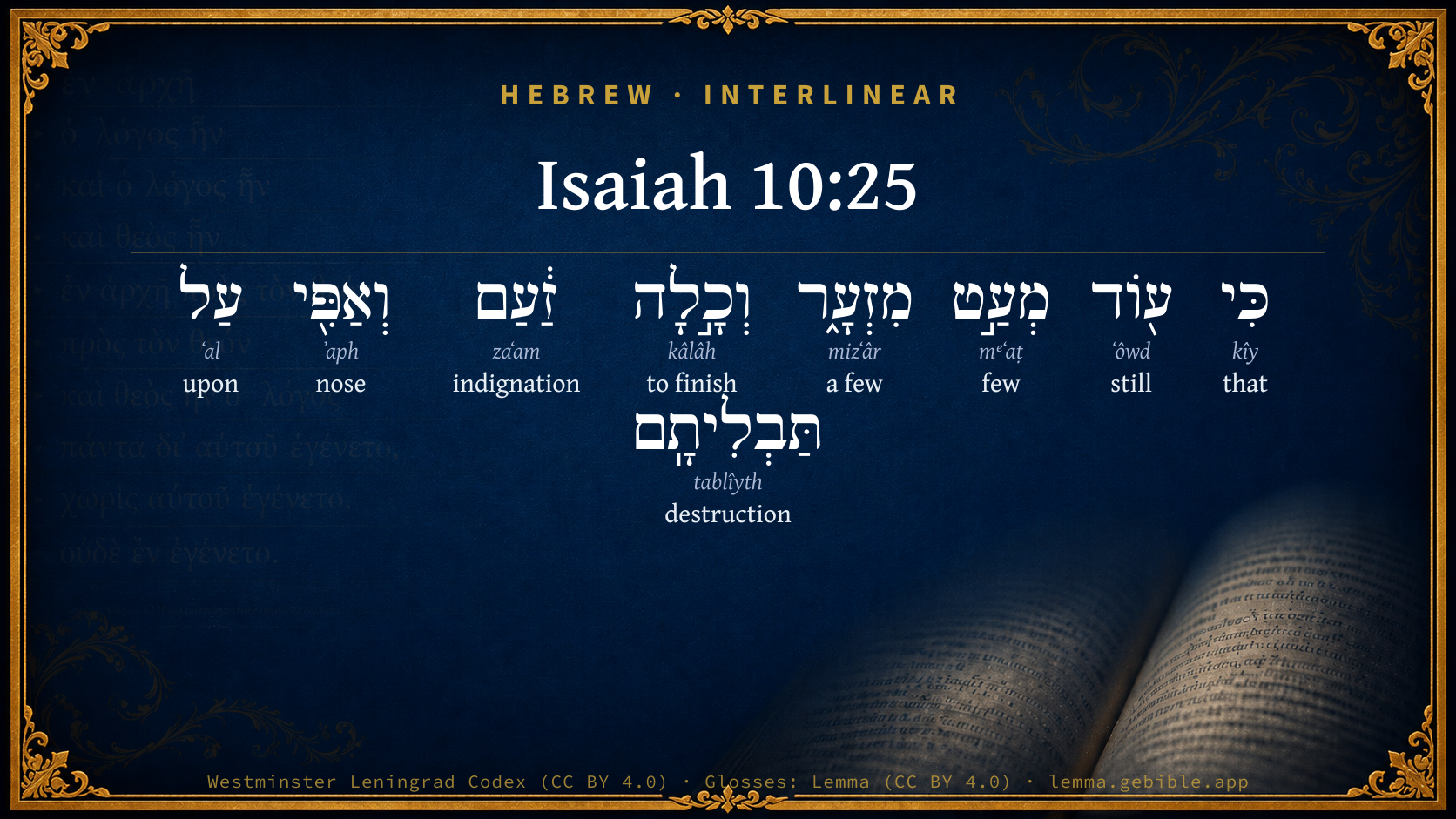
Hebrew (Westminster Leningrad Codex) Isaiah 10:25 appears in the Hebrew Old Testament. The text above is from the Westminster Leningrad Codex. Each word links to its Strong’s number, a concise gloss, and parsing drawn from the Open Scriptures Hebrew Bible morphology. Click any word for its full Brown-Driver-Briggs (BDB) entry.
Download image
Cite this verse

Isaiah 10:25 (World English Bible). Public Domain. Lemma interlinear Bible study tool, https://lemma.gebible.app/v/isaiah/10/25.

Show BibTeX & RIS
BibTeX
RIS
English Translation
For yet a very little while, and the indignation [against you] shall be accomplished, and my anger [shall be directed] to his destruction.
World English Bible · Public Domain
Highlights
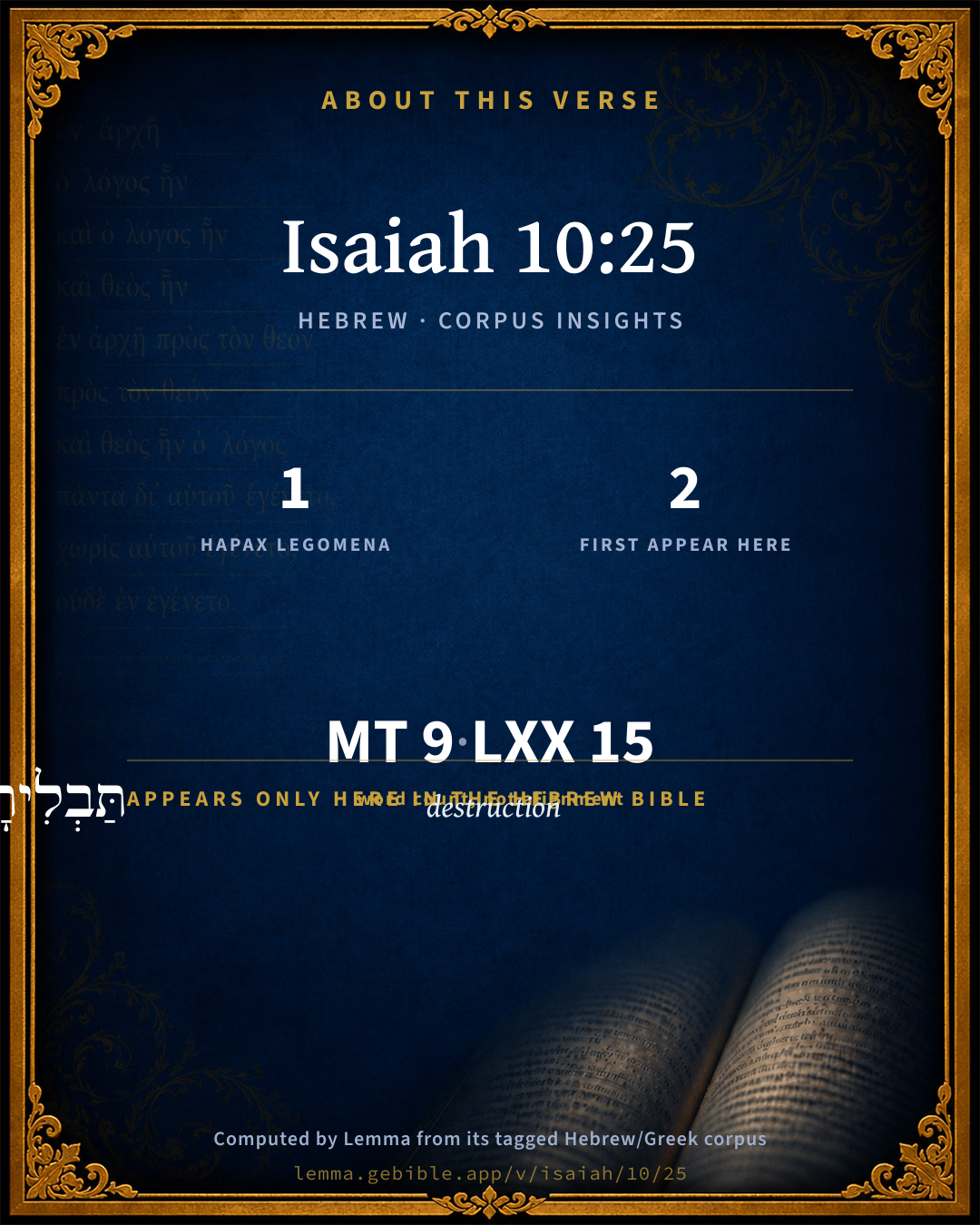
  • 1 hapax legomenon — only here in the Hebrew Bible
  • 2 first appearances in the Hebrew Bible
Full analysis ↓
Download a study sheet

One document with this verse’s original text, its word-by-word gloss line, the meaning frame, cross-references with their text, attributed commentary, and full source and license credits — printable, and it pastes into notes with its structure intact.

This verse Autodidact and up

Study sheet (.html) Plain text (.txt)

A passage Seminary Student

Up to 50 verses in one chapter. A passage sheet keeps up to 6 commentary sources and 12 cross-references per verse, in the order this page ranks them, and says so on the sheet whenever that leaves anything out. Ask for a single verse and you get the Autodidact verse sheet above.

Everything on this page stays free to read, with no account — the sheet is a download of what is already on screen, not access to it.

Want to remove ads? Support Godless Engineer
Compare translations 3

The same verse in 3 English versions, stacked beneath the original-language interlinear above. Click any original word for its lexicon entry.

Each is an independent rendering of the whole verse — the interlinear is not word-aligned to these translations.

Highlighted words mark where these versions differ — a whole-verse word diff, not a word-by-word alignment.

  • World English Bible Public Domain
    For yet a very little while, and the indignation [against you] shall be accomplished, and my anger [shall be directed] to his destruction.
  • King James Version Public Domain
    For yet a very little while, and the indignation shall cease, and mine anger in their destruction.
  • unfoldingWord Literal Text CC BY-SA 4.0
    For yet a little, a trifle, and the fury will end, and my nose to their destruction.”

unfoldingWord Literal Text — © unfoldingWord, licensed CC BY-SA 4.0. Word-aligned USFM3 via Door43 (git.door43.org/unfoldingWord/en_ult).

Versions to compare (up to 4)

3 of 4 selected

Show all 18 translations

Every available English version of this verse, each an independent rendering of the whole verse.

  • World English Bible Public Domain
    For yet a very little while, and the indignation [against you] shall be accomplished, and my anger [shall be directed] to his destruction.
  • Berean Standard Bible Public Domain
    For in just a little while My fury against you will subside, and My anger will turn to their destruction.”
  • Majority Standard Bible Public Domain
    For in just a little while My fury against you will subside, and My anger will turn to their destruction.”
  • King James Version Public Domain
    For yet a very little while, and the indignation shall cease, and mine anger in their destruction.
  • American Standard Version (1901) Public Domain
    For yet a very little while, and the indignation `against thee' shall be accomplished, and mine anger `shall be directed' to his destruction.
  • Revised Version (1885) Public Domain
    For yet a very little while, and the indignation shall be accomplished, and mine anger, in their destruction.
  • Geneva Bible (1599) Public Domain
    But yet a very litle time, and the wrath shall be consumed, and mine anger in their destruction.
  • Douay-Rheims (1899) Public Domain
    For yet a little and a very little while, and my indignation shall cease, and my wrath shall be upon their wickedness.
  • Young's Literal Translation Public Domain
    For yet a very little, And the indignation hath been completed, And Mine anger by their wearing out.
  • Literal Standard Version CC BY-SA 4.0
    For yet a very little [while], || And the indignation has been completed, || And My anger by their wearing out.”
  • Unlocked Literal Bible CC BY-SA 4.0
    Do not fear him, for in a very short time my anger against you will end, and my anger will lead to his destruction.”
  • unfoldingWord Literal Text CC BY-SA 4.0
    For yet a little, a trifle, and the fury will end, and my nose to their destruction.”
  • Darby Bible Public Domain
    for yet a very little while, and the indignation shall be accomplished, and mine anger, in their destruction.
  • World Messianic Bible Public Domain
    For yet a very little while, and the indignation against you will be accomplished, and my anger will be directed to his destruction.”
  • Webster's Bible Public Domain
    For yet a very little while, and the indignation shall cease, and my anger in their destruction.
  • Free Bible Version CC BY-SA 4.0
    Very shortly I will stop being angry with you. Then I will turn my anger on them and I will destroy them.
  • Bible in Basic English Public Domain
    For in a very short time my passion will be over, and my wrath will be turned to their destruction.
  • JPS Tanakh (1917) Public Domain
    For yet a very little while, and the indignation shall be accomplished, and Mine anger shall be to their destruction.

Literal Standard Version (2020), Covenant Press — licensed CC BY-SA 4.0. Text via the HelloAO Bible API (eBible.org). Unlocked Literal Bible (unfoldingWord) — licensed CC BY-SA 4.0. Text via the HelloAO Bible API (eBible.org). unfoldingWord Literal Text — © unfoldingWord, licensed CC BY-SA 4.0. Word-aligned USFM3 via Door43 (git.door43.org/unfoldingWord/en_ult). Free Bible Version, Dr. Jonathan Gallagher — licensed CC BY-SA 4.0. Text via the HelloAO Bible API (eBible.org).

Word by word

More ways to search: Search by grammar → Find every occurrence → Compare this word →

Practice this passage: Drill this verse → Learn its vocabulary →

About this verse

These counts appear in no published source. They are computed here, from the morphology-tagged text and Lemma’s own curated glosses. What Lemma adds →

9
words
9
distinct lemmas
Prophets
section

Notable vocabulary

1 hapax legomenon — a word that appears only here in the entire Hebrew Bible:

  • תַּבְלִיתָֽם destruction H8399

First appearance in Scripture

These words make their first canonical appearance in the Hebrew Bible here:

  • מִזְעָ֑ר a few H4213
  • תַּבְלִיתָֽם destruction H8399

Shared distinctive vocabulary

מִזְעָ֑ר a few H4213 occurs in 4 verses of the Hebrew Bible. Also found in:

Grammatical profile

  • 1 verb
  • 5 nouns
  • 1 preposition
  • 1 conjunction
  • 1 adverb

Verb forms

  • וְכָ֣לָה Qal · Sequential Perfect

Hebrew & Septuagint length

In English translation the verse runs 23 words from the Hebrew and 18 from the Septuagint (LXX English) — closely comparable.

A rough comparison of the two English renderings, which tokenize alike — not a word-level alignment.

Word counts can differ between the Hebrew and the Greek without any difference in meaning — e.g. the Hebrew direct-object marker אֵת has no separate Greek word, and Greek often adds the article ὁ.

In the original languages it is 9 Hebrew tokens and 15 Greek tokens — but the two are counted differently (Hebrew bundles its prefixes and suffixes into one token; the Greek is in lemma form), so that isn’t a like-for-like length.

Cross-references

13

Topical passages linked to Isaiah 10:25 in the Treasury of Scripture Knowledge — connected by theme and wording, ordered by reader-vote popularity; previews shown in the World English Bible.

  • Daniel 11:36 The king shall do according to his will; and he shall exalt himself, and magnify himself above every god, and shall speak marvelous things against the God of gods; and he shall prosper until the indignation be accomplished; for that which is determined shall be done.
  • 2 Kings 19:35 It happened that night, that the angel of Yahweh went forth, and struck in the camp of the Assyrians one hundred eighty-five thousand: and when men arose early in the morning, behold, these were all dead bodies.
  • Hebrews 10:37 "In a very little while, He who comes will come, and will not wait.
  • Psalms 37:10 For yet a little while, and the wicked will be no more. Yes, though you look for his place, he isn't there.
  • Isaiah 10:5 Ho Assyrian, the rod of my anger, the staff in whose hand is my indignation!
  • Isaiah 10:33–34 Behold, the Lord, Yahweh of Hosts, will lop the boughs with terror: and the high of stature shall be hewn down, and the lofty shall be brought low.
  • Isaiah 12:1–2 In that day you will say, "I will give thanks to you, Yahweh; for though you were angry with me, your anger has turned away and you comfort me.
  • Isaiah 14:24–25 Yahweh of Hosts has sworn, saying, Surely, as I have thought, so shall it happen; and as I have purposed, so shall it stand:
  • Isaiah 17:12–14 Ah, the uproar of many peoples, who roar like the roaring of the seas; and the rushing of nations, that rush like the rushing of mighty waters!
  • Isaiah 30:30–33 Yahweh will cause his glorious voice to be heard, and will show the lighting down of his arm, with the indignation of [his] anger, and the flame of a devouring fire, with a blast, and tempest, and hailstones.
  • Isaiah 31:4–9 For thus says Yahweh to me, As the lion and the young lion growling over his prey, if a multitude of shepherds are called forth against him, will not be dismayed at their voice, nor abase himself for the noise of them: so will Yahweh of Hosts come down to fight on Mount Zion, and on the hill of it.
  • Isaiah 37:36–38 The angel of Yahweh went forth, and struck in the camp of the Assyrians one hundred and eighty-five thousand; and when men arose early in the morning, behold, these were all dead bodies.
  • Isaiah 54:7 For a small moment have I forsaken you; but with great mercies will I gather you.

Cross-references courtesy of OpenBible.info (CC BY 4.0).

Hebrew and Greek witnesses Masoretic Hebrew ↔ Greek Septuagint

The same verse in the two great witnesses to the Old Testament, shown verse-for-verse.

These are two independent witnesses, not word-aligned to each other, and the Septuagint is shown in lemma (dictionary) form.

Hebrew Isaiah 10:25 Masoretic · Westminster Leningrad Codex

כִּי ע֖וֹד מְעַ֣ט מִזְעָ֑ר וְכָ֣לָה זַ֔עַם וְאַפִּ֖י עַל תַּבְלִיתָֽם

For yet a very little while, and the indignation [against you] shall be accomplished, and my anger [shall be directed] to his destruction.

World English Bible · Public Domain

Greek LXX Isaiah 10:25 Septuagint · lemma form

ἔτι γάρ μικρός καί παύω ὁ ὀργή ὁ δέ θυμός ἐγώ ἐπί ὁ βουλή αὐτός

For yet a little while, and the indignation shall cease: but my wrath shall be against their council.

LXX2012 (modern English Septuagint) · Public Domain

Hebrew: Westminster Leningrad Codex (CC BY 4.0). Greek: Septuagint (public domain); English from LXX2012 (modern English Septuagint) (Public Domain). How the Septuagint differs from the Hebrew →

Targum (Aramaic paraphrase)

1

The Targum is the ancient Jewish Aramaic paraphrase of the Hebrew Scriptures — an interpretive translation, not the Hebrew text itself. Onkelos (literal) and Pseudo-Jonathan (expansive) render the Torah, and Jonathan the Prophets. Coverage is partial: where no permissively-licensed English translation exists for a verse, only the Aramaic is shown. This is verse-level text, not a word-by-word alignment to the Hebrew.

  1. Targum Jonathan Prophets (Joshua–Malachi)
    אֲרֵי עוֹד צִבְחַר כִּזְעֵיר וִיסוּפוּן לְוָטַיָא מִנְכוֹן דְבֵית יַעֲקֹב וְרוּגְזֵי עַל עַמְמַיָא עָבְדֵי תִבְלָא לְשֵׁיצָיוּתְהוֹן:

    For yet a little while, and the curses shall cease from you of the house of Jacob; and mine anger shall be upon the people that work iniquity, to destroy them.

    Targum Jonathan — Aramaic: “Mikraot Gedolot” (public domain). English: “Sefaria Community Translation” (CC0 1.0 (public-domain dedication)); “London "Chaldee Paraphrase," 1871” (public domain). Text via Sefaria.

Commentary

Notes on Isaiah 10:25 from classic Christian and Jewish commentators (each source and its license shown beneath its notes). The classic Christian expositions comment on the surrounding passage and are grouped to its opening verse, so a note may address several verses; the Jewish commentaries on the Tanakh (Rashi and others) are per-verse, so they appear only where the commentator wrote on this verse.

Lemma curates 59 commentaries, every one of them public domain or Creative Commons licensed, each selected and text-cleaned for this edition rather than reprinted as found. About our sources →

Trapp's Complete Commentary

John Trapp

Isa 10:25 For yet a very little while, and the indignation shall cease, and mine anger in their destruction.

Ver. 25. For yet a very little while.] Heb., A little little, or a little of a little. Yet a little modicum, and wrath shall be at an end. Oecolampadius rendereth it, Adhuc paululum, minus quam paululum. Hold out therefore faith and patience.

John Trapp, A Commentary or Exposition upon All the Books of the Old and New Testament (1647–1656) — public domain. Text from a community e-Sword module.

Joseph Benson's Commentary

Isa 10:25-26. For yet a very little while, &c. — Here the prophet proceeds to assign the reasons why the Lord would not have his people to fear the Assyrians, because, in a short time, he would take vengeance upon them, and that in a very singular and extraordinary manner, as he did upon the Midianites and Egyptians: the consequence of which would be the removal of the yoke now imposed, or to be imposed upon them. The indignation — My displeasure at my people, which is the rod and staff in their hand, Isa 10:5; shall cease — And, when it ceaseth, they will be disarmed, and disabled from doing any farther mischief. And mine anger in their destruction — Hebrew, על תבליתם, upon, or, with their destruction, as Dr. Waterland properly renders the words, namely, the destruction of the Assyrians. The enemy that threatens and afflicts God’s people, shall himself be reckoned with and punished. The rod wherewith God corrected them shall not only be laid aside, but put into the fire, and it shall appear by its destruction that his anger is turned away from them. The reader will recollect that, upon the destruction of the Assyrian army, the calamities wherewith God had chastised his people in a great measure ceased, at least for a time. The Lord of hosts — Who is well able; shall stir up a scourge for him — He lifted up his staff against Zion; and God will now lift up a scourge for him: he was a terror to God’s people, and God will be a terror to him. The destroying angel shall be his scourge, which he can neither flee from nor contend with. According to the slaughter of Midian — Whom God slew suddenly and unexpectedly in the night. At the rock of Oreb — Upon which one of their chief princes was slain, and nigh unto which the Midianites were destroyed. And as his rod was upon the sea — To divide it, and make way for thy deliverance, and for the destruction of the Egyptians. So shall he lift it up after the manner of Egypt — As he did in Egypt, to bring his plagues upon that land and people. Thus the prophet, for the encouragement of God’s people, quotes precedents, and puts them in mind of what God had done formerly against the enemies of his church, who were very strong and formidable, but were brought to ruin. Respecting the last clause of this verse, “I think,” says Bishop Lowth, “there is a designed ambiguity in these words. Sennacherib, soon after his return from his Egyptian expedition, which, I imagine, took him up three years, invested Jerusalem. He is represented by the prophet as lifting up his rod, in his march from Egypt, and threatening the people of God, as Pharaoh and the Egyptians had done, when they pursued them to the Red sea. But God, in his turn, will lift up his rod, as he did at that time over the sea, in the way, or, after the manner of Egypt: and as Sennacherib had imitated the Egyptians in his threats, and came full of rage against them from the same quarter; so God will act over again the same part that he had taken formerly in Egypt, and overthrow their enemies in as signal a manner.”

Joseph Benson's Commentary on the Old and New Testaments (1811–1818) — public domain. Text from a community e-Sword module.

Keil & Delitzsch

C. F. Keil & F. Delitzsch

A still further reason is given for the elevating words, with a resumption of the grounds of consolation upon which they were founded. "For yet a very little the indignation is past, and my wrath turns to destroy them: and Jehovah of hosts moves the whip over it, as He smote Midian at the rock of Oreb; and His staff stretches out over the sea, and He lifts it up in the manner of Egypt." The expression "a very little" (as in Isa 16:14; Isa 29:17) does not date from the actual present, when the Assyrian oppressions had not yet begun, but from the ideal present, when they were threatening Israel with destruction. The indignation of Jehovah would then suddenly come to an end (câlâh za‛am, borrowed in Dan 11:36, and to be interpreted in accordance with Isa 26:20); and the wrath of Jehovah would be, or go, ‛al-tabilthâm. Luzzatto recommends the following emendation of the text, יתּם על־תּבל ואפּי, "and my wrath against the world will cease," tēbēl being used, as in Isa 14:17, with reference to the oikoumenon as enslaved by the imperial power. But the received text gives a better train of thought, if we connect it with Isa 10:26. We must not be led astray, however, by the preposition ‛al, and take the words as meaning, My wrath (burneth) over the destruction inflicted by Asshur upon the people of God, or the destruction endured by the latter. It is to the destruction of the Assyrians that the wrath of Jehovah is now directed; ‛al being used, as it frequently is, to indicate the object upon which the eye is fixed, or to which the intention points (Psa 32:8; Psa 18:42). With this explanation Isa 10:25 leads on to Isa 10:26. The destruction of Asshur is predicted there in two figures drawn from occurrences in the olden time. The almighty Judge would swing the whip over Asshur (‛orer, agitare, as in Sa2 23:18), and smite it, as Midian was once smitten. The rock of Oreb is the place where the Ephraimites slew the Midianitish king 'Oreb (Jdg 7:25). His staff would then be over the sea, i.e., would be stretched out, like the wonder-working staff of Moses, over the sea of affliction, into which the Assyrians had driven Israel (yâm, the sea, an emblem borrowed from the type; see Kohler on Zac 10:11, cf., Psa 66:6); and He would lift it up, commanding the waves of the sea, so that they would swallow Asshur. "In the manner of Egypt:" b'derek Mitzraim (according to Luzzatto in both instances, "on the way to Egypt," which restricts the Assyrian bondage in a most unhistorical manner to the time of the Egyptian campaign) signifies in Isa 10:24, as the Egyptians lifted it up; but here, as it was lifted up above the Egyptians. The expression is intentionally conformed to that in Isa 10:24 : because Asshur had lifted up the rod over Israel in the Egyptian manner, Jehovah would lift it up over Asshur in the Egyptian manner also.

Keil & Delitzsch — Biblical Commentary on the Old Testament (1861–1891) — public domain (CC PDM 1.0). Text via the HelloAO Bible API. (Old Testament only.)

Jamieson, Fausset & Brown

Robert Jamieson, A. R. Fausset & David Brown

For--Be not afraid (Isa 10:24), for, &c.

indignation . . . cease--The punishments of God against Israel shall be consummated and ended (Isa 26:20; Dan 11:36). "Till the indignation be accomplished," &c.

mine anger--shall turn to their (the Assyrians') destruction.

Jamieson, Fausset & Brown — Commentary Critical and Explanatory on the Whole Bible (1871) — public domain (CC PDM 1.0). Text via the HelloAO Bible API.

Adam Clarke's Commentary

Verse 25. The indignation - "Mine indignation."] Indignatio mea, Vulg. ἡ οργη, Sept. μου η οργη κατα σου, MS. Pachom. Μου ἡ οργη ἡ κατα σου, MS. I. D. II. So that זעמי zaami, or הזעם hazzaam, as one MS. has it, seems to be the true reading.

Adam Clarke's Commentary on the Bible (1810–1826) — public domain. Text from a community e-Sword/MySword module.

Ellicott's Commentary for English Readers

(25) The indignation shall cease . . .—The “indignation” is the wrath of Jehovah poured out upon His people. That wrath is to cease, and His anger shall be for the destruction of their enemies.

A Bible Commentary for English Readers, edited by Charles John Ellicott (1878–1897) — public domain. Text from a community e-Sword module.

John Gill's Exposition

And the Lord of hosts shall stir up a scourge for him,.... The Assyrian monarch; this scourge stirred up or awakened by the Lord, with which that monarch was severely scourged, is no other than the angel that was sent of God to destroy his army, Kg2 19:35,

according to the slaughter of Midian at the rock of Oreb: this refers to the destruction of the Midianites in the time of Gideon; and suggests, that the slaughter of the Assyrians should be like that, as it was; for as that was in the night, and very general, and immediately from the hand of the Lord, and was unthought of, and unexpected, and such of their princes that fled were taken and slain, particularly Oreb, at the rock which took its name from him; for not mount Horeb, and the rock there smitten by Moses, are meant, which is written with different letters; see the history of this in Jdg 7:19 so it was in the night when the Assyrian army was destroyed, and that wholly; and not by the Israelites, but by the Angel of the Lord; and at once, at an unawares; and though Sennacherib fled and escaped, he was slain by his own sons, in his own city, in the temple of his god, Kg2 19:35,

and as his rod was upon the sea; referring to Moses's rod, which was lifted up, by the order of the Lord, over the Red Sea, when the Egyptians were drowned:

so shall he lift it up after the manner of Egypt; and destroy the Assyrians, in like manner as he destroyed the Egyptians, all at once.

John Gill's Exposition of the Whole Bible (1746–1763) — public domain (CC PDM 1.0). Text via the HelloAO Bible API.

Albert Barnes' Notes on the Bible

For yet a very little while - This is designed to console them with the hope of deliverance. The threatened invasion was brief and was soon ended by the pestilence that swept off the greater part of the army of the Assyrian.

The indignation shall cease - The anger of God against his offending people shall come to an end; his purposes of chastisement shall be completed; and the land shall be delivered.

In their destruction - על־תבליתם ‛al-tabelı̂ytām from בלה bâlâh, to wear out; to consume; to be annihilated. It means here, that his anger would terminate in the entire annihilation of their power to injure them. Such was the complete overthrow of Sennacherib by the pestilence; 2Ki 19:35. The word used here, occurs in this form in no other place in the Hebrew Bible, though the verb is used, and other forms of the noun. “The verb,” Deu 7:4; Deu 29:5; Jos 9:13; Neh 9:21, ...“Nouns,” Eze 23:43; Isa 38:17; Jer 38:11-12; Isa 17:14, et al.

Albert Barnes' Notes on the Bible (1834–1885) — public domain. Text from a community e-Sword/MySword module.

Haydock's Catholic Bible Commentary

Little. Twenty-eight years, (Psalm lxxxix. 4.) or he alludes to the destruction which took place in a single night, (Calmet) or in a moment, ver. 16. (Haydock)

George Leo Haydock (1774–1849), Haydock's Catholic Family Bible and Commentary, 1859 edition — public domain. Excludes Psalms (Douay-Rheims chapter numbering differs from Protestant) and Deuterocanonical books (Catholic canon only).

Matthew Poole's English Annotations

The indignation; mine anger, as it is explained in the next clause; either,

1. Towards my people; which shall weaken the Assyrian, whose great strength lay there; of which see above, Isa 10:5. Or,

2. Towards the Assyrian, with whom God was very angry, Isa 10:12, &c., yea, so angry, as not to be satisfied without their destruction, as it follows.

Shall cease; as anger commonly doth, when vengeance is fully executed.

Matthew Poole's English Annotations on the Holy Bible (1683–1685) — public domain. Text from a community e-Sword/MySword module.

Whedon's Commentary on the Bible

Daniel D. Whedon

25. Yet a very little while — Time not definite, as in Isa_16:14, nor does it date from the present — but it is very soon.

The indignation shall cease — Whose indignation? — the Assyrian’s or God’s? To be parallel with the next clause, it is God’s — executed, however, by the Assyrian. Hence the indefinite expression. After due chastisement of Israel and Judah by the hand of the Assyrian, indignation is at an end. Then the anger, of which he was the executioner on others, shall tend, or turn, to the Assyrian’s destruction.

Daniel D. Whedon (gen. ed.), Commentary on the Old and New Testaments (1874–1909) — public domain. Text from a community e-Sword module.

The Pulpit Commentary

The indignation shall cease; rather, there shall be an end of wrath; i.e. "my wrath against Israel shall come to an end Israel having been sufficiently punished. And mine auger in their destruction; rather, and my anger shall be to their destruction; i.e. to the destruction of the Assyrians (see the margin of the Revised Version).

The Pulpit Commentary (1880–1919), ed. H.D.M. Spence-Jones & Joseph S. Exell — public domain. Text from a community e-Sword module.

John Wesley's Explanatory Notes

Indignation - Mine anger towards the Assyrian. Cease - As anger commonly does when vengeance is fully executed.

John Wesley, Explanatory Notes Upon the Whole Bible (1754–1765) — public domain. Text via the GEBible commentary corpus.

J. A. Alexander on Isaiah

Joseph Addison Alexander

This verse assigns a reason for the exhortation not to fear in v. 24. “For yet a very little, and wrath is at an end, and my anger (shall go forth or tend) to their destruction,” (i.e., the destruction of the enemy. The first clause may have reference to that destruction also, or to the restoration of God’s people to His favor.

Joseph Addison Alexander, The Prophecies of Isaiah (1846–1847; New York: Scribner, 1870–1878) — public domain. Text from a community e-Sword module.

Rashi

Rabbi Shlomo Yitzchaki (Rashi)

For [in] yet very few days...the fury shall be over My fury, which was given as a staff into the hand of Assyria, as he said above, “And My fury is a staff in his hands” (v. 5).

and My wrath that became a rod, shall return because of their blasphemy Heb. (עַל-תַּבְלִיתָם). Comp. (Lev. 20:12) “they have committed a disgrace (תֶּבֶל),” i.e., because of the insults and blasphemies which the servants of the king of Assyria blasphemed Me.

Rashi on the Tanakh — English translations: “The Judaica Press complete Tanach with Rashi, translated by A. J. Rosenberg” (CC BY 4.0); “Pentateuch with Rashi's commentary by M. Rosenbaum and A.M. Silbermann, 1929-1934” (public domain); “The Metsudah Tanach series, Lakewood, N.J” (CC BY 4.0); and “The Book of Joshua, Metsudah Publications, 1997” (CC BY 4.0). Text via Sefaria.

Ibn Ezra

Rabbi Abraham ibn Ezra

מעט מזער. A very little. Supply בימים, of time. And the indignation, etc. And mine anger and wrath, on account of their great iniquities will all be spent. תבליתם. Their iniquities. According to some, their destruction; comp. בלותי, My old age (Gen. 18:12). The form of the word is like that of תַּכְלִית (Ps. 132:32)

Ibn Ezra on the Tanakh — English translations: “Sefaria Community Translation” (CC0 1.0 (public-domain dedication)); “Yalkut, Sifsei Chachomim Chumash, Metsudah Publications, 2009” (CC BY 4.0); and “Commentary of Ibn Ezra on Isaiah - trans. by M. Friedlander, 1873” (public domain). Text via Sefaria.

Lesson kit

Teaching starters — assembled from the data on this page, not authored interpretation. Every prompt links to the verse data it draws on. Edit before teaching.

Isaiah, in the Prophets, opens this verse with 9 words (9 distinct Hebrew lemmas). Its most distinctive word is tablîyth (“destruction”). A historical commentator’s framing appears above. Read the whole chapter for the surrounding context.

Discussion questions

  1. The word tablîyth carries the sense “destruction.” How does it shape the verse?
  2. 1 word here appears nowhere else in the Hebrew Bible. Why might the author reach for such rare wording?
  3. 2 words make their first appearance in Scripture here. What does this debut establish?
  4. How does Isaiah 16:14, which shares the word «a few», read alongside this verse?
  5. These translations render this verse differently; the difference is in the English rendering, not the original. What questions does that raise?
  6. «וְכָ֣לָה» is a Qal Sequential Perfect verb. How does that grammatical form shape the action described?
  7. Compare how Trapp's Complete Commentary and Joseph Benson's Commentary read this verse. Where do they agree or differ?

Things to notice

Reading settings

Reading text

Shown beneath each verse's original-language words.

Old Testament
Old Testament edition

Read the OT as the Masoretic Hebrew (MT) or the Greek Septuagint (LXX).

English shown for the Greek Septuagint (in the Hebrew ↔ Greek comparison).

Comparing translations? Open the Compare panel on any verse page to stack up to four side by side.