
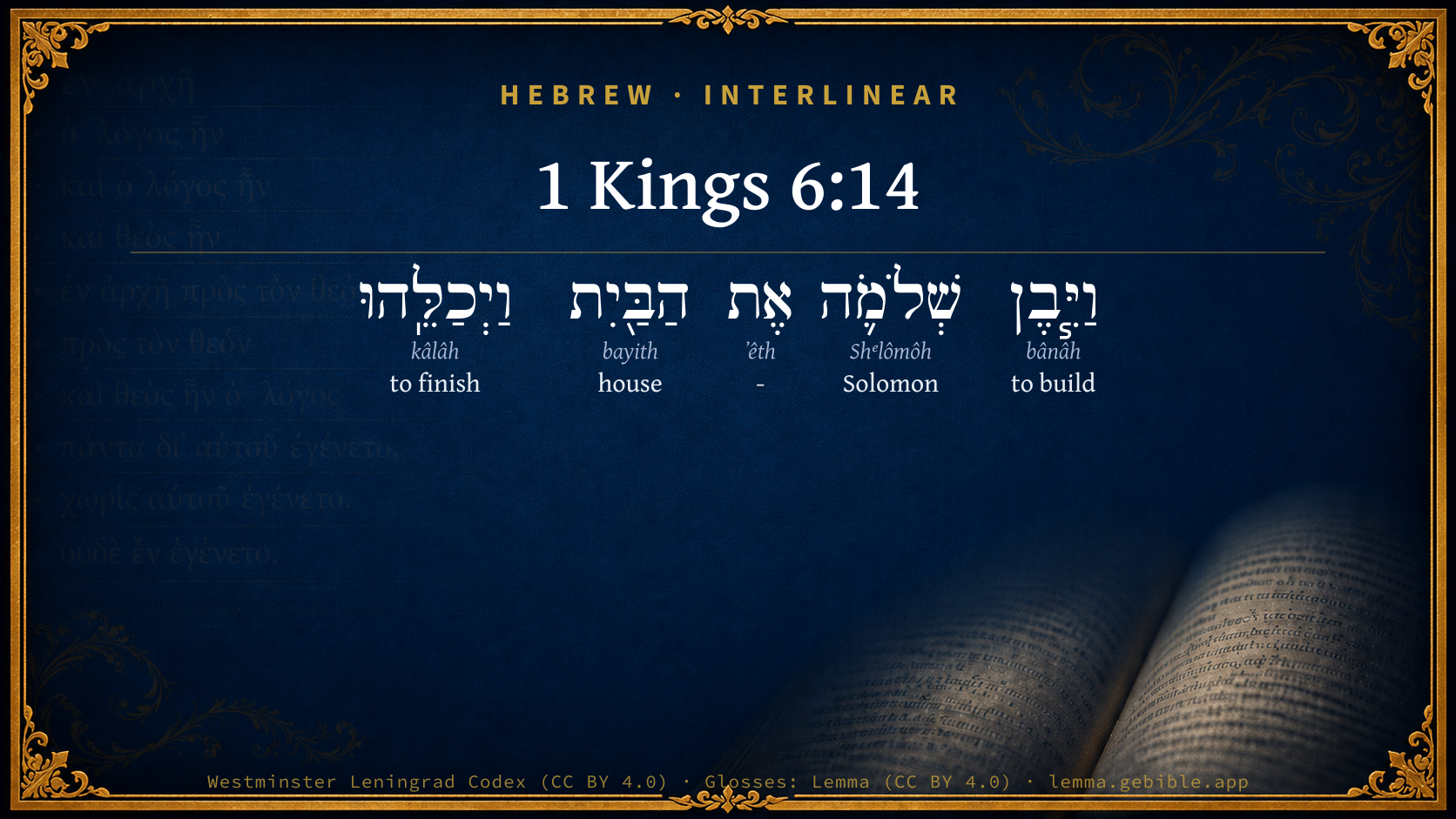
1 Kings 6:14

Hebrew (Westminster Leningrad Codex) 1 Kings 6:14 appears in the Hebrew Old Testament. The text above is from the Westminster Leningrad Codex. Each word links to its Strong’s number, a concise gloss, and parsing drawn from the Open Scriptures Hebrew Bible morphology. Click any word for its full Brown-Driver-Briggs (BDB) entry.
Download image
Cite this verse

1 Kings 6:14 (World English Bible). Public Domain. Lemma interlinear Bible study tool, https://lemma.gebible.app/v/1-kings/6/14.

Show BibTeX & RIS
BibTeX
RIS
English Translation
So Solomon built the house, and finished it.
World English Bible · Public Domain
Download a study sheet

One document with this verse’s original text, its word-by-word gloss line, the meaning frame, cross-references with their text, attributed commentary, and full source and license credits — printable, and it pastes into notes with its structure intact.

This verse Autodidact and up

Study sheet (.html) Plain text (.txt)

A passage Seminary Student

Up to 50 verses in one chapter. A passage sheet keeps up to 6 commentary sources and 12 cross-references per verse, in the order this page ranks them, and says so on the sheet whenever that leaves anything out. Ask for a single verse and you get the Autodidact verse sheet above.

Everything on this page stays free to read, with no account — the sheet is a download of what is already on screen, not access to it.

Want to remove ads? Support Godless Engineer
Compare translations 3

The same verse in 3 English versions, stacked beneath the original-language interlinear above. Click any original word for its lexicon entry.

Each is an independent rendering of the whole verse — the interlinear is not word-aligned to these translations.

Highlighted words mark where these versions differ — a whole-verse word diff, not a word-by-word alignment.

  • World English Bible Public Domain
    So Solomon built the house, and finished it.
  • King James Version Public Domain
    So Solomon built the house, and finished it.
  • unfoldingWord Literal Text CC BY-SA 4.0
    And Solomon built the house and finished it.

unfoldingWord Literal Text — © unfoldingWord, licensed CC BY-SA 4.0. Word-aligned USFM3 via Door43 (git.door43.org/unfoldingWord/en_ult).

Versions to compare (up to 4)

3 of 4 selected

Show all 18 translations

Every available English version of this verse, each an independent rendering of the whole verse.

  • World English Bible Public Domain
    So Solomon built the house, and finished it.
  • Berean Standard Bible Public Domain
    So Solomon built the temple and finished it.
  • Majority Standard Bible Public Domain
    So Solomon built the temple and finished it.
  • King James Version Public Domain
    So Solomon built the house, and finished it.
  • American Standard Version (1901) Public Domain
    So Solomon built the house, and finished it.
  • Revised Version (1885) Public Domain
    So Solomon built the house, and finished it.
  • Geneva Bible (1599) Public Domain
    So Salomon built the house and finished it,
  • Douay-Rheims (1899) Public Domain
    So Solomon built the house and finished it.
  • Young's Literal Translation Public Domain
    And Solomon buildeth the house and completeth it;
  • Literal Standard Version CC BY-SA 4.0
    And Solomon builds the house and completes it;
  • Unlocked Literal Bible CC BY-SA 4.0
    So Solomon built the house and finished it.
  • unfoldingWord Literal Text CC BY-SA 4.0
    And Solomon built the house and finished it.
  • Darby Bible Public Domain
    And Solomon built the house and finished it.
  • World Messianic Bible Public Domain
    So Solomon built the house and finished it.
  • Webster's Bible Public Domain
    So Solomon built the house, and finished it.
  • Free Bible Version CC BY-SA 4.0
    Solomon finished building the Temple.
  • Bible in Basic English Public Domain
    So Solomon made the building of the house complete.)
  • JPS Tanakh (1917) Public Domain
    So Solomon built the house, and finished it.

Literal Standard Version (2020), Covenant Press — licensed CC BY-SA 4.0. Text via the HelloAO Bible API (eBible.org). Unlocked Literal Bible (unfoldingWord) — licensed CC BY-SA 4.0. Text via the HelloAO Bible API (eBible.org). unfoldingWord Literal Text — © unfoldingWord, licensed CC BY-SA 4.0. Word-aligned USFM3 via Door43 (git.door43.org/unfoldingWord/en_ult). Free Bible Version, Dr. Jonathan Gallagher — licensed CC BY-SA 4.0. Text via the HelloAO Bible API (eBible.org).

Word by word

More ways to search: Search by grammar → Find every occurrence → Compare this word →

Practice this passage: Drill this verse → Learn its vocabulary →

וַיְכַלֵּֽהוּ
kâlâh
H3615
“and · to finish · him”
Conjunction + Verb, Piel, Sequential Imperfect, 3rd Person, Masculine, Singular + Suffix, Personal, 3rd Person, Masculine, Singular
Part of Speech
Conjunction + Verb
Stem
Piel
Form
Sequential Imperfect
Person
3rd Person
Gender
Masculine
Number
Singular
Full BDB Definition

Origin: a primitive root

TWOT: 982 , 983 , 984

to accomplish, cease, consume, determine, end, fail, finish, be complete, be accomplished, be ended, be at an end, be finished, be spent - (Qal) - to be complete, be at an end - to be completed, be finished - to be accomplished, be fulfilled - to be determined, be plotted (bad sense) - to be spent, be used up - to waste away, be exhausted, fail - to come to an end, vanish, perish, be destroyed - (Piel) - to complete, bring to an end, finish - to complete (a period of time) - to finish (doing a thing) - to make an end, end - to accomplish, fulfil, bring to pass - to accomplish, determine (in thought) - to put an end to, cause to cease - to cause to fail, exhaust, use up, spend - to destroy, exterminate - (Pual) to be finished, be ended, be completed
  1. וַיִּ֧בֶן bânâh H1129 “and · to build” Conjunction + Verb, Qal, Sequential Imperfect, 3rd Person, Masculine, Singular
  2. שְׁלֹמֹ֛ה Shᵉlômôh H8010 “Solomon” Noun, Proper
  3. אֶת ʼêth H853 “-” Particle, Direct Object
  4. הַבַּ֖יִת bayith H1004 “the · house” Particle, Definite Article + Noun, Common, Masculine, Singular, Absolute

About this verse

These counts appear in no published source. They are computed here, from the morphology-tagged text and Lemma’s own curated glosses. What Lemma adds →

5
words
5
distinct lemmas
Historical
section

Grammatical profile

  • 2 verbs
  • 2 nouns
  • 1 particle

Verb forms

  • וַיִּ֧בֶן Qal · Sequential Imperfect
  • וַיְכַלֵּֽהוּ Piel · Sequential Imperfect

Cross-references

3

Topical passages linked to 1 Kings 6:14 in the Treasury of Scripture Knowledge — connected by theme and wording, ordered by reader-vote popularity; previews shown in the World English Bible.

  • 1 Kings 6:9 So he built the house, and finished it; and he covered the house with beams and planks of cedar.
  • 1 Kings 6:38 In the eleventh year, in the month Bul, which is the eighth month, was the house finished throughout all the parts of it, and according to all the fashion of it. So was he seven years in building it.
  • Acts 7:47–48 But Solomon built him a house.

Cross-references courtesy of OpenBible.info (CC BY 4.0).

Hebrew and Greek witnesses Masoretic Hebrew ↔ Greek Septuagint

The same verse in the two great witnesses to the Old Testament, shown verse-for-verse.

These are two independent witnesses, not word-aligned to each other, and the Septuagint is shown in lemma (dictionary) form.

Hebrew 1 Kings 6:14 Masoretic · Westminster Leningrad Codex

וַיִּ֧בֶן שְׁלֹמֹ֛ה אֶת הַבַּ֖יִת וַיְכַלֵּֽהוּ

So Solomon built the house, and finished it.

World English Bible · Public Domain

Hebrew: Westminster Leningrad Codex (CC BY 4.0). Greek: Septuagint (public domain); English from a public-domain English Septuagint. How the Septuagint differs from the Hebrew →

Targum (Aramaic paraphrase)

1

The Targum is the ancient Jewish Aramaic paraphrase of the Hebrew Scriptures — an interpretive translation, not the Hebrew text itself. Onkelos (literal) and Pseudo-Jonathan (expansive) render the Torah, and Jonathan the Prophets. Coverage is partial: where no permissively-licensed English translation exists for a verse, only the Aramaic is shown. This is verse-level text, not a word-by-word alignment to the Hebrew.

  1. Targum Jonathan Prophets (Joshua–Malachi)
    וּבְנָא שְׁלֹמֹה יַת בֵּיתָא וְשַׁכְלְלֵיהּ:

    (no public-domain English translation for this verse)

    Targum Jonathan — Aramaic: “Mikraot Gedolot” (public domain). English: “Sefaria Community Translation” (CC0 1.0 (public-domain dedication)); “London "Chaldee Paraphrase," 1871” (public domain). Text via Sefaria.

Commentary

Notes on 1 Kings 6:14 from classic Christian and Jewish commentators (each source and its license shown beneath its notes). The classic Christian expositions comment on the surrounding passage and are grouped to its opening verse, so a note may address several verses; the Jewish commentaries on the Tanakh (Rashi and others) are per-verse, so they appear only where the commentator wrote on this verse.

Lemma curates 59 commentaries, every one of them public domain or Creative Commons licensed, each selected and text-cleaned for this edition rather than reprinted as found. About our sources →

Trapp's Complete Commentary

John Trapp

1Ki 6:14 So Solomon built the house, and finished it.

Ver. 14. So Solomon built the house.] See 1Ki 6:9.

John Trapp, A Commentary or Exposition upon All the Books of the Old and New Testament (1647–1656) — public domain. Text from a community e-Sword module.

Keil & Delitzsch

C. F. Keil & F. Delitzsch

The Internal Arrangements of the Temple-House. - Kg1 6:14-22. Internal covering of the house, and division into Holy and Most Holy. - Kg1 6:14 (cf. Kg1 6:9) resumes the description of the building of the temple, which had been interrupted by the divine promise just communicated.

Kg1 6:15

"He built (i.e., so far as the sense is concerned, he covered) the walls of the house within with boards of cedar; from the floor of the house to the walls of the ceiling he overlaid it with wood within, and overlaid the floor with cypress boards." The expression הסּפּן קירות, "walls of the ceiling," is very striking here, and renders it probable that קירות is only a copyist's error for קורות, "beams of the ceiling." The whole of the inside of the house was covered with wood, so that nothing was to be seen of the stone wall (Kg1 6:18). On the other hand, the biblical text knows nothing of any covering of the outer walls also with wood, as many have assumed.

Kg1 6:16-18

"And he built אמּה את־עשׂרים, the twenty cubits (i.e., the space of twenty cubits), of the hindermost side of the house with boards of cedar," from the floor to the beams (of the roof). עד־הקּירות is to be explained from הסּפּן קירות עד in Kg1 6:15. "And built them for it (the house - לו pointing back to הבּית) into the hinder room, into the Most Holy." דּביר is more precisely defined by the apposition הקּדשׁים קדשׁ, and therefore denotes the Most Holy Place. But there is a doubt as to its derivation and true meaning. Aquila and Symmachus render it χρηματιστήριον, Jerome λαλητήριον, or in the Vulg. oraculum, so that they derive it from דּבר, to speak; and Hengstenberg adopts this derivation in Psa 28:2 : דּביר, lit., that which is spoken, then the place where the speaking takes place. Most of the more recent commentators, on the other hand, follow the example of C. B. Michaelis and J. Simonis, and render it, after the Arabic, the hinder portion or back room, which is favoured by the antithesis לפני היכל, the front sanctuary (Kg1 6:17). The words of the text, moreover, are not to be understood as referring to a cedar wall in front of the Most Holy Place which rose to the height of twenty cubits, but to all four walls of the Most Holy Place, so that the wall which divided the hinder room from the Holy Place is not expressly mentioned, simply because it is self-evident. The words also imply that the whole of the hinder space of the house to the length of twenty cubits was cut off for the Most Holy Place, and therefore the party wall must also have filled the whole height of the house, which was as much as thirty cubits, and reached, as is expressly stated, from the floor to the roof. There remained therefore forty cubits of the house (in length) for לפני היכל, the front palace, i.e., the Holy Place of the temple (Kg1 6:17). לפני, anterior, formed from לפני (cf. Ewald, 164, a.). - In Kg1 6:18 there is inserted in a circumstantial clause the statement as to the internal decoration of both rooms; and the further description of the Most Holy Place is given in Kg1 6:19. "And cedar wood was (placed) against the house inside, sculpture of gourds (colocynthides) and open buds." מקלעת is in apposition to ארז, containing a more minute description of the nature of the covering of cedar. מקלעת signifies sculpture, half-raised work (basso relievo); not, however, "that kind of bas-relief in which the figures, instead of rising above the surface on which they are wrought, are simply separated from it by the chiselling out of their outlines, and their being then rounded off according to these outlines" (Thenius). For although the expression מקלעות פּתּוּחי (Kg1 6:29) appears to favour this, yet "merely engraved work" does not harmonize with the decorations of the brazen stands in Kg1 7:31, which are also called מקלעות. פּקעים are figures resembling the פּקּעת, or wild gourds (Kg2 4:39), i.e., oval ornaments, probably running in straight rows along the walls. צצּים פּטוּרי are open flower-buds; not hangings or garlands of flowers (Thenius), for this meaning cannot be derived from פּטר in the sense of loosening or setting free, so as to signify flowers loosened or set free (= garlands), which would be a marvellous expression! The objection that, "flowers not yet opened, i.e., flower-buds, were not צצּים, but פּרחים," rests upon a false interpretation of the passage referred to.

Kg1 6:19

"And (= namely) he prepared a hinder room in the house within, to place the ark of the covenant of Jehovah there." תתּן, as Kg1 17:14 shows, is not a future (ut reponeres), but the infinitive תּת with a repeated syllable תן (see Ewald, 238, c.).

Kg1 6:20

"And the interior of the hinder room was twenty cubits the length, twenty cubits the breadth, and twenty cubits its height." The word לפני I agree with Kimchi in regarding as the construct state of the noun לפנים, which occurs again in Kg1 6:29 in the sense of the inner part or interior, as is evident from the antithesis לחיצום (on the outside). "And he overlaid it with fine gold." סגוּר זהב (= סגור =( ז in Job 28:15) unquestionably signifies fine or costly gold, although the derivation of this meaning is still questionable; viz., whether it is derived from סגר in the sense of to shut up, i.e., gold shut up or carefully preserved, after the analogy of כּתם; or is used in the sense of taking out or selecting, i.e., gold selected or pure; or in the sense of closed, i.e., gold selected or pure; or in the sense of closed, i.e., gold condensed or unadulterated (Frst and Delitzsch on Job 28:15).

The Most Holy Place had therefore the form of a perfect cube in the temple as well as in the tabernacle, only on an enlarged scale. Now, as the internal elevation of the house, i.e., of the whole of the temple-house, the hinder portion of which formed the Most Holy Place, was thirty cubits, there was a space of about ten cubits in height above the Most Holy Place and below the roof of the temple-house for the upper rooms mentioned in Ch2 3:9, on the nature and purpose of which nothing is said in the two accounts.

(Note: This upper room does not presuppose, however, that the party wall, which follows as a matter of course from Kg1 6:16, was not merely a cedar wall, but a wall two cubits thick. The supposed difficulty of setting up a cedar wall thirty cubits high is not so great as to necessitate assumptions opposed to the text. For we cannot possibly see why it could not have been made secure "without injuring the temple wall." The wood panelling must have been nailed firmly to the wall without injuring the wall itself; and therefore this could be done just as well in the case of the cedar beams or boards of the party wall.)

"And he overlaid (clothed) the altar with cedar wood." There is something very striking in the allusion to the altar in this passage, since the verse itself treats simply of the Most Holy Place; and still more striking is the expression לדּביר אשׁר המּזבּח, "the altar belonging to the Debir," in Kg1 6:22, since there was no altar in the Most Holy Place. We cannot remove the strangeness of these sentences by such alterations as Thenius and Bttcher propose, because the alterations suggested are much too complicated to appear admissible. The allusion to the altar in both these verses is rather to be explained from the statements in the Pentateuch as to the position of the altar of incense; viz., Exo 30:6, "Thou shalt place it before the curtain, which is above the ark of the testimony before the capporeth over the testimony;" and Exo 40:5, "before the ark of the testimony;" whereby this altar, although actually standing "before the inner curtain," i.e., in the Holy Place, according to Exo 40:26, was placed in a closer relation to the Most Holy Place than the other two things which were in the Holy Place. The clothing of the altar with cedar presupposes that it had a heart of stone; and the omission of the article before מזבּח may be explained on the ground that it is mentioned here for the first time, just as in Kg1 6:16, where דּביר was first mentioned, it had no article.

Kg1 6:21-22

To the gilding of the Most Holy Place, and the allusion to the altar of incense, which in a certain sense belonged to it, there is now appended in Kg1 6:21 the gilding of the Holy Place. "Solomon overlaid the house from within with fine gold." מפּנימה הבּית cannot be the party wall between the Holy Place and the Most Holy, as I formerly supposed, but is the Holy Place as distinguished from the Most Holy. The following words וגו ויעבּר are very obscure. If we rendered them, "he caused to pass over in (with) golden chains before the hinder room," we could only think of an ornament consisting of golden chains, which ran along the wall in front of the hinder room and above the folding doors. But this would be very singularly expressed. We must therefore take עבּר, as Gesenius, de Wette, and many of the earlier commentators do, according to the Chaldaean usage in the sense of bolting or fastening: "he bolted (fastened) with golden chains before the hinder room;" and must assume with Merz and others that the doors into the Most Holy Place (except on the day of atonement) were closed and fastened with golden chains, which were stretched across the whole breadth of the door and stood out against the wall.

(Note: The conjecture of Thenius, that את־הפּרכת (the curtain) has dropped out of the text and should be restored ("he carried the curtain across with golden chains"), is very properly described by Merz as "certainly untenable," since, apart from the fact that not one of the older versions contains the missing words, chains would have impeded the moving of the curtain. It is true that, according to Ch2 3:14, there was a curtain before the Most Holy Place; but as it is not mentioned so early as this even in the Chronicles, this would not be its proper position in the account before us, but it would be most suitably mentioned either in connection with or after the reference to the doors of the Most Holy Place in Kg1 6:31, Kg1 6:32.)

- The following expression, זהב ויצפּהוּ, "and he overlaid it with gold," can only refer to the altar mentioned in the previous verse, the gilding of which has not yet been noticed, however surprising the separation of these words from Kg1 6:20 may be. - In Kg1 6:22 what has already been stated with regard to the gilding is repeated once more in a comprehensive manner, which brings this subject to a close. The whole house (כּל־הבּית) is the Holy Place and the Most Holy, but not the porch or hall, as this is expressly distinguished from the house. המּזבּח, the whole altar, not merely a portion of it.

Kg1 6:23-28

The large cherub-figures in the Most Holy Place. - Kg1 6:23. He made (caused to be made) in the hinder room two cherubs of olive wood, i.e., wood of the oleaster or wild olive-tree, which is very firm and durable, and, according to Ch2 3:10, צעצעים מעשׂה, i.e., according to the Vulgate, opus statuarium, a peculiar kind of sculpture, which cannot be more precisely defined, as the meaning of צוּע is uncertain. "Ten cubits was the height of it" (i.e., of the one and of the other). The figures had a human form, like the golden cherubs upon the ark of the covenant, and stood upright upon their feet (Ch2 3:13), with extended wings of five cubits in length, so that one wing of the one reached to one wing of the other in the centre of the room, and the other wing of each reached to the opposite wall, and consequently the four extended wings filled the entire breadth of the Most Holy Place ( a breadth of twenty cubits), and the two cherubs stood opposite to one another and ten cubits apart. The wings were evidently fastened to the back and placed close to one another upon the shoulder-blades, so that the small space between their starting-points is not taken into consideration in the calculation of their length. The figures were completely overlaid with gold. The ark of the covenant was placed between these cherubs, and under the wings which pointed towards one another. As they were made like those upon the ark, they had evidently the same meaning, and simply served to strengthen the idea which was symbolized in the cherub, and which we have expounded in the Commentary on Exo 25:20. Only their faces were not turned towards one another and bent down towards the ark, as in the case of the golden cherubim of the ark; but, according to Ch2 3:13, they were turned לבּית, towards the house, i.e., the Holy Place, so as to allow of the extension of the wings along the full length of the Most Holy Place.

Kg1 6:29-35

Ornaments of the walls; the floors and doors. - Kg1 6:29. All the walls of the house (the Holy Place and the Most Holy) round about (מסב, adverb) he made engraved work (carving) of cherubs, palms, and open flowers from within to the outside (i.e., in the Most Holy as well as in the Holy Place). ול...מן = אל...מן; and לפנים as in Kg1 6:20. This completes the account of the nature of the covering of wood. In addition to the oval figures and open flowers (Kg1 6:18), there were also figures of cherubim and palm-trees carved in the wooden panels. Nothing is said as to the distribution of these figures. But a comparison with Eze 41:18 shows at any rate so much, that the palm-trees alternated with the cherubs, so that there was always one cherub standing between two palm-trees. The gourd-shaped figures and the open flowers probably formed the upper and lower setting of the rows of palms and cherubs, the flowers hanging in the form of garlands above the palms and cherubs, and the rows of gourds arranged in bars constituting the boundary lines both above and blow. It is a disputed question whether there was only one row of palms and cherubs running round the walls, or whether there were two, or possibly even three. There is more probability in the second or third of these assumptions than in the first, inasmuch as on the walls of the Egyptian temples there were often three or four rows of mythological characters in relief arranged one above another (compare my work on the Temple, pp. 70ff.).

Kg1 6:30

The floor of the house he overlaid with gold within and without, i.e., in the Most Holy Place and in the Holy Place also.

Kg1 6:31-32

He made the entrance to the back room, doors (i.e., consisting of doors; cf. Ewald, 284, a., β) of olive wood, which moved, according to Kg1 7:50, on golden hinges. וגו האיל, "the projection of the door-posts was fifth" (מזוּזות( " is construed freely as an explanatory apposition to האיל, to which it is really subordinate; cf. Ewald, 290, e.). These obscure words, which have been interpreted in very different ways (see Ges. Thes. pp. 43f.), can hardly have any other meaning than this: the projecting framework of the doors occupied the fifth part of the breadth of the wall. For the explanation given by Bttcher and Thenius, "the entrance framework with posts of fifth strength," has no real support in Eze 41:3. To justify the rendering given to המשּׁית (fifth strength), האיל is supplied, though not in the sense of projection, but in the thoroughly unwarranted sense of strength or thickness of the wall; and in addition to this, a wall two cubits thick is postulated between the Holy Place and the Most Holy Place, in direct contradiction to Kg1 6:16. The further evidence, which Thenius finds in Kg1 8:8, in support of this explanation, has been already rejected by Bttcher as unsustained. It would indeed be extremely strange for the thickness of the door-posts which formed the setting of the entrance to be given, whereas nothing is said about the size of the doors. According to our explanation, "a fifth of the breadth of the wall," the entrance was four cubits broad including the projecting door-posts, and each of the two wings of the folding doors about a cubit and a half broad, if we reckon the projecting framework on either side at half a cubit in breadth.

Kg1 6:32

"And two doors (i.e., folding doors, sc. he made; וּשׁתּי is also governed by עשׂה in Kg1 6:31) of olive wood, and carved upon them carved work," etc., as upon the walls (Kg1 6:29), "and overlaid them with gold, spreading the gold upon the cherubs and palms" (ירד, hiphil of רדד), i.e., he spread gold-leaf upon them, so that, as Rashi observes, all the figures, the elevations and depressions of the carved work, were impressed upon the coating of gold-leaf, and were thus plainly seen. Thenius infers from this explanatory clause, that the gilding upon the walls and doors was most probably confined to the figures engraved, and did not extend over the whole of the walls and doors, because, if the doors had been entirely overlaid with gold, the gilding of the carved work upon them would have followed as a matter of course. But this inference is a very doubtful one. For if it followed as a matter of course from the gilding of the entire doors that the carved work upon them was overlaid with gold, it would by no means follow that the overlaying was such as to leave the carved work visible or prominent, which this clause affirms. Moreover, a partial gilding of the walls would not coincide with the expression כּל־הבּית עד־תּם in Kg1 6:22, since these words, which are used with emphasis, evidently affirm more than "that such (partial) gilding was carried out everywhere throughout the temple proper." The doors in front of the Most Holy Place did not render the curtain mentioned in Ch2 3:14 unnecessary, as many suppose. This curtain may very well have been suspended within the doors; so that even when the doors were opened outwards on the entrance of the high priest, the curtain formed a second covering, which prevented the priests who were ministering in the Holy Place and court from looking in.

(Note: H. Merz (Herzog's Cycl.) now admits this, whereas he formerly agreed with Ewald and others in denying the existence of the curtain in Solomon's temple, and regarded the curtain (veil) in Mat 27:51-52 as an arbitrary addition made by Herod out of his princely caprice, thus overlooking the deep symbolical meaning which the veil or curtain possessed.)

Kg1 6:33-34

"And thus he made upon the door of the Holy Place posts of olive wood from a fourth (of the wall)," i.e., a framework which occupied a fourth of the breadth of the wall, or was five cubits broad (see at Kg1 6:31), "and two doors of cypress wood, two leaves each door turning," i.e., each of the folding doors consisting of two leaves, each of which was made to turn by itself, so that it could be opened and shut alone (without the other; קלעים is probably only a copyist's error for צלעים). Cypress wood was chosen for the folding doors of the Holy Place, and not olive wood, as in the case of the Most Holy Place, probably because it is lighter in weight, and therefore less likely to sink. It is questionable here what idea we are to form of the division of each folding door into two leaves, each of which turned by itself: whether we are to think of each wing as divided lengthwise into two narrow leaves, or as divided half way up, so that the lower half could be opened without the upper. I agree with Merz in thinking the latter the more probable assumption; for the objection made by Thenius, on the ground that doors of this kind are only seen in the houses of the peasantry, is an idle assertion which cannot be proved. In a doorway of five cubits in breadth, after reckoning the doorposts the width of the two wings could not be more than two cubits each. And if such a door had been divided into two halves, each half would have been only one cubit wide, so that when open it would not have furnished the requisite room for one man conveniently to pass through. On the other hand, we may assume that a folding door of four cubits in breadth, if made in just proportions, would be eight cubits high. And a door of such a height might easily be divided into two halves, so that only the lower half (of two cubits in breadth and about four in height) was opened for the daily entrance of the priests into the Holy Place. These doors probably opened outwards, like those in front of the Most Holy Place.

Kg1 6:35

Carving and gilding: as upon the doors before the hinder room. The gold was levelled or smoothed over that which had been engraved, i.e., it was beaten out thin and laid upon the carving in such a manner that the gold plate fitted closely to the figures. Gilding was generally effected in ancient times by the laying on of gold plate, which was fastened with tacks (compare Ch2 3:9).

Keil & Delitzsch — Biblical Commentary on the Old Testament (1861–1891) — public domain (CC PDM 1.0). Text via the HelloAO Bible API. (Old Testament only.)

Tyndale Open Study Notes

Tyndale Open Resources

6:14-35 The focus shifts to the Temple interior. While the Temple site is not mentioned here, the Chronicler located it at the former threshing floor of Araunah (1 Chr 21:18-25; 2 Chr 3:1). This site is traditionally thought to be the location of Mount Moriah (Gen 22:2). Solomon’s Temple was in the northeastern corner of Jerusalem (now called the “old city”) in the area now associated with the Dome of the Rock.

Tyndale Open Study Notes — © Tyndale Open Resources, licensed CC BY-SA 4.0. Text via the HelloAO Bible API.

The Cambridge Bible for Schools and Colleges

gen. ed. J. J. S. Perowne

14–22. Particulars of the interior fittings of the holy place, and of the most holy place (2Ch_3:5-9)

14. So Solomon built the house] This verse resumes the narrative of 1Ki_6:9.

The Cambridge Bible for Schools and Colleges (gen. ed. J. J. S. Perowne; Cambridge University Press, 1878–1918) — public domain. Text from a community e-Sword module.

John Gill's Exposition

So Solomon built the house, and finished it. He went on with it until he had completed it, animated and encouraged by the promise of the divine Presence in it, provided a proper regard was had to the will and ways of God. Abarbinel thinks the above message was sent him in the midst of his work, to strengthen and caution him from a dependence on the continuance of the fabric, because of the strength of it; since its perpetuity depended on his, his successors', and the people's conduct and behaviour; wherefore conscious to himself of his own integrity, and hoping well of posterity, he was not discouraged, but proceeded in his undertaking until he had brought it to perfection.

So Solomon built the house, and finished it. He went on with it until he had completed it, animated and encouraged by the promise of the divine Presence in it, provided a proper regard was had to the will and ways of God. Abarbinel thinks the above message was sent him in the midst of his work, to strengthen and caution him from a dependence on the continuance of the fabric, because of the strength of it; since its perpetuity depended on his, his successors', and the people's conduct and behaviour; wherefore conscious to himself of his own integrity, and hoping well of posterity, he was not discouraged, but proceeded in his undertaking until he had brought it to perfection.

1 Kings 6:15

kg1 6:15

kg1 6:15

kg1 6:15And he built the walls of the house within with boards of cedar,.... For as yet he had only built the stone walls of it without, but now he wainscotted it with cedar boards: and not only them, but

both the floor of the house, and the walls of the ceiling; or from "the floor of the house unto the walls of the ceiling"; that is, from the floor, including that, to the walls on each side, reaching up to the ceiling,

he covered them on the inside with wood: of one sort or another, cedar or fir, or both: particularly he

covered the floor of the house with planks of fir: which Hiram sent him, Kg1 5:8; which is differently interpreted; by Josephus cypress; by others, as the Tigurine version, pine tree wood; it is very probable it was of the cedar kind, and not the floor only, but the ceiling also, Ch2 3:5.

John Gill's Exposition of the Whole Bible (1746–1763) — public domain (CC PDM 1.0). Text via the HelloAO Bible API.

Whedon's Commentary on the Bible

Daniel D. Whedon

14. Solomon built the house, and finished it — This verse need not be understood as a resuming of the description broken off at 1Ki_6:10, but rather as referring to the word of the Lord as told in 1Ki_6:12-13. In accordance with that word of encouragement and promise, Solomon went on to build and finish the sacred edifice.

Daniel D. Whedon (gen. ed.), Commentary on the Old and New Testaments (1874–1909) — public domain. Text from a community e-Sword module.

The Pulpit Commentary

So Solomon built the house and finished it though these words are a repetition of ver. 9, yet they are not without significance. Encouraged by the promise just made, he proceeded with the interior, of which the narrative henceforth treats. Ver. 9 speaks of the finishing of the shell.

The Pulpit Commentary (1880–1919), ed. H.D.M. Spence-Jones & Joseph S. Exell — public domain. Text from a community e-Sword module.

unfoldingWord translationNotes

Door43 World Missions Community

Solomon ... he built ... he covered them ... he covered the floor

Solomon would have commanded his workers to do the building. AT: "Solomon's workers ... they built ... they covered them ... they covered the floor" (See: Metonymy)

interior walls

walls between the rooms on the inside

cypress

Cypress is a kind of wood that was used for building the temple. (See: Translate Unknowns)

translationWords

cedar

cypress

unfoldingWord translationNotes — © Distant Shores Media and the Door43 World Missions Community, licensed CC BY-SA 4.0. Source: git.door43.org/Door43/en_tn.

Lesson kit

Teaching starters — assembled from the data on this page, not authored interpretation. Every prompt links to the verse data it draws on. Edit before teaching.

1 Kings, in the Historical, opens this verse with 5 words (5 distinct Hebrew lemmas). Its most distinctive word is kâlâh (“to finish”). A historical commentator’s framing appears above. Read the whole chapter for the surrounding context.

Discussion questions

  1. How does “to finish” (kâlâh) shape what this verse is saying?
  2. 1 Kings 6:9 shares this passage’s theme. How do the two illuminate each other?
  3. The verb «וַיִּ֧בֶן» is Qal Sequential Imperfect. How does its form color the action?
  4. Reading how Trapp's Complete Commentary and Keil & Delitzsch read this verse, where do the two commentators agree and where do they part?

Reading settings

Reading text

Shown beneath each verse's original-language words.

Old Testament
Old Testament edition

Read the OT as the Masoretic Hebrew (MT) or the Greek Septuagint (LXX).

English shown for the Greek Septuagint (in the Hebrew ↔ Greek comparison).

Comparing translations? Open the Compare panel on any verse page to stack up to four side by side.