
Ezekiel 20:21

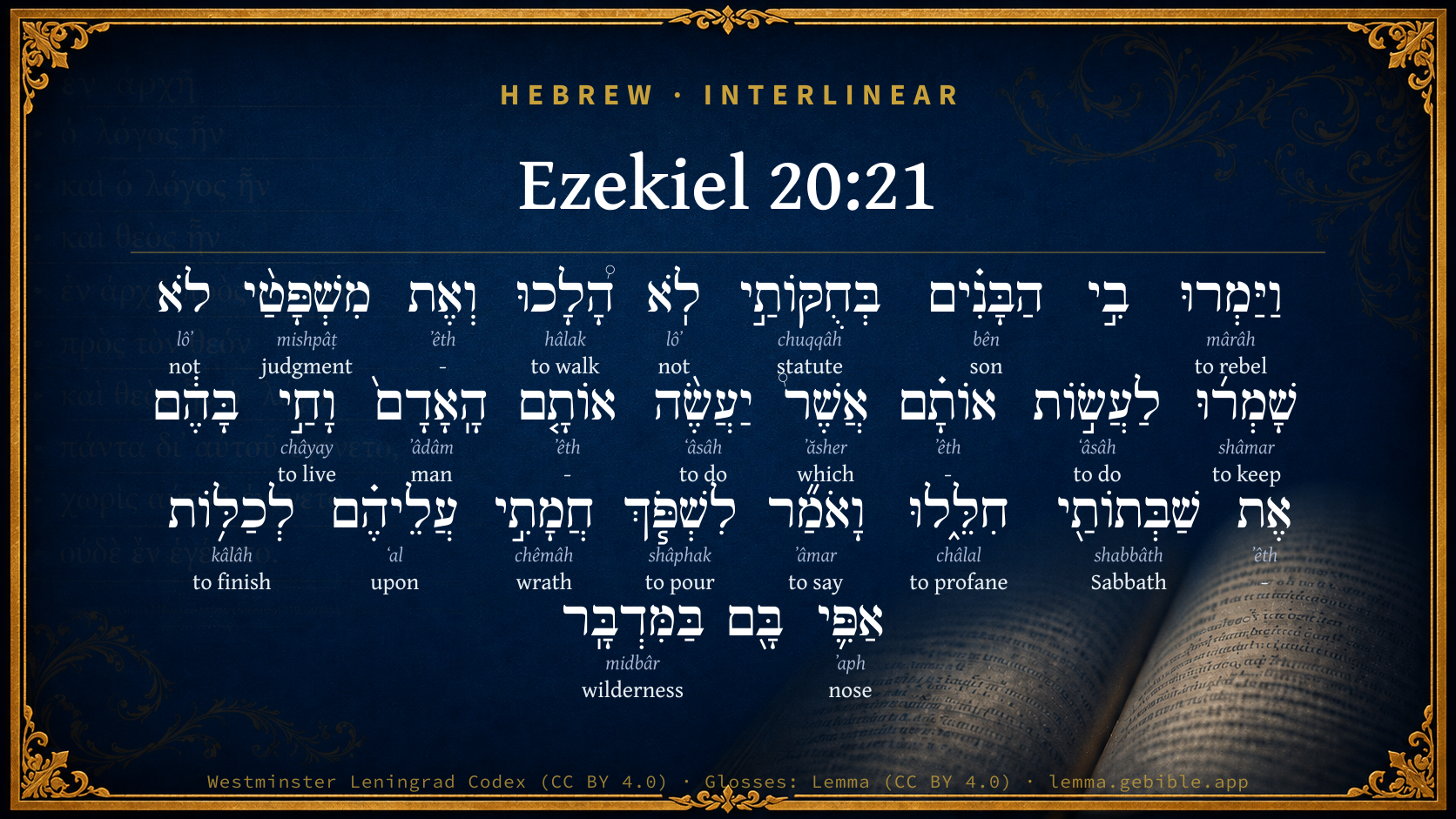
Hebrew (Westminster Leningrad Codex) Ezekiel 20:21 appears in the Hebrew Old Testament. The text above is from the Westminster Leningrad Codex. Each word links to its Strong’s number, a concise gloss, and parsing drawn from the Open Scriptures Hebrew Bible morphology. Click any word for its full Brown-Driver-Briggs (BDB) entry.
Download image
Cite this verse

Ezekiel 20:21 (World English Bible). Public Domain. Lemma interlinear Bible study tool, https://lemma.gebible.app/v/ezekiel/20/21.

Show BibTeX & RIS
BibTeX
RIS
English Translation
But the children rebelled against me; they didn't walk in my statutes, neither kept my ordinances to do them, which if a man do, he shall live in them; they profaned my Sabbaths. Then I said I would pour out my wrath on them, to accomplish my anger against them in the wilderness.
World English Bible · Public Domain
Download a study sheet

One document with this verse’s original text, its word-by-word gloss line, the meaning frame, cross-references with their text, attributed commentary, and full source and license credits — printable, and it pastes into notes with its structure intact.

This verse Autodidact and up

Study sheet (.html) Plain text (.txt)

A passage Seminary Student

Up to 50 verses in one chapter. A passage sheet keeps up to 6 commentary sources and 12 cross-references per verse, in the order this page ranks them, and says so on the sheet whenever that leaves anything out. Ask for a single verse and you get the Autodidact verse sheet above.

Everything on this page stays free to read, with no account — the sheet is a download of what is already on screen, not access to it.

Want to remove ads? Support Godless Engineer
Compare translations 3

The same verse in 3 English versions, stacked beneath the original-language interlinear above. Click any original word for its lexicon entry.

Each is an independent rendering of the whole verse — the interlinear is not word-aligned to these translations.

Highlighted words mark where these versions differ — a whole-verse word diff, not a word-by-word alignment.

  • World English Bible Public Domain
    But the children rebelled against me; they didn't walk in my statutes, neither kept my ordinances to do them, which if a man do, he shall live in them; they profaned my Sabbaths. Then I said I would pour out my wrath on them, to accomplish my anger against them in the wilderness.
  • King James Version Public Domain
    Notwithstanding the children rebelled against me: they walked not in my statutes, neither kept my judgments to do them, which if a man do, he shall even live in them; they polluted my sabbaths: then I said, I would pour out my fury upon them, to accomplish my anger against them in the wilderness.
  • unfoldingWord Literal Text CC BY-SA 4.0
    But their sons and daughters rebelled against me. They did not walk in my statutes or keep my decrees, by which a man might live if he obeys them. They profaned my Sabbaths, so I determined to pour out my fury upon them to satisfy my wrath against them in the wilderness.

unfoldingWord Literal Text — © unfoldingWord, licensed CC BY-SA 4.0. Word-aligned USFM3 via Door43 (git.door43.org/unfoldingWord/en_ult).

Versions to compare (up to 4)

3 of 4 selected

Show all 18 translations

Every available English version of this verse, each an independent rendering of the whole verse.

  • World English Bible Public Domain
    But the children rebelled against me; they didn't walk in my statutes, neither kept my ordinances to do them, which if a man do, he shall live in them; they profaned my Sabbaths. Then I said I would pour out my wrath on them, to accomplish my anger against them in the wilderness.
  • Berean Standard Bible Public Domain
    But the children rebelled against Me. They did not walk in My statutes or carefully observe My ordinances—though the man who does these things will live by them—and they profaned My Sabbaths. So I resolved to pour out My wrath upon them and vent My anger against them in the wilderness.
  • Majority Standard Bible Public Domain
    But the children rebelled against Me. They did not walk in My statutes or carefully observe My ordinances—though the man who does these things will live by them—and they profaned My Sabbaths. So I resolved to pour out My wrath upon them and vent My anger against them in the wilderness.
  • King James Version Public Domain
    Notwithstanding the children rebelled against me: they walked not in my statutes, neither kept my judgments to do them, which if a man do, he shall even live in them; they polluted my sabbaths: then I said, I would pour out my fury upon them, to accomplish my anger against them in the wilderness.
  • American Standard Version (1901) Public Domain
    But the children rebelled against me; they walked not in my statutes, neither kept mine ordinances to do them, which if a man do, he shall live in them; they profaned my sabbaths. Then I said I would pour out my wrath upon them, to accomplish my anger against them in the wilderness.
  • Revised Version (1885) Public Domain
    But the children rebelled against me; they walked not in my statutes, neither kept my judgments to do them, which if a man do, he shall live in them; they profaned my sabbaths: then I said I would pour out my fury upon them, to accomplish my anger against them in the wilderness.
  • Geneva Bible (1599) Public Domain
    Notwithstanding the children rebelled against mee: they walked not in my statutes, nor kept my iudgements to doe them, which if a man doe, hee shall liue in them, but they polluted my Sabbaths: then I thought to powre out mine indignation vpon them, and to accomplish my wrath against them in the wildernes.
  • Douay-Rheims (1899) Public Domain
    But their children provoked me, they walked not in my commandments, nor observed my judgments to do them: which if a man do, he shell live in them: and they violated my sabbaths: and I threatened to pour out my indignation upon them, and to accomplish my wrath in them in the desert.
  • Young's Literal Translation Public Domain
    And -- the sons rebel against Me, In My statutes they have not walked, And My judgments they have not observed -- to do them, Which the man who doth -- liveth by them. My sabbaths they have polluted, And I say to pour out My fury upon them, To complete Mine anger against them in the wilderness.
  • Literal Standard Version CC BY-SA 4.0
    And the sons rebel against Me, || They have not walked in My statutes, || And they have not observed My judgments—to do them, || Which the man who does—lives by them. They have defiled My Sabbaths, || And I speak—to pour out My fury on them, || To complete My anger against them in the wilderness.
  • Unlocked Literal Bible CC BY-SA 4.0
    But their sons and daughters rebelled against me. They did not walk in my statutes or keep my decrees, by which a man might live if he obeys them. They profaned my Sabbaths, so I determined to pour out my fury upon them to satisfy my wrath against them in the wilderness.
  • unfoldingWord Literal Text CC BY-SA 4.0
    But their sons and daughters rebelled against me. They did not walk in my statutes or keep my decrees, by which a man might live if he obeys them. They profaned my Sabbaths, so I determined to pour out my fury upon them to satisfy my wrath against them in the wilderness.
  • Darby Bible Public Domain
    And the children rebelled against me: they walked not in my statutes, neither kept mine ordinances to do them, which if a man do, he shall live by them; they profaned my sabbaths: and I said I would pour out my fury upon them, to accomplish mine anger against them in the wilderness.
  • World Messianic Bible Public Domain
    “‘“But the children rebelled against me. They didn’t walk in my statutes, and didn’t keep my ordinances to do them, which if a man does, he shall live in them. They profaned my Sabbaths. Then I said I would pour out my wrath on them, to accomplish my anger against them in the wilderness.
  • Webster's Bible Public Domain
    Notwithstanding the children rebelled against me: they walked not in my statutes, neither kept my judgments to do them, which if a man doeth, he shall even live in them: they profaned my sabbaths: then I said, I would pour out my fury upon them, to accomplish my anger against them in the wilderness.
  • Free Bible Version CC BY-SA 4.0
    But their children also rebelled against me. They didn't follow my laws and didn't keep my regulations, even though they would have given them life. They violated my Sabbaths. So I warned them that I would punish them in my anger there in the desert.
  • Bible in Basic English Public Domain
    But the children would not be controlled by me; they were not guided by my rules, and they did not keep and do my orders, which, if a man does them, will be life to him; and they had no respect for my Sabbaths: then I said I would let loose my passion on them to give full effect to my wrath against them in the waste land.
  • JPS Tanakh (1917) Public Domain
    But the children rebelled against Me; they walked not in My statutes, neither kept Mine ordinances to do them, which if a man do, he shall live by them; they profaned My sabbaths; then I said I would pour out My fury upon them, to spend My anger upon them in the wilderness.

Literal Standard Version (2020), Covenant Press — licensed CC BY-SA 4.0. Text via the HelloAO Bible API (eBible.org). Unlocked Literal Bible (unfoldingWord) — licensed CC BY-SA 4.0. Text via the HelloAO Bible API (eBible.org). unfoldingWord Literal Text — © unfoldingWord, licensed CC BY-SA 4.0. Word-aligned USFM3 via Door43 (git.door43.org/unfoldingWord/en_ult). Free Bible Version, Dr. Jonathan Gallagher — licensed CC BY-SA 4.0. Text via the HelloAO Bible API (eBible.org).

Word by word

More ways to search: Search by grammar → Find every occurrence → Compare this word →

Practice this passage: Drill this verse → Learn its vocabulary →

וָחַ֣י
châyay
H2425
“and · to live”
Conjunction + Verb, Qal, Sequential Perfect, 3rd Person, Masculine, Singular
Part of Speech
Conjunction + Verb
Stem
Qal
Form
Sequential Perfect
Person
3rd Person
Gender
Masculine
Number
Singular
Full BDB Definition

Origin: a primitive root [compare H2421 ]

TWOT: 644

to live, have life, remain alive, sustain life, live prosperously, live for ever, be quickened, be alive, be restored to life or health - (Qal) - to live - to have life - to continue in life, remain alive - to sustain life, to live on or upon - to live (prosperously) - to revive, be quickened - from sickness - from discouragement - from faintness - from death - (Piel) - to preserve alive, let live - to give life - to quicken, revive, refresh - to restore to life - to cause to grow - to restore - to revive - (Hiphil) - to preserve alive, let live - to quicken, revive - to restore (to health) - to revive - to restore to life
  1. וַיַּמְרוּ mârâh H4784 “and · to rebel” Conjunction + Verb, Hiphil, Sequential Imperfect, 3rd Person, Masculine, Plural
  2. הַבָּנִ֗ים bên H1121 “the · sons” Particle, Definite Article + Noun, Common, Masculine, Plural, Absolute
  3. בְּחֻקּוֹתַ֣י chuqqâh H2708 “in/at · statutes · my” Preposition + Noun, Common, Both, Plural, Construct + Suffix, Personal, 1st Person, Common, Singular
  4. לֹֽא lôʼ H3808 “not” Particle, Negative
  5. הָ֠לָכוּ hâlak H1980 “to walk” Verb, Qal, Perfect, 3rd Person, Common, Plural
  6. וְאֶת ʼêth H853 “and · -” Conjunction + Particle, Direct Object
  7. מִשְׁפָּטַ֨י mishpâṭ H4941 “judgments · my” Noun, Common, Masculine, Plural, Construct + Suffix, Personal, 1st Person, Common, Singular
  8. לֹא lôʼ H3808 “not” Particle, Negative
  9. שָׁמְר֜וּ shâmar H8104 “to keep” Verb, Qal, Perfect, 3rd Person, Common, Plural
  10. לַעֲשׂ֣וֹת ʻâsâh H6213 “to do” Preposition + Verb, Qal, Infinitive Construct
  11. אוֹתָ֗ם ʼêth H853 “- · them” Particle, Direct Object + Suffix, Personal, 3rd Person, Masculine, Plural
  12. אֲשֶׁר֩ ʼăsher H834 “which” Particle, Relative
  13. יַעֲשֶׂ֨ה ʻâsâh H6213 “to do” Verb, Qal, Imperfect, 3rd Person, Masculine, Singular
  14. אוֹתָ֤ם ʼêth H853 “- · them” Particle, Direct Object + Suffix, Personal, 3rd Person, Masculine, Plural
  15. הָֽאָדָם֙ ʼâdâm H120 “the · man” Particle, Definite Article + Noun, Common, Masculine, Singular, Absolute
  16. אֶת ʼêth H853 “-” Particle, Direct Object
  17. שַׁבְּתוֹתַ֖י shabbâth H7676 “Sabbaths · my” Noun, Common, Both, Plural, Construct + Suffix, Personal, 1st Person, Common, Singular
  18. חִלֵּ֑לוּ châlal H2490 “to profane” Verb, Piel, Perfect, 3rd Person, Common, Plural
  19. וָאֹמַ֞ר ʼâmar H559 “and · to say” Conjunction + Verb, Qal, Sequential Imperfect, 1st Person, Common, Singular
  20. לִשְׁפֹּ֧ךְ shâphak H8210 “to pour” Preposition + Verb, Qal, Infinitive Construct
  21. חֲמָתִ֣י chêmâh H2534 “wrath · my” Noun, Common, Feminine, Singular, Construct + Suffix, Personal, 1st Person, Common, Singular
  22. עֲלֵיהֶ֗ם ʻal H5921 “upon · them” Preposition + Suffix, Personal, 3rd Person, Masculine, Plural
  23. לְכַלּ֥וֹת kâlâh H3615 “to finish” Preposition + Verb, Piel, Infinitive Construct
  24. אַפִּ֛י ʼaph H639 “nose · my” Noun, Common, Masculine, Singular, Construct + Suffix, Personal, 1st Person, Common, Singular
  25. בַּמִּדְבָּֽר midbâr H4057 “in/at the · wilderness” Preposition, Determined + Noun, Common, Masculine, Singular, Absolute

About this verse

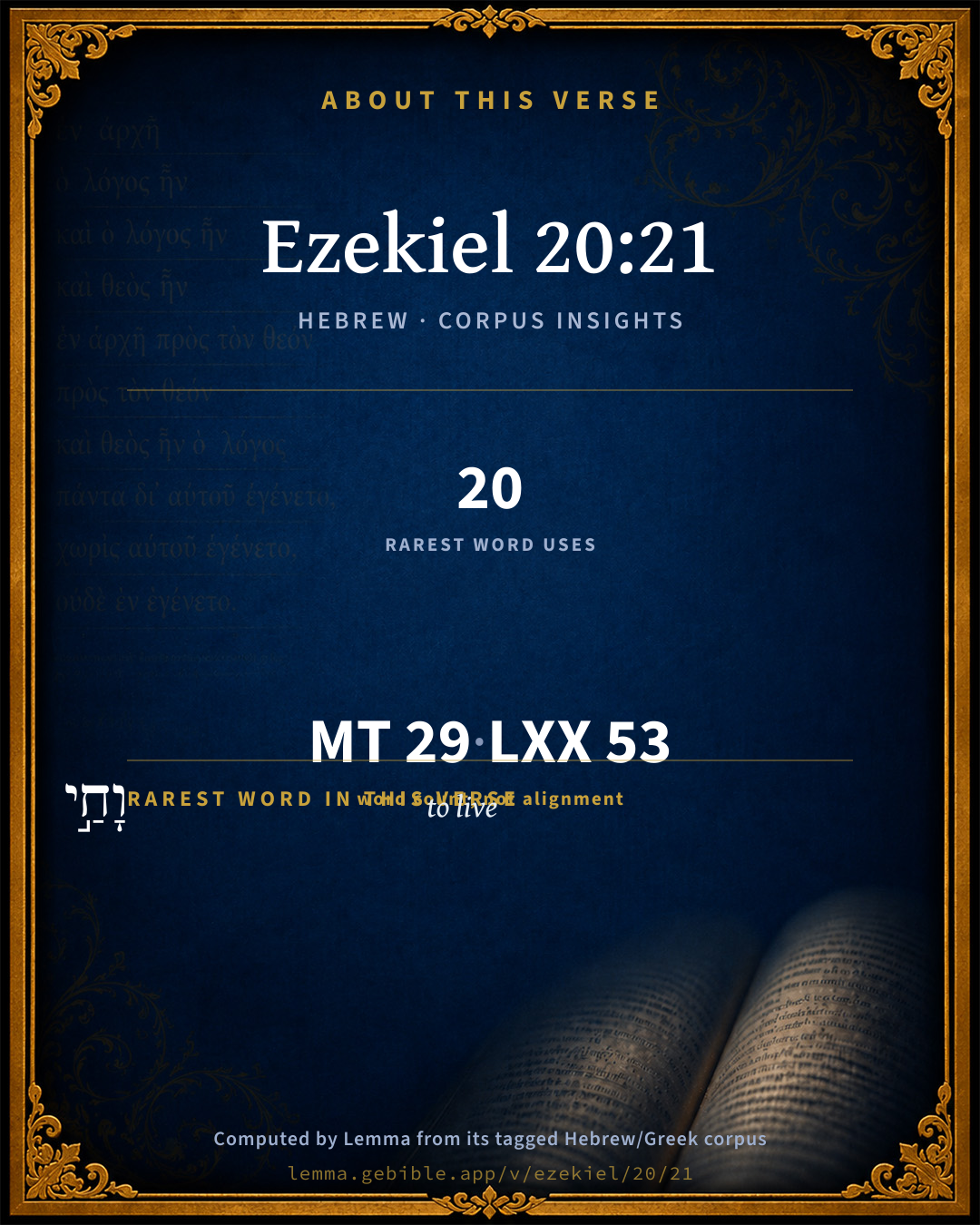
These counts appear in no published source. They are computed here, from the morphology-tagged text and Lemma’s own curated glosses. What Lemma adds →

29
words
21
distinct lemmas
Prophets
section

Notable vocabulary

The rarest word here is וָחַ֣י to live H2425 — appearing just 20 times in the whole Hebrew Bible.

Shared distinctive vocabulary

וָחַ֣י to live H2425 occurs in 20 verses of the Hebrew Bible. Also found in:

Grammatical profile

  • 10 verbs
  • 8 nouns
  • 4 prepositions
  • 7 particles

Verb forms

  • וַיַּמְרוּ Hiphil · Sequential Imperfect
  • הָ֠לָכוּ Qal · Perfect
  • שָׁמְר֜וּ Qal · Perfect
  • לַעֲשׂ֣וֹת Qal · Infinitive Construct
  • יַעֲשֶׂ֨ה Qal · Imperfect
  • וָחַ֣י Qal · Sequential Perfect
  • חִלֵּ֑לוּ Piel · Perfect
  • וָאֹמַ֞ר Qal · Sequential Imperfect
  • לִשְׁפֹּ֧ךְ Qal · Infinitive Construct
  • לְכַלּ֥וֹת Piel · Infinitive Construct

Repetition

Words recur within this verse — often emphatic in Hebrew:

  • לַעֲשׂ֣וֹת to do H6213 ×2
  • לֹֽא not H3808 ×2

Hebrew & Septuagint length

In English translation the verse runs 53 words from the Hebrew and 61 from the Septuagint (LXX English) — closely comparable.

A rough comparison of the two English renderings, which tokenize alike — not a word-level alignment.

Word counts can differ between the Hebrew and the Greek without any difference in meaning — e.g. the Hebrew direct-object marker אֵת has no separate Greek word, and Greek often adds the article ὁ.

In the original languages it is 29 Hebrew tokens and 53 Greek tokens — but the two are counted differently (Hebrew bundles its prefixes and suffixes into one token; the Greek is in lemma form), so that isn’t a like-for-like length.

Cross-references

17

Topical passages linked to Ezekiel 20:21 in the Treasury of Scripture Knowledge — connected by theme and wording, ordered by reader-vote popularity; previews shown in the World English Bible.

  • Ezekiel 20:13 But the house of Israel rebelled against me in the wilderness: they didn't walk in my statutes, and they rejected my ordinances, which if a man keep, he shall live in them; and my Sabbaths they greatly profaned. Then I said I would pour out my wrath on them in the wilderness, to consume them.
  • Ezekiel 20:8 But they rebelled against me, and would not listen to me; they did not every man cast away the abominations of their eyes, neither did they forsake the idols of Egypt. Then I said I would pour out my wrath on them, to accomplish my anger against them in the midst of the land of Egypt.
  • Numbers 21:5 The people spoke against God, and against Moses, Why have you brought us up out of Egypt to die in the wilderness? for there is no bread, and there is no water; and our soul loathes this light bread.
  • Deuteronomy 31:27 For I know your rebellion, and your stiff neck: behold, while I am yet alive with you this day, you have been rebellious against Yahweh; and how much more after my death?
  • Numbers 25:1–8 Israel abode in Shittim; and the people began to play the prostitute with the daughters of Moab:
  • Deuteronomy 9:23–24 When Yahweh sent you from Kadesh-barnea, saying, Go up and possess the land which I have given you; then you rebelled against the commandment of Yahweh your God, and you didn't believe him, nor listen to his voice.
  • 2 Chronicles 34:21 Go you, inquire of Yahweh for me, and for those who are left in Israel and in Judah, concerning the words of the book that is found; for great is the wrath of Yahweh that is poured out on us, because our fathers have not kept the word of Yahweh, to do according to all that is written in this book.
  • 2 Chronicles 34:25 Because they have forsaken me, and have burned incense to other gods, that they might provoke me to anger with all the works of their hands; therefore is my wrath poured out on this place, and it shall not be quenched.
  • Psalms 106:29–33 Thus they provoked him to anger with their deeds. The plague broke in on them.
  • Lamentations 4:11 Yahweh has accomplished his wrath, he has poured out his fierce anger; He has kindled a fire in Zion, which has devoured the foundations of it.
  • Ezekiel 7:8 Now will I shortly pour out my wrath on you, and accomplish my anger against you, and will judge you according to your ways; and I will bring on you all your abominations.
  • Ezekiel 13:15 Thus will I accomplish my wrath on the wall, and on those who have daubed it with whitewash; and I will tell you, The wall is no more, neither those who daubed it;
  • Ezekiel 20:11 I gave them my statutes, and shown them my ordinances, which if a man do, he shall live in them.
  • Ezekiel 21:31 I will pour out my indignation on you; I will blow on you with the fire of my wrath; and I will deliver you into the hand of brutish men, skillful to destroy.
  • Daniel 11:36 The king shall do according to his will; and he shall exalt himself, and magnify himself above every god, and shall speak marvelous things against the God of gods; and he shall prosper until the indignation be accomplished; for that which is determined shall be done.
  • Acts 13:18 For a period of about forty years he put up with them in the wilderness.
  • Revelation 16:1 I heard a loud voice out of the temple, saying to the seven angels, "Go and pour out the seven bowls of the wrath of God on the earth!"

Cross-references courtesy of OpenBible.info (CC BY 4.0).

Hebrew and Greek witnesses Masoretic Hebrew ↔ Greek Septuagint

The same verse in the two great witnesses to the Old Testament, shown verse-for-verse.

These are two independent witnesses, not word-aligned to each other, and the Septuagint is shown in lemma (dictionary) form.

Hebrew Ezekiel 20:21 Masoretic · Westminster Leningrad Codex

וַיַּמְרוּ בִ֣י הַבָּנִ֗ים בְּחֻקּוֹתַ֣י לֹֽא הָ֠לָכוּ וְאֶת מִשְׁפָּטַ֨י לֹא שָׁמְר֜וּ לַעֲשׂ֣וֹת אוֹתָ֗ם אֲשֶׁר֩ יַעֲשֶׂ֨ה אוֹתָ֤ם הָֽאָדָם֙ וָחַ֣י בָּהֶ֔ם אֶת שַׁבְּתוֹתַ֖י חִלֵּ֑לוּ וָאֹמַ֞ר לִשְׁפֹּ֧ךְ חֲמָתִ֣י עֲלֵיהֶ֗ם לְכַלּ֥וֹת אַפִּ֛י בָּ֖ם בַּמִּדְבָּֽר

But the children rebelled against me; they didn't walk in my statutes, neither kept my ordinances to do them, which if a man do, he shall live in them; they profaned my Sabbaths. Then I said I would pour out my wrath on them, to accomplish my anger against them in the wilderness.

World English Bible · Public Domain

Greek LXX Ezekiel 20:21 Septuagint · lemma form

καί παραπικραίνω ἐγώ καί ὁ τέκνον αὐτός ἐν ὁ πρόσταγμα ἐγώ οὐ πορεύομαι καί ὁ δικαίωμα ἐγώ οὐ φυλάσσω ὁ ποιέω αὐτός ὅς ποιέω ἄνθρωπος καί ζάω ἐν αὐτός καί ὁ σάββατον ἐγώ βεβηλόω καί εἶπον ὁ ἐκχέω ὁ θυμός ἐγώ ἐπί αὐτός ἐν ὁ ἔρημος ὁ συντελέω ὁ ὀργή ἐγώ ἐπί αὐτός

But they provoked me, and their children walked not in my commandments, and they took no heed to my ordinances to do them, which if a man shall do, he shall even live in them, and they profaned my sabbaths: then I said that I would pour out my wrath upon them in the wilderness, to accomplish my anger upon them.

LXX2012 (modern English Septuagint) · Public Domain

Hebrew: Westminster Leningrad Codex (CC BY 4.0). Greek: Septuagint (public domain); English from LXX2012 (modern English Septuagint) (Public Domain). How the Septuagint differs from the Hebrew →

Targum (Aramaic paraphrase)

1

The Targum is the ancient Jewish Aramaic paraphrase of the Hebrew Scriptures — an interpretive translation, not the Hebrew text itself. Onkelos (literal) and Pseudo-Jonathan (expansive) render the Torah, and Jonathan the Prophets. Coverage is partial: where no permissively-licensed English translation exists for a verse, only the Aramaic is shown. This is verse-level text, not a word-by-word alignment to the Hebrew.

  1. Targum Jonathan Prophets (Joshua–Malachi)
    וְסָרִיבוּ עַל מֵימְרִי בְּנַיָא בִּקְיָמַי לָא הֲלִיכוּ וְיַת דִינַי לָא נְטָרוּ לְמֶעְבַּד יַתְהוֹן דְאִם יַעְבֵּיד יַתְהוֹן אֱנָשָׁא וִיחֵי בְהוֹן בְחַיֵי עַלְמָא יַת יוֹמֵי שַׁבַּיָא דִילִי אֲחִילוּ וַאֲמָרֵית לְמִשְׁפַּךְ חֵימְתִי עֲלֵיהוֹן דְיָחוּל רוּגְזִי בְהוֹן בְּמַדְבְּרָא:

    (no public-domain English translation for this verse)

    Targum Jonathan — Aramaic: “Mikraot Gedolot” (public domain). English: “Sefaria Community Translation” (CC0 1.0 (public-domain dedication)); “London "Chaldee Paraphrase," 1871” (public domain). Text via Sefaria.

Commentary

Notes on Ezekiel 20:21 from classic Christian and Jewish commentators (each source and its license shown beneath its notes). The classic Christian expositions comment on the surrounding passage and are grouped to its opening verse, so a note may address several verses; the Jewish commentaries on the Tanakh (Rashi and others) are per-verse, so they appear only where the commentator wrote on this verse.

Lemma curates 59 commentaries, every one of them public domain or Creative Commons licensed, each selected and text-cleaned for this edition rather than reprinted as found. About our sources →

Trapp's Complete Commentary

John Trapp

Eze 20:21 Notwithstanding the children rebelled against me: they walked not in my statutes, neither kept my judgments to do them, which [if] a man do, he shall even live in them; they polluted my sabbaths: then I said, I would pour out my fury upon them, to accomplish my anger against them in the wilderness.

Ver. 21. See on Eze 20:13.

John Trapp, A Commentary or Exposition upon All the Books of the Old and New Testament (1647–1656) — public domain. Text from a community e-Sword module.

Jamieson, Fausset & Brown

Robert Jamieson, A. R. Fausset & David Brown

Though warned by the judgment on their fathers, the next generation also rebelled against God. The "kindness of Israel's youth and love of her espousals in the wilderness" (Jer 2:2-3) were only comparative (the corruption in later times being more general), and confined to the minority; as a whole, Israel at no time fully served God. The "children" it was that fell into the fearful apostasy on the plains of Moab at the close of the wilderness sojourn (Num 25:1-2; Deu 31:27).

Jamieson, Fausset & Brown — Commentary Critical and Explanatory on the Whole Bible (1871) — public domain (CC PDM 1.0). Text via the HelloAO Bible API.

John Calvin's Commentaries

I join these four verses together, because they have been already explained, and I do not wish to burden you with useless repetitions. In short, God accuses the whole posterity, because they were by no means more obedient than their fathers. Again, he charges them with rebellion, since they neither obeyed His commands, nor were persuaded by mild promises; for, on the one hand, he demanded the worship due to him, and invited them softly by the promise of reward. He complains that; neither plan succeeded. He adds, what we have already seen, that he proposed to scatter them through various quarters of the world, and utterly to dissipate them. He assigns as a reason for his moderation his unwillingness that his name should be profaned among the nations: he also announces that they had never restrained their impiety from bursting forth, and hence it was only through his own incredible patience and indulgence that they had not perished a hundred, nay, a thousand times. The rest may be gathered from the previous context. It follows —

John Calvin's Commentaries (1540-1563) — public domain. Text from the Calvin Translation Society English edition (1840s-50s) via the Christian Classics Ethereal Library (ccel.org). Calvin's coverage is partial (roughly two-thirds of the Bible); uncommented books and verses are honest gaps, never fabricated. The 19th-century editor's footnotes and remarks are omitted so the notes are faithfully Calvin's own voice.

Ellicott's Commentary for English Readers

(21) The children rebelled.—The history of the wanderings in the wilderness, given in Exodus and Numbers, offers abundant illustrations of the truth of this and the following verse.

A Bible Commentary for English Readers, edited by Charles John Ellicott (1878–1897) — public domain. Text from a community e-Sword module.

The Cambridge Bible for Schools and Colleges

gen. ed. J. J. S. Perowne

21. polluted my sabbaths] profaned.

The Cambridge Bible for Schools and Colleges (gen. ed. J. J. S. Perowne; Cambridge University Press, 1878–1918) — public domain. Text from a community e-Sword module.

John Gill's Exposition

Notwithstanding the children rebelled against me,.... After the death of their fathers, when they were come into the plains of Moab, and just going to enter the land; they rebelled against the Lord, and greatly provoked him, by joining themselves to Baalpeor, the idol of Moab, they worshipped, Num 25:3;

they walked not in my statutes, neither kept my judgments to do them; they did as their fathers before them; though they saw with their eyes the judgments of God upon them, yet this did not deter them from following their evil ways:

which if a man do, he shall even live in them; See Gill on Eze 20:13;

they polluted my sabbaths; just as their fathers had done, taking no warning by them, and what befell them:

then I said, I would pour out my fury upon them, to accomplish mine anger against them in the wilderness; twenty and four thousand died on account of the idolatry of Baalpeor, Num 25:9.

John Gill's Exposition of the Whole Bible (1746–1763) — public domain (CC PDM 1.0). Text via the HelloAO Bible API.

Matthew Poole's English Annotations

These unhappy children do even as their fathers in all points of disobediences to God; are as deaf to his counsel, and as averse to his law, which here is point by point recounted, and is the same with Eze 20:13, where see it explained.

Matthew Poole's English Annotations on the Holy Bible (1683–1685) — public domain. Text from a community e-Sword/MySword module.

Whedon's Commentary on the Bible

Daniel D. Whedon

21. Notwithstanding, the children rebelled against me — These sinned even as their fathers (Num_25:1-2; Deu_9:23-24; Deu_31:27).

Daniel D. Whedon (gen. ed.), Commentary on the Old and New Testaments (1874–1909) — public domain. Text from a community e-Sword module.

unfoldingWord translationNotes

Door43 World Missions Community

General Information:

Yahweh continues giving Ezekiel his message to the elders of Israel.

They did not walk in my statutes

Yahweh speaks of a person obeying his statutes as if the statutes were a path along which the person walks. AT: "They did not obey my statutes" (See: Metaphor)

to pour out my fury upon them

Yahweh speaks of expressing his fury by punishing them as if his fury were a liquid that he poured out on them. See how you translated this in Ezekiel 20:8. AT: "to act against them in my fury" (See: Metaphor)

I turned my hand away

Here the word "hand" represents Yahweh and turning his hand away means that he does not do what he was going to do. AT: "But I did not do that" (See: Synecdoche and Idiom)

for my name's sake

Here the word "name" represents Yahweh's reputation. AT: "for the sake of my reputation" (See: Metonymy)

so it would not be profaned in the eyes of the nations

This can be stated in active form. See how you translated this in Ezekiel 20:9. AT: "so that the people would not profane it in the eyes of the nations" (See: Active or Passive)

in the eyes of the nations

Here the "nations" refer to the people who live in those places. The eyes represent seeing, and seeing represents thoughts or judgment. AT: "in the thoughts of the people in other nations" (See: Metonymy and Metaphor)

translationWords

rebel

wrath

hand

name

nation

unfoldingWord translationNotes — © Distant Shores Media and the Door43 World Missions Community, licensed CC BY-SA 4.0. Source: git.door43.org/Door43/en_tn.

Rashi

Rabbi Shlomo Yitzchaki (Rashi)

But the children rebelled against Me The tribe of Dan, and likewise those who became attached to Baal Peor after the generation of the wilderness had died out.

Rashi on the Tanakh — English translations: “The Judaica Press complete Tanach with Rashi, translated by A. J. Rosenberg” (CC BY 4.0); “Pentateuch with Rashi's commentary by M. Rosenbaum and A.M. Silbermann, 1929-1934” (public domain); “The Metsudah Tanach series, Lakewood, N.J” (CC BY 4.0); and “The Book of Joshua, Metsudah Publications, 1997” (CC BY 4.0). Text via Sefaria.

Lesson kit

Teaching starters — assembled from the data on this page, not authored interpretation. Every prompt links to the verse data it draws on. Edit before teaching.

Ezekiel, in the Prophets, opens this verse with 29 words (21 distinct Hebrew lemmas). Its most distinctive word is châyay (“to live”). A historical commentator’s framing appears above. Read the whole chapter for the surrounding context.

Discussion questions

  1. The word châyay carries the sense “to live.” How does it shape the verse?
  2. Genesis 3:22 shares the word «to live» with this verse. How do the two illuminate each other?
  3. “to do” occurs 2× in this one verse. What is the effect of the repetition?
  4. These translations render this verse differently. What is at stake in choosing one wording over another?
  5. The verb «וַיַּמְרוּ» is Hiphil Sequential Imperfect. How does its form color the action?
  6. Reading how Trapp's Complete Commentary and Jamieson, Fausset & Brown read this verse, where do the two commentators agree and where do they part?

Things to notice

Reading settings

Reading text

Shown beneath each verse's original-language words.

Old Testament
Old Testament edition

Read the OT as the Masoretic Hebrew (MT) or the Greek Septuagint (LXX).

English shown for the Greek Septuagint (in the Hebrew ↔ Greek comparison).

Comparing translations? Open the Compare panel on any verse page to stack up to four side by side.