
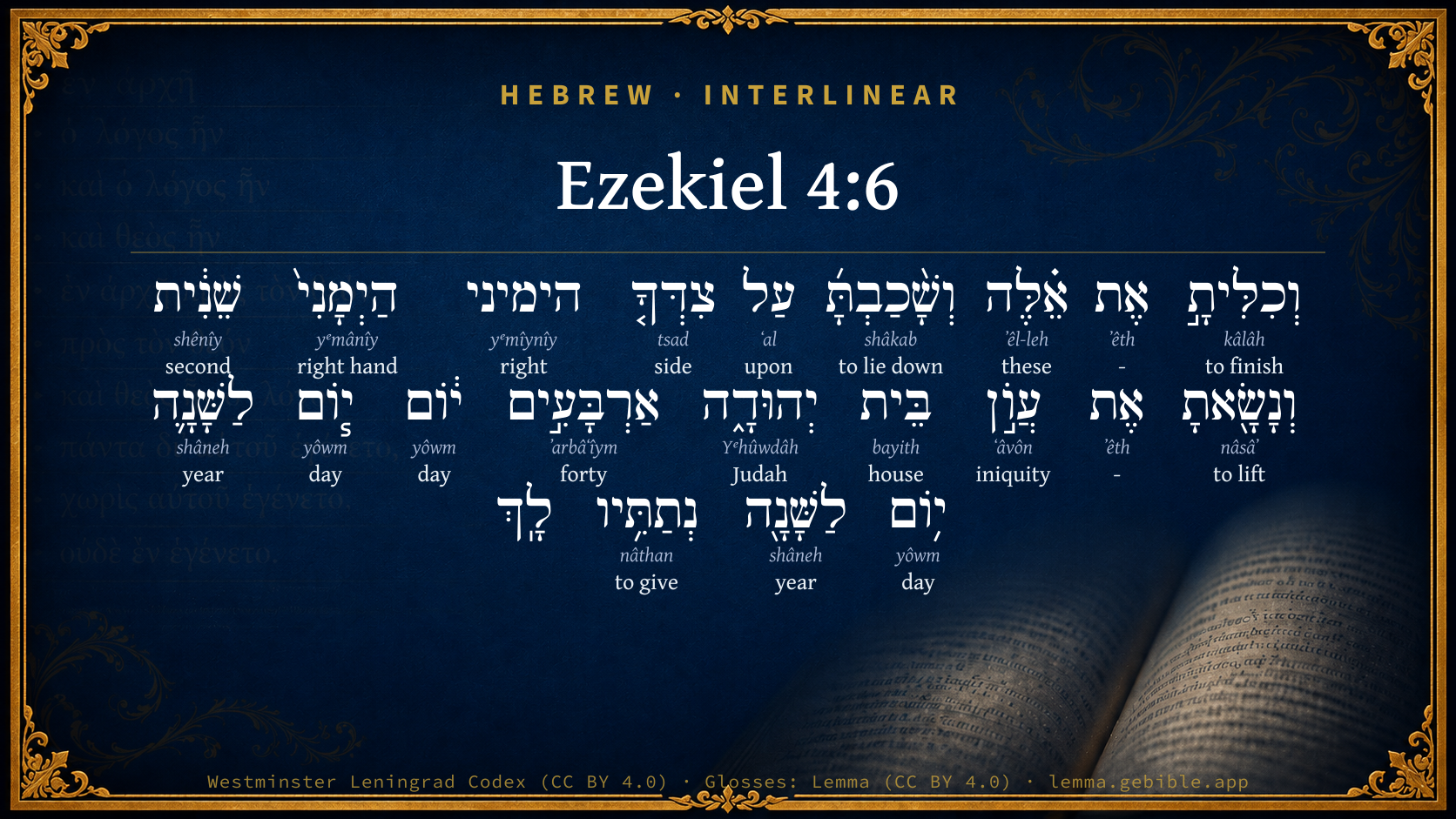
Ezekiel 4:6

Hebrew (Westminster Leningrad Codex) Ezekiel 4:6 appears in the Hebrew Old Testament. The text above is from the Westminster Leningrad Codex. Each word links to its Strong’s number, a concise gloss, and parsing drawn from the Open Scriptures Hebrew Bible morphology. Click any word for its full Brown-Driver-Briggs (BDB) entry.
Download image
Cite this verse

Ezekiel 4:6 (World English Bible). Public Domain. Lemma interlinear Bible study tool, https://lemma.gebible.app/v/ezekiel/4/6.

Show BibTeX & RIS
BibTeX
RIS
English Translation
Again, when you have accomplished these, you shall lie on your right side, and shall bear the iniquity of the house of Judah: forty days, each day for a year, have I appointed it to you.
World English Bible · Public Domain
Download a study sheet

One document with this verse’s original text, its word-by-word gloss line, the meaning frame, cross-references with their text, attributed commentary, and full source and license credits — printable, and it pastes into notes with its structure intact.

This verse Autodidact and up

Study sheet (.html) Plain text (.txt)

A passage Seminary Student

Up to 50 verses in one chapter. A passage sheet keeps up to 6 commentary sources and 12 cross-references per verse, in the order this page ranks them, and says so on the sheet whenever that leaves anything out. Ask for a single verse and you get the Autodidact verse sheet above.

Everything on this page stays free to read, with no account — the sheet is a download of what is already on screen, not access to it.

Want to remove ads? Support Godless Engineer
Compare translations 3

The same verse in 3 English versions, stacked beneath the original-language interlinear above. Click any original word for its lexicon entry.

Each is an independent rendering of the whole verse — the interlinear is not word-aligned to these translations.

Highlighted words mark where these versions differ — a whole-verse word diff, not a word-by-word alignment.

  • World English Bible Public Domain
    Again, when you have accomplished these, you shall lie on your right side, and shall bear the iniquity of the house of Judah: forty days, each day for a year, have I appointed it to you.
  • King James Version Public Domain
    And when thou hast accomplished them, lie again on thy right side, and thou shalt bear the iniquity of the house of Judah forty days: I have appointed thee each day for a year.
  • unfoldingWord Literal Text CC BY-SA 4.0
    When you have completed these days, then lie down a second time on your right side, for you will carry the sin of the house of Judah for forty days. I am assigning to you one day for each year.

unfoldingWord Literal Text — © unfoldingWord, licensed CC BY-SA 4.0. Word-aligned USFM3 via Door43 (git.door43.org/unfoldingWord/en_ult).

Versions to compare (up to 4)

3 of 4 selected

Show all 18 translations

Every available English version of this verse, each an independent rendering of the whole verse.

  • World English Bible Public Domain
    Again, when you have accomplished these, you shall lie on your right side, and shall bear the iniquity of the house of Judah: forty days, each day for a year, have I appointed it to you.
  • Berean Standard Bible Public Domain
    When you have completed these days, lie down again, but on your right side, and bear the iniquity of the house of Judah. I have assigned to you 40 days, a day for each year.
  • Majority Standard Bible Public Domain
    When you have completed these days, lie down again, but on your right side, and bear the iniquity of the house of Judah. I have assigned to you 40 days, a day for each year.
  • King James Version Public Domain
    And when thou hast accomplished them, lie again on thy right side, and thou shalt bear the iniquity of the house of Judah forty days: I have appointed thee each day for a year.
  • American Standard Version (1901) Public Domain
    And again, when thou hast accomplished these, thou shalt lie on thy right side, and shalt bear the iniquity of the house of Judah: forty days, each day for a year, have I appointed it unto thee.
  • Revised Version (1885) Public Domain
    And again, when thou hast accomplished these, thou shalt lie on thy right side, and shalt bear the iniquity of the house of Judah: forty days, each day for a year, have I appointed it unto thee.
  • Geneva Bible (1599) Public Domain
    And when thou hast accomplished them, sleepe againe vpon thy right side, and thou shalt beare the iniquitie of the house of Iudah fourtie dayes: I haue appointed thee a day for a yeere, euen a day for a yeere.
  • Douay-Rheims (1899) Public Domain
    And when thou hast accomplished this, thou shalt sleep again upon thy right side, and thou shalt take upon thee the iniquity of the house of Juda forty days: a day for it year, yea, a day for a year I have appointed to thee.
  • Young's Literal Translation Public Domain
    And thou hast completed these, and hast lain on thy right side, a second time, and hast borne the iniquity of the house of Judah forty days -- a day for a year -- a day for a year I have appointed to thee.
  • Literal Standard Version CC BY-SA 4.0
    And you have completed these, and have lain on your right side, a second time, and have borne the iniquity of the house of Judah forty days—a day for a year—a day for a year I have appointed to you.
  • Unlocked Literal Bible CC BY-SA 4.0
    When you have completed these days, then lie down a second time on your right side, for you will carry the sin of the house of Judah for forty days. I am assigning to you one day for each year.
  • unfoldingWord Literal Text CC BY-SA 4.0
    When you have completed these days, then lie down a second time on your right side, for you will carry the sin of the house of Judah for forty days. I am assigning to you one day for each year.
  • Darby Bible Public Domain
    And when thou hast accomplished them, thou shalt lie again on thy right side, and thou shalt bear the iniquity of the house of Judah forty days: I have appointed thee each day for a year.
  • World Messianic Bible Public Domain
    “Again, when you have accomplished these, you shall lie on your right side, and shall bear the iniquity of the house of Judah. I have appointed forty days, each day for a year, to you.
  • Webster's Bible Public Domain
    And when thou hast accomplished them, lie again on thy right side, and thou shalt bear the iniquity of the house of Judah forty days: I have appointed thee each day for a year.
  • Free Bible Version CC BY-SA 4.0
    Once you have finished doing this for these days, then you are to lie down again, but this time on your right side, and carry the sins of the people of Judah. I will make you stay there for 40 days, one day for every year.
  • Bible in Basic English Public Domain
    And when these days are ended, turning on your right side, you are to take on yourself the sin of the children of Judah: forty days, a day for a year, I have had it fixed for you.
  • JPS Tanakh (1917) Public Domain
    And again, when thou hast accomplished these, thou shalt lie on thy right side, and shalt bear the iniquity of the house of Judah; forty days, each day for a year, have I appointed it unto thee.

Literal Standard Version (2020), Covenant Press — licensed CC BY-SA 4.0. Text via the HelloAO Bible API (eBible.org). Unlocked Literal Bible (unfoldingWord) — licensed CC BY-SA 4.0. Text via the HelloAO Bible API (eBible.org). unfoldingWord Literal Text — © unfoldingWord, licensed CC BY-SA 4.0. Word-aligned USFM3 via Door43 (git.door43.org/unfoldingWord/en_ult). Free Bible Version, Dr. Jonathan Gallagher — licensed CC BY-SA 4.0. Text via the HelloAO Bible API (eBible.org).

Word by word

More ways to search: Search by grammar → Find every occurrence → Compare this word →

Practice this passage: Drill this verse → Learn its vocabulary →

הימיני
yᵉmîynîy
H3227
“the · right”
Particle, Definite Article + Adjective, Adjective, Masculine, Singular, Absolute
Part of Speech
Particle + Adjective
Type
Adjective
Gender
Masculine
Number
Singular
State
Absolute
Full BDB Definition

Origin: for H3225

TWOT: 872b

right, on the right, right hand
  1. וְכִלִּיתָ֣ kâlâh H3615 “and · to finish” Conjunction + Verb, Piel, Sequential Perfect, 2nd Person, Masculine, Singular
  2. אֶת ʼêth H853 “-” Particle, Direct Object
  3. אֵ֗לֶּה ʼêl-leh H428 “these” Pronoun, Demonstrative, Common, Plural
  4. וְשָׁ֨כַבְתָּ֜ shâkab H7901 “and · to lie down” Conjunction + Verb, Qal, Sequential Perfect, 2nd Person, Masculine, Singular
  5. עַל ʻal H5921 “upon” Preposition
  6. צִדְּךָ֤ tsad H6654 “side · your” Noun, Common, Masculine, Singular, Construct + Suffix, Personal, 2nd Person, Masculine, Singular
  7. הַיְמָנִי֙ yᵉmânîy H3233 “the · right hand” Particle, Definite Article + Adjective, Adjective, Masculine, Singular, Absolute
  8. שֵׁנִ֔ית shênîy H8145 “second” Adjective, Ordinal number, Feminine, Singular, Absolute
  9. וְנָשָׂ֖אתָ nâsâʼ H5375 “and · to lift” Conjunction + Verb, Qal, Sequential Perfect, 2nd Person, Masculine, Singular
  10. אֶת ʼêth H853 “-” Particle, Direct Object
  11. עֲוֺ֣ן ʻâvôn H5771 “iniquity of” Noun, Common, Both, Singular, Construct
  12. בֵּית bayith H1004 “house of” Noun, Common, Masculine, Singular, Construct
  13. יְהוּדָ֑ה Yᵉhûwdâh H3063 “Judah” Noun, Proper
  14. אַרְבָּעִ֣ים ʼarbâʻîym H705 “forty” Adjective, Cardinal number, Both, Plural, Absolute
  15. י֔וֹם yôwm H3117 “day” Noun, Common, Masculine, Singular, Absolute
  16. י֧וֹם yôwm H3117 “day” Noun, Common, Masculine, Singular, Absolute
  17. לַשָּׁנָ֛ה shâneh H8141 “to/for the · year” Preposition, Determined + Noun, Common, Feminine, Singular, Absolute
  18. י֥וֹם yôwm H3117 “day” Noun, Common, Masculine, Singular, Absolute
  19. לַשָּׁנָ֖ה shâneh H8141 “to/for the · year” Preposition, Determined + Noun, Common, Feminine, Singular, Absolute
  20. נְתַתִּ֥יו nâthan H5414 “to give · him” Verb, Qal, Perfect, 1st Person, Common, Singular + Suffix, Personal, 3rd Person, Masculine, Singular

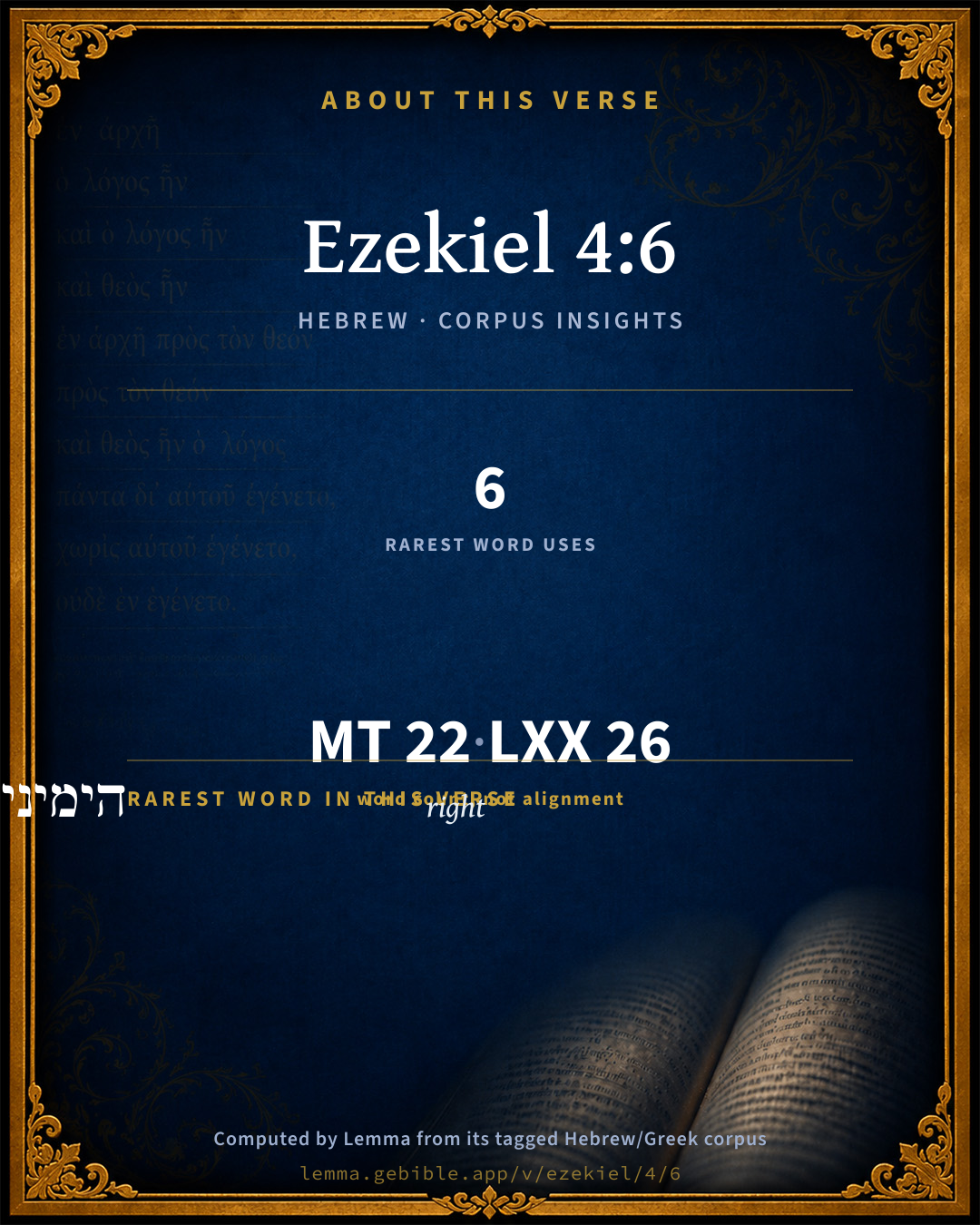
About this verse

These counts appear in no published source. They are computed here, from the morphology-tagged text and Lemma’s own curated glosses. What Lemma adds →

22
words
17
distinct lemmas
Prophets
section

Notable vocabulary

The rarest word here is הימיני right H3227 — appearing just 6 times in the whole Hebrew Bible.

Shared distinctive vocabulary

הימיני right H3227 occurs in 6 verses of the Hebrew Bible. Also found in:

Grammatical profile

  • 4 verbs
  • 9 nouns
  • 4 adjectives
  • 1 pronoun
  • 2 prepositions
  • 2 particles

Verb forms

  • וְכִלִּיתָ֣ Piel · Sequential Perfect
  • וְשָׁ֨כַבְתָּ֜ Qal · Sequential Perfect
  • וְנָשָׂ֖אתָ Qal · Sequential Perfect
  • נְתַתִּ֥יו Qal · Perfect

Repetition

Words recur within this verse — often emphatic in Hebrew:

  • י֔וֹם day H3117 ×3
  • לַשָּׁנָ֛ה year H8141 ×2

Hebrew & Septuagint length

In English translation the verse runs 36 words from the Hebrew and 34 from the Septuagint (LXX English) — closely comparable.

A rough comparison of the two English renderings, which tokenize alike — not a word-level alignment.

Word counts can differ between the Hebrew and the Greek without any difference in meaning — e.g. the Hebrew direct-object marker אֵת has no separate Greek word, and Greek often adds the article ὁ.

In the original languages it is 22 Hebrew tokens and 26 Greek tokens — but the two are counted differently (Hebrew bundles its prefixes and suffixes into one token; the Greek is in lemma form), so that isn’t a like-for-like length.

Cross-references

7

Topical passages linked to Ezekiel 4:6 in the Treasury of Scripture Knowledge — connected by theme and wording, ordered by reader-vote popularity; previews shown in the World English Bible.

  • Numbers 14:34 After the number of the days in which you spied out the land, even forty days, for every day a year, shall you bear your iniquities, even forty years, and you shall know my alienation.
  • Daniel 9:24–26 Seventy weeks are decreed on your people and on your holy city, to finish disobedience, and to make an end of sins, and to make reconciliation for iniquity, and to bring in everlasting righteousness, and to seal up vision and prophecy, and to anoint the most holy.
  • Daniel 12:11–12 From the time that the continual [burnt offering] shall be taken away, and the abomination that makes desolate set up, there shall be one thousand two hundred ninety days.
  • Revelation 11:2–3 Leave out the court which is outside of the temple, and don't measure it, for it has been given to the gentiles. They will tread the holy city under foot for forty-two months.
  • Revelation 13:5 A mouth speaking great things and blasphemy was given to him. Authority to make war for forty-two months was given to him.
  • Revelation 9:15 The four angels were freed who had been prepared for that hour and day and month and year, so that they might kill one third of mankind.
  • Revelation 12:14 Two wings of the great eagle were given to the woman, that she might fly into the wilderness to her place, so that she might be nourished for a time, and times, and half a time, from the face of the serpent.

Cross-references courtesy of OpenBible.info (CC BY 4.0).

Hebrew and Greek witnesses Masoretic Hebrew ↔ Greek Septuagint

The same verse in the two great witnesses to the Old Testament, shown verse-for-verse.

These are two independent witnesses, not word-aligned to each other, and the Septuagint is shown in lemma (dictionary) form.

Hebrew Ezekiel 4:6 Masoretic · Westminster Leningrad Codex

וְכִלִּיתָ֣ אֶת אֵ֗לֶּה וְשָׁ֨כַבְתָּ֜ עַל צִדְּךָ֤ הימיני הַיְמָנִי֙ שֵׁנִ֔ית וְנָשָׂ֖אתָ אֶת עֲוֺ֣ן בֵּית יְהוּדָ֑ה אַרְבָּעִ֣ים י֔וֹם י֧וֹם לַשָּׁנָ֛ה י֥וֹם לַשָּׁנָ֖ה נְתַתִּ֥יו לָֽךְ

Again, when you have accomplished these, you shall lie on your right side, and shall bear the iniquity of the house of Judah: forty days, each day for a year, have I appointed it to you.

World English Bible · Public Domain

Greek LXX Ezekiel 4:6 Septuagint · lemma form

καί συντελέω οὗτος πᾶς καί κοιμάω ἐπί ὁ πλευρόν σύ ὁ δεξιός καί λαμβάνω ὁ ἀδικία ὁ οἶκος ιουδα τεσσαράκοντα ἡμέρα ἡμέρα εἰς ἐνιαυτός τίθημι σύ

And you shall accomplish this, and then shall lie on your right side, and shall bear the iniquities of the house of Juda forty days: I have appointed you a day for a year.

LXX2012 (modern English Septuagint) · Public Domain

On this verse, The Cambridge Bible for Schools and Colleges discusses the Septuagint’s reading. Read the note in Commentary ↓

Hebrew: Westminster Leningrad Codex (CC BY 4.0). Greek: Septuagint (public domain); English from LXX2012 (modern English Septuagint) (Public Domain). How the Septuagint differs from the Hebrew →

Targum (Aramaic paraphrase)

1

The Targum is the ancient Jewish Aramaic paraphrase of the Hebrew Scriptures — an interpretive translation, not the Hebrew text itself. Onkelos (literal) and Pseudo-Jonathan (expansive) render the Torah, and Jonathan the Prophets. Coverage is partial: where no permissively-licensed English translation exists for a verse, only the Aramaic is shown. This is verse-level text, not a word-by-word alignment to the Hebrew.

  1. Targum Jonathan Prophets (Joshua–Malachi)
    וְתַשְׁלִים יַת אִלֵין וְתִשְׁכּוֹב עַל סִטְרָךְ דִיְמִינָא תִּנְיָנוּת וּתְקַבֵּיל יַת חוֹבֵי בֵית יְהוּדָה אַרְבְּעִין יוֹמִין יוֹמָא לְשַׁתָּא יוֹמָא לְשַׁתָּא יְהַבְתִּינוּן לָךְ:

    (no public-domain English translation for this verse)

    Targum Jonathan — Aramaic: “Mikraot Gedolot” (public domain). English: “Sefaria Community Translation” (CC0 1.0 (public-domain dedication)); “London "Chaldee Paraphrase," 1871” (public domain). Text via Sefaria.

Commentary

Notes on Ezekiel 4:6 from classic Christian and Jewish commentators (each source and its license shown beneath its notes). The classic Christian expositions comment on the surrounding passage and are grouped to its opening verse, so a note may address several verses; the Jewish commentaries on the Tanakh (Rashi and others) are per-verse, so they appear only where the commentator wrote on this verse.

Lemma curates 59 commentaries, every one of them public domain or Creative Commons licensed, each selected and text-cleaned for this edition rather than reprinted as found. About our sources →

The Cambridge Bible for Schools and Colleges

gen. ed. J. J. S. Perowne

6. In Eze_4:5 the number of days for Israel is stated to be 390, and in Eze_4:6 the number for Judah 40. The number 390 creates a difficulty. Several things have to be borne in mind. 1. To bear iniquity means to bear the penalty of it. The period of bearing iniquity, therefore, does not refer to the time of sinning but to the time of being punished for sin. Consequently any allusion to the period of the duration of the Northern Kingdom is excluded. 2. The representation in this prophet, as in all the prophets, is that the overthrow of the state is due to the sin of the people, and this overthrow with the continued state of the Exile and its hardships is the punishment of the people’s sin. To be subdued by the heathen and driven into exile is for the people to have to bear their iniquity. Hence restoration is impossible until the iniquity of the people is paid off, or atoned in suffering (Isa_40:2). Israel’s bearing of iniquity comes to an end with the Restoration: “Cry unto her that her warfare is accomplished, her iniquity pardoned.” 3. It is the view of all the prophets, Ezekiel included, that the Restoration will embrace all the existing captives both of the North and South, every one called by Jehovah’s name (Isa_43:6-7; cf. Isa_11:12 seq.; Jer_3:12; Jer_3:18; Eze_37:16 seq. &c.). And this restoration is final. 4. It follows from all this that the periods during which Israel and Judah bear their iniquity terminate simultaneously. Israel bears iniquity longer than Judah because it began to bear earlier. It is evident (cf. Eze_4:9) that the whole period of bearing iniquity in exile is 390 years, not 390 + 40 or 430, but 350 + 40, the 40 years of Judah running parallel to the last 40 of Israel. The period of 40 years for Judah’s exile is confirmed by ch. Eze_29:11-14, where it is said that Egypt shall be carried into captivity 40 years by Nebuchadnezzar, and at the end of that period restored, though not to its former greatness. Forty years is the period of Chaldean supremacy; at the end of that period Babylon shall fall, a new world arise, and the captive nations shall be restored. Now the prophet cannot possibly have supposed that Israel went into exile 350 years before Judah. From the fall of Samaria (722) to the destruction of Jerusalem (586) is only 136 years. In Eze_4:5 LXX. reads 190 (so Eze_4:9); in Eze_4:4 the reading is 150, which probably is an addition (Field’s Hex.). The number 190 is probably the original one. It is not quite certain from what point the prophet computed, whether from the fall of Samaria (722), which is most natural, or from the deportation of the Northern tribes by Tiglath Pileser twelve years earlier; as he spoke also before the fall of Jerusalem even this point may be somewhat indefinite. Most probably he used general and round numbers, computing the time which Israel had already passed in captivity at 150 years, to which, if the 40 years still to be undergone in common with Judah be added, the whole period is 190 years.

Eze_4:7-8 recapitulate Eze_4:1-6 : Eze_4:7, Eze_4:1-3, and Eze_4:8, Eze_4:4-6. Eze_4:1-6 form one passage describing first the siege (Eze_4:1-3), and secondly the rigours of the siege, which are prolonged into exile (Eze_4:4-6). While enduring these hardships in siege and exile the people are bearing their iniquity. The apparent incongruity of the prophet’s playing two rôles, that of besieger (Eze_4:1-3), and that of being besieged (Eze_4:4-6), could hardly be avoided if both things were to be represented.

The Cambridge Bible for Schools and Colleges (gen. ed. J. J. S. Perowne; Cambridge University Press, 1878–1918) — public domain. Text from a community e-Sword module.

Trapp's Complete Commentary

John Trapp

Eze 4:6 And when thou hast accomplished them, lie again on thy right side, and thou shalt bear the iniquity of the house of Judah forty days: I have appointed thee each day for a year.

Ver. 6. And when thou hast accomplished them.] That is, art within forty years of accomplishing them.

Thou shalt bear the iniquity of the house of Judah forty days,] i.e., Years, beginning at the eighteenth year of Josiah; or, as others compute it, at his thirteenth year, and ending them in the eleventh of Zedekiah, which are the bounds of Jeremiah’s prophecy. A very learned man yet living observeth, that God doth here set and mark out Judah’s singular iniquity by a singular mark; for that they had forty years so pregnant instructions and admonitions by so eminent a prophet as Jeremiah, yet were they impenitent to their own destruction. And the like may well be said of Dr Ussher, that prophet of Ireland, who, upon the toleration of Popery there, preaching before the State at Dublin upon a special solemnity, made a full and bold application of this text unto them in these very words: From this year, said he - viz., A.D. 1601 - will I reckon the sin of Ireland; and dare say that those whom you embrace shall be your ruin, and you shall bear this iniquity. {a} And it happened accordingly; for, forty years after - viz., A.D. 1641 - began the rebellion and destruction of Ireland, done by those Papists and Popish priests then connived at.

{a} Dr Ussher’s Funeral Sermon, by Dr Bern. 39.

John Trapp, A Commentary or Exposition upon All the Books of the Old and New Testament (1647–1656) — public domain. Text from a community e-Sword module.

Tyndale Open Study Notes

Tyndale Open Resources

4:6 Judah was the community of those in exile, whose sojourn outside the land was represented by the symbolic figure of 40 years. They were a lost generation, just like the generation that spent 40 years in the wilderness for their sin (Num 14:34). • The 430 days of Ezekiel’s confinement (cp. Ezek 4:5) parallel the 430 years that Israel spent in Egypt (Exod 12:40), hinting that there would be a new exodus at the end of the Exile.

Tyndale Open Study Notes — © Tyndale Open Resources, licensed CC BY-SA 4.0. Text via the HelloAO Bible API.

Geneva Bible (1599)

Geneva Bible translators

Which declared Judah, who had now from the time of Josiah slept in their sins forty years.

Geneva Bible (1599) marginal notes — public domain. Text via Bolls.life.

Jamieson, Fausset & Brown

Robert Jamieson, A. R. Fausset & David Brown

each day for a year--literally, "a day for a year, a day for a year." Twice repeated, to mark more distinctly the reference to Num 14:34. The picturing of the future under the image of the past, wherein the meaning was far from lying on the surface, was intended to arouse to a less superficial mode of thinking, just as the partial veiling of truth in Jesus' parables was designed to stimulate inquiry; also to remind men that God's dealings in the past are a key to the future, for He moves on the same everlasting principles, the forms alone being transitory.

Jamieson, Fausset & Brown — Commentary Critical and Explanatory on the Whole Bible (1871) — public domain (CC PDM 1.0). Text via the HelloAO Bible API.

Adam Clarke's Commentary

Verse 6. Forty days] Reckon, says Archbishop Newcome, near fifteen years and six months in the reign of Manasseh, two years in that of Amon, three months in that of Jehoahaz, eleven years in that of Jehoiakim, three months and ten days in that of Jehoiachin, and eleven years in that of Zedekiah; and there arises a period of forty years, during which gross idolatry was practiced in the kingdom of Judah. Forty days may have been employed in spoiling and desolating the city and the temple.

Adam Clarke's Commentary on the Bible (1810–1826) — public domain. Text from a community e-Sword/MySword module.

John Gill's Exposition

And when thou hast accomplished them,.... The three hundred and ninety days, by lying so long on the left side, bearing the sins of the house of Israel in this way; or, as Cocceius renders the words, "and thou shall accomplish them, and thou shalt lie", &c. (g), that is, thou shalt so accomplish these days, that thou mayest lie through forty days on the right hand, and then make bare thine arm, and prophesy against Jerusalem; for he thinks the forty days are part of the three hundred and ninety, as before observed: and so Piscator's note is, "when thou shalt accomplish", &c. namely, when there shall remain yet forty days, as appears by comparing Eze 4:9 with this verse and Eze 4:5; so Polanus interprets the passage: then

lie again on thy right side; that is, for Judah; which tribe, as Jarchi observes, lay to the south, and so to the right of Jerusalem; see Eze 16:46; or rather the prophet lay on the right side for Judah, because more honourable, and in greater esteem with the Lord; nor were their sins so many, or continued in so long as those of the ten tribes; and therefore they, and the punishment of them, are borne a less time by the prophet, as follows:

and thou shall bear the iniquity of the house of Judah forty days: which some think answers to the forty years of Manasseh's evil reign; others reckon from the thirteenth of Josiah to the end of Zedekiah, and others from the eighteenth of Josiah to the destruction of Jerusalem, which was five years after the carrying of Zedekiah captive:

I have appointed thee each day for a year; which is not only the key for the understanding of the forty days, but also the three hundred and ninety.

(g) "et absolves hos, et decumbes", Cocceius, Starckius; "et consummabis haec, et jacebis", Montanus.

John Gill's Exposition of the Whole Bible (1746–1763) — public domain (CC PDM 1.0). Text via the HelloAO Bible API.

Matthew Poole's English Annotations

When thou hast almost accomplished, or when about to accomplish them, i.e. forty days, before the three hundred and ninety do expire, at the end of three hundred and fifty days turn thou to thy right side, and bear the iniquity of the house of Judah; and that this is the true account appears from this verse, compared with Eze 1:1,2; 8:1, say some, and those very learned men. Others will have the forty days distinct from the three hundred and ninety, and reckon them by themselves, and so the better and grammatical construction in the Hebrew seems to carry it, for it speaks in the perfect tense, and lying. a second time. But be these numbers distinct or but one, is no great concern; either way they do plainly speak God’s wonderful patience with Israel and Judah, and point out the time of the miseries of both for their sinfulness.

Again, Heb. a second time. Thou shalt bear the iniquity: see Eze 4:4.

Of the house of Judah; of the two tribes, say some; of the royal family, say others, and countenance it with Isa 22:21; and then Israel distinguished is the whole body of the two tribes, and the remnant of the ten tribes that escaped, and embodied with the two tribes; as some did at the first division, others afterward in Asa’s, Jehoshaphat’s, Hezekiah’s, and Josiah’s time, leave their places and came to Jerusalem.

Forty days; it is plain they are so many years, but not so plain where to begin them, whether from Manasseh, or more probably from Josiah’s renewing covenant, until the destruction of the temple, which is forty years; during which time God deferred to punish, expecting whether they would keep covenant and walk with God, or retain their idolatries and wicked ways, which latter they did for thirteen years of Josiah’s reign, for eleven of Jehoiakim, and eleven of Zedekiah’s reign, and five of his captivity, which amount to just forty years; and they are mentioned, say some, apart from the three hundred and ninety, because they were more wickedly abused to promote sin.

Matthew Poole's English Annotations on the Holy Bible (1683–1685) — public domain. Text from a community e-Sword/MySword module.

Whedon's Commentary on the Bible

Daniel D. Whedon

6. Lie again on thy right side… forty days, etc. — The left side represented the northern kingdom (Israel), which lay to the left, according to Hebrew geography; the right represented the southern kingdom (Judah), which lay to the right. The punishment in both cases comes because of iniquity. Israel went into captivity earlier and therefore bears her punishment longer. For Judah the prophet is to lie upon his side for forty days; “one day for a year do I appoint it to thee” (Hebrews).

Daniel D. Whedon (gen. ed.), Commentary on the Old and New Testaments (1874–1909) — public domain. Text from a community e-Sword module.

The Pulpit Commentary

Each day for a year. The Hebrew formula is that of iteration day for a year, a day for a year." It originates, as has been said, in Num_14:34. What has been known as the year-day theory of prophetic interpretation flows naturally from it, and has been applied

(1) to the "seventy weeks" of Dan_9:24-27, and

(2) the twelve hundred and sixty and the three days and a half of Rev_11:3, Rev_11:9.

The Pulpit Commentary (1880–1919), ed. H.D.M. Spence-Jones & Joseph S. Exell — public domain. Text from a community e-Sword module.

John Wesley's Explanatory Notes

Accomplished - That is, almost accomplished. House of Judah - Of the two tribes. Forty days - Probably from Josiah's renewing the covenant, until the destruction of the temple, during which time God deferred to punish, expecting whether they would keep their covenant, or retain their idolatries, which latter they did for thirteen years of Josiah's reign, for eleven of Jehoiakim's, and eleven of Zedekiah's reign, and five of his captivity, which amount to just forty years. But all this was done in a vision.

John Wesley, Explanatory Notes Upon the Whole Bible (1754–1765) — public domain. Text via the GEBible commentary corpus.

unfoldingWord translationNotes

Door43 World Missions Community

General Information:

The Spirit continues speaking to Ezekiel.

these days

the days Ezekiel lies down on his left side to illustrate the siege of the kingdom of Israel

you will carry the sin

Possible meanings are 1) "you will be guilty of the sin" or 2) "you will be punished for the sin." Either of these meanings will be demonstrated symbolically by Ezekiel as noted in the UDB. See how you translated these words in Ezekiel 4:4.

the house of Judah

The word "house" is a metonym for the family that lives in the house, in this case the descendants of Judah over many years. See how you translated these words in Ezekiel 3:1. AT: "the Judah people group" or "the people of Judah" (See: Metonymy)

I am assigning to you one day for each year

"I will make you do this one day for each year that I will punish them"

Set your face toward Jerusalem that is under siege

This is a command to stare at the model of Jerusalem as a symbol of punishing Jerusalem. See how you translated a similar phrase in Ezekiel 4:3. AT: "Stare at Jerusalem that is under siege" or "Stare at Jerusalem that is under siege, so that it will be harmed" (See: Symbolic Action)

Set your face

Here "face" is a metonym for attention or gaze. "Set your face" refers to literally staring at something. (See: Metonymy)

prophesy against it

"prophesy about the bad things that will happen to Jerusalem"

For behold

"Look" or "Listen" or "Pay attention to what I am about to tell you"

I am placing bonds on you

Bonds are ropes or chains that keep a person from moving. It is not clear whether the word "bonds" is a metaphor for something Yahweh does that is as if he had bound Ezekiel or if he is using literal, physical ropes. (See: Metaphor)

translationWords

kingdom of Judah

face

Jerusalem

siege

prophet

bind

unfoldingWord translationNotes — © Distant Shores Media and the Door43 World Missions Community, licensed CC BY-SA 4.0. Source: git.door43.org/Door43/en_tn.

Rashi

Rabbi Shlomo Yitzchaki (Rashi)

the iniquity of the house of Judah forty days This teaches us that the house of Judah sinned, from the time that the ten tribes were exiled until Jerusalem was destroyed, forty years: 22 of Manasseh, about whom it is written (II Kings 21:3): “as Ahab...had made,” and Ahab had reigned 22 years; two of Ammon and 11 of Jehoiakim, and this prophecy was transmitted to Ezekiel in the fifth year of Zedekiah. This totals 40 years. The grand total is four hundred and thirty [years]. After this prophecy, they remained yet six years, equaling 8 jubilees and 36 years. In 8 jubilees [there] are 8 cycles of Sabbatical years, equaling 56 Sabbatical years, totaling 64 [hallowed years]. In 36 years, there are 5 Sabbatical years, totaling 69 land-release years, and the final jubilee year is accounted to them as an iniquity because they were exiled from it [the land] because of their iniquity, totaling 70 hallowed years of land release, which Israel did not observe. Therefore, they were exiled 70 years to fulfill (Lev. 26:34): “Then the land will appease its Sabbaths.” That is what is written at the end of Chronicles (II 36:21): “To fulfill the word of the Lord [that was] in the mouth of Jeremiah, until the land has appeased its Sabbaths, for as long as it lay desolate, it rested, to complete seventy years.”

“Your left side” symbolizes Samaria; “your right side” symbolizes Judah, because Judah is in the south of the land of Israel, as it is said (16:46): “And your big sister Samaria...who lives at your left.” Also in the Book of Joshua (15:1), he describes the border of the tribe of Judah as occupying the entire southern border.

Rashi on the Tanakh — English translations: “The Judaica Press complete Tanach with Rashi, translated by A. J. Rosenberg” (CC BY 4.0); “Pentateuch with Rashi's commentary by M. Rosenbaum and A.M. Silbermann, 1929-1934” (public domain); “The Metsudah Tanach series, Lakewood, N.J” (CC BY 4.0); and “The Book of Joshua, Metsudah Publications, 1997” (CC BY 4.0). Text via Sefaria.

Lesson kit

Teaching starters — assembled from the data on this page, not authored interpretation. Every prompt links to the verse data it draws on. Edit before teaching.

Ezekiel, in the Prophets, opens this verse with 22 words (17 distinct Hebrew lemmas). Its most distinctive word is yᵉmîynîy (“right”). A historical commentator’s framing appears above. Read the whole chapter for the surrounding context.

Discussion questions

  1. The word yᵉmîynîy carries the sense “right.” How does it shape the verse?
  2. How does 1 Samuel 9:1, which shares the word «right», read alongside this verse?
  3. What does the repetition of “day” (3× in this one verse) do in this verse?
  4. The translations on this page render this verse differently — a whole-verse word diff, not a word-by-word alignment. What might account for the different wordings?
  5. «וְכִלִּיתָ֣» is a Piel Sequential Perfect verb. How does that grammatical form shape the action described?
  6. Compare how The Cambridge Bible for Schools and Colleges and Trapp's Complete Commentary read this verse. Where do they agree or differ?

Things to notice

Reading settings

Reading text

Shown beneath each verse's original-language words.

Old Testament
Old Testament edition

Read the OT as the Masoretic Hebrew (MT) or the Greek Septuagint (LXX).

English shown for the Greek Septuagint (in the Hebrew ↔ Greek comparison).

Comparing translations? Open the Compare panel on any verse page to stack up to four side by side.