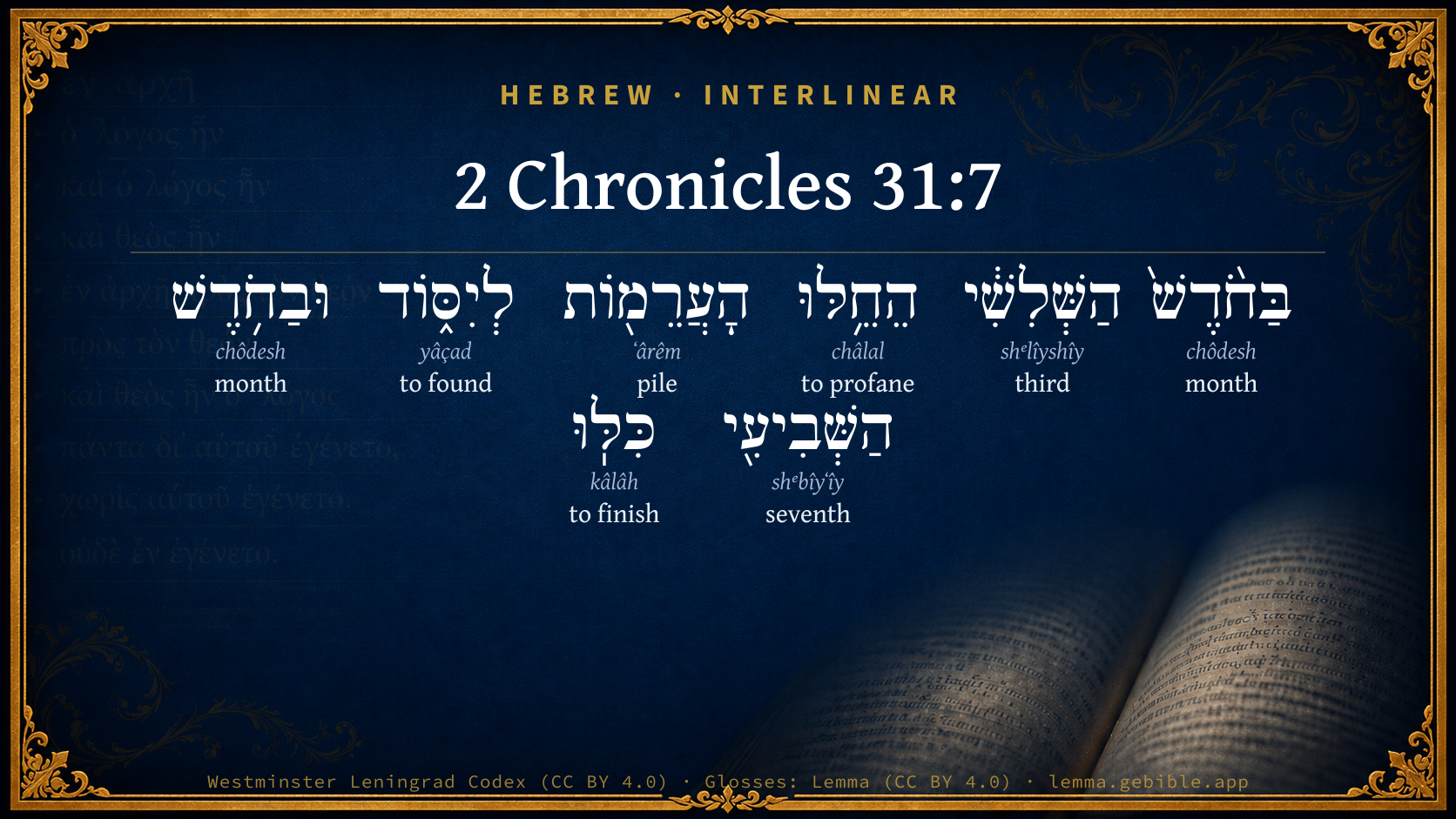
2 Chronicles 31:7

Hebrew (Westminster Leningrad Codex) 2 Chronicles 31:7 appears in the Hebrew Old Testament. The text above is from the Westminster Leningrad Codex. Each word links to its Strong’s number, a concise gloss, and parsing drawn from the Open Scriptures Hebrew Bible morphology. Click any word for its full Brown-Driver-Briggs (BDB) entry.
Download image
Cite this verse

2 Chronicles 31:7 (World English Bible). Public Domain. Lemma interlinear Bible study tool, https://lemma.gebible.app/v/2-chronicles/31/7.

Show BibTeX & RIS
BibTeX
RIS
English Translation
In the third month they began to lay the foundation of the heaps, and finished them in the seventh month.
World English Bible · Public Domain
Download a study sheet

One document with this verse’s original text, its word-by-word gloss line, the meaning frame, cross-references with their text, attributed commentary, and full source and license credits — printable, and it pastes into notes with its structure intact.

This verse Autodidact and up

Study sheet (.html) Plain text (.txt)

A passage Seminary Student

Up to 50 verses in one chapter. A passage sheet keeps up to 6 commentary sources and 12 cross-references per verse, in the order this page ranks them, and says so on the sheet whenever that leaves anything out. Ask for a single verse and you get the Autodidact verse sheet above.

Everything on this page stays free to read, with no account — the sheet is a download of what is already on screen, not access to it.

Want to remove ads? Support Godless Engineer
Compare translations 3

The same verse in 3 English versions, stacked beneath the original-language interlinear above. Click any original word for its lexicon entry.

Each is an independent rendering of the whole verse — the interlinear is not word-aligned to these translations.

Highlighted words mark where these versions differ — a whole-verse word diff, not a word-by-word alignment.

  • World English Bible Public Domain
    In the third month they began to lay the foundation of the heaps, and finished them in the seventh month.
  • King James Version Public Domain
    In the third month they began to lay the foundation of the heaps, and finished them in the seventh month.
  • unfoldingWord Literal Text CC BY-SA 4.0
    In the third month, they began the heaps to establish, and in the seventh month they finished.

unfoldingWord Literal Text — © unfoldingWord, licensed CC BY-SA 4.0. Word-aligned USFM3 via Door43 (git.door43.org/unfoldingWord/en_ult).

Versions to compare (up to 4)

3 of 4 selected

Show all 18 translations

Every available English version of this verse, each an independent rendering of the whole verse.

  • World English Bible Public Domain
    In the third month they began to lay the foundation of the heaps, and finished them in the seventh month.
  • Berean Standard Bible Public Domain
    In the third month they began building up the heaps, and they finished in the seventh month.
  • Majority Standard Bible Public Domain
    In the third month they began building up the heaps, and they finished in the seventh month.
  • King James Version Public Domain
    In the third month they began to lay the foundation of the heaps, and finished them in the seventh month.
  • American Standard Version (1901) Public Domain
    In the third month they began to lay the foundation of the heaps, and finished them in the seventh month.
  • Revised Version (1885) Public Domain
    In the third month they began to lay the foundation of the heaps, and finished them in the seventh month.
  • Geneva Bible (1599) Public Domain
    In the thirde moneth they beganne to lay the foundation of the heapes, and finished them in the seuenth moneth.
  • Douay-Rheims (1899) Public Domain
    In the third month they began to lay the foundations of the heaps, and in the seventh month, they finished them.
  • Young's Literal Translation Public Domain
    in the third month they have begun to lay the foundation of the heaps, and in the seventh month they have finished.
  • Literal Standard Version CC BY-SA 4.0
    In the third month they have begun to lay the foundation of the heaps, and in the seventh month they have finished.
  • Unlocked Literal Bible CC BY-SA 4.0
    It was in the third month when they began piling up their contribution in heaps, and they finished in the seventh month.
  • unfoldingWord Literal Text CC BY-SA 4.0
    In the third month, they began the heaps to establish, and in the seventh month they finished.
  • Darby Bible Public Domain
    In the third month they began to lay the heaps, and finished them in the seventh month.
  • World Messianic Bible Public Domain
    In the third month, they began to lay the foundation of the heaps, and finished them in the seventh month.
  • Webster's Bible Public Domain
    In the third month they began to lay the foundation of the heaps, and finished them in the seventh month.
  • Free Bible Version CC BY-SA 4.0
    They started doing this in the third month, and they finished in the seventh month.
  • Bible in Basic English Public Domain
    The first store of things was put down in the third month, and in the seventh month the masses were complete.
  • JPS Tanakh (1917) Public Domain
    In the third month they began to lay the foundation of the heaps, and finished them in the seventh month.

Literal Standard Version (2020), Covenant Press — licensed CC BY-SA 4.0. Text via the HelloAO Bible API (eBible.org). Unlocked Literal Bible (unfoldingWord) — licensed CC BY-SA 4.0. Text via the HelloAO Bible API (eBible.org). unfoldingWord Literal Text — © unfoldingWord, licensed CC BY-SA 4.0. Word-aligned USFM3 via Door43 (git.door43.org/unfoldingWord/en_ult). Free Bible Version, Dr. Jonathan Gallagher — licensed CC BY-SA 4.0. Text via the HelloAO Bible API (eBible.org).

Word by word

More ways to search: Search by grammar → Find every occurrence → Compare this word →

Practice this passage: Drill this verse → Learn its vocabulary →

הָעֲרֵמ֖וֹת
ʻârêm
H6194
“the · piles”
Particle, Definite Article + Noun, Common, Feminine, Plural, Absolute
Part of Speech
Particle + Noun
Type
Common
Gender
Feminine
Number
Plural
State
Absolute
Full BDB Definition

Origin: from H6192

TWOT: 1696a

heap, pile
  1. בַּחֹ֨דֶשׁ֙ chôdesh H2320 “in/at the · month” Preposition, Determined + Noun, Common, Masculine, Singular, Absolute
  2. הַשְּׁלִשִׁ֔י shᵉlîyshîy H7992 “the · third” Particle, Definite Article + Adjective, Ordinal number, Masculine, Singular, Absolute
  3. הֵחֵ֥לּוּ châlal H2490 “to profane” Verb, Hiphil, Perfect, 3rd Person, Common, Plural
  4. לְיִסּ֑וֹד yâçad H3245 “to found” Preposition + Verb, Qal, Infinitive Construct
  5. וּבַחֹ֥דֶשׁ chôdesh H2320 “and · in/at the · month” Conjunction + Preposition, Determined + Noun, Common, Masculine, Singular, Absolute
  6. הַשְּׁבִיעִ֖י shᵉbîyʻîy H7637 “the · seventh” Particle, Definite Article + Adjective, Ordinal number, Masculine, Singular, Absolute
  7. כִּלּֽוּ kâlâh H3615 “to finish” Verb, Piel, Perfect, 3rd Person, Common, Plural

About this verse

These counts appear in no published source. They are computed here, from the morphology-tagged text and Lemma’s own curated glosses. What Lemma adds →

8
words
7
distinct lemmas
Historical
section

Notable vocabulary

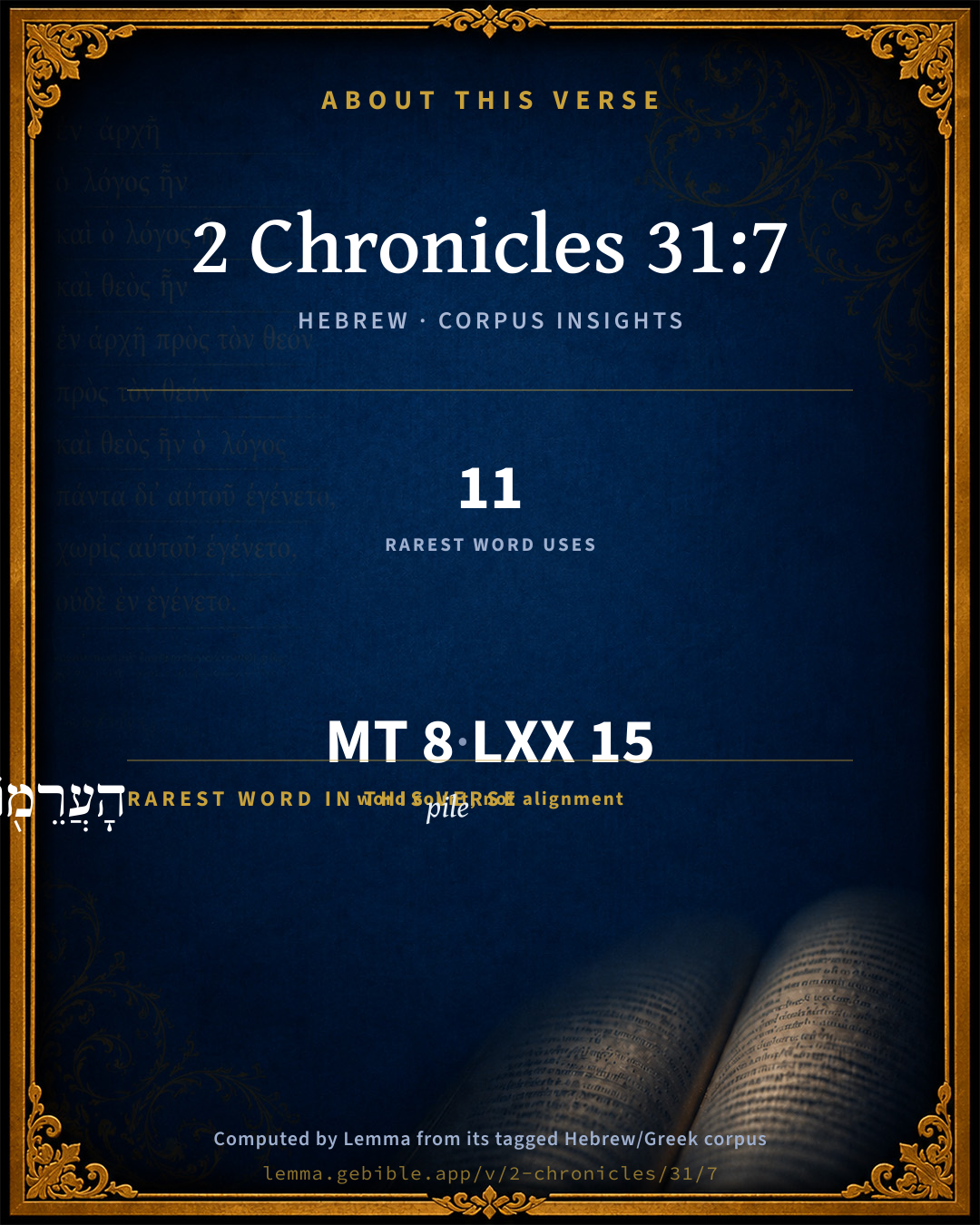
The rarest word here is הָעֲרֵמ֖וֹת pile H6194 — appearing just 11 times in the whole Hebrew Bible.

Shared distinctive vocabulary

הָעֲרֵמ֖וֹת pile H6194 occurs in 10 verses of the Hebrew Bible. Also found in:

Grammatical profile

  • 3 verbs
  • 3 nouns
  • 2 adjectives

Verb forms

  • הֵחֵ֥לּוּ Hiphil · Perfect
  • לְיִסּ֑וֹד Qal · Infinitive Construct
  • כִּלּֽוּ Piel · Perfect

Repetition

A word recurs within this verse — often emphatic in Hebrew:

  • בַּחֹ֨דֶשׁ֙ month H2320 ×2

Hebrew & Septuagint length

In English translation the verse runs 20 words from the Hebrew and 18 from the Septuagint (LXX English) — closely comparable.

A rough comparison of the two English renderings, which tokenize alike — not a word-level alignment.

Word counts can differ between the Hebrew and the Greek without any difference in meaning — e.g. the Hebrew direct-object marker אֵת has no separate Greek word, and Greek often adds the article ὁ.

In the original languages it is 8 Hebrew tokens and 15 Greek tokens — but the two are counted differently (Hebrew bundles its prefixes and suffixes into one token; the Greek is in lemma form), so that isn’t a like-for-like length.

Cross-references

1

Topical passages linked to 2 Chronicles 31:7 in the Treasury of Scripture Knowledge — connected by theme and wording, ordered by reader-vote popularity; previews shown in the World English Bible.

  • Leviticus 23:16–24 even to the next day after the seventh Sabbath you shall number fifty days; and you shall offer a new meal offering to Yahweh.

Cross-references courtesy of OpenBible.info (CC BY 4.0).

Hebrew and Greek witnesses Masoretic Hebrew ↔ Greek Septuagint

The same verse in the two great witnesses to the Old Testament, shown verse-for-verse.

These are two independent witnesses, not word-aligned to each other, and the Septuagint is shown in lemma (dictionary) form.

Hebrew 2 Chronicles 31:7 Masoretic · Westminster Leningrad Codex

בַּחֹ֨דֶשׁ֙ הַשְּׁלִשִׁ֔י הֵחֵ֥לּוּ הָעֲרֵמ֖וֹת לְיִסּ֑וֹד וּבַחֹ֥דֶשׁ הַשְּׁבִיעִ֖י כִּלּֽוּ

In the third month they began to lay the foundation of the heaps, and finished them in the seventh month.

World English Bible · Public Domain

Greek LXX 2 Chronicles 31:7 Septuagint · lemma form

ἐν ὁ μήν ὁ τρίτος ἄρχω ὁ σωρός θεμελιόω καί ἐν ὁ ἕβδομος μήν συντελέω

In the third month the heaps began to be piled, and in the seventh month they were finished.

LXX2012 (modern English Septuagint) · Public Domain

Hebrew: Westminster Leningrad Codex (CC BY 4.0). Greek: Septuagint (public domain); English from LXX2012 (modern English Septuagint) (Public Domain). How the Septuagint differs from the Hebrew →

Commentary

Notes on 2 Chronicles 31:7 from classic Christian and Jewish commentators (each source and its license shown beneath its notes). The classic Christian expositions comment on the surrounding passage and are grouped to its opening verse, so a note may address several verses; the Jewish commentaries on the Tanakh (Rashi and others) are per-verse, so they appear only where the commentator wrote on this verse.

Lemma curates 59 commentaries, every one of them public domain or Creative Commons licensed, each selected and text-cleaned for this edition rather than reprinted as found. About our sources →

Trapp's Complete Commentary

John Trapp

2Ch 31:7 In the third month they began to lay the foundation of the heaps, and finished [them] in the seventh month.

Ver. 7. In the third month.] About pentecost which is called the feast of harvest.

They began to lay the foundation of the heaps.] That is, Of the grain stacks, brought by the people into the tithe barns. {Mal 3:10} This they did not, till the king both exhorted them, and began to them.

And finished them in the seventh month.] About the feast of tabernacles, called the feast of ingathering at the end of the year. {Exo 23:16}

John Trapp, A Commentary or Exposition upon All the Books of the Old and New Testament (1647–1656) — public domain. Text from a community e-Sword module.

Adam Clarke's Commentary

Verse 7. In the third month] "The month Sivan; the seventh, Tisri." - Targum.

The heaps] The vast collections of grain which they had from the tithes over and above their own consumption; see 2Ch 31:10.

Adam Clarke's Commentary on the Bible (1810–1826) — public domain. Text from a community e-Sword/MySword module.

Ellicott's Commentary for English Readers

(7) In the third month.—And so at the end of wheat-harvest, the third month (Sivan) answering to our May—June. Pentecost, the Feast of Harvest, or Firstfruits, fell in this month.

To lay the foundation.—To found, or lay. Heb., lîsôd, a curious form only met with here. (Comp. lîsôd, Isa_51:16.)

In the seventh month.—Tisri (September to October), in which was held the great Feast of Tabernacles, after all the fruits had been gathered in, and the vintage was over.

A Bible Commentary for English Readers, edited by Charles John Ellicott (1878–1897) — public domain. Text from a community e-Sword module.

The Cambridge Bible for Schools and Colleges

gen. ed. J. J. S. Perowne

7. the third month] The Feast of Harvest took place at the beginning of this month and seven weeks later the Feast of Ingathering followed.

The Cambridge Bible for Schools and Colleges (gen. ed. J. J. S. Perowne; Cambridge University Press, 1878–1918) — public domain. Text from a community e-Sword module.

John Gill's Exposition

In the third month they began to lay the foundation of the heaps..... The month Sivan, as the Targum, in which month was the feast of Pentecost, called the feast of the harvest, Exo 23:16, for then barley harvest was ended, and wheat harvest began, and the firstfruits were brought:

and finished them in the seventh month; the month Tisri, as the Targum, in which was the feast of tabernacles, sometimes called the feast of ingathering, of the fruits of the earth, the wine, oil, &c. and so a proper time for bringing the tithes of all.

John Gill's Exposition of the Whole Bible (1746–1763) — public domain (CC PDM 1.0). Text via the HelloAO Bible API.

Albert Barnes' Notes on the Bible

The third month - Compare 2Ch 29:3; 2Ch 30:2, 2Ch 30:13. The events hitherto described - the destruction of the high places, the re-appointment of the courses, and the re-establishment of the tithes followed so closely upon the Passover, that a month had not elapsed from the conclusion of the Feast before the gifts began to pour in. In the seventh month the harvest was completed; and the last tithes and first-fruits of the year would naturally come in then.

Albert Barnes' Notes on the Bible (1834–1885) — public domain. Text from a community e-Sword/MySword module.

Haydock's Catholic Bible Commentary

Them, bringing from Pentecost till the harvest was ended.

George Leo Haydock (1774–1849), Haydock's Catholic Family Bible and Commentary, 1859 edition — public domain. Excludes Psalms (Douay-Rheims chapter numbering differs from Protestant) and Deuterocanonical books (Catholic canon only).

Matthew Poole's English Annotations

In the third month, to wit, of the sacred year, Exo 12:2 in which their harvest began.

In the seventh month; in which their harvest ended and the feast of tabernacles was kept, Exo 23:16; Lev 23:34.

Matthew Poole's English Annotations on the Holy Bible (1683–1685) — public domain. Text from a community e-Sword/MySword module.

Whedon's Commentary on the Bible

Daniel D. Whedon

7. The foundation of the heaps — The beginning of the piles, or collections, of corn, wine, and oil. They began to heap up their stores of material for the continual service.

Daniel D. Whedon (gen. ed.), Commentary on the Old and New Testaments (1874–1909) — public domain. Text from a community e-Sword module.

The Pulpit Commentary

The third month the heaps the seventh month. The grain harvest closed with the Feast of Weeks, about the sixth day of the third month so that tithe in kind would be paid. The seventh month brought the Feast of Ingathering, when the vintage was over. For illustration of the despatch with which Hezekiah proceeded in his reforming works, comp. 2Ch_29:3 2Ch_30:2, 2Ch_30:13.

The Pulpit Commentary (1880–1919), ed. H.D.M. Spence-Jones & Joseph S. Exell — public domain. Text from a community e-Sword module.

John Wesley's Explanatory Notes

Third month - Of the sacred year, in which their harvest began. Seventh - In which their harvest ended and the feast of tabernacles was kept.

John Wesley, Explanatory Notes Upon the Whole Bible (1754–1765) — public domain. Text via the GEBible commentary corpus.

Scofield Reference Notes

C. I. Scofield

third month i.e. June.

seventh month i.e. October.

The Scofield Reference Bible (1917 edition), notes by C. I. Scofield — public domain. Text from a community e-Sword module.

Rashi

Rabbi Shlomo Yitzchaki (Rashi)

they commenced to lay the foundations of the stacks The beginning of anything is called a foundation, like the foundation of a house, which is the beginning of the structure, and like the verse in Ezra (7:9) “that is the commencement of (יְסֻד) the ascent, etc.”

Rashi on the Tanakh — English translations: “The Judaica Press complete Tanach with Rashi, translated by A. J. Rosenberg” (CC BY 4.0); “Pentateuch with Rashi's commentary by M. Rosenbaum and A.M. Silbermann, 1929-1934” (public domain); “The Metsudah Tanach series, Lakewood, N.J” (CC BY 4.0); and “The Book of Joshua, Metsudah Publications, 1997” (CC BY 4.0). Text via Sefaria.

Lesson kit

Teaching starters — assembled from the data on this page, not authored interpretation. Every prompt links to the verse data it draws on. Edit before teaching.

2 Chronicles, in the Historical, opens this verse with 8 words (7 distinct Hebrew lemmas). Its most distinctive word is ʻârêm (“pile”). A historical commentator’s framing appears above. Read the whole chapter for the surrounding context.

Discussion questions

  1. The word ʻârêm carries the sense “pile.” How does it shape the verse?
  2. How does Ruth 3:7, which shares the word «pile», read alongside this verse?
  3. What does the repetition of “month” (2× in this one verse) do in this verse?
  4. These translations render this verse differently. What is at stake in choosing one wording over another?
  5. «הֵחֵ֥לּוּ» is a Hiphil Perfect verb. How does that grammatical form shape the action described?
  6. Compare how Trapp's Complete Commentary and Adam Clarke's Commentary read this verse. Where do they agree or differ?

Things to notice

Reading settings

Reading text

Shown beneath each verse's original-language words.

Old Testament
Old Testament edition

Read the OT as the Masoretic Hebrew (MT) or the Greek Septuagint (LXX).

English shown for the Greek Septuagint (in the Hebrew ↔ Greek comparison).

Comparing translations? Open the Compare panel on any verse page to stack up to four side by side.