
1 Kings 6:38

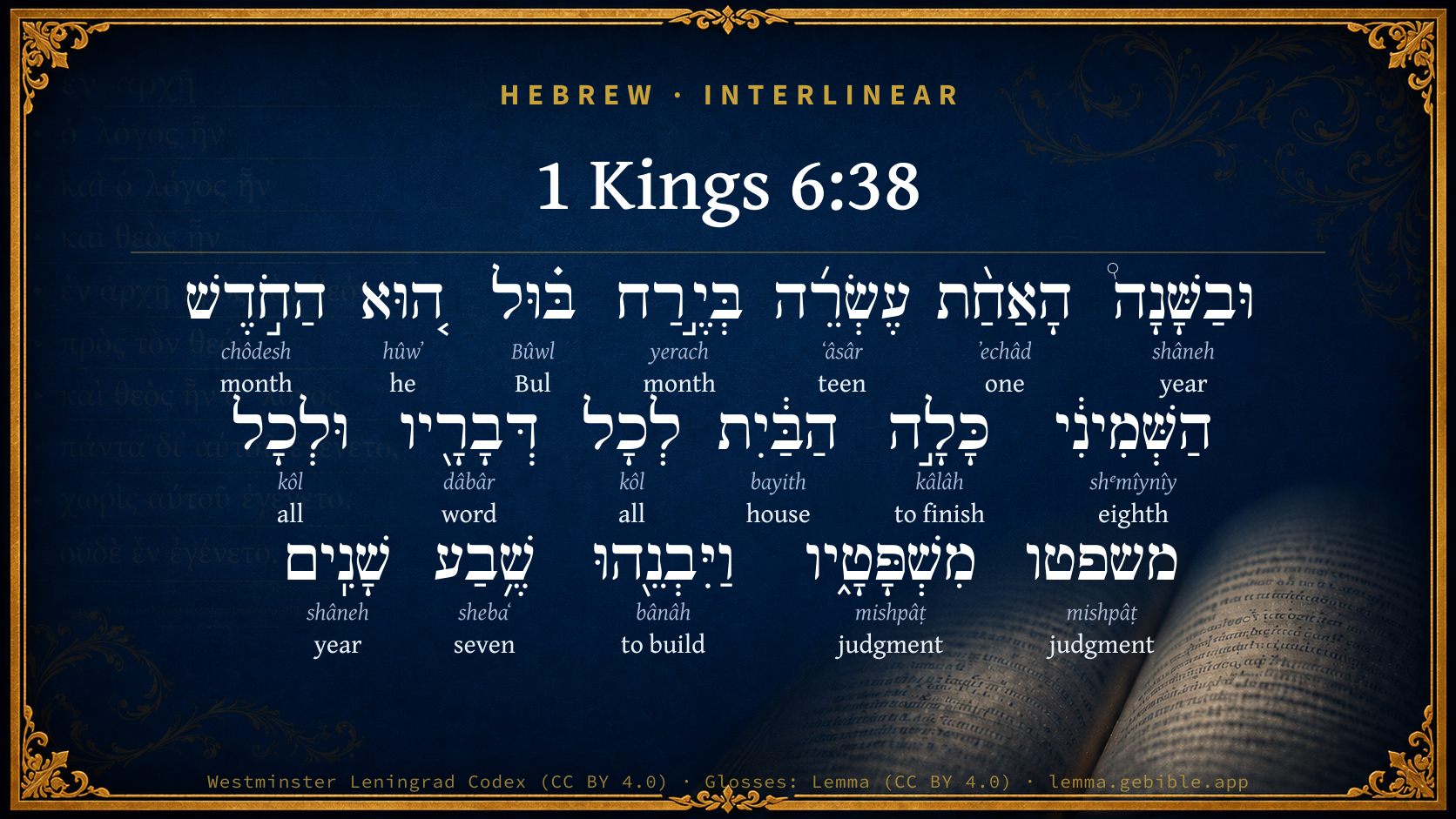
Hebrew (Westminster Leningrad Codex) 1 Kings 6:38 appears in the Hebrew Old Testament. The text above is from the Westminster Leningrad Codex. Each word links to its Strong’s number, a concise gloss, and parsing drawn from the Open Scriptures Hebrew Bible morphology. Click any word for its full Brown-Driver-Briggs (BDB) entry.
Download image
Cite this verse

1 Kings 6:38 (World English Bible). Public Domain. Lemma interlinear Bible study tool, https://lemma.gebible.app/v/1-kings/6/38.

Show BibTeX & RIS
BibTeX
RIS
English Translation
In the eleventh year, in the month Bul, which is the eighth month, was the house finished throughout all the parts of it, and according to all the fashion of it. So was he seven years in building it.
World English Bible · Public Domain
Highlights
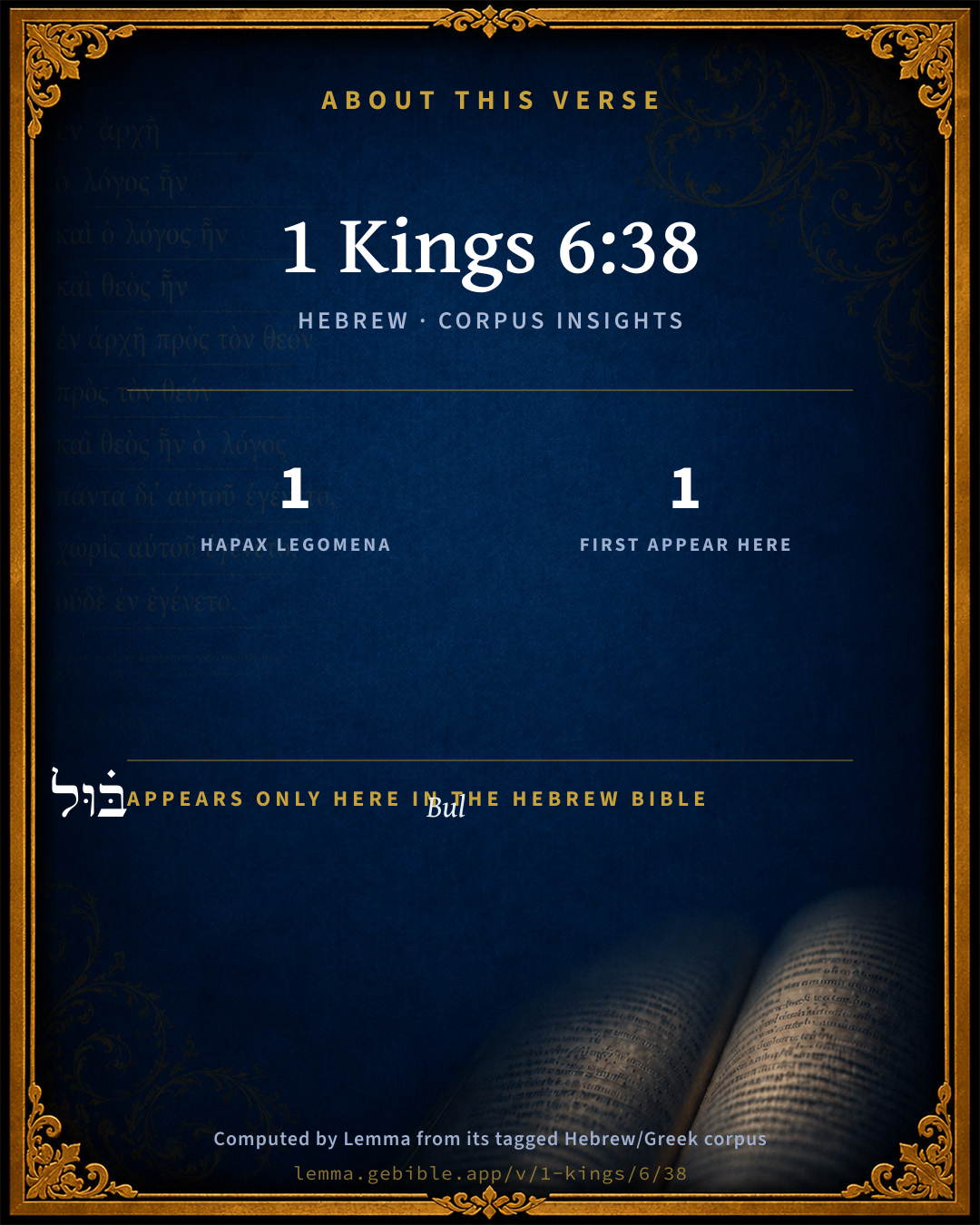
  • 1 hapax legomenon — only here in the Hebrew Bible
  • 1 first appearance in the Hebrew Bible
Full analysis ↓
Download a study sheet

One document with this verse’s original text, its word-by-word gloss line, the meaning frame, cross-references with their text, attributed commentary, and full source and license credits — printable, and it pastes into notes with its structure intact.

This verse Autodidact and up

Study sheet (.html) Plain text (.txt)

A passage Seminary Student

Up to 50 verses in one chapter. A passage sheet keeps up to 6 commentary sources and 12 cross-references per verse, in the order this page ranks them, and says so on the sheet whenever that leaves anything out. Ask for a single verse and you get the Autodidact verse sheet above.

Everything on this page stays free to read, with no account — the sheet is a download of what is already on screen, not access to it.

Want to remove ads? Support Godless Engineer
Compare translations 3

The same verse in 3 English versions, stacked beneath the original-language interlinear above. Click any original word for its lexicon entry.

Each is an independent rendering of the whole verse — the interlinear is not word-aligned to these translations.

Highlighted words mark where these versions differ — a whole-verse word diff, not a word-by-word alignment.

  • World English Bible Public Domain
    In the eleventh year, in the month Bul, which is the eighth month, was the house finished throughout all the parts of it, and according to all the fashion of it. So was he seven years in building it.
  • King James Version Public Domain
    And in the eleventh year, in the month Bul, which is the eighth month, was the house finished throughout all the parts thereof, and according to all the fashion of it. So was he seven years in building it.
  • unfoldingWord Literal Text CC BY-SA 4.0
    And in year 11, in the month of Bul (it the eighth month), the house finished, in all of its matters and according to all of its plans. So he built it seven years.

unfoldingWord Literal Text — © unfoldingWord, licensed CC BY-SA 4.0. Word-aligned USFM3 via Door43 (git.door43.org/unfoldingWord/en_ult).

Versions to compare (up to 4)

3 of 4 selected

Show all 18 translations

Every available English version of this verse, each an independent rendering of the whole verse.

  • World English Bible Public Domain
    In the eleventh year, in the month Bul, which is the eighth month, was the house finished throughout all the parts of it, and according to all the fashion of it. So was he seven years in building it.
  • Berean Standard Bible Public Domain
    In his eleventh year and eighth month, the month of Bul, the temple was finished in every detail and according to every specification. So he built the temple in seven years.
  • Majority Standard Bible Public Domain
    In the eleventh year, in the month of Bul, the eighth month, the temple was finished in every detail and according to every specification. So he built the temple in seven years.
  • King James Version Public Domain
    And in the eleventh year, in the month Bul, which is the eighth month, was the house finished throughout all the parts thereof, and according to all the fashion of it. So was he seven years in building it.
  • American Standard Version (1901) Public Domain
    And in the eleventh year, in the month Bul, which is the eighth month, was the house finished throughout all the parts thereof, and according to all the fashion of it. So was he seven years in building it.
  • Revised Version (1885) Public Domain
    And in the eleventh year, in the month Bul, which is the eighth month, was the house finished throughout all the parts thereof, and according to all the fashion of it. So was he seven years in building it.
  • Geneva Bible (1599) Public Domain
    And in the eleuenth yeere in the moneth of Bul, (which is the eight moneth) hee finished the house with all the furniture thereof, and in euery point: so was he seuen yeere in building it.
  • Douay-Rheims (1899) Public Domain
    And he built the inner court with three rows of polished stones, and one row of beams of cedar.
  • Young's Literal Translation Public Domain
    and in the eleventh year, in the month Bul -- `that is' the eighth month -- hath the house been finished in all its matters, and in all its ordinances, and he buildeth it seven years.
  • Literal Standard Version CC BY-SA 4.0
    and in the eleventh year, in the month of Bul (the eighth month), the house has been finished in all its matters, and in all its ordinances, and he builds it [in] seven years.
  • Unlocked Literal Bible CC BY-SA 4.0
    In the eleventh year, in the month of Bul, which is the eighth month, the house was finished in all its parts and conforming to all its specifications. Solomon took seven years to build the temple.
  • unfoldingWord Literal Text CC BY-SA 4.0
    And in year 11, in the month of Bul (it the eighth month), the house finished, in all of its matters and according to all of its plans. So he built it seven years.
  • Darby Bible Public Domain
    and in the eleventh year, in the month Bul, which is the eighth month, was the house finished in all its parts, and according to all the fashion of it. So he was seven years in building it.
  • World Messianic Bible Public Domain
    In the eleventh year, in the month Bul, which is the eighth month, the house was finished throughout all its parts and according to all its specifications. So he spent seven years building it.
  • Webster's Bible Public Domain
    And in the eleventh year, in the month Bul (which is the eighth month) was the house finished throughout all its parts, and according to all the fashion of it. So was he seven years in building it.
  • Free Bible Version CC BY-SA 4.0
    The Temple was finished exactly as specified and planned in Solomon's eleventh year, in the eighth month, the month of Bul. So it took him seven years to build the Temple.
  • Bible in Basic English Public Domain
    And in the eleventh year, in the month Bul, which is the eighth month, the building of the house was complete in every detail, as it had been designed. So he was seven years building it.
  • JPS Tanakh (1917) Public Domain
    And in the eleventh year, in the month Bul, which is the eighth month, was the house finished throughout all the parts thereof, and according to all the fashion of it. So was he seven years in building it.

Literal Standard Version (2020), Covenant Press — licensed CC BY-SA 4.0. Text via the HelloAO Bible API (eBible.org). Unlocked Literal Bible (unfoldingWord) — licensed CC BY-SA 4.0. Text via the HelloAO Bible API (eBible.org). unfoldingWord Literal Text — © unfoldingWord, licensed CC BY-SA 4.0. Word-aligned USFM3 via Door43 (git.door43.org/unfoldingWord/en_ult). Free Bible Version, Dr. Jonathan Gallagher — licensed CC BY-SA 4.0. Text via the HelloAO Bible API (eBible.org).

Word by word

More ways to search: Search by grammar → Find every occurrence → Compare this word →

Practice this passage: Drill this verse → Learn its vocabulary →

בּ֗וּל
Bûwl
H945
“Bul”
Noun, Proper
Part of Speech
Noun
Type
Proper
Full BDB Definition

Origin: the same as H944 (in the sense of rain)

TWOT: 215

Bul = "increase: produce" - the eighth Hebrew month, corresponding to modern Nov-Dec
  1. וּבַשָּׁנָה֩ shâneh H8141 “and · in/at the · year” Conjunction + Preposition, Determined + Noun, Common, Feminine, Singular, Absolute
  2. הָאַחַ֨ת ʼechâd H259 “the · one” Particle, Definite Article + Adjective, Cardinal number, Feminine, Singular, Absolute
  3. עֶשְׂרֵ֜ה ʻâsâr H6240 “teen” Adjective, Cardinal number, Feminine, Singular, Absolute
  4. בְּיֶ֣רַח yerach H3391 “in/at · month of” Preposition + Noun, Common, Masculine, Singular, Construct
  5. ה֚וּא hûwʼ H1931 “he” Pronoun, Personal, 3rd Person, Masculine, Singular
  6. הַחֹ֣דֶשׁ chôdesh H2320 “the · month” Particle, Definite Article + Noun, Common, Masculine, Singular, Absolute
  7. הַשְּׁמִינִ֔י shᵉmîynîy H8066 “the · eighth” Particle, Definite Article + Adjective, Ordinal number, Masculine, Singular, Absolute
  8. כָּלָ֣ה kâlâh H3615 “to finish” Verb, Qal, Perfect, 3rd Person, Masculine, Singular
  9. הַבַּ֔יִת bayith H1004 “the · house” Particle, Definite Article + Noun, Common, Masculine, Singular, Absolute
  10. לְכָל kôl H3605 “to/for · all of” Preposition + Noun, Common, Masculine, Singular, Construct
  11. דְּבָרָ֖יו dâbâr H1697 “words · his” Noun, Common, Masculine, Plural, Construct + Suffix, Personal, 3rd Person, Masculine, Singular
  12. וּלְכָל kôl H3605 “and · to/for · all of” Conjunction + Preposition + Noun, Common, Masculine, Singular, Construct
  13. משפטו mishpâṭ H4941 “judgment · his” Noun, Common, Masculine, Singular, Construct + Suffix, Personal, 3rd Person, Masculine, Singular
  14. מִשְׁפָּטָ֑יו mishpâṭ H4941 “judgments · his” Noun, Common, Masculine, Plural, Construct + Suffix, Personal, 3rd Person, Masculine, Singular
  15. וַיִּבְנֵ֖הוּ bânâh H1129 “and · to build · him” Conjunction + Verb, Qal, Sequential Imperfect, 3rd Person, Masculine, Singular + Suffix, Personal, 3rd Person, Masculine, Singular
  16. שֶׁ֥בַע shebaʻ H7651 “seven” Adjective, Cardinal number, Feminine, Singular, Absolute
  17. שָׁנִֽים shâneh H8141 “years” Noun, Common, Feminine, Plural, Absolute

About this verse

These counts appear in no published source. They are computed here, from the morphology-tagged text and Lemma’s own curated glosses. What Lemma adds →

18
words
15
distinct lemmas
Historical
section

Notable vocabulary

1 hapax legomenon — a word that appears only here in the entire Hebrew Bible:

  • בּ֗וּל Bul H945

First appearance in Scripture

This word makes its first canonical appearance in the Hebrew Bible here:

  • בּ֗וּל Bul H945

Shared distinctive vocabulary

בְּיֶ֣רַח month H3391 occurs in 13 verses of the Hebrew Bible. Also found in:

Grammatical profile

  • 2 verbs
  • 11 nouns
  • 4 adjectives
  • 1 pronoun

Verb forms

  • כָּלָ֣ה Qal · Perfect
  • וַיִּבְנֵ֖הוּ Qal · Sequential Imperfect

Repetition

Words recur within this verse — often emphatic in Hebrew:

  • וּבַשָּׁנָה֩ year H8141 ×2
  • לְכָל all H3605 ×2
  • משפטו judgment H4941 ×2

Cross-references

8

Topical passages linked to 1 Kings 6:38 in the Treasury of Scripture Knowledge — connected by theme and wording, ordered by reader-vote popularity; previews shown in the World English Bible.

  • 1 Kings 7:1 Solomon was building his own house thirteen years, and he finished all his house.
  • Ezra 3:8–13 Now in the second year of their coming to the house of God at Jerusalem, in the second month, began Zerubbabel the son of Shealtiel, and Jeshua the son of Jozadak, and the rest of their brothers the priests and the Levites, and all those who were come out of the captivity to Jerusalem, and appointed the Levites, from twenty years old and upward, to have the oversight of the work of the house of Yahweh.
  • Ezra 6:14–15 The elders of the Jews built and prospered, through the prophesying of Haggai the prophet and Zechariah the son of Iddo. They built and finished it, according to the commandment of the God of Israel, and according to the decree of Cyrus, and Darius, and Artaxerxes king of Persia.
  • Zechariah 4:9 "The hands of Zerubbabel have laid the foundation of this house. His hands shall also finish it; and you will know that Yahweh of Hosts has sent me to you.
  • 1 Kings 6:1 It happened in the four hundred and eightieth year after the children of Israel were come out of the land of Egypt, in the fourth year of Solomon's reign over Israel, in the month Ziv, which is the second month, that he began to build the house of Yahweh.
  • 1 Kings 6:9 So he built the house, and finished it; and he covered the house with beams and planks of cedar.
  • Zechariah 6:13–15 even he shall build the temple of Yahweh; and he shall bear the glory, and shall sit and rule on his throne; and he shall be a priest on his throne; and the counsel of peace shall be between them both.
  • John 2:20 The Jews therefore said, "Forty-six years was this temple in building, and will you raise it up in three days?"

Cross-references courtesy of OpenBible.info (CC BY 4.0).

Hebrew and Greek witnesses Masoretic Hebrew ↔ Greek Septuagint

The same verse in the two great witnesses to the Old Testament, shown verse-for-verse.

These are two independent witnesses, not word-aligned to each other, and the Septuagint is shown in lemma (dictionary) form.

Hebrew 1 Kings 6:38 Masoretic · Westminster Leningrad Codex

וּבַשָּׁנָה֩ הָאַחַ֨ת עֶשְׂרֵ֜ה בְּיֶ֣רַח בּ֗וּל ה֚וּא הַחֹ֣דֶשׁ הַשְּׁמִינִ֔י כָּלָ֣ה הַבַּ֔יִת לְכָל דְּבָרָ֖יו וּלְכָל משפטו מִשְׁפָּטָ֑יו וַיִּבְנֵ֖הוּ שֶׁ֥בַע שָׁנִֽים

In the eleventh year, in the month Bul, which is the eighth month, was the house finished throughout all the parts of it, and according to all the fashion of it. So was he seven years in building it.

World English Bible · Public Domain

Hebrew: Westminster Leningrad Codex (CC BY 4.0). Greek: Septuagint (public domain); English from a public-domain English Septuagint. How the Septuagint differs from the Hebrew →

Targum (Aramaic paraphrase)

1

The Targum is the ancient Jewish Aramaic paraphrase of the Hebrew Scriptures — an interpretive translation, not the Hebrew text itself. Onkelos (literal) and Pseudo-Jonathan (expansive) render the Torah, and Jonathan the Prophets. Coverage is partial: where no permissively-licensed English translation exists for a verse, only the Aramaic is shown. This is verse-level text, not a word-by-word alignment to the Hebrew.

  1. Targum Jonathan Prophets (Joshua–Malachi)
    וּבְשַׁתָּא חֲדָא עַסְרֵי בְּיֶרַח מֵיסַף אִבְבַיָא הוּא יַרְחָא תְמִינָאָה אִשְׁתַּכְלַל בֵּיתָא לְכָל גְזֵרָתֵיהּ וּלְכָל דַחֲזֵי לֵיהּ וּבְנָהִי שְׁבַע שְׁנִין:

    (no public-domain English translation for this verse)

    Targum Jonathan — Aramaic: “Mikraot Gedolot” (public domain). English: “Sefaria Community Translation” (CC0 1.0 (public-domain dedication)); “London "Chaldee Paraphrase," 1871” (public domain). Text via Sefaria.

Commentary

Notes on 1 Kings 6:38 from classic Christian and Jewish commentators (each source and its license shown beneath its notes). The classic Christian expositions comment on the surrounding passage and are grouped to its opening verse, so a note may address several verses; the Jewish commentaries on the Tanakh (Rashi and others) are per-verse, so they appear only where the commentator wrote on this verse.

Lemma curates 59 commentaries, every one of them public domain or Creative Commons licensed, each selected and text-cleaned for this edition rather than reprinted as found. About our sources →

Trapp's Complete Commentary

John Trapp

1Ki 6:38 And in the eleventh year, in the month Bul, which [is] the eighth month, was the house finished throughout all the parts thereof, and according to all the fashion of it. So was he seven years in building it.

Ver. 38. In the month Bul.] Which hath its name either from fading, because then the leaves fall; or from the store of rain that then falleth. Bul quasi Mabbul, that is, a deluge. It answereth to our November.

So was he seven years.] Seven years and six months: and, everything reckoned, he made very good despatch of so great a work. He was much longer about building his own house, {1Ki 7:1} because less diligent and expeditious.

John Trapp, A Commentary or Exposition upon All the Books of the Old and New Testament (1647–1656) — public domain. Text from a community e-Sword module.

Tyndale Open Study Notes

Tyndale Open Resources

6:38 midautumn, in the month of Bul: The year was 960 BC.

Tyndale Open Study Notes — © Tyndale Open Resources, licensed CC BY-SA 4.0. Text via the HelloAO Bible API.

Geneva Bible (1599)

Geneva Bible translators

Which containeth part of October and part of November.

Geneva Bible (1599) marginal notes — public domain. Text via Bolls.life.

Adam Clarke's Commentary

Verse 38. In the eleventh year - was the house finished] It is rather strange that this house required seven years and about six months to put all the stones and the timbers in their places, for we have already seen that they were all prepared before they came to Jerusalem; but the ornamenting, gilding, or overlaying with gold, making the carved work, cherubim, trees, flowers, c., must have consumed a considerable time. The month Bul answers to a part of our October and November, as Zif, in which it was begun, answers to a part of April and May.

The dedication did not take place till the following year, the twelfth of Solomon, because then, according to Archbishop Usher, the jubilee happened.

So was he seven years in building it.] Properly seven years and six months but the Scripture generally expresses things in round numbers.

DIANA'S temple at Ephesus was one of the seven wonders of the world. It is said that almost all Asia was employed in the building of it for about two hundred years; but it was certainly more extensive than the temple at Jerusalem, for it may be justly questioned, notwithstanding the profusion of gold, silver, precious stones, c., employed in the temple of Solomon, whether it cost any thing like the money expended on the temple of Diana.

Pliny informs us, Hist. Nat., lib. xxxvi., cap. 12, that, in order to build one of the pyramids in Egypt, no less than three hundred and sixty thousand men were employed for the space of twenty years. But neither was the temple any such work as this. We may also observe that the temple was never intended to hold a vast concourse of people it was only for the service of the Lord, and the priests were those alone who were employed in it. The courts, chambers, and other apartments, were far more extensive than the temple itself; it was never designed to be a place to worship in, but a place to worship at. There God was known to have a peculiar residence, and before him the tribes came, and the priests were a sort of mediators between him and the people. In short, the temple was to the Jews in the promised land what the tabernacle was to the Hebrews in the wilderness; the place where God's honour dwelt, and whither the people flocked to pay their adoration.

"Solomon laid the foundation of the temple in the year of the world 2992, before Christ 1008, before the vulgar era, 1012; and it was finished in the year of the world 3000, and dedicated in 3001, before Christ 999, before the vulgar era 1003; 1Kg 8:1 c. 2Ch 5:1; 2Ch 7:1; 2Ch 8:1 c. The place that was pitched on for erecting this magnificent structure was on the side of Mount Sion called Moriah. Its entrance or frontispiece stood towards the east, and the most holy or most retired part was towards the west. The author of the first book of Kings, and of the second of Chronicles has chiefly made it his business to describe the temple properly so called, that is the sanctuary, the sanctum, and the apartments belonging to them, as also the vessels, the implements, and the ornaments of the temple, without giving any description scarcely of the courts and open areas, which, however, made a principal part of the grandeur of this august edifice.

"But Ezekiel has supplied this defect by the exact plan he has delineated of these necessary parts. Indeed it must be owned that the temple as described by Ezekiel was never restored after the captivity of Babylon, according to the model and the mensuration that this prophet has given of it. But as the measures he sets down for the sanctum and the sanctuary are, within a small matter, the same as those of the temple of Solomon and as this prophet, who was himself a priest, had seen the first temple; it is to be supposed that the description he gives us of the temple of Jerusalem is the same as that of the temple of Solomon.

"The ground-plot upon which the temple was built was a square of six hundred cubits, or twenty-five thousand royal feet; Eze 45:1 c. This space was encompassed with a wall of the height of six cubits, and of the same breadth. Beyond this wall was the court of the Gentiles, being fifty cubits wide. After this was seen a great wall, which encompassed the whole court of the children of Israel. This wall was a square of five hundred cubits. The court of Israel was a hundred cubits square, and was encompassed all round with magnificent galleries supported by two or three rows of pillars. It had four gates or entrances one to the east, another to the west, a third to the north, and the fourth to the south. They were all of the same form and largeness, and each had an ascent of seven steps. The court was paved with marble of divers colours, and had no covering; but the people in case of need could retire under the galleries that were all round about. These apartments were to lodge the priests in, and to lay up such things as were necessary for the use of the temple. There were but three ways to come in, to the east, to the north, and to the south, and they went to it by an ascent of eight steps. Before, and over against the gate of the court of the priests, in the court of Israel, was erected a throne for the king, being a magnificent alcove, where the king seated himself when he came into the temple. Within the court of the priests, and over against the same eastern gate, was the altar of burnt-offerings, of twelve cubits square, according to Eze 43:16, or of ten cubits high and twenty broad, according to 2Ch 4:1. They went up to it by stairs on the eastern side.

"Beyond this, and to the west of the altar of burnt-offerings was the temple, properly so called, that is to say, the sanctuary, the sanctum, and the porch of entrance. The porch was twenty cubits wide and six cubits deep. Its gate was fourteen cubits wide. The sanctum was forty cubits wide and twenty deep. There stood the golden candlestick, the table of shew-bread, and the golden altar, upon which the incense was offered. The sanctuary was a square of twenty cubits. There was nothing in the sanctuary but the ark of the covenant, which included the tables of the law. The high priest entered here but once a year, and none but himself was allowed to enter. Solomon had embellished the inside of this holy place with palm trees in relief, and cherubim of wood covered with plates of gold, and in general the whole sanctuary was adorned, and as it were overlaid, with plates of gold.

"Round the sanctum and sanctuary were three stories of chambers, to the number of thirty-three. Ezekiel makes them but four cubits wide; but the first book of Kings, 1Kg 6:6, allows five cubits to the first story, six to the second, and seven to the third.

"Since the consecration or dedication of the temple by Solomon in the year of the world 3001, this edifice has suffered many revolutions, which it is proper to take notice of here.

"In the year of the world 3033, before Christ 967, before the vulgar era 971, Shishak, king of Egypt, having declared war with Rehoboam, king of Judah, took Jerusalem, and carried away the treasures of the temple; 1Kg 14:25-26; 2Ch 12:1-9.

"In 3146, Jehoash, king of Judah, got silver together to go upon the repairs of the temple; they began to work upon it in earnest in 3148, before Christ 852, before the vulgar era 856; 2Kg 12:4-5, and 2Ch 24:7-9, c.

"Ahaz king of Judah having called to his assistance Tiglath-pileser king of Assyria, against the kings of Israel and Damascus, who were at war with him, robbed the temple of the Lord of its riches to give away to this strange king, 2Ch 28:21-22, c., in the year of the world 3264, before Christ 736, before the vulgar era 740, and not contented with this, he profaned this holy place by setting up there an altar like one he had seen at Damascus, and taking away the brazen altar that Solomon had made 2Kg 16:10-12, c. He also took away the brazen sea from off the brazen oxen that supported it, and the brazen basons from their pedestals, and the king's throne or oratory, which was of brass. These he took away to prevent their being carried away by the king of Assyria. Nor did he stop here, but carried his wickedness so far as to sacrifice to strange gods, and to erect profane altars in all the corners of the streets of Jerusalem 2Ch 28:24-25. He pillaged the temple of the Lord, broke the sacred vessels, and, lastly, shut up the house of God. This happened in the year of the world 3264, before Christ 736, before the vulgar era 740, to his death, which happened in 3278, before Christ 722, before the vulgar era 726.

"Hezekiah, the son and successor of Ahaz, opened again and repaired the gates of the temple which his father had shut up and robbed of their ornaments; 2Ch 29:3-4, c., in the year of the world 3278, before Christ 722, before the vulgar era 726. He restored the worship of the Lord and the sacrifices, and made new sacred vessels in the place of those that Ahaz had destroyed. But in the fourteenth year of his reign, 2Kg 18:15-16, in the year of the world 3291, before Christ 709, before the vulgar era 713, Sennacherib, king of Assyria, coming with an army into the land of Judah, Hezekiah was forced to take all the riches of the temple, and even the plates of gold that he himself had put upon the gates of the temple, and give them to the king of Assyria. But when Sennacherib was gone back into his own country, there is no doubt that Hezekiah restored all these things to their first condition.

"Manasseh, son and successor of Hezekiah, profaned the temple of the Lord, by setting up altars to all the host of heaven, even in the courts of the house of the Lord 2Kg 21:4-7; 2Ch 33:5-7; in the year of the world 3306, and the following years. He set up idols there, and worshipped them. God delivered him into the hands of the king of Babylon, who loaded him with chains, and carried him away beyond the Euphrates; 2Ch 33:11-12, c. in the year of the world 3328, before Christ 672, before the vulgar era 676. There he acknowledged and repented of his sins; and being sent back to his own dominions, he redressed the profanations he had made of the temple of the Lord, by taking away the idols, destroying the profane altars, and restoring the altar of burnt-offering, upon which he offered his sacrifices.

"Josiah, king of Judah, laboured with all his might in repairing the edifices of the temple, (2Kg 22:4-6, c. 2Ch 34:8-10; in the year of the world 3380, before Christ 620, before the vulgar era 624,) which had been either neglected or demolished by the kings of Judah, his predecessors. He also commanded the priests and Levites to replace the ark of the Lord in the sanctuary, in its appointed place; and ordered that it should not any more be removed from place to place as it had been during the reigns of the wicked kings, his predecessors, 2Ch 35:3.

"Nebuchadnezzar took away a part of the sacred vessels of the temple of the Lord, and placed them in the temple of his god at Babylon, under the reign of Jehoiakim, king of Judah; 2Ch 36:6-7, in the year of the world 3398, before Christ 602, before the vulgar era 606. He also carried away others under the reign of Jehoiachin, 2Ch 36:10; in the year of the world 3405, before Christ 595, before the vulgar era 599. Lastly, he took the city of Jerusalem, and entirely destroyed the temple, in the eleventh year of Zedekiah, in the year of the world 3416, before Christ 584, before the vulgar era 588; 2Kg 25:1-3, c. 2CH 36:18-19.

"The temple continued buried in its ruins for the space of fifty-two years, till the first year of Cyrus at Babylon, in the year of the world 3468, before Christ 532, before the vulgar era 536. Then Cyrus gave permission to the Jews to return to Jerusalem, and there to rebuild the temple of the Lord, Ezr 1:1-3, c. The following year they laid the foundation of the second temple but they had hardly been at work upon it one year, when either Cyrus or his officers, being gained over by the enemies of the Jews, forbade them to go on with their work; Ezr 4:5; in the year of the world 3470, before Christ 530, before the vulgar era 534. After the death of Cyrus and Cambyses, they were again forbidden by the magian, who reigned after Cambyses, and whom the Scripture calls by the name of Artaxerxes; Ezr 4:7; Ezr 4:17-18, c. in the year of the world 3483, before Christ 517, before the vulgar era 521. Lastly, these prohibitions being superseded, under the reign of Darius, son of Hystaspes, (Ezr 5:1; Ezr 6:14; Hag 1:1, c. in the year of the world 3485, before Christ 515, before the vulgar era 519,) the temple was finished and dedicated four years after, in the year of the world 3489, before Christ 511, before the vulgar era 515, twenty years after the return from the captivity.

"This temple was profaned by order of Antiochus Epiphanes in the year of the world 3837. The ordinary sacrifices were discontinued therein, and the idol of Jupiter Olympus was set up upon the altar. It continued in this condition for three years; then Judas Maccabeus purified it, and restored the sacrifice and the worship of the Lord, 1 Mac. iv. 36; in the year of the world 8840, before Christ 160, before the vulgar era 164.

"Herod the Great undertook to rebuild the whole temple of Jerusalem anew, in the eighteenth year of his reign, and in the year of the world 3986; Joseph., Antiq., lib. xv., cap. 14. He began to lay the foundation of it in the year of the world 3987, forty-six years before the first passover of Jesus Christ, as the Jews observe to him by saying, Forty and six years was this temple in building, and wilt thou rear it up in three days? Joh 2:20. This is not saying that Herod had employed six and forty years in building it; for Josephus assures us that he finished it in nine years and a half; Joseph., Antiq., lib. xv., cap. 14. But, after the time of this prince, they all continued to make some new addition to it; and the same Josephus tells us that they went on working upon it, even to the beginning of the Jewish war; Joseph., Antiq., lib. xx., cap. 8.

"This temple, built by Herod, did not subsist more than seventy-seven years, being destroyed in the year of the world 4073, of Christ 73, of the vulgar era 69. It was begun by Herod in 3987, finished in 3996, burnt and destroyed by the Romans in 4073.

"This temple of Herod was very different from that of Solomon, and from that which was rebuilt by Zerubbabel after the captivity. This is the description that Josephus has left us of it, who himself had seen it: -

"The temple, properly so called, was built sixty cubits high, and as many broad; but there were two sides of front, like two arms or shoulderings, which advanced twenty cubits on each side, which gave in the whole front a hundred cubits wide, as well as in height. The stones made use of in this building were white and hard, twenty-five cubits long, eight in height, and twelve in width; Joseph., de Bell., lib. vi., p. 917.

"The front of this magnificent building resembled that of a royal palace. The two extremes of each face were lower than the middle, which middle was so exalted that those who were over against the temple, or that approached towards it at a distance, might see it, though they were many furlongs from it. The gates were almost of the same height as the temple; and on the top of the gates were veils or tapestry of several colours, embellished with purple flowers. On the two sides of the doors were two pillars, the cornices of which were adorned with the branches of a golden vine, which hung down with their grapes and clusters, and were so well imitated, that art did not at all yield to nature. Herod made very large and very high galleries about the temple, which were suitable to the magnificence of the rest of the building, and exceeded in beauty and sumptuousness all of the kind that had been seen before.

"The temple was built upon a very irregular mountain, and at first there was hardly place enough on the top of it for the site of the temple and altar. The rest of it was steep and sloping: Joseph., de Bell, lib. vi., p. 915, εκφιδ.; Antiq., lib. xv., c. 14. But when King Solomon built it, he raised a wall towards the east, to support the earth on that side; and after this side was filled up, he then built one of the porticoes or galleries. At that time this face only was cased with stone, but in succeeding times, the people endeavouring to enlarge this space, and the top of the mountain being much extended, they broke down the wall which was on the north side, and enclosed another space as large as that which the whole circumference of the temple contained at first. So that at last, against all hope and expectation, this work was carried so far that the whole mountain was surrounded by a treble wall. But, for the completing of this great work whole ages were no more than sufficient; and all the sacred treasures were applied to this use, that the devotion of the people had brought to the temple from all the provinces of the world. In some places these walls were above three hundred cubits high, and the stones used in these walls were some forty cubits long. They were fastened together by iron cramps and lead, to be able to resist the injuries of time. The platform on which the temple was built was a furlong square, or one hundred and twenty-five paces." Thus far Calmet and Josephus.

Adam Clarke's Commentary on the Bible (1810–1826) — public domain. Text from a community e-Sword/MySword module.

Ellicott's Commentary for English Readers

(38) Bul (the month of “rain”) to about November. The whole time occupied was, therefore, seven years and a half.

A Bible Commentary for English Readers, edited by Charles John Ellicott (1878–1897) — public domain. Text from a community e-Sword module.

The Cambridge Bible for Schools and Colleges

gen. ed. J. J. S. Perowne

38. in the month Bul] This month is only mentioned here. The name is derived from the same root as mabbul = the deluge, and intimates that the character of the month was rainy. The later name of the month was Marchesvan. It was between the new moon of November and December, and this being the eighth month, while Zif was the second, it is seen that the exact time occupied by the building of the Temple was seven years and a half. Probably the preparation of wood and stone in Lebanon is not included in this time, but was made during the four years of Solomon’s reign which preceded the building.

The Cambridge Bible for Schools and Colleges (gen. ed. J. J. S. Perowne; Cambridge University Press, 1878–1918) — public domain. Text from a community e-Sword module.

Albert Barnes' Notes on the Bible

Seven years - More exactly, “seven years and six months,” since Zif was the second, and Bul the eighth month. 1Ki 6:1.

Albert Barnes' Notes on the Bible (1834–1885) — public domain. Text from a community e-Sword/MySword module.

Haydock's Catholic Bible Commentary

Bul, afterwards styled Marchesvan. Pagnin thinks that the former name alludes to "the inundation" of rain, at that season, corresponding with our October and November. Chaldean, "the month of collected fruits." (Menochius) --- Years. Six months are neglected, (see chap. ii. 11.) and as many are redundant, chap. vii. 1. Odd numbers are often treated in this manner. (Calmet) --- It is wonderful that Solomon could complete this most stupendous structure (Haydock) in so short a time. All Asia was 200 years in building the temple of Diana, at Ephesus, and 400 more in embellishing it. (Pliny, [Natural History?] xxxvi. 12.) --- It is reported that 360,000 men were employed for twenty years, to build a pyramid of Egypt; (Calmet) which was designed, perhaps for no other purpose but to shew the pride and magnificence of the king while living, and to contain his ashes after death. Many of the materials for the temple had indeed been collected by David, (1 Paralipomenon xxii.) so that Solomon was enabled to finish it in a much shorter time than his own palace, which took him almost thirteen years to bring to perfection. They were almost contiguous to each other, though built on separate hills. The temple occupied the whole of Moria, which was levelled a great deal, to allow space sufficient for such an amazing structure. It was thus founded upon a rock, as an emblem of the perpetuity of the true religion, which has subsisted from the beginning of the world: as may be seen at large in Dr. Worthington; who, on this occasion, gives a retrospective view of what had taken place in the Jewish state, with respect to this most important subject, during the fourth age, or for the space of the last 480 years. See Douay Bible, p. 701, &c. We may be dispensed from repeating these things after him, as they are already, for the most part, observed in the notes; where the attentive reader cannot fail to remark, that the law of the Old Testament was only a figure of that which all must now embrace. I am not come to destroy, (the law or the prophets) says our Saviour, (Matthew v. 17.) but to fulfil, by accomplishing all the figures and predictions, and by perfecting all that was imperfect, though suitable for the state of mortals in former ages. Children cannot rationally be required to attain, at once, the perfection of manhood. The painter first marks the outlines, which the colouring is calculated to efface, yet so as to render the picture more beautiful. "The cunning Jew" would therefore, in vain, allege the greater antiquity of his religion, as it prefigured and foretold the author and finisher of our faith. And Protestants will act very childishly if they suppose, with Mr. Slack, a Methodist preacher, at Whitby, that this can in any degree enervate the argument of Catholics, who always arraign them before the tribunal of the apostolic ages, in which they confess our bishops, Linus, &c., existed, and were ordained by the apostles themselves. "Setting aside the apostles, Linus, agreeably to the common opinion, was the first bishop of the Rome see, who was ordained before the martyrdom both of Peter and Paul." Campbell, 12 lect., quoted by Mr. Slack; (p. 63) who says that he was the first pope, and of course, that our religion mounts up to the age of the apostles; and, if he thinks to evade this difficulty, by saying, that the Jewish religion was more ancient still, and yet rejected, we may desire him to point out where the Scripture mentions that the religion of Christ was to be rendered more perfect than he left it; as we know from that source, that he was to establish a new law, founded on better promises than those which had been made to the Jew? How will this state of fluctuation, and this relapsing into abominable errors and idolatry, for many hundred years, accord with the promises of Christ? (Matthew xxviii., &c.) (Haydock) --- Building it. The dedication was deferred till the following year, probably on account of the jubilee recurring at that time. (Usher, the year of the world 3000.) (Calmet) --- But this is very uncertain. Salien fixes upon the year 3030, which was not a year of jubilee; and he rather thinks that the delay was occasioned by the vessels, the brazen sea, &c., which had to be brought from the other side of the Jordan. We may also recollect, that the rainy season was set in before the temple was quite finished; so that it would have been very inconvenient for all Israel to assemble at that time. After the dedication, the temple continued to be adorned, till it was destroyed by Nebuchadonoser, (Haydock) in the year 3416, and lay in ruins fifty-two years, when the Jews were authorized by Cyrus to rebuild it. They could not however finish the work, so as to proceed to a fresh dedication, till the reign of Darius Hystaspes, in the year 3489. Herod undertook to rebuild (Button) the greatest part of this second temple, and to adorn it, in the most magnificent manner, in the year 3986. This place was honoured by the presence of the Son of God, who foretold the destruction, which took place within that generation, [in] A.D. 70. (Haydock)

George Leo Haydock (1774–1849), Haydock's Catholic Family Bible and Commentary, 1859 edition — public domain. Excludes Psalms (Douay-Rheims chapter numbering differs from Protestant) and Deuterocanonical books (Catholic canon only).

Matthew Poole's English Annotations

Seven years complete, and six months, as appears by computation. But smaller sums are usually neglected, and swallowed up in the greater, both in Scripture, as Jdg 20:46; 2Sa 5:4; 1Ki 2:11, and in other authors. It is not strange that this work took up so much time; for,

1. The temple properly so called was for quantity the least part of it, there being very many and great buildings both above ground in the several courts, (for though only the court of the priests be mentioned, yet it is thereby implied that the same thing was proportionably done in the others,) and under ground.

2. The great curiosity of art which was used here, and the fewness of exquisite artists, required the longer time for the doing of it. And if the building of Diana’s temple did employ all Asia for two hundred years, and the building of one pyramid employed three hundred and sixty thousand men for twenty years together, both which Pliny affirms; no reasonable man can wonder that this temple was seven years in building.

Matthew Poole's English Annotations on the Holy Bible (1683–1685) — public domain. Text from a community e-Sword/MySword module.

Whedon's Commentary on the Bible

Daniel D. Whedon

38. The month Bul — According to Furst and Gesenius, the word Bul means rain; according to others, fruit, produce. Hence the rain-month, or fruit-month, corresponding with November. “Solomon began,” says Wordsworth, “to build the temple in the flower-month, and finished the building in the fruit-month. Such is the life of the Church, and of every believer, who is a temple of the Spirit. it begins with flowers but must end in fruit. ‘The harvest is the end of the world.’”

Seven years — And six months, if we reckon more closely.

The temple of Solomon was not distinguished, like the temples of Thebes, for gigantic vastness, for it was not a very large structure, but rather for its harmonious proportions, its beauty and completeness of workmanship, and the excessive costliness of its materials. And the Church, the spiritual house of the living God, is to be specially distinguished for the excellency and completeness of the elect and precious stones which are required to build it; for these are not the many that go in the broad way to destruction, but the comparatively few that find the way of life. Mat_7:13-14.

Daniel D. Whedon (gen. ed.), Commentary on the Old and New Testaments (1874–1909) — public domain. Text from a community e-Sword module.

The Pulpit Commentary

Ver. 38. And in the eleventh year, in the month Bul lWBrain.

Hence Bul would be the month of rain (Gesen.) Keil understands it to signify produce (prowntus), and sees in it the month of fruits. It extended from the November to the December full moon), which is the eighth month, was the house finished throughout all the parts thereof Heb. wyrbDi, and according to all the fashion of it Heb. wyfpvmi. So was he seven years in building it. As Bul was the eighth month, and Zif the second, the house was precisely seven and a half years in building a short period, if we consider the magnitude of the undertaking, but long enough, if we remember the enormous number of hands employed upon it, the preparations made by David, and the modest dimensions of the edifice (ver. 2). The commentators all cite Pliny"s statement that all Asia was building the temple of Diana at Ephesus 200 years, but the cases are not at all parallel. We learn from 2Ch_3:2, that it was on the second day of the month that the building was commenced. Bishop Wordsworth, who assigns seven years and seven months as the time occupied in this work, sees in this hebdomatie period an analogy to the seven days of the creation.

The Pulpit Commentary (1880–1919), ed. H.D.M. Spence-Jones & Joseph S. Exell — public domain. Text from a community e-Sword module.

John Wesley's Explanatory Notes

Seven years - It is not strange that this work took up so much time: for,

1. The temple properly so called, was for quantity the least part of it, there being very many and great buildings both above ground in the several courts, (for though only the court of the priests be mentioned, yet it is thereby implied, that the same thing was proportionably done in the others) and under ground.

2. The great art which was used here, and the small number of exquisite artists, required the longer time for the doing it. And if the building of Diana's temple employed all Asia for two hundred years; and the building of one pyramid employed three hundred and sixty thousand men, for twenty years together; both which, Pliny affirms: no reasonable man can wonder that this temple was seven years in building. Now let us see what this temple typifies.

1. Christ himself is the true temple. He himself spoke of the temple of his body: and in him dwelt all the fulness of the godhead. In him all the Israel of God meet, and thro' him have access with confidence to God.

2. Every believer is a living temple, in whom the spirit of God dwelleth. We are wonderfully made by the Divine Providence, but more wonderfully made anew by the Divine grace. And as Solomon's temple was built on a rock, so are we built on Christ.

3. The church is a mystical temple, enriched and beautified, not with gold and precious stones, but with the gifts and graces of the spirit. Angels are ministering spirits, attending the church and all the members of it on all sides.

4. Heaven is the everlasting temple. There the church will be fixt, and no longer moveable. The cherubim there always attend upon the throne of glory. In the temple there was no noise of axes or hammers: every thing is quiet and serene in heaven. All that shall be stones in that building, must here be fitted and made ready for it; must be hewn and squared by the Divine grace, and so made meet for a place in that temple.

John Wesley, Explanatory Notes Upon the Whole Bible (1754–1765) — public domain. Text via the GEBible commentary corpus.

Scofield Reference Notes

C. I. Scofield

Bul

Eighth month i.e. November.

The Scofield Reference Bible (1917 edition), notes by C. I. Scofield — public domain. Text from a community e-Sword module.

Rashi

Rabbi Shlomo Yitzchaki (Rashi)

In the month of Bul. This is [the month of] Mar Cheshvan; [when] the grass in the field decays, and cattle is given fodder from what is stored, from the expression “and he gave fodder [ויבל] to the donkeys.”

Rashi on the Tanakh — English translations: “The Judaica Press complete Tanach with Rashi, translated by A. J. Rosenberg” (CC BY 4.0); “Pentateuch with Rashi's commentary by M. Rosenbaum and A.M. Silbermann, 1929-1934” (public domain); “The Metsudah Tanach series, Lakewood, N.J” (CC BY 4.0); and “The Book of Joshua, Metsudah Publications, 1997” (CC BY 4.0). Text via Sefaria.

Lesson kit

Teaching starters — assembled from the data on this page, not authored interpretation. Every prompt links to the verse data it draws on. Edit before teaching.

1 Kings, in the Historical, opens this verse with 18 words (15 distinct Hebrew lemmas). Its most distinctive word is Bûwl (“Bul”). A historical commentator’s framing appears above. Read the whole chapter for the surrounding context.

Discussion questions

  1. How does “Bul” (Bûwl) shape what this verse is saying?
  2. This verse holds 1 word here found nowhere else in the Hebrew Bible. What might the rare word draw attention to?
  3. The word “Bul” first appears here in Scripture. What is being introduced at this debut?
  4. Exodus 2:2 shares the word «month» with this verse. How do the two illuminate each other?
  5. “year” occurs 2× in this one verse. What is the effect of the repetition?
  6. These translations render this verse differently. What is at stake in choosing one wording over another?
  7. The verb «כָּלָ֣ה» is Qal Perfect. How does its form color the action?
  8. Reading how Trapp's Complete Commentary and Tyndale Open Study Notes read this verse, where do the two commentators agree and where do they part?

Things to notice

  • 1 word in this verse appears nowhere else in the Hebrew Bible.
  • 1 word makes its first canonical appearance in Scripture here.
  • These translations choose different wording for 11 words in this verse.
  • “year” occurs 2× in this single verse.
  • 15 distinct Hebrew lemmas span 18 words in this verse.

Reading settings

Reading text

Shown beneath each verse's original-language words.

Old Testament
Old Testament edition

Read the OT as the Masoretic Hebrew (MT) or the Greek Septuagint (LXX).

English shown for the Greek Septuagint (in the Hebrew ↔ Greek comparison).

Comparing translations? Open the Compare panel on any verse page to stack up to four side by side.